
Study Guides
Cambridge International AS & A Level Psychology (9990): 1.3 Impulse control disorders
Topic 1.3 for Cambridge 9990 Psychology: kleptomania, pyromania and gambling disorder, the K-SAS, dopamine, reinforcement, feeling-state theory and treatments.
- Subject
- Psychology
- Level
- A LEVEL
- Topic
- Specialist Option 1: Clinical Psychology
- Author
- Marlbridge Academic Team
- Updated
- Reviewed by
- Kanwal Aslam (what this means)
Aligned to Cambridge A Level Psychology (9990), 2024-2026. Official specification .
Syllabus page (what it covers and how it is assessed): Cambridge A Level Psychology.
Syllabus points this page covers
9990 (A Level)
- 1.3 Impulse control disorders
Topic 1.3 of Specialist Option 1, Clinical Psychology, in Cambridge International AS & A Level Psychology (9990) covers impulse control disorders. The syllabus names three: kleptomania, pyromania and gambling disorder. You need their ICD-11 diagnostic criteria and one measure (1.3.1), a biological and two psychological explanations (1.3.2), and biological and psychological treatments, including the key study by Grant et al. (2008) (1.3.3). The Clinical Psychology study guide summarises the topic; this page goes further into each part and into evaluation.
Revise with the impulse control disorders revision notes and test yourself with the impulse control disorders practice questions.
1.3.1 Diagnosis and measurement
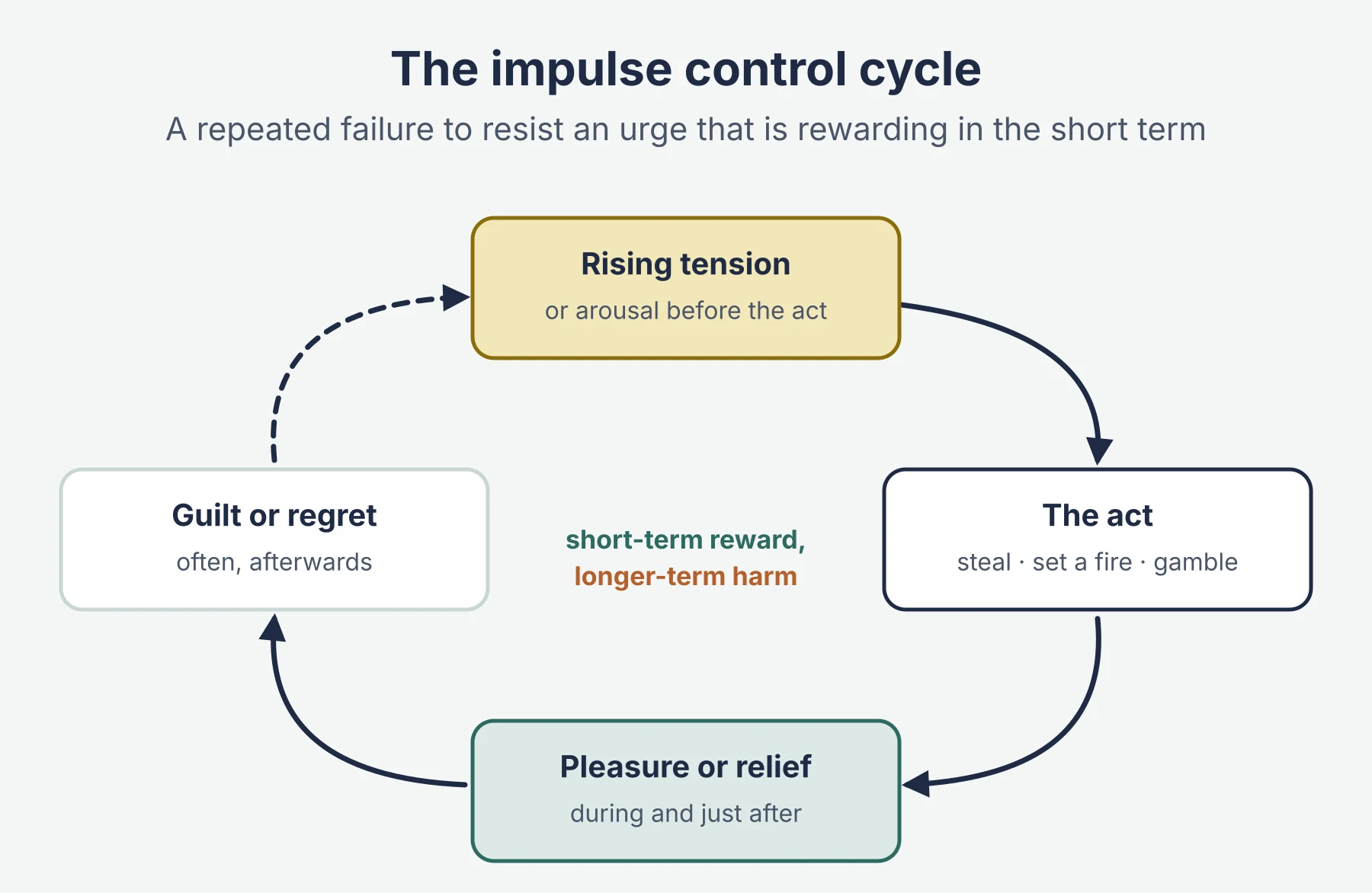
What links these disorders is a repeated failure to resist an impulse, drive or urge to carry out an act that is rewarding in the short term, despite longer-term harm to the person or others. The cycle is typically rising tension before the act, pleasure or relief during it, and often guilt or regret afterwards.
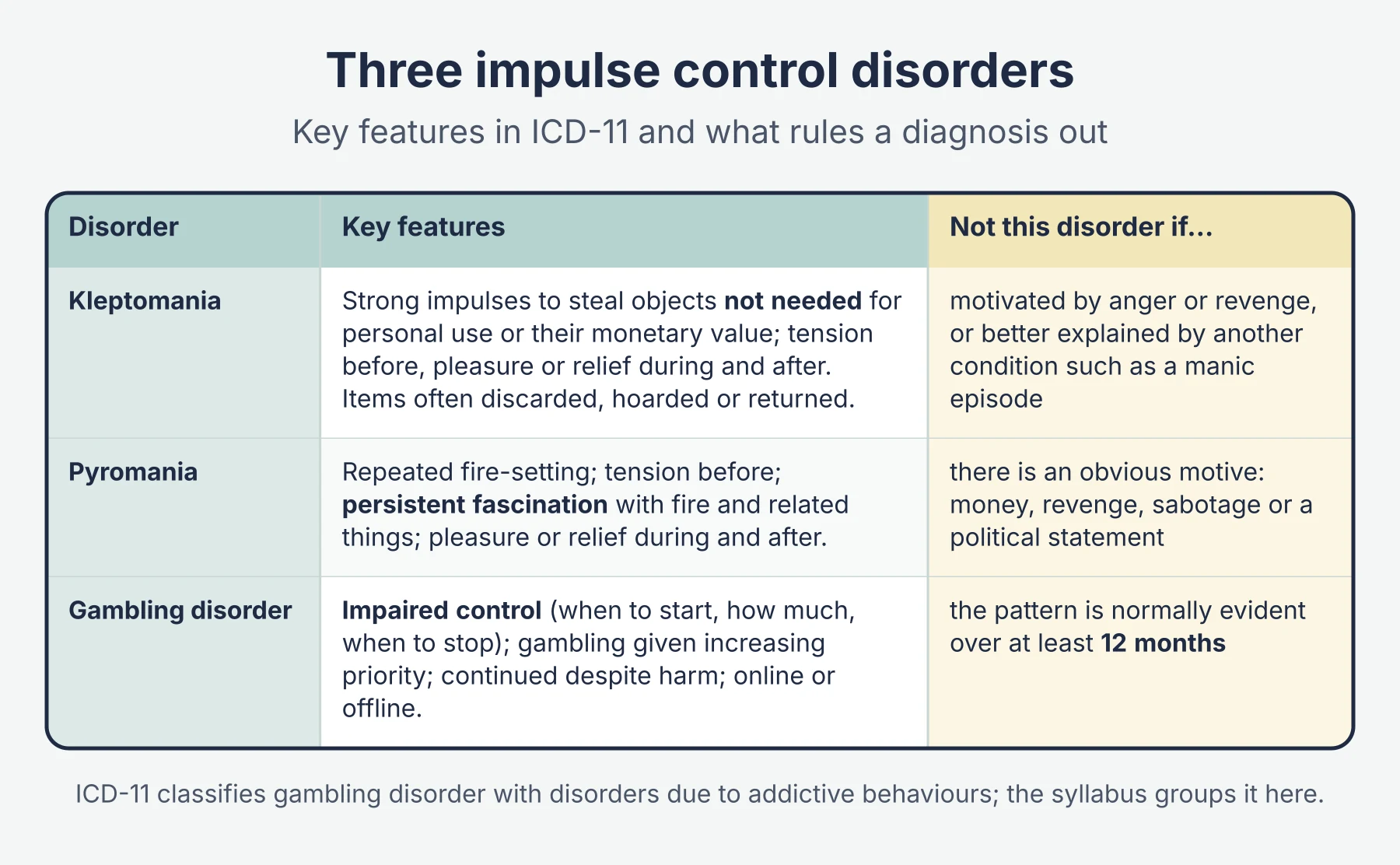
Kleptomania. A recurrent failure to control strong impulses to steal objects that are not needed for personal use or for their monetary value. There is increasing tension or arousal before the theft and pleasure, excitement, relief or gratification during and immediately after it. The stealing is not motivated by anger or revenge, and is not better explained by another condition such as a manic episode. The key difference from ordinary shoplifting is motive: the person often discards, hoards or returns the items.
Pyromania. Repeated fire-setting without an obvious motive such as money, revenge, sabotage or a political statement. There is tension or arousal before setting a fire, a persistent fascination with fire and related things (watching fires, fire equipment), and pleasure, excitement or relief during and after.
Gambling disorder. A persistent pattern of gambling, online or offline, with impaired control over it (when to start, how much, when to stop), increasing priority given to gambling over other interests and daily activities, and continuation or escalation despite negative consequences. The pattern is normally evident over at least 12 months. ICD-11 itself classifies gambling disorder with disorders due to addictive behaviours; the syllabus groups it here with impulse control disorders, and Cambridge accepts alternative terms used appropriately.
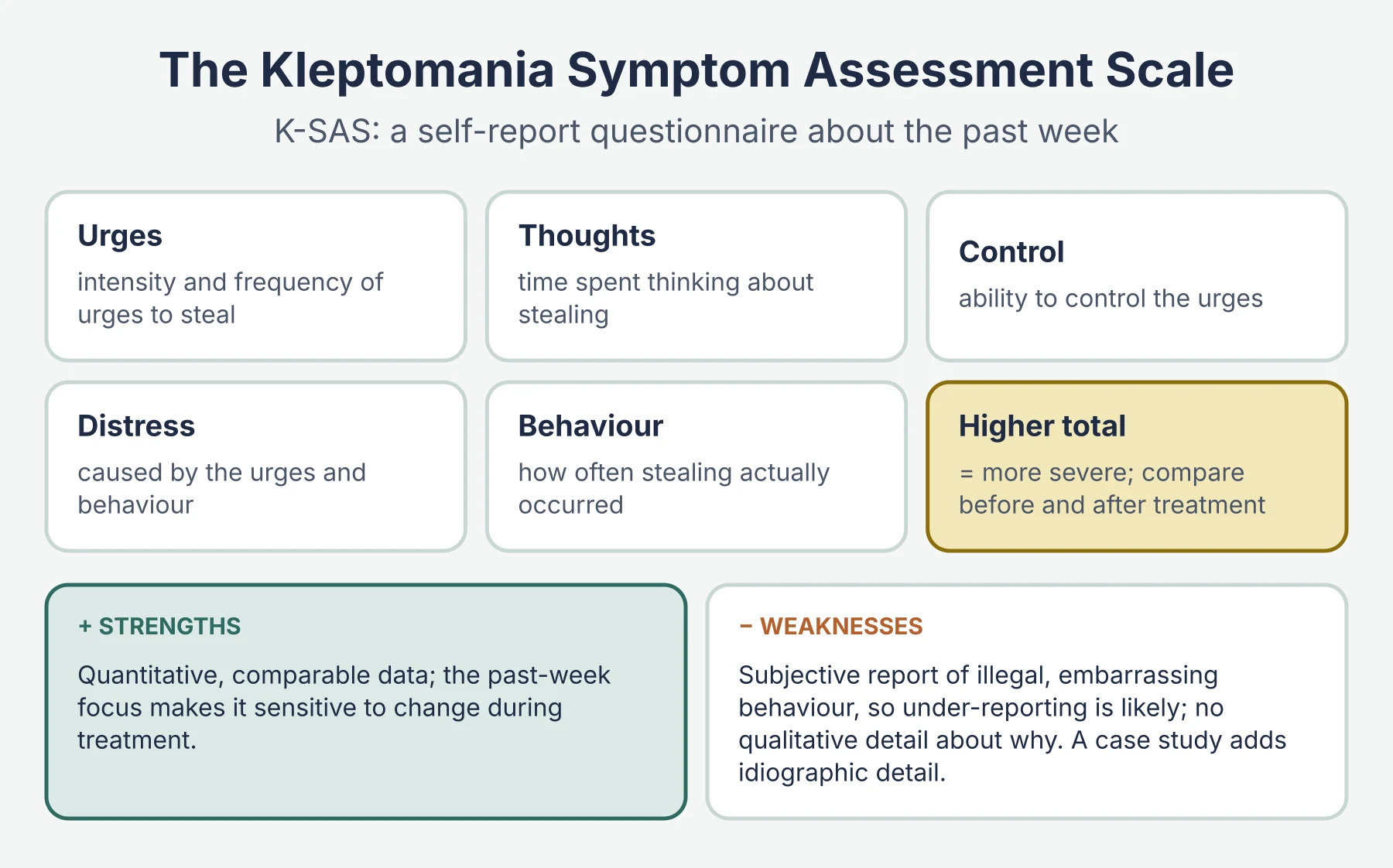
The Kleptomania Symptom Assessment Scale (K-SAS). A self-report questionnaire that asks about the past week: the intensity and frequency of urges to steal, time spent thinking about stealing, ability to control urges, the distress the urges and behaviour cause, and how often stealing actually occurred. Higher totals show more severe symptoms, so scores can be compared before and after treatment.
Evaluating the K-SAS. It gives quantitative, comparable data and focuses on the past week, so it is sensitive to change during treatment. But it is subjective self-report about behaviour that is illegal and embarrassing, so under-reporting is likely, and it gives no qualitative detail about why the person steals. The syllabus also lists case studies and objective versus subjective data for this part: a case study adds the idiographic detail that a scale lacks.
1.3.2 Explanations
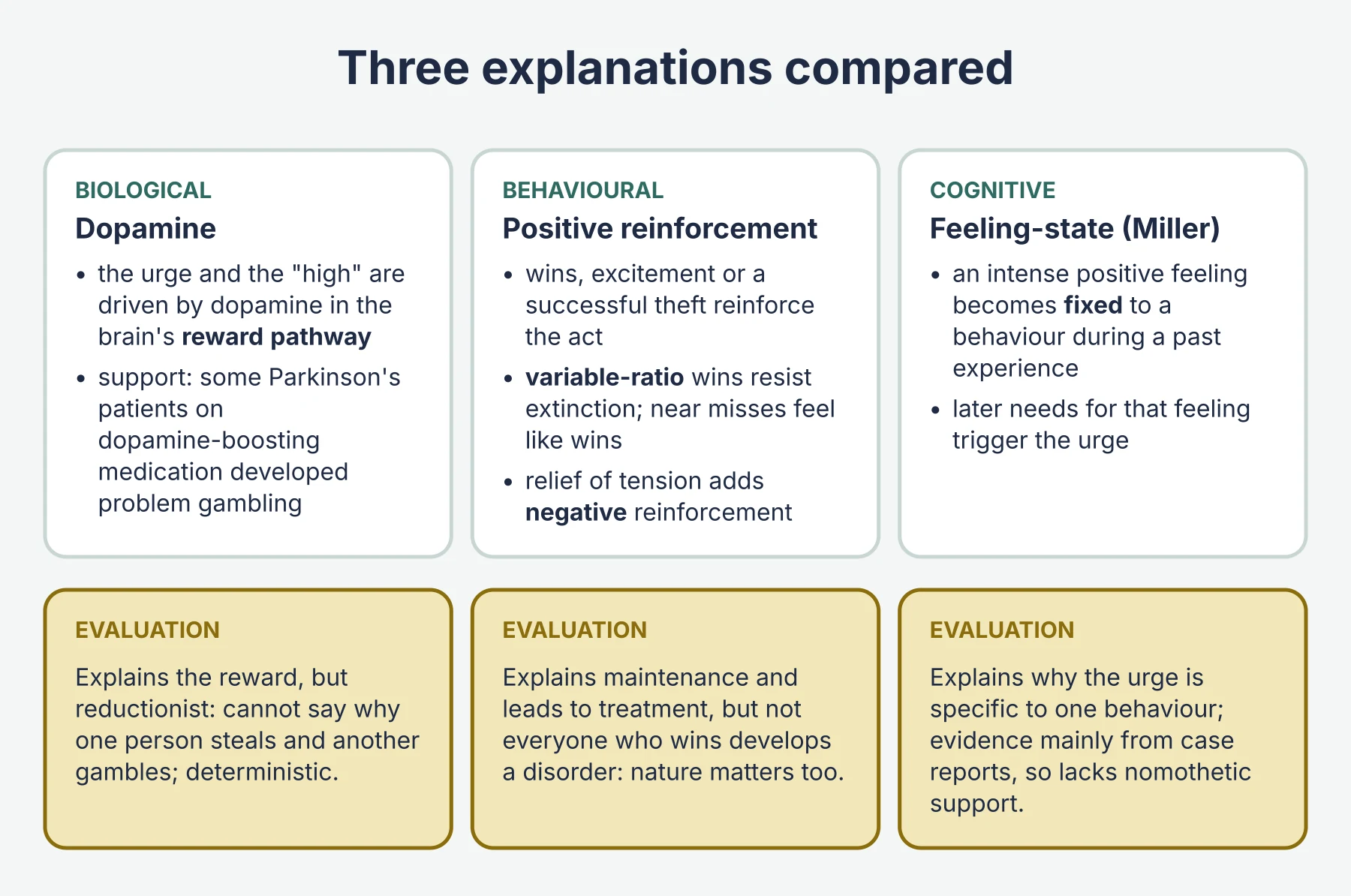
Biological: dopamine
Dopamine in the brain’s reward pathway signals pleasure and motivates behaviour that is rewarding. The explanation proposes that the urge and the “high” of stealing, setting fires or gambling are driven by dopamine activity in this pathway. Support: some patients taking dopamine-boosting medication for Parkinson’s disease have developed problem gambling or other impulsive behaviours, which suggests dopamine can drive these acts. Evaluation: it explains why the acts are so rewarding, but it is reductionist and cannot explain why one person steals and another gambles; it also implies a deterministic view, which may reduce feelings of personal responsibility.
Behavioural: positive reinforcement
Operant conditioning explains the disorders through consequences. Winning money, the excitement of a bet or the thrill of a successful theft is a positive reinforcer, so the behaviour is repeated. In gambling, wins come on a variable-ratio schedule, which makes behaviour very resistant to extinction, and near misses can feel almost like wins. The relief of tension after the act can add negative reinforcement. Evaluation: it explains how the behaviour is maintained and leads to behavioural treatments, but not everyone who gambles or wins develops a disorder, so individual differences (nature) must matter too.
Cognitive: Miller’s feeling-state theory
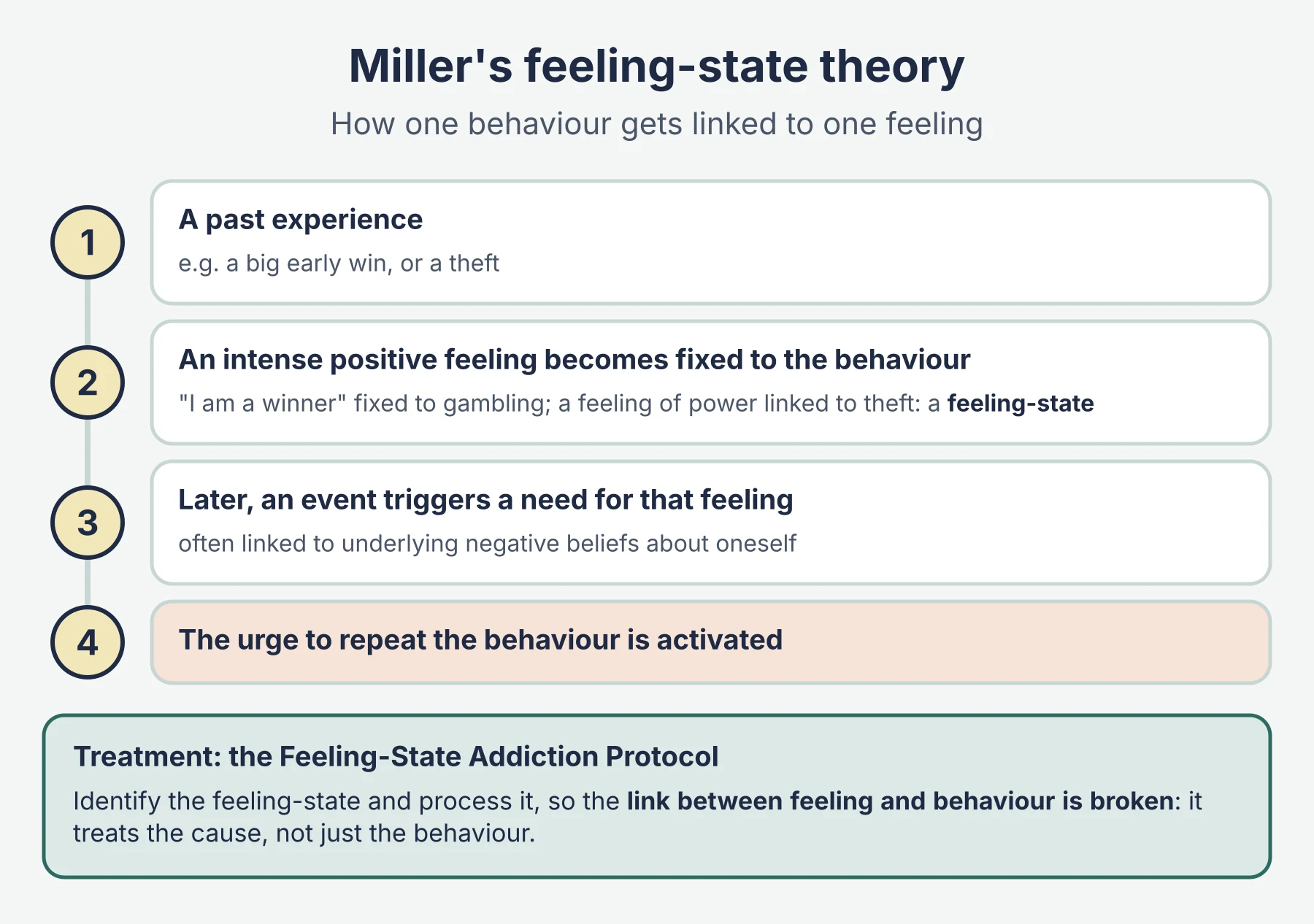
Miller proposed that an impulse control disorder begins when an intense positive feeling becomes fixed to a specific behaviour during a past experience, creating a feeling-state. For example, a big early win might fix a feeling of “I am a winner” to gambling, or a theft might become linked to a feeling of power. Later, events that trigger a need for that feeling (often linked to underlying negative beliefs about oneself) activate the urge to repeat the behaviour. His Feeling-State Addiction Protocol aims to identify the feeling-state and process it so that the link between feeling and behaviour is broken. Evaluation: it explains why the urge is so specific to one behaviour and treats the cause, not just the behaviour. However, the supporting evidence is mainly from case reports, so it lacks nomothetic support.
1.3.3 Treatment and management
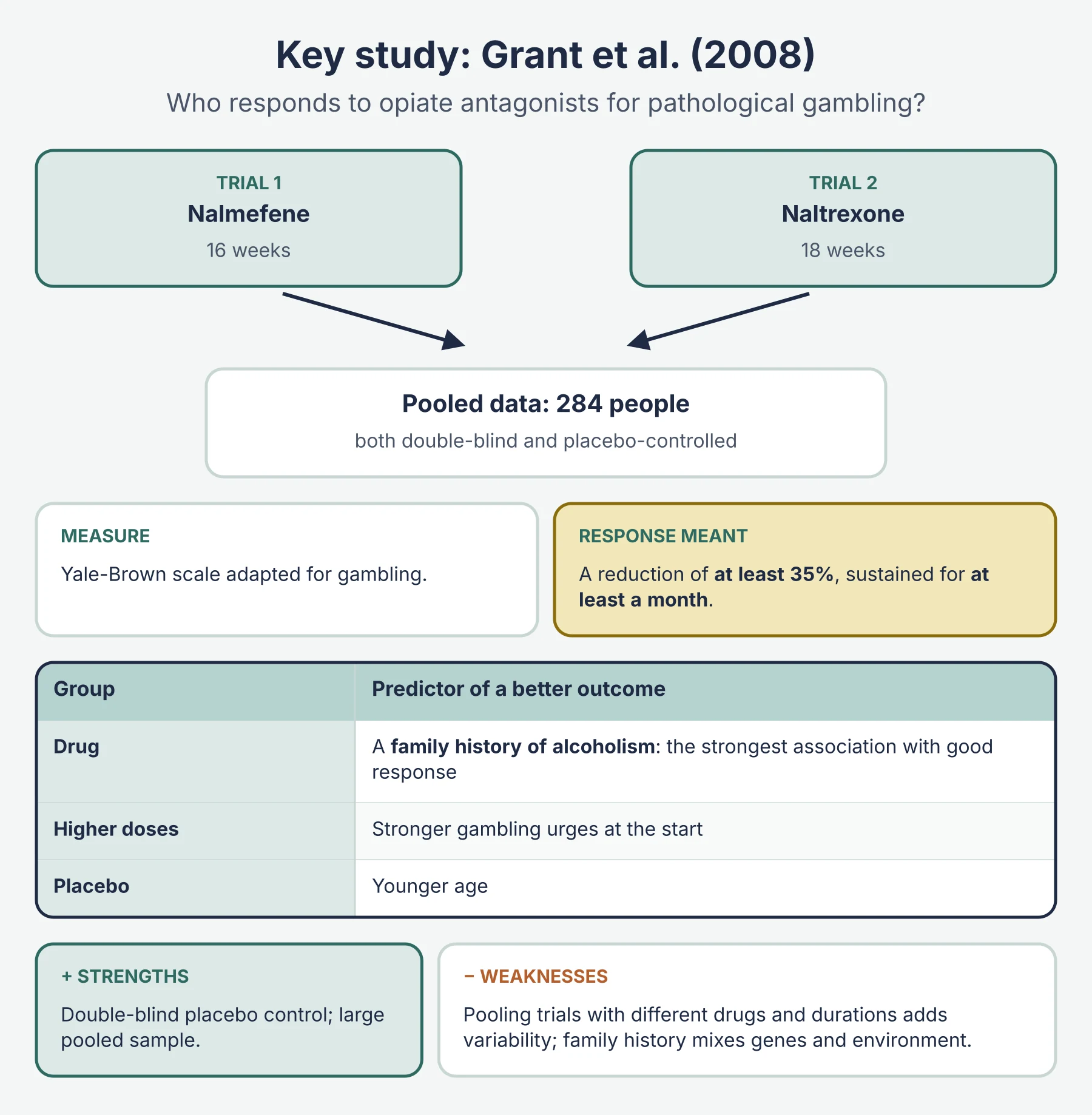
Key study: Grant et al. (2008)
Context. Opiate antagonists block opioid receptors, which reduces the dopamine release that follows a rewarding act, so they might reduce gambling urges. Earlier trials showed they helped some gamblers but not others, raising the question of who responds.
Aim. To identify variables that predict response to opiate antagonists and to placebo in pathological gambling.
Method. Data pooled from two double-blind, placebo-controlled trials, one of nalmefene (16 weeks) and one of naltrexone (18 weeks), with 284 people with pathological gambling. Severity was measured with a version of the Yale-Brown scale adapted for gambling; a response meant a reduction of at least 35% sustained for at least a month.
Results. A family history of alcoholism was the variable most strongly associated with a good response to the drug. Among those on higher doses, stronger gambling urges at the start predicted a better response. Among those on placebo, younger age was associated with better outcome.
Conclusions. Opiate antagonists may work best for gamblers with a family history of alcoholism, possibly reflecting a shared biological vulnerability in reward systems.
Evaluation. Double-blind placebo control and a large pooled sample support internal validity and generalisation. But pooling two trials with different drugs and durations adds variability, and a family history reflects both genes and environment, so it does not separate nature from nurture. The placebo response shows expectations alone can reduce symptoms.
Psychological (cognitive-behavioural) therapies
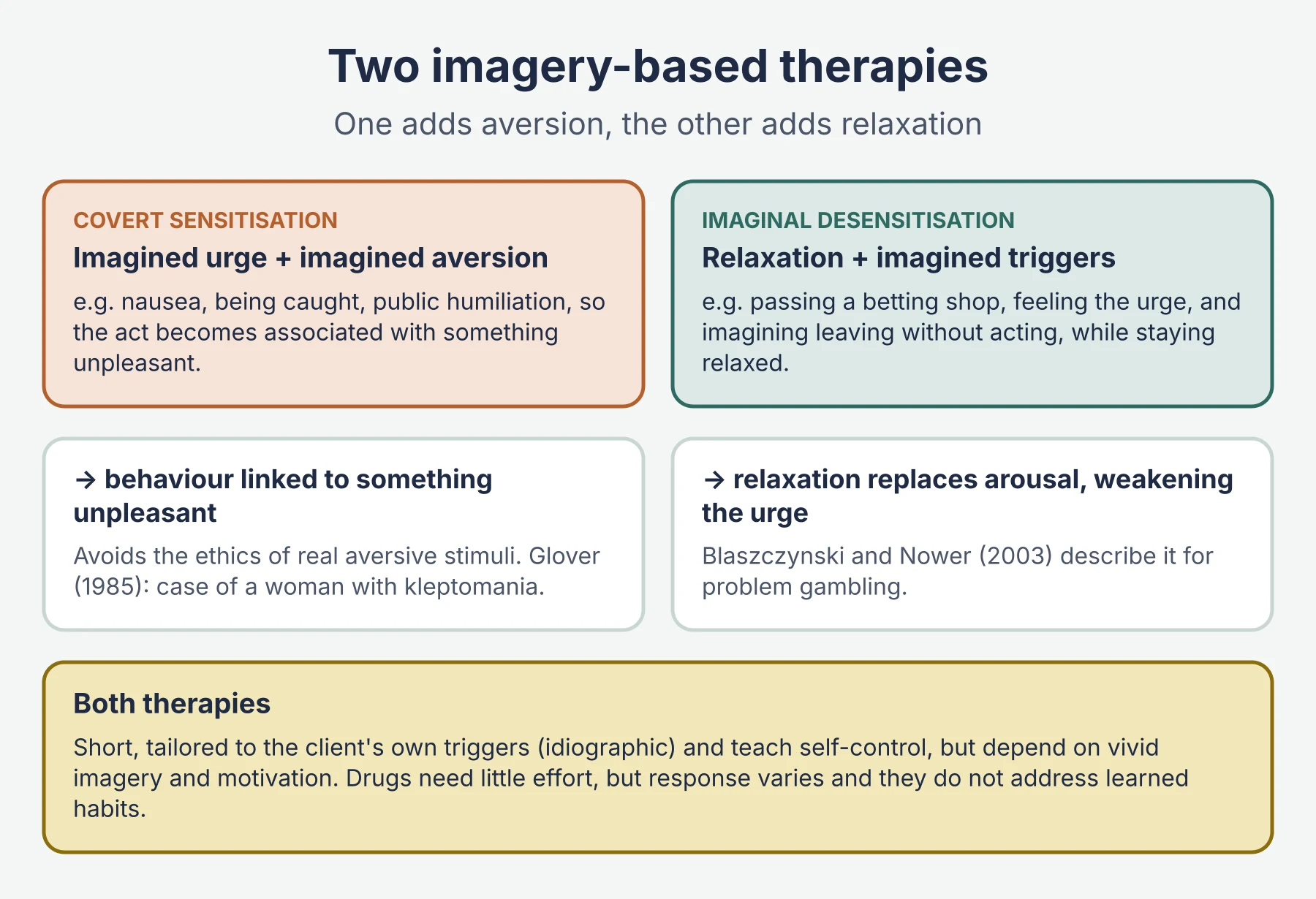
Covert sensitisation pairs the imagined urge or act with an imagined aversive consequence, such as nausea, being caught or public humiliation, so the behaviour becomes associated with something unpleasant. Because everything happens in imagination, it avoids the ethical problems of real aversive stimuli. Glover (1985) described using covert sensitisation with a woman with kleptomania, a case study that gives detail but cannot be generalised.
Imaginal desensitisation first teaches relaxation, then has the client imagine a sequence of trigger situations (for example passing a betting shop and feeling the urge) and imagine leaving without acting on it, while staying relaxed. The urge is weakened because relaxation replaces arousal. Blaszczynski and Nower (2003) describe the technique for problem gambling.
Comparing treatments. Drugs need little effort but may not suit everyone (Grant et al. show response varies) and do not address learned habits. Covert sensitisation adds aversion; imaginal desensitisation removes arousal. Both psychological therapies are short, tailored to the client’s own triggers (idiographic) and teach self-control, but depend on vivid imagery and motivation.
Common mistakes
- Defining kleptomania as “stealing a lot”: the defining features are lack of need for the item, tension before and relief after.
- Saying pyromania is arson for money or revenge: those motives exclude the diagnosis.
- Describing Grant et al. as a single trial of one drug.
- Mixing up covert sensitisation (adds aversion) and imaginal desensitisation (adds relaxation).
Exam technique
The syllabus pairs this topic with application to everyday life and reductionism: be ready to explain how explanations inform treatment, for example the dopamine explanation leading to opiate antagonists. In Paper 4 questions on Grant et al., the double-blind design and the 35% response criterion are frequent targets.
Official syllabus
Cambridge International AS & A Level Psychology 9990 syllabus for 2024, 2025 and 2026, Specialist Option 1, 1.3 Impulse control disorders — cambridgeinternational.org.
More resources on this topic
Related resources
-
Practice questions
Cambridge International AS & A Level Psychology (9990): 1.3 Impulse control disorders – Practice Questions
Original Paper 3 and Paper 4 style questions with answers on 9990 topic 1.3 impulse control disorders: diagnosis, K-SAS, Grant et al. and therapies.
Psychology · Cambridge · A Level
Try questions -
Revision notes
Cambridge International AS & A Level Psychology (9990): 1.3 Impulse control disorders – Revision Notes
Revision notes for 9990 topic 1.3 impulse control disorders: diagnosis, K-SAS, three explanations, Grant et al. and the two imagery therapies, with a self-test.
Psychology · Cambridge · A Level
Revise topic -
Study guides
Cambridge International AS & A Level Psychology (9990): 1.2 Mood (affective) disorders: depressive disorder (unipolar) and bipolar disorder
Topic 1.2 mood disorders for Cambridge 9990 Psychology: ICD-11 depression and bipolar, the BDI, Oruč et al., Beck, learned helplessness and treatments.
Psychology · Cambridge · A Level
Read guide
Studying Psychology?
This page is free and stays free. Marlbridge is not offering Psychology classes at the moment, so there is no tuition to book for it. The free study resources stay open to everyone.
Get free revision emails (optional)
Occasional emails with practice questions, worked explanations and links to free resources for the qualification and subjects you choose. No spam, and you can unsubscribe from any email. The free tools on this site never need an email.