
Revision Notes
Cambridge International AS & A Level Psychology (9990): 1.4 Anxiety disorders and fear-related disorders – Revision Notes
Revision notes for 9990 topic 1.4 anxiety and fear-related disorders: diagnosis, GAD-7, BIPI, Little Albert, Little Hans, applied tension and a self-test.
- Subject
- Psychology
- Level
- A LEVEL
- Topic
- Specialist Option 1: Clinical Psychology
- Author
- Marlbridge Academic Team
- Updated
- Reviewed by
- Kanwal Aslam (what this means)
Aligned to Cambridge A Level Psychology (9990), 2024-2026. Official specification .
Syllabus page (what it covers and how it is assessed): Cambridge A Level Psychology.
Syllabus points this page covers
9990 (A Level)
- 1.4 Anxiety disorders and fear-related disorders
These notes condense topic 1.4, anxiety disorders and fear-related disorders, from Specialist Option 1, Clinical Psychology, of Cambridge International AS & A Level Psychology (9990), syllabus for 2024 to 2026. The topic names three disorders, two measures, three explanations and three treatments, with Chapman and DeLapp (2013) as the key study. Full explanations are in the anxiety and fear-related disorders study guide; test yourself with the anxiety and fear-related disorders practice questions.
1.4.1 Diagnosis
| Disorder | Core feature | Duration |
|---|---|---|
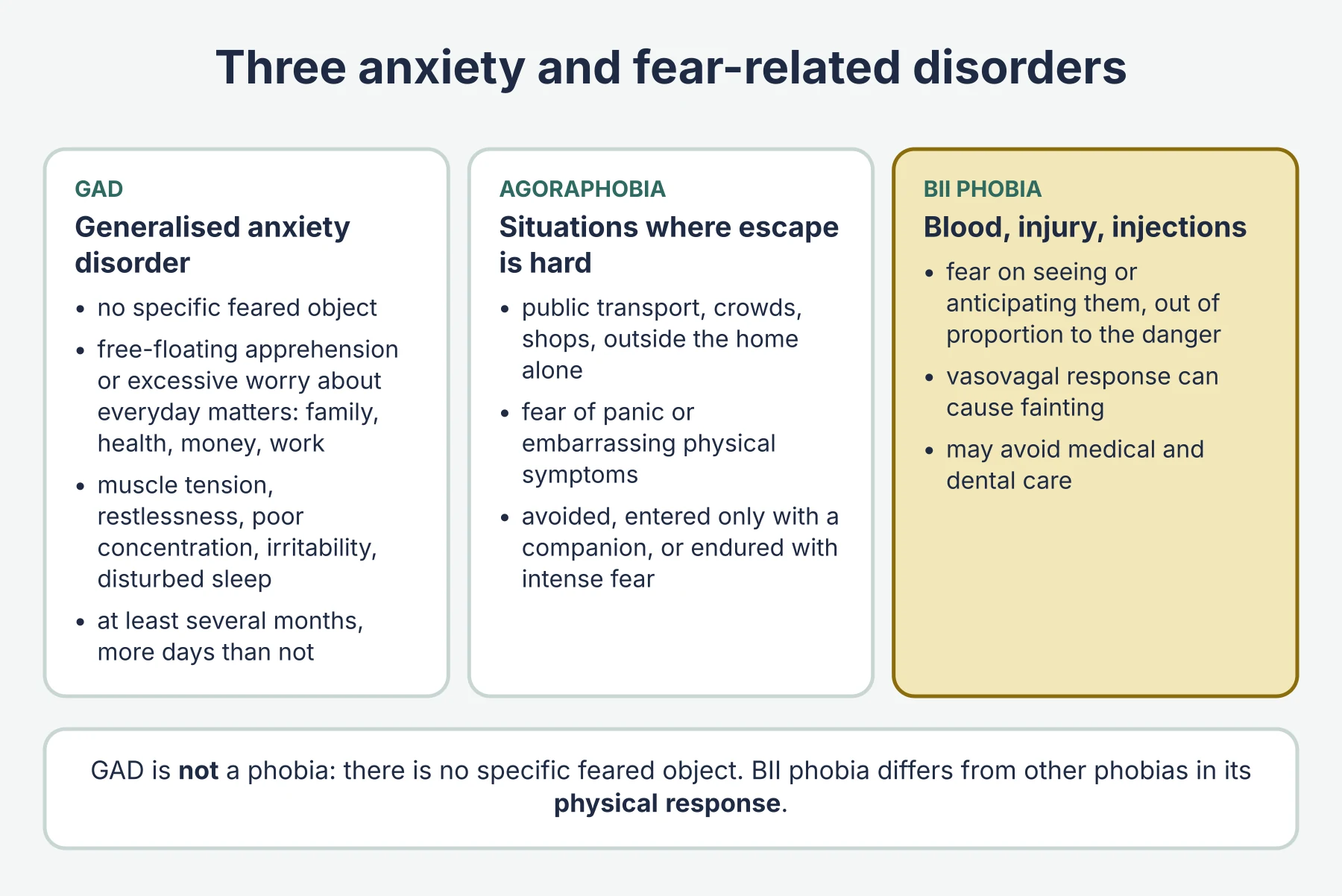
| Generalised anxiety disorder | General apprehension or excessive worry about several everyday matters; tension, restlessness, poor concentration, irritability, poor sleep | At least several months, more days than not |
| Agoraphobia | Fear of several situations where escape is hard or help unavailable (transport, crowds, shops, outside alone); avoidance or companion needed | At least several months |
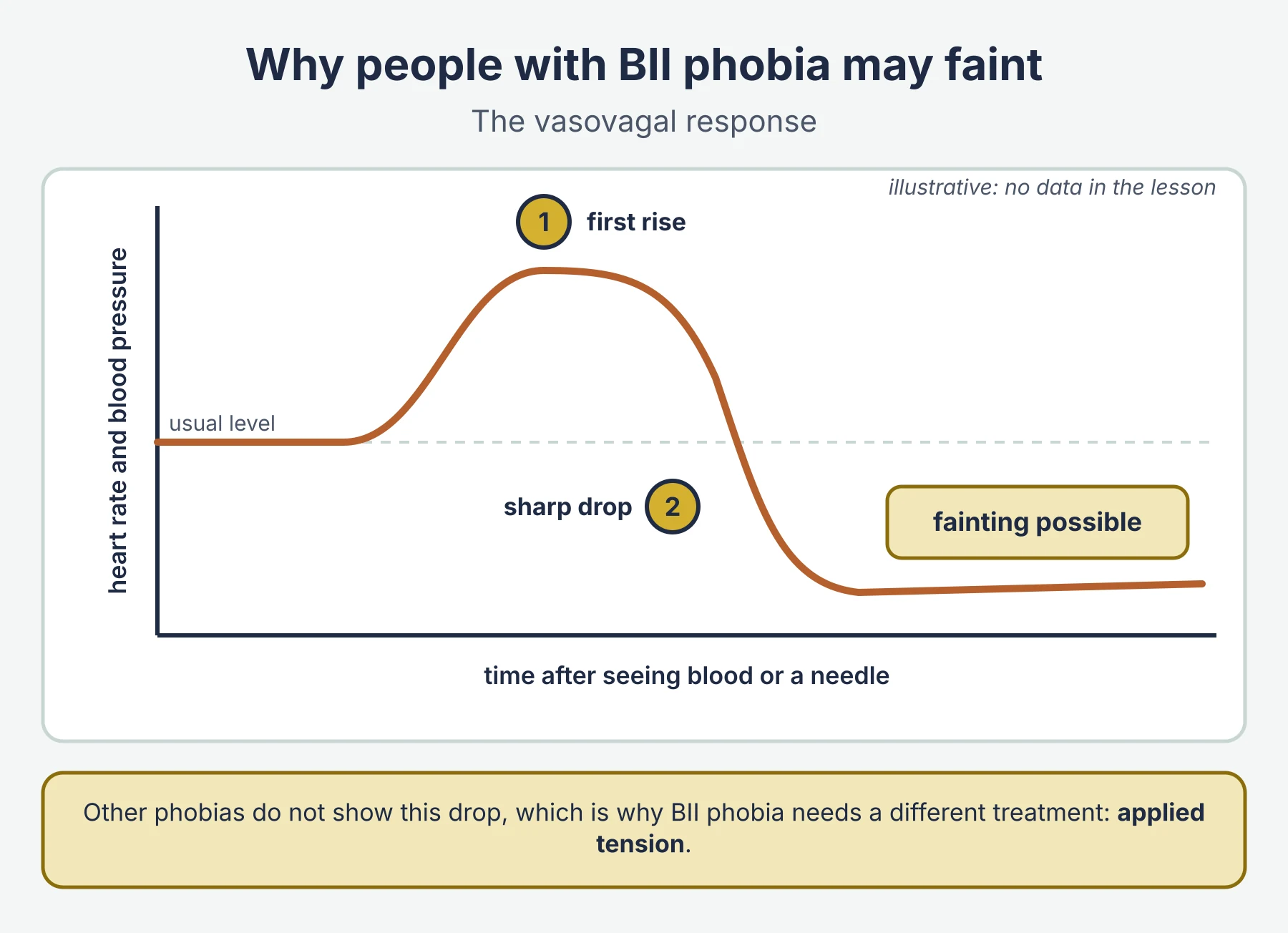
| Blood-injection-injury phobia | Excessive fear of blood, injury or injections; avoidance; vasovagal drop in blood pressure and fainting | At least several months |
Measures
| Measure | Key facts | Evaluation |
|---|---|---|
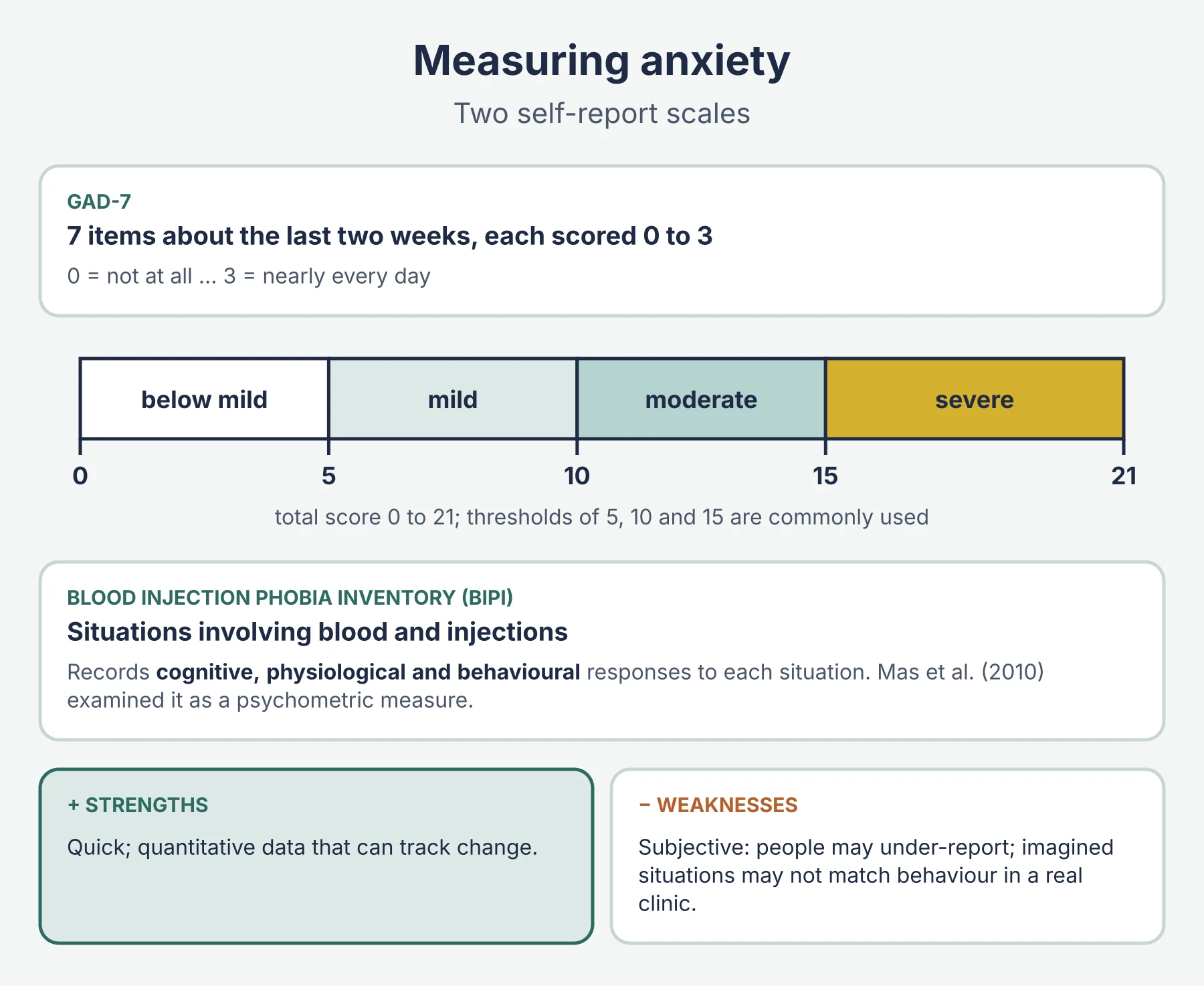
| GAD-7 | 7 items; last two weeks; 0–3 each; total 0–21; thresholds 5, 10, 15 for mild, moderate, severe | Quick, quantitative; self-report bias |
| BIPI | Situations involving blood and injections; cognitive, physiological and behavioural responses; e.g. Mas et al. (2010) | Detailed profile across three response systems; imagined situations may not match real behaviour |
1.4.2 Explanations
| Explanation | Evidence | Strength | Weakness |
|---|---|---|---|
| Genetic | Öst (1992): many BII phobics have a relative with the same fear | Explains strong family pattern; vasovagal response may be inherited | Families share environment and modelling |
| Classical conditioning | Watson and Rayner (1920), Little Albert | Shows fear can be learned; leads to exposure therapy | Single case; unethical; many phobics recall no trauma |
| Psychodynamic | Freud (1909), Little Hans | Rich case detail; considers unconscious meaning | Subjective, unfalsifiable; father’s reports may be biased |
Little Albert in steps
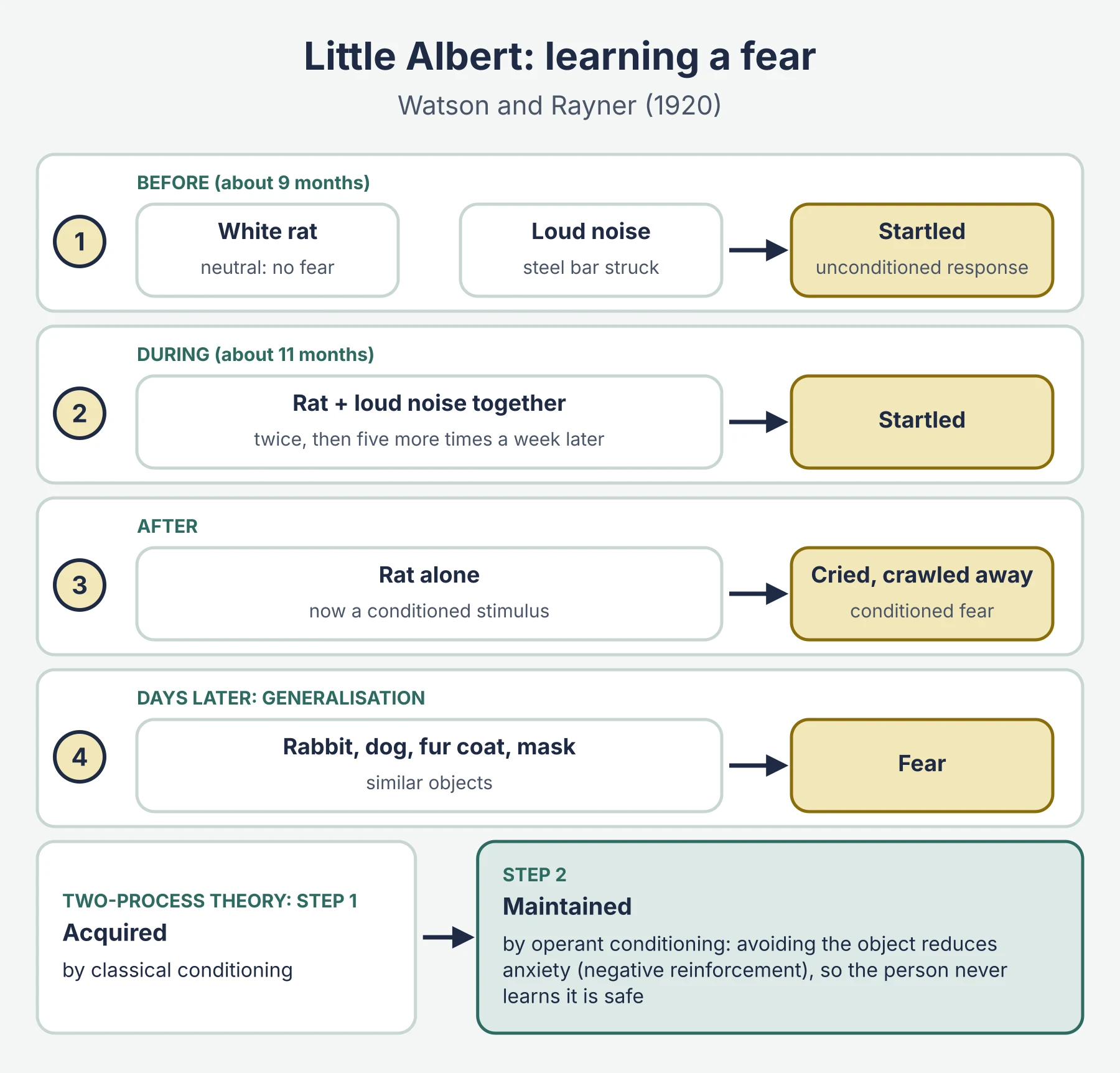
- About 9 months: no fear of rat, rabbit, dog, masks, cotton wool; fear of loud noise.
- About 11 months: rat paired with the noise, 2 times, then 5 more a week later.
- Rat alone produces crying and crawling away.
- Fear generalises to similar objects (rabbit, dog, fur coat, mask).
- Albert leaves before the fear is removed.
Little Hans in steps
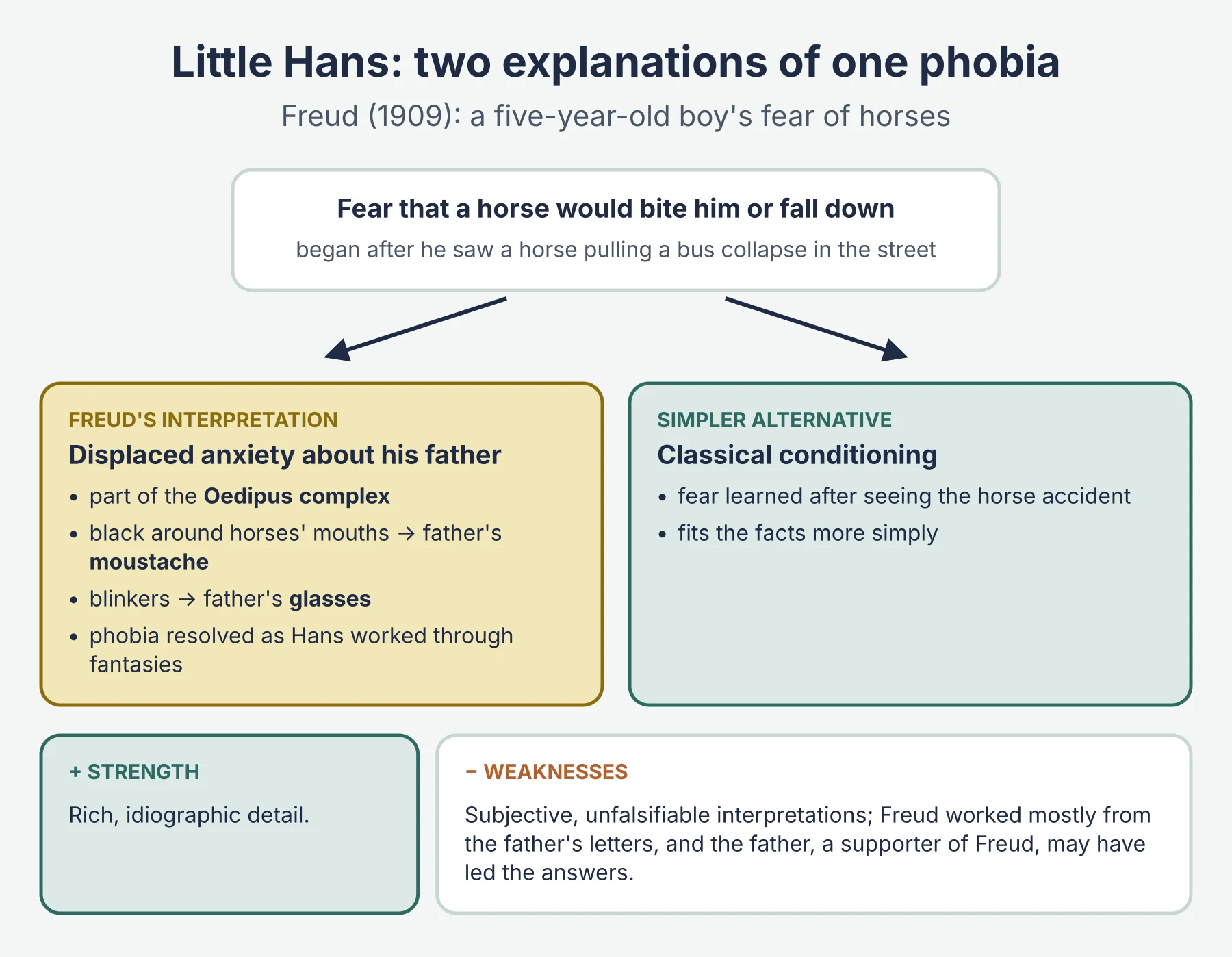
- Five-year-old fears horses biting or falling down, after seeing a bus-horse collapse.
- Father reports to Freud by letter; Freud meets Hans briefly.
- Freud: displaced fear of father; Oedipus complex; black around mouth and blinkers linked to moustache and glasses.
- Phobia fades as fantasies resolve the complex.
Two-process theory: acquired by classical conditioning; maintained by avoidance (negative reinforcement).
1.4.3 Treatments
| Treatment | Key idea | Note |
|---|---|---|
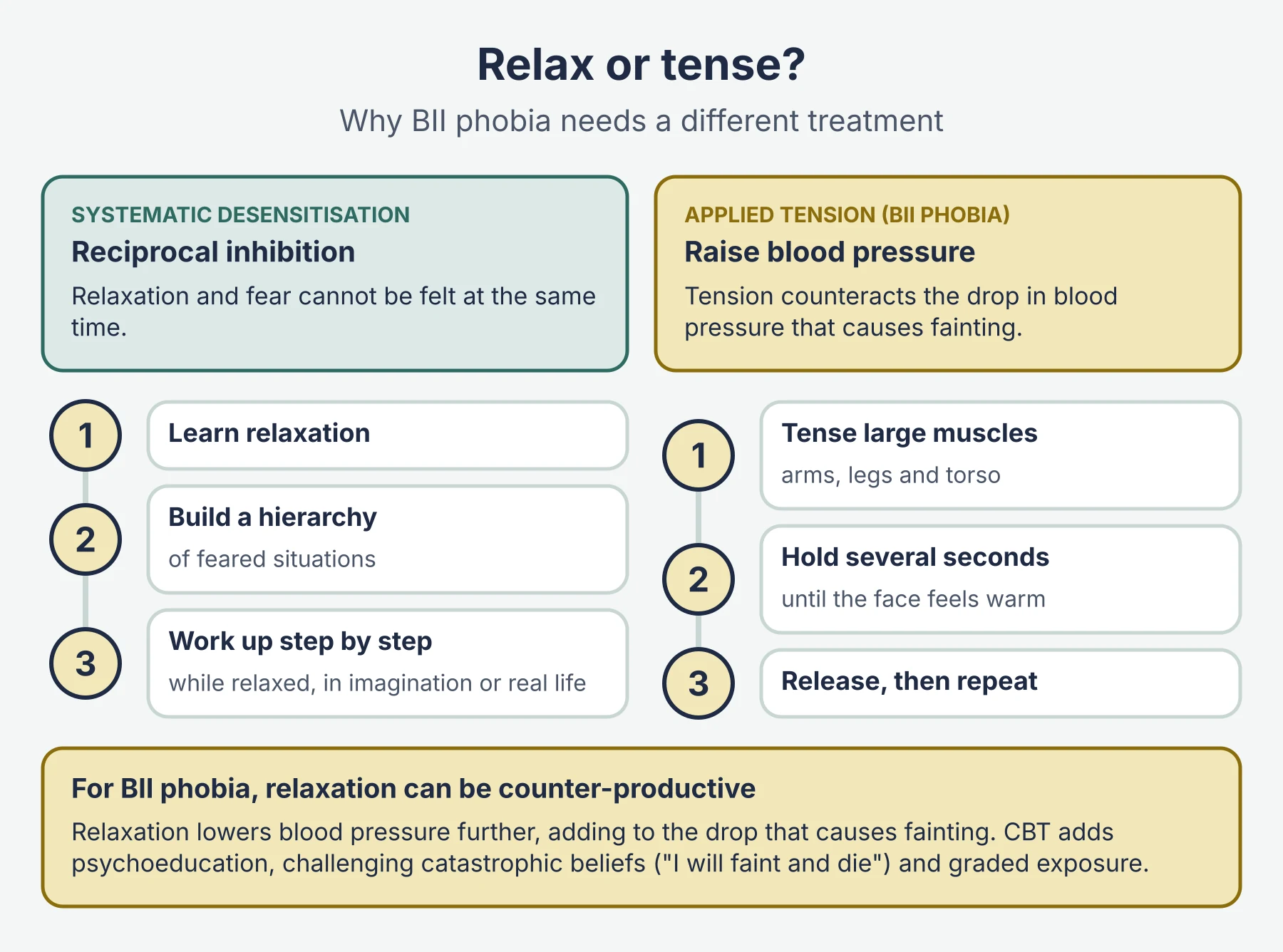
| Systematic desensitisation | Reciprocal inhibition: relaxation replaces fear while working up a hierarchy | Any fear-related disorder; relaxation may worsen fainting in BII phobia |
| CBT | Psychoeducation; challenge catastrophic thoughts; graded exposure | Addresses beliefs as well as behaviour |
| Applied tension | Tense large muscles until the face feels warm, release, repeat | Raises blood pressure to prevent fainting |
Key study: Chapman and DeLapp (2013)
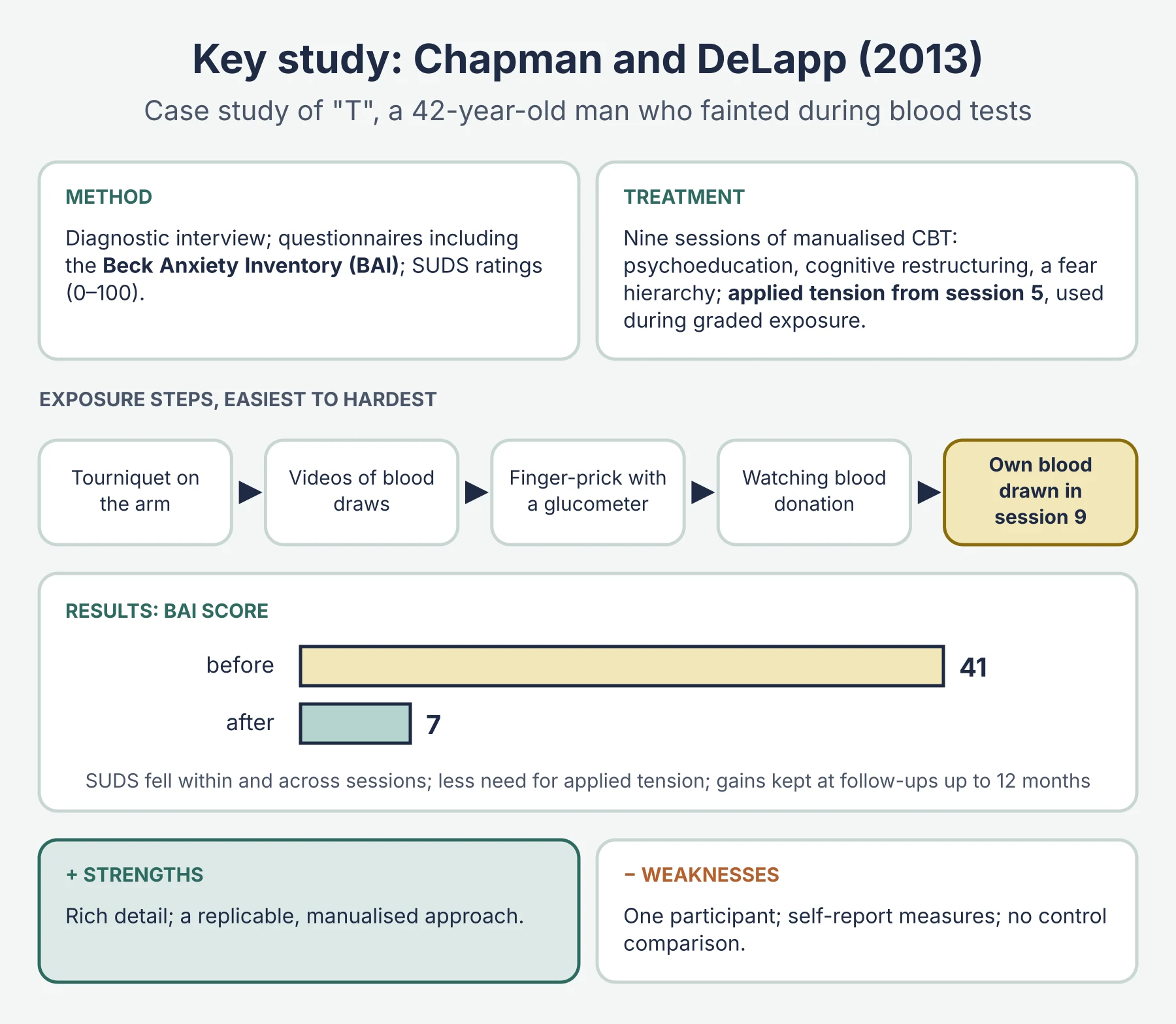
- Case study of “T”, 42, self-referred; fainted during blood tests.
- Nine sessions of manualised CBT; SUDS hierarchy; applied tension from session 5.
- Exposure from a tourniquet to having his own blood drawn in session 9.
- BAI fell from 41 to 7; gains maintained at follow-ups up to 12 months.
- Strengths: detailed, manualised, follow-up. Weaknesses: one participant, self-report, no control.
Key terms
| Term | Meaning |
|---|---|
| Free-floating anxiety | General apprehension not tied to a specific object |
| Vasovagal response | Rise then sudden fall in heart rate and blood pressure, causing fainting |
| Generalisation | A conditioned response spreading to similar stimuli |
| Displacement | Defence mechanism: redirecting feelings onto a safer target |
| Oedipus complex | Freud: a boy’s desire for his mother and rivalry with his father |
| Reciprocal inhibition | Two incompatible responses cannot occur together |
| SUDS | Subjective units of distress, rated 0–100 |
| Manualised therapy | Treatment following a standard written protocol |
Exam traps
- Giving GAD a specific feared object.
- Recommending relaxation for BII phobia without explaining the fainting problem.
- Calling Little Hans a study of conditioning: it is psychodynamic.
- Saying Little Albert’s fear was removed.
- Writing “Chapman and DeLapp used a sample” without saying it was one man.
Self-test
- What is the minimum duration for GAD?
- Name three situations typically feared in agoraphobia.
- Why can blood-injection-injury phobia cause fainting?
- What is the maximum score on the GAD-7?
- Which three response systems does the BIPI cover?
- What did Öst (1992) find?
- What was paired with the white rat in Little Albert?
- Give one ethical criticism of Watson and Rayner.
- How did Freud gather most of his information about Hans?
- What is reciprocal inhibition?
- Why does applied tension help BII phobia?
- By how much did T’s BAI score fall?
Answers: (1) at least several months. (2) any three of public transport, crowds, shops, being outside the home alone, queues. (3) blood pressure rises then drops sharply (vasovagal response). (4) 21. (5) cognitive, physiological and behavioural. (6) many people with blood or injection phobias had a close relative with the same fear. (7) a loud noise from a steel bar being struck. (8) he was deliberately frightened and his fear was not removed before he left. (9) letters from Hans’s father. (10) relaxation and fear cannot occur together, so relaxation replaces fear. (11) tensing muscles raises blood pressure and prevents fainting. (12) from 41 to 7.
Official syllabus
Cambridge International AS & A Level Psychology 9990 syllabus for 2024, 2025 and 2026, Specialist Option 1, 1.4 Anxiety disorders and fear-related disorders — cambridgeinternational.org.
More resources on this topic
Related resources
-
Study guides
Cambridge International AS & A Level Psychology (9990): 1.3 Impulse control disorders
Topic 1.3 for Cambridge 9990 Psychology: kleptomania, pyromania and gambling disorder, the K-SAS, dopamine, reinforcement, feeling-state theory and treatments.
Psychology · Cambridge · A Level
Read guide -
Practice questions
Cambridge International AS & A Level Psychology (9990): 1.3 Impulse control disorders – Practice Questions
Original Paper 3 and Paper 4 style questions with answers on 9990 topic 1.3 impulse control disorders: diagnosis, K-SAS, Grant et al. and therapies.
Psychology · Cambridge · A Level
Try questions -
Revision notes
Cambridge International AS & A Level Psychology (9990): 1.3 Impulse control disorders – Revision Notes
Revision notes for 9990 topic 1.3 impulse control disorders: diagnosis, K-SAS, three explanations, Grant et al. and the two imagery therapies, with a self-test.
Psychology · Cambridge · A Level
Revise topic
Studying Psychology?
This page is free and stays free. Marlbridge is not offering Psychology classes at the moment, so there is no tuition to book for it. The free study resources stay open to everyone.
Get free revision emails (optional)
Occasional emails with practice questions, worked explanations and links to free resources for the qualification and subjects you choose. No spam, and you can unsubscribe from any email. The free tools on this site never need an email.