
Study Guides
Cambridge International AS & A Level Psychology (9990): 1.5 Obsessive-compulsive disorder (OCD)
Topic 1.5 OCD for Cambridge 9990 Psychology: ICD-11 obsessions and compulsions, MOCI and Y-BOCS, five explanations, SSRIs, ERP and Lovell et al.
- Subject
- Psychology
- Level
- A LEVEL
- Topic
- Specialist Option 1: Clinical Psychology
- Author
- Marlbridge Academic Team
- Updated
- Reviewed by
- Kanwal Aslam (what this means)
Aligned to Cambridge A Level Psychology (9990), 2024-2026. Official specification .
Syllabus page (what it covers and how it is assessed): Cambridge A Level Psychology.
Syllabus points this page covers
9990 (A Level)
- 1.5 Obsessive-compulsive disorder (OCD)
Topic 1.5 of Specialist Option 1, Clinical Psychology, in Cambridge International AS & A Level Psychology (9990) covers obsessive-compulsive disorder (OCD). It has three parts: 1.5.1 diagnostic criteria, a case study and two measures; 1.5.2 five explanations, two biological and three psychological; and 1.5.3 treatments, including the key study by Lovell et al. (2006). This page develops each part beyond the Clinical Psychology study guide, with a focus on how to compare explanations and treatments.
Revise with the OCD revision notes and test yourself with the OCD practice questions.
1.5.1 Diagnosis and measurement
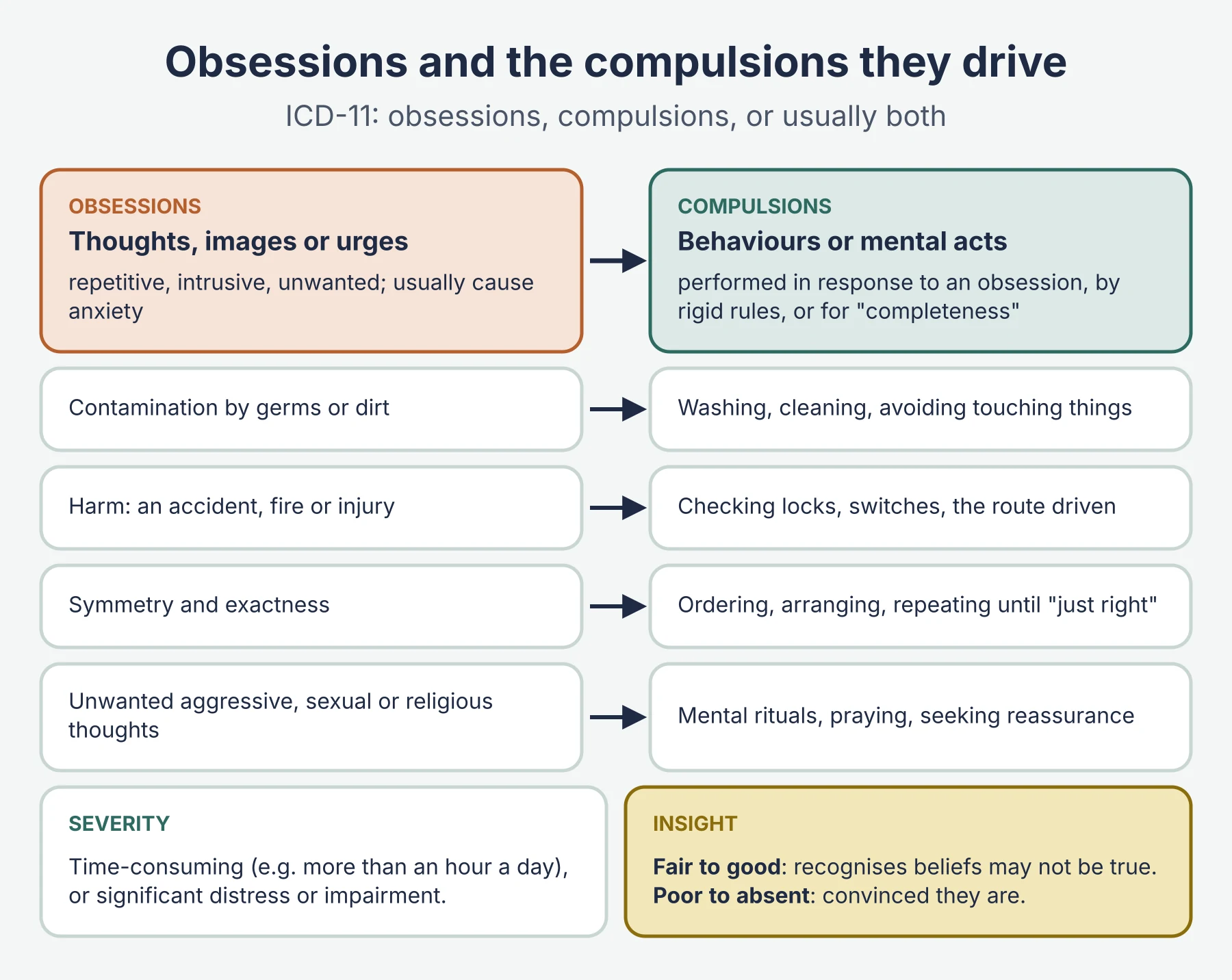
ICD-11 criteria. OCD involves persistent obsessions, compulsions, or usually both.
- Obsessions are repetitive, persistent thoughts, images or urges that are intrusive and unwanted and usually cause anxiety. The person tries to ignore or suppress them, or to neutralise them by performing compulsions.
- Compulsions are repetitive behaviours (such as washing, checking or ordering) or mental acts (such as counting or repeating phrases) that the person feels driven to perform in response to an obsession, according to rigid rules, or to achieve a sense of “completeness”.
The symptoms are time-consuming (for example more than an hour a day) or cause significant distress or impairment. ICD-11 also records the level of insight: whether the person recognises that the beliefs behind the symptoms may not be true (“fair to good”) or is convinced they are (“poor to absent”).
Types of obsessions and compulsions. The syllabus asks you to focus on these.
| Obsession | Typical compulsion |
|---|---|
| Contamination by germs or dirt | Washing, cleaning, avoiding touching things |
| Harm (fear of causing an accident, fire or injury) | Checking locks, switches, the route driven |
| Symmetry and exactness | Ordering, arranging, repeating until it feels “just right” |
| Unwanted aggressive, sexual or religious thoughts | Mental rituals, praying, seeking reassurance |
Case study: Rapoport (1989), “Charles”. Judith Rapoport described Charles, a teenage boy, in her book The Boy Who Couldn’t Stop Washing. His washing rituals took hours each day and dominated his life. The case shows the time-consuming, distressing nature of compulsions and how the person may recognise them as excessive yet feel unable to stop. As a case study it is detailed and idiographic but cannot represent all types of OCD.
Measures.
| Measure | Format | Scoring |
|---|---|---|
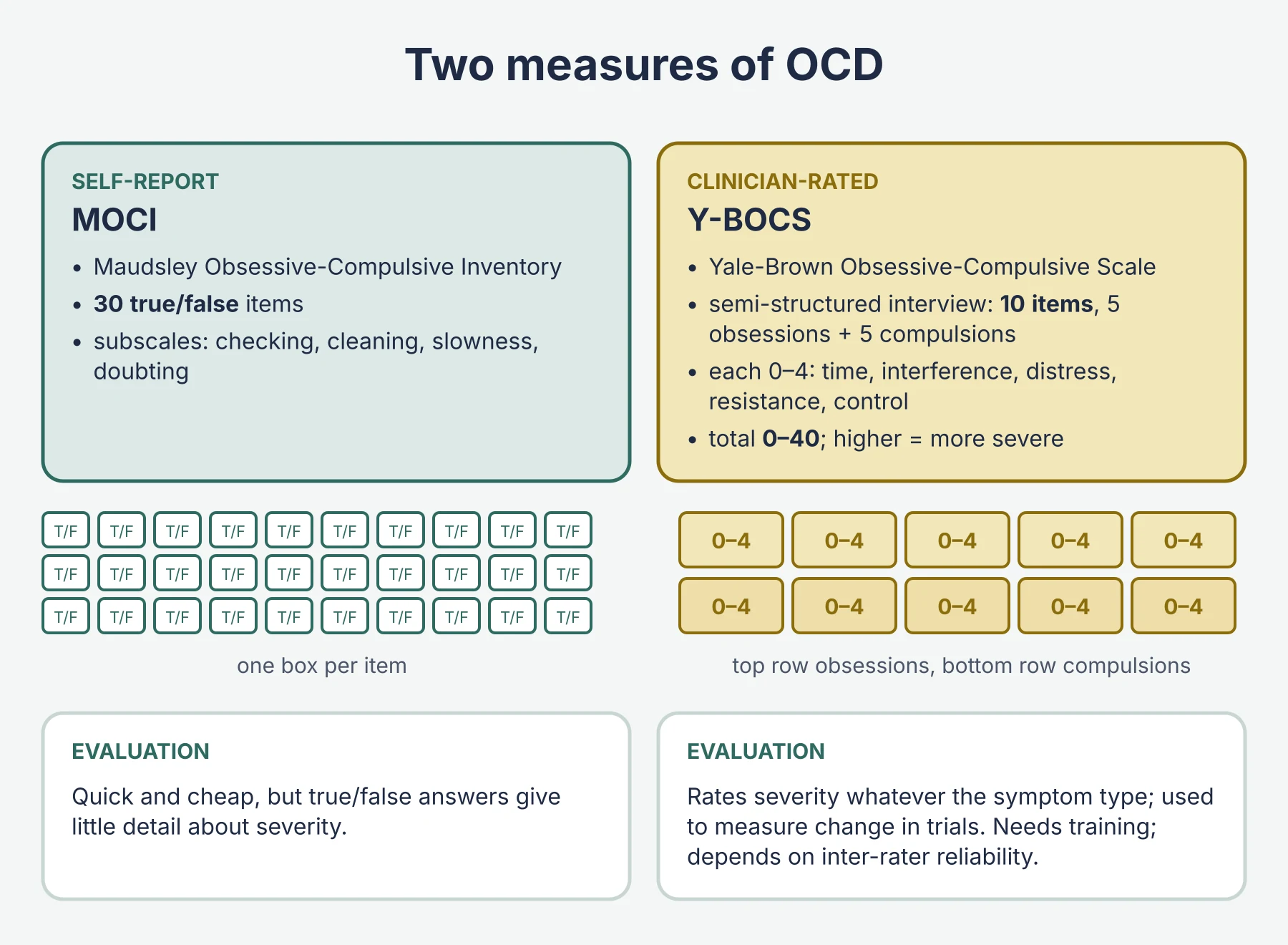
| Maudsley Obsessive-Compulsive Inventory (MOCI) | 30 true/false self-report items | Subscales: checking, cleaning, slowness, doubting |
| Yale-Brown Obsessive-Compulsive Scale (Y-BOCS) | Clinician-rated, semi-structured interview; 10 items, five on obsessions and five on compulsions | Each item 0–4 (time, interference, distress, resistance, control); total 0–40; higher = more severe |
The MOCI is quick and cheap, but true/false answers give little detail about severity. The Y-BOCS rates severity whatever the type of symptom and is widely used to measure change in treatment trials, but as a clinician-rated interview it needs training and depends on inter-rater reliability. Both are psychometric measures, and the syllabus links this part to interviews, case studies, quantitative and qualitative data and validity.
1.5.2 Explanations
Biological
Biochemical. Low serotonin activity is linked to OCD. The main support is that SSRIs, which increase serotonin availability, reduce symptoms for many patients. But many people improve only partly, which suggests other neurotransmitters (such as dopamine) and other factors are involved, and the treatment-causation argument is weak: a drug that helps does not prove what caused the problem.
Genetic. Twin studies find higher concordance for identical than for non-identical twins, and OCD is more common in first-degree relatives of people with OCD. Because concordance is not 100%, environmental factors also matter, and many genes appear to contribute small effects.
Psychological
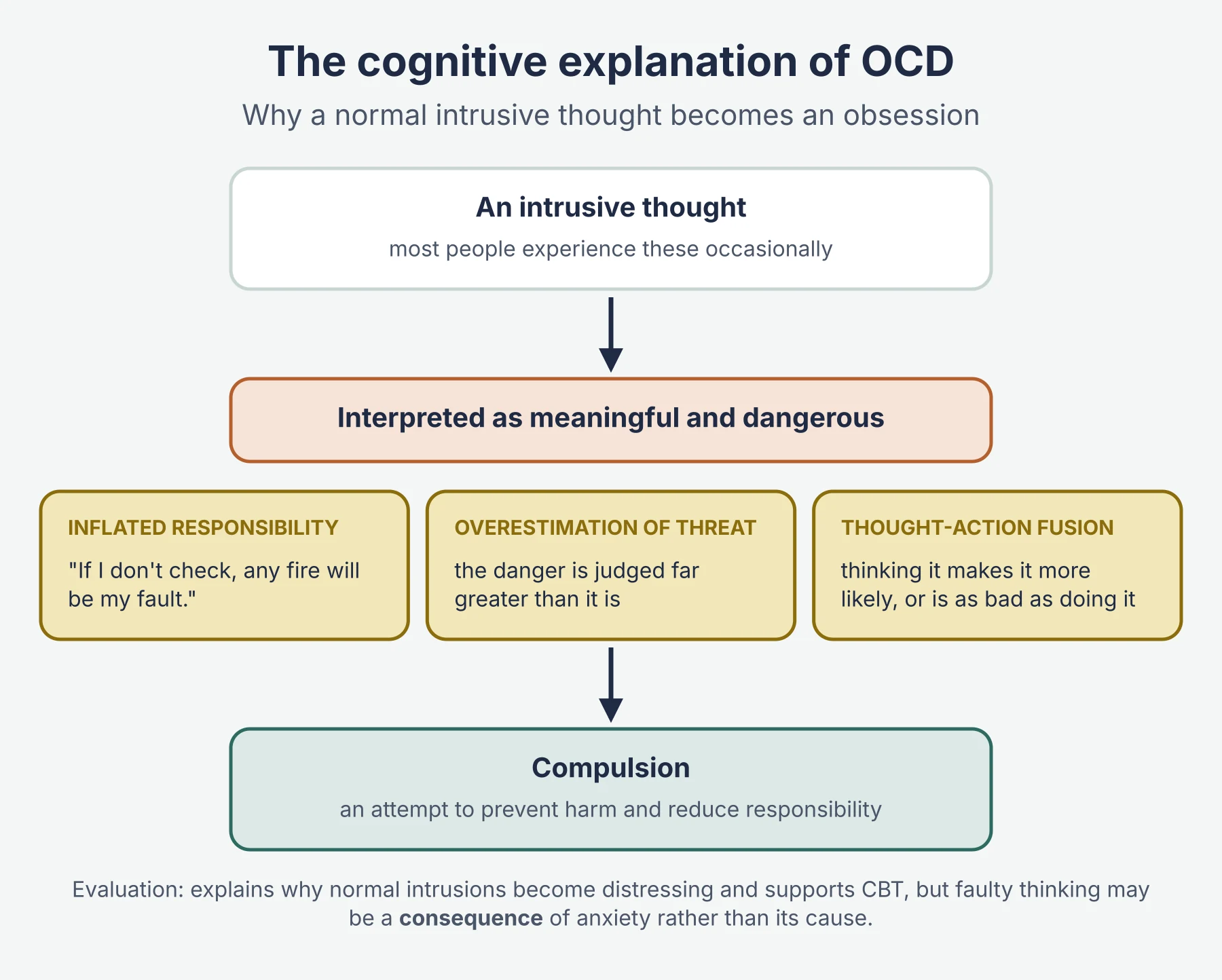
Cognitive (thinking error). Most people experience intrusive thoughts occasionally; cognitive theory argues that OCD develops when such thoughts are interpreted as meaningful and dangerous. Typical thinking errors include inflated responsibility (“if I don’t check, any fire will be my fault”), overestimation of threat, and thought-action fusion (believing that thinking about something makes it more likely, or is as bad as doing it). The compulsion is an attempt to prevent harm and reduce responsibility. Evaluation: this explains why normal intrusions become distressing and supports CBT, but faulty thinking may be a consequence of anxiety rather than its cause.
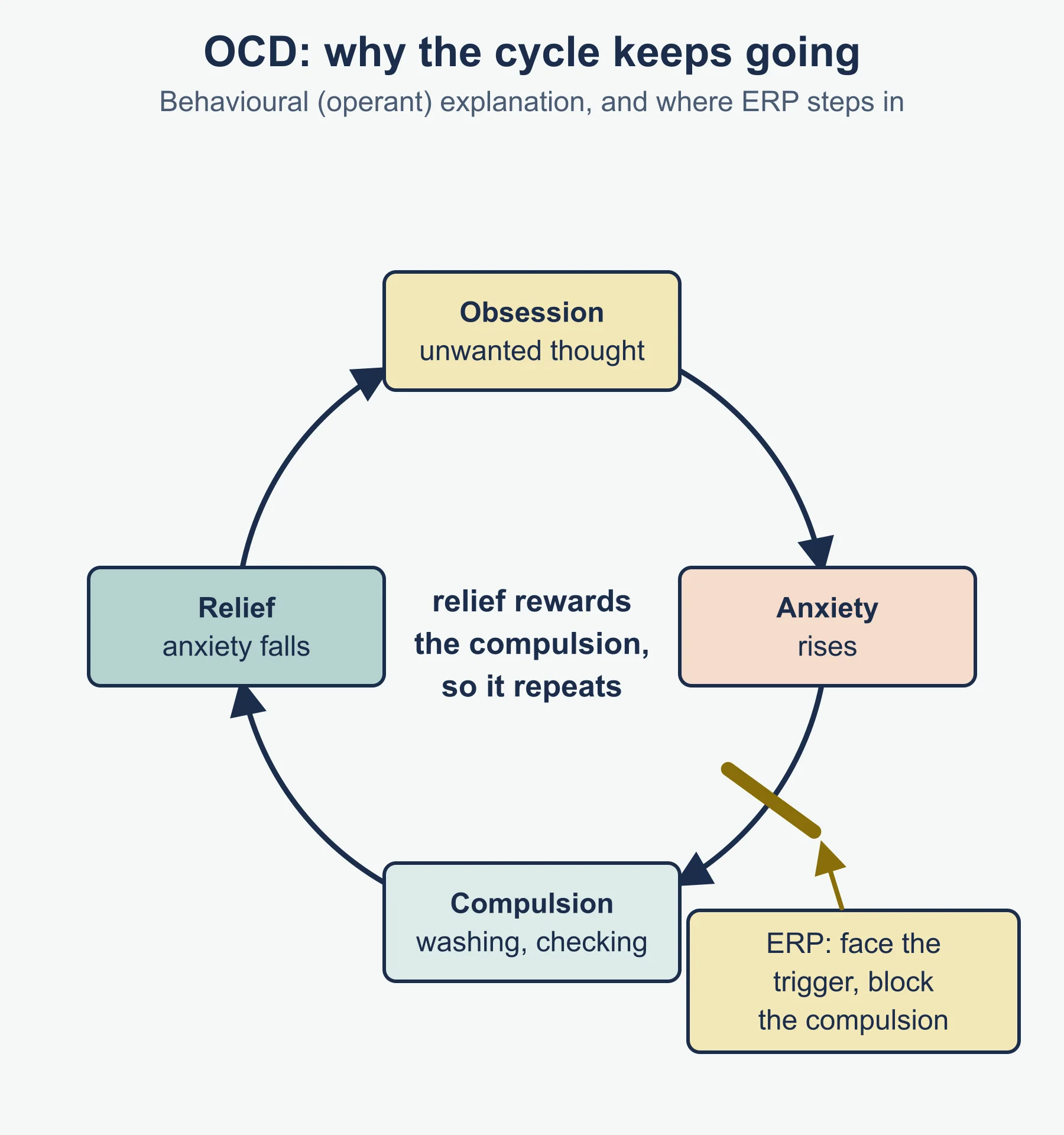
Behavioural (operant conditioning). Anxiety becomes linked to a trigger, and the compulsion reduces the anxiety. Because the compulsion removes an unpleasant state, it is negatively reinforced and repeated, and the person never discovers that the feared outcome would not have happened. Evaluation: it explains maintenance well and leads directly to ERP, but it is less good at explaining the specific content of obsessions.
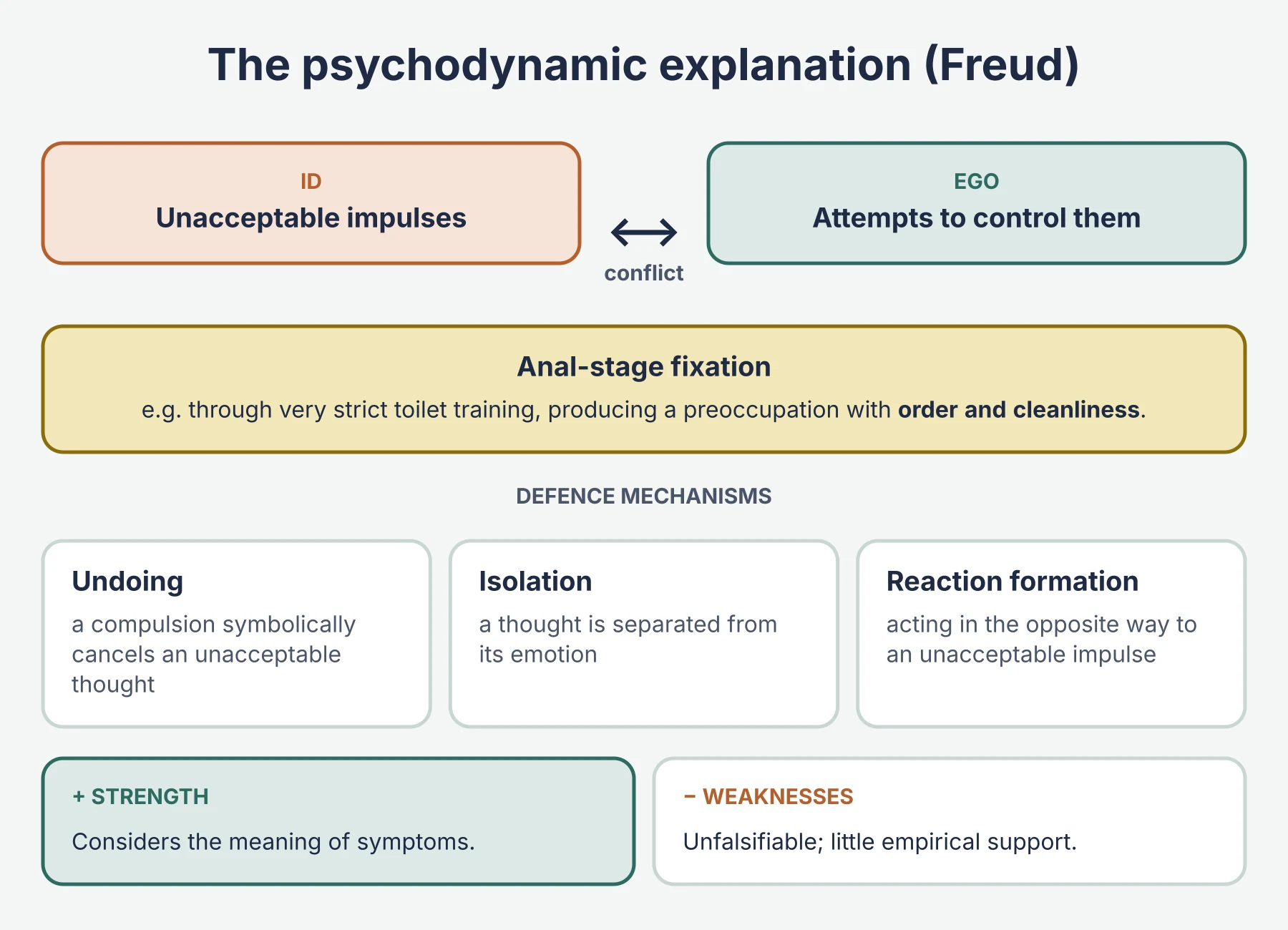
Psychodynamic. Freud linked OCD to conflict between the id’s unacceptable impulses and the ego’s attempts to control them, with fixation in the anal stage, for example through very strict toilet training, producing a preoccupation with order and cleanliness. Defence mechanisms include undoing (a compulsion that symbolically cancels an unacceptable thought), isolation (separating a thought from its emotion) and reaction formation (acting in the opposite way to an unacceptable impulse). Evaluation: it considers the meaning of symptoms, but is unfalsifiable and has little empirical support.
Comparing explanations
| Debate | Most relevant point |
|---|---|
| Nature versus nurture | Genetic and biochemical (nature) versus conditioning and learned thinking (nurture) |
| Reductionism versus holism | Serotonin is reductionist; cognitive and psychodynamic accounts consider meaning |
| Determinism versus free will | Biological and psychodynamic accounts are strongly determinist; cognitive therapy assumes thoughts can be changed |
| Individual versus situational | Thinking errors and genes are individual; reinforcing situations are situational |
1.5.3 Treatment and management
SSRIs increase serotonin availability by blocking its reuptake. They are easy to take and need little effort, but can take several weeks to work, have side effects such as nausea, and symptoms often return when they are stopped.
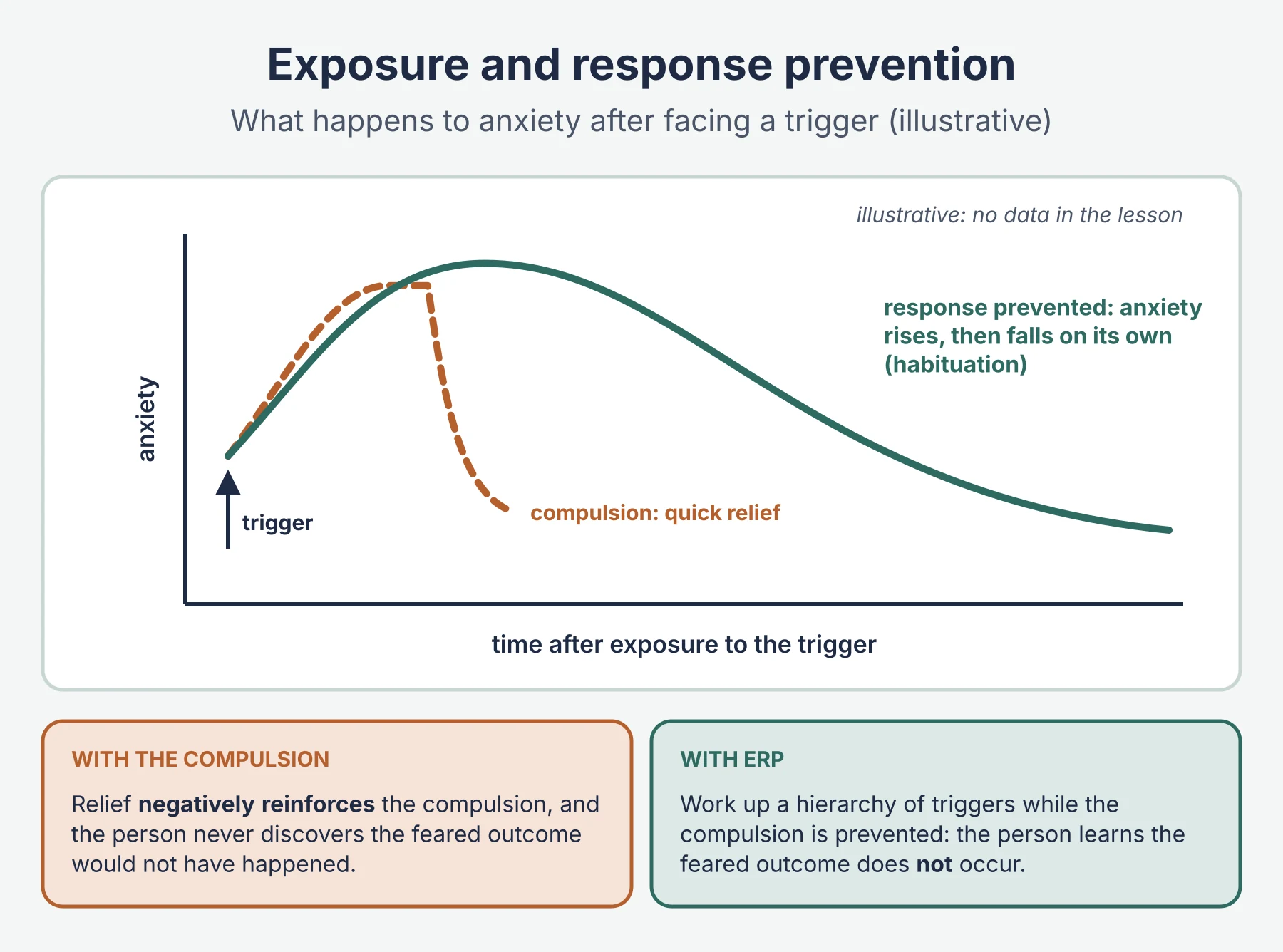
Exposure and response prevention (ERP) exposes the person to a trigger, step by step through a hierarchy, while preventing the compulsion. Anxiety rises and then falls without the ritual (habituation), so the person learns that the feared outcome does not occur. Lehmkuhl et al. (2008) reported a case of a 12-year-old boy with autism and OCD who improved with CBT including ERP, which shows the approach can be adapted for children and for people with additional needs.
Cognitive-behavioural therapy combines ERP with challenging thinking errors such as inflated responsibility.
Key study: Lovell et al. (2006)
Context. CBT with ERP is effective for OCD, but many people cannot attend face-to-face therapy because of distance, cost or embarrassment. Telephone delivery could widen access.
Aim. To test whether CBT delivered by telephone is as effective as face-to-face CBT (a non-inferiority question).
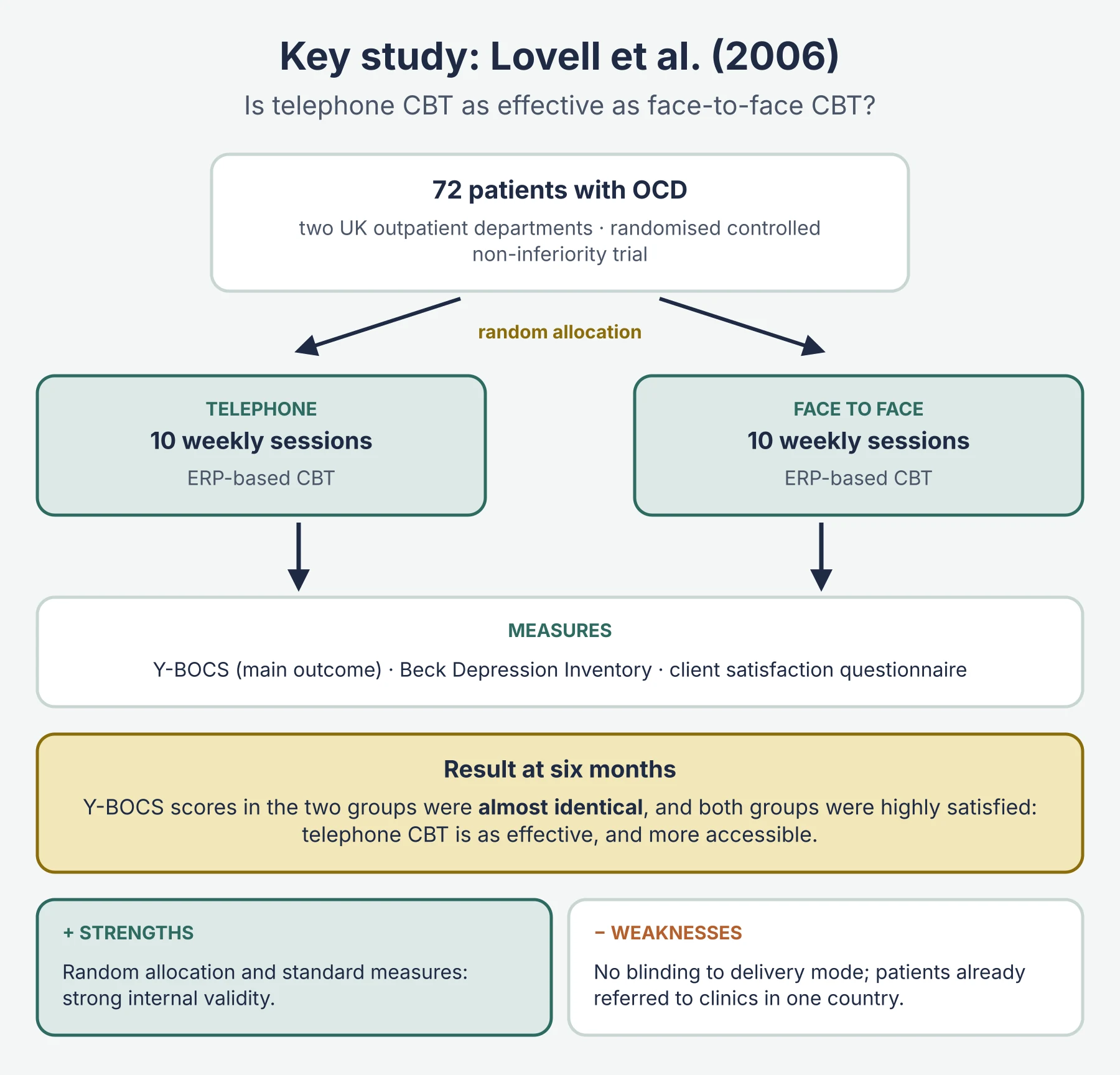
Method. A randomised controlled non-inferiority trial in two UK outpatient departments. 72 patients with OCD were randomly allocated to ten weekly sessions of ERP-based CBT, either by telephone or face to face.
Measures. The Y-BOCS (main outcome), the Beck Depression Inventory and a client satisfaction questionnaire.
Results. At six months, Y-BOCS scores in the two groups were almost identical, and both groups were highly satisfied.
Conclusions. Telephone CBT is as effective as face-to-face CBT, making treatment more accessible.
Evaluation. Random allocation and standard measures give strong internal validity. Patients and therapists could not be blind to how therapy was delivered, which could affect expectations, and the sample came from people already referred to clinics in one country, which limits generalisation, including across cultures.
Common mistakes
- Saying obsessions are behaviours: they are thoughts, images or urges.
- Treating compulsions as always visible: mental acts count.
- Describing ERP without the response prevention component.
- Giving the Y-BOCS as self-report.
Exam technique
For a Paper 3 part (b) evaluation of explanations, use at least two of the debates in the table above and compare rather than list. For treatments, compare SSRIs and ERP on effectiveness, side effects, how long benefits last and what each demands of the patient.
Official syllabus
Cambridge International AS & A Level Psychology 9990 syllabus for 2024, 2025 and 2026, Specialist Option 1, 1.5 Obsessive-compulsive disorder (OCD) — cambridgeinternational.org.
More resources on this topic
Related resources
-
Practice questions
Cambridge International AS & A Level Psychology (9990): 1.5 Obsessive-compulsive disorder (OCD) – Practice Questions
Original Paper 3 and Paper 4 style questions with mark-scheme answers on 9990 topic 1.5 OCD: diagnosis, MOCI, Y-BOCS, explanations, ERP and Lovell et al.
Psychology · Cambridge · A Level
Try questions -
Revision notes
Cambridge International AS & A Level Psychology (9990): 1.5 Obsessive-compulsive disorder (OCD) – Revision Notes
Revision notes for 9990 topic 1.5 OCD: ICD-11 criteria, Charles, MOCI and Y-BOCS, five explanations, SSRIs, ERP, Lovell et al. and a 12-question self-test.
Psychology · Cambridge · A Level
Revise topic -
Study guides
Cambridge International AS & A Level Psychology (9990): 1.1 Schizophrenia
Topic 1.1 Schizophrenia for Cambridge 9990 Psychology: ICD-11 diagnosis, delusions and Freeman et al., genetic, dopamine and cognitive explanations, treatments.
Psychology · Cambridge · A Level
Read guide
Studying Psychology?
This page is free and stays free. Marlbridge is not offering Psychology classes at the moment, so there is no tuition to book for it. The free study resources stay open to everyone.
Get free revision emails (optional)
Occasional emails with practice questions, worked explanations and links to free resources for the qualification and subjects you choose. No spam, and you can unsubscribe from any email. The free tools on this site never need an email.