
Revision Notes
Cambridge International AS & A Level Psychology (9990): 1.5 Obsessive-compulsive disorder (OCD) – Revision Notes
Revision notes for 9990 topic 1.5 OCD: ICD-11 criteria, Charles, MOCI and Y-BOCS, five explanations, SSRIs, ERP, Lovell et al. and a 12-question self-test.
- Subject
- Psychology
- Level
- A LEVEL
- Topic
- Specialist Option 1: Clinical Psychology
- Author
- Marlbridge Academic Team
- Updated
- Reviewed by
- Kanwal Aslam (what this means)
Aligned to Cambridge A Level Psychology (9990), 2024-2026. Official specification .
Syllabus page (what it covers and how it is assessed): Cambridge A Level Psychology.
Syllabus points this page covers
9990 (A Level)
- 1.5 Obsessive-compulsive disorder (OCD)
These notes condense topic 1.5, obsessive-compulsive disorder (OCD), from Specialist Option 1, Clinical Psychology, of Cambridge International AS & A Level Psychology (9990), syllabus for 2024 to 2026. Learn the definitions of obsessions and compulsions, the two measures, five explanations with an evaluation point each, and the three treatments with Lovell et al. (2006). Full explanations are in the OCD study guide; test yourself with the OCD practice questions.
1.5.1 Diagnosis
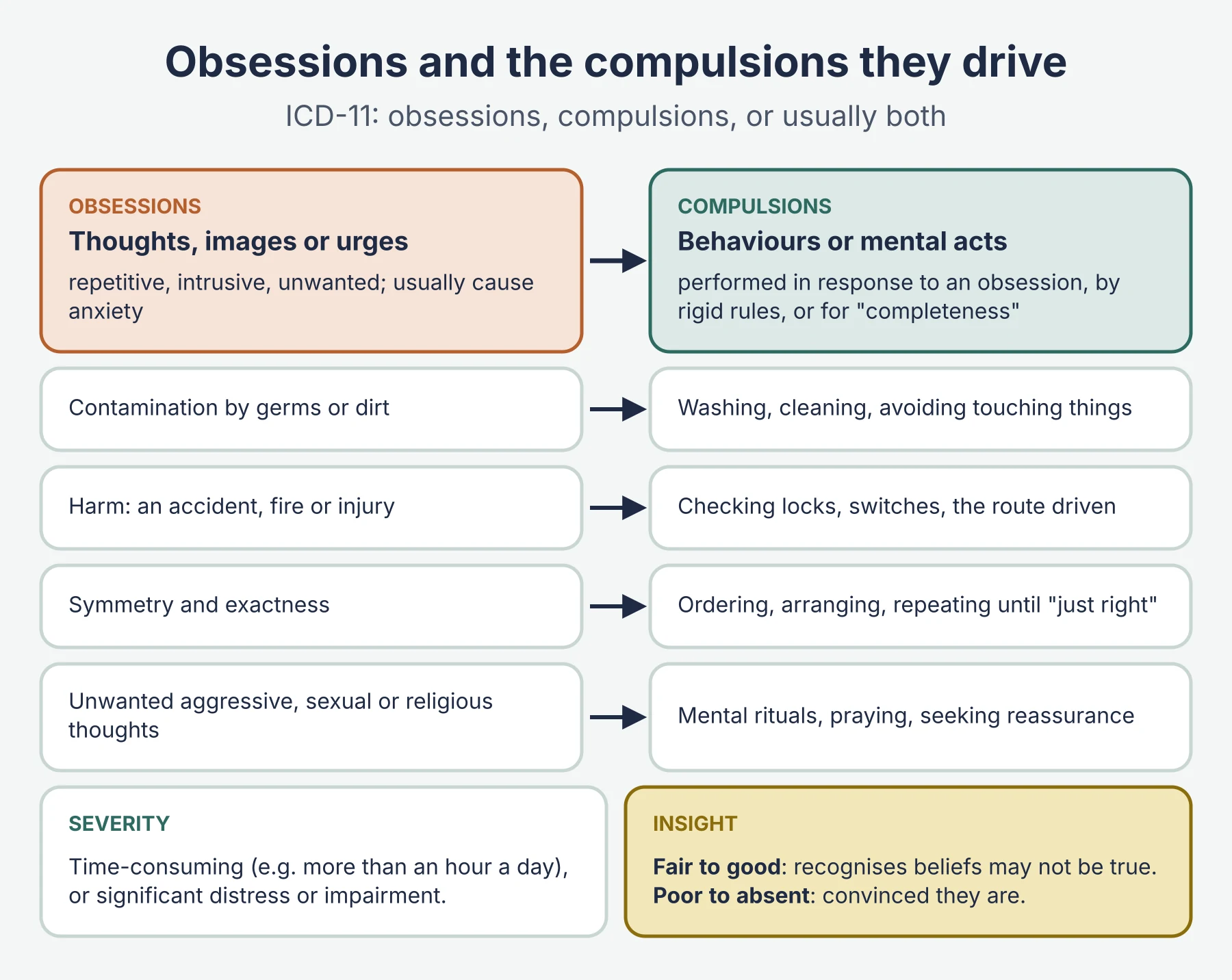
- Obsessions: repetitive, persistent, intrusive and unwanted thoughts, images or urges, usually causing anxiety.
- Compulsions: repetitive behaviours or mental acts performed in response to an obsession, by rigid rules, or for a sense of completeness.
- Severity: time-consuming (for example more than an hour a day) or causing significant distress or impairment.
- Insight: “fair to good” or “poor to absent”.
| Obsession type | Compulsion |
|---|---|
| Contamination | Washing, cleaning |
| Harm | Checking |
| Symmetry | Ordering, repeating |
| Unwanted aggressive, sexual or religious thoughts | Mental rituals, reassurance seeking |
Case study: Rapoport (1989), “Charles”, a teenage boy whose washing rituals took hours a day (The Boy Who Couldn’t Stop Washing).
Measures
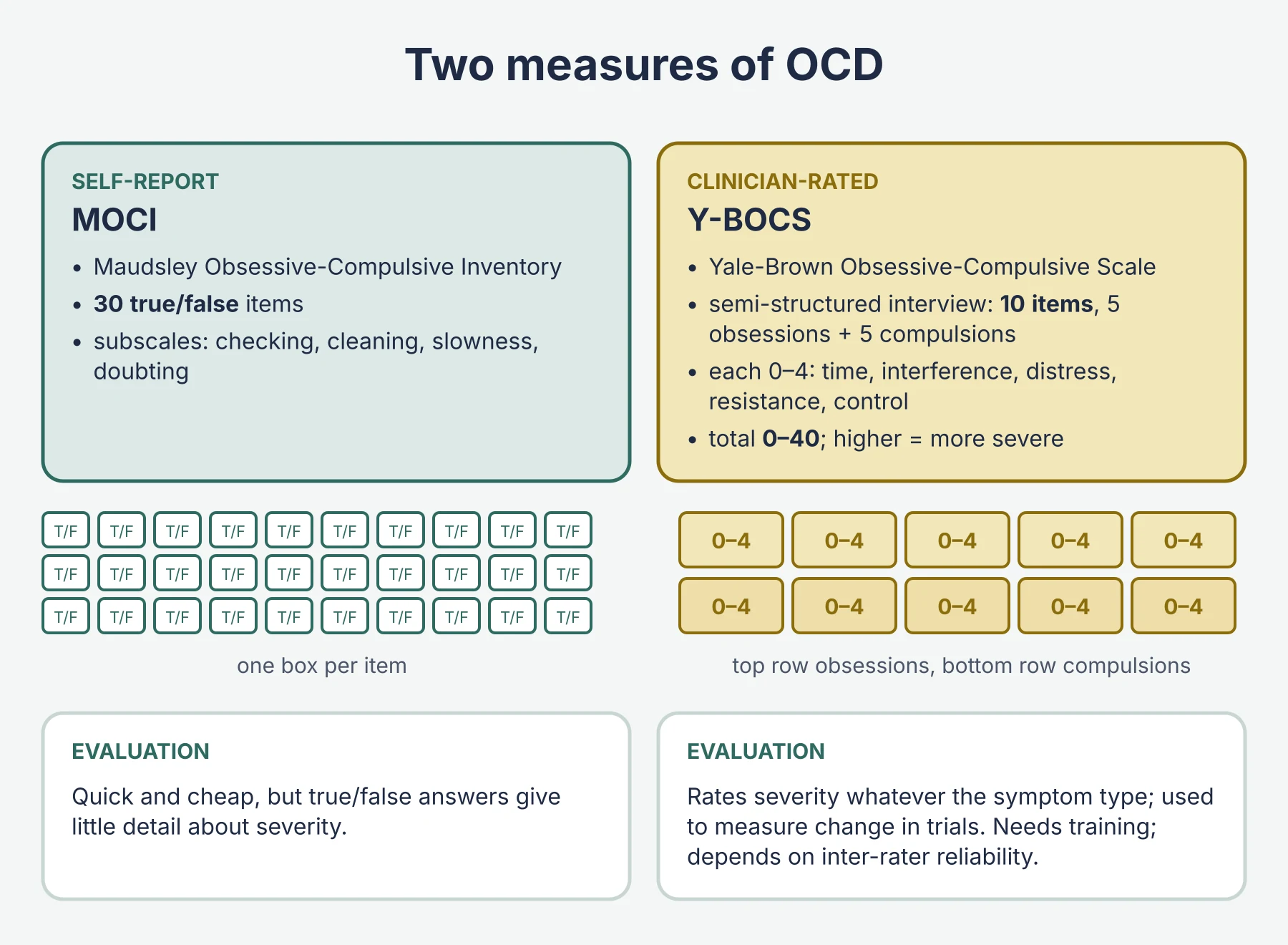
| MOCI | Y-BOCS | |
|---|---|---|
| Who completes it | The person (self-report) | A clinician (semi-structured interview) |
| Items | 30 true/false | 10 (5 obsessions, 5 compulsions), each 0–4 |
| Output | Checking, cleaning, slowness, doubting subscales | Severity total 0–40 |
| Strength | Quick and cheap | Rates severity of any symptom type; standard outcome in trials |
| Weakness | True/false gives little severity detail; self-report bias | Needs training; inter-rater reliability |
1.5.2 Explanations
| Explanation | Core idea | Evaluation |
|---|---|---|
| Biochemical | Low serotonin activity | SSRIs help many, but often only partly; treatment does not prove cause |
| Genetic | Inherited vulnerability | Higher identical-twin concordance; never 100%, so environment matters |
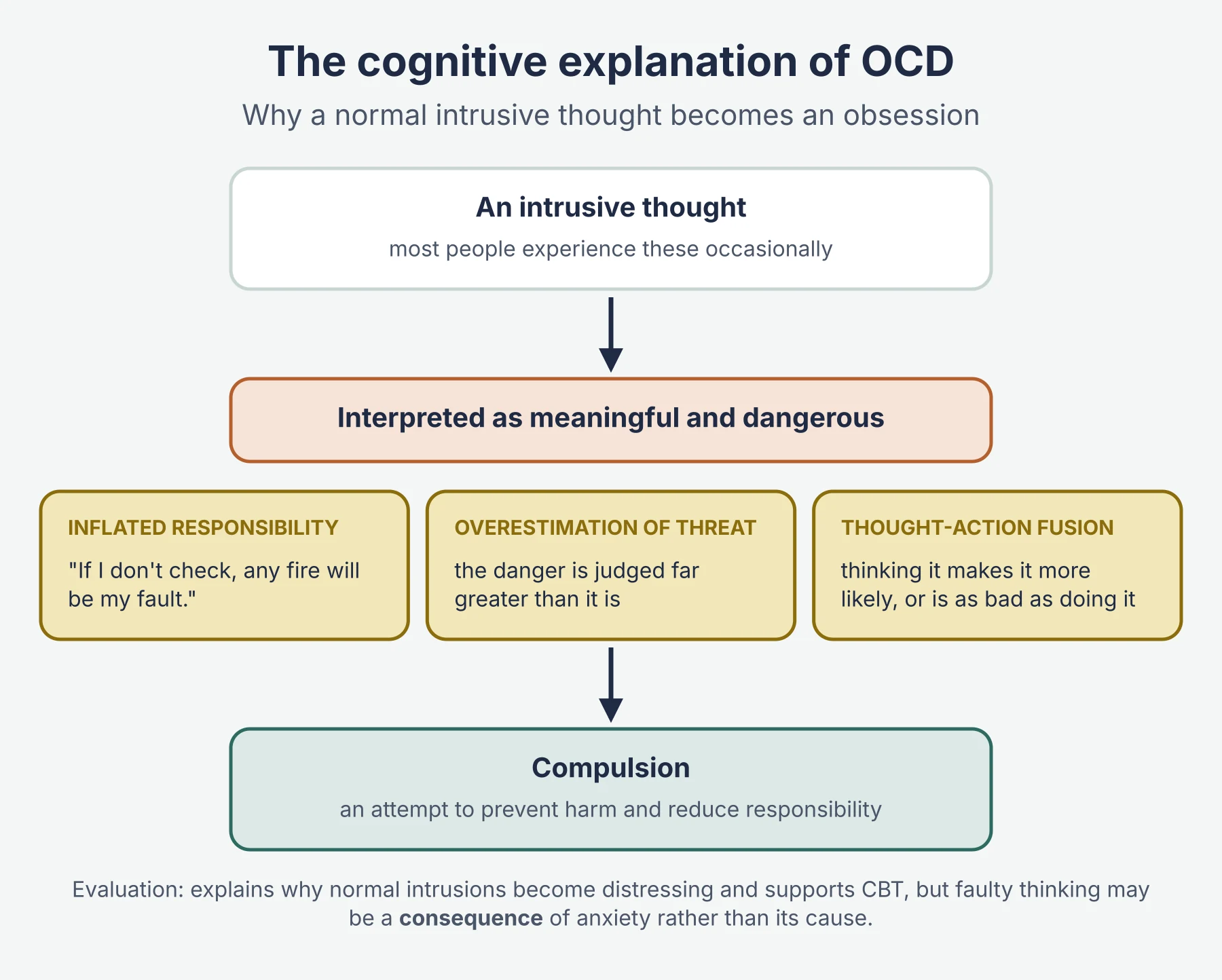
| Cognitive (thinking error) | Normal intrusions misinterpreted: inflated responsibility, overestimated threat, thought-action fusion | Explains distress and supports CBT; may be effect rather than cause |
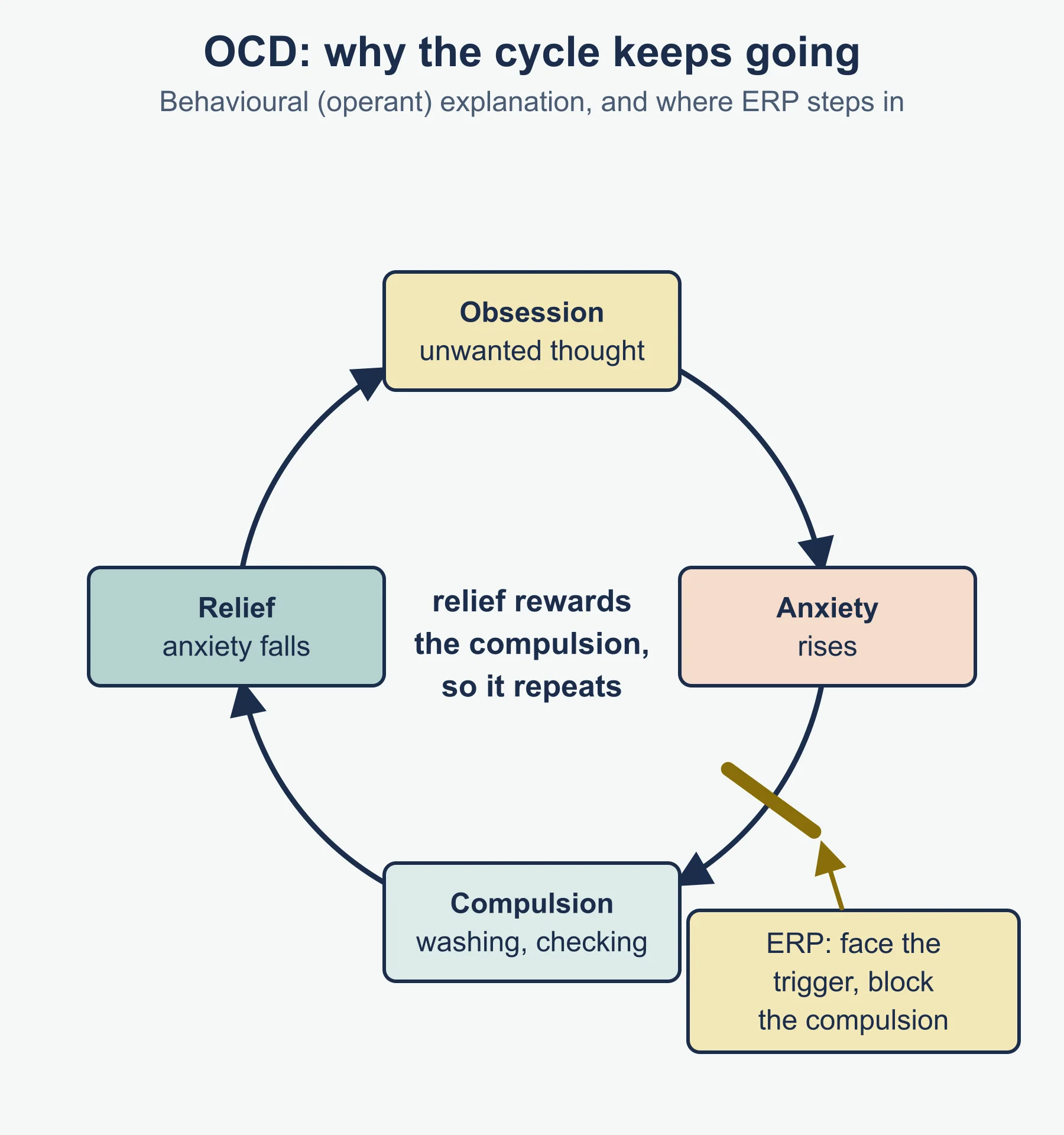
| Behavioural (operant) | Compulsions reduce anxiety, so they are negatively reinforced | Explains maintenance; leads to ERP; weak on content of obsessions |
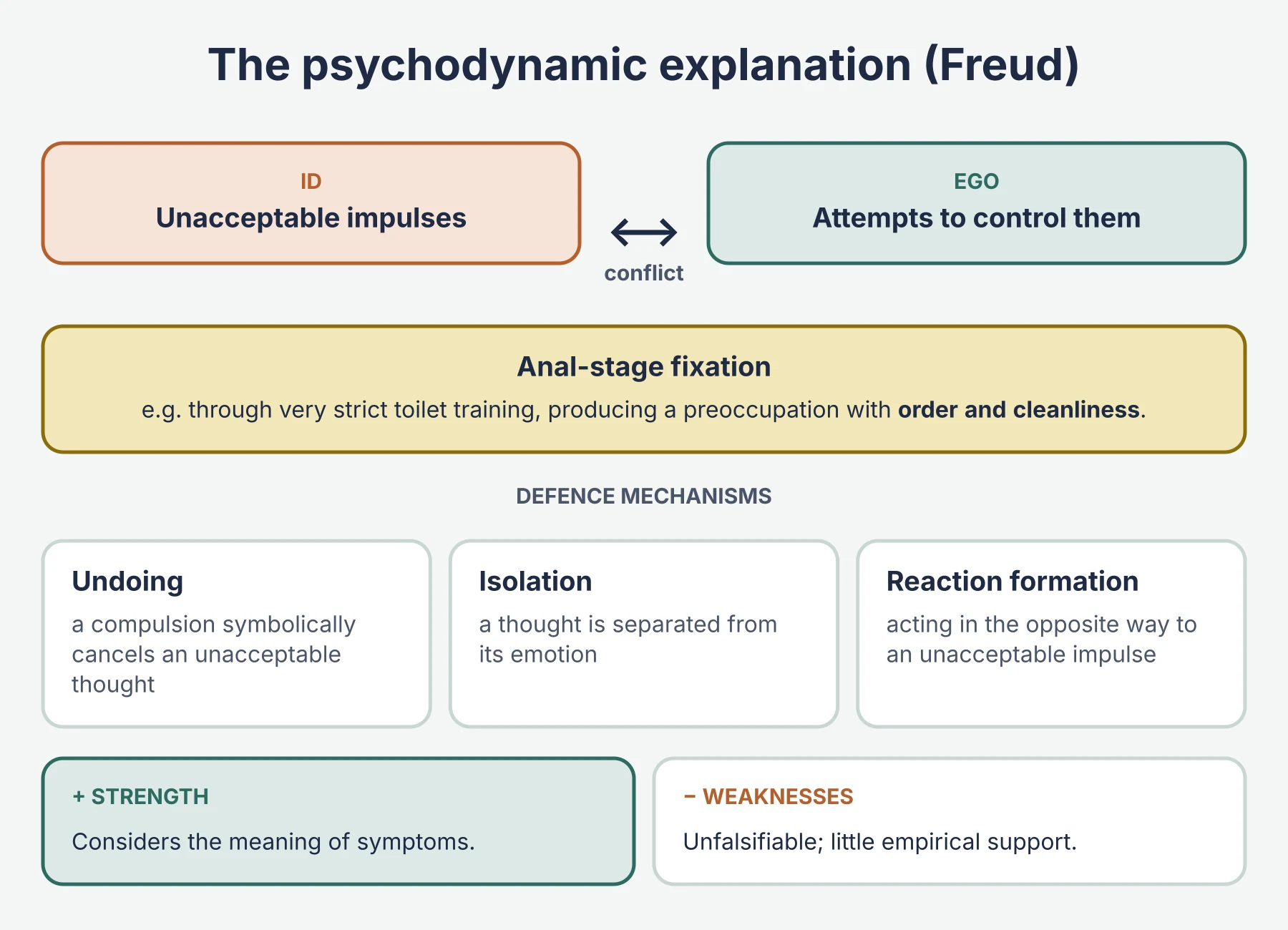
| Psychodynamic | Id-ego conflict; anal-stage fixation; undoing, isolation, reaction formation | Considers meaning; unfalsifiable, little evidence |
1.5.3 Treatments
| Treatment | How it works | Main drawback |
|---|---|---|
| SSRIs | Block serotonin reuptake | Weeks to work; side effects; relapse on stopping |
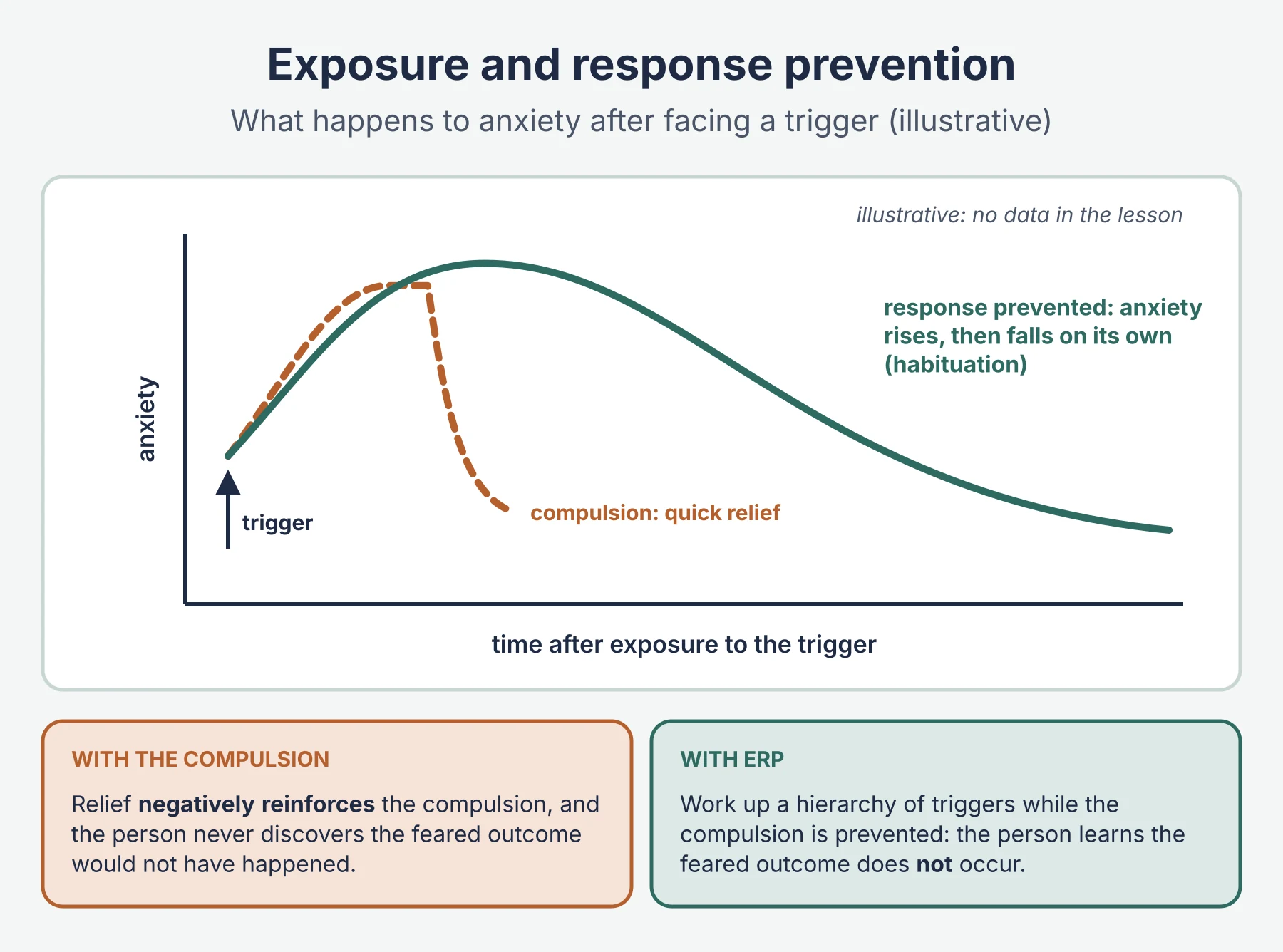
| ERP | Graded exposure to triggers while compulsions are prevented; anxiety habituates | Distressing at first; high dropout risk |
| CBT | ERP plus challenging thinking errors | Needs motivation and a trained therapist |
Lehmkuhl et al. (2008): case of a 12-year-old boy with autism and OCD who improved with CBT including ERP.
Key study: Lovell et al. (2006)
| Element | Detail |
|---|---|
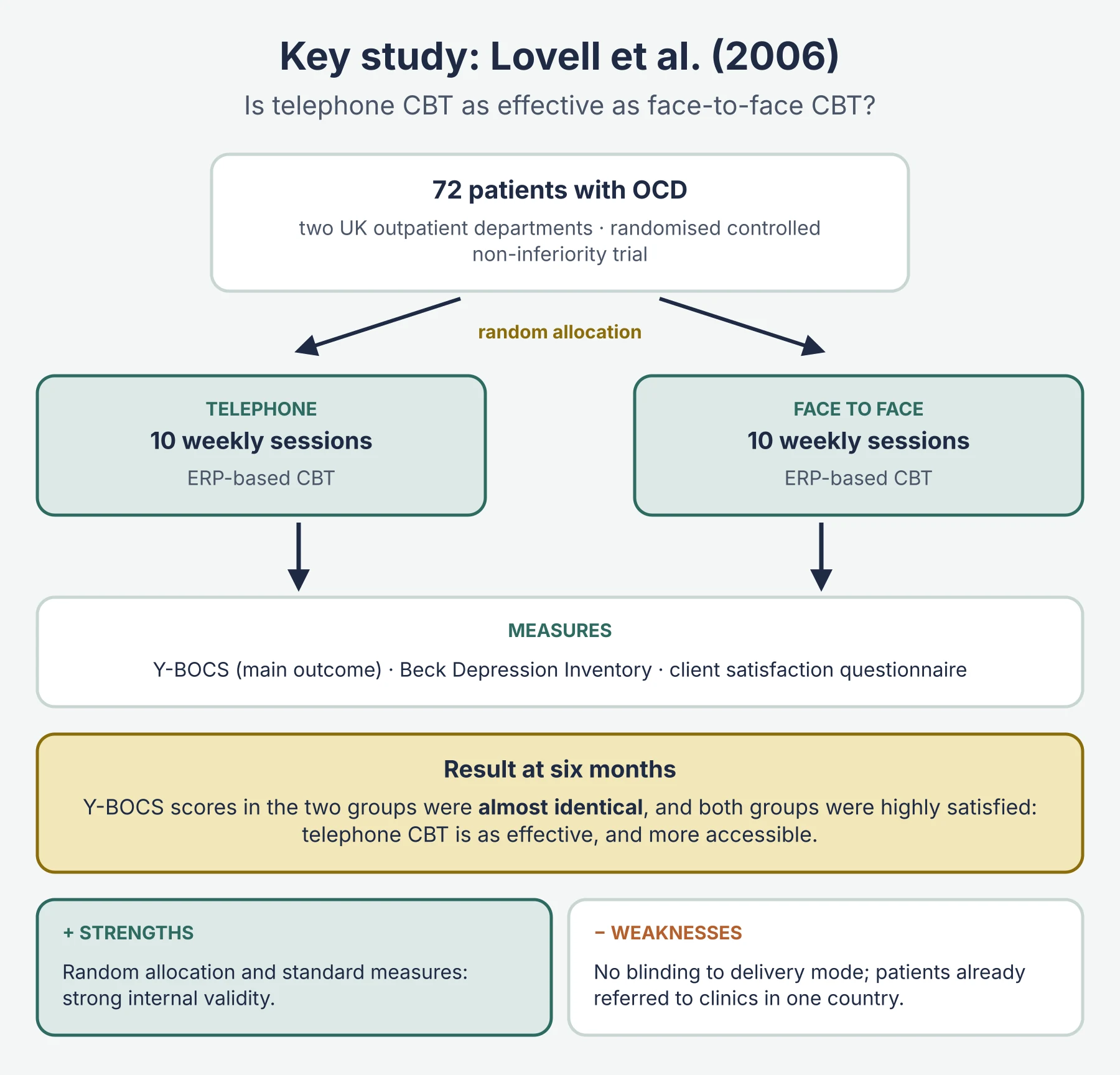
| Aim | Is telephone CBT as effective as face-to-face CBT for OCD? |
| Design | Randomised controlled non-inferiority trial, two UK outpatient departments |
| Sample | 72 patients with OCD |
| Treatment | Ten weekly sessions of ERP-based CBT by telephone or face to face |
| Measures | Y-BOCS (main), Beck Depression Inventory, client satisfaction |
| Results | At six months, Y-BOCS scores almost identical; high satisfaction in both |
| Strengths | Random allocation; standard measures; real patients |
| Weaknesses | Patients and therapists not blind; referred UK clinic sample |
Key terms
| Term | Meaning |
|---|---|
| Intrusive thought | An unwanted thought that enters the mind uninvited |
| Neutralising | Any act intended to cancel an obsession |
| Inflated responsibility | Belief that one is responsible for preventing harm |
| Thought-action fusion | Belief that thinking something makes it more likely, or is morally equal to doing it |
| Negative reinforcement | Removal of an unpleasant state strengthens a behaviour |
| Undoing | Defence mechanism: an act that symbolically cancels an unacceptable thought |
| Reaction formation | Behaving in the opposite way to an unacceptable impulse |
| Habituation | Gradual fall in anxiety with prolonged exposure |
| Non-inferiority trial | Tests whether a new treatment is no worse than an existing one |
Issues and debates hooks
- Individual and situational: thinking errors and genes versus reinforcing situations.
- Cultural differences: the content of obsessions (for example religious themes) varies with culture; telephone CBT was tested only in the UK.
- Use of children: Lehmkuhl et al.; consent from parents; adapting ERP.
- Reliability: inter-rater reliability of the Y-BOCS.
Exam traps
- Calling obsessions behaviours.
- Forgetting that compulsions can be mental acts.
- Describing ERP as exposure only.
- Calling Lovell et al. a superiority trial: it tested whether telephone delivery was not worse.
- Mixing up the MOCI (self-report) and the Y-BOCS (clinician-rated).
Self-test
- Define an obsession.
- Give an example of a compulsion that is a mental act.
- What two insight levels does ICD-11 record?
- How many items does the MOCI have, and what response format?
- What does each Y-BOCS item rate?
- What is the maximum Y-BOCS score?
- Give two thinking errors in the cognitive explanation.
- Explain how negative reinforcement maintains compulsions.
- Name two defence mechanisms linked to OCD.
- What does the “response prevention” part of ERP involve?
- How many patients took part in Lovell et al., and how many sessions did they have?
- What did Lovell et al. find at six months?
Answers: (1) a repetitive, persistent, intrusive and unwanted thought, image or urge, usually causing anxiety. (2) counting or repeating phrases silently. (3) fair to good; poor to absent. (4) 30; true/false. (5) aspects such as time, interference, distress, resistance and control, each 0–4. (6) 40. (7) any two of inflated responsibility, overestimation of threat, thought-action fusion. (8) the compulsion reduces anxiety, and removal of this unpleasant state makes the compulsion more likely to be repeated. (9) any two of undoing, isolation, reaction formation. (10) stopping the person from carrying out the compulsion after exposure to the trigger. (11) 72; ten weekly sessions. (12) Y-BOCS scores were almost identical in the telephone and face-to-face groups.
Official syllabus
Cambridge International AS & A Level Psychology 9990 syllabus for 2024, 2025 and 2026, Specialist Option 1, 1.5 Obsessive-compulsive disorder (OCD) — cambridgeinternational.org.
More resources on this topic
Related resources
-
Study guides
Cambridge International AS & A Level Psychology (9990): 1.1 Schizophrenia
Topic 1.1 Schizophrenia for Cambridge 9990 Psychology: ICD-11 diagnosis, delusions and Freeman et al., genetic, dopamine and cognitive explanations, treatments.
Psychology · Cambridge · A Level
Read guide -
Practice questions
Cambridge International AS & A Level Psychology (9990): 1.1 Schizophrenia – Practice Questions
Original Paper 3 and Paper 4 style questions with mark-scheme answers on 9990 topic 1.1 Schizophrenia: diagnosis, Freeman et al., explanations and treatments.
Psychology · Cambridge · A Level
Try questions -
Revision notes
Cambridge International AS & A Level Psychology (9990): 1.1 Schizophrenia – Revision Notes
Revision notes for 9990 topic 1.1 Schizophrenia: ICD-11 criteria, delusion types, Freeman et al., explanations, treatments, key terms and a self-test.
Psychology · Cambridge · A Level
Revise topic
Studying Psychology?
This page is free and stays free. Marlbridge is not offering Psychology classes at the moment, so there is no tuition to book for it. The free study resources stay open to everyone.
Get free revision emails (optional)
Occasional emails with practice questions, worked explanations and links to free resources for the qualification and subjects you choose. No spam, and you can unsubscribe from any email. The free tools on this site never need an email.