
Study Guides
Cambridge A Level World History (9489): Imperialism and the emergence of world powers, c.1870-1918
Study guide to Cambridge 9489 History topic 7, c.1870-1918: the Scramble for Africa and its impact, imperial rivalry, and the rise of Japan and the USA.
- Subject
- World History
- Level
- AS LEVEL
- Topic
- Paper 1 and Paper 2 – International Option: International History, 1870–1939
- Author
- Marlbridge Academic Team
- Updated
- Reviewed by
- Azam Siddique (what this means)
Aligned to Cambridge A Level World History (9489), 2027-2029. Official specification .
Syllabus page (what it covers and how it is assessed): Cambridge A Level World History.
Syllabus points this page covers
9489 (AS Level)
- 7 Imperialism and the emergence of world powers, c.1870–1918
Found an error? Report a correction.
Need help with this topic? Request a free trial class for A Level World History (9489).
Imperialism and the emergence of world powers, c.1870-1918 is the first topic of the International option at AS Level in Cambridge International History 9489. It asks why imperialism was a significant force in Africa from 1870 (7.1), what impact imperial expansion had on international relations (7.2), and why Japan (7.3) and the USA (7.4) emerged as world powers and with what effect. The option overview is the International History, 1870-1939 study guide.
Where this fits in 9489
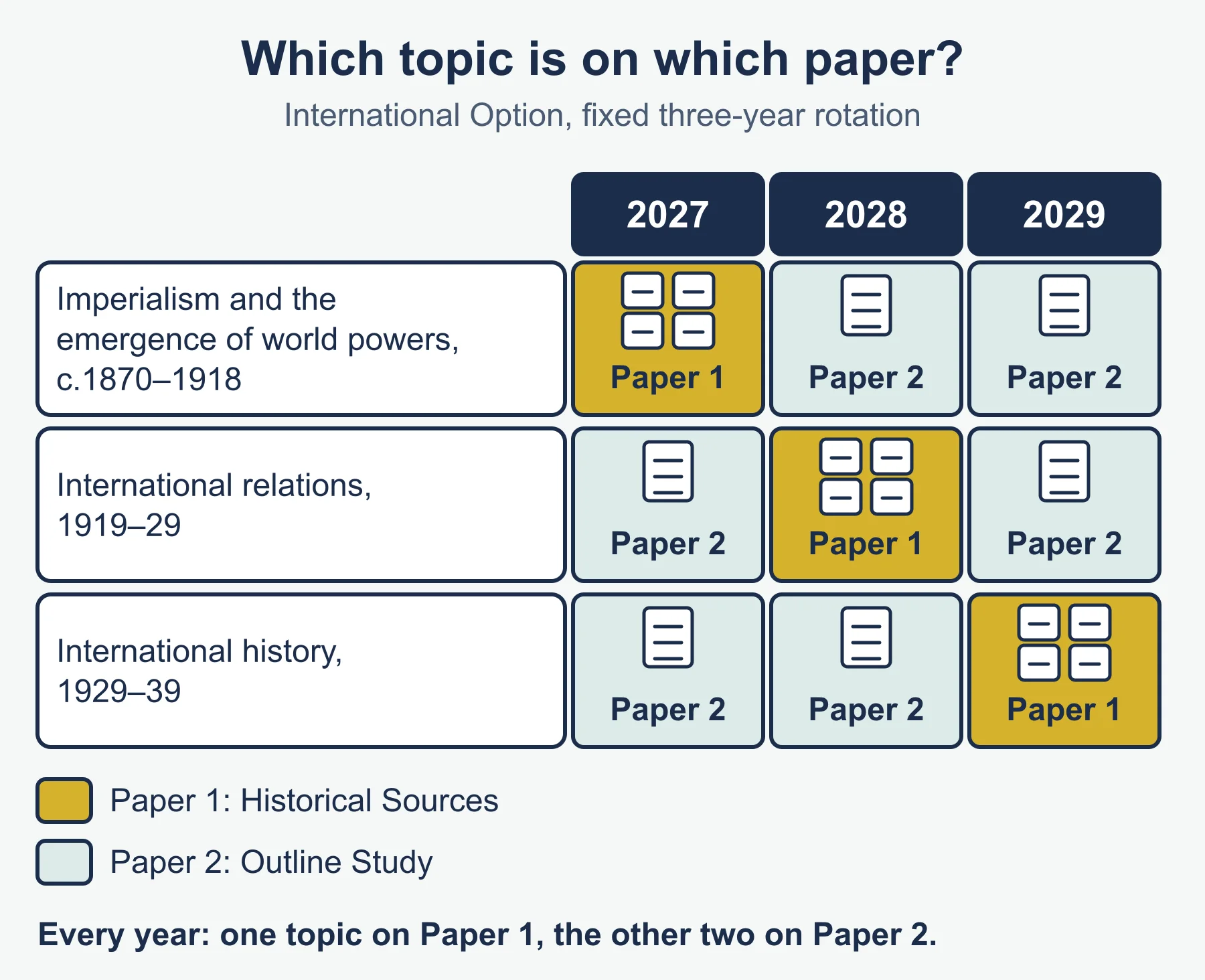
Under the 2027-2029 rotation this topic is on Paper 1 (Historical Sources) in 2027 and on Paper 2 (Outline Study) in 2028 and 2029. Paper 1 sets a 15-mark comparison of two sources and a 25-mark question on four sources; Paper 2 sets “Explain why” (10 marks) and a comparative judgement (20 marks). Use the Imperialism and world powers revision notes for recall and the Imperialism and world powers practice questions for exam work.
7.1 Why was imperialism a significant force in Africa from 1870?
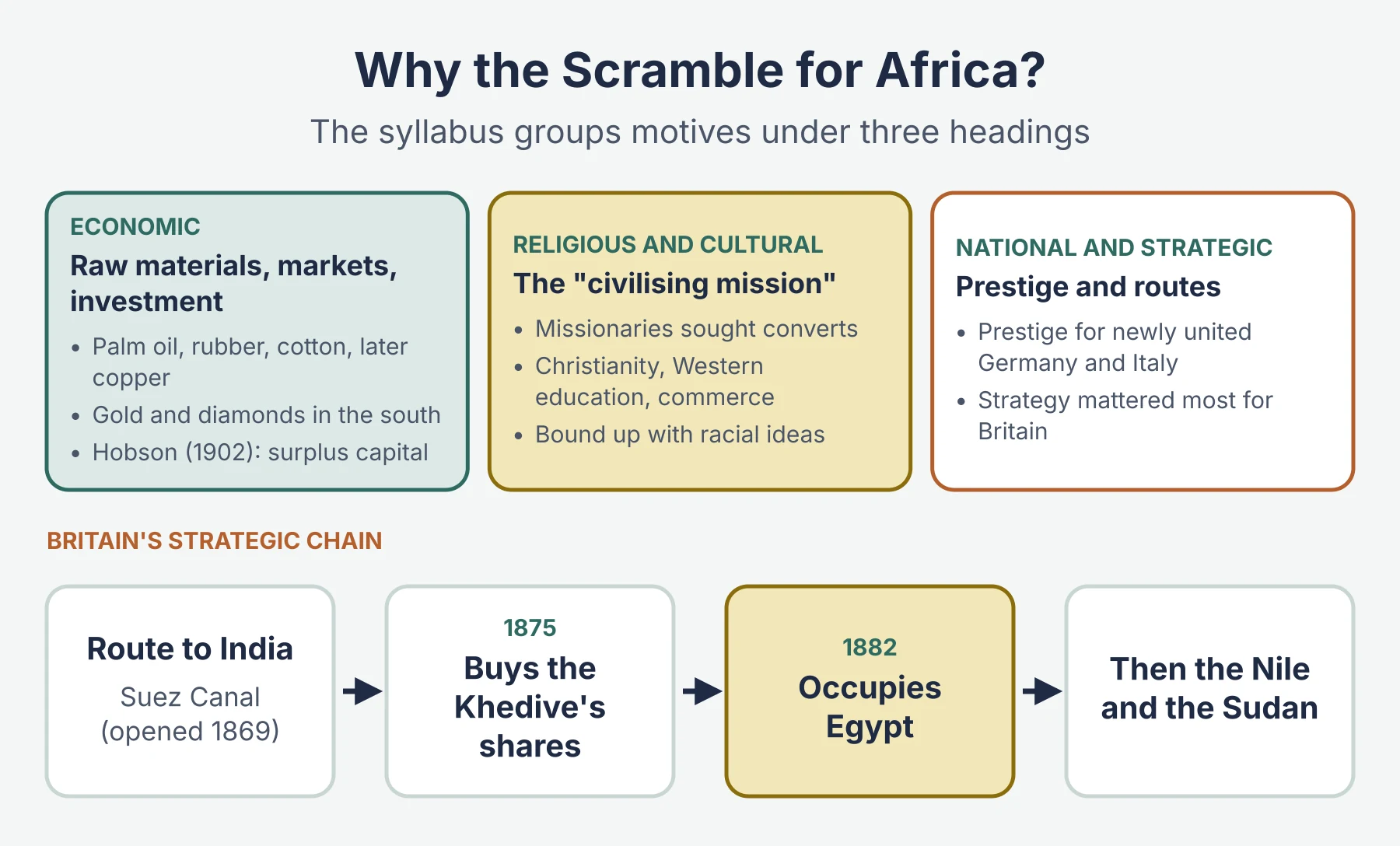
Motives. The syllabus groups motives under three headings.
- Economic. Industrial Europe wanted raw materials (palm oil, rubber, cotton, later copper), markets for manufactures and outlets for investment. Gold and diamond discoveries in southern Africa drew capital and settlers. Contemporary critics such as J.A. Hobson (Imperialism, 1902) argued that surplus capital seeking profit drove expansion.
- Religious and cultural. Missionary societies sought converts; many Europeans believed in a “civilising mission” to spread Christianity, Western education and commerce, often bound up with racial ideas of European superiority.
- National and strategic rivalry. Colonies brought prestige, especially for newly united Germany and Italy. Strategic concerns mattered most for Britain: the route to India via the Suez Canal led to the occupation of Egypt in 1882, and from Egypt to concern for the Nile and the Sudan.
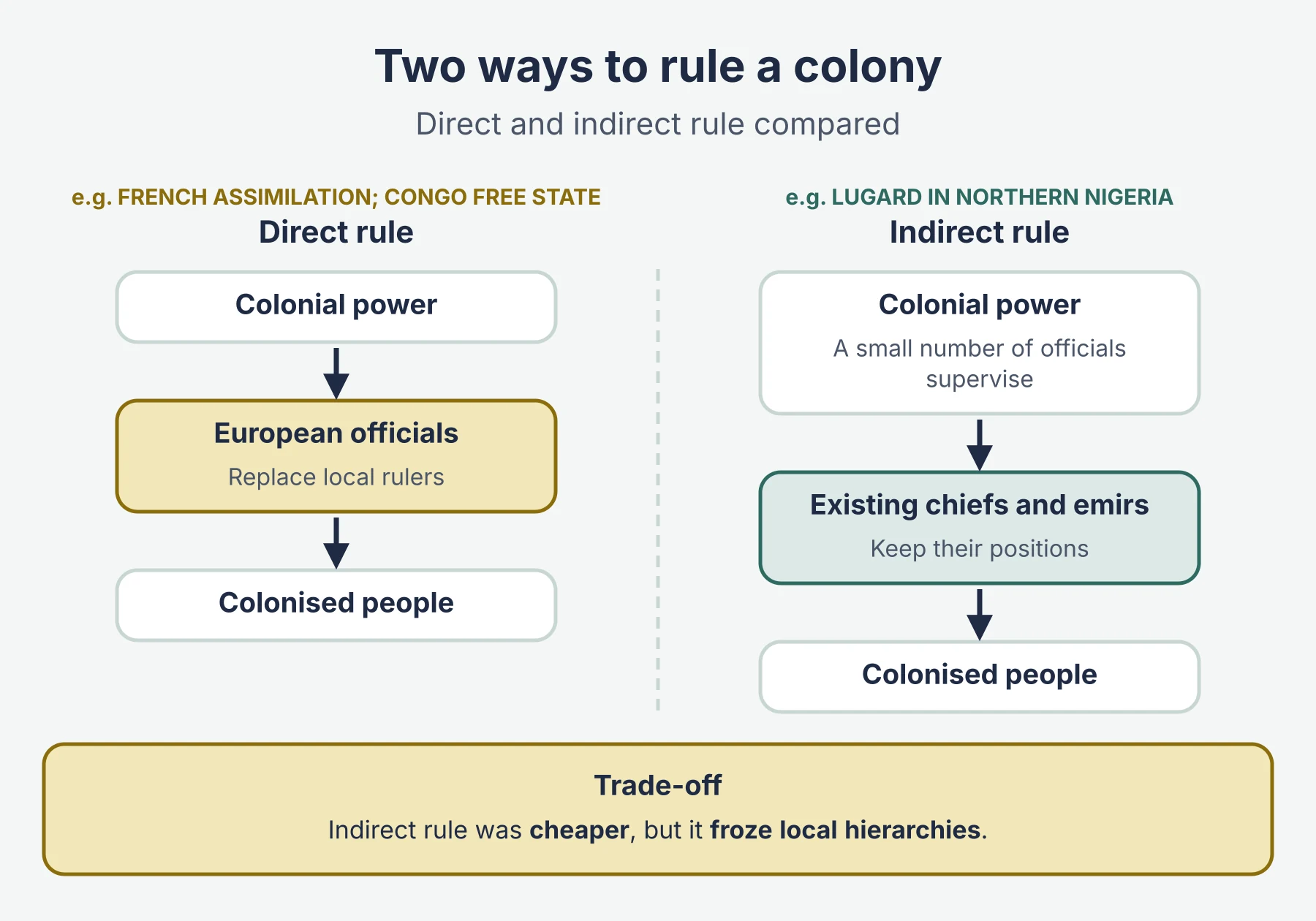
The process of colonisation. Powers ruled either directly, through European officials who replaced local rulers (the French model of assimilation, or the Congo Free State), or indirectly, through existing chiefs and emirs supervised by a small number of officials (associated with Frederick Lugard in Northern Nigeria). Indirect rule was cheaper but froze local hierarchies.
Explorers opened the interior to European knowledge and ambition. Heinrich Barth, a German working for a British expedition in the 1850s, crossed the Sahara and described the states of the Sahel and Timbuktu. David Livingstone, a Scottish missionary, mapped the Zambezi and campaigned against the slave trade; his death in 1873 made him a symbol of the civilising mission. Henry Morton Stanley found Livingstone at Ujiji in 1871, traced the Congo River to the Atlantic (1874-77) and then worked for King Leopold II to establish stations along it.
Technology and science made conquest possible: quinine reduced deaths from malaria; steamships carried Europeans up rivers; railways and the telegraph moved troops and orders; breech-loading rifles and the Maxim machine gun gave small forces overwhelming firepower. The Suez Canal, opened in 1869, cut the sea route to Asia; Britain bought the Khedive’s shares in 1875.
Impact on Africa.
- Arbitrary boundaries drawn in Europe divided peoples – the Somali across several colonies, the Ewe between British and German Togoland – and grouped rivals together.
- Exploitation in the Congo Free State, Leopold’s personal possession from 1885, used forced labour and rubber quotas enforced by the Force Publique through hostage-taking, mutilation and killing. Roger Casement’s report (1904) and E.D. Morel’s Congo Reform Association exposed it, and Belgium annexed the territory in 1908.
- Christianity, healthcare and education spread through missions; mission-educated Africans later led nationalist movements.
- Infrastructure – railways such as the Uganda Railway, ports and roads – was built mainly to move exports and troops rather than to link African communities.
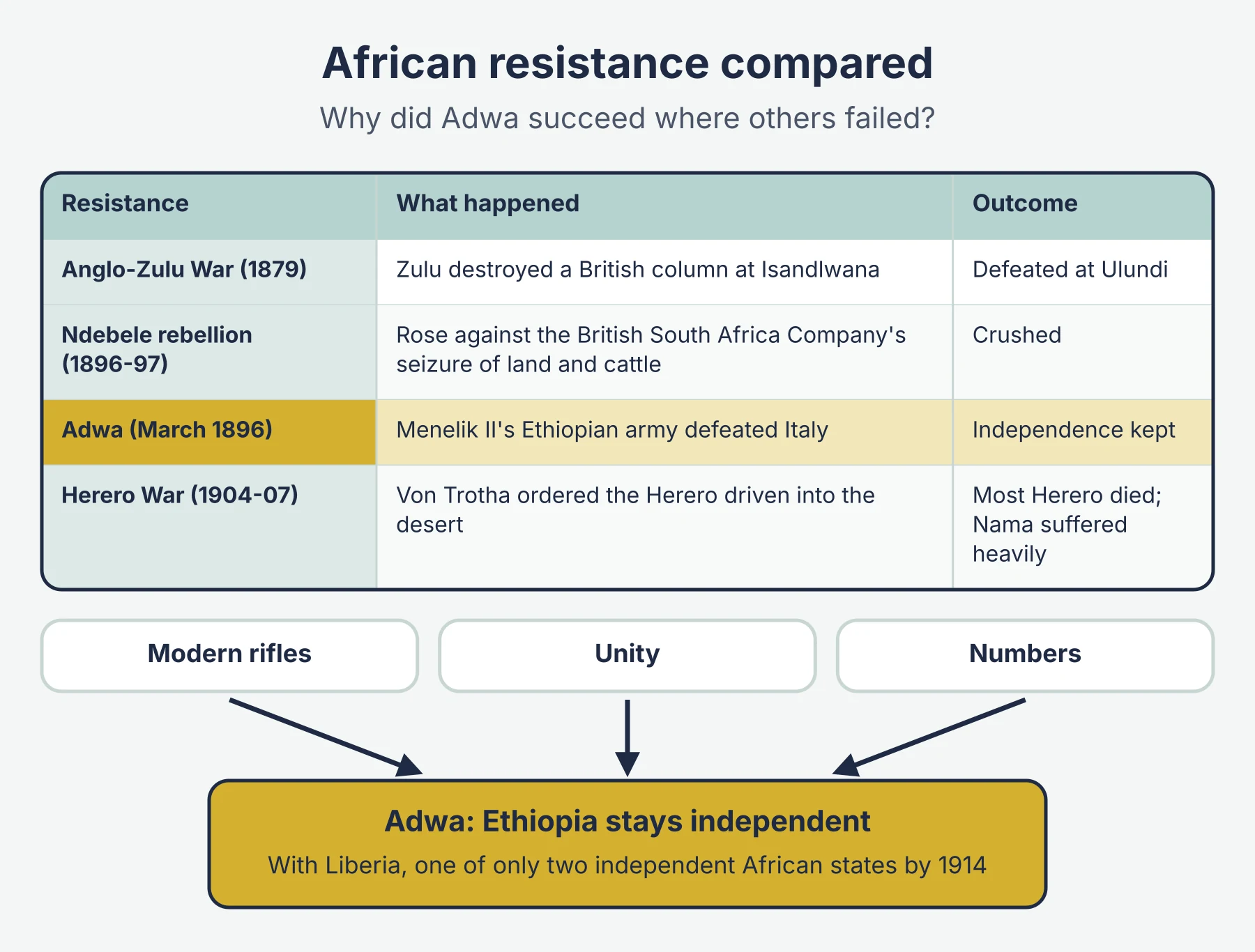
African resistance. In the Anglo-Zulu War (1879), the Zulu destroyed a British column at Isandlwana before losing at Ulundi. The Ndebele rebellion (1896-97) rose against the British South Africa Company’s seizure of land and cattle and was crushed. At Adwa (March 1896) Menelik II’s Ethiopian army defeated Italy, securing Ethiopia’s independence. In German South West Africa, the Herero War (1904-07) was answered by General von Trotha’s order to drive the Herero into the desert; most of the Herero people died, and the Nama suffered heavily too. Adwa succeeded where others failed because Ethiopia had modern rifles, unity and numbers.
7.2 What was the impact of imperial expansion on international relations?
The Berlin Conference (1884-85) set rules for claims and is covered in the practice set. Rivalries then followed three main lines:
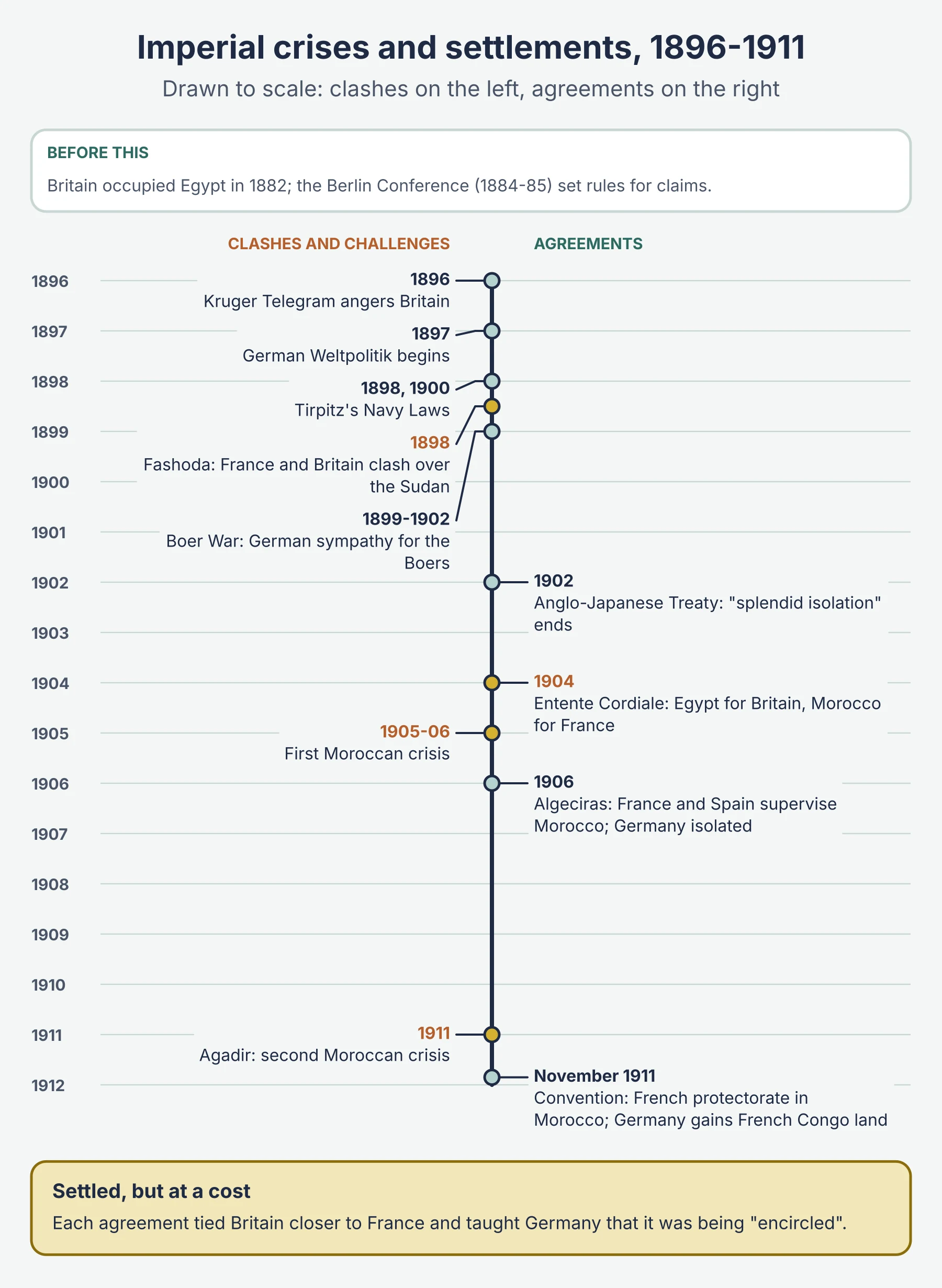
- Britain and Germany. Germany’s Weltpolitik (from 1897) and Tirpitz’s Navy Laws (1898, 1900) challenged British naval supremacy. In South Africa, the Kaiser’s Kruger Telegram (1896), congratulating the Transvaal on defeating the Jameson Raid, angered British opinion, and German sympathy for the Boers during the war of 1899-1902 deepened distrust.
- France and Britain clashed over the Sudan at Fashoda (1898).
- France and Germany clashed over Morocco in 1905-06 and 1911.
Attempts to resolve tension. Britain ended “splendid isolation” with the Anglo-Japanese Treaty (1902) and the Entente Cordiale (1904), which traded British control of Egypt for French influence in Morocco. The Algeciras Conference (1906) gave France and Spain a supervisory role in Morocco, isolating Germany. The convention of November 1911 ended the Agadir crisis: Germany accepted a French protectorate in Morocco in return for territory in the French Congo.
The situation in 1914. Only Ethiopia and Liberia in Africa remained independent. Colonial disputes had been settled by agreement, but each settlement tied Britain closer to France and taught Germany that it was being “encircled”. Contemporaries divided: imperialists such as Cecil Rhodes and Joseph Chamberlain saw empire as national strength; Lenin, in Imperialism, the Highest Stage of Capitalism (1916), saw it as a cause of war.
7.3 Why did Japan emerge as a world power?
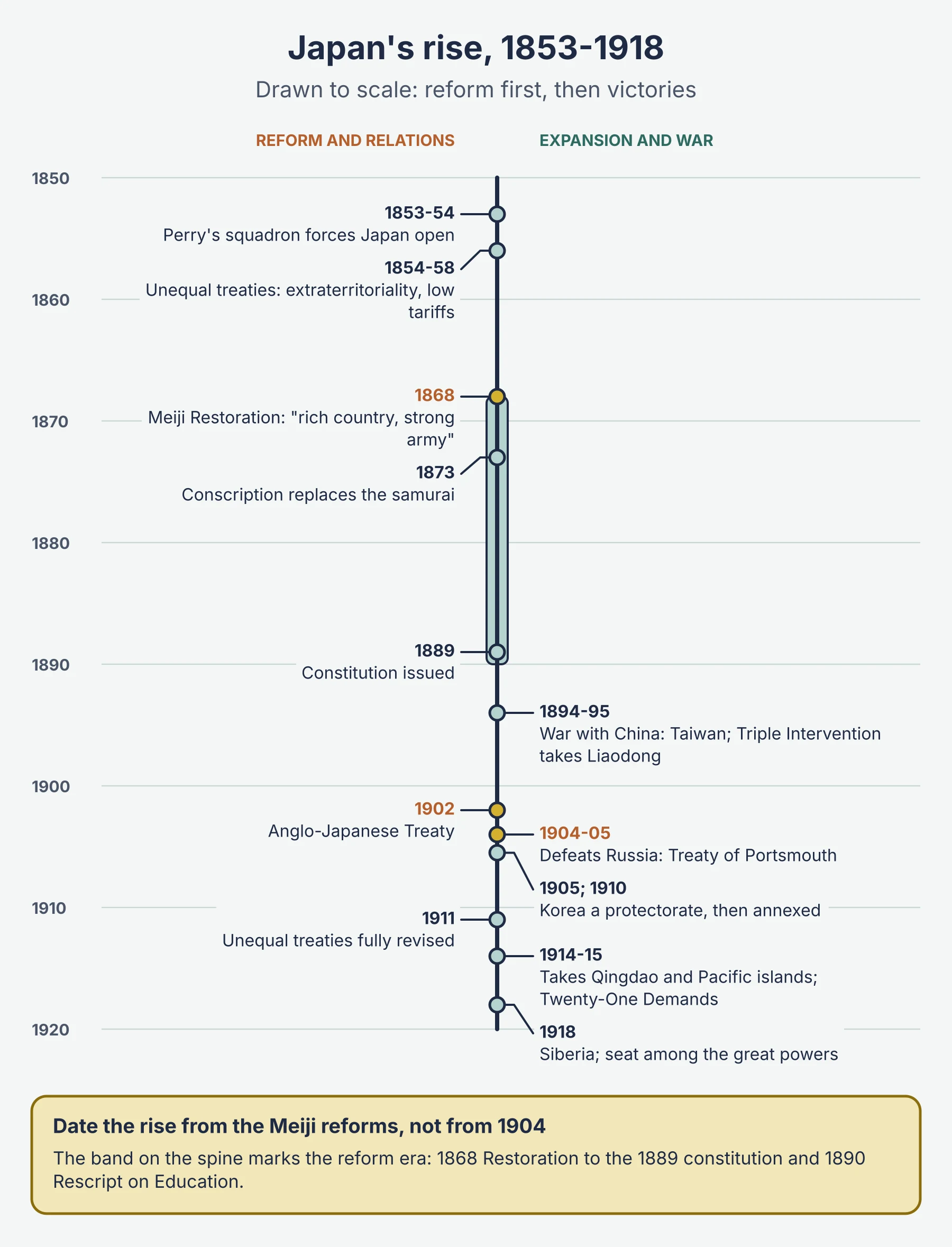
Relations with the West. Commodore Perry’s US squadron (1853-54) forced Japan to open its ports. The unequal treaties of 1854-58 gave Western powers extraterritoriality (their citizens were tried by their own consuls) and fixed low tariffs. Humiliation convinced reformers that Japan must modernise or be colonised.
Rapid modernisation. The Meiji Restoration (1868) restored imperial authority and launched reform under the slogan “rich country, strong army”. Feudal domains were abolished; conscription (1873) replaced the samurai; a constitution was issued (1889). The state built railways, shipyards and model factories and then sold many to private groups that became the zaibatsu. The Iwakura Mission (1871-73) studied Western institutions. Compulsory elementary education and the Imperial Rescript on Education (1890) built a literate, loyal population.
Recognition as a world power. Japan’s main objective was Korea, which it saw as a “dagger pointed at the heart of Japan”. Victory over China (1894-95) brought Taiwan and Korean “independence”, but the Triple Intervention of Russia, France and Germany forced Japan to return the Liaodong peninsula – which Russia then leased. The Anglo-Japanese Treaty (1902) arose from shared fear of Russia in Manchuria and Britain’s wish to reduce its naval burden in the Pacific. Its consequence was that Japan could fight Russia knowing no third power would join. Victory in the Russo-Japanese War (1904-05), ended by the Treaty of Portsmouth, made Japan the first Asian state in modern times to defeat a European great power. Korea became a protectorate (1905) and was annexed in 1910; the unequal treaties had been fully revised by 1911.
The First World War. Japan joined the Allies in 1914, seized Germany’s base at Qingdao and its Pacific islands (the Marshalls, Marianas and Carolines), sent warships to escort Allied convoys in the Mediterranean, and pressed China with the Twenty-One Demands (1915). From 1918 it sent the largest foreign force to Siberia during the Russian Civil War. By 1918 Japan sat among the great powers at the peace conference.
7.4 Why did the USA emerge as a world power?
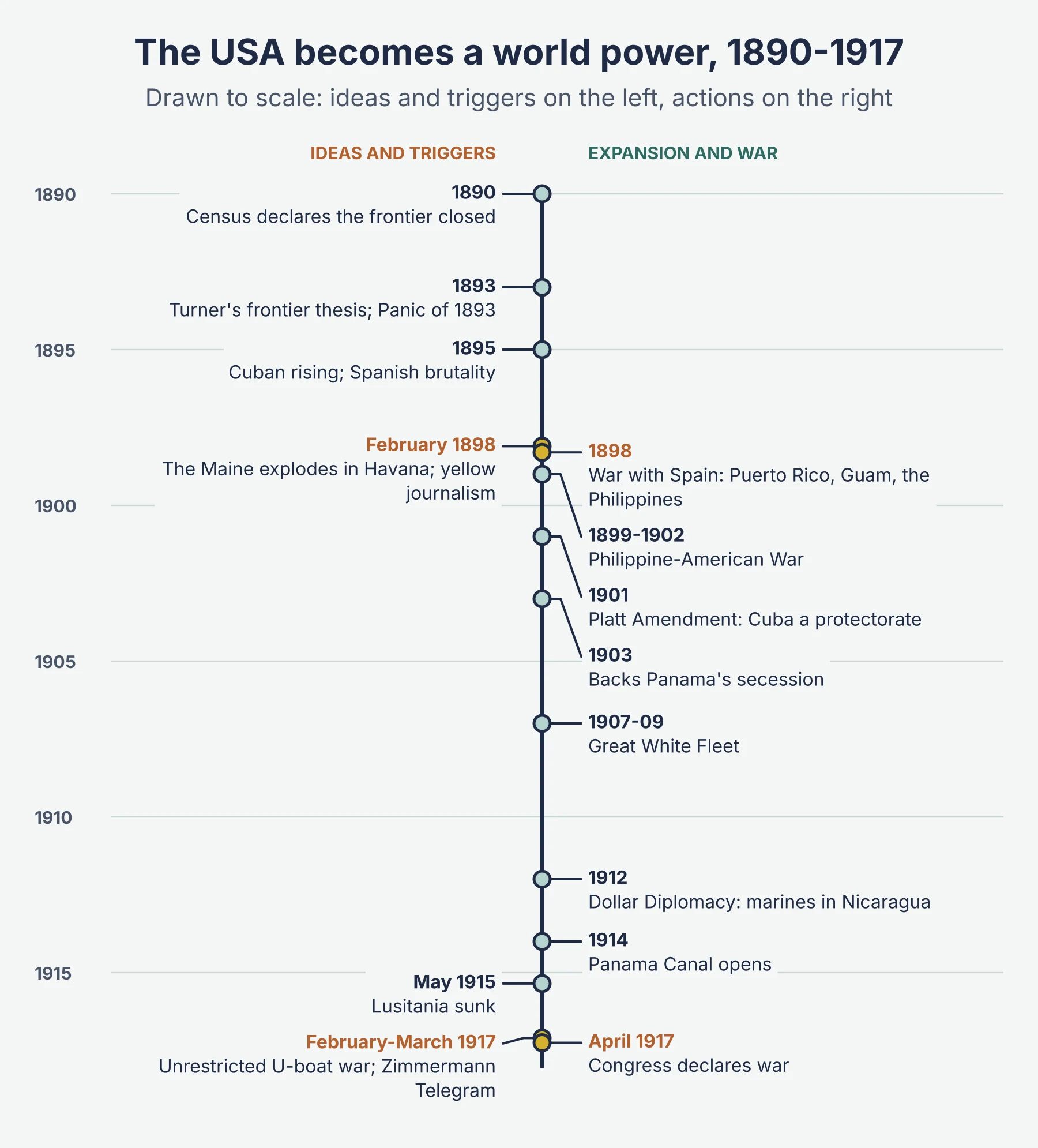
Changing attitudes. The 1890 census declared the frontier closed, and Frederick Jackson Turner argued (1893) that the frontier had shaped American character – encouraging some to look overseas. Alfred Thayer Mahan argued that sea power, coaling stations and colonies made nations great; the navy grew, and Roosevelt sent the Great White Fleet round the world (1907-09). Rapid economic growth and the depression after the Panic of 1893 strengthened the case for overseas markets. The Panama Canal, built after the USA backed Panama’s secession from Colombia in 1903, opened in 1914.
The Spanish-American War (1898). American interest in Cuba, Central America and the Caribbean, Spanish brutality against the Cuban rising of 1895, the yellow journalism of Hearst and Pulitzer, and the explosion of the Maine in Havana harbour (February 1898) produced war. Victory brought Puerto Rico, Guam and the Philippines; Cuba became a protectorate under the Platt Amendment (1901). Under Taft, Dollar Diplomacy used loans and investment, backed by marines when needed (Nicaragua, 1912), to extend influence in Latin America.
The Philippine-American War (1899-1902). Filipino nationalists under Emilio Aguinaldo, who had declared independence in 1898, fought US rule. The war, with its guerrilla tactics, harsh counter-insurgency and heavy Filipino civilian losses, caused controversy: the Anti-Imperialist League, including Mark Twain and Andrew Carnegie, argued that colonies betrayed American principles.
Entry into the First World War. Wilson declared neutrality, but trade and loans tied the USA to Britain and France. German U-boats sank the Lusitania (May 1915), killing over a hundred Americans; Germany paused, then resumed unrestricted submarine warfare in February 1917. The Zimmermann Telegram, proposing a German alliance with Mexico, was published in March, and Congress declared war in April 1917 despite opposition from pacifists, socialists and some German- and Irish-Americans. American troops and supplies helped the Allies win in 1918, and Wilson’s Fourteen Points made him a central figure at the peace.
Worked example: a Paper 2 part (a)
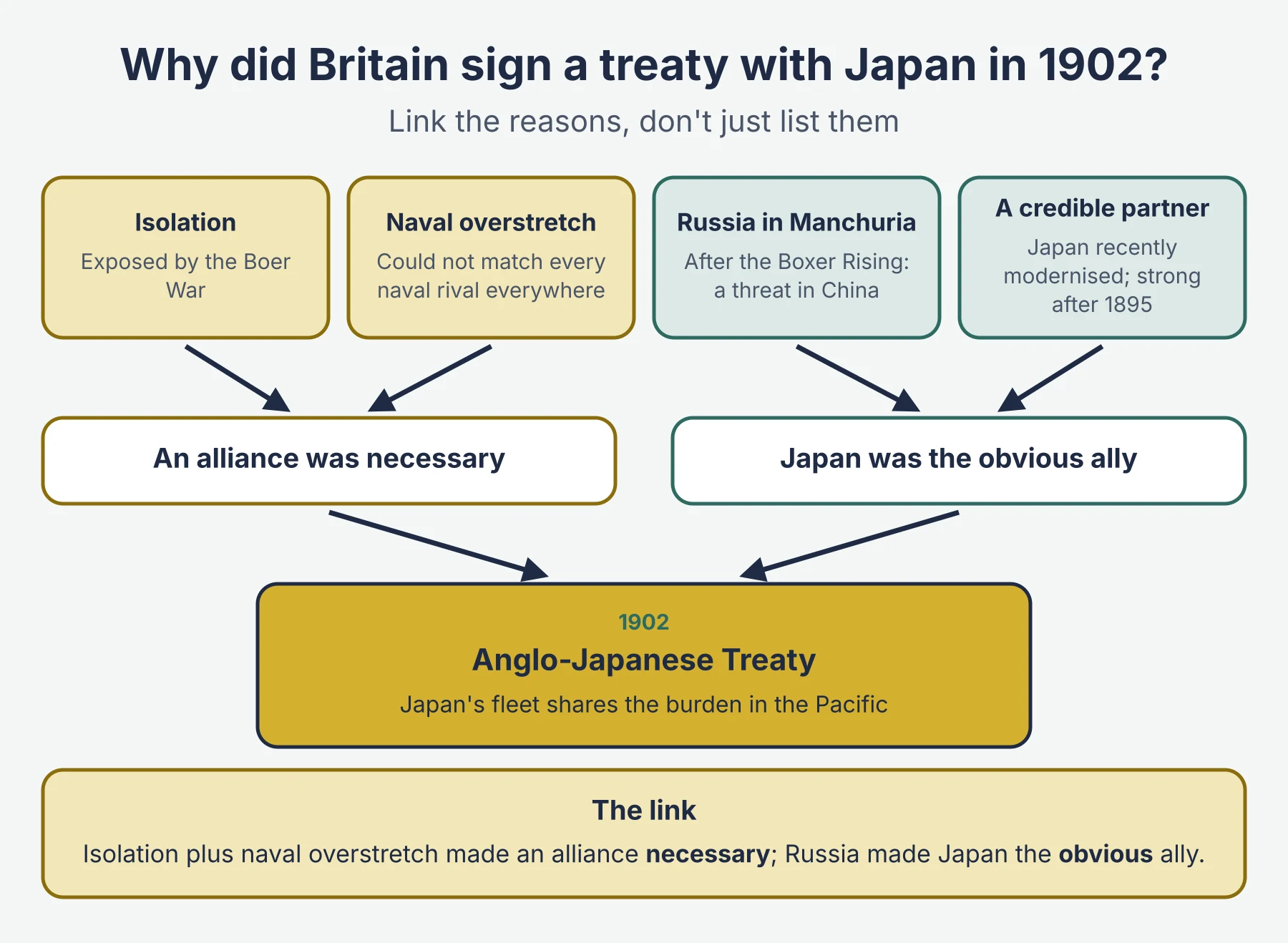
Explain why Britain signed a treaty with Japan in 1902. [10]
Link several reasons: Russia’s advance into Manchuria after the Boxer Rising threatened British interests in China; the Boer War had exposed Britain’s isolation; Britain could not match every naval rival everywhere and wanted Japan’s fleet to share the burden in the Pacific; Japan, recently modernised, was a credible partner after 1895. The strongest answers connect them: isolation plus naval overstretch made an alliance necessary, and Russia made Japan the obvious ally.
Common mistakes
- Treating “economic motives” as the only explanation of the Scramble.
- Ignoring African agency: resistance, collaboration and Adwa.
- Dating Japan’s rise from 1904 instead of from the Meiji reforms.
- Forgetting the Philippine-American War when explaining the USA’s rise.
Official syllabus
Cambridge International AS & A Level History (9489) syllabus for 2027, 2028 and 2029 – cambridgeinternational.org (subject content, topic 7; Topics assessed on Paper 1 and Paper 2). Always check the current syllabus before an exam.
Related resources
-
Revision notes
Cambridge A Level World History (9489): Imperialism and the emergence of world powers, c.1870-1918 – Revision Notes
Revision notes for Cambridge 9489 History topic 7: Scramble motives, African resistance, imperial crises, Japan and the USA as world powers, and a self-test.
World History · Cambridge · AS Level
Revise topic -
Study guides
Cambridge A Level World History (9489): International history 1929-39: the rise of extremism and the road to war
Study guide to Cambridge 9489 History topic 9, 1929-39: extremism after the Depression, the League's failure, appeasement and why war broke out in 1939.
World History · Cambridge · AS Level
Read guide -
Practice questions
Cambridge A Level World History (9489): International history 1929-39: the rise of extremism and the road to war – Practice Questions
Twelve original practice questions on Cambridge 9489 international history 1929-39, with invented Paper 1 sources, Paper 2 essays and mark-scheme style answers.
World History · Cambridge · AS Level
Try questions
Get free revision emails (optional)
Occasional emails with practice questions, worked explanations and links to free resources for the qualification and subjects you choose. No spam, and you can unsubscribe from any email. The free tools on this site never need an email.