
Revision Notes
Cambridge A Level World History (9489): Imperialism and the emergence of world powers, c.1870-1918 – Revision Notes
Revision notes for Cambridge 9489 History topic 7: Scramble motives, African resistance, imperial crises, Japan and the USA as world powers, and a self-test.
- Subject
- World History
- Level
- AS LEVEL
- Topic
- Paper 1 and Paper 2 – International Option: International History, 1870–1939
- Author
- Marlbridge Academic Team
- Updated
- Reviewed by
- Azam Siddique (what this means)
Aligned to Cambridge A Level World History (9489), 2027-2029. Official specification .
Syllabus page (what it covers and how it is assessed): Cambridge A Level World History.
Syllabus points this page covers
9489 (AS Level)
- 7 Imperialism and the emergence of world powers, c.1870–1918
Found an error? Report a correction.
Need help with this topic? Request a free trial class for A Level World History (9489).
These notes condense Cambridge 9489 AS topic 7, Imperialism and the emergence of world powers, c.1870-1918, for recall. The key questions are imperialism in Africa (7.1), its impact on international relations (7.2), the rise of Japan (7.3) and the rise of the USA (7.4). The explanations sit in the Imperialism and world powers study guide; source and essay practice is in the Imperialism and world powers practice questions.
Rotation (2027-2029 syllabus): Paper 1 (Historical Sources) in 2027; Paper 2 (Outline Study) in 2028 and 2029.
7.1 Motives for the Scramble – with evidence
| Motive | Example to quote |
|---|---|
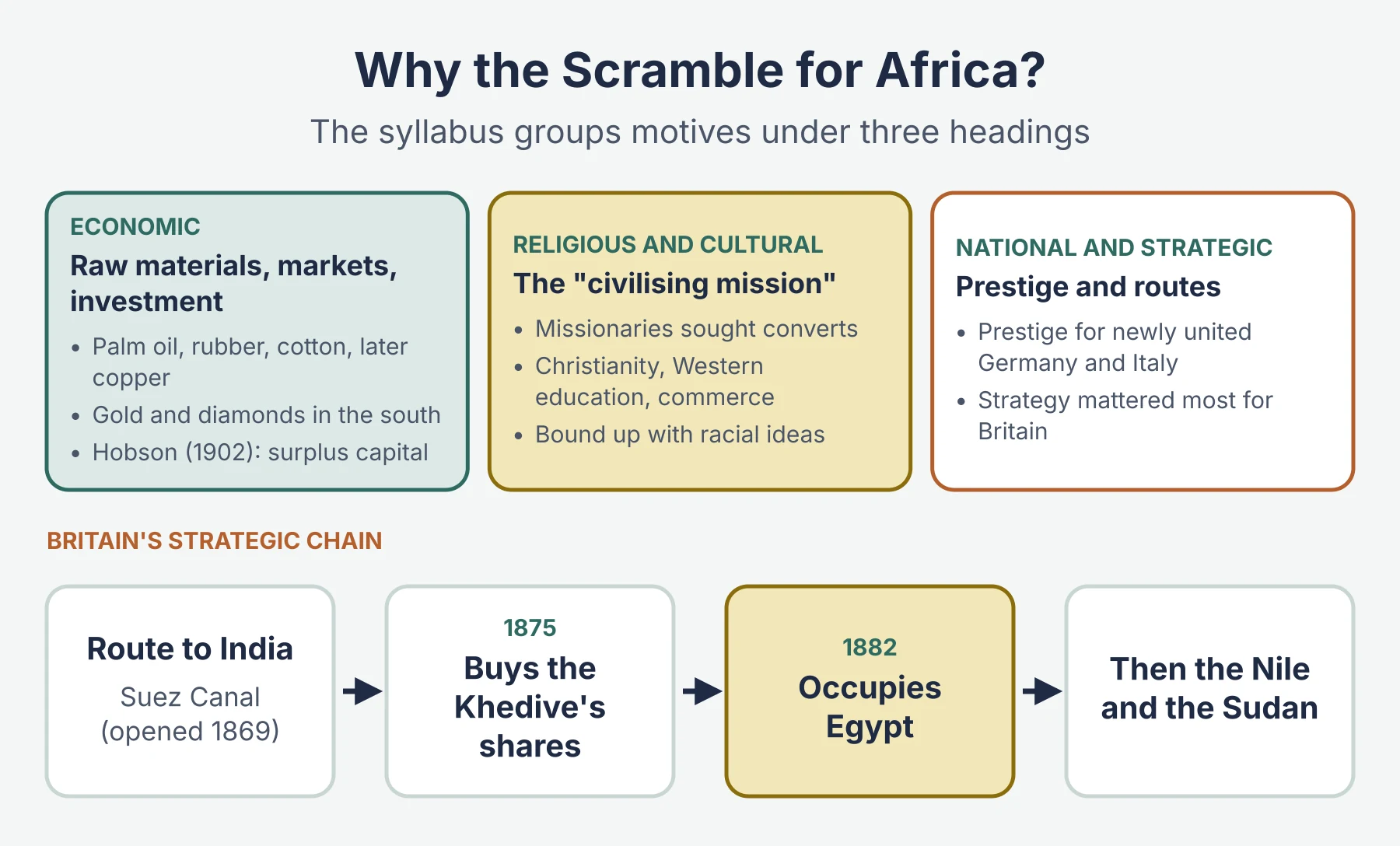
| Economic | Rubber and ivory in the Congo; gold and diamonds in southern Africa; palm oil in West Africa |
| Religious and cultural | Missionary societies; Livingstone’s “Christianity and commerce”; the “civilising mission” |
| National and strategic | Britain in Egypt (1882) to protect Suez; German colonies of 1884-85 for prestige; Italy in Eritrea and Somaliland |
| Enabling factors | Quinine, steamships, railways, telegraph, the Maxim gun |
Explorers named in the syllabus
| Explorer | Contribution |
|---|---|
| Heinrich Barth | 1850s Saharan and Sahel journeys; detailed scholarly accounts of West African states |
| David Livingstone | Missionary; Zambezi and Central Africa; anti-slave-trade campaigner; died 1873 |
| Henry Morton Stanley | Found Livingstone (1871); traced the Congo (1874-77); worked for Leopold II |
African resistance compared
| Resistance | Date | Against | Outcome | Why |
|---|---|---|---|---|
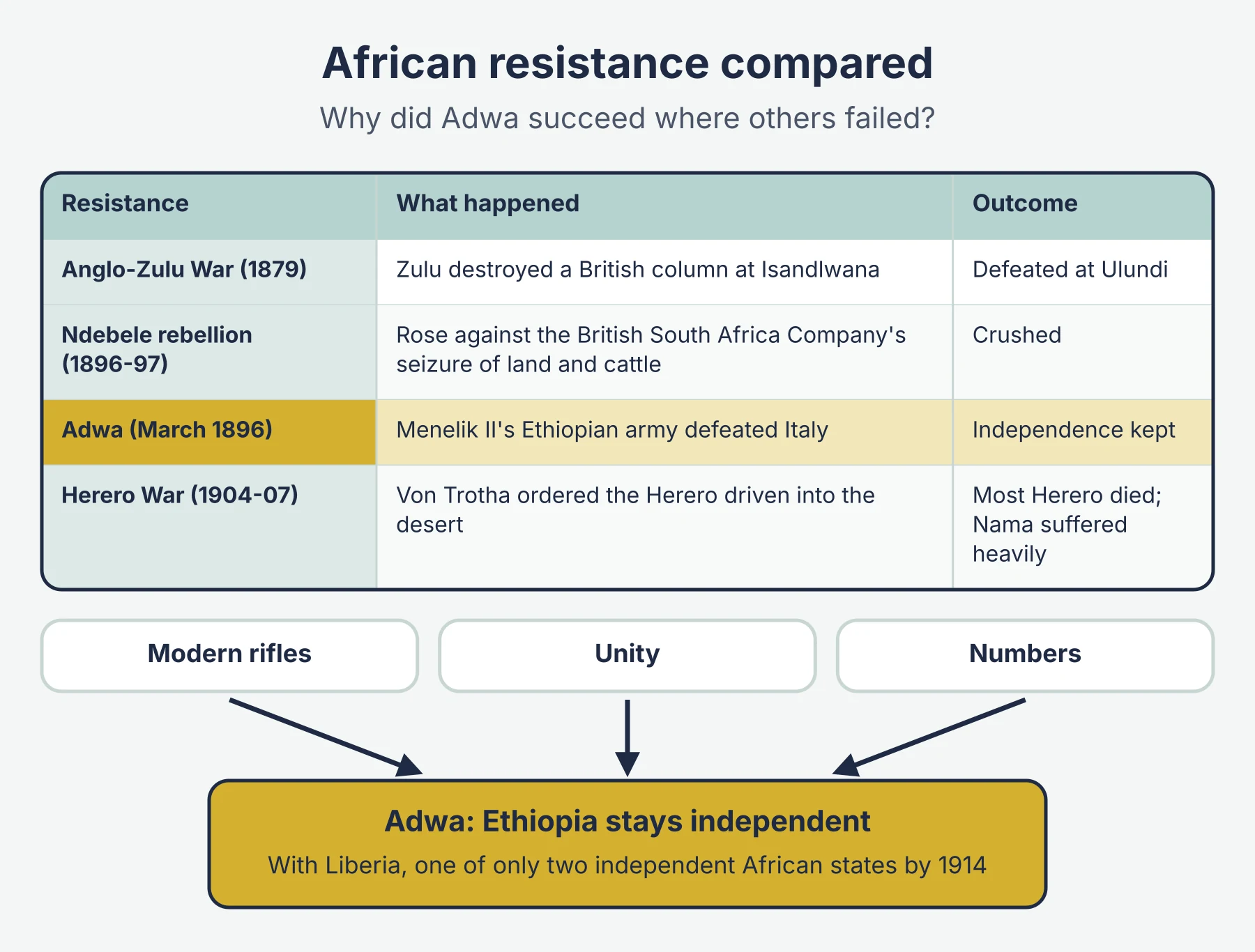
| Anglo-Zulu War | 1879 | Britain | Zulu victory at Isandlwana, defeat at Ulundi | Discipline and numbers, then British firepower |
| Ndebele rebellion | 1896-97 | British South Africa Company | Defeated; Rhodes negotiated a settlement with Ndebele leaders in the Matopos | Seizure of land and cattle provoked it; superior firepower and hunger wore it down |
| Adwa | 1896 | Italy | Ethiopian victory; independence kept | Modern rifles, unity under Menelik II, numbers |
| Herero War | 1904-07 | Germany | Crushed; mass death of Herero and Nama | Land loss provoked it; von Trotha’s extermination policy |
7.2 Crises and settlements
| Rivalry | Crisis | Settlement | Effect on alliances |
|---|---|---|---|
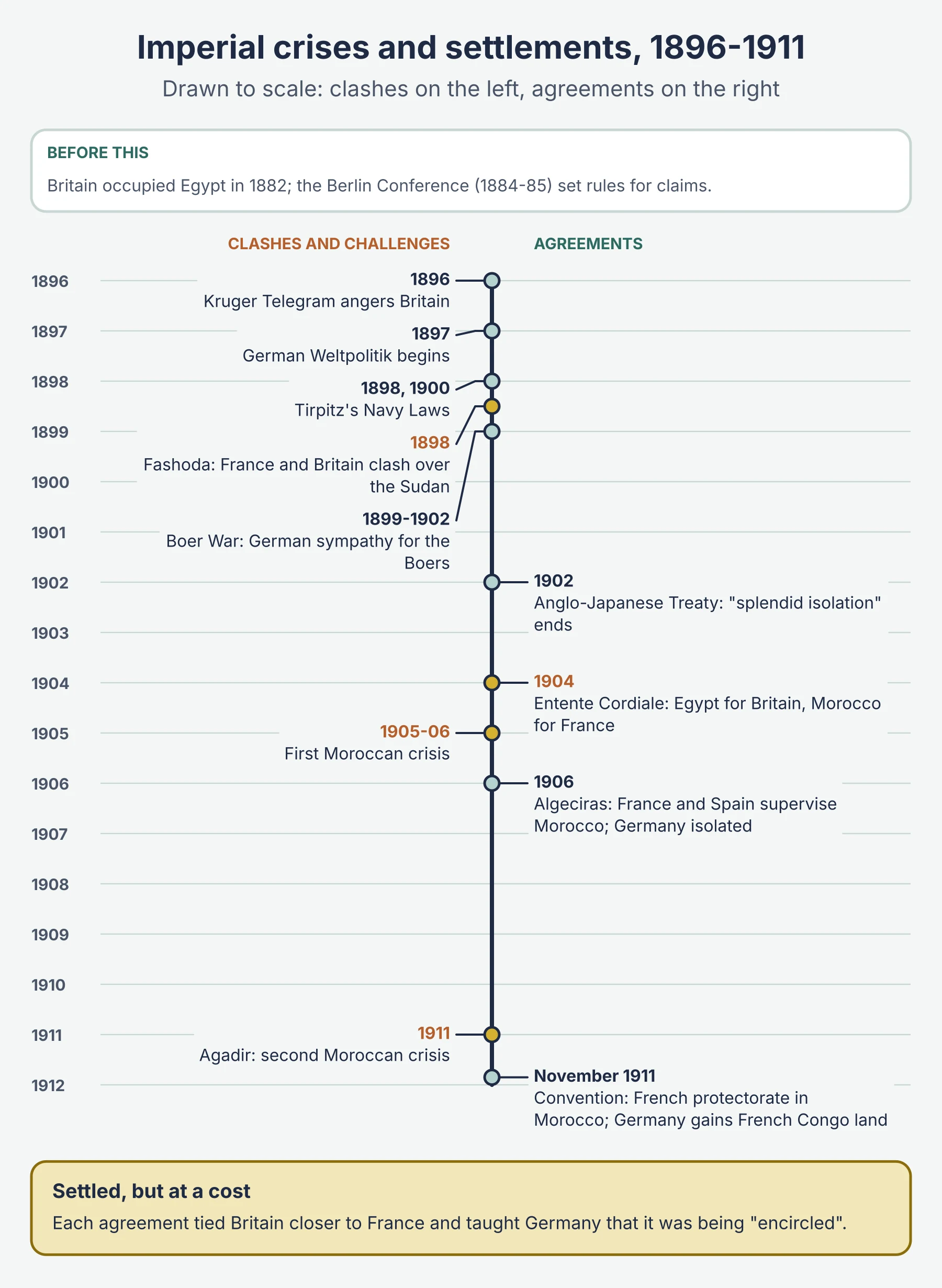
| Britain v Germany | Kruger Telegram (1896); naval laws (1898, 1900); Boer War sympathy | Naval race unresolved | Britain looks for partners |
| Britain v France | Fashoda (1898) | France withdraws; Sudan agreement (1899) | Prepares the Entente |
| France v Germany | Tangier (1905) | Algeciras (1906) | Entente strengthened; Germany isolated |
| France v Germany | Agadir (1911) | November 1911 convention: Morocco for part of the French Congo | British support for France confirmed |
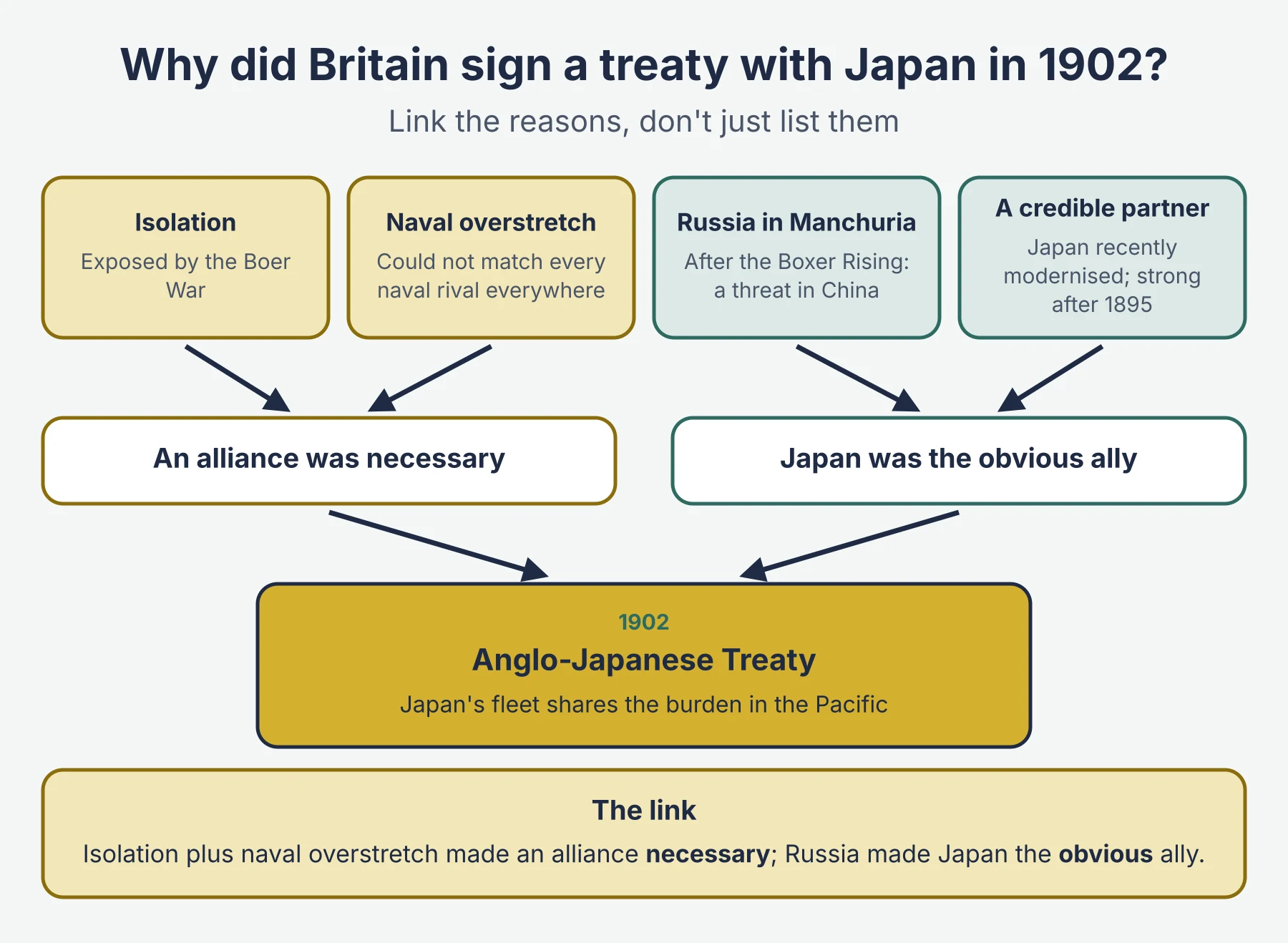
Ending isolation: Anglo-Japanese Treaty (1902); Entente Cordiale (1904); Anglo-Russian Convention (1907).
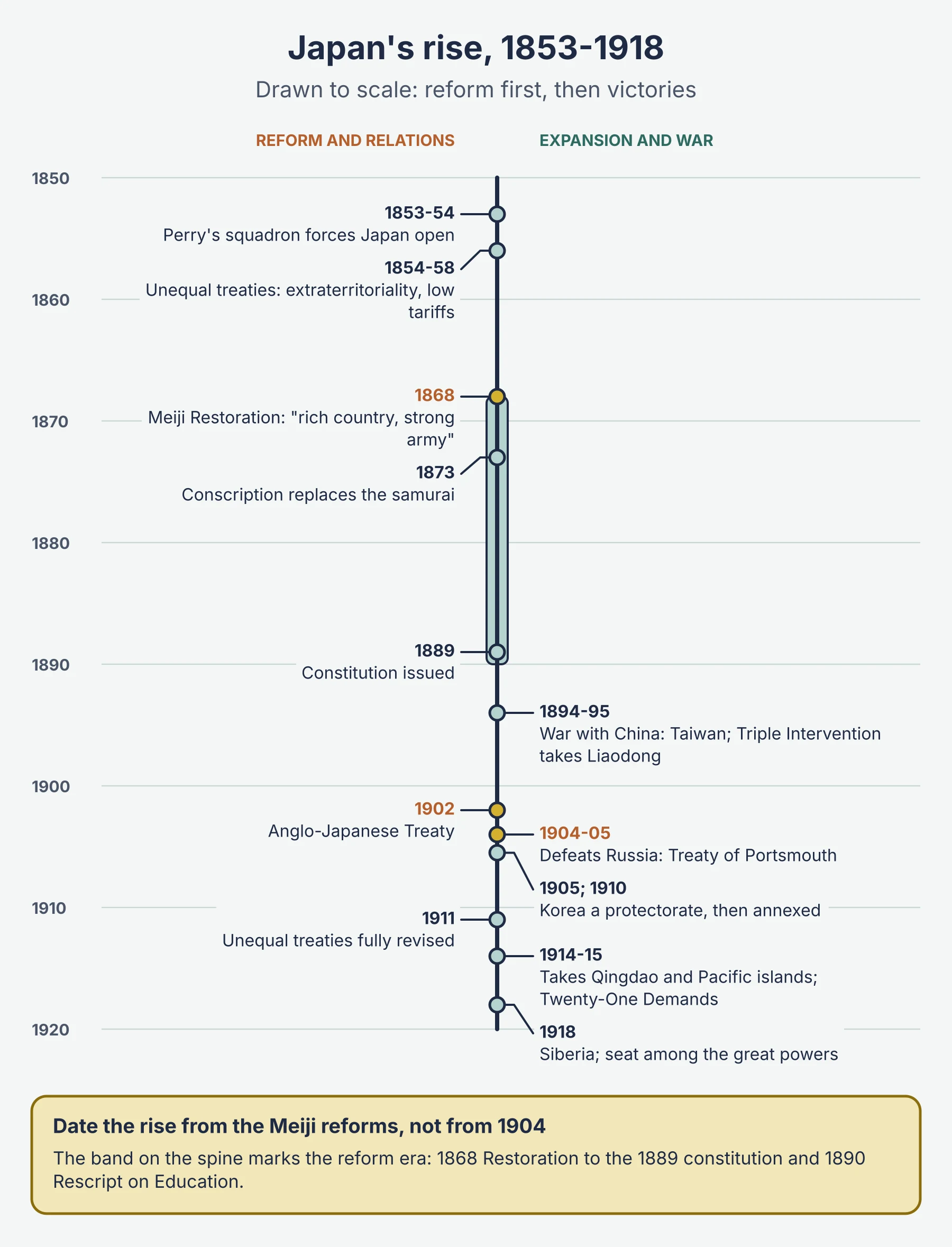
7.3 Japan – the steps to great-power status
| Date | Step |
|---|---|
| 1853-54 | Perry’s mission; ports opened |
| 1858 | Unequal treaties: extraterritoriality and fixed tariffs |
| 1868 | Meiji Restoration |
| 1871-73 | Iwakura Mission studies the West |
| 1873 | Conscription |
| 1889 / 1890 | Constitution / Rescript on Education |
| 1894-95 | War with China; Treaty of Shimonoseki; Triple Intervention |
| 1902 | Anglo-Japanese Treaty |
| 1904-05 | Russo-Japanese War; Treaty of Portsmouth |
| 1910 | Korea annexed |
| 1911 | Tariff autonomy completes treaty revision |
| 1914-18 | Qingdao and German Pacific islands taken; Twenty-One Demands (1915); Siberian intervention (from 1918) |
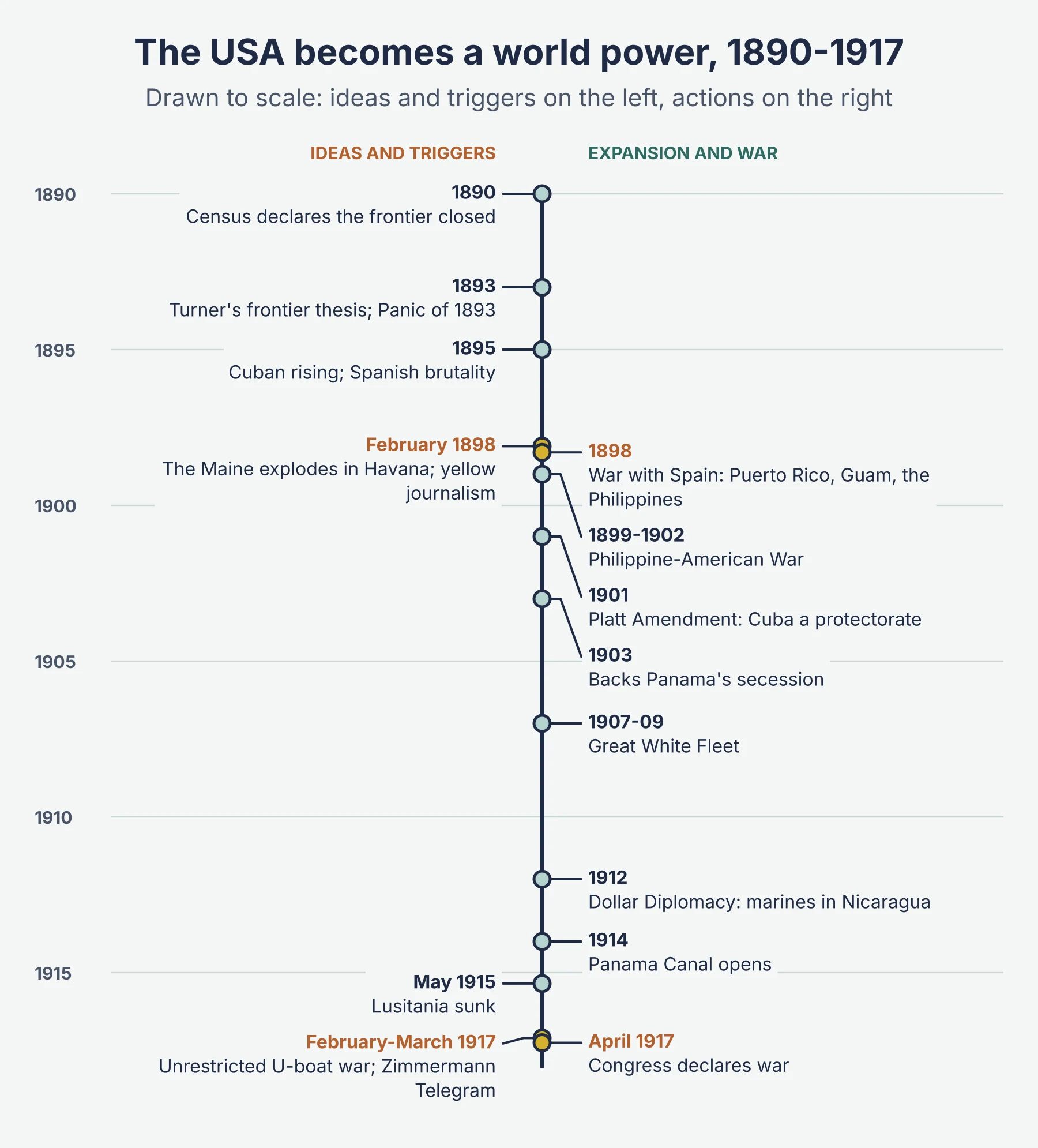
7.4 USA – the steps to world power
| Date | Step |
|---|---|
| 1890 | Census declares the frontier closed; Mahan’s The Influence of Sea Power upon History |
| 1893 | Panic of 1893 and depression |
| 1898 | Maine sinks; Spanish-American War; Hawaii annexed; Treaty of Paris |
| 1899-1902 | Philippine-American War |
| 1901 | Platt Amendment makes Cuba a protectorate |
| 1903 | Panama secedes with US backing; canal zone acquired |
| 1907-09 | Great White Fleet |
| 1909-13 | Taft’s Dollar Diplomacy |
| 1914 | Panama Canal opens; neutrality declared |
| May 1915 | Lusitania |
| Feb-April 1917 | Unrestricted U-boat warfare; Zimmermann Telegram; war declared |
Key terms
| Term | Meaning |
|---|---|
| New Imperialism | Rapid European expansion, especially in Africa, after c.1870 |
| Effective occupation | Berlin Conference principle that claims needed real control |
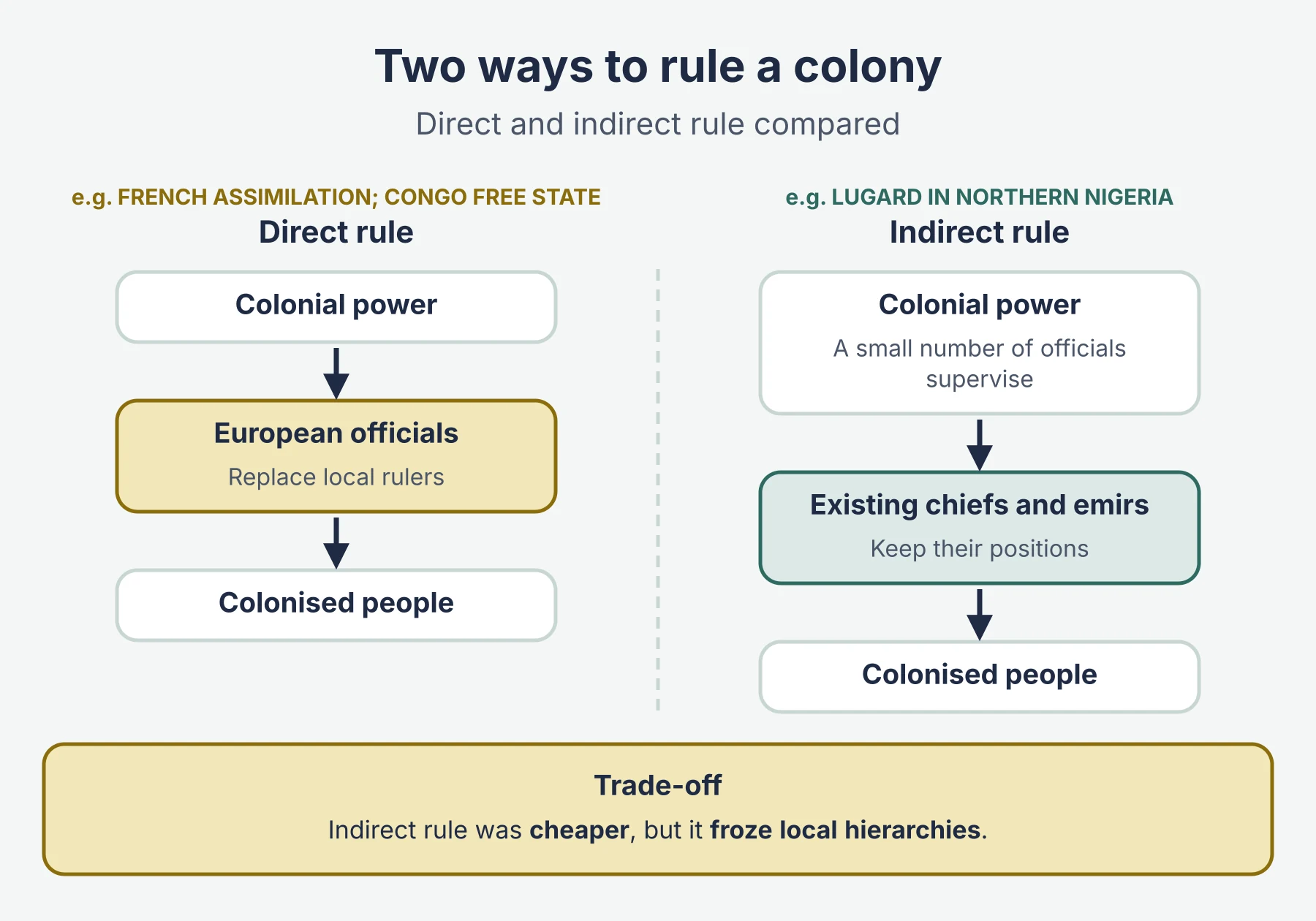
| Direct / indirect rule | Rule by European officials / through local rulers |
| Civilising mission | Belief that Europeans should spread their religion and culture |
| Protectorate | Territory controlled by a power while keeping a local ruler |
| Weltpolitik | German “world policy” for colonies, a navy and global influence |
| Splendid isolation | Britain’s late nineteenth-century avoidance of alliances |
| Unequal treaties | Treaties forced on Japan (and China) giving foreigners privileges |
| Extraterritoriality | Foreigners tried by their own courts, not local ones |
| Yellow journalism | Sensational newspaper reporting to build sales and opinion |
| Dollar Diplomacy | Taft’s use of investment and loans to extend US influence |
Exam traps
- Berlin Conference. It did not divide Africa; it set rules (effective occupation, free navigation) for a scramble already under way.
- Fashoda and Morocco. All were settled peacefully; their significance lies in reshaping alliances, not in causing war directly.
- Japan’s victory in 1905. Explain Japanese preparation as well as Russian weakness, and the British alliance that kept others out.
- The USA’s rise. Do not stop at 1898; the Philippine war, Panama and 1917 are all named in the syllabus.
- Paper 1. Imperial speeches, missionary reports and African testimony each carry a purpose; use provenance to explain differences.
Self-test
- Why did Britain occupy Egypt in 1882? To protect the Suez Canal and the route to India.
- Give one technological and one medical factor that aided conquest. Maxim gun or steamships or railways; quinine.
- What is indirect rule, and who is associated with it? Rule through existing local rulers under European supervision; Lugard in Northern Nigeria.
- Which reports exposed abuses in the Congo Free State? Casement’s report (1904), publicised by Morel’s Congo Reform Association.
- Why did Ethiopia win at Adwa? Modern rifles, unity under Menelik II and superior numbers.
- What did the Entente Cordiale exchange? British control of Egypt for French influence in Morocco.
- What did Germany gain in the November 1911 convention? Part of the French Congo, in return for accepting a French protectorate in Morocco.
- What did the Triple Intervention force Japan to give up? The Liaodong peninsula.
- Give two consequences of the Anglo-Japanese Treaty. Any two: Japan could fight Russia without fear of a third power; Britain could concentrate its navy; Japan gained recognition as a great power.
- What did Mahan argue? That sea power, a strong navy and overseas bases made nations great.
- Which territories did the USA gain from Spain in 1898? Puerto Rico, Guam and the Philippines.
- Name two events of early 1917 that brought the USA into the war. Resumption of unrestricted U-boat warfare and the Zimmermann Telegram.
Official syllabus
Cambridge International AS & A Level History (9489) syllabus for 2027, 2028 and 2029 – cambridgeinternational.org (subject content, topic 7; Topics assessed on Paper 1 and Paper 2).
Related resources
-
Study guides
Cambridge A Level World History (9489): International history 1929-39: the rise of extremism and the road to war
Study guide to Cambridge 9489 History topic 9, 1929-39: extremism after the Depression, the League's failure, appeasement and why war broke out in 1939.
World History · Cambridge · AS Level
Read guide -
Practice questions
Cambridge A Level World History (9489): International history 1929-39: the rise of extremism and the road to war – Practice Questions
Twelve original practice questions on Cambridge 9489 international history 1929-39, with invented Paper 1 sources, Paper 2 essays and mark-scheme style answers.
World History · Cambridge · AS Level
Try questions -
Revision notes
Cambridge A Level World History (9489): International history 1929-39: the rise of extremism and the road to war – Revision Notes
Revision notes for Cambridge 9489 History topic 9, 1929-39: Depression and extremism, the League's crises, appeasement, the 1939 alliances and a self-test.
World History · Cambridge · AS Level
Revise topic
Get free revision emails (optional)
Occasional emails with practice questions, worked explanations and links to free resources for the qualification and subjects you choose. No spam, and you can unsubscribe from any email. The free tools on this site never need an email.