
Study Guides
Cambridge A Level World History (9489): International relations 1919-29: conflict and cooperation
Study guide to Cambridge 9489 History topic 8, 1919-29: the peace treaties, the League and its disputes, the crises of 1919-23 and the improvement of 1924-29.
- Subject
- World History
- Level
- AS LEVEL
- Topic
- Paper 1 and Paper 2 – International Option: International History, 1870–1939
- Author
- Marlbridge Academic Team
- Updated
- Reviewed by
- Azam Siddique (what this means)
Aligned to Cambridge A Level World History (9489), 2027-2029. Official specification .
Syllabus page (what it covers and how it is assessed): Cambridge A Level World History.
Syllabus points this page covers
9489 (AS Level)
- 8 International relations 1919–29: conflict and cooperation
Found an error? Report a correction.
Need help with this topic? Request a free trial class for A Level World History (9489).
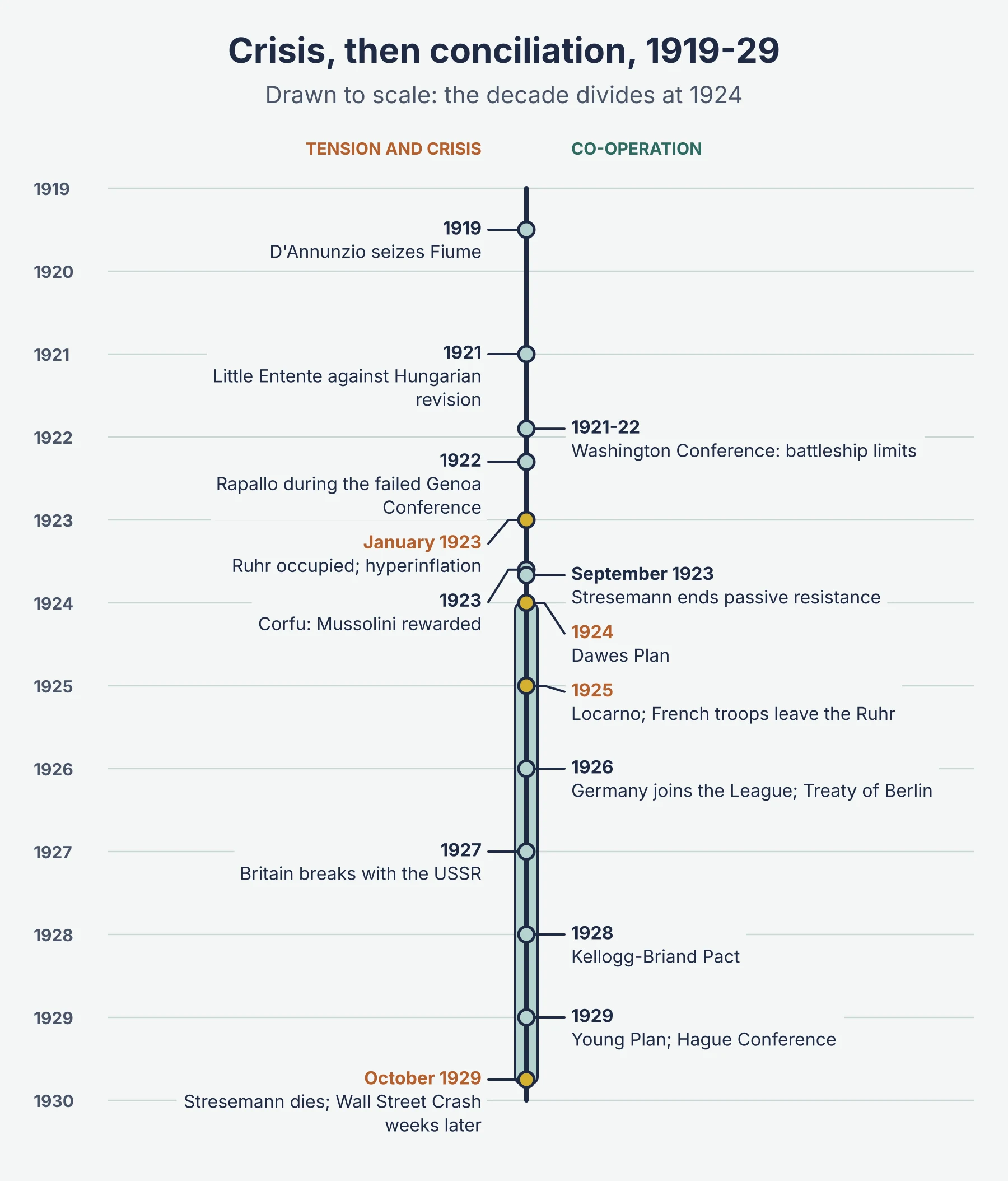
International relations 1919-29: conflict and cooperation is the second topic of the International option at AS Level in Cambridge International History 9489. It asks why the peace settlements of 1919-20 caused such dissatisfaction (8.1), why the League of Nations was created and what challenges it faced (8.2), why tension remained high after Versailles (8.3), and how and why relations improved in 1924-29 (8.4). The decade divides naturally at 1924: crisis and confrontation before, conciliation after – and the last key question asks whether that improvement was real. For the option as a whole, see the International History, 1870-1939 study guide.
Where this fits in 9489
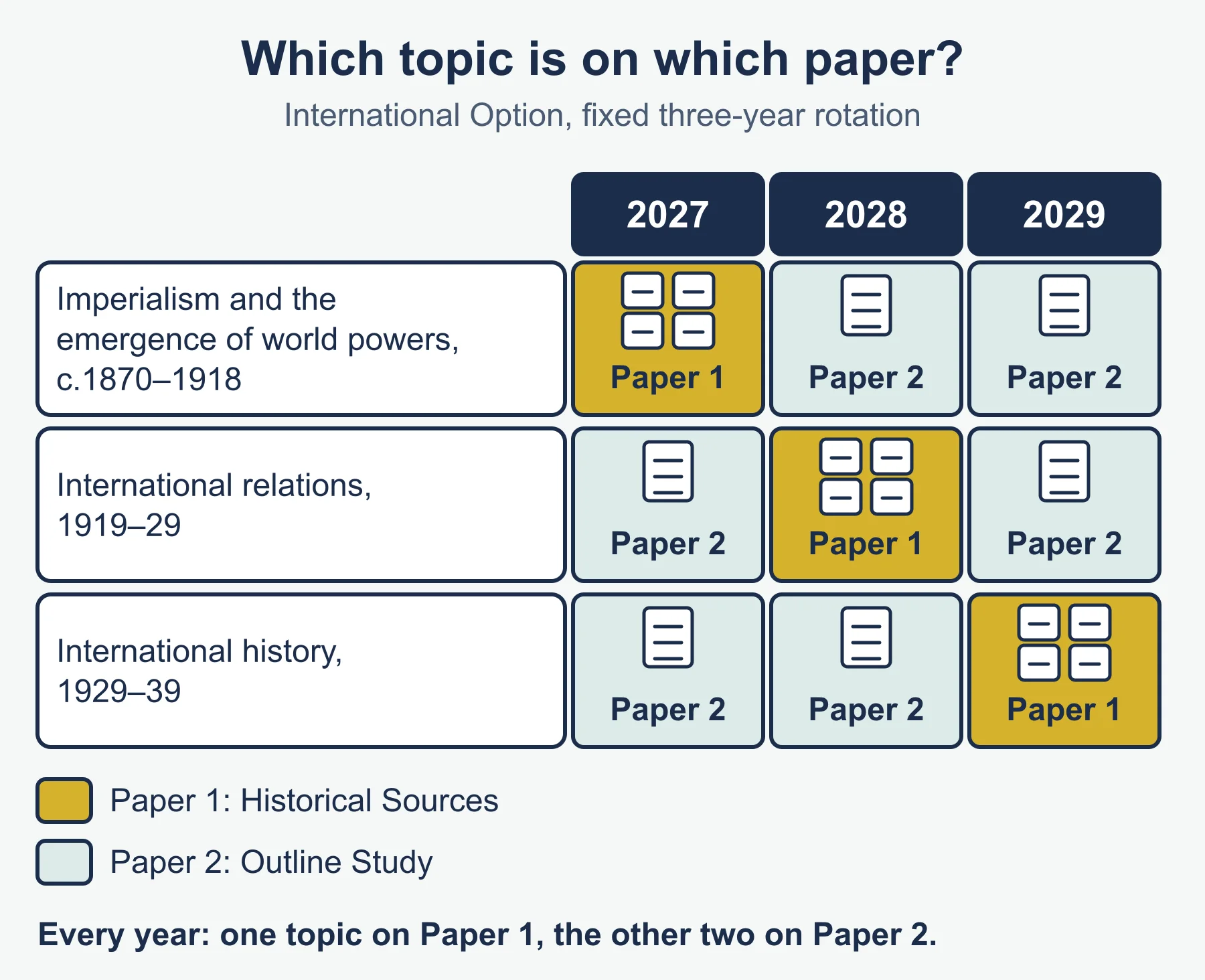
Under the 2027-2029 rotation this topic is on Paper 2 (Outline Study) in 2027 and 2029 and on Paper 1 (Historical Sources) in 2028. The syllabus’s own example of a Paper 2 part (a) comes from this topic: “Explain why the League of Nations was involved in a dispute over the Aaland Islands in 1921.” Revise with the International relations 1919-29 revision notes and practise with the International relations 1919-29 practice questions.
8.1 Why was there such dissatisfaction with the peace settlements?
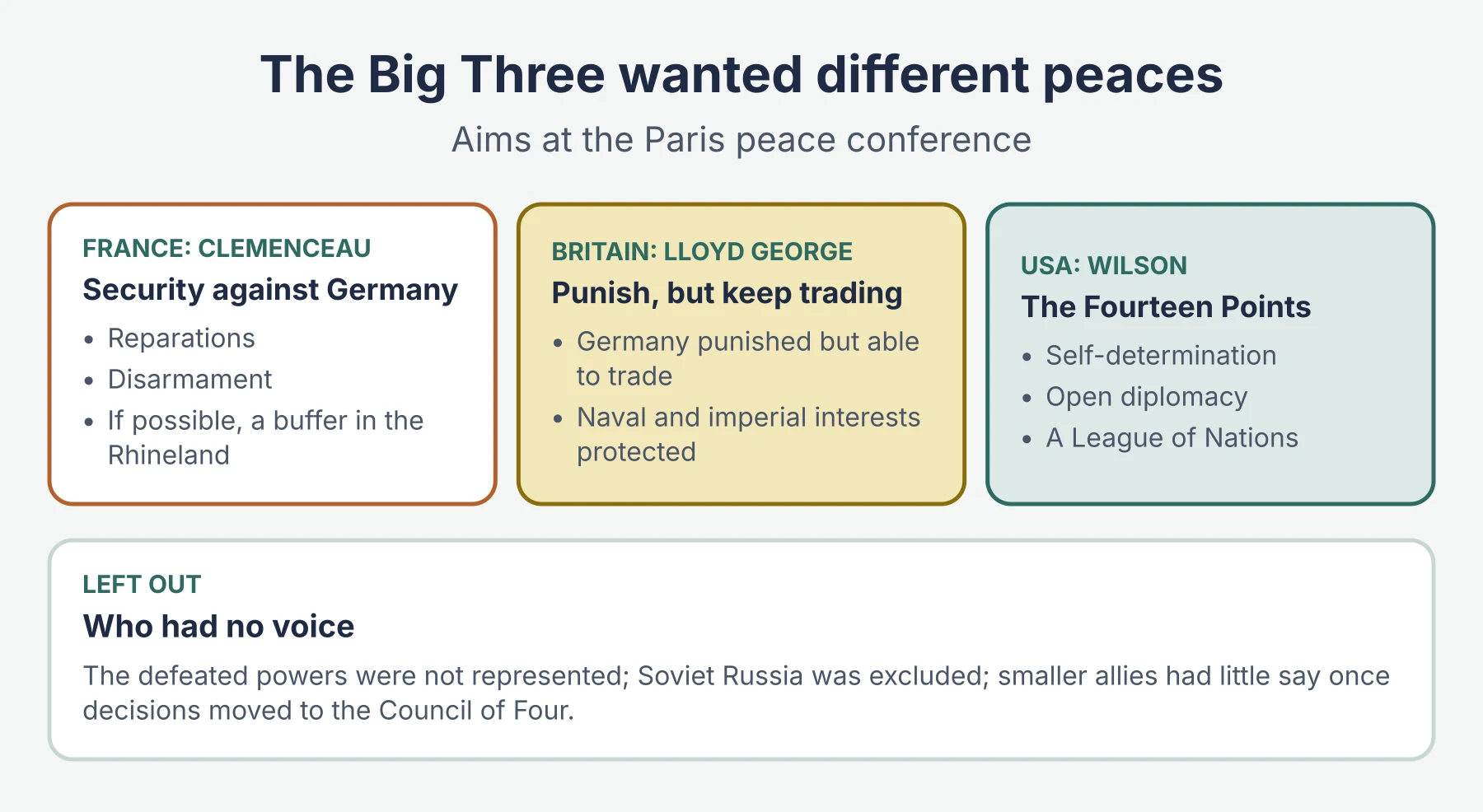
Negotiating the treaties. The Big Three wanted different things. Clemenceau wanted security against Germany – reparations, disarmament and, if possible, a buffer in the Rhineland. Wilson wanted a peace based on his Fourteen Points: self-determination, open diplomacy and a League of Nations. Lloyd George wanted Germany punished but able to trade, and British naval and imperial interests protected. The defeated powers were not represented, Soviet Russia was excluded, and smaller allies had little say once decisions moved to the Council of Four.
Key terms.
| Treaty | Defeated state | Main terms |
|---|---|---|
| Versailles (June 1919) | Germany | Alsace-Lorraine to France; West Prussia and Posen to Poland; Danzig a Free City; Saar under the League; Rhineland demilitarised and occupied; army of 100,000; no air force, submarines or tanks; colonies to mandates; no union with Austria; Article 231; reparations |
| Saint-Germain (Sept 1919) | Austria | Lands to Czechoslovakia, Poland, Italy and the Kingdom of Serbs, Croats and Slovenes; no union with Germany |
| Neuilly (Nov 1919) | Bulgaria | Western Thrace to Greece, losing the Aegean coast; land to Yugoslavia |
| Trianon (June 1920) | Hungary | About two-thirds of territory lost, including Transylvania to Romania and Slovakia to Czechoslovakia |
| Sèvres (Aug 1920) | Ottoman Empire | Arab lands as British and French mandates; Straits internationalised; Smyrna to Greek administration |
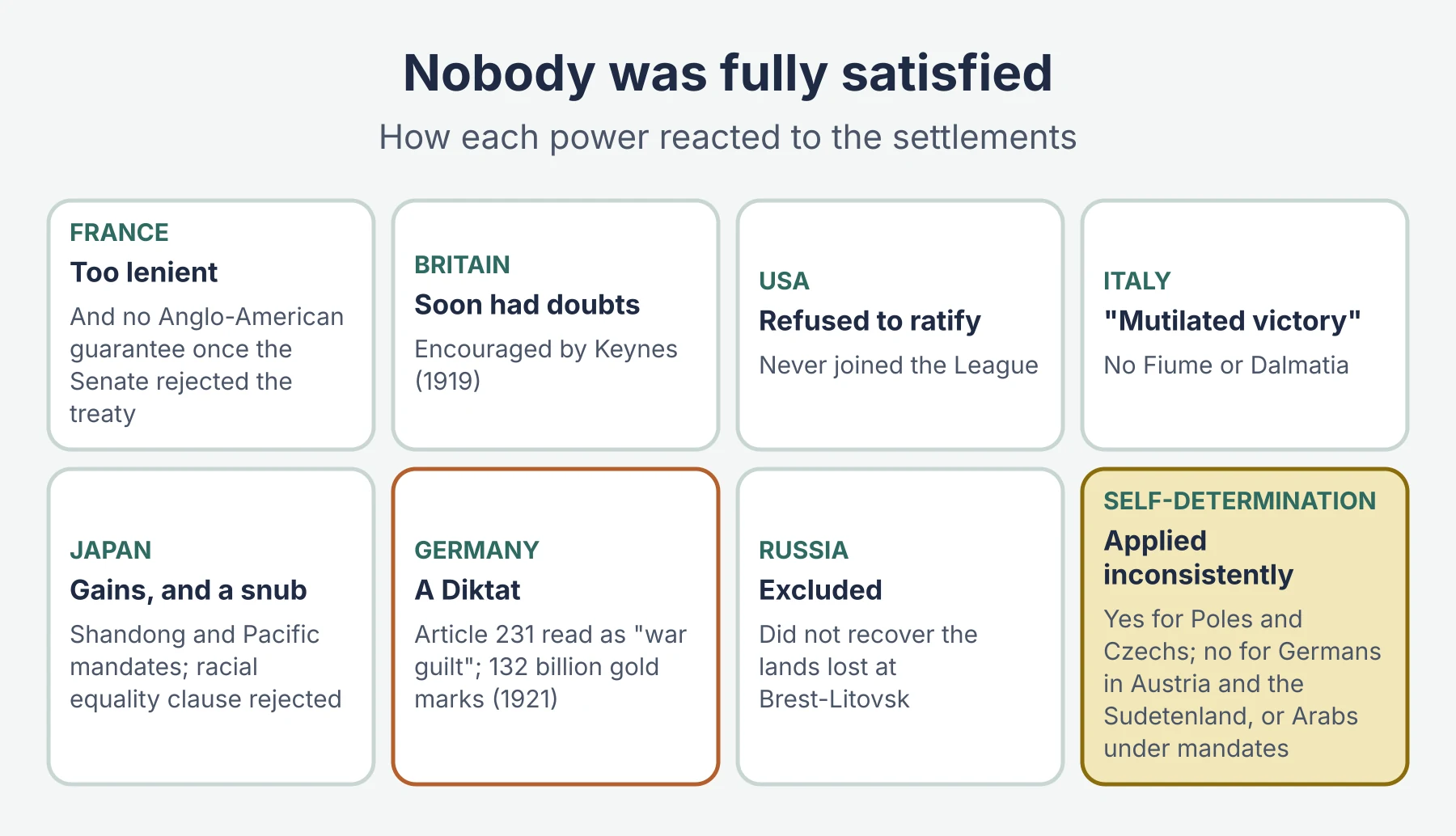
Difficulties created. New boundaries left millions in states they did not choose: Germans in Czechoslovakia and Poland, Hungarians in Romania and Czechoslovakia. Self-determination was applied inconsistently – granted to Poles and Czechs, denied to Germans in Austria and the Sudetenland, and to Arabs placed under mandates.
Reactions. France thought the treaty too lenient and lacked the Anglo-American guarantee it had been promised once the US Senate rejected the treaty. Britain soon had doubts, encouraged by Keynes’s The Economic Consequences of the Peace (1919). The USA refused to ratify and never joined the League. Italy spoke of a “mutilated victory” after failing to win Fiume and Dalmatia. Japan gained Germany’s rights in Shandong and Pacific mandates, but its proposal for a racial equality clause was rejected. Germany called the treaty a Diktat. Russia, excluded, did not recover the lands lost at Brest-Litovsk.
Reparations. Article 231 made Germany accept responsibility for loss and damage; Germans read it as a “war guilt” clause. The Reparations Commission set the total at 132 billion gold marks in 1921. Arguments over whether Germany could pay – and whether it was deliberately defaulting – dominated the next three years.
8.2 Why was the League created and what challenges did it face?
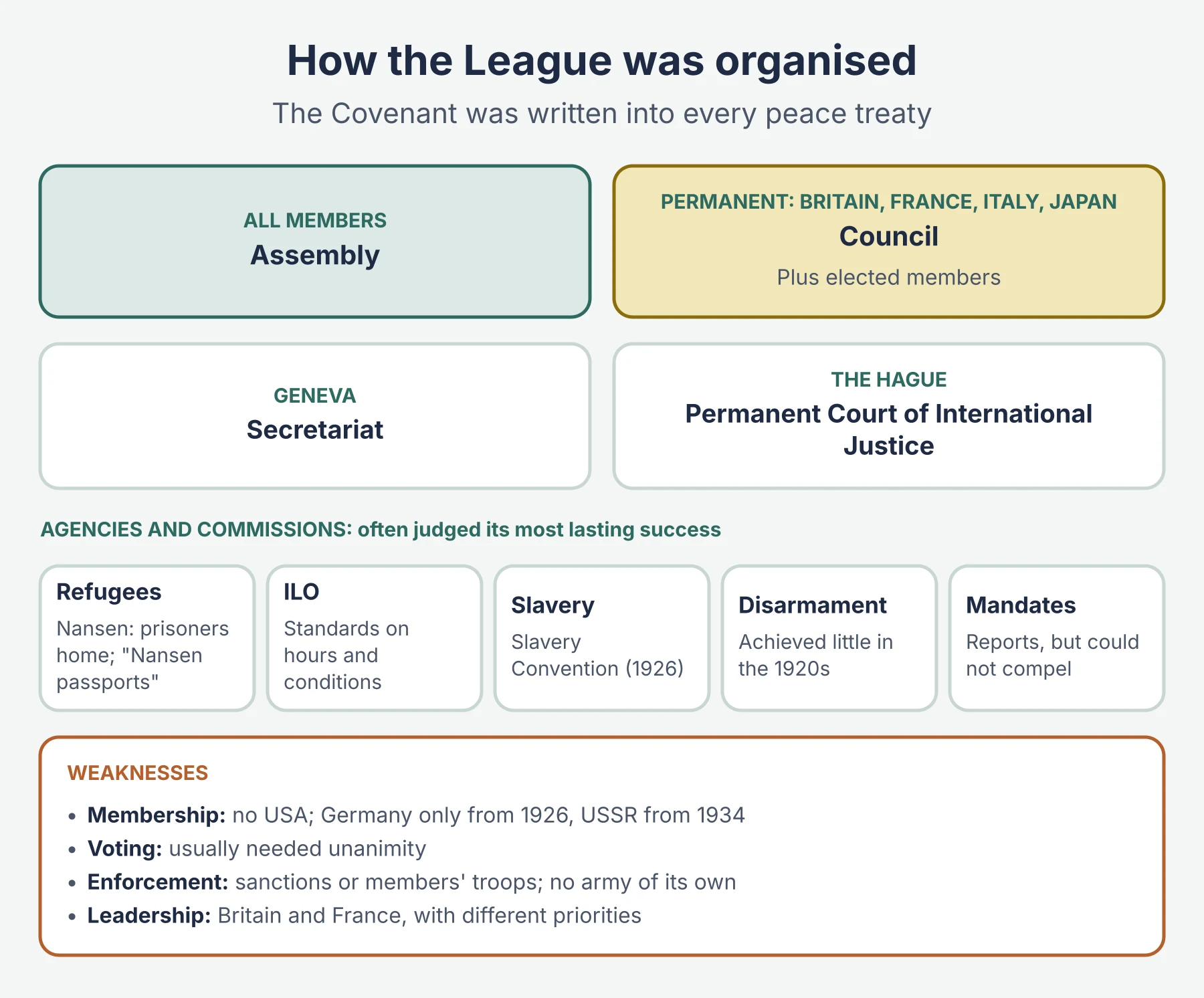
Creation. The League was the fourteenth of Wilson’s Fourteen Points, and its Covenant was written into all the peace treaties. Its aims were to prevent war through collective security, encourage disarmament, settle disputes and improve living and working conditions. Its structure: an Assembly of all members, a Council (permanent members Britain, France, Italy and Japan, plus elected members), a Secretariat in Geneva, the Permanent Court of International Justice at The Hague, and specialist agencies and commissions.
Weaknesses. Membership was restricted – the USA never joined, Germany was admitted only in 1926 and the USSR only in 1934. Leadership fell to Britain and France, whose priorities differed. Voting in the Assembly and Council usually needed unanimity. Enforcement depended on members applying economic sanctions or providing troops; the League had no army.
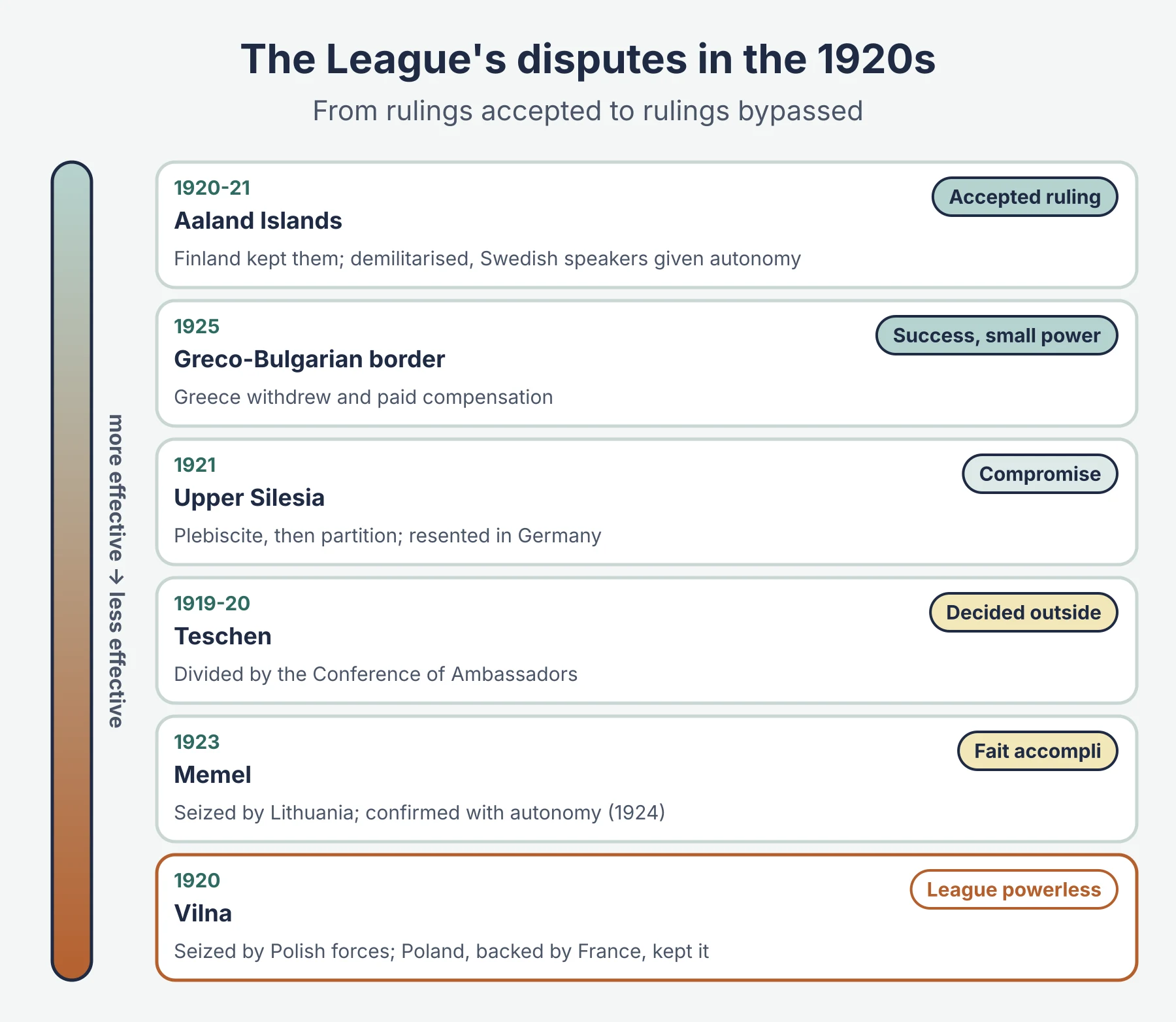
Disputes in the 1920s.
| Dispute | Outcome | Lesson |
|---|---|---|
| Aaland Islands (1920-21) | Finland kept the islands; demilitarised, with autonomy for the Swedish-speaking population | Success when both sides accepted a ruling |
| Teschen (1919-20) | Divided between Poland and Czechoslovakia by the Conference of Ambassadors | Great powers outside the League often decided |
| Vilna (1920) | Seized by Polish forces; Poland kept it | League could not act against a state backed by France |
| Upper Silesia (1921) | Plebiscite, then partition: Germany most of the land, Poland most of the industry | Workable compromise, resented in Germany |
| Memel (1923) | Seized by Lithuania; confirmed with autonomy (1924) | Fait accompli accepted |
| Greco-Bulgarian border (1925) | Greece withdrew and paid compensation | Success against a small power |
The agencies. The Commission for Refugees, under Fridtjof Nansen, returned prisoners of war and issued “Nansen passports” to stateless people. The International Labour Organisation gathered information and promoted standards on working hours and conditions. The Slavery Commission investigated forced labour and led to the Slavery Convention of 1926. The Disarmament Commission prepared for a conference but achieved little in the 1920s. The Mandates Commission received reports on former German and Ottoman territories but could not compel the mandatory powers. The agencies are often judged the League’s most lasting success.
8.3 Why did tensions remain high after Versailles?
Crises. In Fiume, the poet D’Annunzio seized the city in 1919; it became a Free State in 1920 and was annexed by Italy in 1924. In Corfu (1923), after an Italian general was murdered on the Greek-Albanian border, Mussolini bombarded and occupied the island; the Conference of Ambassadors made Greece pay compensation, and Italy withdrew – a precedent for rewarding aggression. In the Ruhr crisis (January 1923), France and Belgium occupied the Ruhr after German defaults on deliveries; passive resistance and the printing of money produced hyperinflation, until Stresemann ended resistance in September 1923. The successor states faced minorities, border disputes, weak economies and fragile democracies.
Treaties and conferences.
- Little Entente (1921): Czechoslovakia, Romania and Yugoslavia against Hungarian revision and a Habsburg restoration; France later allied with its members.
- Washington Conference (1921-22): limited battleship tonnage between the USA, Britain, Japan, France and Italy; replaced the Anglo-Japanese alliance with a Four-Power Treaty; guaranteed China’s integrity.
- Genoa Conference (1922): an attempt at European economic reconstruction including Germany and Soviet Russia; it failed.
- Rapallo Pact (1922): signed by Germany and Soviet Russia during Genoa; they renounced claims on each other and opened relations, alarming the West.
- Treaty of Lausanne (1923): replaced Sèvres after Turkish victory over Greece; Turkey regained eastern Thrace and Smyrna and paid no reparations – the first successful revision of a peace treaty.
Changing relations. Britain and France disagreed over Germany: France sought enforcement, Britain recovery. Italy under Mussolini from 1922 was restless. The Soviet Union, through the Comintern, was seen as a revolutionary threat; Britain recognised it in 1924 but broke off relations in 1927.
8.4 How and why did relations improve, 1924-29?
Economic recovery. The Dawes Plan (1924) scheduled reparations to rise gradually, reorganised the Reichsbank and provided an American loan; French troops left the Ruhr in 1925. As Foreign Minister from 1923 to 1929, Stresemann pursued “fulfilment” – meeting obligations to win revision. Germany joined the League in 1926 with a permanent Council seat. The Young Plan (1929) reduced the total and extended payments over decades.
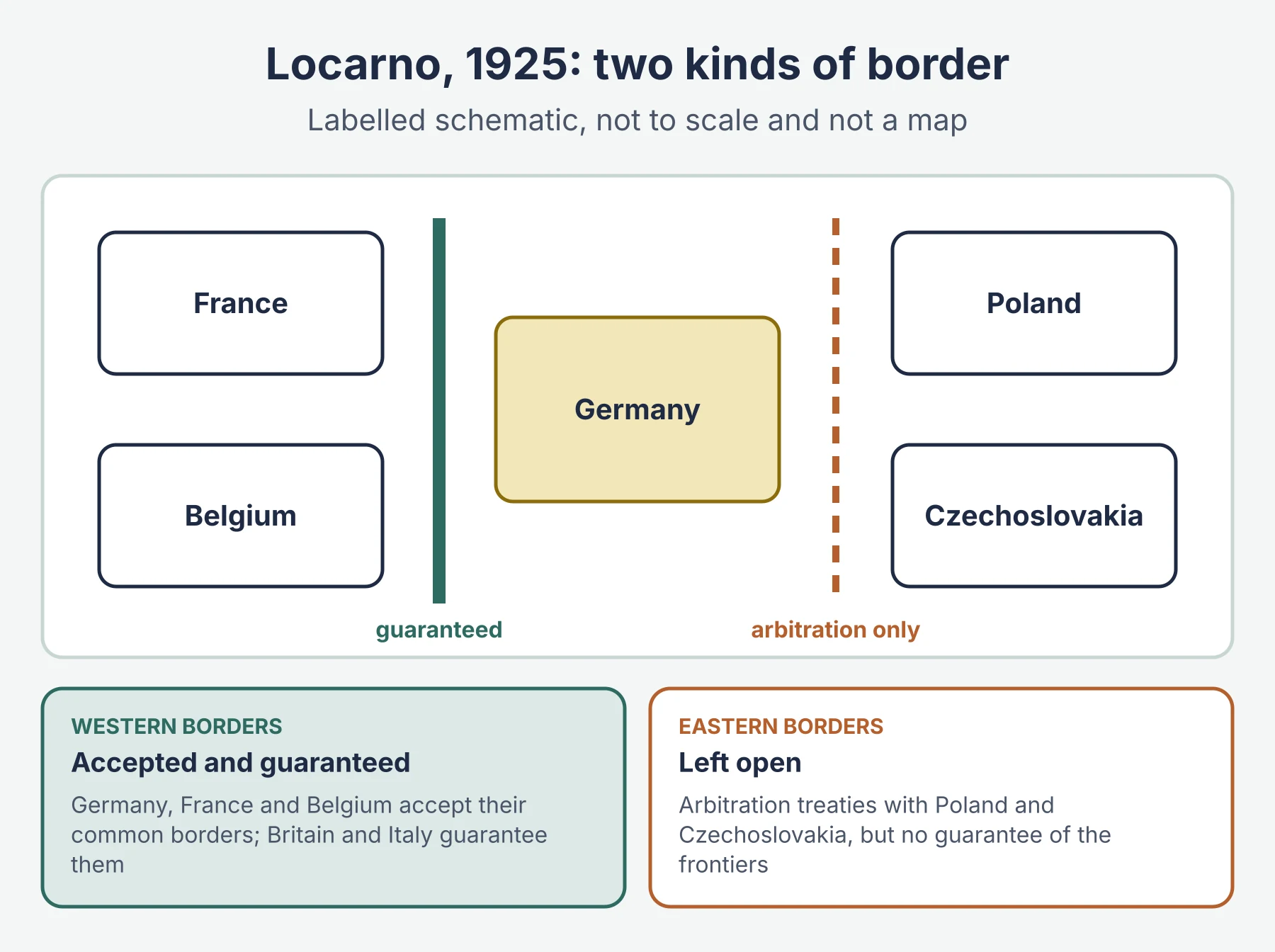
Treaties and conferences. The Geneva Protocol (1924) would have made arbitration compulsory; supported by France and Britain’s Labour government, it was rejected by the Conservatives in 1925. At Locarno (1925) Germany, France and Belgium accepted their common borders, guaranteed by Britain and Italy; Germany signed arbitration treaties with Poland and Czechoslovakia but did not guarantee its eastern frontiers. The Kellogg-Briand Pact (1928) renounced war as an instrument of policy but had no enforcement. The Hague Conference (1929) accepted the Young Plan and agreed Allied evacuation of the Rhineland by 1930, five years early, after disputes among the creditors.
Relations between the powers. Stresemann and Briand built a working partnership and shared the Nobel Peace Prize (1926). Mussolini signed Locarno but asserted Italian influence in the Adriatic and Albania. Relations with the Soviet Union shifted: the Treaty of Berlin (1926) renewed ties with Germany, while Britain’s 1927 break showed Western suspicion.
Reality or illusion? The “Locarno spirit” was real – no major war threat existed in 1925-29 – but rested on American loans and on the personal relationship of Stresemann and Briand; eastern borders remained open questions. Japan and the USA co-operated under the Washington system, though the US Immigration Act of 1924 offended Japan. Stresemann died in October 1929 and the Wall Street Crash followed weeks later: American loans were recalled, German recovery collapsed and the Young Plan lost its basis.
Worked example: a Paper 2 part (b)
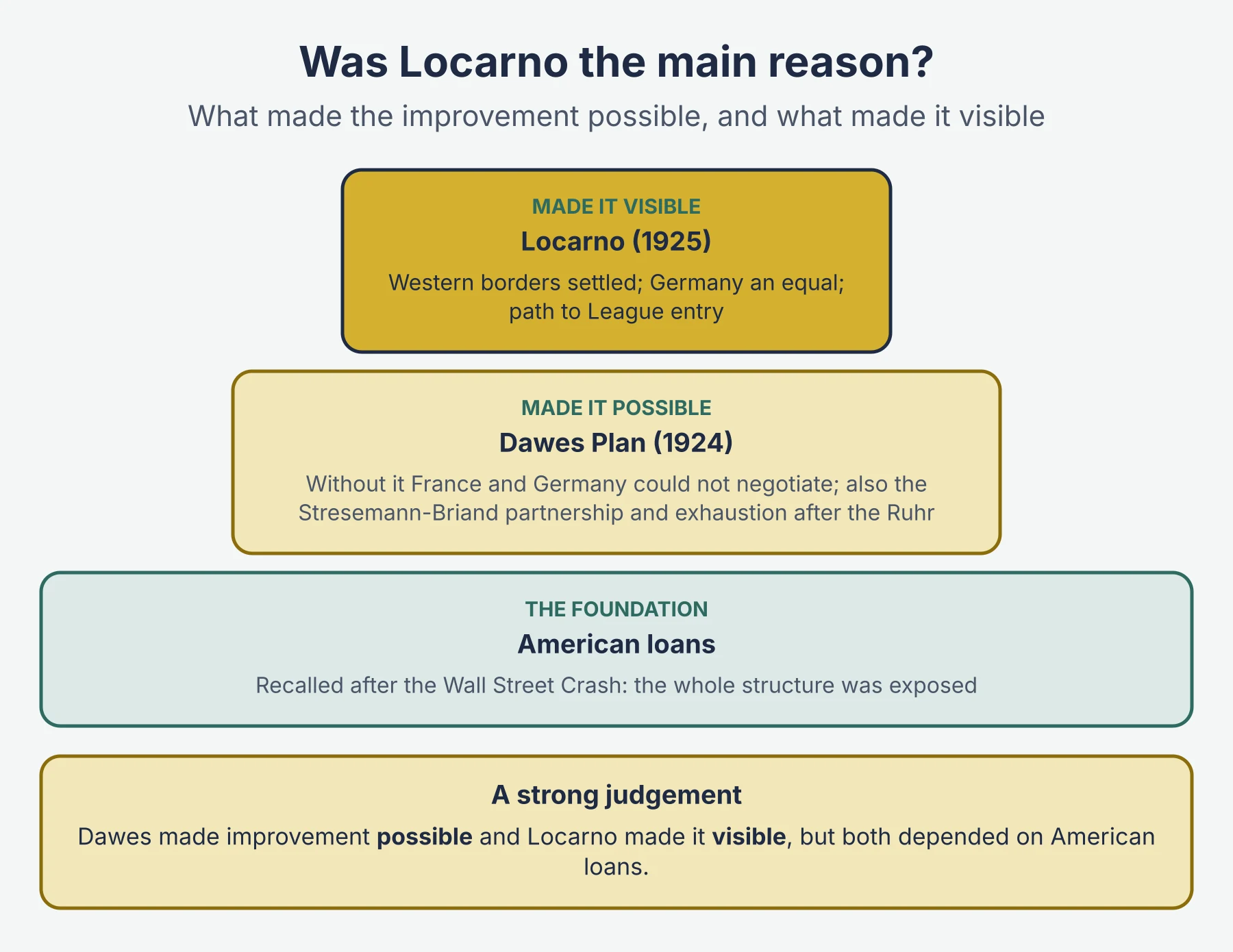
“The Locarno Treaties were the main reason for the improvement in international relations, 1924-29.” How far do you agree? [20]
Explain the case for Locarno (western borders settled voluntarily; Germany accepted as an equal; the path to League entry). Then weigh alternatives: the Dawes Plan, without which France and Germany could not have negotiated; the Stresemann-Briand partnership; American money; exhaustion after the Ruhr crisis. A strong judgement might argue that Dawes made improvement possible and Locarno made it visible – but that both depended on American loans.
Common mistakes
- Treating every treaty as “Versailles”; know which applied to whom.
- Judging the League only by the 1930s.
- Forgetting that the Conference of Ambassadors, not the League, decided Corfu.
- Ignoring the eastern frontier gap at Locarno.
Official syllabus
Cambridge International AS & A Level History (9489) syllabus for 2027, 2028 and 2029 – cambridgeinternational.org (subject content, topic 8; Topics assessed on Paper 1 and Paper 2). Always check the current syllabus before an exam.
Related resources
-
Practice questions
Cambridge A Level World History (9489): International relations 1919-29: conflict and cooperation – Practice Questions
Twelve original practice questions on Cambridge 9489 international relations 1919-29, with invented sources, Paper 2 essays and mark-scheme style answers.
World History · Cambridge · AS Level
Try questions -
Revision notes
Cambridge A Level World History (9489): International relations 1919-29: conflict and cooperation – Revision Notes
Revision notes for Cambridge 9489 History topic 8, 1919-29: the Big Three, treaty reactions, League disputes and agencies, Locarno, traps and a self-test.
World History · Cambridge · AS Level
Revise topic -
Practice questions
Cambridge A Level World History (9489): Imperialism and the Emergence of World Powers – Practice Questions
Original Paper 1 source and Paper 2 essay practice for Cambridge 9489 topic 7, imperialism and world powers c.1870-1918, with mark-scheme style worked answers.
World History · Cambridge · AS Level
Try questions
Get free revision emails (optional)
Occasional emails with practice questions, worked explanations and links to free resources for the qualification and subjects you choose. No spam, and you can unsubscribe from any email. The free tools on this site never need an email.