
Revision Notes
Cambridge A Level World History (9489): International relations 1919-29: conflict and cooperation – Revision Notes
Revision notes for Cambridge 9489 History topic 8, 1919-29: the Big Three, treaty reactions, League disputes and agencies, Locarno, traps and a self-test.
- Subject
- World History
- Level
- AS LEVEL
- Topic
- Paper 1 and Paper 2 – International Option: International History, 1870–1939
- Author
- Marlbridge Academic Team
- Updated
- Reviewed by
- Azam Siddique (what this means)
Aligned to Cambridge A Level World History (9489), 2027-2029. Official specification .
Syllabus page (what it covers and how it is assessed): Cambridge A Level World History.
Syllabus points this page covers
9489 (AS Level)
- 8 International relations 1919–29: conflict and cooperation
Found an error? Report a correction.
Need help with this topic? Request a free trial class for A Level World History (9489).
These notes condense Cambridge 9489 AS topic 8, International relations 1919-29: conflict and cooperation, for recall. The key questions are dissatisfaction with the peace settlements (8.1), the creation and challenges of the League (8.2), continuing tension after Versailles (8.3), and the improvement of 1924-29 (8.4). The explanations are in the International relations 1919-29 study guide; exam questions are in the International relations 1919-29 practice questions.
Rotation (2027-2029 syllabus): Paper 2 (Outline Study) in 2027 and 2029; Paper 1 (Historical Sources) in 2028.
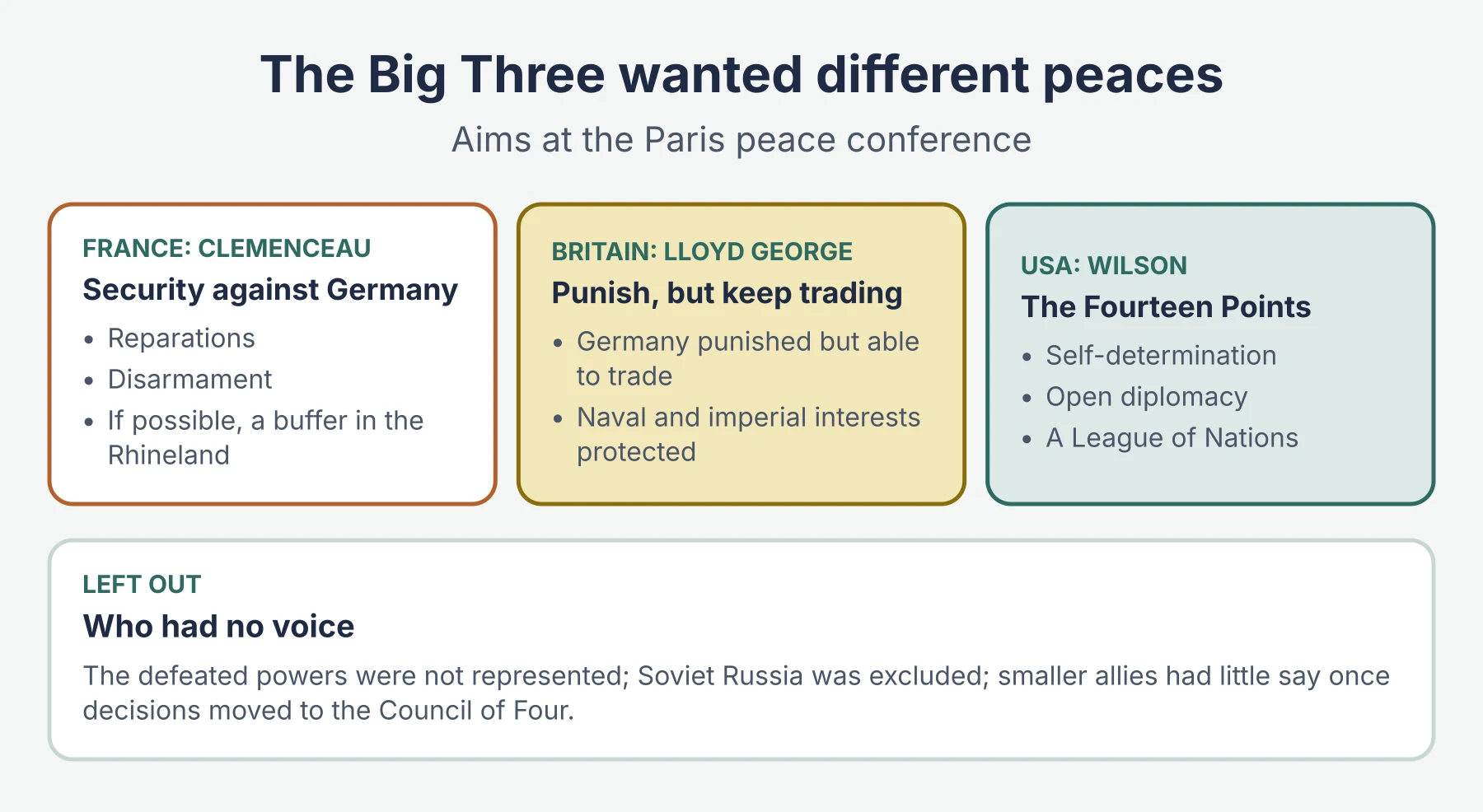
The Big Three – aims and what they got
| Leader | Main aims | Satisfied? |
|---|---|---|
| Clemenceau (France) | Security; reparations; weak Germany; Rhineland buffer | Partly: Alsace-Lorraine, demilitarised Rhineland, reparations – but no separate Rhineland state and no lasting guarantee |
| Wilson (USA) | Fourteen Points; self-determination; League | Partly: League created – but the Senate rejected the treaty |
| Lloyd George (Britain) | Punish Germany but keep it as a trading partner; protect navy and empire | Largely: German fleet and colonies gone – but soon thought the treaty too harsh |
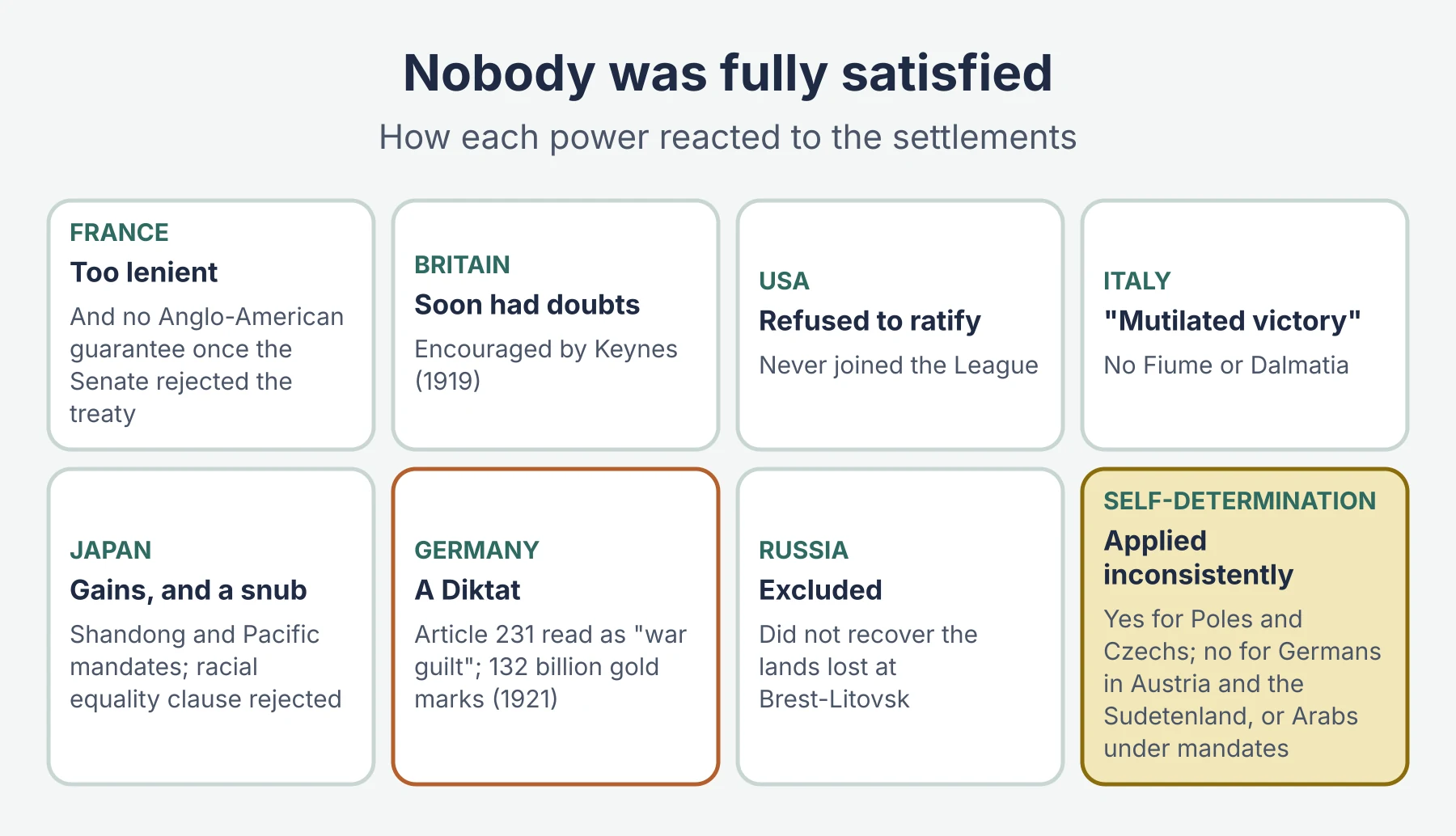
Reactions to the settlement
| Power | Reaction |
|---|---|
| France | Too lenient; promised Anglo-American guarantee lapsed |
| Britain | Growing sympathy for revision (Keynes, 1919) |
| USA | Senate refused ratification; separate peace with Germany (1921) |
| Italy | “Mutilated victory”: no Fiume or Dalmatia |
| Japan | Gained Shandong and Pacific mandates; racial equality clause rejected |
| Germany | Diktat; anger at Article 231, reparations and territorial loss |
| Russia | Excluded; borders settled by war with Poland (Treaty of Riga, 1921) |
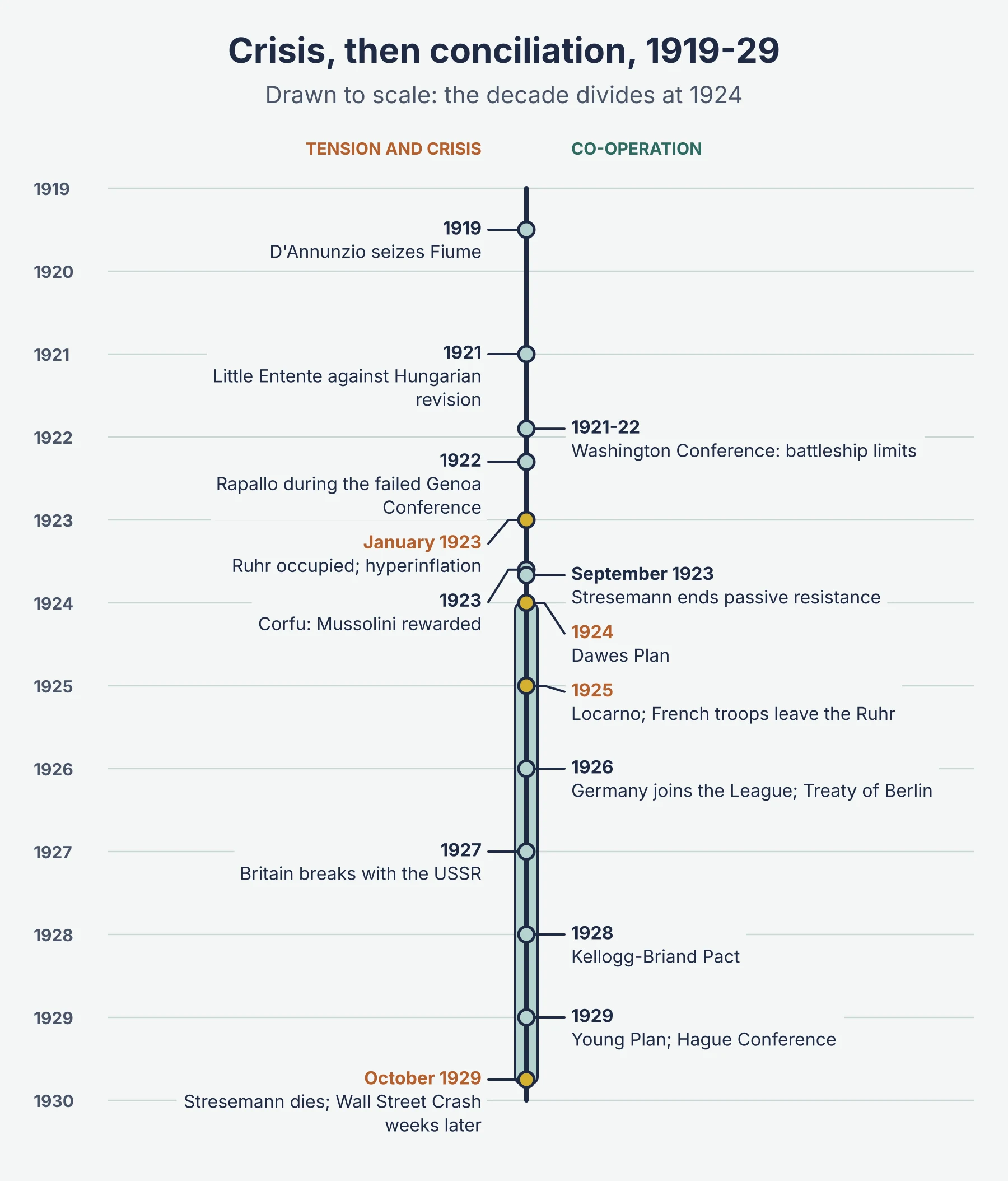
Chronology
| Date | Event |
|---|---|
| Jan 1919 | Paris Peace Conference opens |
| June 1919 | Treaty of Versailles |
| Sept / Nov 1919 | Saint-Germain / Neuilly; D’Annunzio seizes Fiume |
| Jan 1920 | League of Nations begins work |
| June / Aug 1920 | Trianon / Sèvres |
| Oct 1920 | Vilna seized by Polish forces |
| 1920-21 | Aaland Islands dispute; Little Entente formed |
| 1921 | Upper Silesia plebiscite and partition; reparations total fixed |
| Nov 1921-Feb 1922 | Washington Conference |
| April 1922 | Genoa Conference; Rapallo Pact |
| Jan 1923 | Ruhr occupied; Memel seized by Lithuania |
| July 1923 | Treaty of Lausanne |
| Aug-Sept 1923 | Corfu incident |
| Nov 1923 | Peak of German hyperinflation |
| 1924 | Dawes Plan; Geneva Protocol |
| 1925 | Greco-Bulgarian dispute; Locarno Treaties |
| 1926 | Germany joins the League |
| Aug 1928 | Kellogg-Briand Pact |
| 1929 | Young Plan; Hague Conference; Stresemann dies (October); Wall Street Crash |
Key terms
| Term | Meaning |
|---|---|
| Self-determination | Right of a nation to choose its own government |
| Mandate | Former colony governed by a League member under supervision |
| Article 231 | Clause making Germany accept responsibility for loss and damage |
| Reparations | Compensation payments imposed on the defeated |
| Collective security | Members acting together against an aggressor |
| Covenant | The League’s founding rules |
| Unanimity | Decisions requiring every member’s agreement |
| Sanctions | Economic or military measures against an aggressor |
| Conference of Ambassadors | Allied body outside the League that enforced the treaties |
| Successor states | New or enlarged states formed from the old empires |
| Passive resistance | German refusal to work for the occupiers in the Ruhr |
| Fulfilment | Stresemann’s policy of meeting obligations to win revision |
| Locarno spirit | Optimism about co-operation after 1925 |
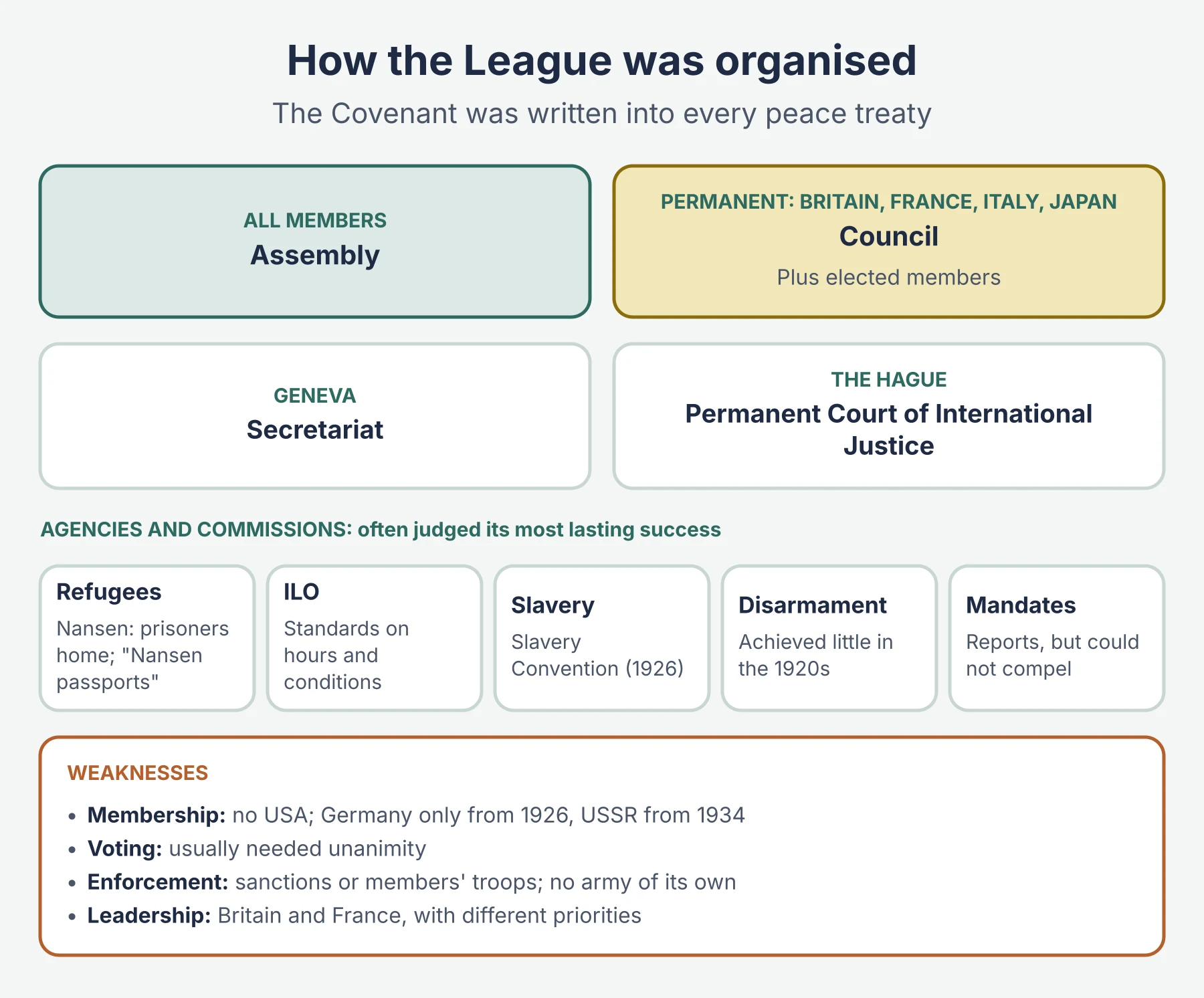
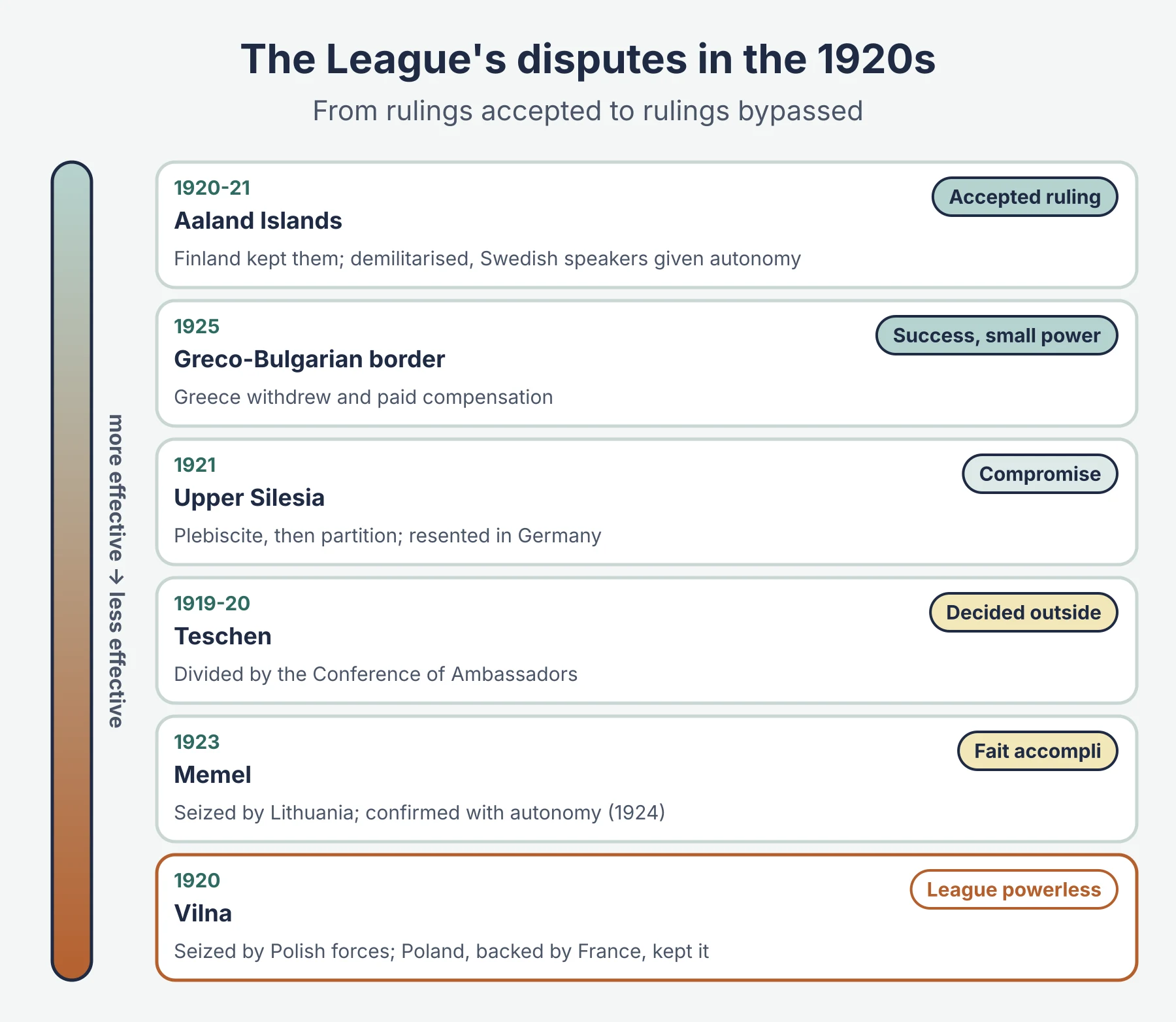
League successes and failures, 1920s
| Success | Partial | Failure |
|---|---|---|
| Aaland Islands; Greco-Bulgarian border | Upper Silesia; Memel | Vilna; Corfu (decided outside the League) |
| Nansen’s refugee work; ILO | Slavery Commission; Mandates Commission | Disarmament Commission |
Pattern: the League succeeded when the parties were small powers willing to accept its decisions; it failed when a great power or its ally was involved.
The treaties of conciliation
| Agreement | Purpose | Limitation |
|---|---|---|
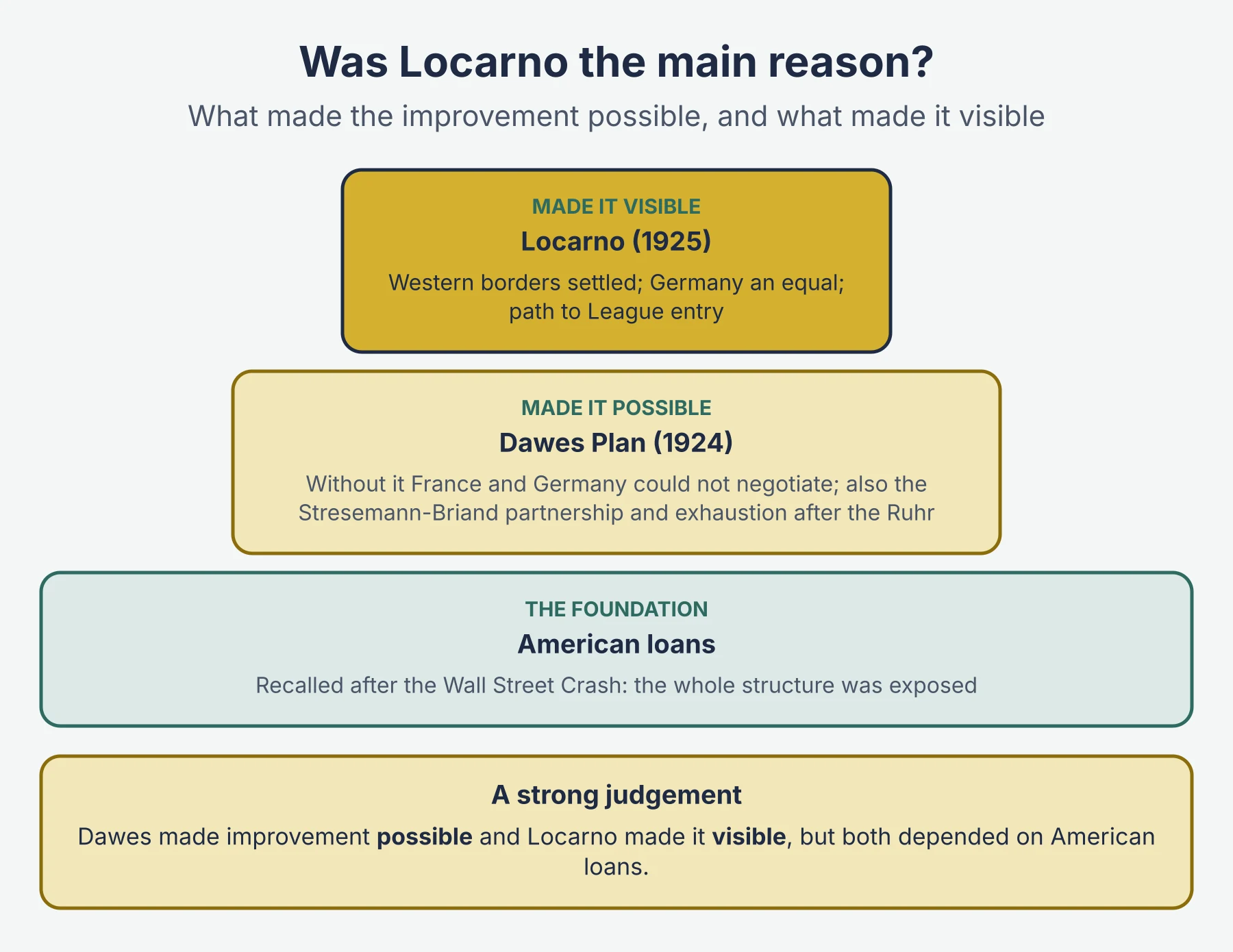
| Dawes Plan (1924) | Phased reparations; US loan | Depended on American money |
| Geneva Protocol (1924) | Compulsory arbitration | Rejected by Britain |
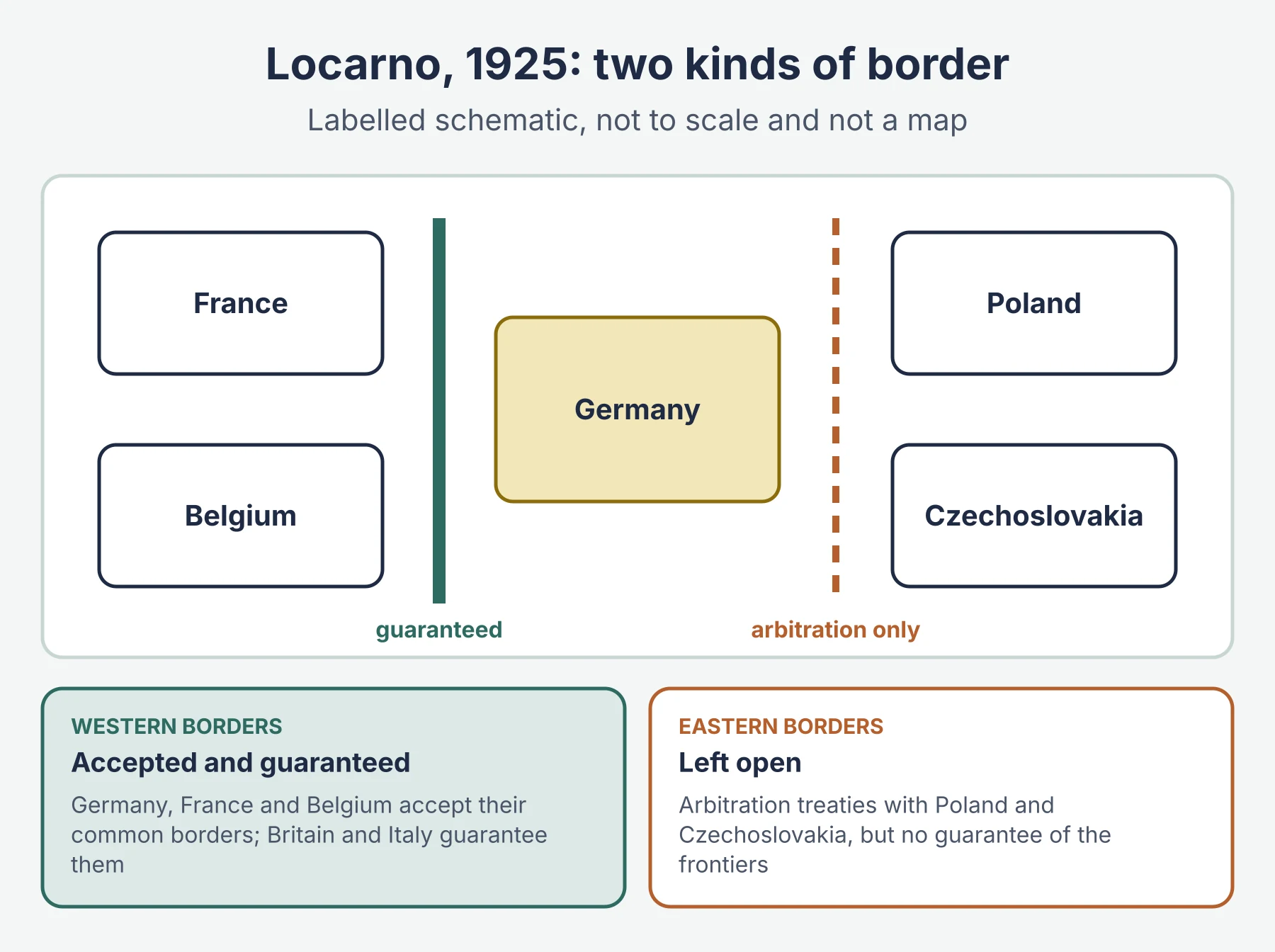
| Locarno (1925) | Western borders guaranteed | Eastern borders left open |
| Kellogg-Briand (1928) | Renounce war | No enforcement |
| Young Plan (1929) | Lower total, longer schedule | Overtaken by the Depression |
| Hague Conference (1929) | Young Plan accepted; Rhineland evacuation by 1930 | Creditor disputes |
Exam traps
- Article 231 does not use the words “war guilt”; that was the German description.
- Corfu was resolved by the Conference of Ambassadors, not the League Council.
- Rapallo (1922) is the German-Soviet pact; do not confuse it with the 1920 Italian-Yugoslav treaty of the same name.
- Lausanne replaced Sèvres – the first major treaty revision, won by force.
- “Reality or illusion?” needs evidence on both sides; mention the eastern frontiers, American loans and the effect of the Crash.
Self-test
- What did Clemenceau most want from the peace? Security against Germany.
- Which treaty applied to Hungary? Trianon.
- Give one example of self-determination being denied. Any one: Germans in the Sudetenland; ban on Austrian union with Germany; Arabs under mandates.
- Name the permanent members of the League Council in 1920. Britain, France, Italy and Japan.
- How was the Aaland Islands dispute settled? Finland kept the islands, which were demilitarised with autonomy for the Swedish-speaking population.
- Why did the League fail over Vilna? Poland, an ally of France, kept the city it had seized, and Britain and France would not act.
- What did the Commission for Refugees issue? Nansen passports.
- Why did France occupy the Ruhr? Germany had defaulted on reparations deliveries.
- What did the Washington Conference achieve? Battleship limits, the Four-Power Treaty in place of the Anglo-Japanese alliance, and a guarantee of China’s integrity.
- Why did the Rapallo Pact alarm the Western powers? It linked the two outcasts, Germany and Soviet Russia, outside the Versailles system.
- What did the Locarno Treaties not guarantee? Germany’s eastern borders.
- Why was the Wall Street Crash so damaging to the improvement of the 1920s? American loans were recalled, wrecking German recovery and the reparations settlement.
Official syllabus
Cambridge International AS & A Level History (9489) syllabus for 2027, 2028 and 2029 – cambridgeinternational.org (subject content, topic 8; Topics assessed on Paper 1 and Paper 2).
Related resources
-
Practice questions
Cambridge A Level World History (9489): Imperialism and the Emergence of World Powers – Practice Questions
Original Paper 1 source and Paper 2 essay practice for Cambridge 9489 topic 7, imperialism and world powers c.1870-1918, with mark-scheme style worked answers.
World History · Cambridge · AS Level
Try questions -
Study guides
A Level World History: International History, 1870-1939 (Cambridge 9489)
The International option of Cambridge AS and A Level History 9489 (2027-2029): imperialism and world powers, 1919-29 relations, and the road to war in 1939.
World History · Cambridge · AS Level
Read guide -
Practice questions
A Level World History: International History, 1870-1939 — Practice Questions
Original practice questions with worked answers on the three topics of the International option for Cambridge AS and A Level History 9489, 2027-2029 syllabus.
World History · Cambridge · AS Level
Try questions
Get free revision emails (optional)
Occasional emails with practice questions, worked explanations and links to free resources for the qualification and subjects you choose. No spam, and you can unsubscribe from any email. The free tools on this site never need an email.