
Study Guides
Cambridge A Level World History (9489): International history 1929-39: the rise of extremism and the road to war
Study guide to Cambridge 9489 History topic 9, 1929-39: extremism after the Depression, the League's failure, appeasement and why war broke out in 1939.
- Subject
- World History
- Level
- AS LEVEL
- Topic
- Paper 1 and Paper 2 – International Option: International History, 1870–1939
- Author
- Marlbridge Academic Team
- Updated
- Reviewed by
- Azam Siddique (what this means)
Aligned to Cambridge A Level World History (9489), 2027-2029. Official specification .
Syllabus page (what it covers and how it is assessed): Cambridge A Level World History.
Syllabus points this page covers
9489 (AS Level)
- 9 International history 1929–39: the rise of extremism and the road to war
Found an error? Report a correction.
Need help with this topic? Request a free trial class for A Level World History (9489).
International history 1929-39: the rise of extremism and the road to war is the third topic of the International option at AS Level in Cambridge International History 9489. Its four key questions are: how the rise of extremism affected international relations (9.1), why the League of Nations failed to keep the peace (9.2), why and with what effects Britain and France pursued appeasement (9.3), and why war broke out in 1939 (9.4). The topic begins where the 1920s topic ends – with the Wall Street Crash – and rewards answers that show how economic crisis, ideology and the choices of governments interacted. For the whole option, see the International History, 1870-1939 study guide.
Where this fits in 9489
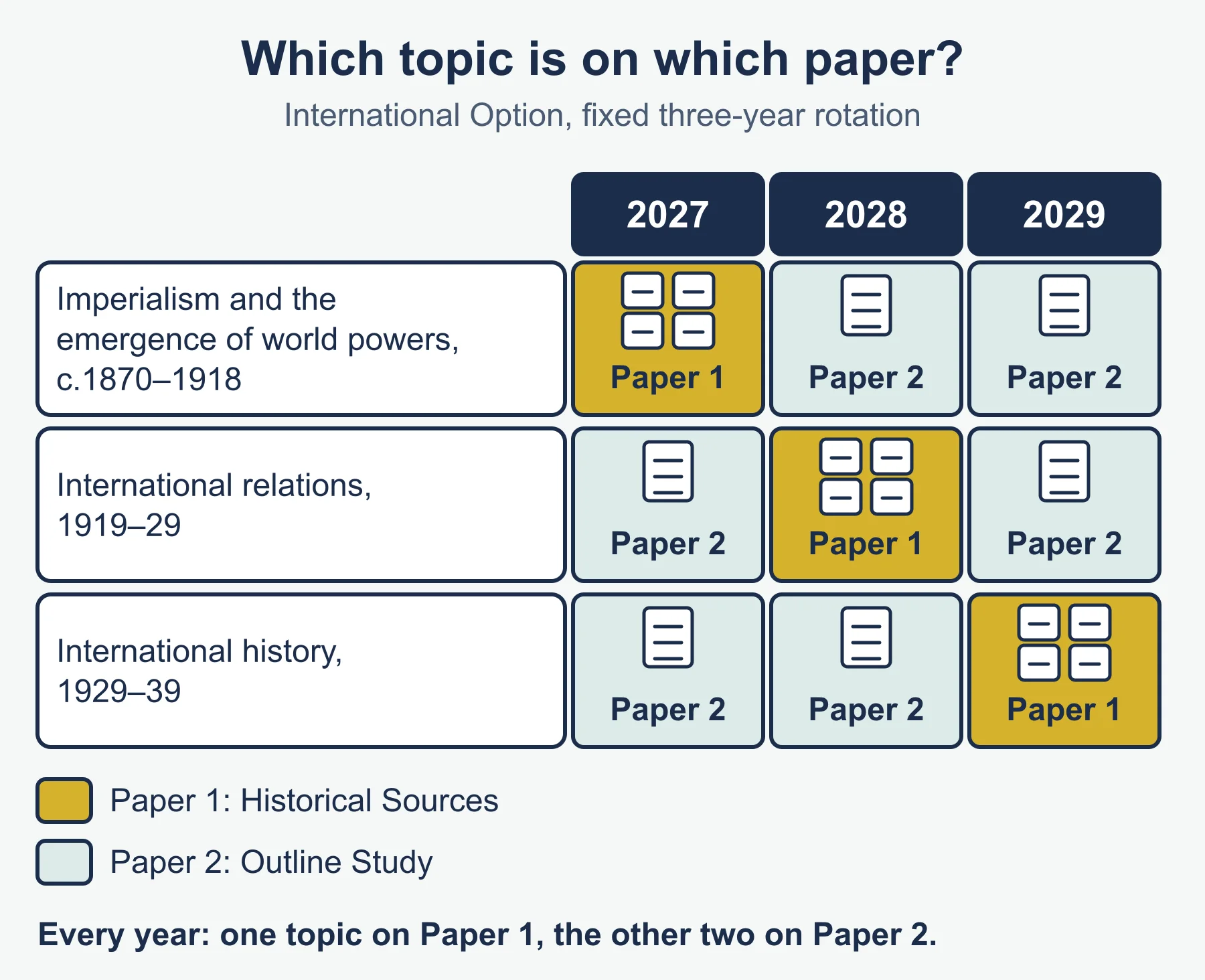
Under the 2027-2029 rotation this topic is on Paper 2 (Outline Study) in 2027 and 2028 and on Paper 1 (Historical Sources) in 2029. Revise with the International history 1929-39 revision notes and practise with the International history 1929-39 practice questions.
9.1 How did the rise of extremism affect international relations?
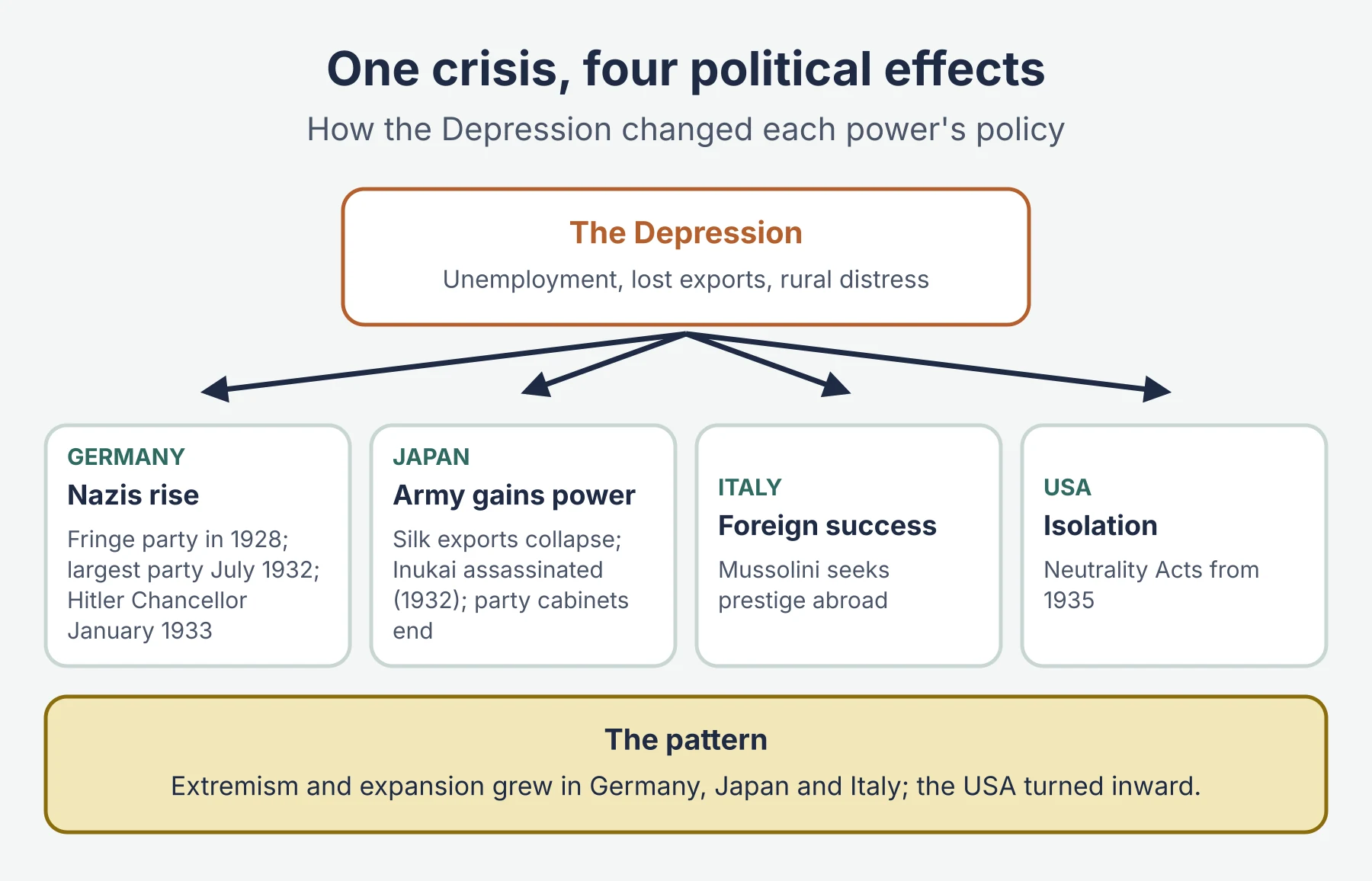
The Depression changed politics. In Germany, mass unemployment and the recall of American loans destroyed faith in the Weimar parties; the Nazis rose from a fringe party in 1928 to the largest party in the Reichstag in July 1932, and Hitler became Chancellor in January 1933. In Japan, the collapse of silk exports and rural distress discredited party government; nationalist officers assassinated Prime Minister Inukai in 1932, after which party cabinets ended and the army’s influence grew. In Italy, economic difficulty pushed Mussolini towards foreign success to restore prestige. In the USA, the Depression strengthened isolation: Congress passed Neutrality Acts from 1935 to keep the country out of foreign wars.
The World Disarmament Conference (1932-34). It met because the Covenant and the peace treaties had promised general disarmament after German disarmament. International events – fighting between Japan and China at Shanghai as it opened in February 1932, then Hitler’s appointment – undermined it. The central problem was France and Germany: France demanded security before disarming; Germany demanded equality of rights, which was conceded in principle in December 1932. In October 1933 Hitler withdrew from both the conference and the League, and it petered out in 1934.
Changing relationships.
- London Naval Conference (1930): Britain, the USA and Japan extended limits to smaller warships; Japanese nationalists saw the terms as humiliating.
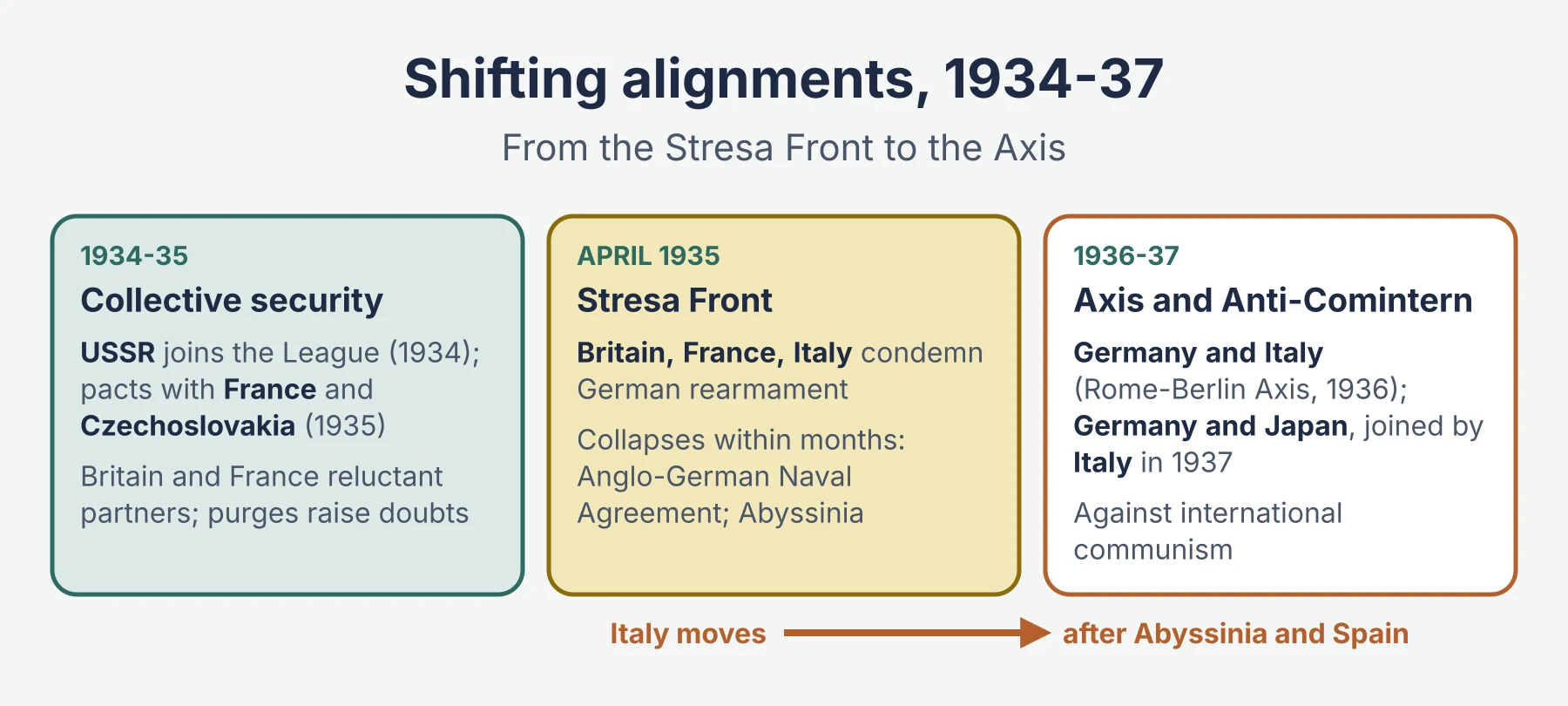
- Stresa Front (April 1935): Britain, France and Italy condemned German rearmament and affirmed Locarno and Austrian independence – but it collapsed within months over the Anglo-German Naval Agreement and Abyssinia.
- Rome-Berlin Axis (1936): after Abyssinia and joint intervention in Spain, Mussolini moved towards Hitler.
- Anti-Comintern Pact (1936-37): Germany and Japan, joined by Italy in 1937, against international communism.
The USSR. Alarmed by Nazism, Stalin switched to collective security: the USSR joined the League in 1934 and signed pacts with France and Czechoslovakia in 1935, and the Comintern called for Popular Fronts against fascism. Yet fear of communism in Britain and France made them reluctant partners, and the purges of 1936-38 led them to doubt Soviet military value.
9.2 Why did the League fail to keep the peace in the 1930s?
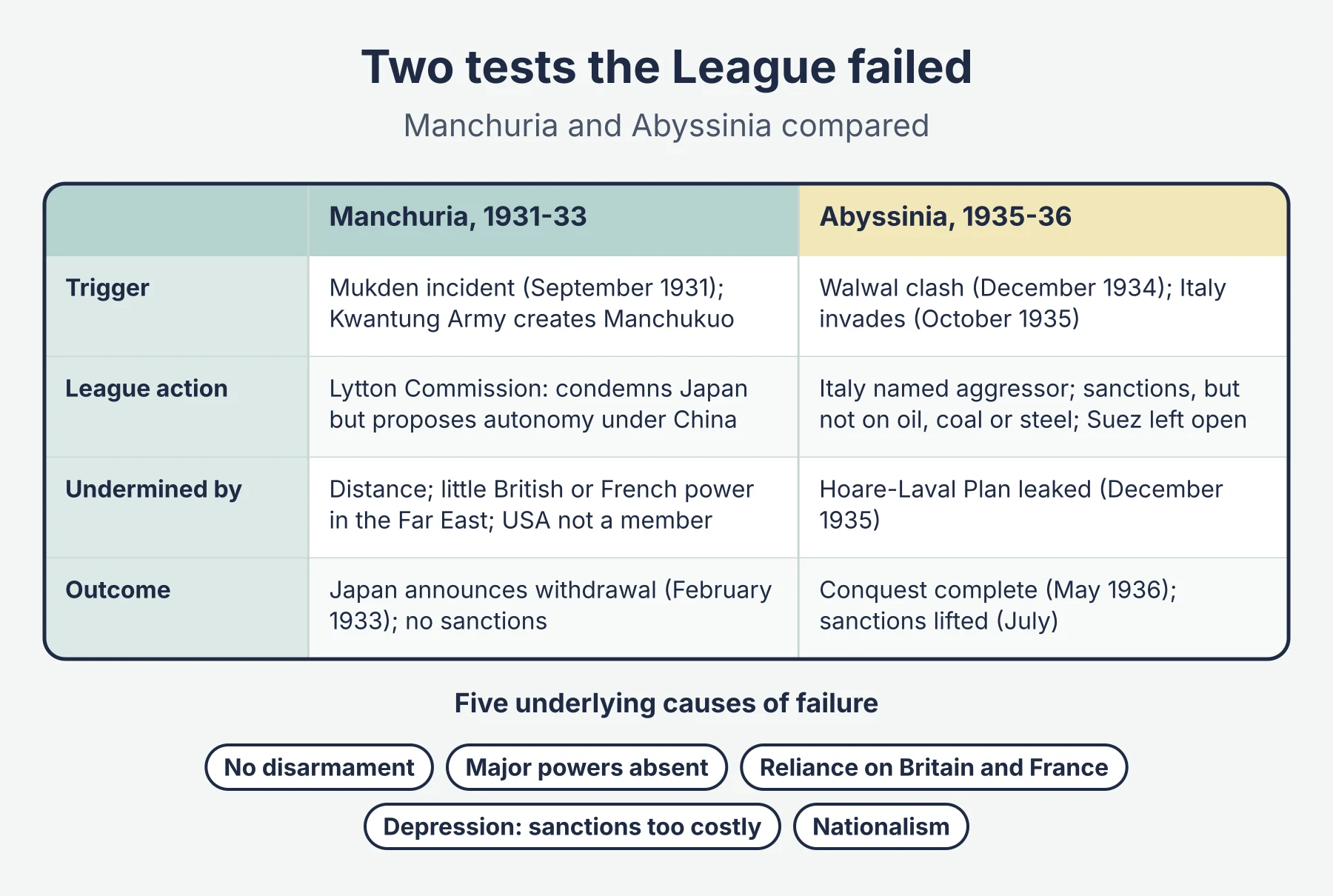
Manchuria (1931-33). After the Mukden incident (September 1931), the Kwantung Army occupied Manchuria and created the puppet state of Manchukuo. The League sent the Lytton Commission, whose report condemned Japan but proposed autonomy for Manchuria under Chinese sovereignty. When the Assembly adopted it in February 1933, Japan announced its withdrawal from the League. No sanctions were imposed: Manchuria was distant, Britain and France had little military power in the Far East, and the USA was not a member.
Abyssinia (1935-36). After a clash at Walwal (December 1934), Italy invaded in October 1935. The League named Italy the aggressor and imposed sanctions – but not on oil, coal or steel, and Britain did not close the Suez Canal. In December 1935 the leaked Hoare-Laval Plan offered Italy much of Abyssinia, discrediting both governments. Italy completed its conquest in May 1936; sanctions were lifted in July. Britain and France had hoped to keep Mussolini as an ally against Hitler, and lost both him and the League’s credibility.
Changing attitudes. Japan (March 1933) and Germany (October 1933) withdrew, and Italy announced its withdrawal in December 1937 (the syllabus list gives 1936, but the announcement came after Italy joined the Anti-Comintern Pact in November 1937); the USSR’s admission in 1934 did not compensate. Increasingly, the great powers negotiated outside the League: Stresa, the Anglo-German Naval Agreement, Munich.
The Spanish Civil War (1936-39). The League did not respond because the war was treated as an internal conflict and because Britain and France preferred a separate arrangement. The Non-Intervention Agreement (1936), supervised by a committee in London, failed because Germany and Italy sent aircraft, weapons and troops to Franco, and the USSR supplied the Republic; Britain and France lacked the commitment to enforce it, and France under Blum, though sympathetic to the Republic, would not act without Britain. The Comintern organised International Brigades of foreign volunteers for the Republic. The war tested German weapons – the bombing of Guernica (1937) – and drew Hitler and Mussolini together.
Causes of failure. The League could not achieve disarmament; major powers were absent; it relied on Britain and France, whose own interests came first; the Depression made members unwilling to pay the cost of sanctions; and rising nationalism produced states that rejected the League’s principles.
9.3 Why, and with what effects, did Britain and France pursue appeasement?
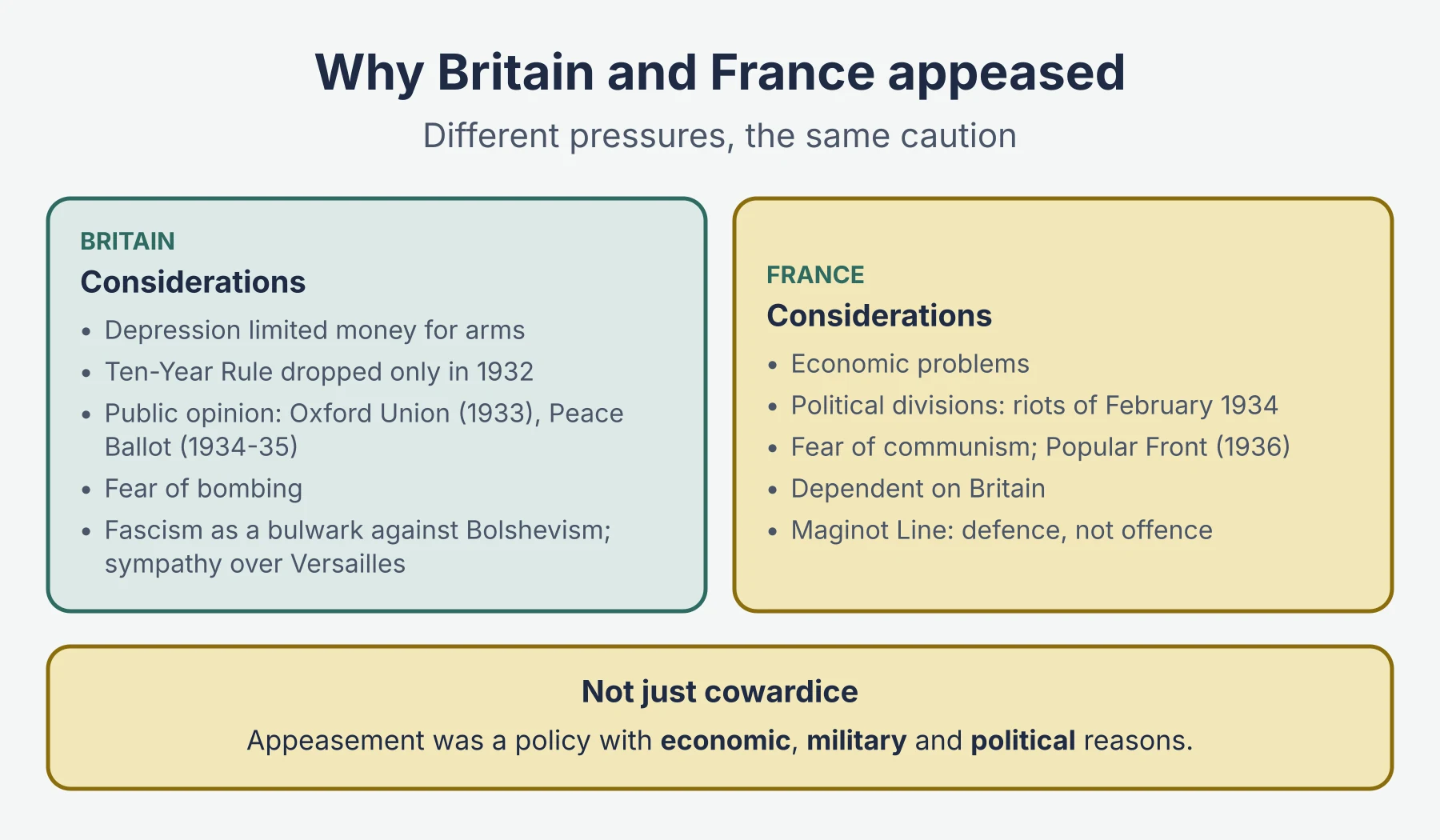
British considerations. The Depression limited money for arms. The Ten-Year Rule, which had assumed no major war for ten years, was dropped only in 1932, leaving forces run down. Public opinion seemed pacifist: the Oxford Union voted in 1933 that it would “in no circumstances fight for its King and Country”, and the Peace Ballot (1934-35) showed overwhelming support for the League and disarmament. Many feared bombing of cities. Some in the elite saw fascism as a bulwark against Bolshevism, and some sympathised with German grievances over Versailles.
French considerations. Economic problems, deep political divisions (including the riots of February 1934), fear of communism, and the election of the Popular Front in 1936 made France cautious and dependent on Britain. French Grand Strategy relied on the Maginot Line, a defensive fortification that made offensive action to help eastern allies unlikely.
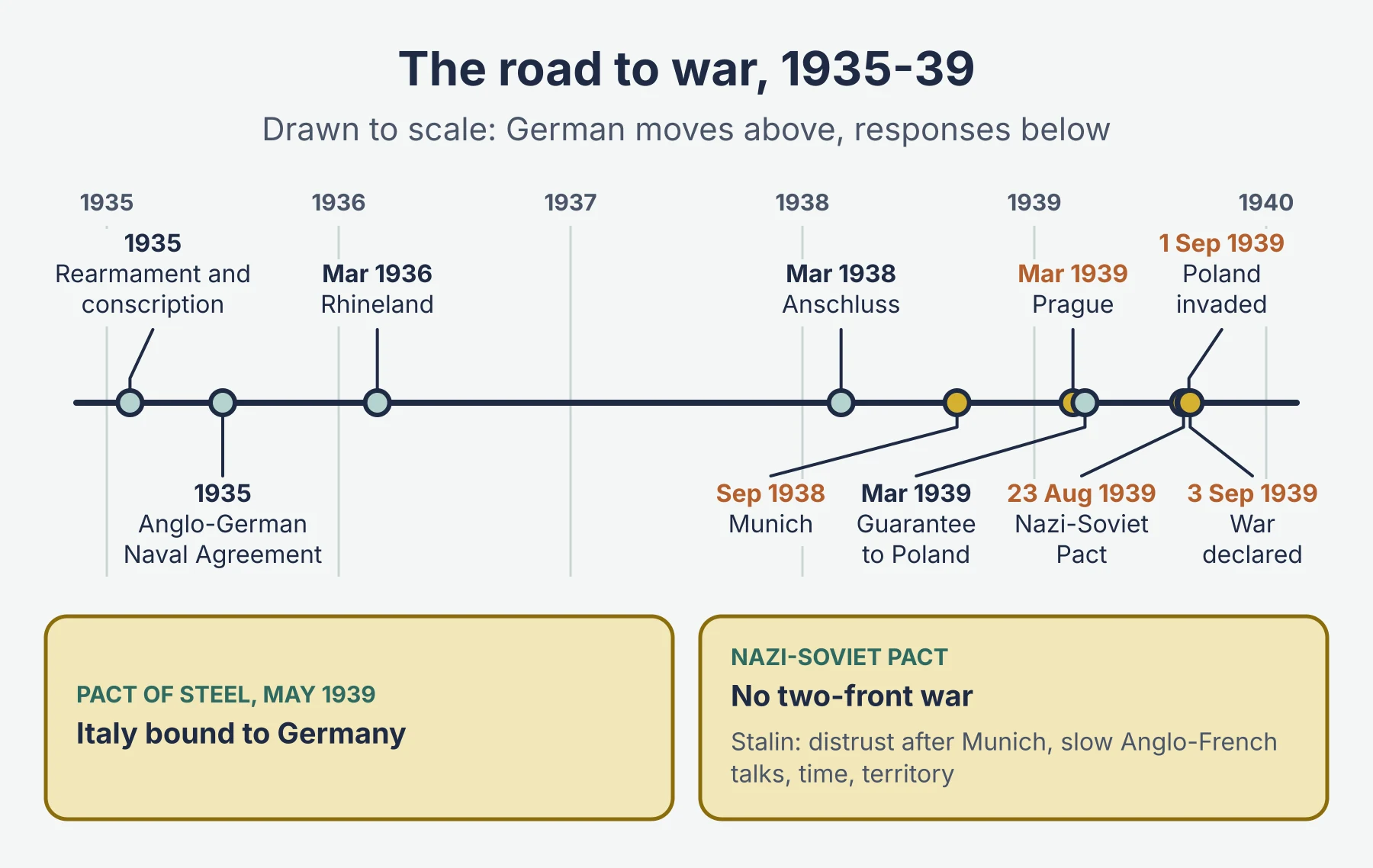
Actions. Britain accepted German rearmament through the Anglo-German Naval Agreement (1935), allowing a German fleet of 35 per cent of British surface strength. Neither power acted when Germany remilitarised the Rhineland (March 1936) or carried out the Anschluss (March 1938). In the Sudetenland crisis, Chamberlain flew to Germany twice and, at the Munich Conference (September 1938), Britain, France, Italy and Germany agreed to transfer the Sudetenland to Germany without consulting Czechoslovakia. When Hitler occupied Prague in March 1939, appeasement ended: Britain and France guaranteed Poland.
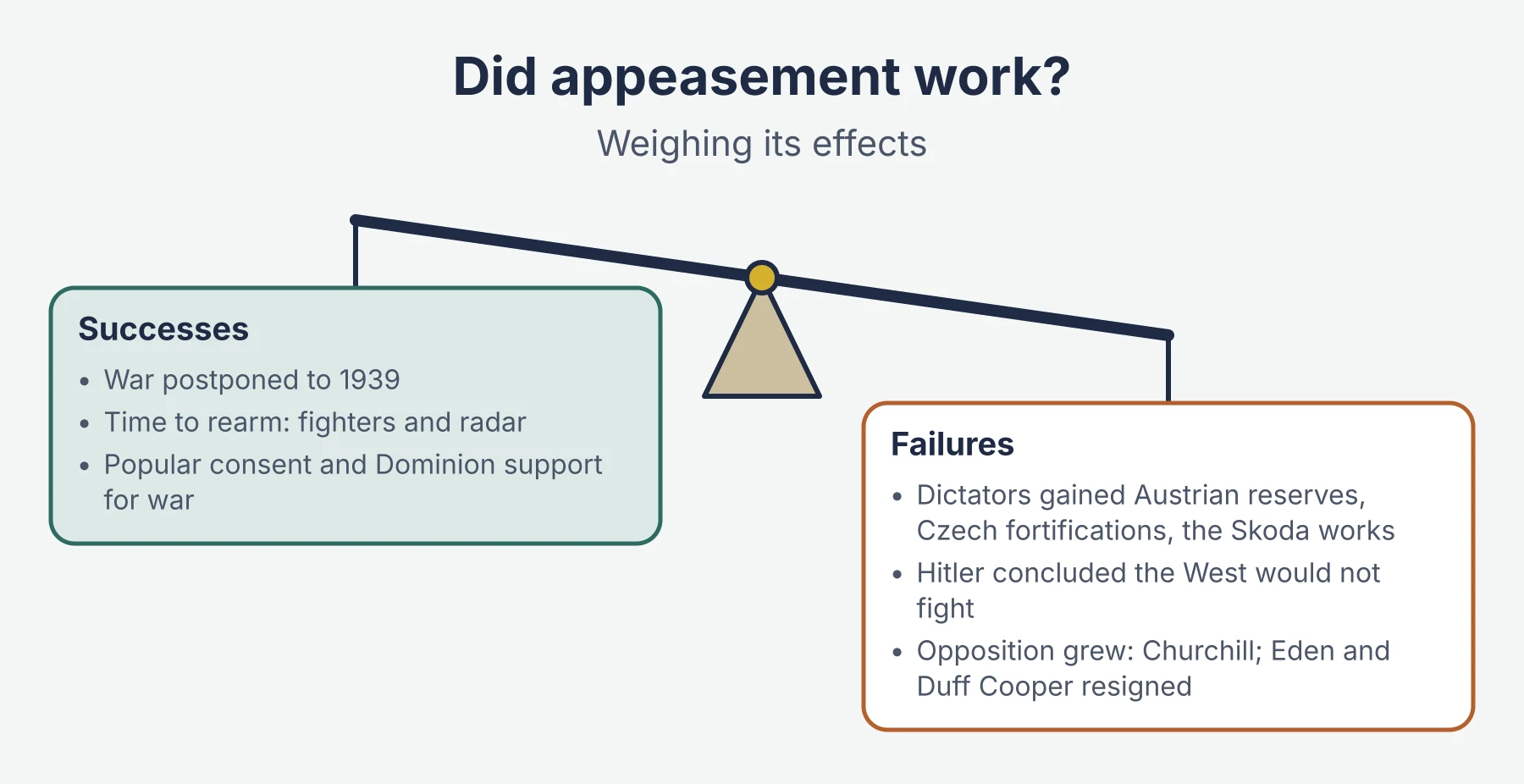
Successes. War was postponed to 1939; Britain used the time for rearmament, especially fighters and radar; and by 1939 Chamberlain had shown that every peaceful option had been tried, gaining popular consent and Dominion support for war.
Failures. Appeasement increased the dictators’ resources – Austrian reserves, Czech fortifications and the Skoda arms works – and their morale: Hitler concluded the Western leaders would not fight. Opposition grew: Churchill warned throughout, Eden resigned in 1938, and Duff Cooper resigned over Munich.
9.4 Why did war break out in 1939?
Hitler’s aims and actions. Hitler aimed to overturn Versailles, unite German-speakers and win Lebensraum in the east. He announced rearmament and conscription (1935), remilitarised the Rhineland (1936), annexed Austria and the Sudetenland (1938) and destroyed Czechoslovakia (1939). Each success raised his confidence and weakened his opponents.
British rearmament. From the mid-1930s Britain expanded the RAF, prioritising fighters such as the Hurricane and Spitfire and building radar stations; it prepared for air raids with gas masks, shelters and air-raid precautions. By 1939 fighter output and the radar chain were growing fast, though the army remained small.
German alliances. The Anti-Comintern Pact linked Germany with Japan and Italy; the Pact of Steel (May 1939) bound Italy to Germany. The Nazi-Soviet Pact (23 August 1939) gave Hitler freedom to attack Poland without a two-front war; its secret protocol divided eastern Europe. Stalin’s motives included distrust of Britain and France after Munich, from which the USSR had been excluded, the slow Anglo-French negotiations of 1939, the need to buy time, and territorial gain.
Poland. Hitler demanded Danzig and a route across the Polish Corridor. Britain and France’s guarantee to Poland (March 1939) marked the end of appeasement. Some in the German High Command feared a general war – General Beck had resigned in 1938 – but Hitler overrode them; he expected Britain and France to back down again. Germany invaded Poland on 1 September 1939; Britain and France declared war on 3 September.
Worked example: a Paper 2 part (b)
“Hitler’s foreign policy was the main reason for the outbreak of war in 1939.” How far do you agree? [20]
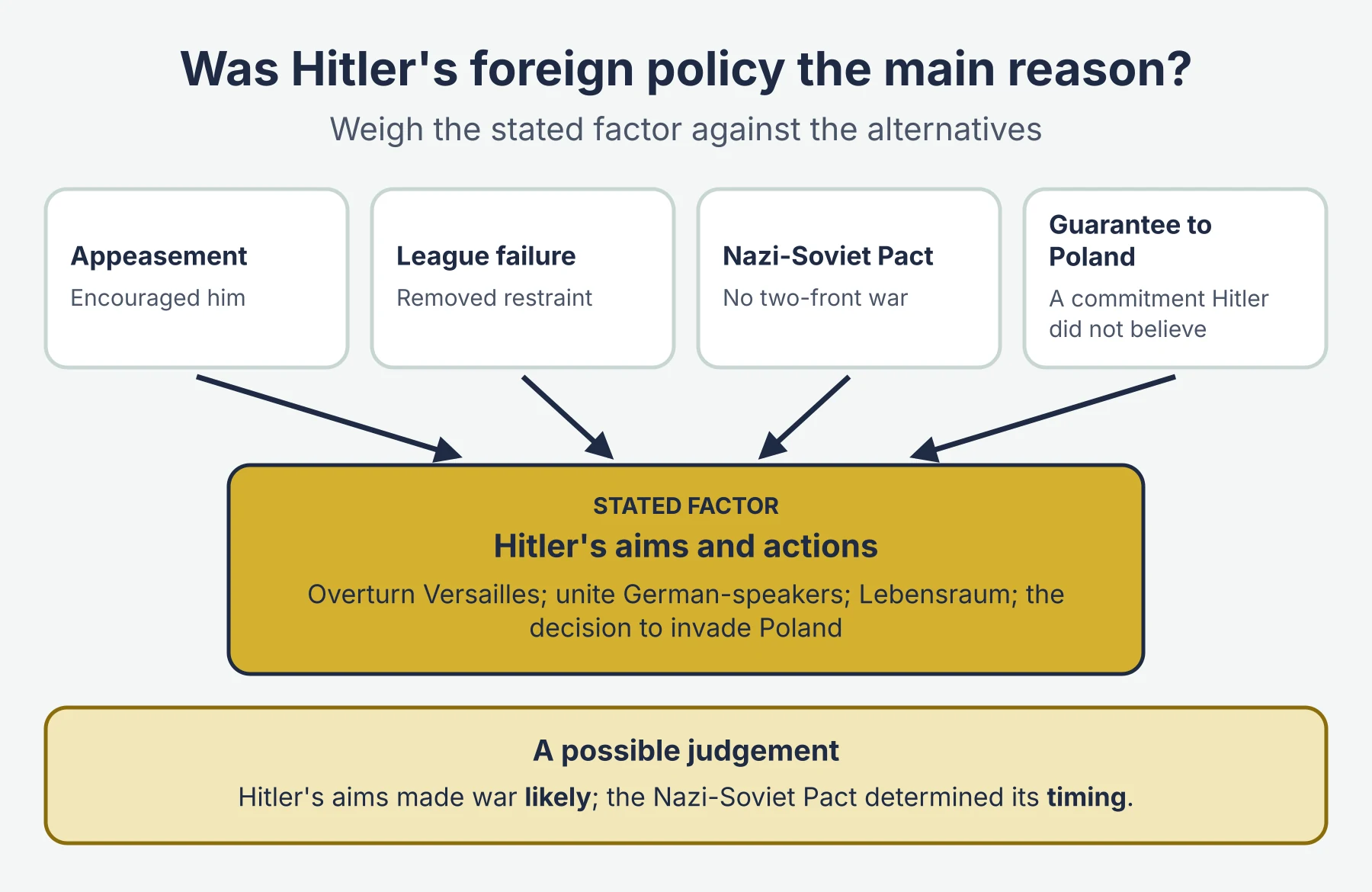
Explain the case for Hitler: aims, expansion and the decision to invade Poland. Weigh alternatives: appeasement encouraged him; the League’s failure removed restraint; the Nazi-Soviet Pact removed the risk of a two-front war; the guarantee to Poland created a commitment Hitler did not believe. Judge, for example, that Hitler’s aims made war likely and the Nazi-Soviet Pact determined its timing.
Common mistakes
- Treating appeasement only as cowardice instead of a policy with economic, military and political reasons.
- Writing about the Spanish Civil War’s battles rather than international responses.
- Confusing the Anti-Comintern Pact with the Pact of Steel.
- Forgetting the Disarmament Conference and the USSR.
Official syllabus
Cambridge International AS & A Level History (9489) syllabus for 2027, 2028 and 2029 – cambridgeinternational.org (subject content, topic 9; Topics assessed on Paper 1 and Paper 2). Always check the current syllabus before an exam.
Related resources
-
Practice questions
Cambridge A Level World History (9489): International history 1929-39: the rise of extremism and the road to war – Practice Questions
Twelve original practice questions on Cambridge 9489 international history 1929-39, with invented Paper 1 sources, Paper 2 essays and mark-scheme style answers.
World History · Cambridge · AS Level
Try questions -
Revision notes
Cambridge A Level World History (9489): International history 1929-39: the rise of extremism and the road to war – Revision Notes
Revision notes for Cambridge 9489 History topic 9, 1929-39: Depression and extremism, the League's crises, appeasement, the 1939 alliances and a self-test.
World History · Cambridge · AS Level
Revise topic -
Study guides
Cambridge A Level World History (9489): International relations 1919-29: conflict and cooperation
Study guide to Cambridge 9489 History topic 8, 1919-29: the peace treaties, the League and its disputes, the crises of 1919-23 and the improvement of 1924-29.
World History · Cambridge · AS Level
Read guide
Get free revision emails (optional)
Occasional emails with practice questions, worked explanations and links to free resources for the qualification and subjects you choose. No spam, and you can unsubscribe from any email. The free tools on this site never need an email.