
Revision Notes
Cambridge A Level World History (9489): International history 1929-39: the rise of extremism and the road to war – Revision Notes
Revision notes for Cambridge 9489 History topic 9, 1929-39: Depression and extremism, the League's crises, appeasement, the 1939 alliances and a self-test.
- Subject
- World History
- Level
- AS LEVEL
- Topic
- Paper 1 and Paper 2 – International Option: International History, 1870–1939
- Author
- Marlbridge Academic Team
- Updated
- Reviewed by
- Azam Siddique (what this means)
Aligned to Cambridge A Level World History (9489), 2027-2029. Official specification .
Syllabus page (what it covers and how it is assessed): Cambridge A Level World History.
Syllabus points this page covers
9489 (AS Level)
- 9 International history 1929–39: the rise of extremism and the road to war
Found an error? Report a correction.
Need help with this topic? Request a free trial class for A Level World History (9489).
These notes condense Cambridge 9489 AS topic 9, International history 1929-39: the rise of extremism and the road to war, for fast recall. The key questions are the effect of extremism on international relations (9.1), the League’s failure (9.2), appeasement (9.3) and the outbreak of war in 1939 (9.4). Full explanations are in the International history 1929-39 study guide; exam practice is in the International history 1929-39 practice questions.
Rotation (2027-2029 syllabus): Paper 2 (Outline Study) in 2027 and 2028; Paper 1 (Historical Sources) in 2029.
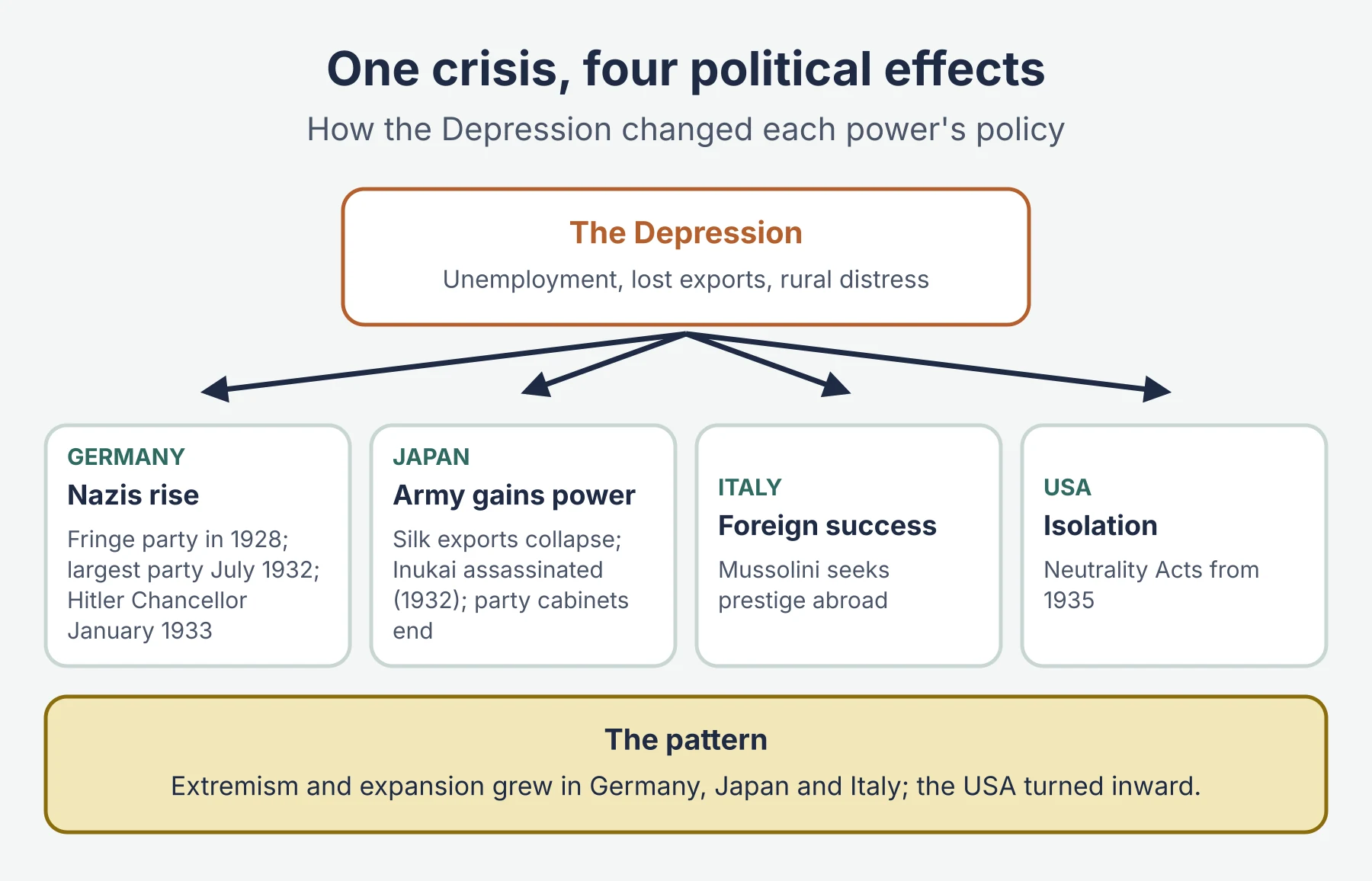
How the Depression changed four powers
| Power | Political effect | International effect |
|---|---|---|
| Germany | Collapse of Weimar coalition politics; Nazis largest party (1932); Hitler Chancellor (1933) | Rearmament; exit from League and Disarmament Conference |
| Japan | Party government discredited; assassinations; army dominant | Manchuria (1931); exit from League (1933) |
| Italy | Pressure on Mussolini to restore prestige | Abyssinia (1935); move towards Germany |
| USA | Isolationism strengthened | Neutrality Acts; no role in collective security |
Chronology
| Date | Event |
|---|---|
| Oct 1929 | Wall Street Crash |
| 1930 | London Naval Conference |
| Sept 1931 | Mukden incident |
| Feb 1932 | World Disarmament Conference opens |
| March 1932 | Manchukuo proclaimed |
| Jan 1933 | Hitler Chancellor |
| Feb-March 1933 | Lytton Report adopted; Japan announces withdrawal |
| Oct 1933 | Germany leaves Conference and League |
| Sept 1934 | USSR joins the League |
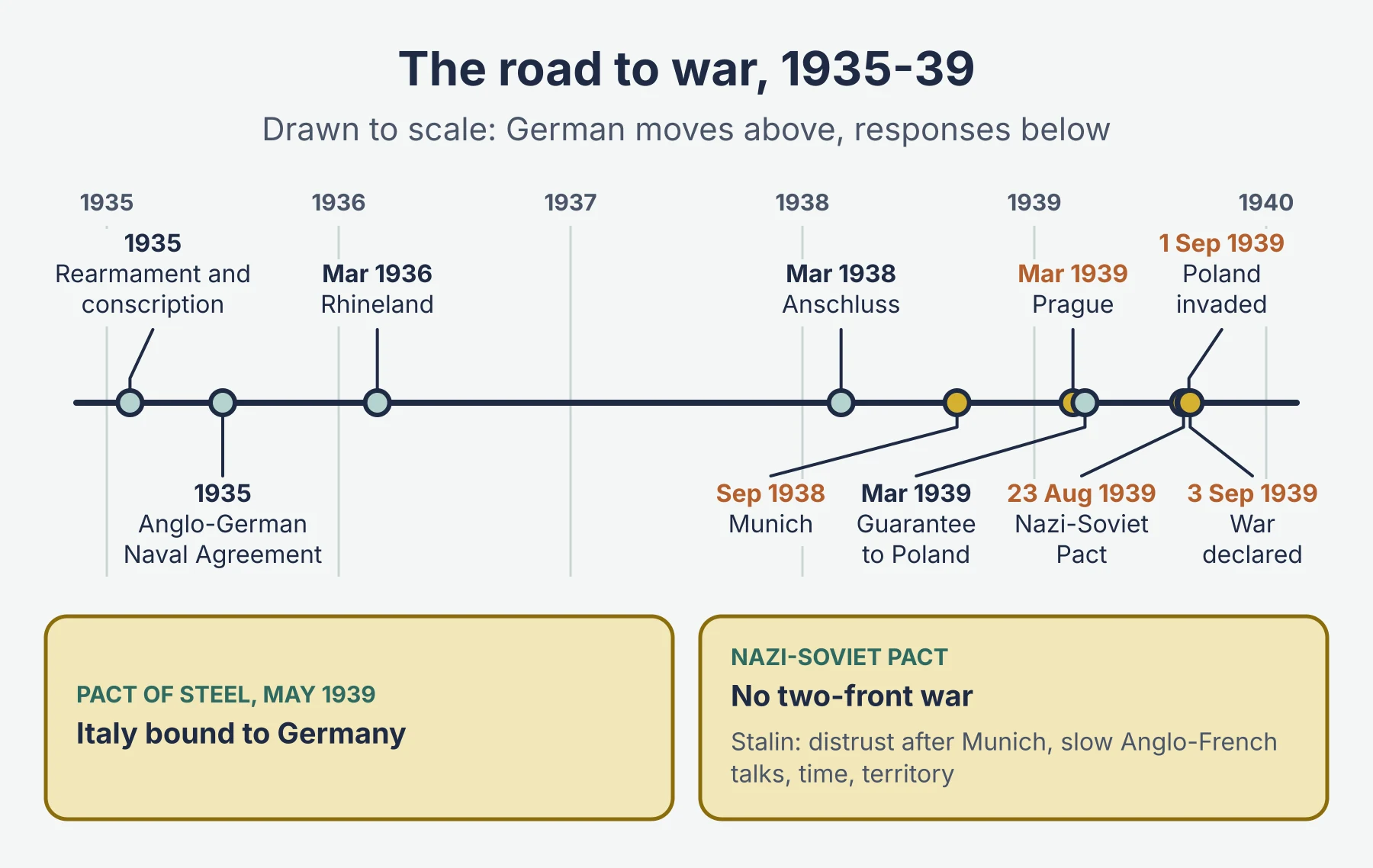
| March 1935 | German rearmament and conscription announced |
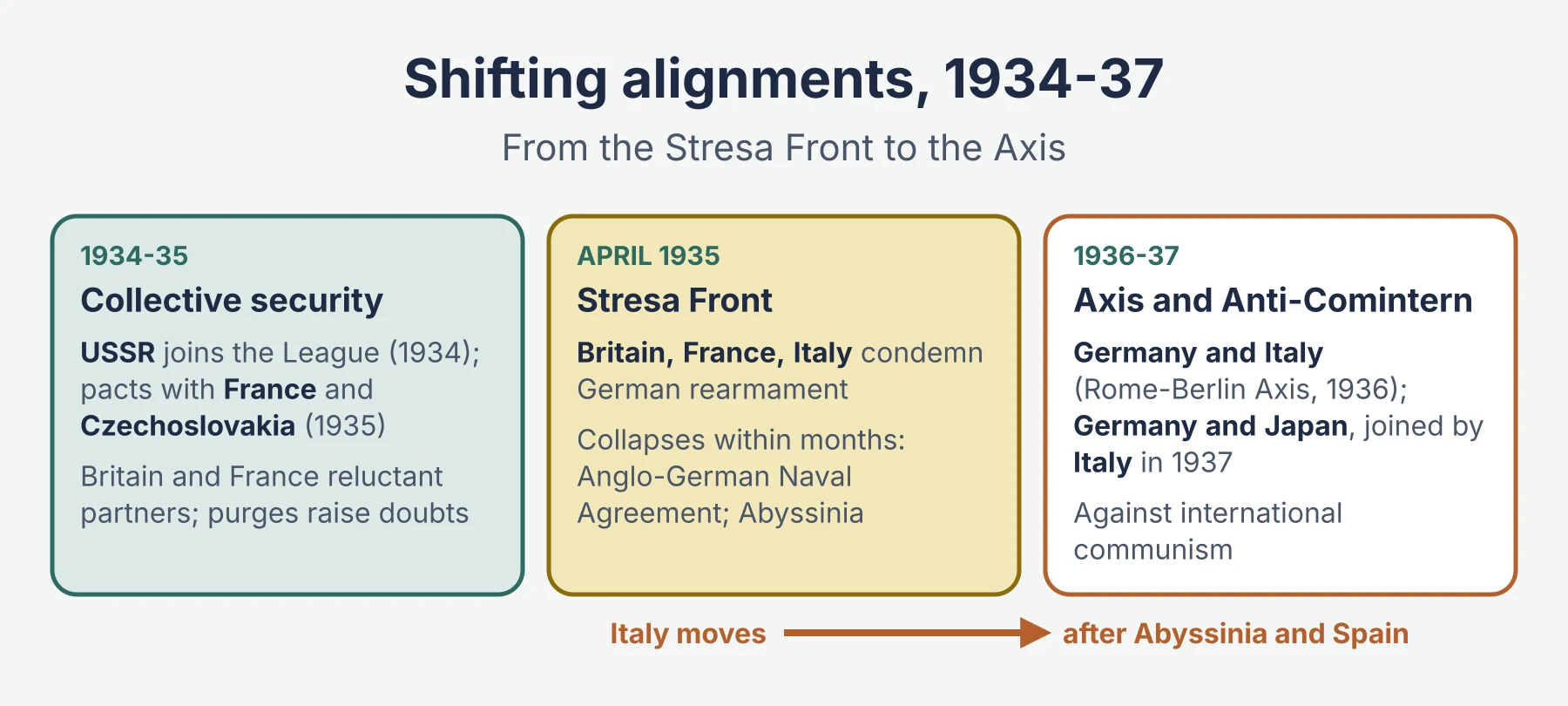
| April 1935 | Stresa Front |
| May 1935 | Franco-Soviet and Czech-Soviet pacts |
| June 1935 | Anglo-German Naval Agreement |
| Oct 1935 | Italy invades Abyssinia; limited sanctions |
| Dec 1935 | Hoare-Laval Plan leaked |
| March 1936 | Rhineland remilitarised |
| July 1936 | Spanish Civil War begins; sanctions on Italy lifted |
| Aug-Sept 1936 | Non-Intervention Agreement and Committee |
| Oct-Nov 1936 | Rome-Berlin Axis; Anti-Comintern Pact |
| Nov 1937 | Italy joins the Anti-Comintern Pact |
| March 1938 | Anschluss |
| Sept 1938 | Munich Conference |
| March 1939 | Prague occupied; guarantee to Poland |
| May 1939 | Pact of Steel |
| 23 Aug 1939 | Nazi-Soviet Pact |
| 1-3 Sept 1939 | Poland invaded; Britain and France declare war |
Key terms
| Term | Meaning |
|---|---|
| Extremism | Political movements rejecting democracy: fascism, Nazism, militarism, communism |
| Militarism | Dominance of the armed forces and military values in politics |
| Isolationism | US policy of avoiding foreign commitments |
| Equality of rights | German demand to be treated as other powers on armaments |
| Collective security | Joint action by League members against aggression |
| Sanctions | Economic penalties imposed on an aggressor |
| Non-intervention | Agreement not to supply either side in Spain |
| International Brigades | Foreign volunteers who fought for the Spanish Republic |
| Appeasement | Avoiding war by negotiating concessions to grievances |
| Ten-Year Rule | British assumption of no major war within ten years (dropped 1932) |
| Maginot Line | French defensive fortifications on the German border |
| Lebensraum | “Living space” in eastern Europe for Germans |
| Secret protocol | Hidden part of the Nazi-Soviet Pact dividing eastern Europe |
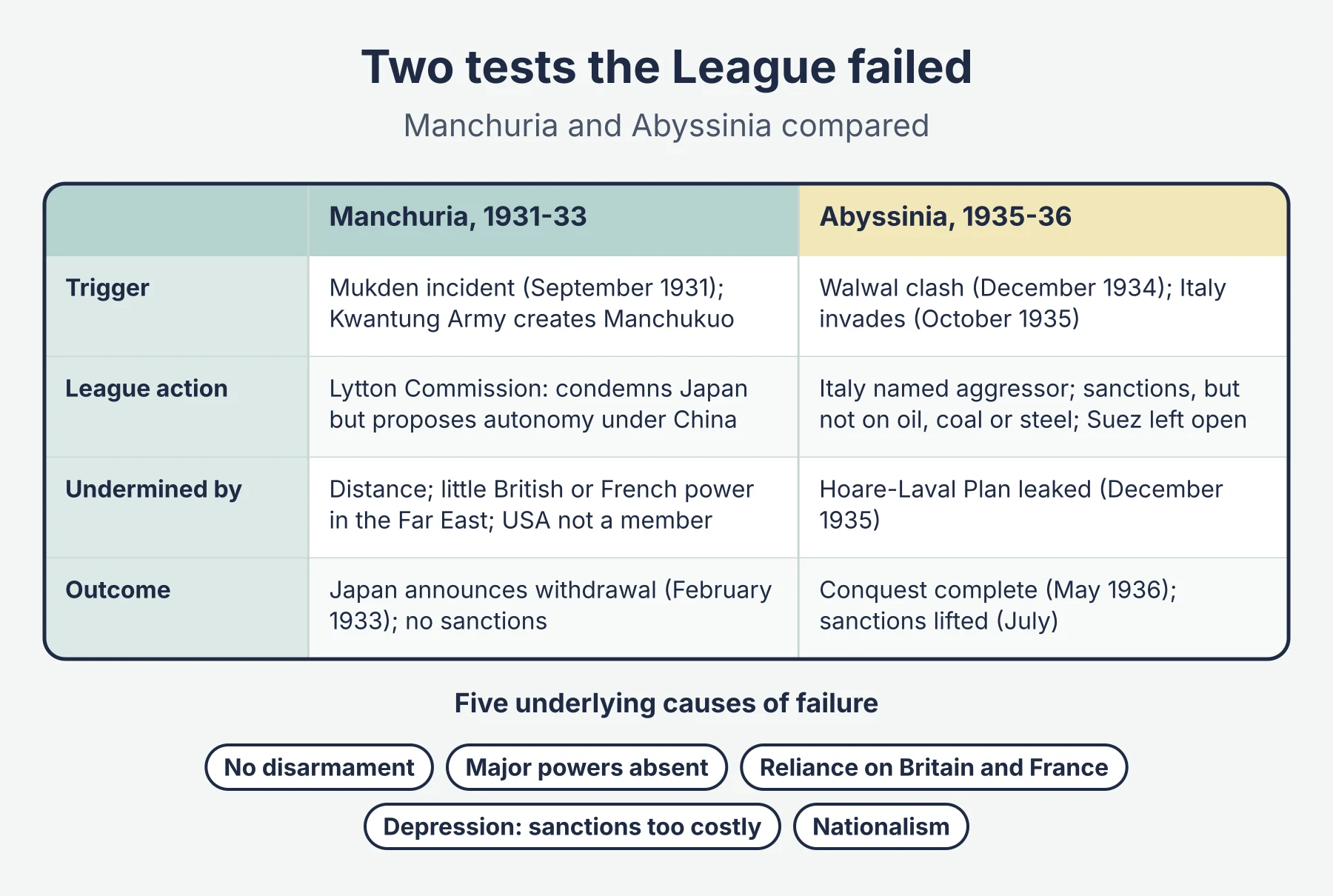
The League’s two great tests
| Manchuria, 1931-33 | Abyssinia, 1935-36 | |
|---|---|---|
| Aggressor | Japan (Kwantung Army) | Italy |
| League action | Lytton Commission; report adopted | Aggressor named; partial sanctions |
| What was missing | Any sanctions; US membership | Oil sanctions; closure of Suez |
| Great-power behaviour | Britain and France unwilling to act in Asia | Hoare-Laval Plan undermined sanctions |
| Result | Japan left the League | Conquest completed; sanctions lifted |
Appeasement – motives, actions, verdict
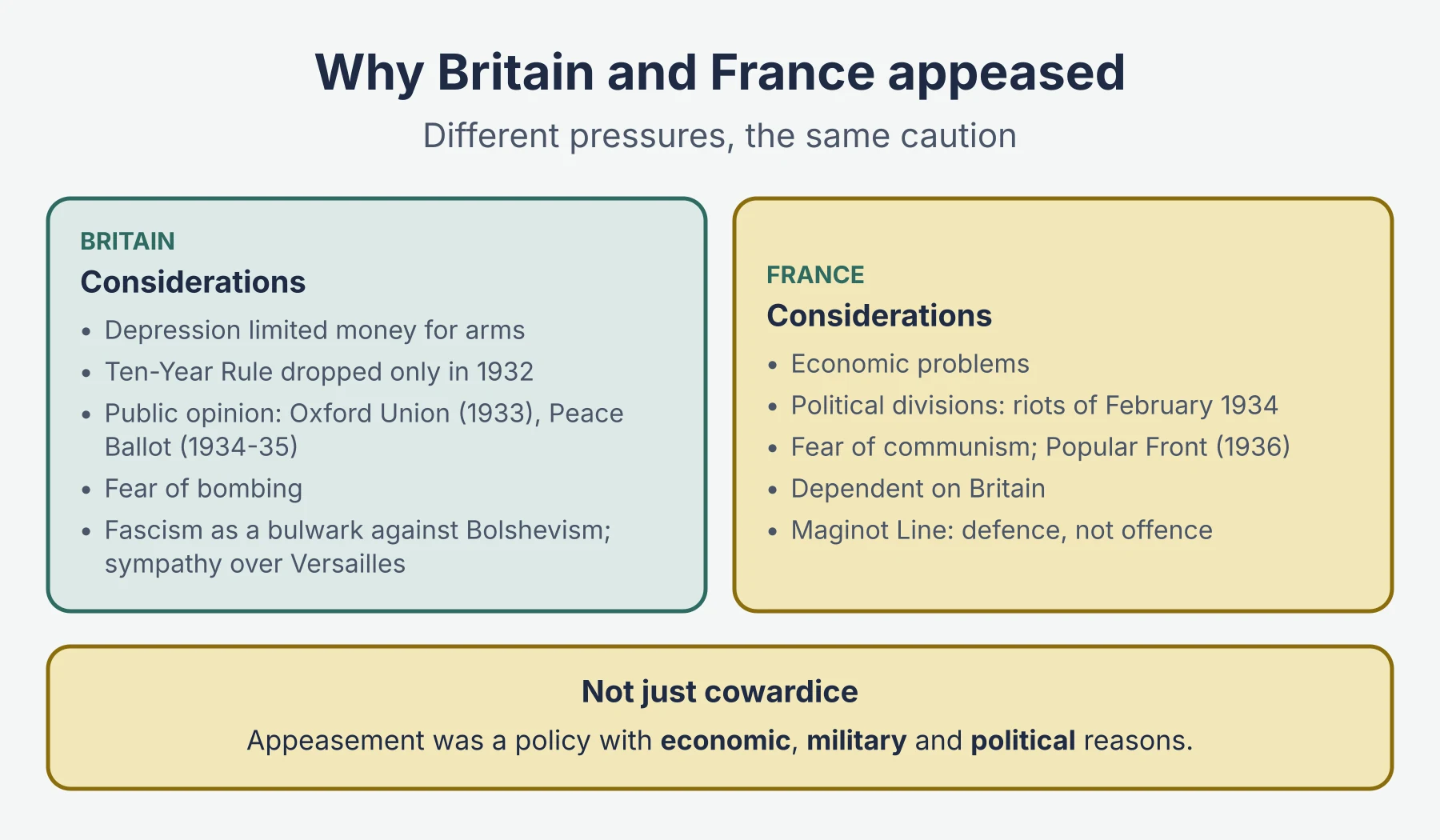
- Motives (Britain): Depression and cost; the Ten-Year Rule’s legacy; public opinion (Oxford Union, Peace Ballot); fear of bombing; Versailles thought unfair; fascism as a barrier to communism; imperial commitments.
- Motives (France): economic weakness; political division; fear of communism; Popular Front (1936); Maginot defensive strategy; dependence on Britain.
- Actions: Naval Agreement (1935); Rhineland (1936); Anschluss (1938); Munich (1938); response to Prague (1939).
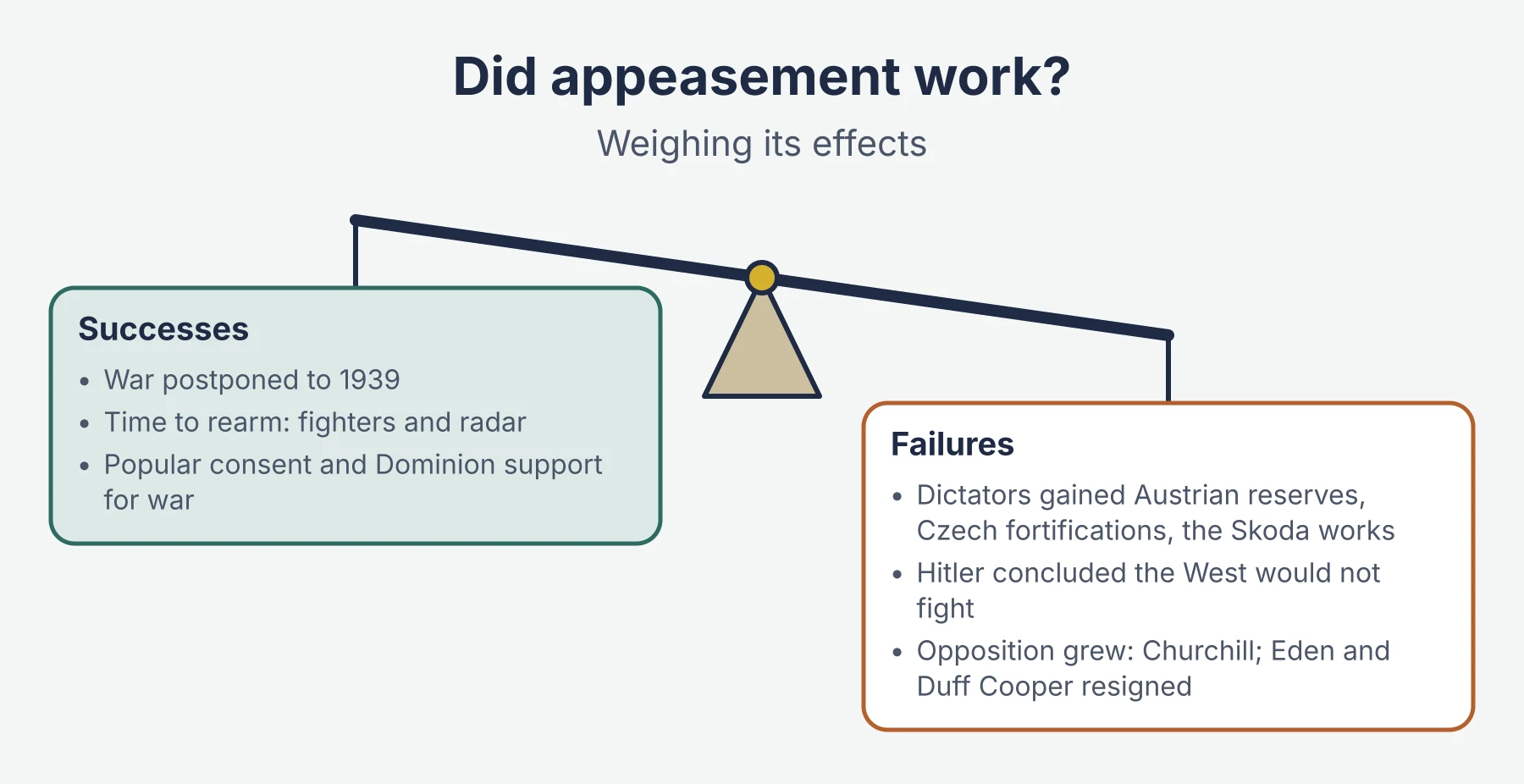
- Successes: war postponed; time for rearmament; public and Dominion consent in 1939.
- Failures: dictators gained resources and confidence; opposition grew; the USSR was alienated.
Exam traps
- Anti-Comintern Pact v. Pact of Steel. The first (1936) was against communism; the second (May 1939) was a German-Italian military alliance.
- Abyssinia and Stresa. British and French hesitation over sanctions came partly from the wish to keep Italy in the Stresa Front.
- Spain. The question is about international responses, not the battles.
- Munich. Czechoslovakia was not represented, and the USSR was not invited.
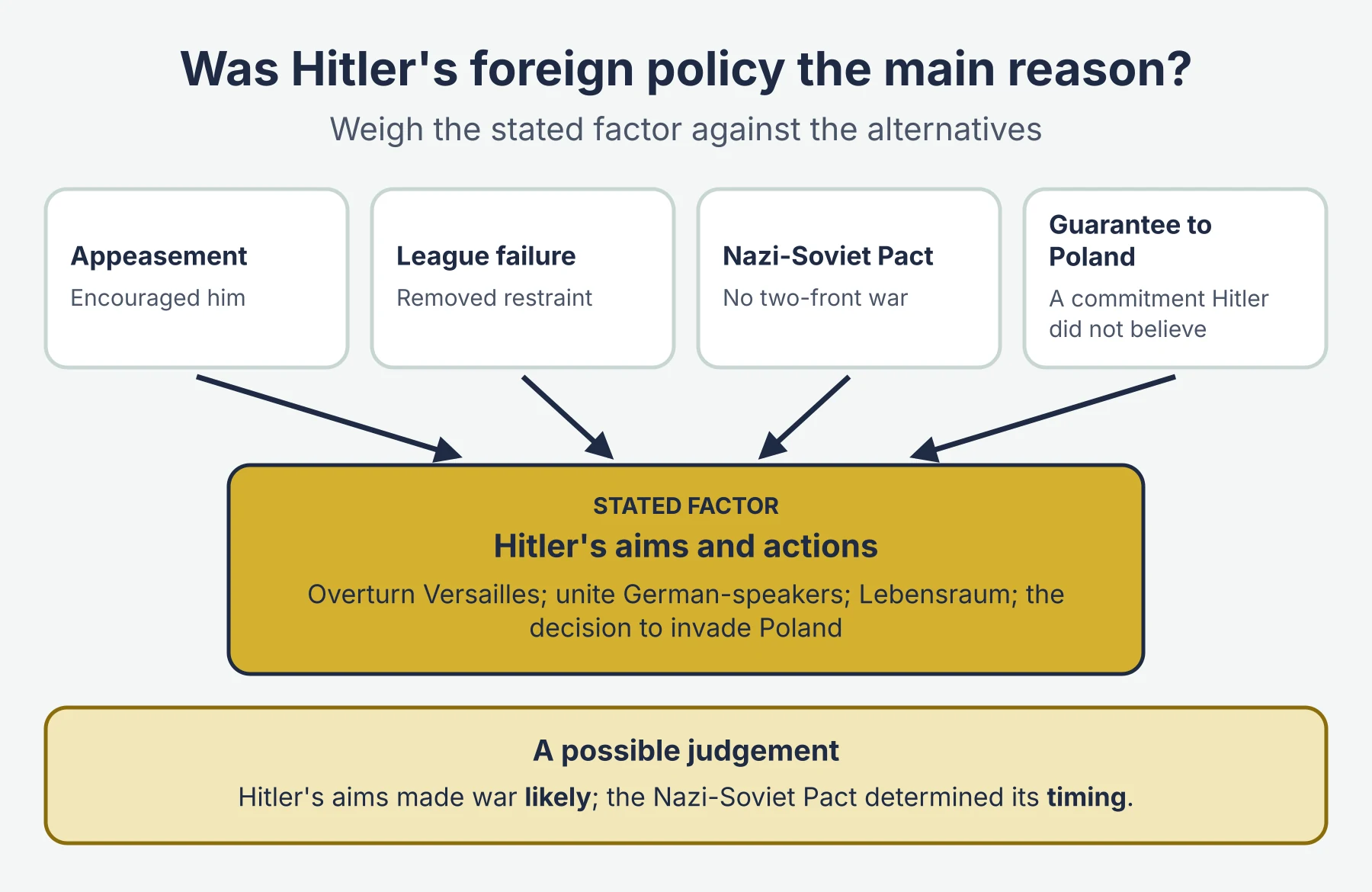
- 1939. The guarantee to Poland was given in March; war came in September after the Nazi-Soviet Pact.
Self-test
- Why did Japan’s government become more militarist after 1930? The Depression discredited party government, and assassinations by nationalist officers left the army dominant.
- What was France’s position at the Disarmament Conference? Security must come before French disarmament.
- What did the Stresa Front agree? To oppose German rearmament and uphold Locarno and Austrian independence.
- Which two events broke the Stresa Front? The Anglo-German Naval Agreement and Italy’s invasion of Abyssinia.
- What did the Lytton Report recommend? Japanese withdrawal and an autonomous Manchuria under Chinese sovereignty.
- Name two goods left out of the sanctions on Italy. Any two: oil, coal, steel.
- What was the Hoare-Laval Plan? A secret Anglo-French proposal to give Italy much of Abyssinia.
- Why did the Non-Intervention Agreement fail? Germany, Italy and the USSR intervened, and Britain and France did not enforce it.
- What did the Peace Ballot suggest? Strong public support for the League and disarmament.
- What did the Anglo-German Naval Agreement allow? A German fleet of 35 per cent of British surface strength.
- Give two reasons for the Nazi-Soviet Pact from Stalin’s point of view. Any two: distrust of Britain and France after Munich; slow Anglo-French talks; buying time; territory in eastern Europe.
- What two German demands on Poland led to war? Danzig and a route across the Polish Corridor.
Official syllabus
Cambridge International AS & A Level History (9489) syllabus for 2027, 2028 and 2029 – cambridgeinternational.org (subject content, topic 9; Topics assessed on Paper 1 and Paper 2).
Related resources
-
Study guides
Cambridge A Level World History (9489): International relations 1919-29: conflict and cooperation
Study guide to Cambridge 9489 History topic 8, 1919-29: the peace treaties, the League and its disputes, the crises of 1919-23 and the improvement of 1924-29.
World History · Cambridge · AS Level
Read guide -
Practice questions
Cambridge A Level World History (9489): International relations 1919-29: conflict and cooperation – Practice Questions
Twelve original practice questions on Cambridge 9489 international relations 1919-29, with invented sources, Paper 2 essays and mark-scheme style answers.
World History · Cambridge · AS Level
Try questions -
Revision notes
Cambridge A Level World History (9489): International relations 1919-29: conflict and cooperation – Revision Notes
Revision notes for Cambridge 9489 History topic 8, 1919-29: the Big Three, treaty reactions, League disputes and agencies, Locarno, traps and a self-test.
World History · Cambridge · AS Level
Revise topic
Get free revision emails (optional)
Occasional emails with practice questions, worked explanations and links to free resources for the qualification and subjects you choose. No spam, and you can unsubscribe from any email. The free tools on this site never need an email.