
Study Guides
Cambridge A Level World History (9489): The origins of the First World War
Study guide to Cambridge 9489 Paper 3, the origins of the First World War: war guilt, shared responsibility, Fischer and his critics, Clark and contingency.
- Subject
- World History
- Level
- A LEVEL
- Topic
- Topic 4: Historical interpretations
- Author
- Marlbridge Academic Team
- Updated
- Reviewed by
- Azam Siddique (what this means)
Aligned to Cambridge A Level World History (9489), 2027-2029. Official specification .
Syllabus page (what it covers and how it is assessed): Cambridge A Level World History.
Syllabus points this page covers
9489 (A Level)
- 1 The origins of the First World War
Found an error? Report a correction.
Need help with this topic? Request a free trial class for A Level World History (9489).
The origins of the First World War is Topic 1 of Paper 3 (Historical interpretations) in Cambridge International A Level History 9489. The syllabus sets one over-arching key question: “Who or what was to blame for the First World War?” You do not learn a new period; you learn how historians have answered that question since 1919, why their answers differ, and how to recognise an approach in an unseen extract. This guide works through each content point the syllabus lists. The overview of all three Paper 3 topics is the Historical interpretations study guide.
What Paper 3 asks
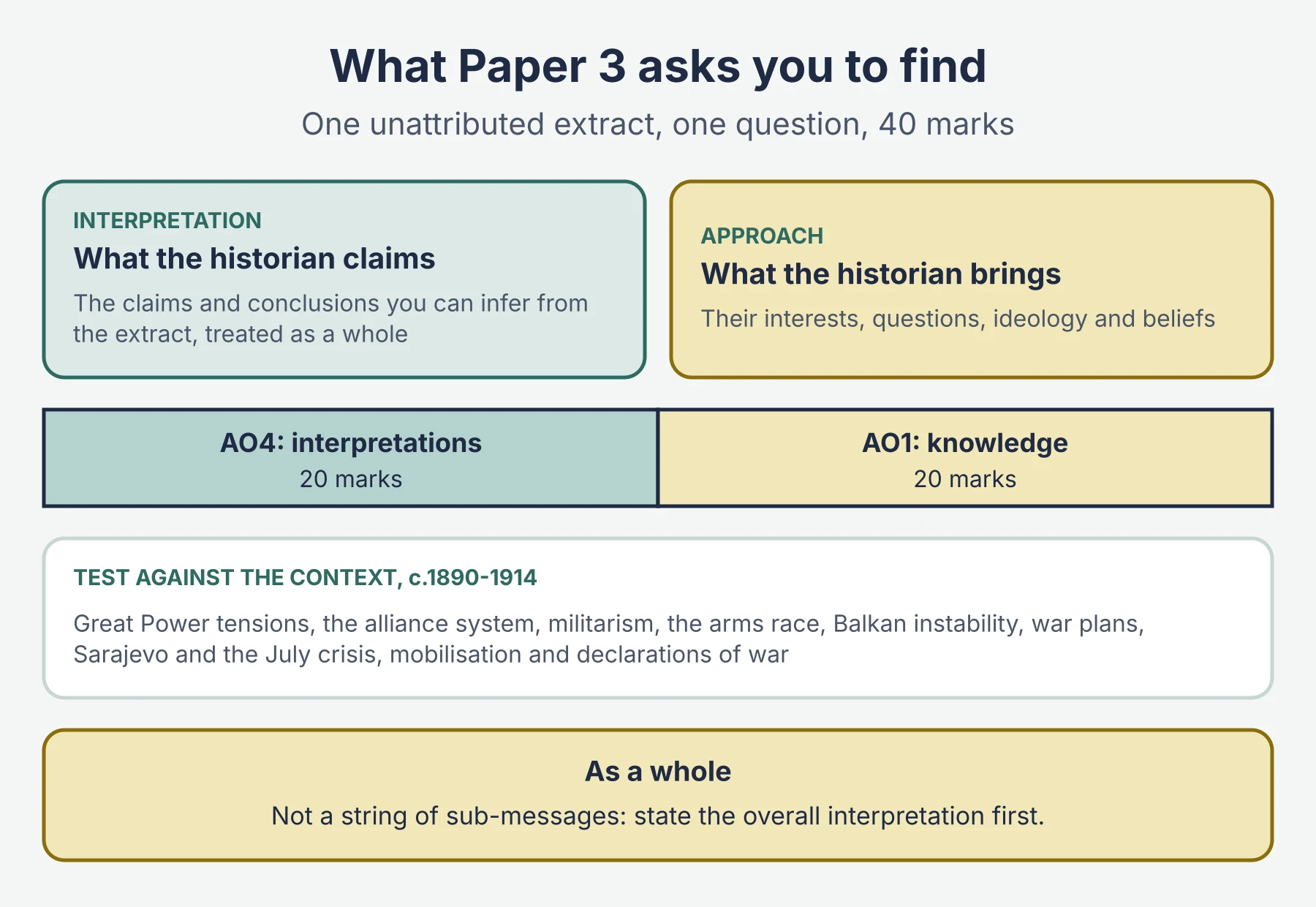
Paper 3 (1 hour 15 minutes, 40 marks) sets one unattributed extract of up to 600 words on each topic, and one question: “What can you learn from this extract about the interpretation and approach of the historian who wrote it?” Marks are shared equally between AO4 (interpretations) and AO1 (knowledge). Cambridge defines interpretation as what can be inferred about the historian’s claims and conclusions, and approach as what the historian brings: their interests, questions, ideology and beliefs. You must treat the interpretation as a whole, not as a string of sub-messages. Revise with the origins of the First World War revision notes and practise with the origins of the First World War practice extracts.
The context you test extracts against is c.1890-1914: tensions between the Great Powers, the alliance system, militarism, the arms race, Balkan instability, war plans, Sarajevo and the July crisis, mobilisation and declarations of war.
The debate, content point by content point
Was tension between the Great Powers likely to lead to war?
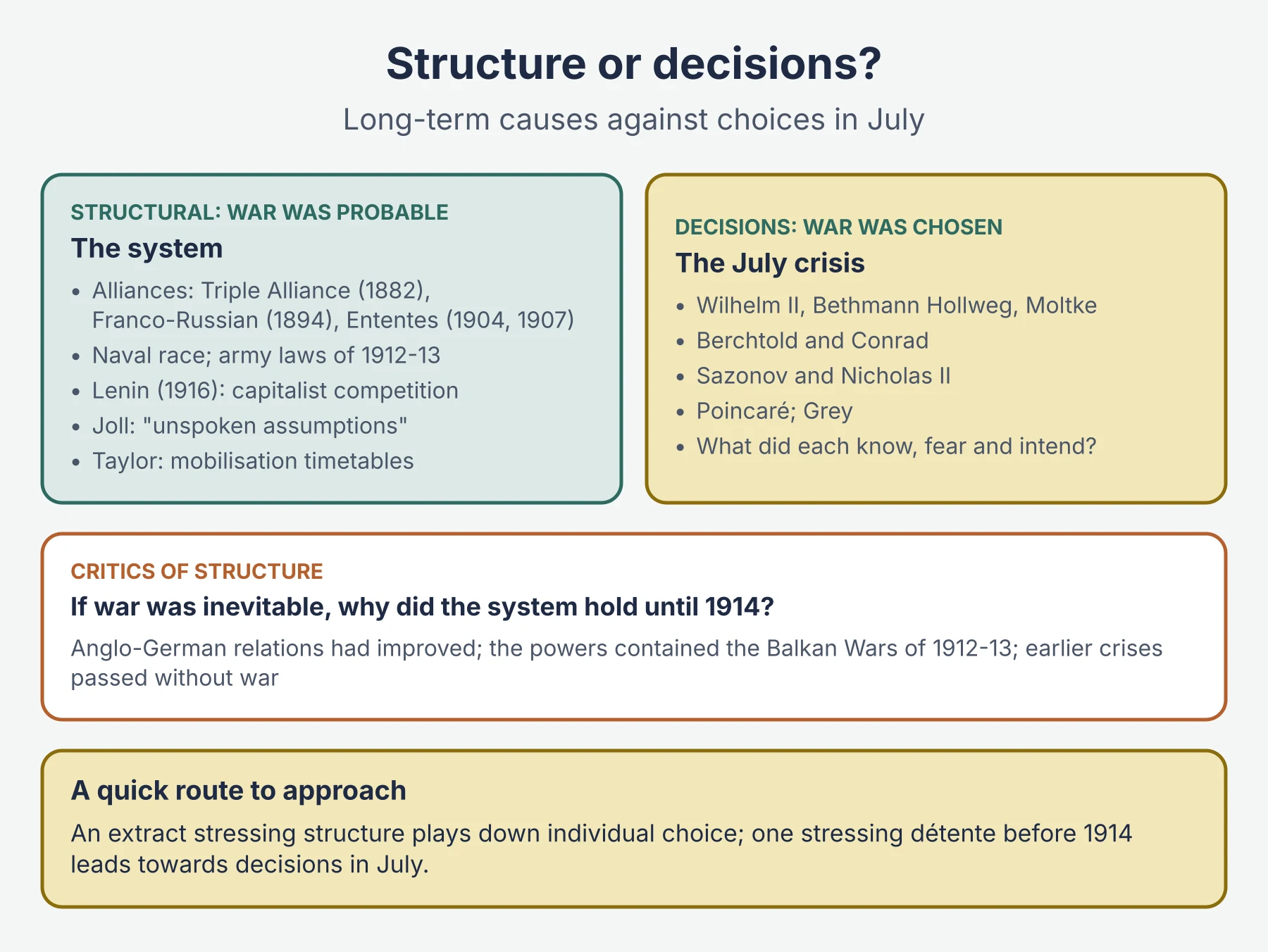
Structural interpretations argue that the system made war probable. The alliances – the Triple Alliance (1882), the Franco-Russian alliance (1894) and the Ententes of 1904 and 1907 – turned local quarrels into continental ones. The naval race and the army laws of 1912-13 created fear. Marxists, following Lenin’s Imperialism, the Highest Stage of Capitalism (1916), saw war as the product of capitalist competition for markets and colonies. James Joll pointed to the “unspoken assumptions” – Social Darwinism, nationalism and the belief that war was natural – shared by Europe’s elites. A.J.P. Taylor argued that mobilisation timetables, once started, pushed governments into war.
Critics note that Anglo-German relations had improved by 1914, that the powers co-operated to contain the Balkan Wars of 1912-13, and that earlier crises had passed without war. If the system made war inevitable, why did it hold until 1914? An extract that emphasises structure will usually play down individual choice; an extract stressing détente before 1914 will usually lead towards decisions in July.
How important were the decisions of key individuals?
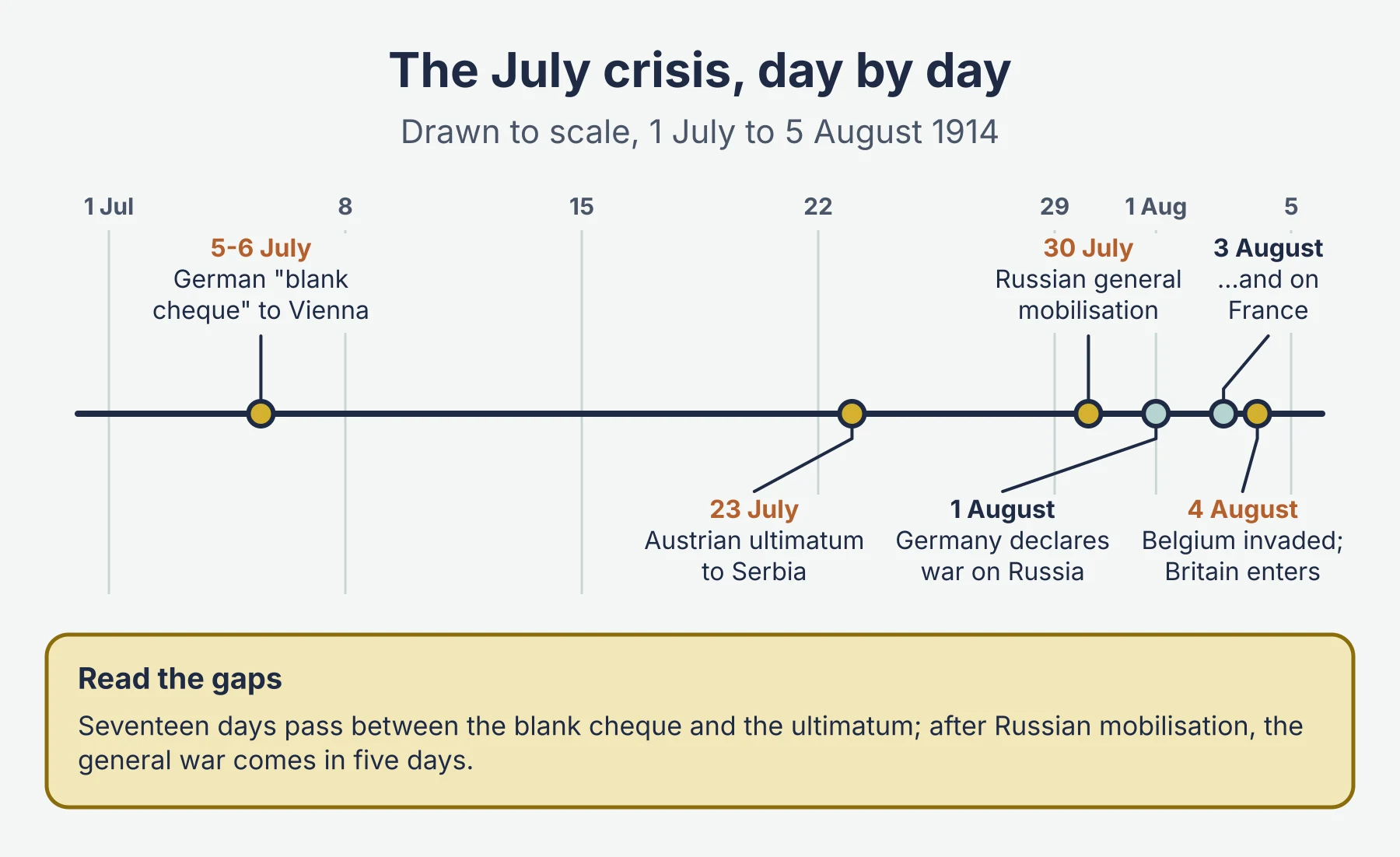
This approach studies the men who decided: Wilhelm II, Bethmann Hollweg and Moltke in Berlin; Berchtold and Conrad in Vienna; Sazonov and Nicholas II in St Petersburg; Poincaré in Paris; Grey in London. Key decisions include Germany’s “blank cheque” to Austria-Hungary (5-6 July), the Austrian ultimatum to Serbia (23 July), Russia’s general mobilisation (30 July), the German declarations of war on Russia (1 August) and France (3 August), and the invasion of Belgium that brought in Britain (4 August). Historians in this tradition ask what each leader knew, feared and intended.
How did Article 231 shape the debate?
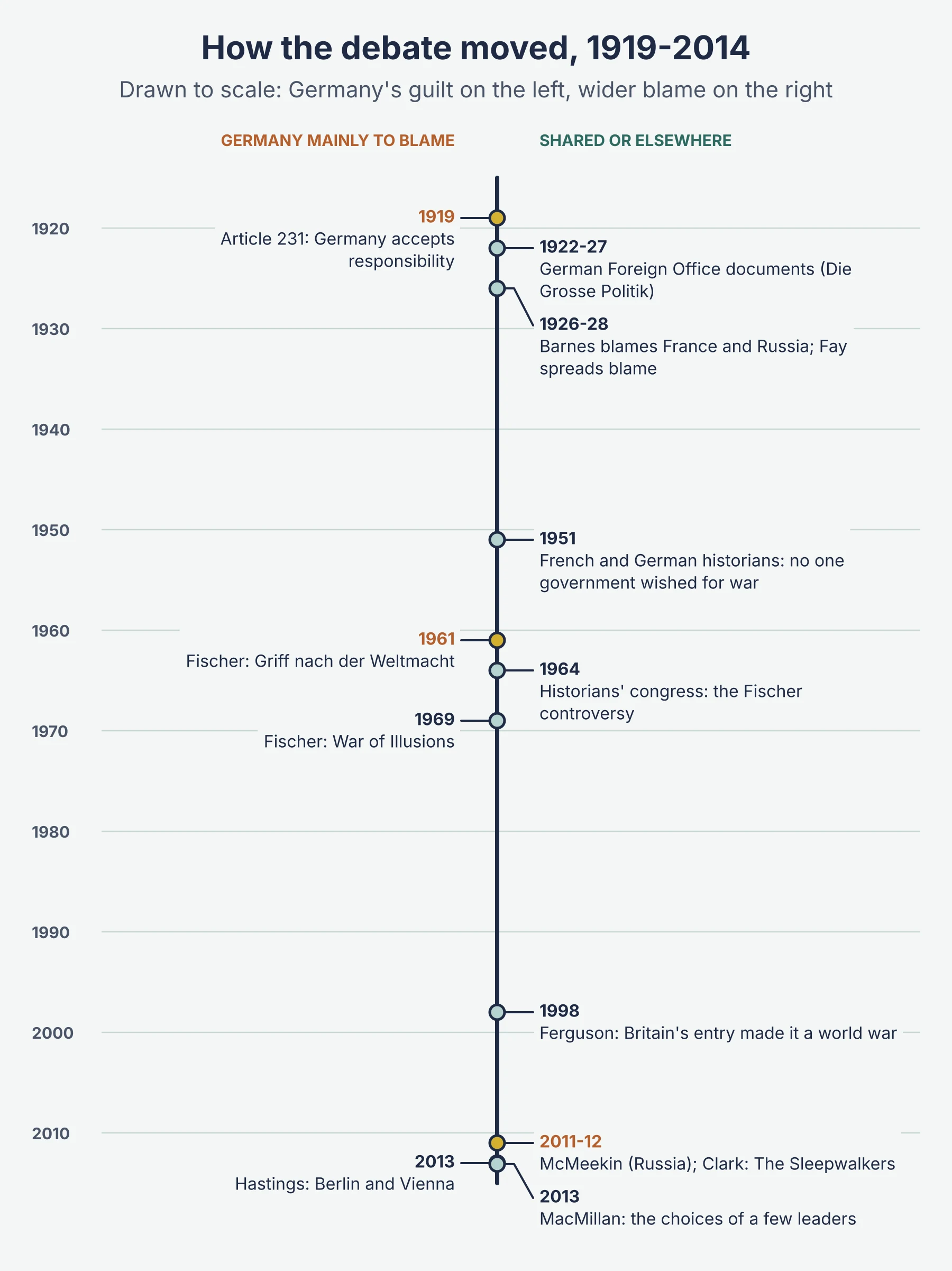
Article 231 of the Treaty of Versailles made Germany accept responsibility for the loss and damage of the war. Germans called it the “war guilt” clause, and in the 1920s the German Foreign Office funded a campaign to refute it, publishing a selection of diplomatic documents in forty volumes (Die Grosse Politik der Europäischen Kabinette, 1922-27) and supporting a specialist journal. Holger Herwig later called this “patriotic self-censorship”. Britain and France answered with their own document collections. The debate was therefore shaped from the start by selected evidence published for a political purpose – a point the syllabus asks you to understand.
How and why did “shared responsibility” arise?
By the late 1920s many writers rejected sole German guilt. The American Sidney Fay (The Origins of the World War, 1928) spread blame widely; Harry Elmer Barnes (1926) went further and blamed France and Russia. Lloyd George wrote in his War Memoirs that the nations “slithered over the brink”. The idea suited a generation that wanted reconciliation, saw the treaty as harsh, and was horrified by the scale of the slaughter. In 1951 French and German historians agreed that the documents did not permit attributing a deliberate wish for war to any one government.
How did the Second World War affect the debate?
After 1945, many West German historians, such as Gerhard Ritter, presented Nazism as a break from the German past, so the Kaiser’s Germany could share responsibility for 1914 with others. Shared responsibility also suited the Cold War, when West Germany became an ally. At the same time, German archives captured or opened after 1945 gave historians material that had been unavailable in the 1920s – the material Fritz Fischer would use.
The Fischer thesis
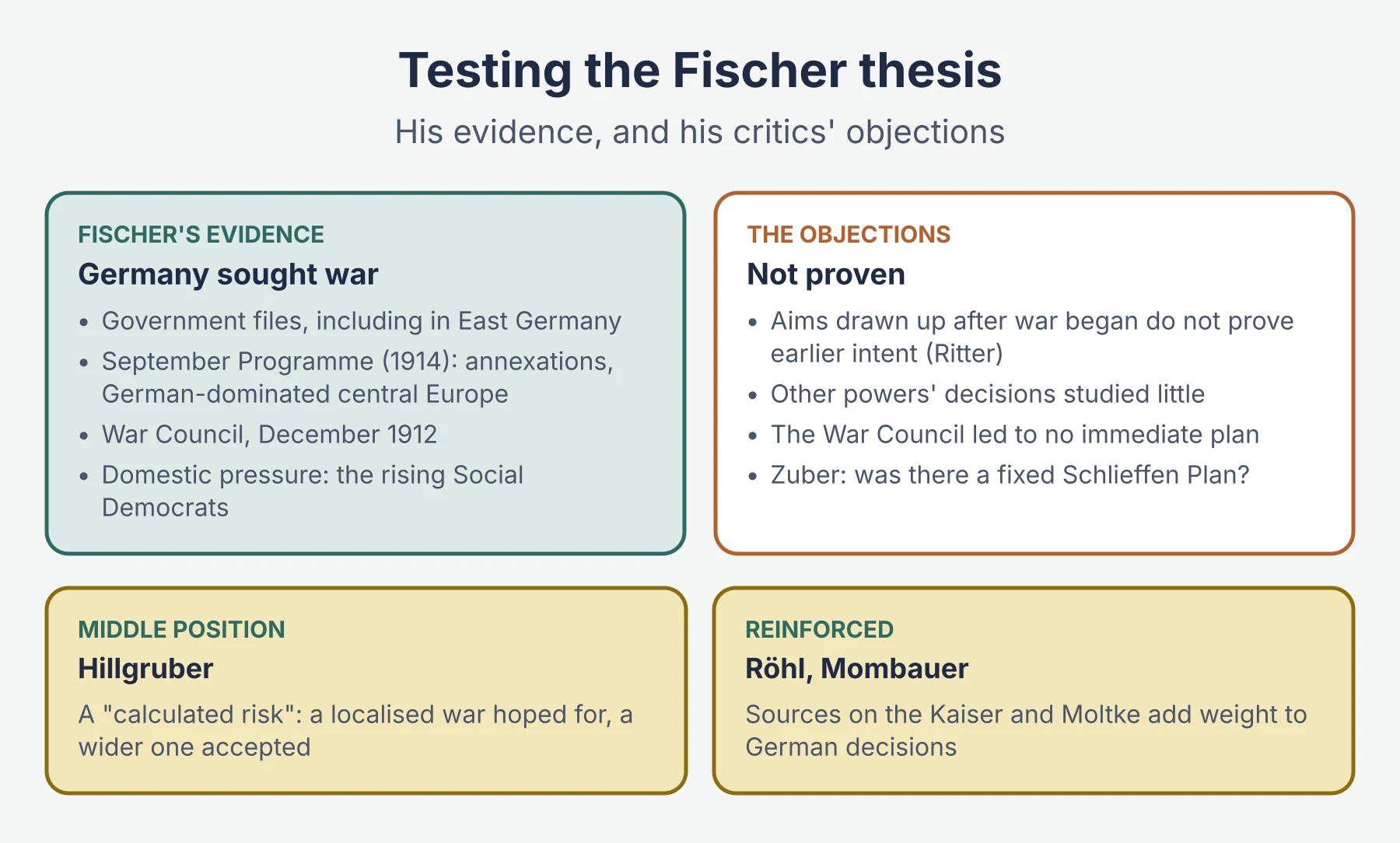
In Griff nach der Weltmacht (1961, translated as Germany’s Aims in the First World War), Fritz Fischer used government files, including those held in East Germany, to argue that Germany’s leaders bore the main responsibility: they sought European dominance and world-power status, and in July 1914 they deliberately risked a general war. The September Programme (1914), listing annexations and a German-dominated central Europe, showed aims he traced back before the war. In War of Illusions (1969) he went further, pointing to the War Council of December 1912 and to domestic pressure – the rise of the Social Democrats – as reasons the elites sought war. His approach linked foreign policy to domestic politics and suggested continuity between the Kaiser’s Germany and Hitler’s.
The German reaction to Fischer
The reaction was fierce. Ritter accused Fischer of reading wartime aims back into July 1914. The “Fischer controversy” dominated the German historians’ congress of 1964, and the West German Foreign Office withdrew funding for Fischer’s lecture tour of the United States in the same year. Andreas Hillgruber offered a middle position: Bethmann Hollweg took a “calculated risk”, hoping for a localised war but accepting a wider one. Younger historians, notably Hans-Ulrich Wehler, built on Fischer’s link between domestic politics and foreign policy.
Challenges to Fischer
Critics argued that war aims drawn up after war began do not prove intentions before it; that Fischer studied German archives closely but other powers’ decisions little; and that the War Council of 1912 led to no immediate plan. Later scholarship divided. John Röhl and Annika Mombauer, using sources on the Kaiser and on Moltke, reinforced the weight of German decisions. Terence Zuber questioned whether a fixed “Schlieffen Plan” existed at all, which complicates arguments about war plans driving events.
Modern interpretations of other nations’ responsibility
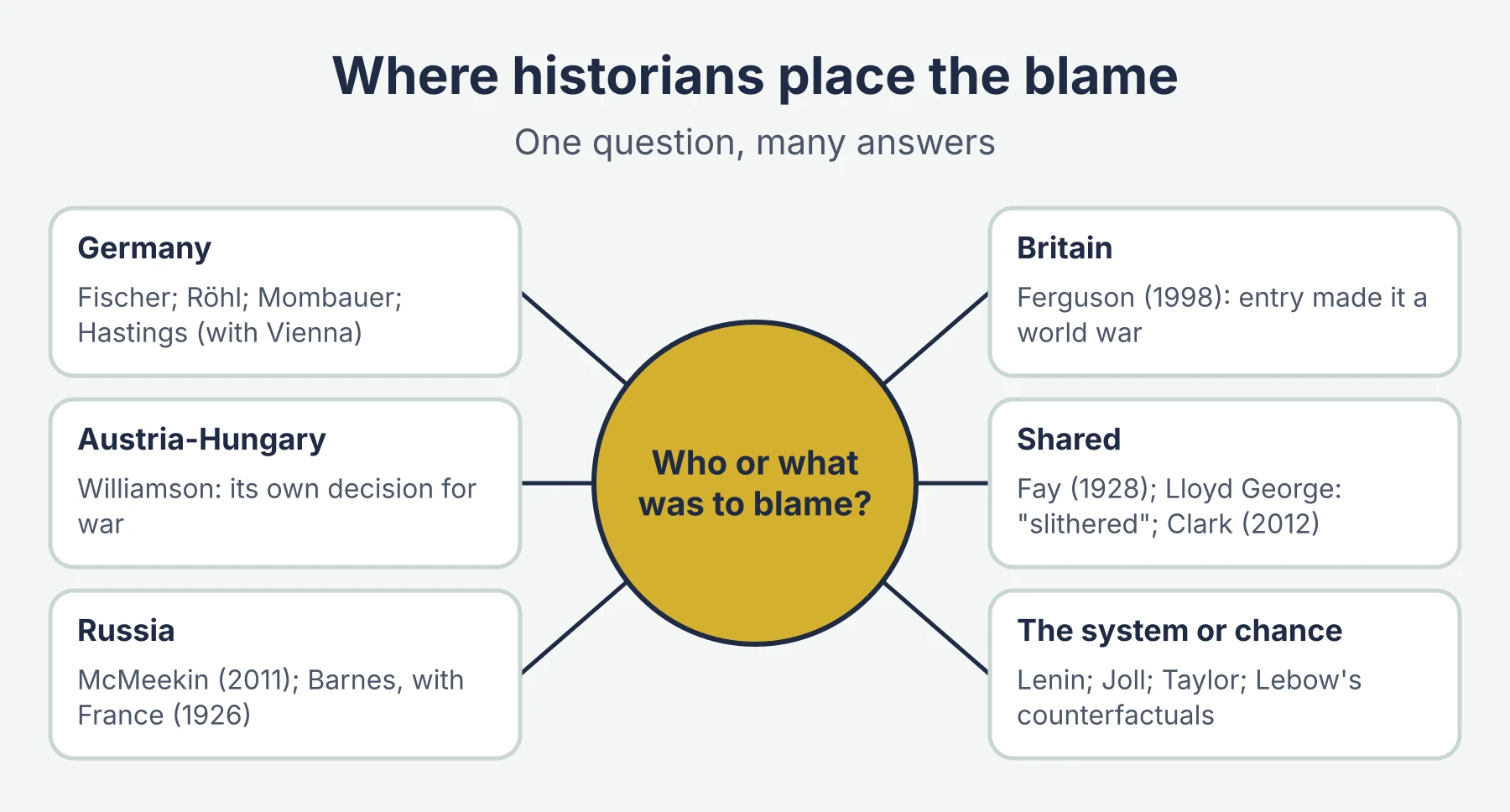
From the 1990s, historians widened the lens. Samuel Williamson stressed Austria-Hungary’s own decision for war on Serbia. Niall Ferguson (The Pity of War, 1998) argued that Britain’s entry turned a continental war into a world war. Sean McMeekin (The Russian Origins of the First World War, 2011) emphasised Russia’s ambitions and early military preparations. Christopher Clark (The Sleepwalkers, 2012) examined Serbia, Austria-Hungary, Russia, France, Germany and Britain together and argued that responsibility was spread among decision-makers who were “blind to the reality of the horror they were about to bring into the world”.
Long-term and short-term factors
Structural historians privilege long-term causes; those who study the July crisis privilege short-term decisions. Clark said he was more interested in how war came than why, because “why” questions push historians towards long-term causes and a search for the guilty. Recognising which an extract favours is often the quickest route to its approach.
How the centenary affected the debate
Around 2014 a wave of books appeared. Clark’s became a bestseller in Germany, where some welcomed it as lifting the burden of guilt. Margaret MacMillan’s The War That Ended Peace (2013) emphasised the choices of a few leaders. Others, including Mombauer and Röhl, restated the case for German and Austro-Hungarian responsibility, and Max Hastings’s Catastrophe (2013) also placed the main blame on Berlin and Vienna. The centenary showed how the time and place in which historians write – here, debates about Germany’s role in Europe – affects reception and emphasis.
Contingency over motive
Some historians stress chance and the unpredictable: the assassination succeeded only after a wrong turn by the archduke’s driver, and leaders acted on incomplete information under pressure of time. Richard Ned Lebow has used counterfactual reasoning to argue that a world without the assassination might have avoided general war. Contingency arguments sit uneasily with arguments about motive and intention; an extract stressing accident and misjudgement is usually downplaying planned aggression.
Worked example: annotating an extract
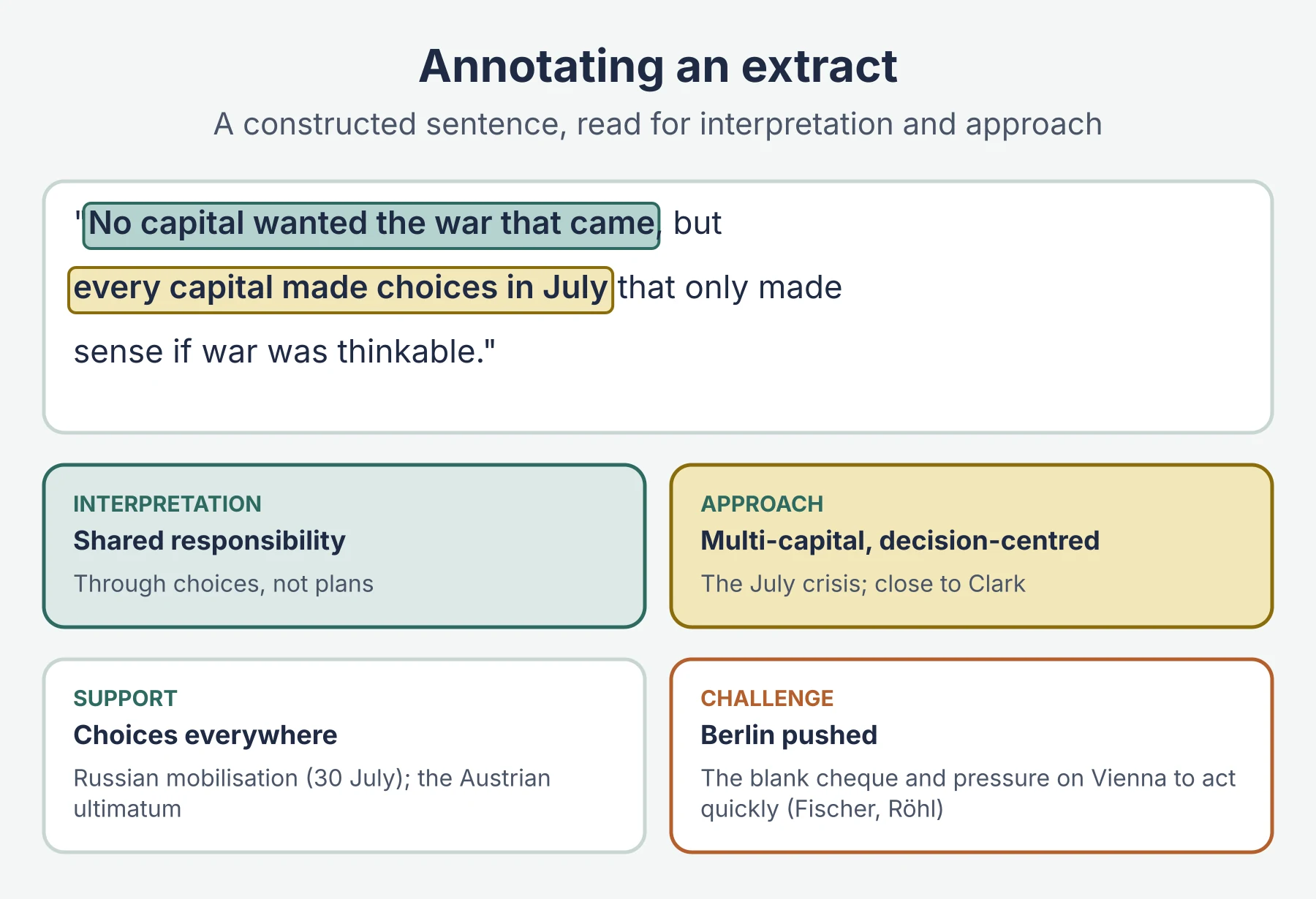
Constructed sentence (Marlbridge): “No capital wanted the war that came, but every capital made choices in July that only made sense if war was thinkable.”
- Interpretation: shared responsibility, through choices rather than plans.
- Approach: a multi-capital, decision-centred study of the July crisis, close to Clark.
- Test with knowledge: support – Russian mobilisation on 30 July and the Austrian ultimatum; challenge – the blank cheque and German pressure on Vienna to act quickly, as Fischer and Röhl argue.
Common mistakes
- Naming historians without explaining the extract’s claims.
- Treating “revisionist” as one view: in this topic it usually means the 1920s rejection of war guilt.
- Using knowledge only to describe events, not to test the interpretation.
- Assuming that a recent interpretation must be the correct one.
Official syllabus
Cambridge International AS & A Level History (9489) syllabus for 2027, 2028 and 2029 – cambridgeinternational.org (Paper 3, Topic 1; Paper 3 details of the assessment). Always check the current syllabus before an exam.
Related resources
-
Practice questions
Cambridge A Level World History (9489): The origins of the First World War – Practice Questions
Original Cambridge 9489 Paper 3 practice on the origins of the First World War: eight short items and three constructed extracts with indicative content.
World History · Cambridge · A Level
Try questions -
Revision notes
Cambridge A Level World History (9489): The origins of the First World War – Revision Notes
Revision notes for Cambridge 9489 Paper 3 on the origins of the First World War: July 1914 dates, schools of interpretation, key terms and a self-test.
World History · Cambridge · A Level
Revise topic -
Study guides
Cambridge A Level World History (9489): The Holocaust
Study guide to Cambridge 9489 Paper 3, the Holocaust: pre-Nazi racism, intentionalism, structuralism, functionalism, perpetrators, victims and bystanders.
World History · Cambridge · A Level
Read guide
Get free revision emails (optional)
Occasional emails with practice questions, worked explanations and links to free resources for the qualification and subjects you choose. No spam, and you can unsubscribe from any email. The free tools on this site never need an email.