
Revision Notes
Cambridge A Level World History (9489): The origins of the First World War – Revision Notes
Revision notes for Cambridge 9489 Paper 3 on the origins of the First World War: July 1914 dates, schools of interpretation, key terms and a self-test.
- Subject
- World History
- Level
- A LEVEL
- Topic
- Topic 4: Historical interpretations
- Author
- Marlbridge Academic Team
- Updated
- Reviewed by
- Azam Siddique (what this means)
Aligned to Cambridge A Level World History (9489), 2027-2029. Official specification .
Syllabus page (what it covers and how it is assessed): Cambridge A Level World History.
Syllabus points this page covers
9489 (A Level)
- 1 The origins of the First World War
Found an error? Report a correction.
Need help with this topic? Request a free trial class for A Level World History (9489).
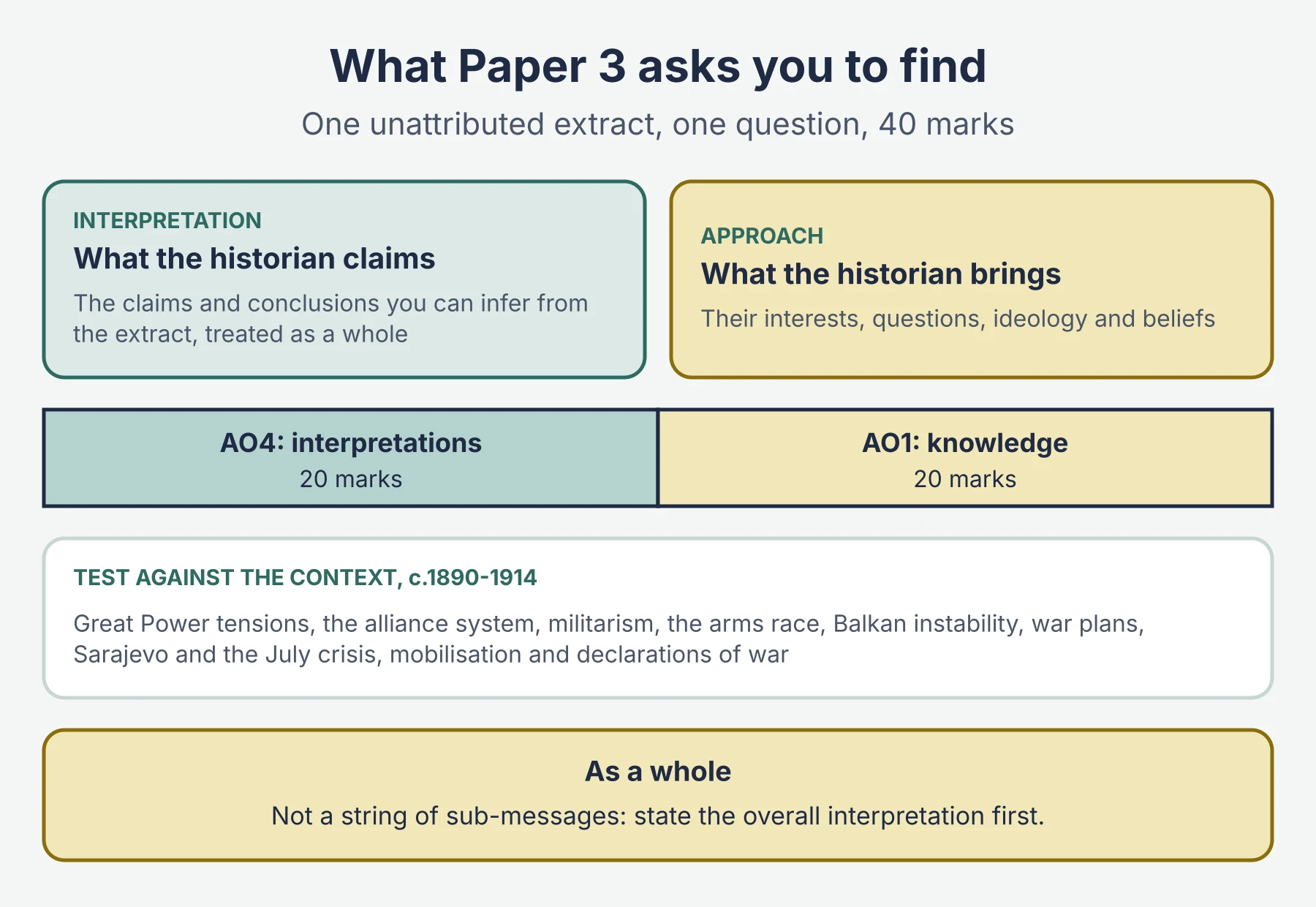
These notes condense Paper 3 Topic 1 of Cambridge 9489, the origins of the First World War, for quick recall before the exam. Paper 3 sets one unattributed extract and asks what you can learn about the historian’s interpretation and approach, with the key question “Who or what was to blame for the First World War?” behind it. The full explanation of each debate is in the origins of the First World War study guide; practice extracts with indicative content are in the origins of the First World War practice extracts.
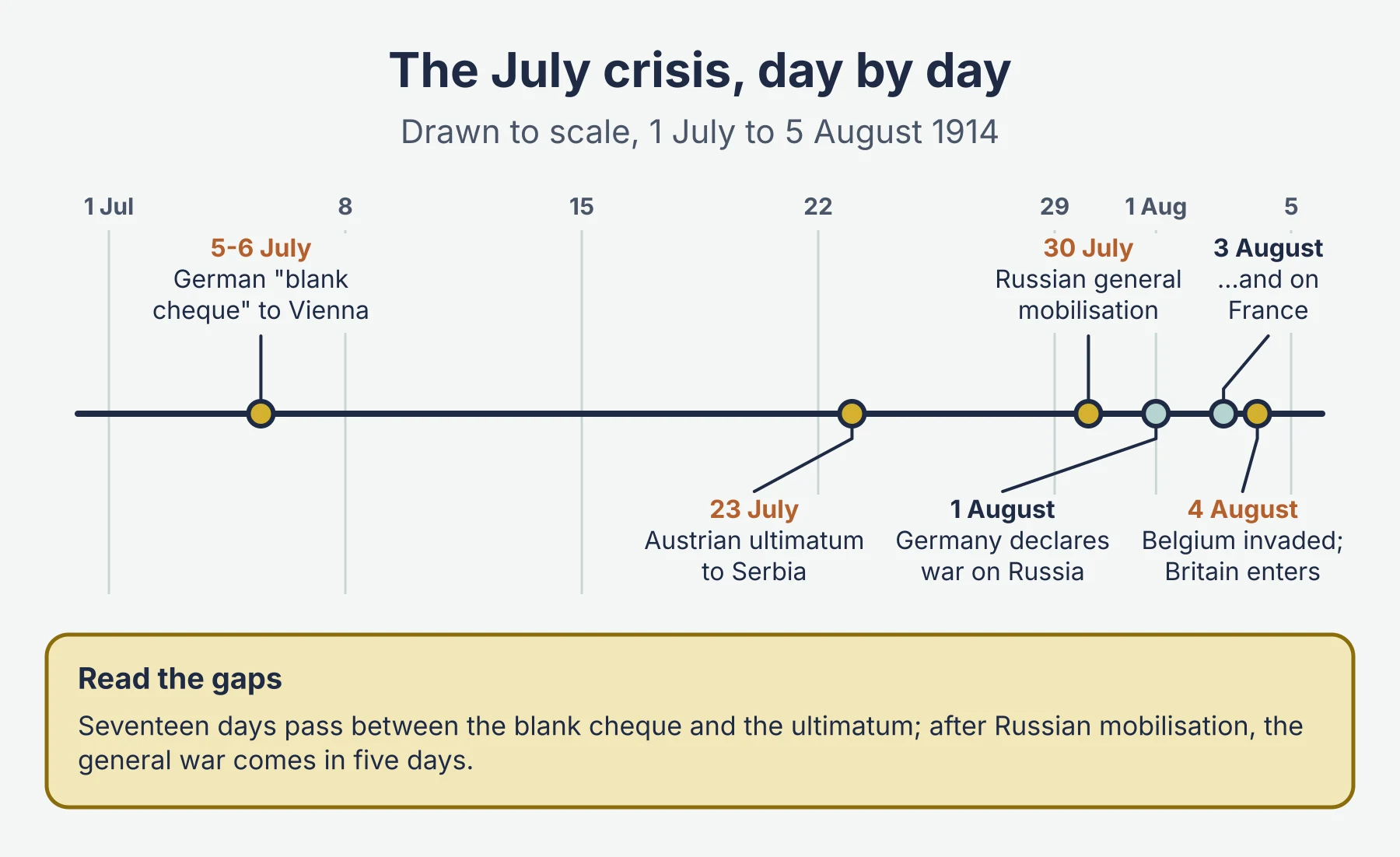
The July crisis – dates to test extracts against
| Date (1914) | Event | Usually cited by |
|---|---|---|
| 28 June | Franz Ferdinand assassinated in Sarajevo | Contingency arguments |
| 5-6 July | German “blank cheque” to Austria-Hungary | Fischer and those stressing German responsibility |
| 20-23 July | Poincaré’s state visit to St Petersburg | Those stressing French and Russian responsibility |
| 23 July | Austro-Hungarian ultimatum to Serbia | Those stressing Vienna’s responsibility |
| 25 July | Serbian reply; Russia decides on pre-mobilisation measures | McMeekin and Clark |
| 26 July | Grey proposes a conference | Defenders of British policy |
| 28 July | Austria-Hungary declares war on Serbia; Kaiser’s “halt in Belgrade” idea | Those stressing missed chances |
| 30 July | Russian general mobilisation | Critics of Russia |
| 1 / 3 August | Germany declares war on Russia / France | Those stressing German war plans |
| 4 August | Germany invades Belgium; Britain declares war | Ferguson and debates on Britain |
Longer-term context
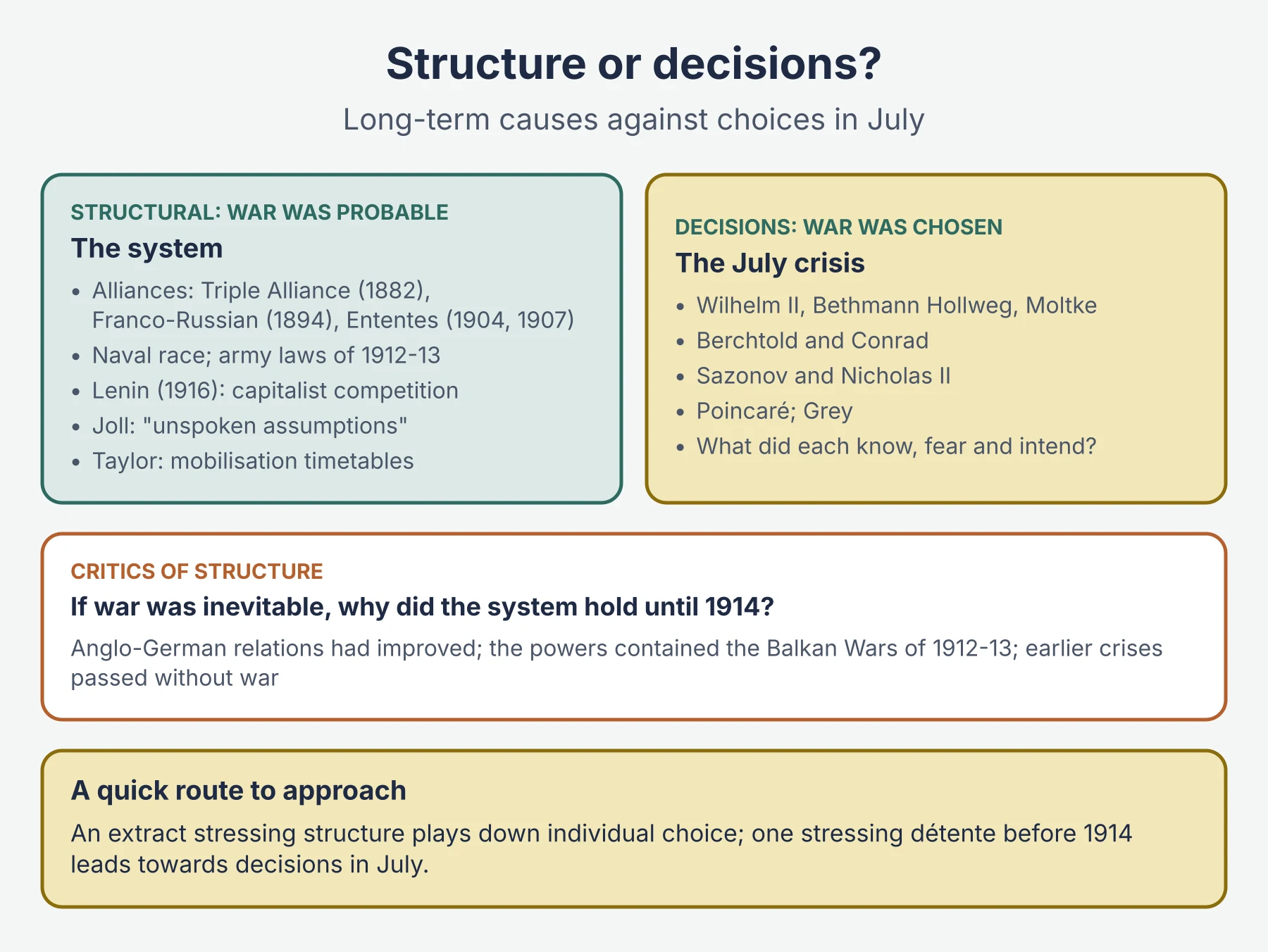
| Date | Event |
|---|---|
| 1882 / 1894 | Triple Alliance / Franco-Russian alliance |
| 1898-1912 | Anglo-German naval race |
| 1904 / 1907 | Entente Cordiale / Anglo-Russian Convention |
| 1905-06, 1911 | Moroccan crises |
| 1908-09 | Bosnian crisis |
| Dec 1912 | Kaiser’s “War Council” |
| 1912-13 | Balkan Wars; London conference of ambassadors |
| 1913 | German army law; Russian “Great Programme” of rearmament |
How the debate developed
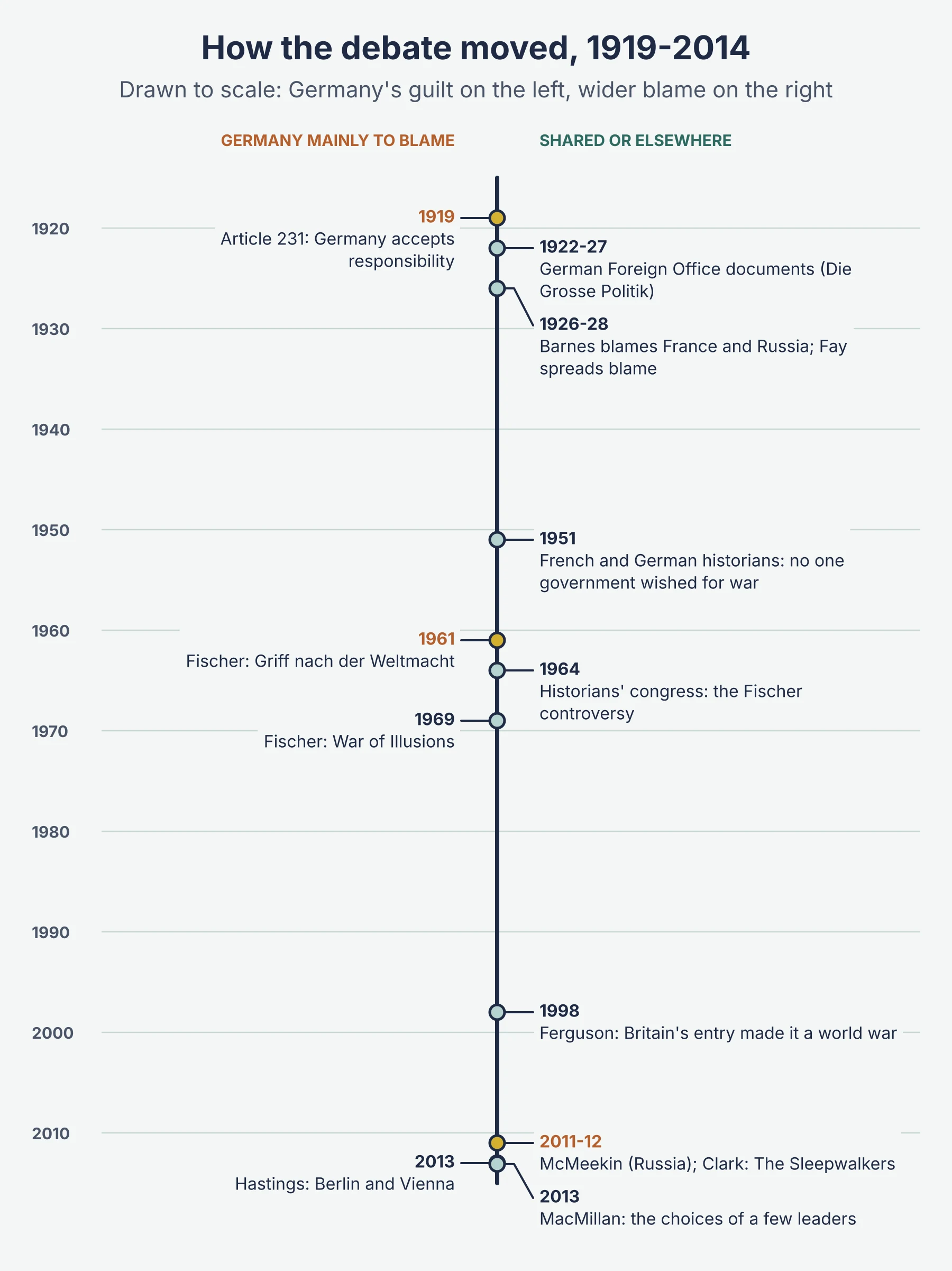
| Stage | Key idea | Names and works to recognise |
|---|---|---|
| 1919 | German responsibility in Article 231 | Treaty of Versailles |
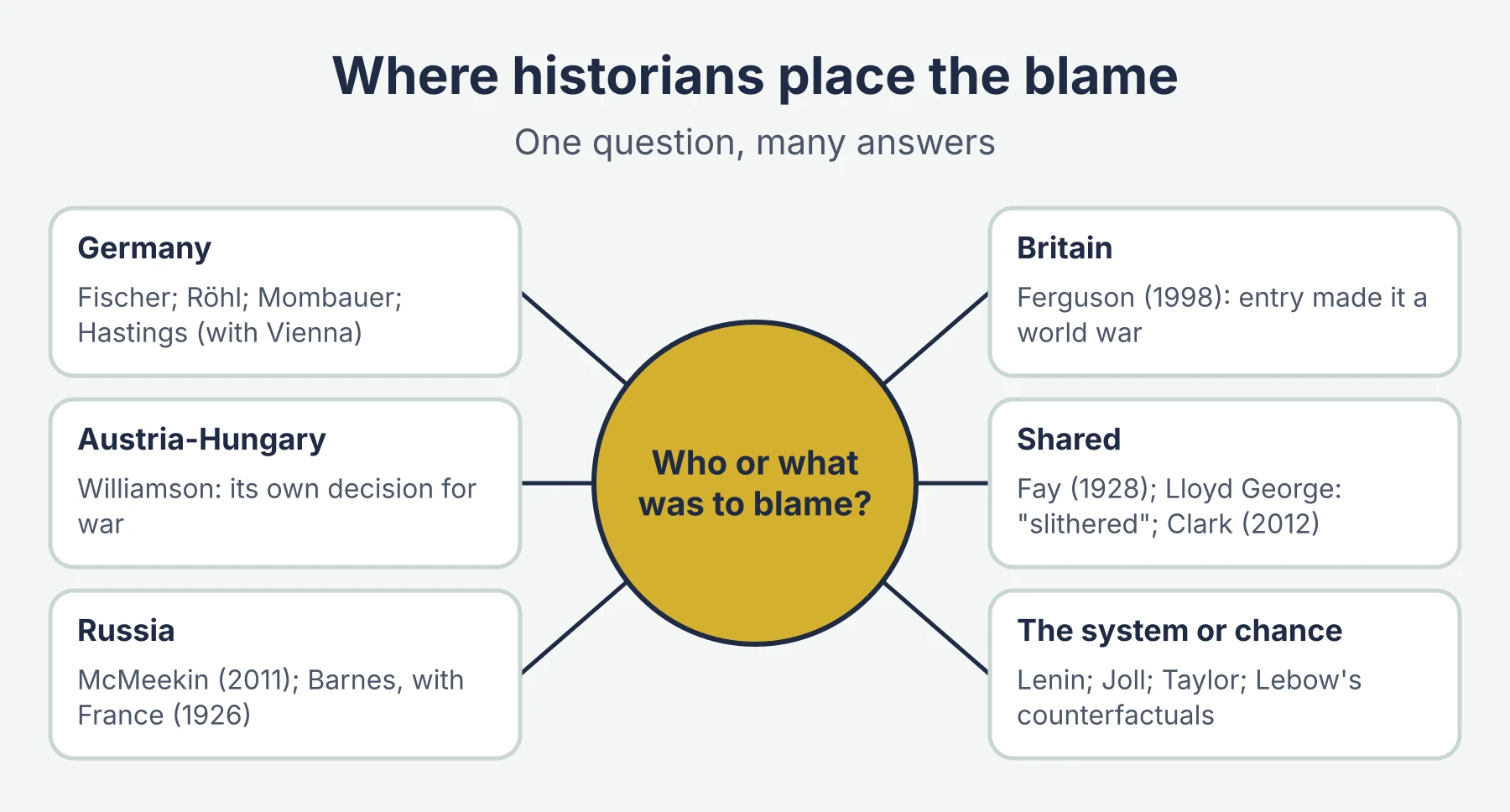
| 1920s-30s | Rejection of war guilt; blame spread or shifted | Barnes (1926); Fay (1928); Lloyd George, War Memoirs |
| 1940s-50s | Shared responsibility consensus; Nazism as a break | Ritter; Franco-German historians’ agreement (1951) |
| 1961-70s | German drive for world power; continuity | Fischer (1961, 1969); Geiss; Wehler; Berghahn |
| 1960s reaction | Fischer reads war aims backwards; “calculated risk” | Ritter; Hillgruber |
| 1990s-2000s | Other states’ choices; doubts about war plans | Williamson (1991); Ferguson (1998); Zuber (2002); Mombauer (2001); Röhl |
| 2011-14 | Multi-national, contingent decisions | McMeekin (2011); Clark (2012); MacMillan (2013); Hastings (2013) |
Why historians differ on this topic
| Syllabus reason | Example here |
|---|---|
| Fragmentary evidence | Many decisions were taken in conversation; some records were lost or kept closed |
| Selection of evidence | Governments in the 1920s published chosen documents to clear themselves |
| New evidence and new interpretations | German archives opened after 1945 enabled Fischer; Russian and Serbian material shaped McMeekin and Clark |
| Time and place | Post-1945 West Germany, the 1960s generational revolt, and the 2014 centenary each changed emphasis |
| Questions asked | “Why?” leads to long-term causes and blame; “How?” leads to decisions and contingency |
| Ideology | Marxist writers stress capitalism and imperialism; liberal and conservative writers stress diplomacy and states |
Key terms
| Term | Meaning |
|---|---|
| War guilt | German name for the responsibility assigned by Article 231 |
| Revisionism (1920s) | Rejection of sole German responsibility |
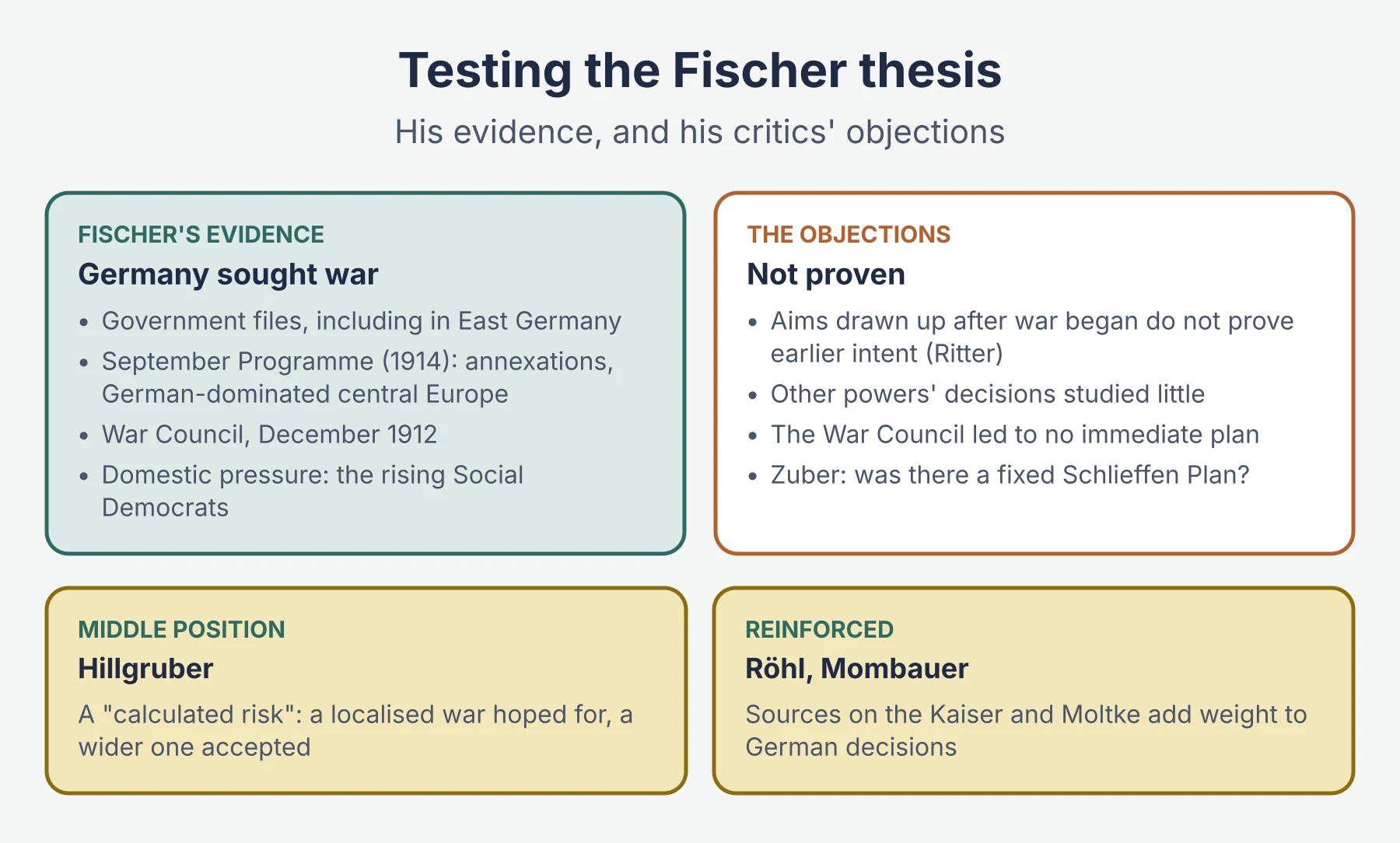
| Fischer thesis | Germany’s leaders sought world power and deliberately risked war in 1914 |
| September Programme | Bethmann Hollweg’s 1914 list of German war aims |
| War Council | Kaiser’s meeting with military leaders, 8 December 1912 |
| Primat der Innenpolitik | Primacy of domestic politics in explaining foreign policy |
| Continuity thesis | Link between Imperial Germany’s aims and Nazi aims |
| Calculated risk | Hillgruber’s view that Berlin hoped for a local war but accepted a wider one |
| Contingency | Outcomes shaped by chance and unforeseen decisions |
| Structural explanation | Causes rooted in alliances, arms and ideologies rather than individuals |
Exam traps
- Labelling. “This is the Fischer thesis” is a starting point, not an answer; explain what the extract argues.
- Sub-messages. An extract may mention Russian mobilisation while arguing for German responsibility; do not make the mention the main interpretation.
- Dating by name. You will not be told the author, and naming one is not required.
- One-sided testing. Use knowledge that supports and knowledge that challenges the extract.
- Irrelevant narrative. Knowledge used without reference to the interpretation is not rewarded.
Self-test
- What did Article 231 state? That Germany and its allies accepted responsibility for the loss and damage of the war.
- How did the German government respond in the 1920s? It published selected documents and funded work to refute war guilt.
- Which American historian argued for widely shared responsibility in 1928? Sidney Fay.
- Why did shared responsibility suit West Germany after 1945? It separated the Kaiser’s Germany from Nazism and fitted the Cold War alliance.
- What was the title of Fischer’s 1961 book in English? Germany’s Aims in the First World War.
- What did War of Illusions add? The War Council of December 1912 and domestic pressures as reasons for seeking war.
- What did Ritter argue against Fischer? That he read wartime aims back into July 1914.
- What is Hillgruber’s “calculated risk”? Berlin hoped for a localised war but accepted the risk of a general one.
- Which historian emphasised Russian responsibility in 2011? Sean McMeekin.
- Why did Clark prefer “how” to “why” questions? “Why” questions push towards long-term causes and a search for the guilty.
- Give one way the centenary affected the debate. Clark’s popularity in Germany provoked replies restating German responsibility, such as those of Röhl and Mombauer.
- What does an emphasis on contingency usually play down? Planned aggression and long-term motive.
Official syllabus
Cambridge International AS & A Level History (9489) syllabus for 2027, 2028 and 2029 – cambridgeinternational.org (Paper 3, Topic 1).
Related resources
-
Study guides
Cambridge A Level World History (9489): The Holocaust
Study guide to Cambridge 9489 Paper 3, the Holocaust: pre-Nazi racism, intentionalism, structuralism, functionalism, perpetrators, victims and bystanders.
World History · Cambridge · A Level
Read guide -
Practice questions
Cambridge A Level World History (9489): The Holocaust – Practice Questions
Original Cambridge 9489 Paper 3 practice on the Holocaust: eight short items and three constructed extracts on intention, perpetrators and bystanders.
World History · Cambridge · A Level
Try questions -
Revision notes
Cambridge A Level World History (9489): The Holocaust – Revision Notes
Revision notes for Cambridge 9489 Paper 3 on the Holocaust: schools of interpretation, perpetrators, victims and bystanders, key terms and a self-test.
World History · Cambridge · A Level
Revise topic
Get free revision emails (optional)
Occasional emails with practice questions, worked explanations and links to free resources for the qualification and subjects you choose. No spam, and you can unsubscribe from any email. The free tools on this site never need an email.