
Revision Notes
Cambridge A Level World History (9489): The Holocaust – Revision Notes
Revision notes for Cambridge 9489 Paper 3 on the Holocaust: schools of interpretation, perpetrators, victims and bystanders, key terms and a self-test.
- Subject
- World History
- Level
- A LEVEL
- Topic
- Topic 4: Historical interpretations
- Author
- Marlbridge Academic Team
- Updated
- Reviewed by
- Azam Siddique (what this means)
Aligned to Cambridge A Level World History (9489), 2027-2029. Official specification .
Syllabus page (what it covers and how it is assessed): Cambridge A Level World History.
Syllabus points this page covers
9489 (A Level)
- 2 The Holocaust
Found an error? Report a correction.
Need help with this topic? Request a free trial class for A Level World History (9489).
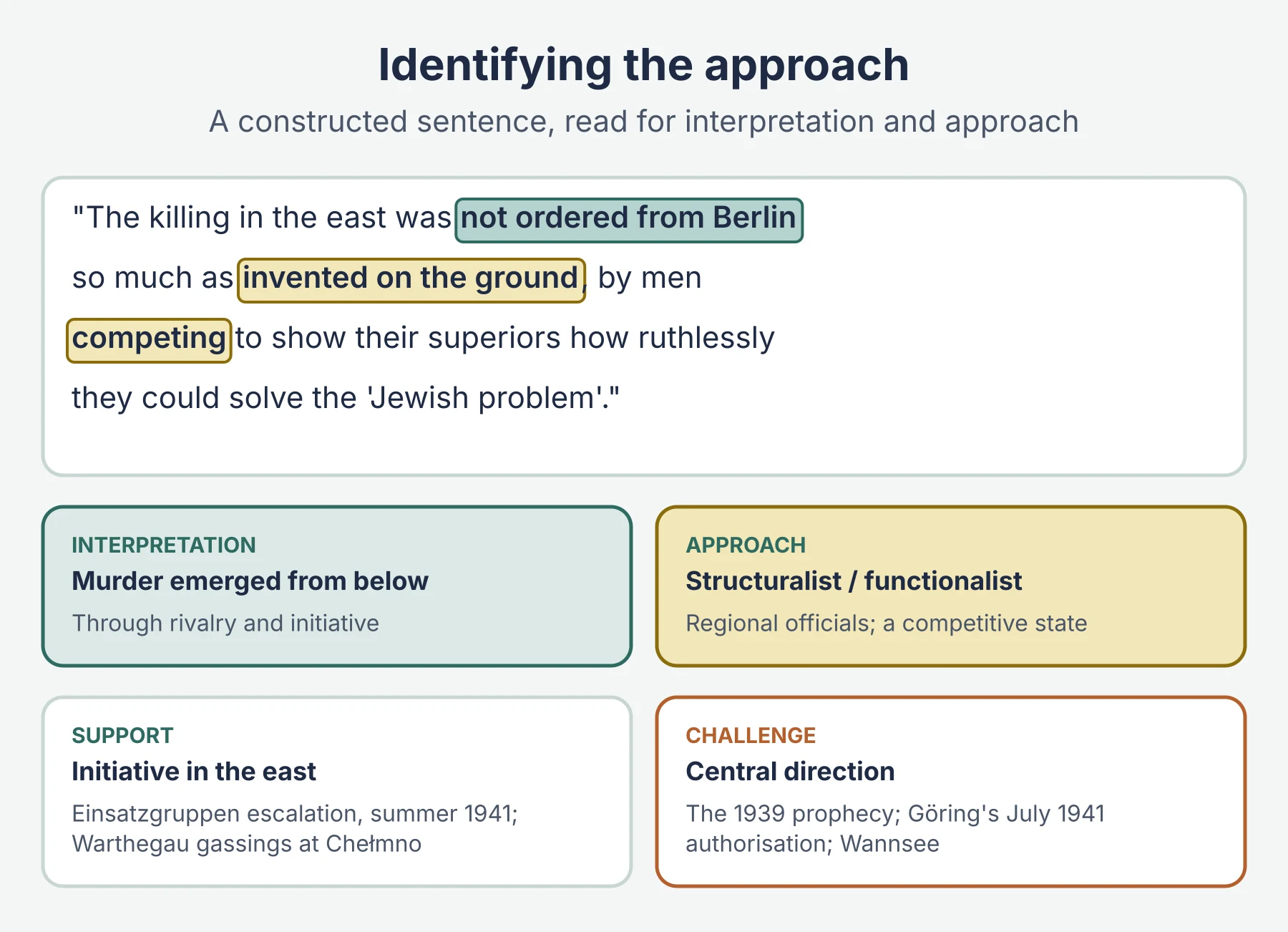
These notes condense Paper 3 Topic 2 of Cambridge 9489, the Holocaust, for recall in the final weeks. The key question is “Who or what was to blame for the Holocaust?”, and the exam asks what you can learn from an unattributed extract about its historian’s interpretation and approach. The full explanation is in the Holocaust study guide; practice extracts are in the Holocaust practice extracts.
The syllabus’s eight debates – in one table
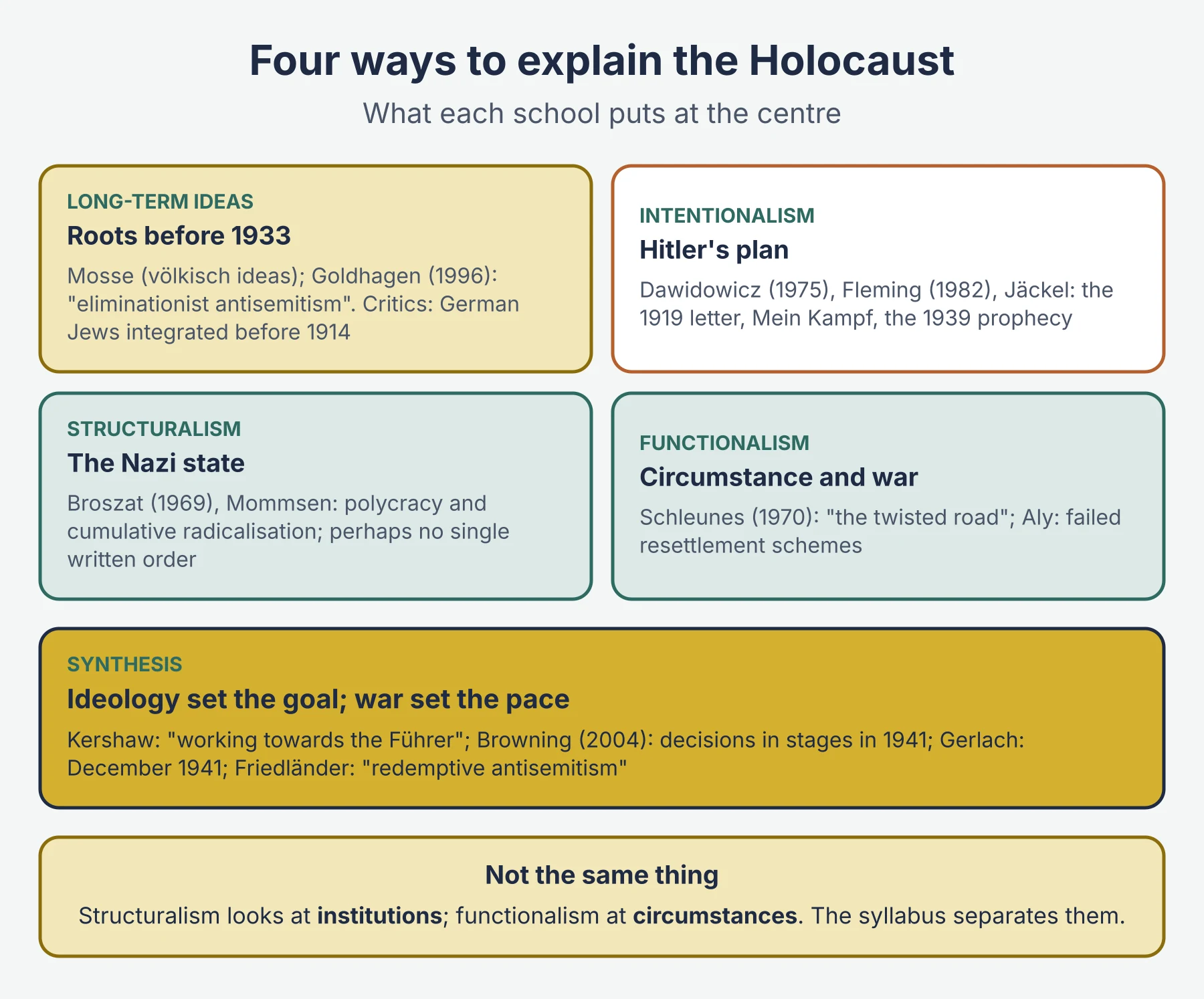
| Syllabus question | Short answer of each side | Names to recognise |
|---|---|---|
| Pre-Nazi racist ideas? | Yes: deep roots in German culture / No: ideas made it possible, not inevitable | Mosse; Goldhagen; critics of Goldhagen |
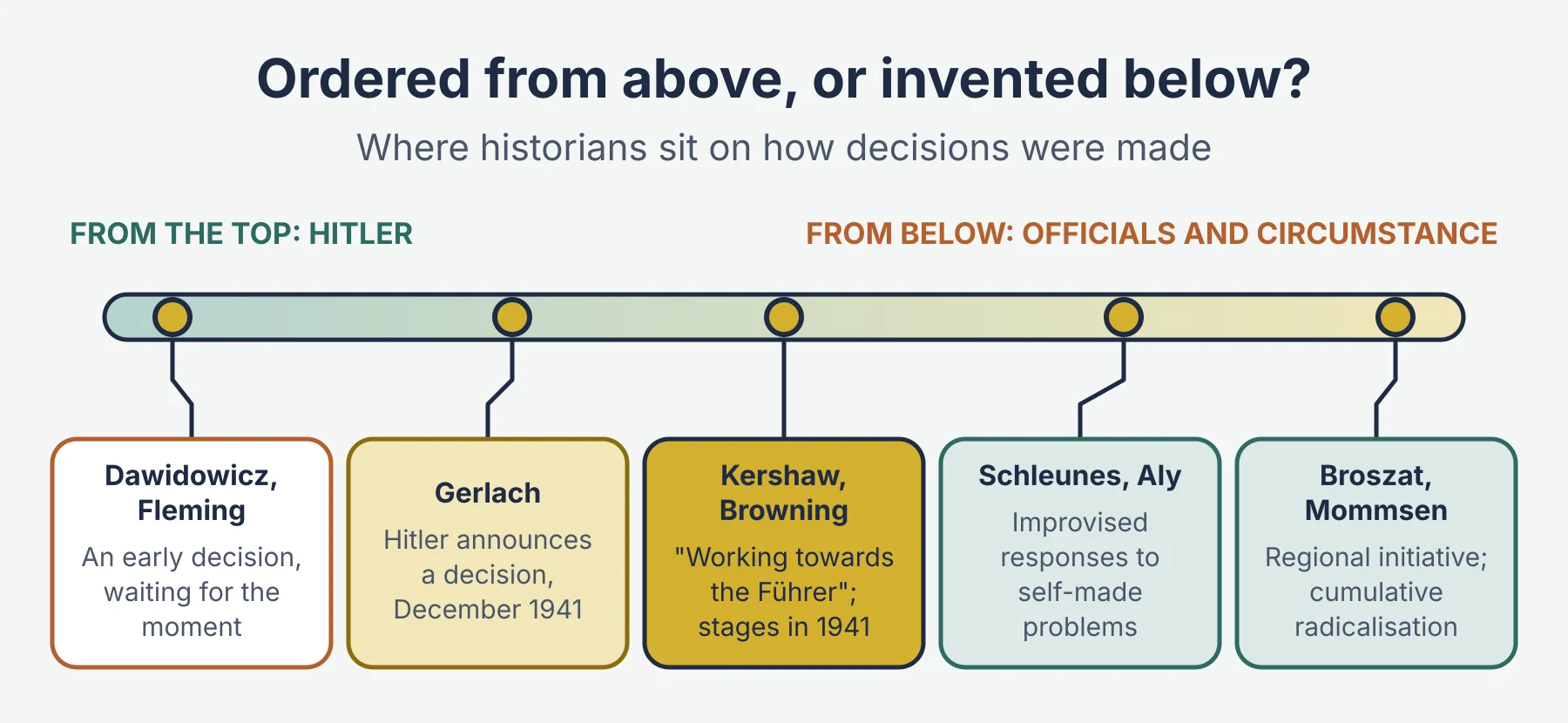
| Intentionalism | Hitler’s ideology and decisions drove events from early on | Dawidowicz; Fleming; Jäckel |
| Structuralism | Competing agencies radicalised policy | Broszat; Mommsen |
| Functionalism | War and failed plans pushed policy step by step | Schleunes; Aly |
| Synthesis | Ideology set the goal; war and initiative set the pace | Kershaw; Browning; Gerlach; Friedländer |
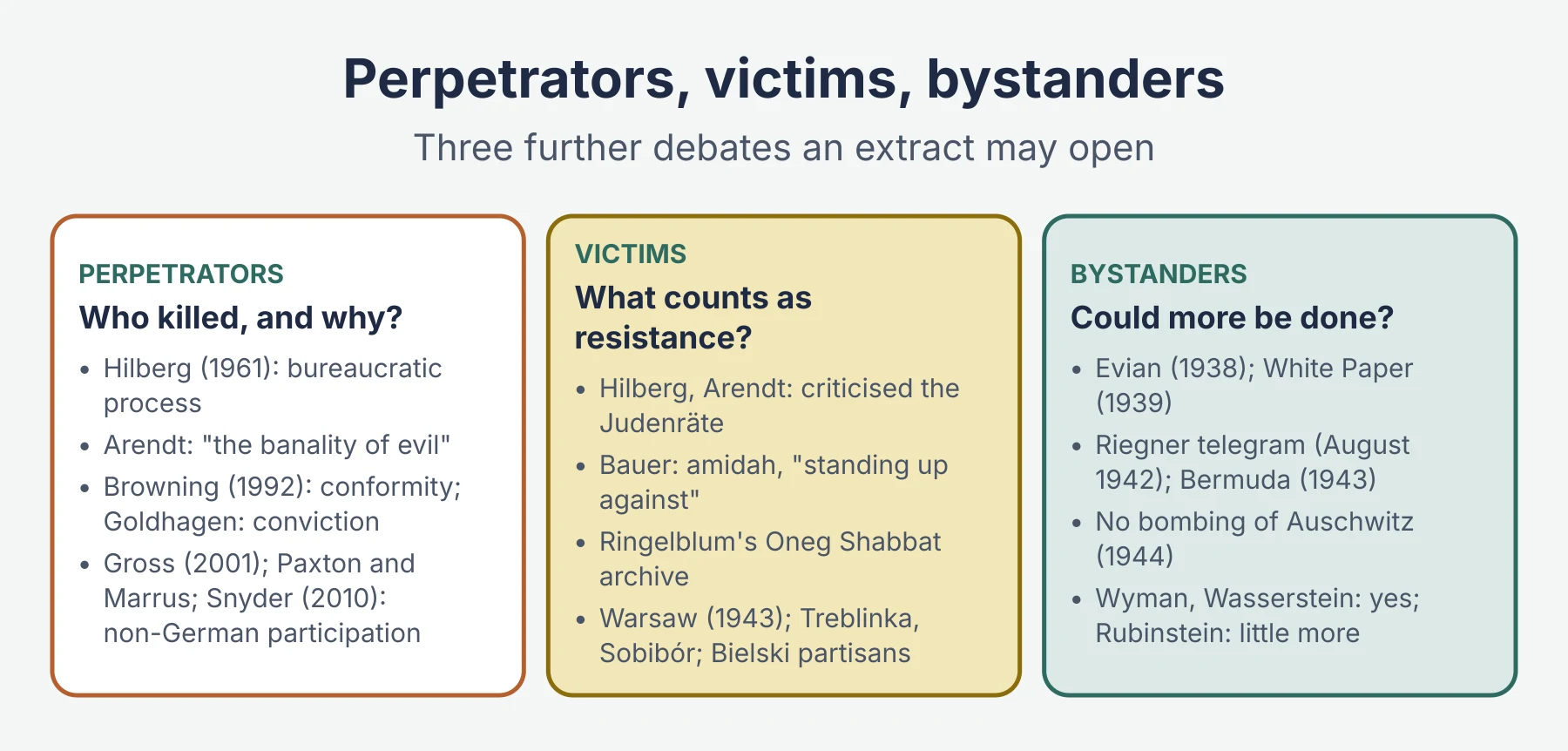
| Perpetrators | Bureaucrats, police, soldiers and non-German collaborators; motives debated | Hilberg; Arendt; Browning; Goldhagen; Gross; Snyder |
| Victims | Resistance widely defined; other victim groups | Bauer; Hilberg; Friedlander (Henry) |
| Bystanders | Britain and the USA could have done more / little more was possible | Wyman; Wasserstein; Rubinstein |
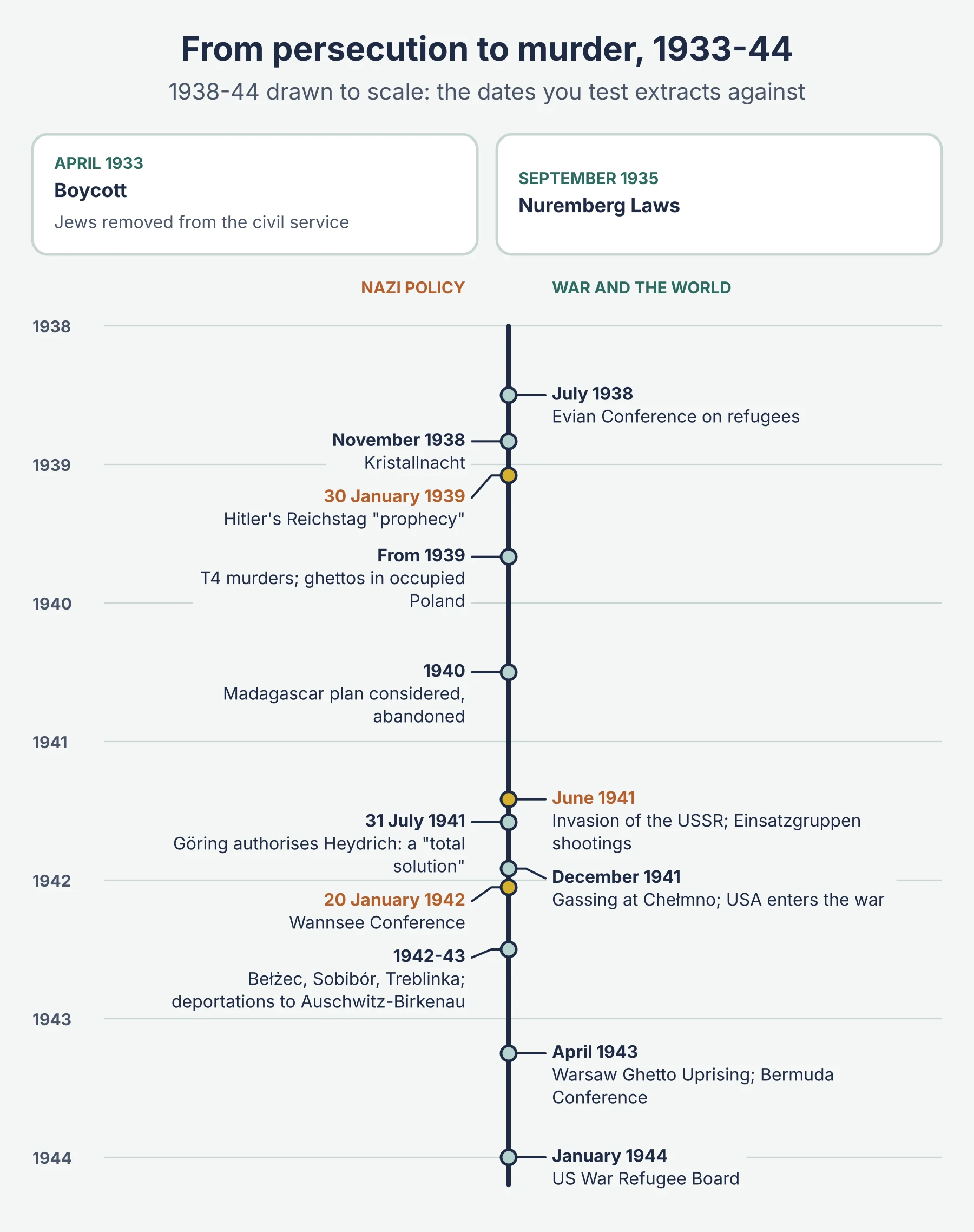
Stages of Nazi policy – what each school stresses
| Stage | Policy | Intentionalist reading | Functionalist / structuralist reading |
|---|---|---|---|
| 1933-38 | Exclusion, Nuremberg Laws, emigration | Steps towards a known goal | Improvised; aimed at emigration |
| Nov 1938 | Kristallnacht | Radical intent shown | Goebbels’s initiative; regime rivalry |
| 1939-40 | Ghettos in Poland; Madagascar plan | Preparation for murder | Search for a “territorial solution” that failed |
| Summer-autumn 1941 | Einsatzgruppen shootings in the USSR | Implementation of a decision | Escalation on the ground; local initiative |
| Dec 1941-Jan 1942 | Chełmno; Wannsee | Execution of the plan | Co-ordination of a programme already under way |
| 1942-44 | Death camps; Europe-wide deportation | Fulfilment | Momentum of the system |
Why historians differ on this topic
| Syllabus reason | Example |
|---|---|
| Fragmentary evidence | No written Hitler order for the “Final Solution” has been found; much was destroyed or spoken |
| Selection of evidence | Hitler’s speeches support intention; regional files support initiative from below |
| New evidence | Archives in eastern Europe opened after 1989-91 revealed local killings and collaboration |
| Time and place | Early post-war German writing stressed a small Nazi elite; later generations examined wider society |
| Ideology and questions | Studies of the state ask about institutions; studies of victims ask about agency and experience |
Key terms
| Term | Meaning |
|---|---|
| Antisemitism | Hostility to Jews; in the late nineteenth century increasingly defined in racial terms |
| Völkisch | Nationalism based on the idea of an ethnic people and its “blood” |
| Intentionalism | Explanation centred on Hitler’s ideology and planned intention |
| Structuralism | Explanation centred on how the Nazi state worked |
| Functionalism | Explanation centred on contingent circumstances, especially war |
| Polycracy | A state with many competing centres of power |
| Cumulative radicalisation | Mommsen’s term for policy escalating through rivalry |
| “Working towards the Führer” | Kershaw’s phrase for officials anticipating Hitler’s wishes |
| Einsatzgruppen | Mobile killing units of the SS and police |
| Judenrat | Jewish council forced to administer a ghetto |
| Amidah | Bauer’s broad concept of resistance as “standing up against” |
| T4 | Programme of murdering disabled people from 1939 |
| Bystander | A state, group or individual who knew and did not intervene |
Exam traps
- Two schools in one label. The syllabus distinguishes structuralism (the nature of the state) from functionalism (contingency such as war). An extract may combine them; explain which it stresses.
- Wannsee. It co-ordinated and extended killing already under way; it did not “decide” the Holocaust.
- Goldhagen. His thesis was strongly criticised; represent it accurately rather than as accepted fact.
- Bystander extracts. Do not force intentionalist or functionalist labels onto them.
- Victim numbers and groups. Use only figures you are sure of; the main argument rarely needs them.
Self-test
- What did Goldhagen mean by “eliminationist antisemitism”? A widespread German belief that Jews must be removed from society, which he argued long pre-dated 1933.
- Give one criticism of explanations based on pre-Nazi racism. German Jews were well integrated before 1914, and antisemitism was as strong elsewhere.
- Which evidence do intentionalists use? Any one: Hitler’s 1919 letter; Mein Kampf; the January 1939 prophecy.
- What is cumulative radicalisation? Mommsen’s idea that competition between Nazi agencies pushed policy to ever more extreme measures.
- What did Schleunes call the path to genocide? “The twisted road to Auschwitz.”
- How did the invasion of the USSR change Nazi policy? It brought mass shootings by the Einsatzgruppen and the move to systematic murder.
- What does “working towards the Führer” mean? Officials took radical initiatives they believed Hitler wanted.
- What did Browning conclude in Ordinary Men? That ordinary men killed for reasons including conformity and peer pressure, not only ideology.
- Which book described the Jedwabne massacre? Jan Gross’s Neighbors (2001).
- How did Bauer widen the definition of resistance? Through amidah: unarmed acts such as smuggling, schooling, worship and record-keeping.
- Name two other groups murdered by the Nazis. Any two: Roma and Sinti; disabled people; Soviet prisoners of war.
- What did the War Refugee Board show about US policy? That the USA created a rescue agency only in January 1944, late in the war.
Official syllabus
Cambridge International AS & A Level History (9489) syllabus for 2027, 2028 and 2029 – cambridgeinternational.org (Paper 3, Topic 2).
Related resources
-
Practice questions
Cambridge A Level World History (9489): Historical interpretations – Practice Questions
Three original Paper 3-style extracts for Cambridge 9489 History on 1914, the Holocaust and the Cold War, with indicative content and AO4/AO1 level guidance.
World History · Cambridge · A Level
Try questions -
Revision notes
Cambridge A Level World History (9489): Historical interpretations – Revision Notes
Paper 3 revision notes for Cambridge 9489 History: schools of thought on the First World War, the Holocaust and the Cold War and the 40-mark extract skill.
World History · Cambridge · A Level
Revise topic -
Study guides
Cambridge A Level World History (9489): Historical interpretations – Study Guide
How historians interpret the origins of the First World War, the Holocaust and the Cold War, and how to answer the 40-mark Paper 3 extract question in 9489.
World History · Cambridge · A Level
Read guide
Get free revision emails (optional)
Occasional emails with practice questions, worked explanations and links to free resources for the qualification and subjects you choose. No spam, and you can unsubscribe from any email. The free tools on this site never need an email.