
Study Guides
Cambridge A Level World History (9489): The origins and development of the Cold War
Study guide to Cambridge 9489 Paper 3 topic 3: the Cold War debate from traditionalism to post-post-revisionism, the 1941-49 context and the extract question.
- Subject
- World History
- Level
- A LEVEL
- Topic
- Topic 4: Historical interpretations
- Author
- Marlbridge Academic Team
- Updated
- Reviewed by
- Azam Siddique (what this means)
Aligned to Cambridge A Level World History (9489), 2027-2029. Official specification .
Syllabus page (what it covers and how it is assessed): Cambridge A Level World History.
Syllabus points this page covers
9489 (A Level)
- 3 The origins and development of the Cold War
Found an error? Report a correction.
Need help with this topic? Request a free trial class for A Level World History (9489).
The origins and development of the Cold War is Topic 3 of Paper 3, Historical Interpretations, in Cambridge 9489. Its over-arching key question is “Who or what was to blame for the Cold War?”, set in the context of Europe, 1941-49. Paper 3 (1 hour 15 minutes, 40 marks) gives you one unattributed extract of up to 600 words and one question: what can you learn from it about the historian’s interpretation and approach? Marks divide equally between AO4 (interpretations) and AO1 (knowledge). This guide goes deeper on the Cold War than the Historical interpretations study guide; for quick recall use the Cold War interpretations revision notes, and for extracts to practise on use the Cold War interpretations practice questions.
Syllabus coverage
Context (1941-49): tensions in the wartime alliance; problems of peace-making; Yalta and Potsdam; increasing tensions in a divided Europe; the Truman Doctrine and Marshall Plan; the Berlin Blockade and Airlift; the creation of NATO.
Content – how these shaped the debate on causation:
- How far were inherent tensions between East and West bound to resurface in 1945?
- How important were the personalities of the leaders of the Great Powers?
- How far were ideology, security and economics the factors that created tensions?
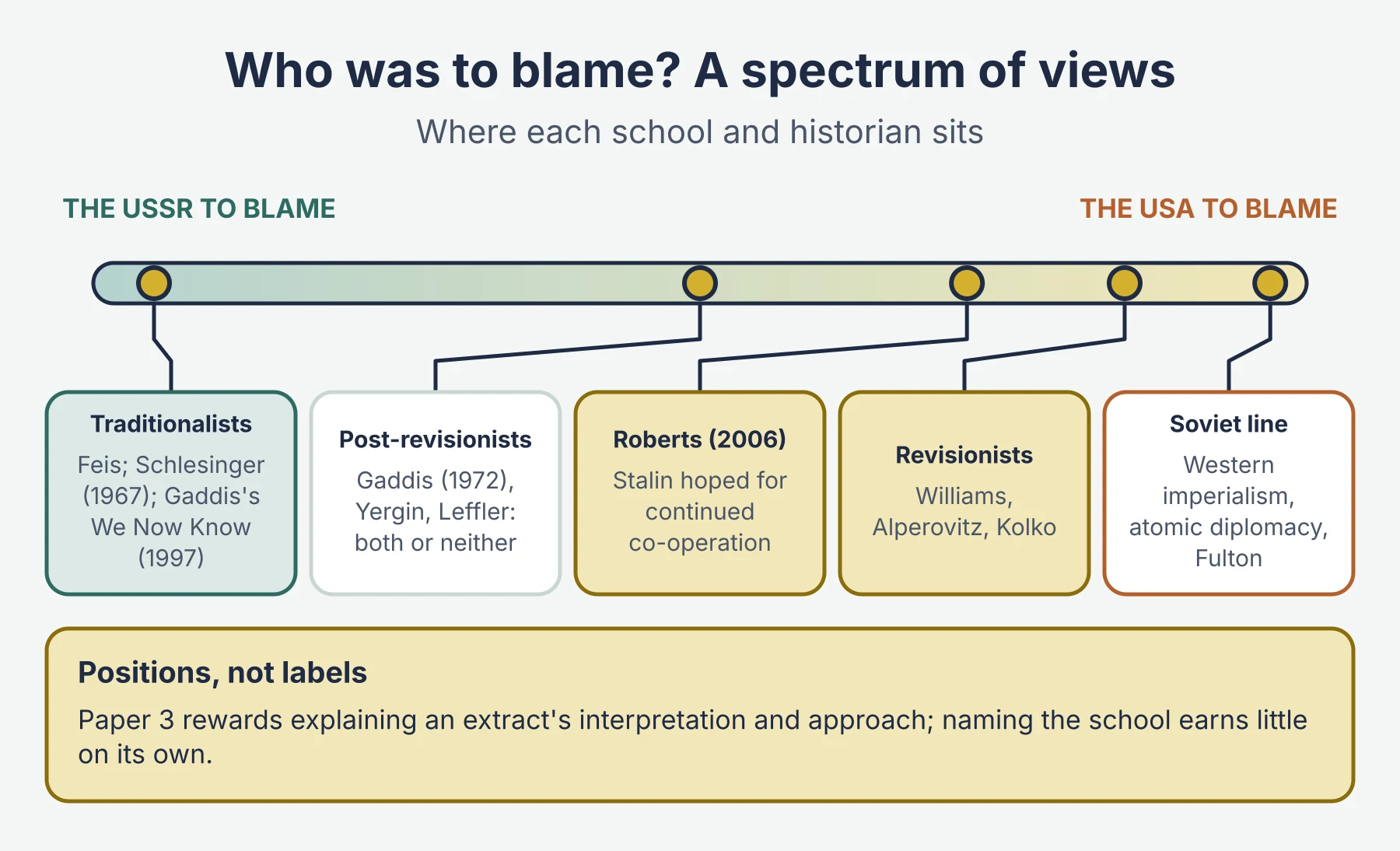
- Traditionalism (blaming the USSR), revisionism (blaming the USA), post-revisionism (blaming both or neither).
- How Russian historians’ perspectives have differed from those in the West.
- Reinterpretations in the light of new archival sources.
- The emergence of the “New” Cold War history: post-post-revisionism.
The three questions behind every interpretation
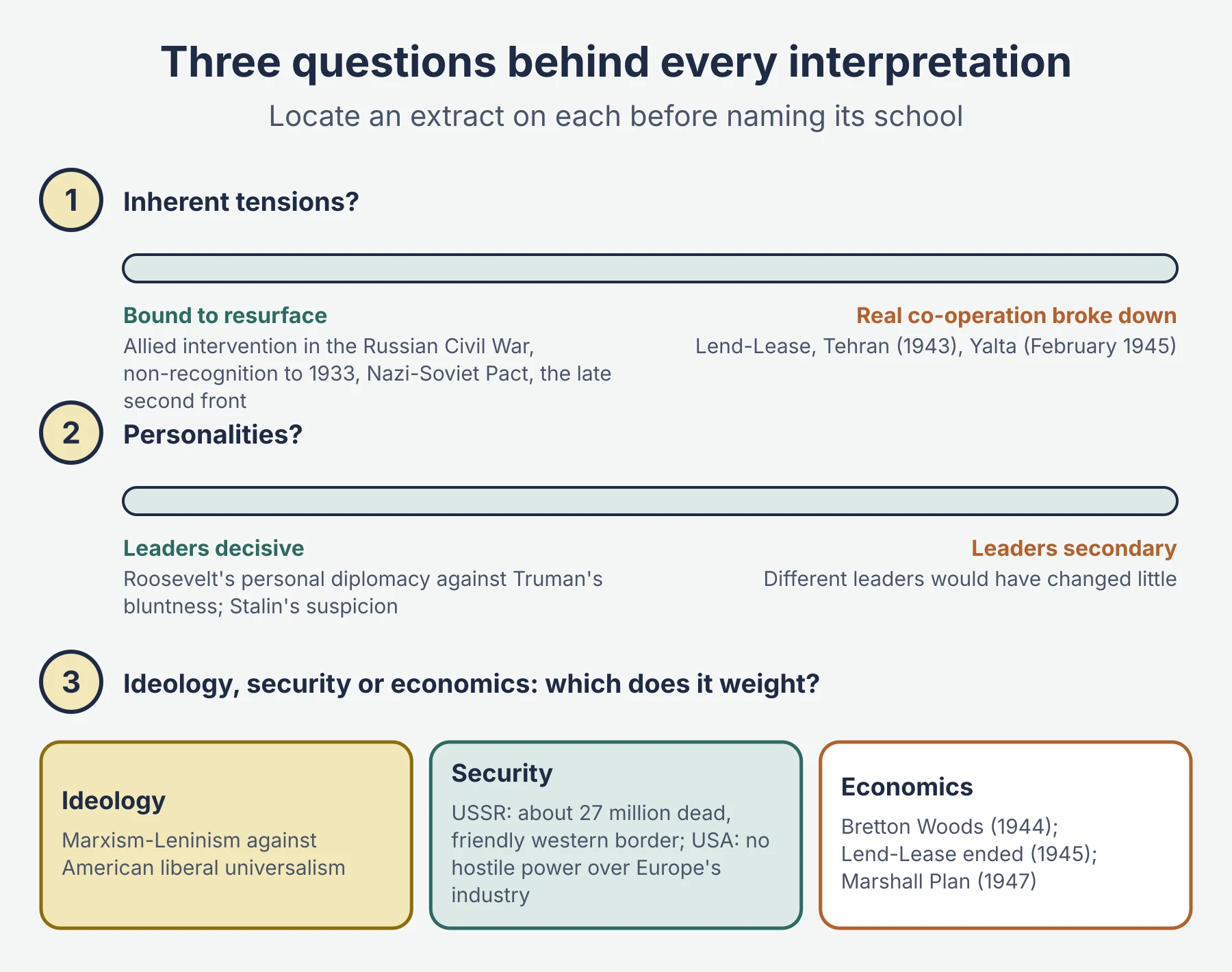
The syllabus’s first three content points are the variables historians weigh. When you read an extract, locate it on each.
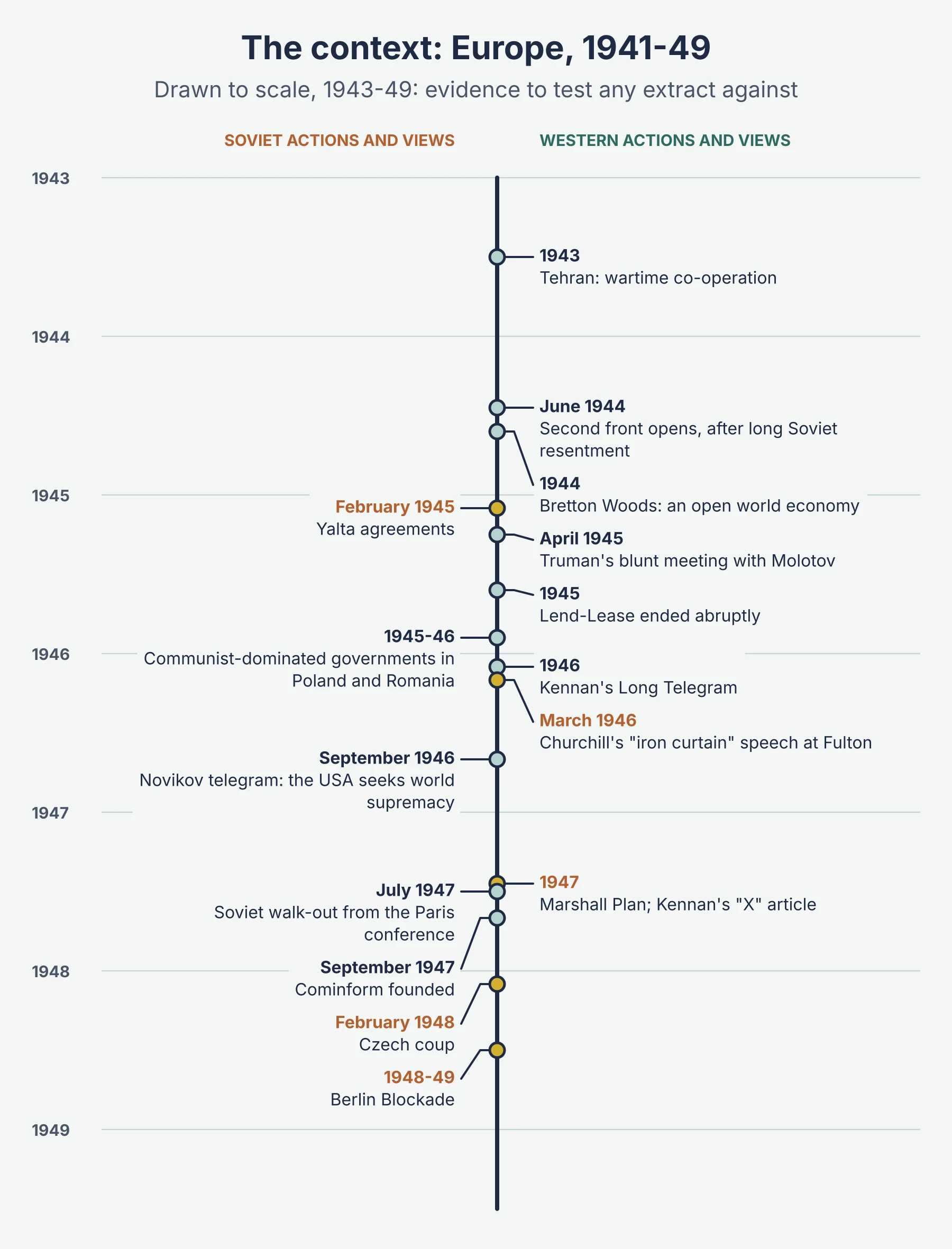
1. Inherent tensions. Some historians stress a conflict built in since 1917: Allied intervention in the Russian Civil War, US non-recognition of the USSR until 1933, the Nazi-Soviet Pact (1939), and Soviet resentment at the delay of the second front until June 1944. On this view the wartime alliance was a marriage of convenience, and conflict was “bound to resurface”. Others argue that wartime co-operation was real – Lend-Lease, Tehran (1943), the agreements at Yalta (February 1945) – so the breakdown needs a specific explanation.
2. Personalities. Roosevelt’s personal diplomacy and belief that he could “handle” Stalin contrast with Truman’s blunter style, shown in his meeting with Molotov in April 1945. Churchill’s anti-communism (the Fulton “iron curtain” speech, March 1946) and Stalin’s suspicion and ruthlessness feature in almost every account. Extracts that stress personality usually suggest that different leaders might have produced a different outcome.
3. Ideology, security and economics.
- Ideology: Marxist-Leninist belief in conflict with capitalism against American liberal universalism.
- Security: the USSR lost an estimated 27 million people and wanted friendly governments on its western border; the USA wanted no hostile power to dominate Europe’s industrial resources.
- Economics: US plans for an open world economy (Bretton Woods, 1944), the abrupt end of Lend-Lease (1945), and the Marshall Plan (1947), which the USSR rejected and blocked for Eastern Europe.
An extract’s weighting of these three is often the quickest way to its school.
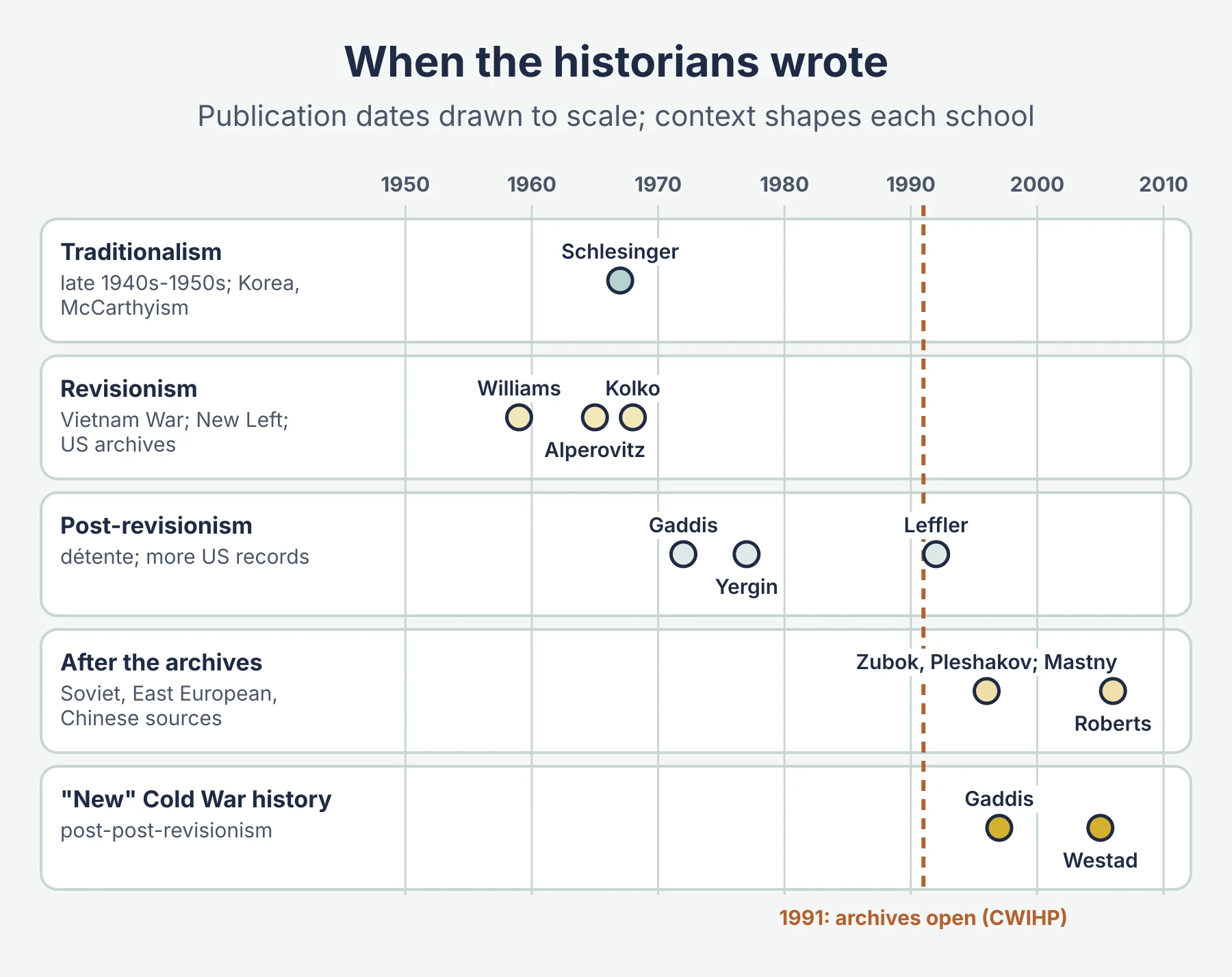
Traditionalism: blaming the Soviet Union
Argument. Stalin’s ideology and expansionism – the imposition of communist governments in Poland, Romania and Bulgaria in breach of the Declaration on Liberated Europe, the Czech coup (February 1948) and the Berlin Blockade (1948-49) – forced the West to respond. The Truman Doctrine, Marshall Aid and NATO were defensive reactions.
Historians. Herbert Feis, a former State Department adviser who wrote with privileged access to US records, presented American policy as reactive. Arthur Schlesinger Jr (“Origins of the Cold War”, 1967) argued that Soviet ideology and Stalin’s suspicion made conflict almost certain, whatever the West did. George Kennan’s Long Telegram (1946) and “X” article (1947) are not histories but supplied the traditionalist analysis of Soviet behaviour.
Approach and context. Written mainly in the late 1940s and 1950s, in the shadow of Korea and McCarthyism, with Western official sources and almost no Soviet evidence. Traditionalists tend to treat Soviet actions as ideologically driven and Western actions as responses.
Revisionism: blaming the United States
Argument. American economic and political ambitions – the drive for open markets and a capitalist world order – produced an expansionist US policy; Soviet actions were largely defensive responses to encirclement.
Historians. William Appleman Williams (The Tragedy of American Diplomacy, 1959) traced an “Open Door” policy of economic expansion. Gar Alperovitz (Atomic Diplomacy, 1965) argued that the atomic bomb was used partly to intimidate the USSR and strengthen the US hand at Potsdam. Gabriel Kolko (The Politics of War, 1968) argued that the USA sought to reshape the post-war world in its own interests.
Approach and context. Many revisionists wrote during the Vietnam War, influenced by the New Left and by newly opened US archives. Their approach is to examine American motives, especially economic ones, and to read Soviet behaviour in terms of security. Critics noted that they lacked Soviet sources and could underplay Stalin’s choices.
Post-revisionism: both or neither
Argument. Responsibility was shared, or the conflict was the product of the post-war situation: two powers with different systems, a power vacuum in Europe, and mutual misperception in which each side’s defensive actions looked aggressive to the other.
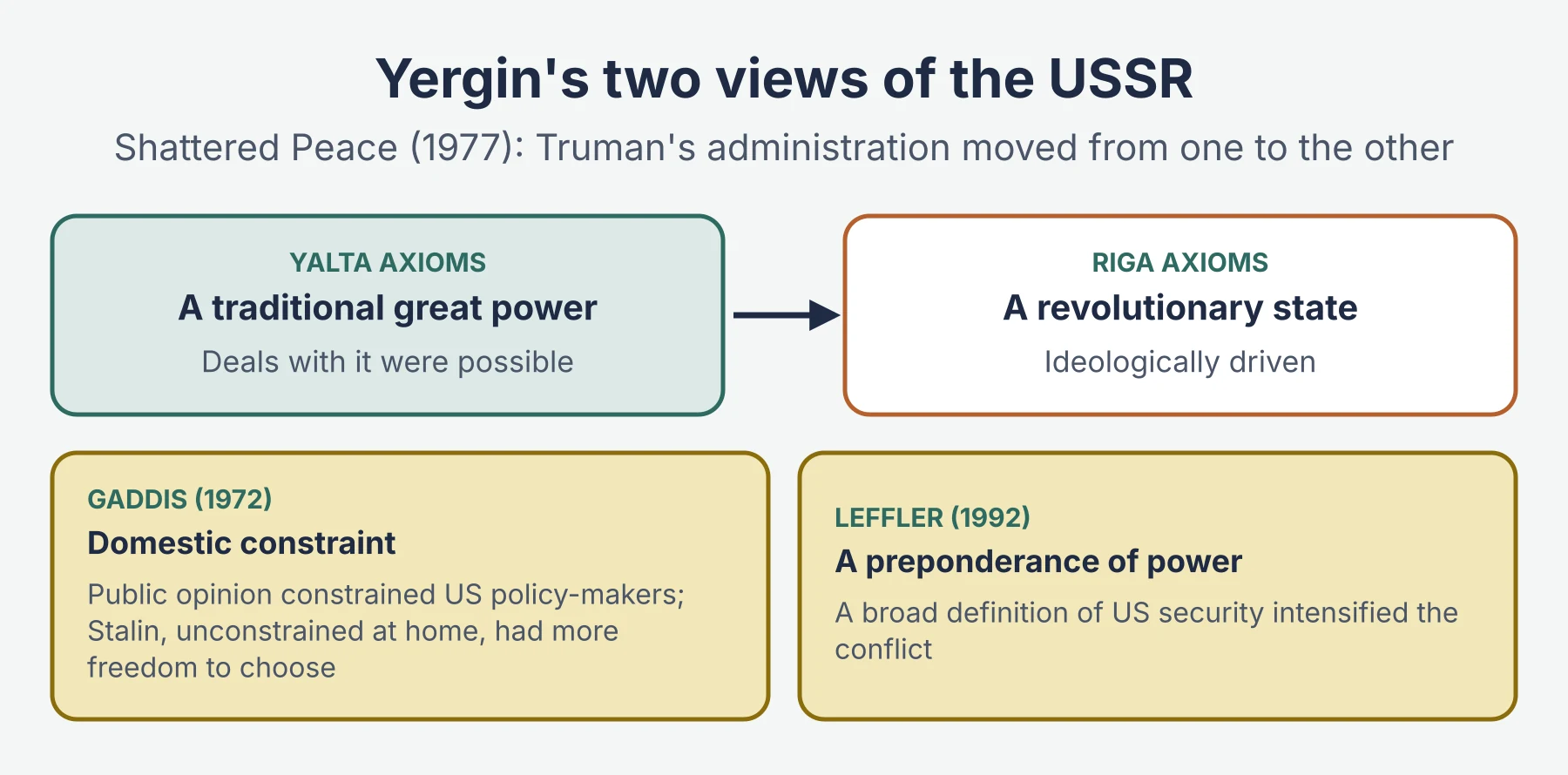
Historians. John Lewis Gaddis (The United States and the Origins of the Cold War, 1941-1947, 1972) stressed how domestic politics and public opinion constrained US policy-makers, while suggesting that Stalin, unconstrained at home, had more freedom to choose. Daniel Yergin (Shattered Peace, 1977) contrasted the “Yalta axioms” (the USSR as a traditional great power with which deals were possible) with the “Riga axioms” (the USSR as an ideologically driven revolutionary state) and argued that Truman’s administration moved to the second. Melvyn Leffler (A Preponderance of Power, 1992) argued that US officials’ broad definition of national security led them to seek a preponderance of power, which intensified the conflict.
Approach and context. Written as détente encouraged less moralised history and more US records became available. The approach is often structural or systemic, and attentive to perception and domestic politics.
Russian perspectives and new archives
Soviet-era writing followed the official line: Western imperialism, atomic diplomacy and the Fulton speech caused the Cold War, while Soviet policy defended peace and socialism.
After 1991 historians gained partial access to Soviet, East European and Chinese archives, published through bodies such as the Cold War International History Project (founded 1991). Documents such as the Novikov telegram (September 1946), which read US policy as a drive for world supremacy, and US releases such as the Venona decrypts of Soviet espionage (1995), changed the evidence base. Russian-born historians Vladislav Zubok and Constantine Pleshakov (Inside the Kremlin’s Cold War, 1996) described a “revolutionary-imperial paradigm” in which ideology and traditional Russian security concerns combined. Vojtech Mastny (The Cold War and Soviet Insecurity, 1996) stressed how Stalin’s pursuit of absolute security produced the insecurity he feared. Geoffrey Roberts (Stalin’s Wars, 2006) argued that Stalin hoped for continued co-operation after 1945.
Post-post-revisionism and the “New” Cold War history
Gaddis’s We Now Know (1997) used the new archives to return much of the responsibility to Stalin, arguing that his authoritarian personality and ideology made a cold war very likely while he ruled. Because this restated part of the traditionalist case with new evidence, it is often called post-post-revisionism or neo-orthodoxy. The wider “New” Cold War history also stresses ideology, uses multi-archival and international sources, and widens the lens beyond Washington and Moscow – Odd Arne Westad’s The Global Cold War (2005) is an example. Critics, including Leffler, argued that the new evidence did not settle the debate and that the US role still needed explaining.
Worked example: reading an extract’s approach
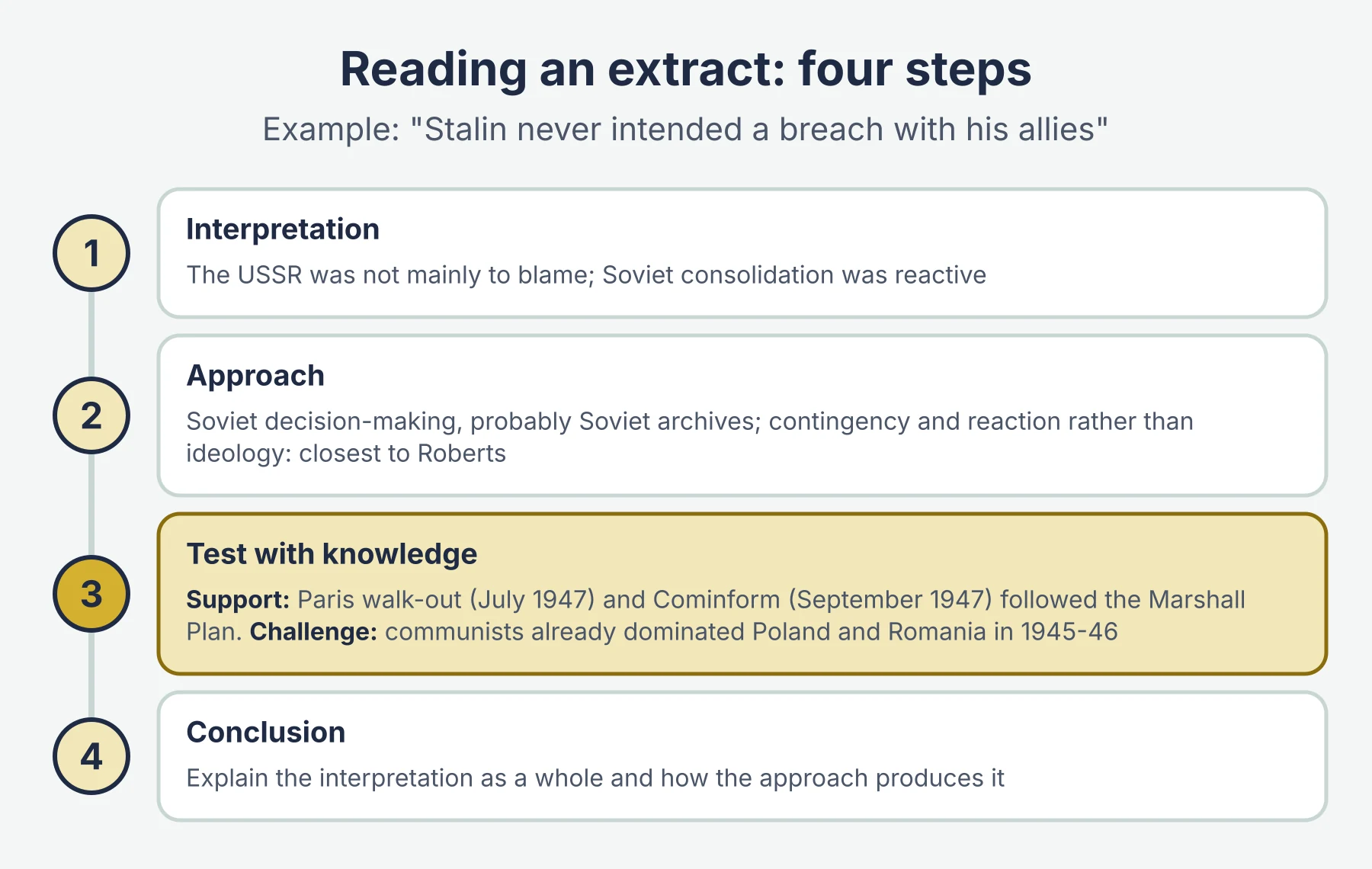
Suppose an extract argues that Stalin “never intended a breach with his allies” and that Soviet policy in Eastern Europe was improvised in response to the Marshall Plan.
- Interpretation: the USSR was not mainly to blame; Soviet consolidation was reactive.
- Approach: focus on Soviet decision-making, probably using Soviet archives; interest in contingency and reaction rather than ideology – closest to Roberts or some post-revisionist work, with revisionist elements.
- Test with knowledge: support – Soviet withdrawal from the Paris conference (July 1947) and the founding of Cominform (September 1947) followed the Marshall Plan; challenge – coalition governments in Poland and Romania were already dominated by communists in 1945-46.
- Conclusion: explain the interpretation as a whole and how the approach produces it.
Common mistakes
- Labelling an extract with a school and stopping there: Paper 3 rewards explaining the interpretation and approach, and labels earn little on their own.
- Treating “post-post-revisionism” as simply traditionalism again; it rests on new evidence and wider questions.
- Using Korea or Cuba as context: the syllabus context is Europe, 1941-49.
- Discussing sub-messages instead of the extract’s overall claim.
Exam technique
The command phrase is always “What can you learn…”. Read the whole extract, state its overall interpretation in your first paragraph, explain the approach (whose actions it focuses on, what kind of cause, what evidence), then test it with accurate knowledge from 1941-49.
Official syllabus
Cambridge International AS & A Level History (9489) syllabus for 2027, 2028 and 2029 – cambridgeinternational.org (Paper 3, Topic 3; Paper 3 details of the assessment).
Related resources
-
Practice questions
Cambridge A Level World History (9489): The origins and development of the Cold War – Practice Questions
Twelve original questions on Cambridge 9489 Paper 3 Cold War interpretations: short recall items and three invented 40-mark extracts with mark-scheme answers.
World History · Cambridge · A Level
Try questions -
Revision notes
Cambridge A Level World History (9489): The origins and development of the Cold War – Revision Notes
Revision notes for Cambridge 9489 Paper 3 Cold War interpretations: the schools, historians and approaches, the 1941-49 evidence, exam traps and a self-test.
World History · Cambridge · A Level
Revise topic -
Study guides
Cambridge A Level World History (9489): The origins of the First World War
Study guide to Cambridge 9489 Paper 3, the origins of the First World War: war guilt, shared responsibility, Fischer and his critics, Clark and contingency.
World History · Cambridge · A Level
Read guide
Get free revision emails (optional)
Occasional emails with practice questions, worked explanations and links to free resources for the qualification and subjects you choose. No spam, and you can unsubscribe from any email. The free tools on this site never need an email.