
Revision Notes
Cambridge A Level World History (9489): The origins and development of the Cold War – Revision Notes
Revision notes for Cambridge 9489 Paper 3 Cold War interpretations: the schools, historians and approaches, the 1941-49 evidence, exam traps and a self-test.
- Subject
- World History
- Level
- A LEVEL
- Topic
- Topic 4: Historical interpretations
- Author
- Marlbridge Academic Team
- Updated
- Reviewed by
- Azam Siddique (what this means)
Aligned to Cambridge A Level World History (9489), 2027-2029. Official specification .
Syllabus page (what it covers and how it is assessed): Cambridge A Level World History.
Syllabus points this page covers
9489 (A Level)
- 3 The origins and development of the Cold War
Found an error? Report a correction.
Need help with this topic? Request a free trial class for A Level World History (9489).
These notes condense Topic 3 of Cambridge 9489 Paper 3, the origins and development of the Cold War, for fast recall. The key question is “Who or what was to blame for the Cold War?” For fuller explanation and a worked reading of an extract see the Cold War interpretations study guide; for original extracts to practise on see the Cold War interpretations practice questions.
Syllabus coverage
- Inherent East-West tensions; personalities; ideology, security and economics.
- Traditionalism; revisionism; post-revisionism.
- Russian perspectives compared with Western ones.
- Reinterpretations from new archives; the “New” Cold War history and post-post-revisionism.
- Context: Europe, 1941-49.
Key terms
| Term | Meaning |
|---|---|
| Interpretation | What can be inferred about the historian’s claims and conclusions |
| Approach | What the historian brings: interests, questions asked, ideology and beliefs |
| Traditionalism (orthodox) | Interpretations blaming the Soviet Union |
| Revisionism | Interpretations blaming the USA |
| Post-revisionism | Interpretations blaming both or neither side |
| Post-post-revisionism | Archive-based work after 1991, often returning weight to Stalin and ideology |
| New Cold War history | Multi-archival, international and ideology-aware study after 1991 |
| Open Door | American pursuit of open markets, central to Williams’s revisionism |
| Atomic diplomacy | Using the bomb to pressure the USSR (Alperovitz) |
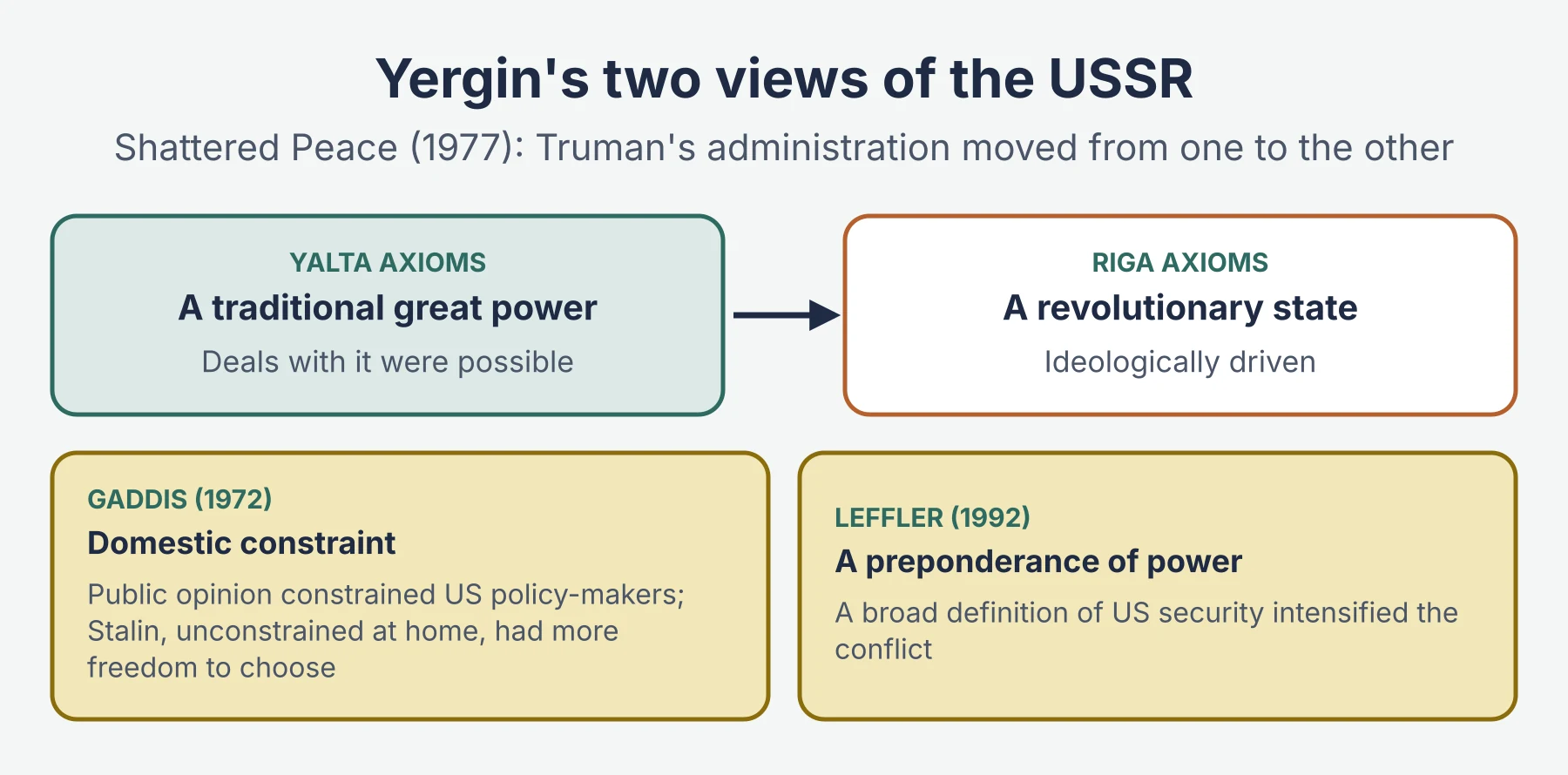
| Riga and Yalta axioms | Yergin’s two US images of the USSR: revolutionary state or traditional great power |
| Revolutionary-imperial paradigm | Zubok and Pleshakov’s fusion of ideology and Russian imperial security |
| Security dilemma | One side’s defensive measures appear as threats to the other |
| Sub-message | A secondary point in an extract, not its overall interpretation |
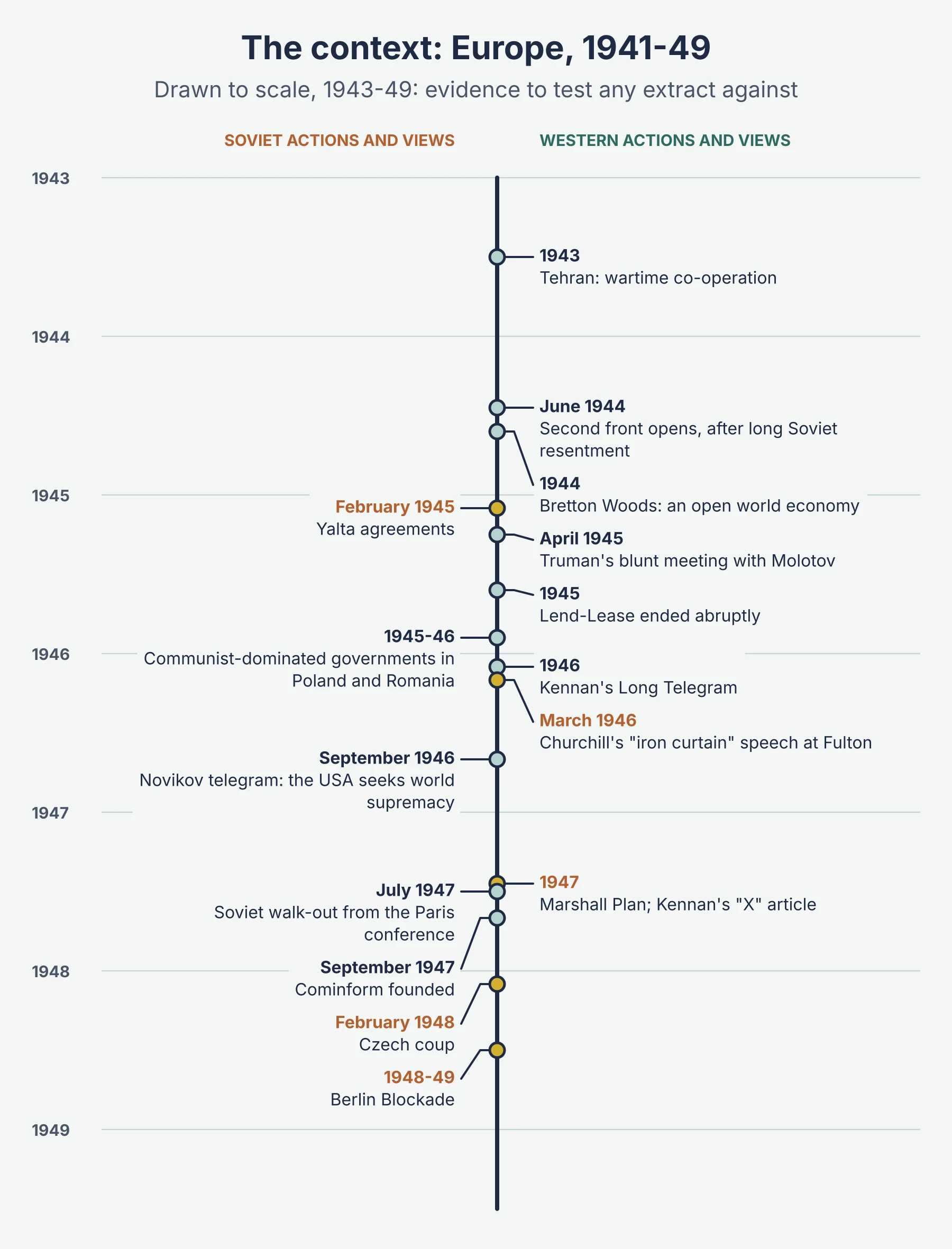
Context timeline, 1941-49
| Date | Event | Typically used by |
|---|---|---|
| June 1941 | Germany invades the USSR; the Grand Alliance forms | Inherent-tension and wartime-co-operation arguments |
| Nov 1943 | Tehran Conference | Personalities (Roosevelt’s diplomacy) |
| June 1944 | D-Day: the delayed second front | Soviet grievance, revisionists |
| Oct 1944 | Churchill-Stalin “percentages” agreement | Realist and post-revisionist readings |
| Feb 1945 | Yalta: Poland, Declaration on Liberated Europe | All schools; Soviet breaches for traditionalists |
| April 1945 | Truman’s meeting with Molotov | Personality and revisionist arguments |
| July-Aug 1945 | Potsdam; Hiroshima and Nagasaki | Atomic diplomacy (revisionists) |
| Feb 1946 | Kennan’s Long Telegram | Traditionalist analysis |
| March 1946 | Churchill’s Fulton speech | Soviet-era accounts of Western hostility |
| Sept 1946 | Novikov telegram | Post-1991 evidence of Soviet perceptions |
| March 1947 | Truman Doctrine | Defensive (traditionalist) or expansionist (revisionist) |
| June-July 1947 | Marshall Plan; Soviet walk-out from Paris talks | Economics; security dilemma |
| Sept 1947 | Cominform founded | Soviet consolidation as reaction |
| Feb 1948 | Communist coup in Czechoslovakia | Traditionalist evidence of expansion |
| June 1948-May 1949 | Berlin Blockade and Airlift | Both sides’ security; personalities |
| April 1949 | NATO founded | Defensive alliance or bloc-building |
The schools in one table
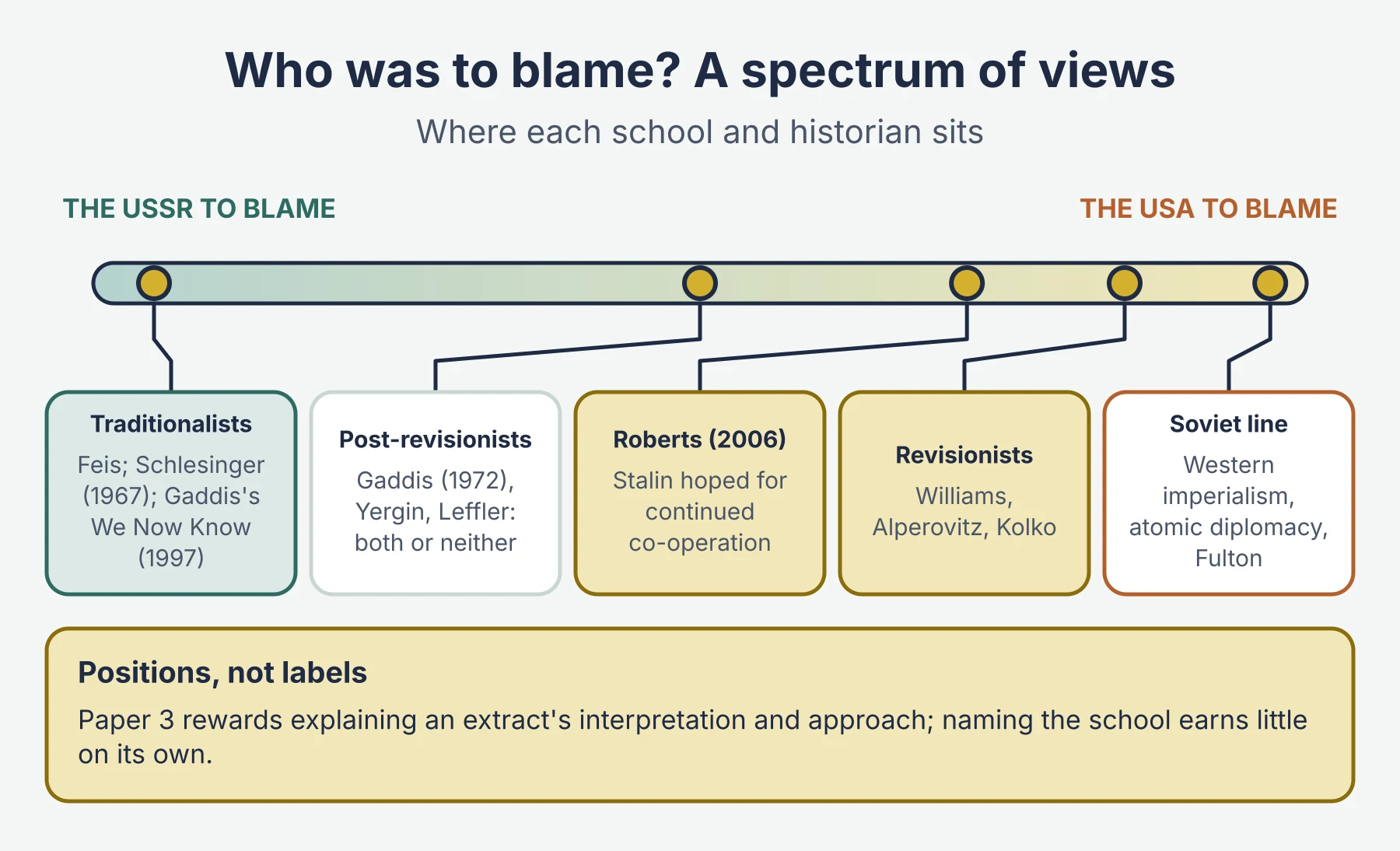
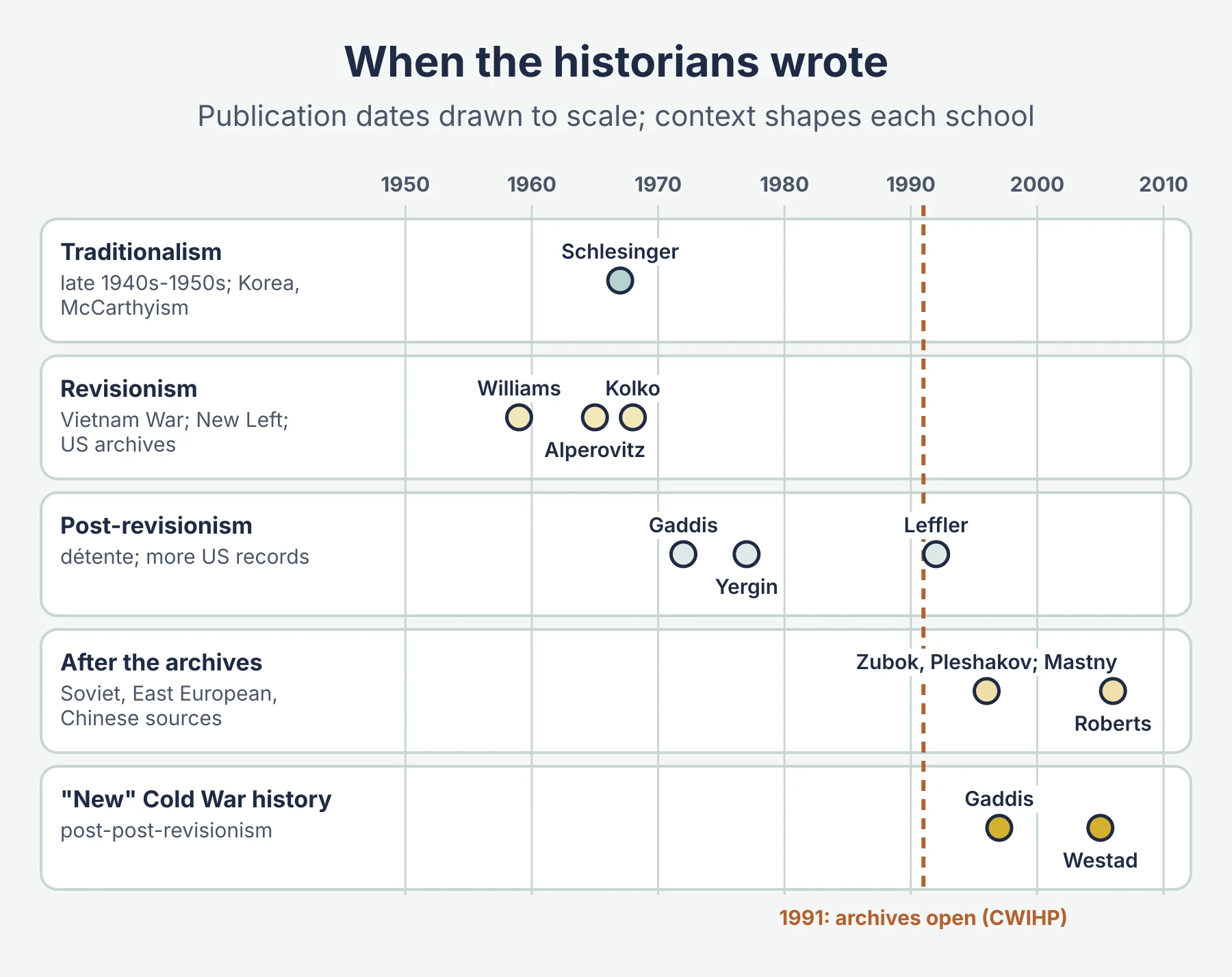
| School | Historians and works | Core argument | Approach and context |
|---|---|---|---|
| Traditionalist | Feis; Schlesinger, 1967 | Soviet ideology and expansion; Western response defensive | Western official sources, early Cold War, little Soviet evidence |
| Revisionist | Williams, 1959; Alperovitz, 1965; Kolko, 1968 | US economic expansion and atomic diplomacy; Soviet defensiveness | Vietnam era, New Left, newly opened US archives |
| Post-revisionist | Gaddis, 1972; Yergin, 1977; Leffler, 1992 | Shared responsibility, misperception, national security | Détente, broader US records, systemic analysis |
| Russian / Soviet-era | Official histories | US imperialism and Fulton speech to blame | Party line, closed archives |
| Archive-era | Zubok and Pleshakov, 1996; Mastny, 1996; Roberts, 2006 | Ideology plus security; Stalin’s insecurity; or Stalin’s wish for co-operation | Soviet and East European archives |
| Post-post-revisionist | Gaddis, We Now Know, 1997; Westad, 2005 | Stalin and ideology central; global, multi-archival view | Post-1991 archives, international history |
How to identify an extract’s position
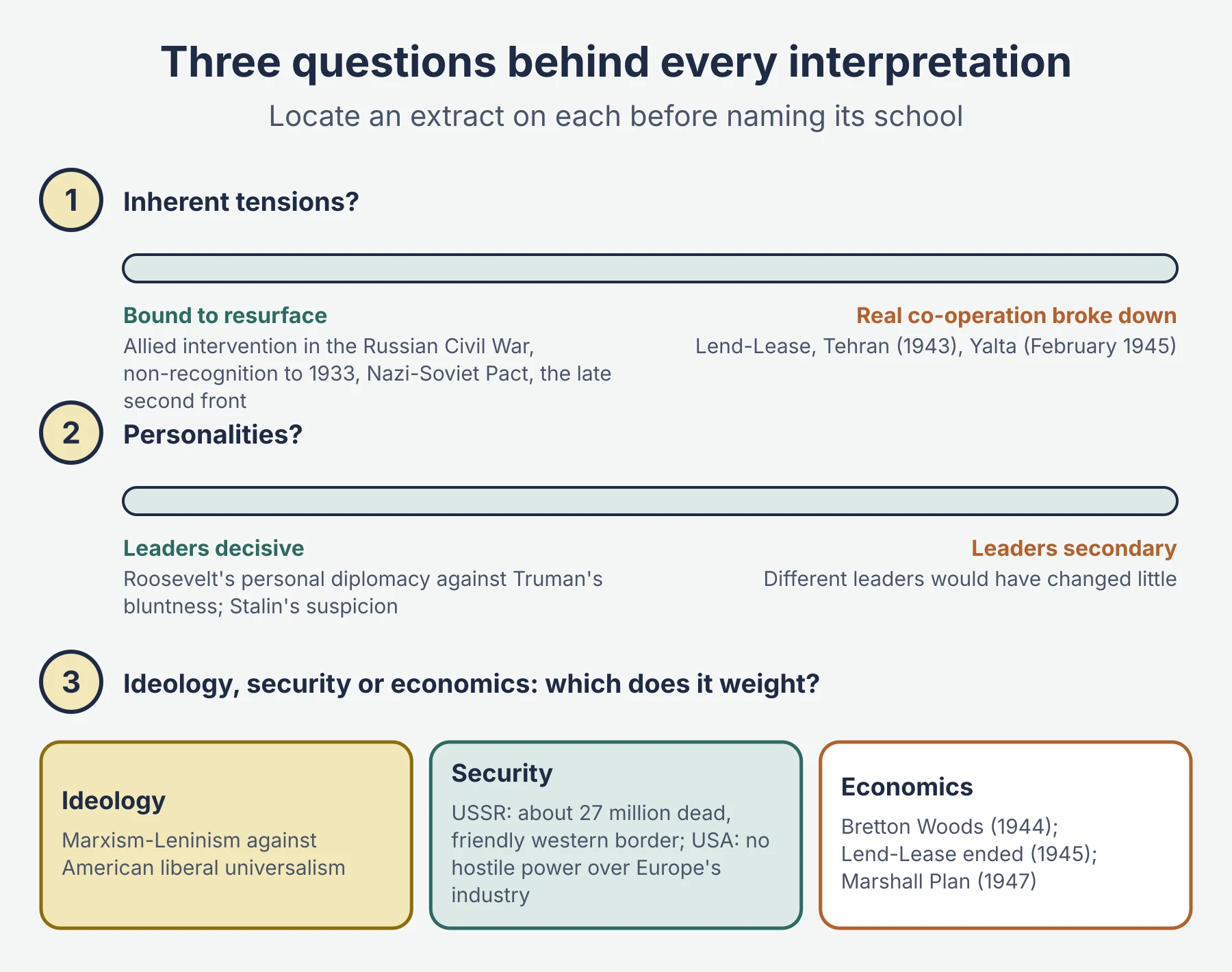
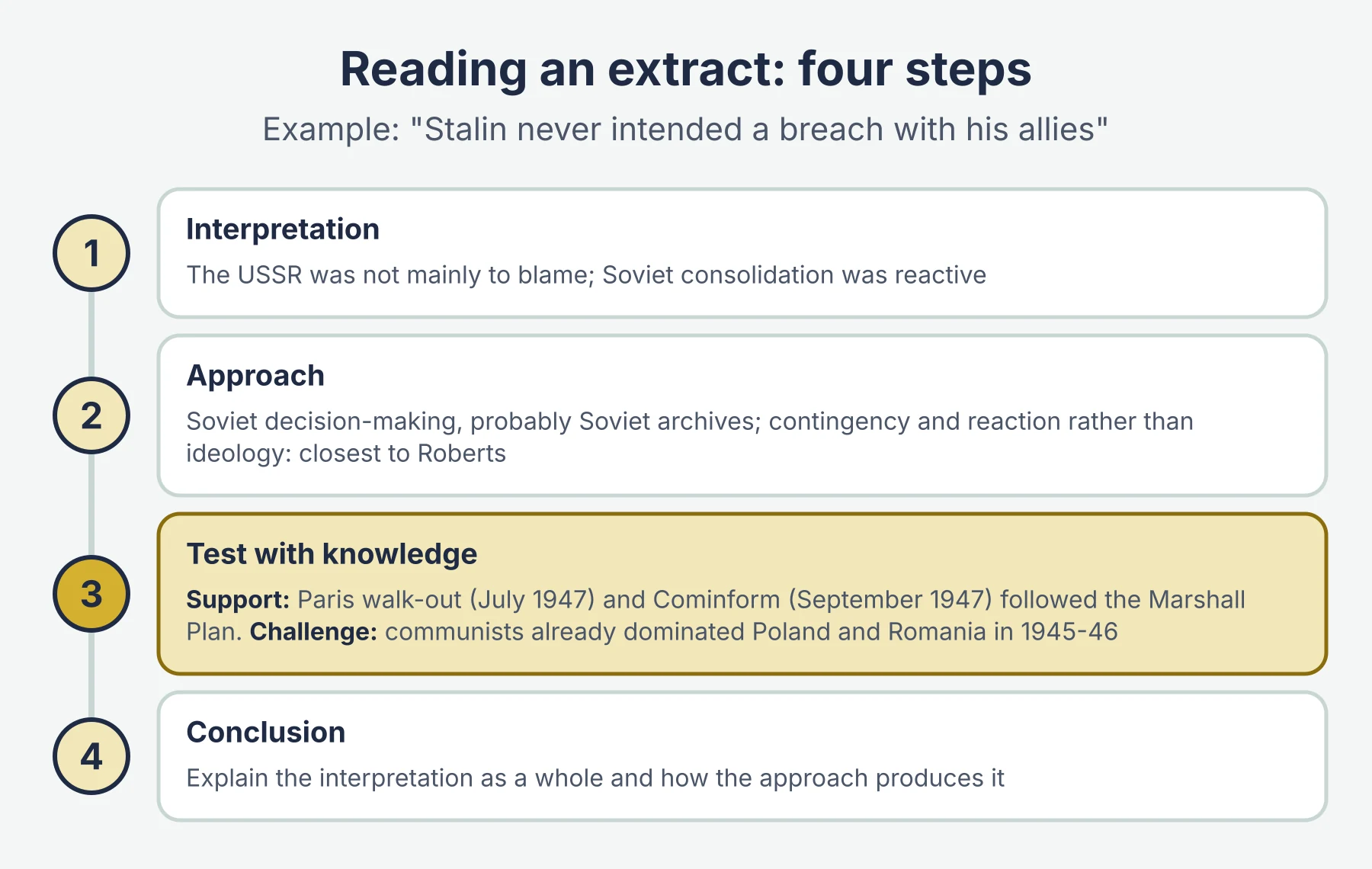
- Who acts, who reacts? If the USSR acts and the West reacts, it leans traditionalist; the reverse leans revisionist.
- Which cause dominates? Ideology, security, economics or personality.
- What evidence is cited? Soviet archival material suggests post-1991 work.
- What tone towards blame? Moral language (“aggression”) or structural language (“dilemma”, “vacuum”).
Exam traps
- Labels are not answers: explain the interpretation and approach; a school label alone earns little.
- Sub-messages: do not build the answer on a single sentence of the extract.
- Context limits: the syllabus context is Europe, 1941-49.
- Dating fallacy: old does not mean wrong; judge the argument and evidence.
- Naming the author: not required and not rewarded.
- Knowledge for its own sake: AO1 must test the interpretation.
Self-test
- What is the over-arching key question of this topic? Who or what was to blame for the Cold War?
- Which school blames the Soviet Union? Traditionalism (orthodox).
- What did Williams mean by the “Open Door”? A US policy of economic expansion through open markets.
- What did Alperovitz argue about the atomic bomb? That it was used partly to intimidate the USSR and strengthen the US position.
- What were Yergin’s “Riga axioms”? A view of the USSR as an ideologically driven revolutionary state.
- How did Gaddis’s 1972 book explain US policy? It stressed the constraints of domestic politics and opinion on US leaders.
- What is Leffler’s main argument? US officials’ broad view of national security led them to seek a preponderance of power.
- What did Zubok and Pleshakov call Stalin’s outlook? A revolutionary-imperial paradigm.
- Name one new source that became available in the 1990s. Soviet archival documents such as the Novikov telegram; or the Venona decrypts.
- Why is We Now Know called post-post-revisionist? It used new archives to return much of the blame to Stalin and ideology.
- How did Soviet-era historians explain the Cold War? As the result of Western imperialism and hostility, such as the Fulton speech.
- What does the syllabus mean by “approach”? What the historian brings to the topic: interests, questions and beliefs.
Official syllabus
Cambridge International AS & A Level History (9489) syllabus for 2027, 2028 and 2029 – cambridgeinternational.org (Paper 3, Topic 3).
Related resources
-
Study guides
Cambridge A Level World History (9489): The origins of the First World War
Study guide to Cambridge 9489 Paper 3, the origins of the First World War: war guilt, shared responsibility, Fischer and his critics, Clark and contingency.
World History · Cambridge · A Level
Read guide -
Practice questions
Cambridge A Level World History (9489): The origins of the First World War – Practice Questions
Original Cambridge 9489 Paper 3 practice on the origins of the First World War: eight short items and three constructed extracts with indicative content.
World History · Cambridge · A Level
Try questions -
Revision notes
Cambridge A Level World History (9489): The origins of the First World War – Revision Notes
Revision notes for Cambridge 9489 Paper 3 on the origins of the First World War: July 1914 dates, schools of interpretation, key terms and a self-test.
World History · Cambridge · A Level
Revise topic
Get free revision emails (optional)
Occasional emails with practice questions, worked explanations and links to free resources for the qualification and subjects you choose. No spam, and you can unsubscribe from any email. The free tools on this site never need an email.