
Study Guides
Cambridge A Level World History (9489): The Holocaust
Study guide to Cambridge 9489 Paper 3, the Holocaust: pre-Nazi racism, intentionalism, structuralism, functionalism, perpetrators, victims and bystanders.
- Subject
- World History
- Level
- A LEVEL
- Topic
- Topic 4: Historical interpretations
- Author
- Marlbridge Academic Team
- Updated
- Reviewed by
- Azam Siddique (what this means)
Aligned to Cambridge A Level World History (9489), 2027-2029. Official specification .
Syllabus page (what it covers and how it is assessed): Cambridge A Level World History.
Syllabus points this page covers
9489 (A Level)
- 2 The Holocaust
Found an error? Report a correction.
Need help with this topic? Request a free trial class for A Level World History (9489).
The Holocaust is Topic 2 of Paper 3 (Historical interpretations) in Cambridge International A Level History 9489. The over-arching key question is “Who or what was to blame for the Holocaust?” The topic asks you to understand how historians have explained the persecution and murder of Europe’s Jews, why their explanations differ, and how to identify an interpretation and approach in an unseen extract. It is a subject that demands precision and care: arguments should be represented accurately, and the people who suffered should never become mere illustrations. The overview of all three Paper 3 topics is the Historical interpretations study guide.
What Paper 3 asks
Paper 3 (1 hour 15 minutes, 40 marks) sets one unattributed extract of up to 600 words on each topic and one question: “What can you learn from this extract about the interpretation and approach of the historian who wrote it?” Half the marks are for AO4 (interpretation) and half for AO1 (knowledge used to test the extract). The examiner wants the interpretation as a whole, not a list of secondary points. Use the Holocaust revision notes for recall and the Holocaust practice extracts for timed work.
The context includes European and German antisemitism and racist theories; Nazi persecution of the Jews, 1933-41; the impact of war on Nazi policy; ghettoisation and Jewish responses; the development of extermination policies towards Jews and other minorities; and contemporary reactions.
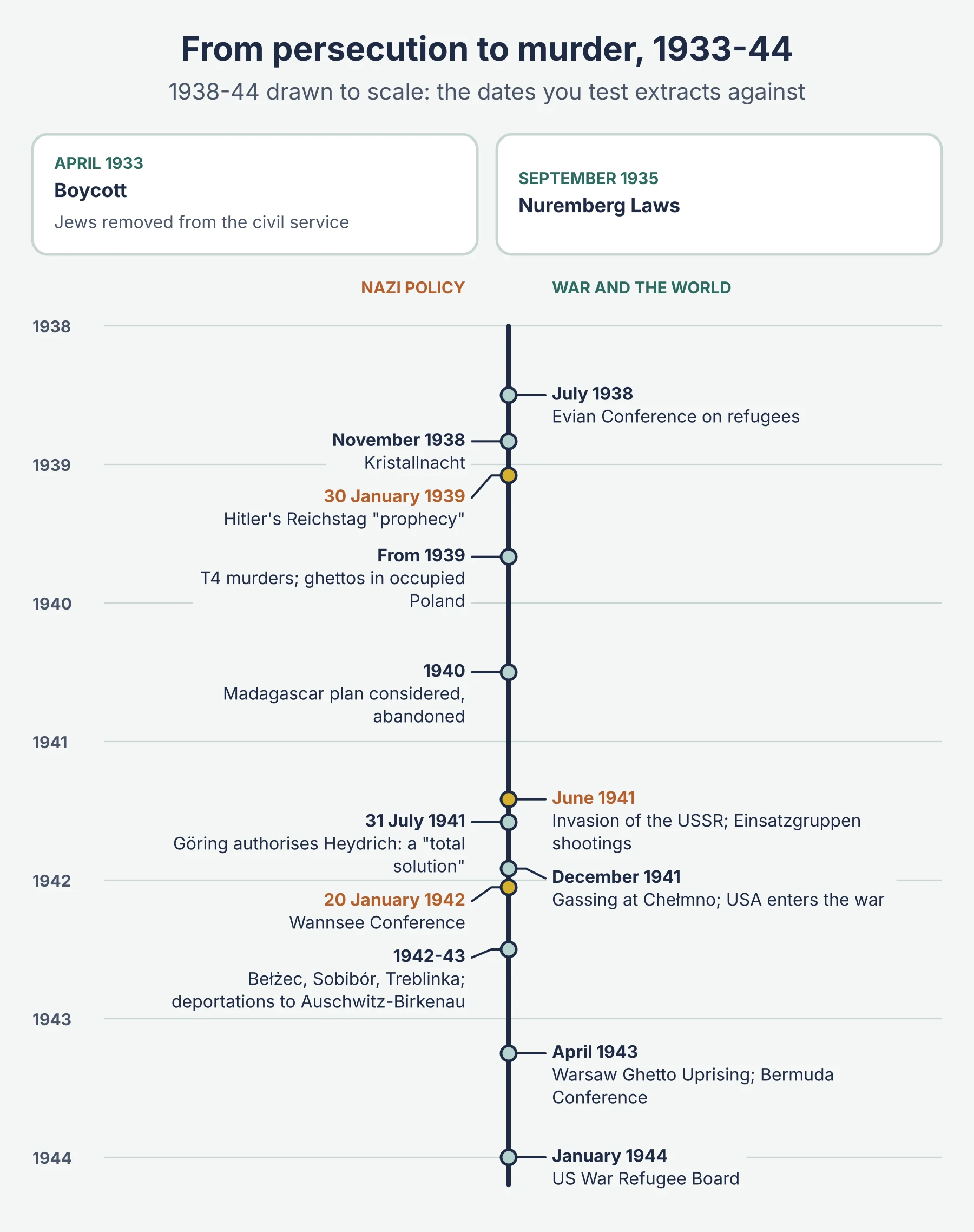
Context dates to test extracts against
| Date | Event |
|---|---|
| April 1933 | Boycott of Jewish shops; law removing Jews from the civil service |
| Sept 1935 | Nuremberg Laws |
| July 1938 | Evian Conference on refugees |
| Nov 1938 | Kristallnacht pogrom |
| 30 Jan 1939 | Hitler’s Reichstag “prophecy” of the annihilation of the Jews in the event of war |
| From 1939 | “T4” murder of disabled people; ghettos in occupied Poland |
| 1940 | Madagascar plan considered and abandoned |
| June 1941 | Invasion of the USSR; Einsatzgruppen mass shootings |
| 31 July 1941 | Göring authorises Heydrich to prepare a “total solution” |
| Dec 1941 | Gassing begins at Chełmno; USA enters the war |
| 20 Jan 1942 | Wannsee Conference |
| 1942-43 | Operation Reinhard camps: Bełżec, Sobibór, Treblinka; mass deportations to Auschwitz-Birkenau |
| April 1943 | Warsaw Ghetto Uprising; Bermuda Conference |
| Jan 1944 | US War Refugee Board |
The debate, content point by content point
How far was the Holocaust a consequence of racist ideas that existed before the Nazis?
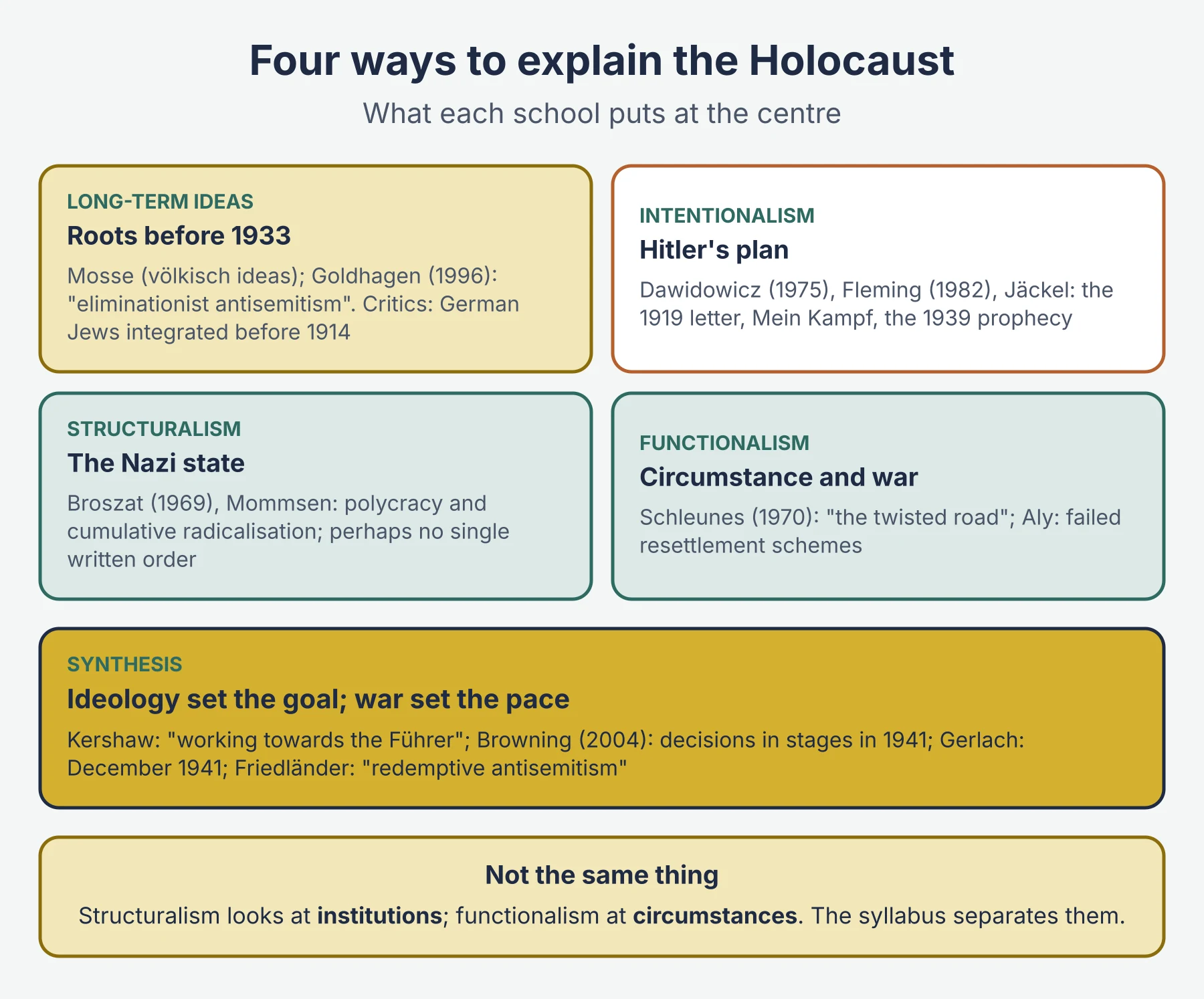
Some historians trace the Holocaust’s roots to long-standing ideas: Christian hostility to Judaism, the racial antisemitism of the late nineteenth century (the word “antisemitism” was popularised in Germany around 1879), völkisch nationalism, Social Darwinism and eugenics. George Mosse examined the völkisch ideas that shaped German nationalism. Daniel Goldhagen (Hitler’s Willing Executioners, 1996) argued that an “eliminationist antisemitism” was widespread in German society long before 1933. Critics point out that German Jews were well integrated before 1914, that antisemitic parties declined after the 1890s, and that antisemitism was at least as strong in France or Russia. They argue that ideas made persecution possible but cannot explain why murder came when and how it did.
Intentionalism: was the Holocaust planned in advance by Hitler?
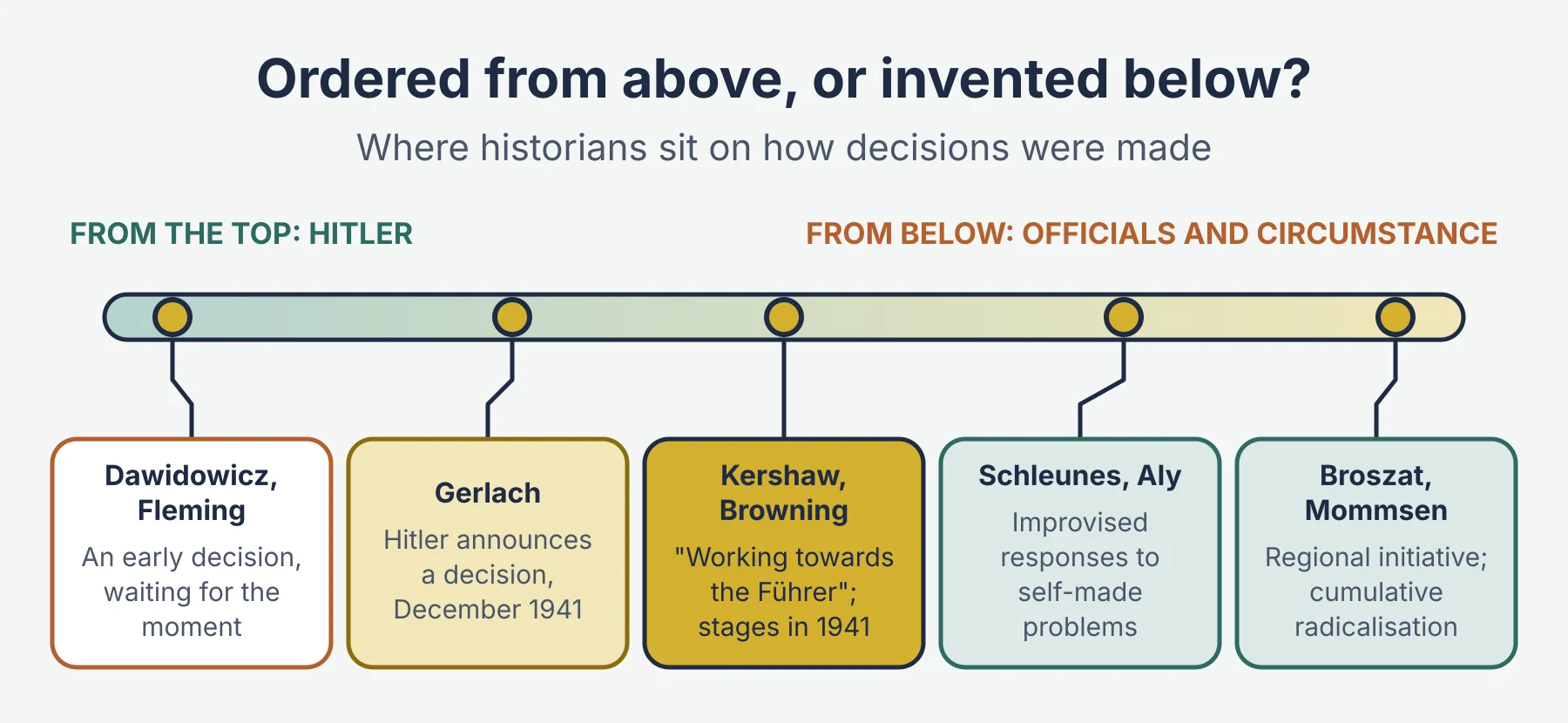
Intentionalists place Hitler and his ideology at the centre. Lucy Dawidowicz (The War Against the Jews, 1975) argued that Hitler had decided on annihilation early and waited for the right moment. Gerald Fleming (Hitler and the Final Solution, 1982) traced a line of intention from Hitler’s early statements. Eberhard Jäckel analysed Hitler’s world view as a coherent programme. Evidence they cite includes the 1919 letter in which Hitler called for the “removal” of the Jews, Mein Kampf, and the Reichstag “prophecy” of January 1939. The approach focuses on the leader, ideology and decisions from the top.
Structuralism: how far did the nature of the Nazi state determine the Holocaust?
Structuralists study how the regime worked. Martin Broszat (The Hitler State, 1969) described a chaotic system of overlapping agencies competing for Hitler’s favour. Hans Mommsen argued that this “polycracy” produced cumulative radicalisation: rivals such as Himmler’s SS, Göring’s Four-Year Plan office, regional Gauleiters and the civil administration outbid one another, pushing policy further than anyone had planned. In 1977 Broszat argued that there may have been no single written order for the “Final Solution” and that killing grew from regional initiatives. This approach looks at institutions and officials rather than at Hitler’s mind.
Functionalism: how far did contingent factors such as war determine the Holocaust?
Functionalists emphasise circumstances. Karl Schleunes described “the twisted road to Auschwitz” (1970): policy before 1939 aimed at emigration and was improvised. War changed everything. The conquest of Poland brought millions more Jews under German rule; “resettlement” plans, ghettos and the Madagascar plan of 1940 all failed or were overtaken; the invasion of the USSR in June 1941 brought mass shootings by the Einsatzgruppen. Götz Aly linked the move to murder with the failure of Nazi population-resettlement schemes. On this reading, each step was a response to problems the regime had created.
Synthesis interpretations
Most recent historians combine elements. Ian Kershaw’s idea of “working towards the Führer” explains how officials took initiatives they believed Hitler wanted, linking his ideology to a competitive state. Christopher Browning (The Origins of the Final Solution, 2004) argued that the decisive decisions were taken in stages in 1941, encouraged by the “euphoria of victory” in the east. Christian Gerlach argued that Hitler announced a decision for the murder of all European Jews in December 1941, after the USA entered the war. Saul Friedländer (Nazi Germany and the Jews, 1997 and 2007) placed what he called “redemptive antisemitism” at the centre while integrating the experience of victims. Syntheses usually hold that ideology set the goal and war set the pace.
Perpetrators: who carried out the Holocaust, and why?
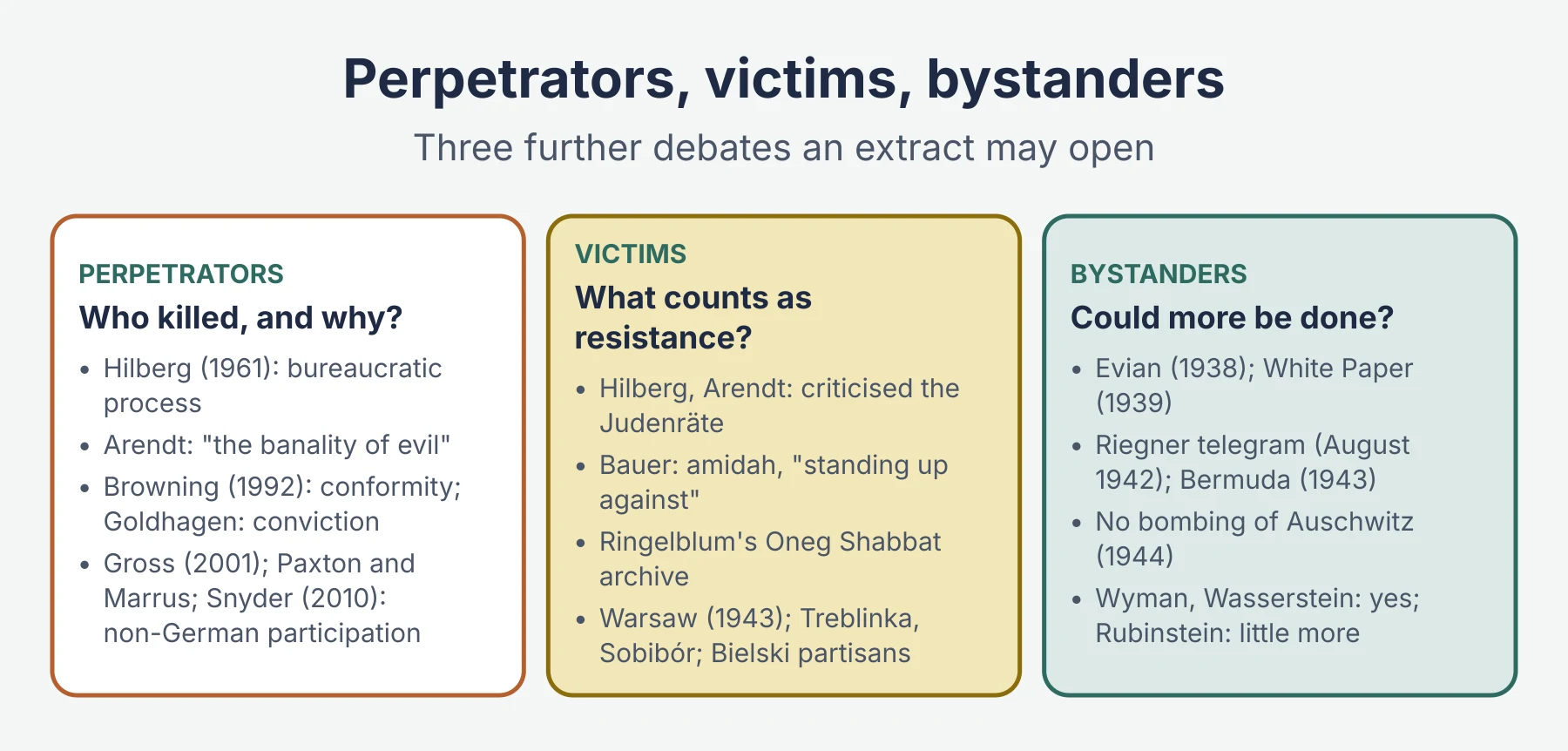
Raul Hilberg (The Destruction of the European Jews, 1961) showed how ordinary bureaucratic processes – definition, expropriation, concentration, deportation – involved thousands of officials. Hannah Arendt, reporting Adolf Eichmann’s trial (1961), used the phrase “the banality of evil”. Christopher Browning’s Ordinary Men (1992) studied Reserve Police Battalion 101 and found that conformity, deference to authority and peer pressure mattered alongside ideology; most men took part though some refused without serious punishment. Goldhagen studied the same battalion and stressed antisemitic conviction. The Wehrmacht exhibition of the 1990s challenged the belief that the regular army had kept its hands clean. Non-German participation is a growing field: Jan Gross’s Neighbors (2001) described the murder of the Jews of Jedwabne by their Polish neighbours in 1941; Robert Paxton and Michael Marrus showed Vichy France’s role in deportations; Lithuanian, Latvian, Ukrainian and Romanian forces took part in killings. Timothy Snyder’s Bloodlands (2010) placed the killing in the lands between Germany and the USSR, where states had been destroyed.
Victims: how far did Jews resist, and how should resistance be defined?
Hilberg, and Arendt more sharply, criticised the Jewish councils (Judenräte) for co-operating with the Germans, which provoked bitter controversy. Yehuda Bauer argued for a wider definition, the Hebrew amidah (“standing up against”): smuggling food, schooling children, religious observance and keeping records – such as Emanuel Ringelblum’s secret Oneg Shabbat archive in the Warsaw ghetto – were all resistance. Armed resistance included the Warsaw Ghetto Uprising (1943), revolts at Treblinka and Sobibór (1943) and partisan groups such as the Bielski brothers’.
Should definitions include other victims? The Nazis also murdered Roma and Sinti, disabled people in the “T4” programme, millions of Soviet prisoners of war, and members of other groups. Henry Friedlander linked the T4 programme to the later killing centres through personnel and gassing methods. Bauer and others argue that the Holocaust should refer to the attempt to murder every Jew, while recognising other genocides and persecutions alongside it.
Bystanders: how did the USA and Britain respond at the time?
At Evian (1938), almost no state offered to take more refugees. Britain admitted children through the Kindertransport but restricted Jewish immigration to Palestine in the White Paper of 1939. The Riegner telegram (August 1942) and other reports reached London and Washington; the Allies publicly condemned the killing in December 1942, but the Bermuda Conference (1943) achieved little. The USA created the War Refugee Board only in January 1944. In 1944 Allied governments refused requests to bomb Auschwitz or the railways leading to it. David Wyman (The Abandonment of the Jews, 1984) and Bernard Wasserstein argued that more could have been done; William Rubinstein (The Myth of Rescue, 1997) argued that little more was possible.
Worked example: identifying the approach
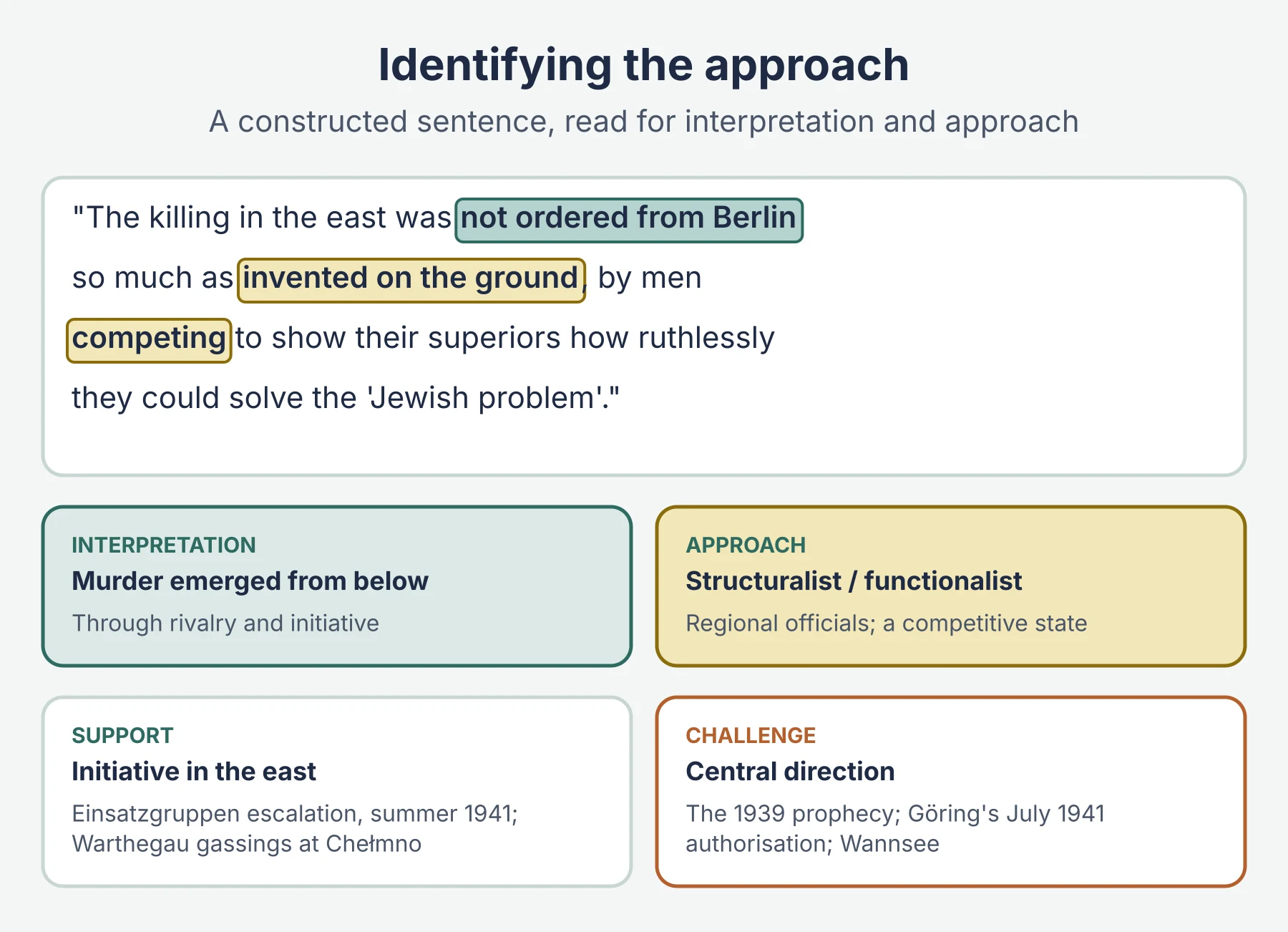
Constructed sentence (Marlbridge): “The killing in the east was not ordered from Berlin so much as invented on the ground, by men competing to show their superiors how ruthlessly they could solve the ‘Jewish problem’.”
- Interpretation: murder emerged from below, through rivalry and initiative.
- Approach: structuralist/functionalist, focusing on regional officials and the competitive state.
- Test: support – Einsatzgruppen escalation in summer 1941 and the Warthegau gassings at Chełmno; challenge – Hitler’s prophecy, Göring’s authorisation of July 1941 and Wannsee show central direction.
Common mistakes
- Treating “functionalist” and “structuralist” as identical; the syllabus separates them.
- Forcing a label onto an extract that does not fit it – for example, a bystander extract.
- Writing context without testing the extract.
- Ignoring victims’ agency and other victim groups when the extract raises them.
Official syllabus
Cambridge International AS & A Level History (9489) syllabus for 2027, 2028 and 2029 – cambridgeinternational.org (Paper 3, Topic 2; Paper 3 details of the assessment). Always check the current syllabus before an exam.
Related resources
-
Practice questions
Cambridge A Level World History (9489): The Holocaust – Practice Questions
Original Cambridge 9489 Paper 3 practice on the Holocaust: eight short items and three constructed extracts on intention, perpetrators and bystanders.
World History · Cambridge · A Level
Try questions -
Revision notes
Cambridge A Level World History (9489): The Holocaust – Revision Notes
Revision notes for Cambridge 9489 Paper 3 on the Holocaust: schools of interpretation, perpetrators, victims and bystanders, key terms and a self-test.
World History · Cambridge · A Level
Revise topic -
Practice questions
Cambridge A Level World History (9489): Historical interpretations – Practice Questions
Three original Paper 3-style extracts for Cambridge 9489 History on 1914, the Holocaust and the Cold War, with indicative content and AO4/AO1 level guidance.
World History · Cambridge · A Level
Try questions
Get free revision emails (optional)
Occasional emails with practice questions, worked explanations and links to free resources for the qualification and subjects you choose. No spam, and you can unsubscribe from any email. The free tools on this site never need an email.