
Study Guides
Cambridge A Level World History (9489): The Soviet Empire in Eastern Europe, 1953-91
Study guide to Cambridge 9489 Paper 4 topic 7, the Soviet Empire 1953-91: the satellite states to 1968, Brezhnev's stagnation, Gorbachev and the collapse.
- Subject
- World History
- Level
- A LEVEL
- Topic
- Topic 7: International option: International history, 1909-94
- Author
- Marlbridge Academic Team
- Updated
- Reviewed by
- Azam Siddique (what this means)
Aligned to Cambridge A Level World History (9489), 2027-2029. Official specification .
Syllabus page (what it covers and how it is assessed): Cambridge A Level World History.
Syllabus points this page covers
9489 (A Level)
- 7 The Soviet Empire in Eastern Europe, 1953–91
Found an error? Report a correction.
Need help with this topic? Request a free trial class for A Level World History (9489).
The Soviet Empire in Eastern Europe, 1953-91 is the first topic of the International option on Cambridge 9489 Paper 4. Its key questions ask how the USSR’s relationship with the satellite states developed up to 1968 (7.1), why 1964-85 became a period of political and economic stagnation (7.2), how Gorbachev tried to respond to the crisis (7.3) and how and why Soviet control of Eastern Europe collapsed by 1991 (7.4). Paper 4 sets two 30-mark essays from your option in 1 hour 45 minutes. This guide deepens the International option study guide; for recall use the Soviet Empire revision notes and for essays the Soviet Empire practice questions.
Syllabus coverage
- 7.1 The Warsaw Pact; government in Czechoslovakia, Poland, East Germany and Hungary; repression (censorship, the Stasi, the Church, emigration); social and economic conditions; uprisings in the 1950s, Hungary 1956, Berlin and the Wall, the Prague Spring; Soviet reactions and the Brezhnev Doctrine.
- 7.2 Brezhnev, Andropov and Chernenko; corruption, the nomenklatura and gerontocracy; the economy, the 10th Five Year Plan and defence spending; détente, Afghanistan and the Second Cold War; the satellite states and challenges from the West, activism and the Church.
- 7.3 Gorbachev’s rise; the situation in 1985; glasnost, perestroika and demokratizatsiya; the 12th Five Year Plan, Chernobyl; summits with the USA.
- 7.4 Solidarity and Poland; Gorbachev’s impact on Eastern Europe; the collapse of the Soviet Union.
7.1 Control and challenge to 1968
The Warsaw Pact (May 1955) was formed days after West Germany joined NATO. It gave the USSR a legal basis for stationing troops in member states and a unified command under a Soviet officer, and formalised a bloc already bound by COMECON (1949).
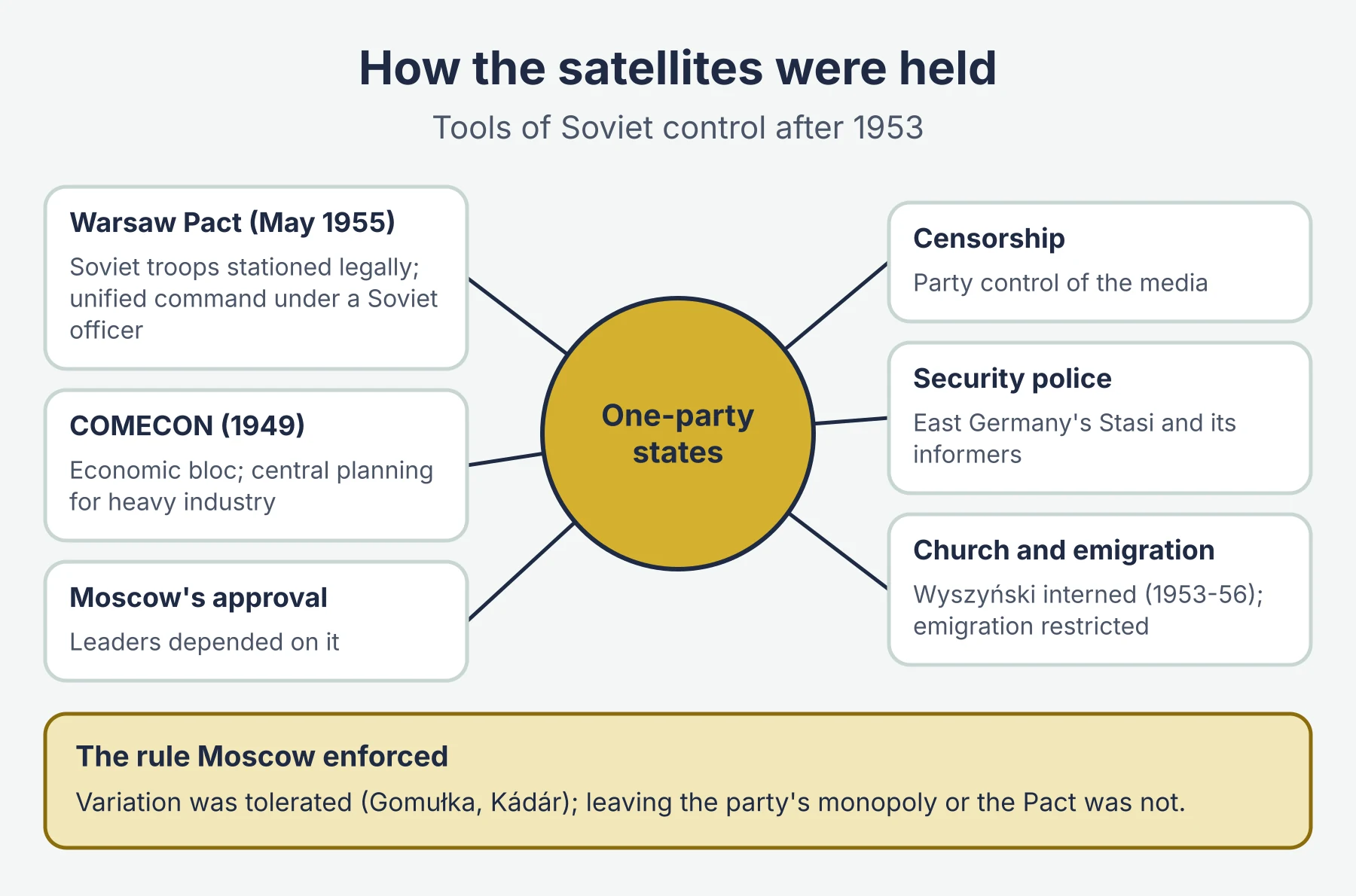
How the satellites were governed. Each was a one-party state where the Communist Party controlled the government, police, media and economy, and leaders depended on Moscow’s approval. Common tools were censorship; security police such as East Germany’s Stasi, which built a vast network of informers; pressure on churches – Cardinal Wyszyński was interned in Poland from 1953 to 1956 – and restrictions on emigration. Central planning prioritised heavy industry; collectivisation and shortages of consumer goods and housing meant living standards lagged behind the West, although employment, education and basic welfare were guaranteed.
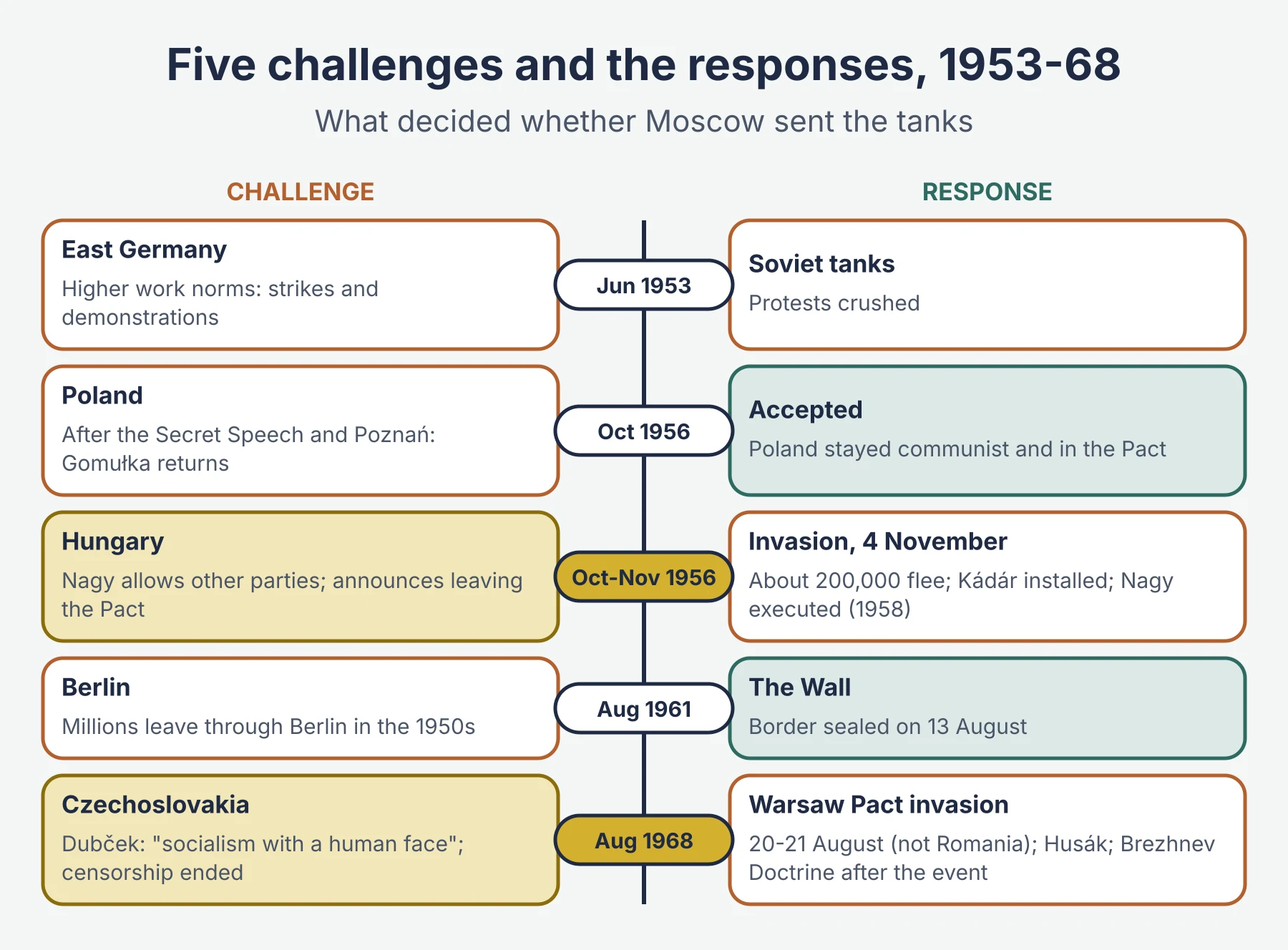
Threats to stability.
- East Germany, June 1953: higher work norms provoked strikes and demonstrations across the GDR; Soviet tanks crushed them.
- Poland, 1956: after Khrushchev’s Secret Speech (February 1956) and the Poznań riots (June), Władysław Gomułka returned as leader in October. Khrushchev accepted him because Poland stayed communist and in the Warsaw Pact.
- Hungary, 1956: student demonstrations on 23 October led to the return of Imre Nagy, who allowed other parties and announced withdrawal from the Warsaw Pact. Soviet forces invaded on 4 November; thousands died, around 200,000 fled, and János Kádár was installed. Nagy was executed in 1958. The West did not intervene, distracted by Suez and unwilling to risk war.
- Berlin: millions of East Germans left through Berlin in the 1950s. Khrushchev’s ultimatum of 1958 failed, and on 13 August 1961 the GDR sealed the border with what became the Berlin Wall.
- Czechoslovakia, 1968: Alexander Dubček’s “socialism with a human face” – the Action Programme, the end of censorship and plans for economic reform – alarmed Moscow and neighbouring leaders. Warsaw Pact forces invaded on 20-21 August 1968 (Romania refused to take part). Dubček was replaced by Gustáv Husák in 1969, and “normalisation” followed.
The Brezhnev Doctrine (1968) declared that when socialism was threatened in one country it was the concern of all socialist states – justifying intervention after the event and warning others.
Lesson for essays: Moscow tolerated variation (Gomułka, Kádár’s later “goulash communism”) but not departure from the party’s monopoly or the Pact.
7.2 Stagnation, 1964-85
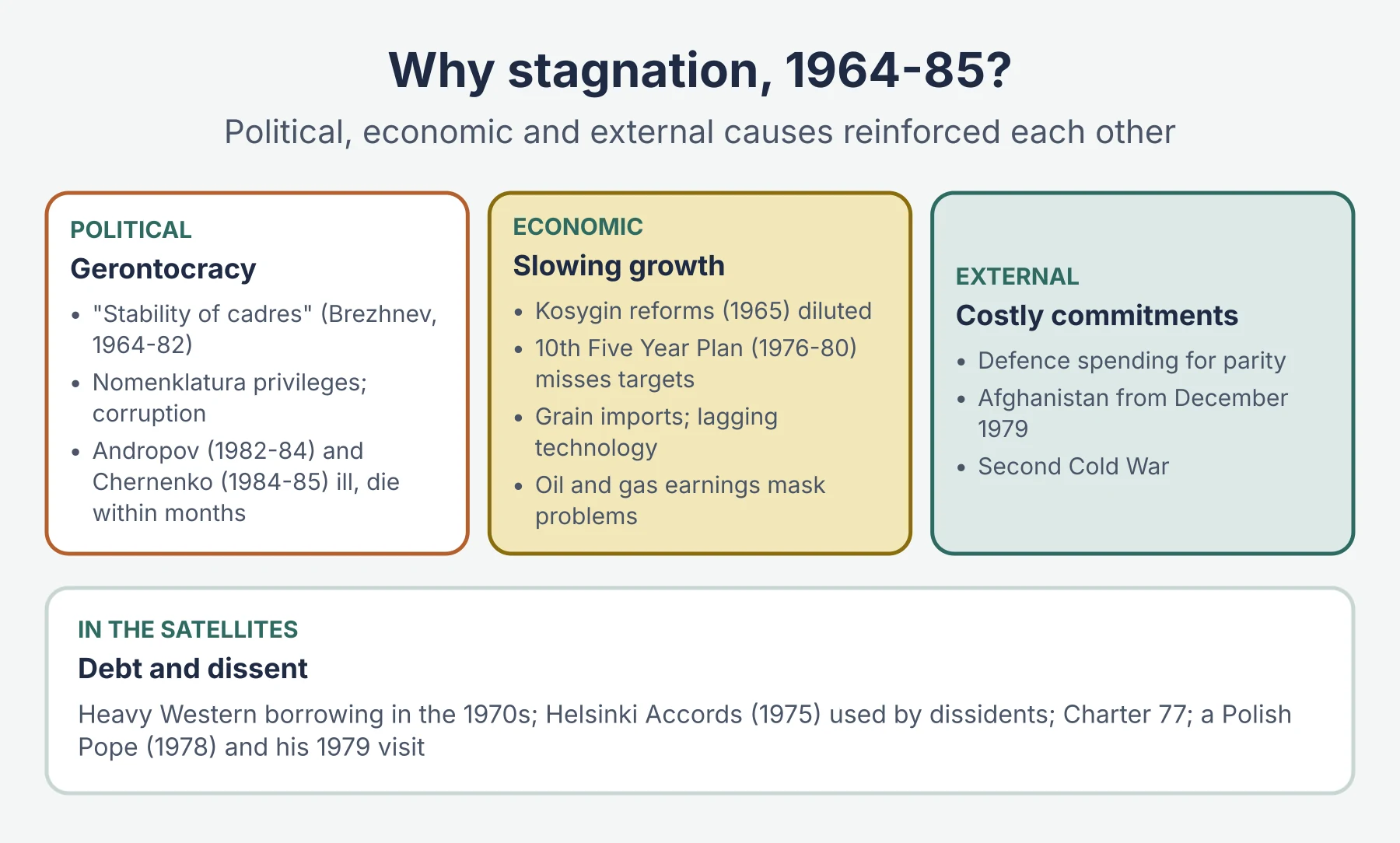
Leadership. Brezhnev (1964-82) promised “stability of cadres” after Khrushchev’s reorganisations. The nomenklatura – officials appointed from party-approved lists – gained job security and privileges, and corruption spread, notably in Uzbekistan and the Caucasus. The leadership aged into a gerontocracy; Brezhnev’s successors Andropov (1982-84), who began a discipline and anti-corruption campaign, and Chernenko (1984-85) were both ill and died within months of each other.
Economy. Growth slowed. The Kosygin reforms of 1965 gave enterprises limited autonomy but were diluted. The 10th Five Year Plan (1976-80) stressed “quality and efficiency” but missed key targets. Agriculture needed large grain imports; technology lagged, especially in computing; and defence spending took a large share of resources to maintain parity with the USA. Soviet oil and gas earnings in the 1970s masked the problems.
Foreign relations. Détente brought SALT I (1972) and the Helsinki Accords (1975), whose human rights clauses dissidents used. The invasion of Afghanistan (December 1979) became a costly war that damaged morale and international standing, and helped start the Second Cold War with Reagan’s rearmament.
The satellite states. Many borrowed heavily from the West in the 1970s to fund consumption and investment; debt and price rises became political dangers. Challenges came from Western radio and television, dissident groups such as Czechoslovakia’s Charter 77 (1977), and the Church – strengthened in Poland by the election of the Polish Pope John Paul II (1978) and his visit in 1979.
7.3 Gorbachev’s response
Rise. Gorbachev, aged 54, was chosen in March 1985 with Andropov’s patronage behind him, as the leadership recognised the need for a younger, energetic leader.
The situation in 1985: a stagnant economy; food shortages and rationing in some areas; a growing budget deficit; absenteeism and alcoholism; poor housing and services; pressure from the arms race and from the young and educated who knew about Western living standards.
New thinking.
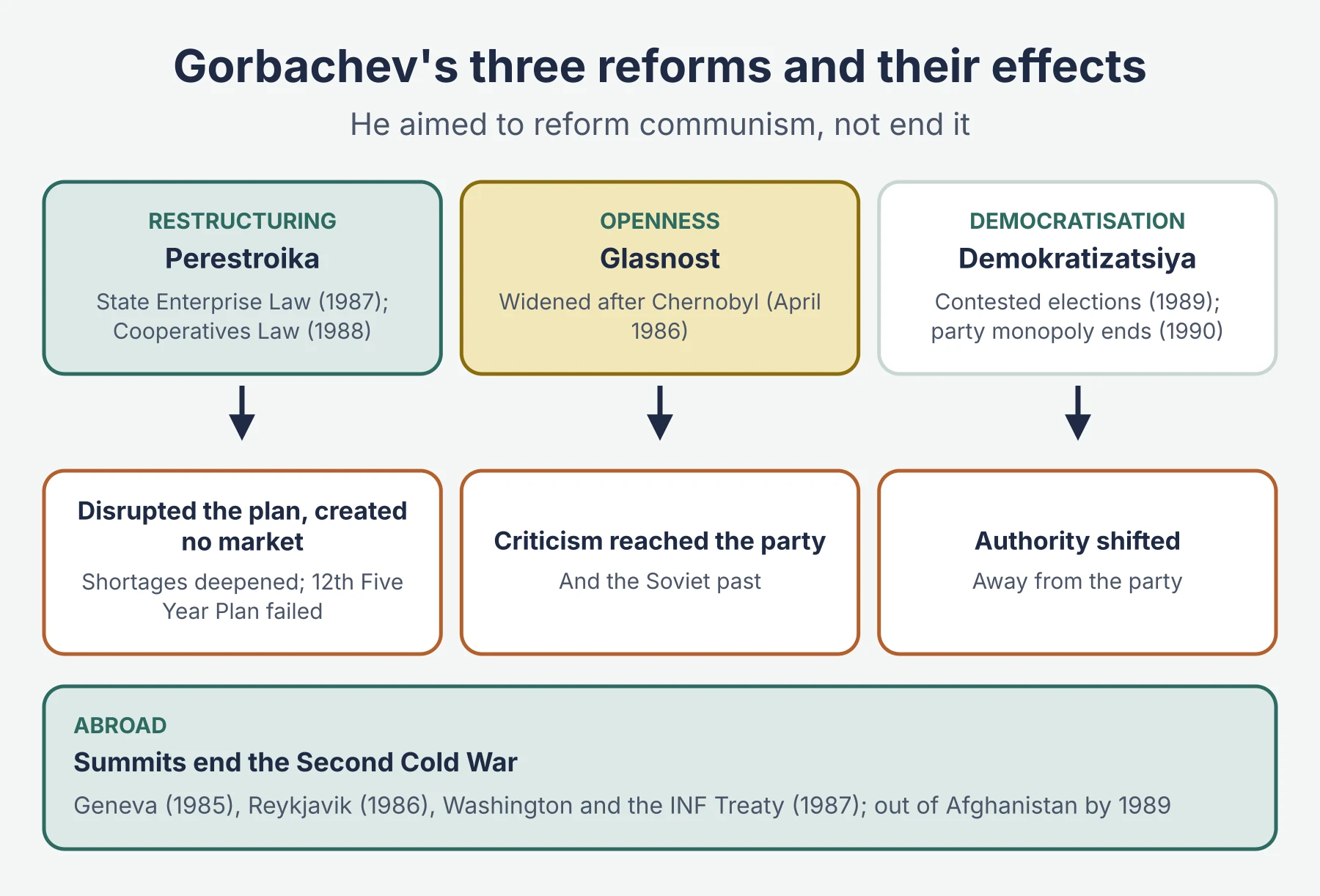
- Perestroika (restructuring): the Law on State Enterprise (1987) and the Law on Cooperatives (1988) allowed more autonomy and small private businesses. Partial reform disrupted the planned economy without creating a market.
- Glasnost (openness): freedom to criticise and publish; after the Chernobyl disaster (April 1986), whose concealment exposed secrecy, glasnost widened. Criticism soon reached the party and the Soviet past.
- Demokratizatsiya: contested elections to a new Congress of People’s Deputies (1989) and, in 1990, the end of the party’s constitutional monopoly.
Economic results. The 12th Five Year Plan (1986-90) aimed at acceleration but failed. Falling world oil prices, the cost of the anti-alcohol campaign to state revenue, declining foreign trade and the fragmentation of supply chains as republics and enterprises acted independently deepened shortages.
Foreign relations. Summits at Geneva (1985), Reykjavik (1986) and Washington (1987), where the INF Treaty was signed, ended the Second Cold War. Withdrawal from Afghanistan was completed in 1989.
7.4 Collapse
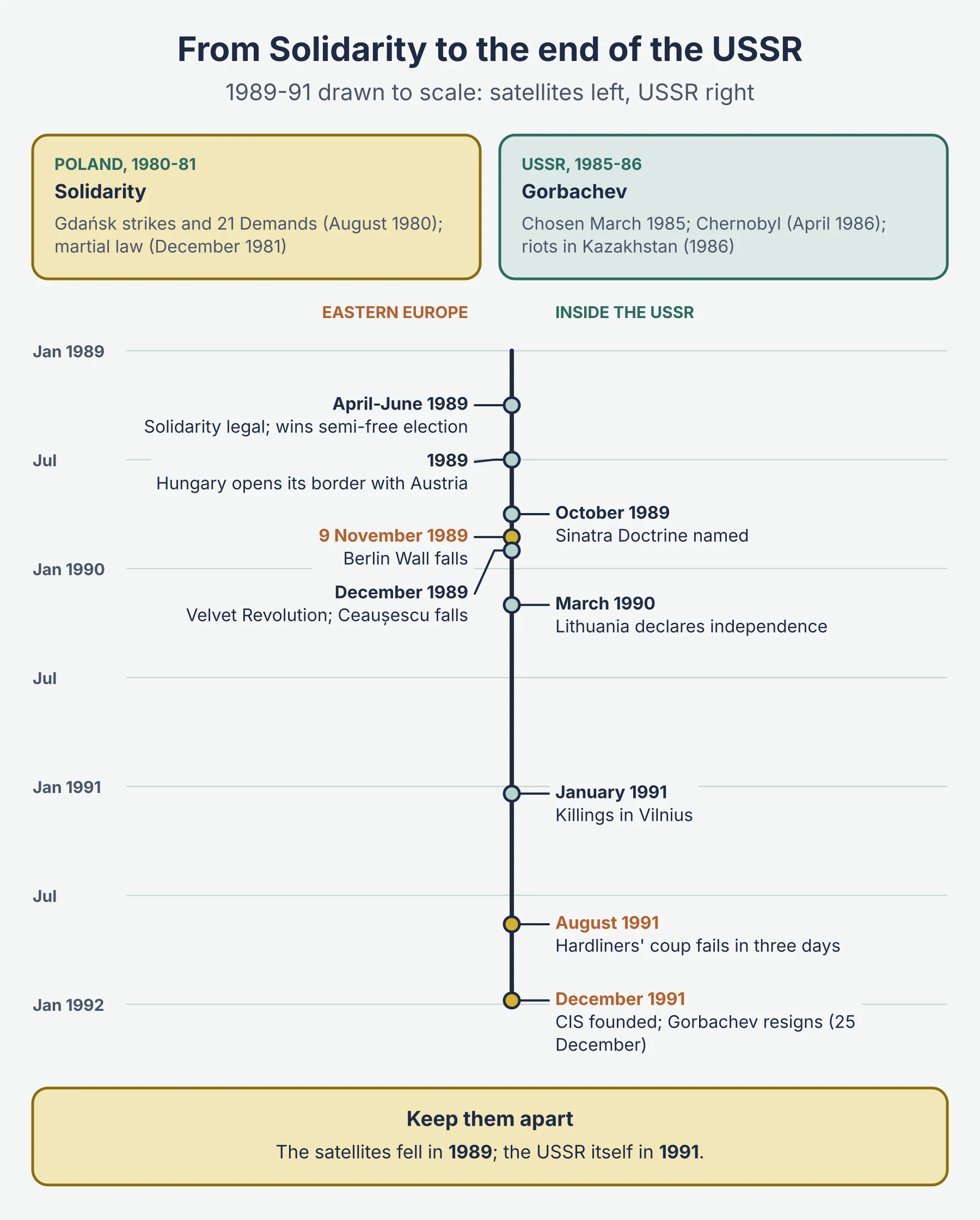
Solidarity. Debt, falling living standards and meat price rises (July 1980) led to strikes; at the Gdańsk shipyard in August 1980 workers led by Lech Wałęsa issued 21 Demands, including free trade unions and the right to strike. The government conceded, and Solidarity grew to around ten million members. Under Soviet pressure, General Jaruzelski imposed martial law in December 1981 and banned Solidarity, avoiding a Soviet invasion.
Gorbachev’s impact. He told Eastern European leaders they would no longer be propped up by force – the Sinatra Doctrine (“do it their way”), named in October 1989. Solidarity was re-legalised in April 1989 after round-table talks, and won the semi-free election of June 1989. Hungary opened its border with Austria in 1989; East Germans fled west, mass protests followed, and the Berlin Wall fell on 9 November 1989. The Velvet Revolution in Czechoslovakia and the violent fall of Ceaușescu in Romania followed in December. Within the USSR, riots in Kazakhstan (1986) and independence movements in the Baltic states – Lithuania declared independence in March 1990 – met a mix of concessions and force, including the killings in Vilnius in January 1991.
The end of the USSR. Conservatives opposed Gorbachev’s reforms and a new union treaty; reformers led by Boris Yeltsin wanted faster change. The August 1991 coup by hardliners collapsed within three days after Yeltsin led resistance in Moscow and troops refused to fire. It discredited the party and destroyed Gorbachev’s authority. Republics declared independence; Russia, Ukraine and Belarus founded the Commonwealth of Independent States in December 1991, and Gorbachev resigned on 25 December 1991.
Worked example: setting up a judgement
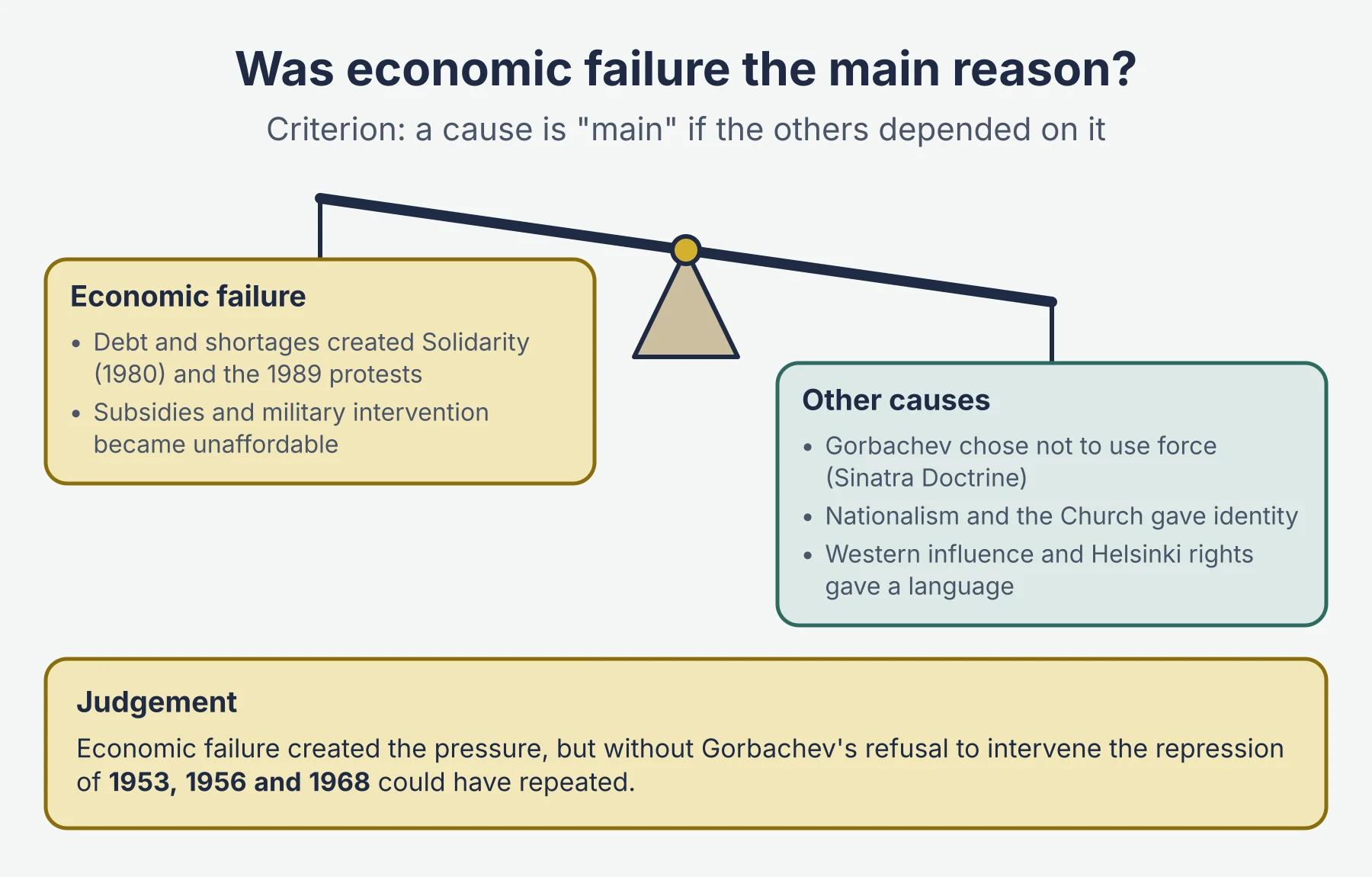
“Economic failure was the main reason for the collapse of Soviet control in Eastern Europe.” Assess this view. [30]
- Criterion: a cause is “main” if the others depended on it.
- For: debt and shortages created Solidarity (1980) and the protests of 1989; Soviet economic weakness made subsidies and military intervention unaffordable.
- Against: Gorbachev’s decision not to use force (the Sinatra Doctrine) was a political choice; nationalism and the Church gave movements their identity; Western influence and Helsinki rights gave them a language.
- Judgement: economic failure created the pressure, but without Gorbachev’s refusal to intervene, the 1953, 1956 and 1968 pattern of repression could have repeated.
Common mistakes
- Merging the collapse of the satellites (1989) and of the USSR (1991).
- Describing the Brezhnev Doctrine as announced before the 1968 invasion.
- Treating Gorbachev as aiming to end communism; he aimed to reform it.
Exam technique
Assess questions on “how and why” need both narrative precision and causation. Group causes (economic, political, national, external) and show links between them.
Official syllabus
Cambridge International AS & A Level History (9489) syllabus for 2027, 2028 and 2029 – cambridgeinternational.org (Paper 4, International option, topic 7).
Related resources
-
Practice questions
Cambridge A Level World History (9489): The Soviet Empire in Eastern Europe, 1953-91 – Practice Questions
Twelve original practice questions on Cambridge 9489 Soviet Empire in Eastern Europe 1953-91: recall items and Paper 4-style essays with mark-scheme answers.
World History · Cambridge · A Level
Try questions -
Revision notes
Cambridge A Level World History (9489): The Soviet Empire in Eastern Europe, 1953-91 – Revision Notes
Revision notes for Cambridge 9489 Paper 4, the Soviet Empire 1953-91: key terms, a timeline, the four key questions condensed, exam traps and a self-test.
World History · Cambridge · A Level
Revise topic -
Practice questions
Cambridge A Level World History (9489): International option: International history, 1909-94 – Practice Questions
Original Paper 4-style essays for Cambridge 9489 History on the Soviet bloc, apartheid and Zimbabwe, and Malaysia and Indonesia, with indicative content.
World History · Cambridge · A Level
Try questions
Get free revision emails (optional)
Occasional emails with practice questions, worked explanations and links to free resources for the qualification and subjects you choose. No spam, and you can unsubscribe from any email. The free tools on this site never need an email.