
Revision Notes
Cambridge A Level World History (9489): The Soviet Empire in Eastern Europe, 1953-91 – Revision Notes
Revision notes for Cambridge 9489 Paper 4, the Soviet Empire 1953-91: key terms, a timeline, the four key questions condensed, exam traps and a self-test.
- Subject
- World History
- Level
- A LEVEL
- Topic
- Topic 7: International option: International history, 1909-94
- Author
- Marlbridge Academic Team
- Updated
- Reviewed by
- Azam Siddique (what this means)
Aligned to Cambridge A Level World History (9489), 2027-2029. Official specification .
Syllabus page (what it covers and how it is assessed): Cambridge A Level World History.
Syllabus points this page covers
9489 (A Level)
- 7 The Soviet Empire in Eastern Europe, 1953–91
Found an error? Report a correction.
Need help with this topic? Request a free trial class for A Level World History (9489).
These notes condense The Soviet Empire in Eastern Europe, 1953-91, the first topic of the Paper 4 International option in Cambridge 9489. For explanation see the Soviet Empire study guide; for essays and short questions see the Soviet Empire practice questions.
Syllabus coverage
- 7.1 How did the Soviet Union’s relationship with the satellite states develop in the period up to 1968?
- 7.2 Why did the period 1964-85 become characterised by political and economic stagnation?
- 7.3 How did Gorbachev try to respond to the crisis in the Soviet Union?
- 7.4 How and why did Soviet control of Eastern Europe collapse in 1991?
Key terms
| Term | Meaning |
|---|---|
| Satellite state | Nominally independent state under Soviet control |
| Warsaw Pact | Soviet-led military alliance, 1955-91 |
| COMECON | Soviet bloc economic organisation, founded 1949 |
| Stasi | East German Ministry for State Security |
| Brezhnev Doctrine | 1968 claim that a threat to socialism in one state concerned all socialist states |
| Nomenklatura | List of posts filled by party approval, and the privileged officials who held them |
| Gerontocracy | Rule by old men, as under Brezhnev, Andropov and Chernenko |
| Stagnation | The slowing of growth and reform under Brezhnev |
| Second Cold War | Renewed tension after Afghanistan, c.1979-85 |
| Glasnost | Openness: freer discussion and media |
| Perestroika | Restructuring of the economy and later the political system |
| Demokratizatsiya | Democratisation: contested elections within, and later beyond, the party |
| Sinatra Doctrine | Gorbachev’s policy of letting satellites choose their own path |
| Solidarity | Polish independent trade union founded in 1980 |
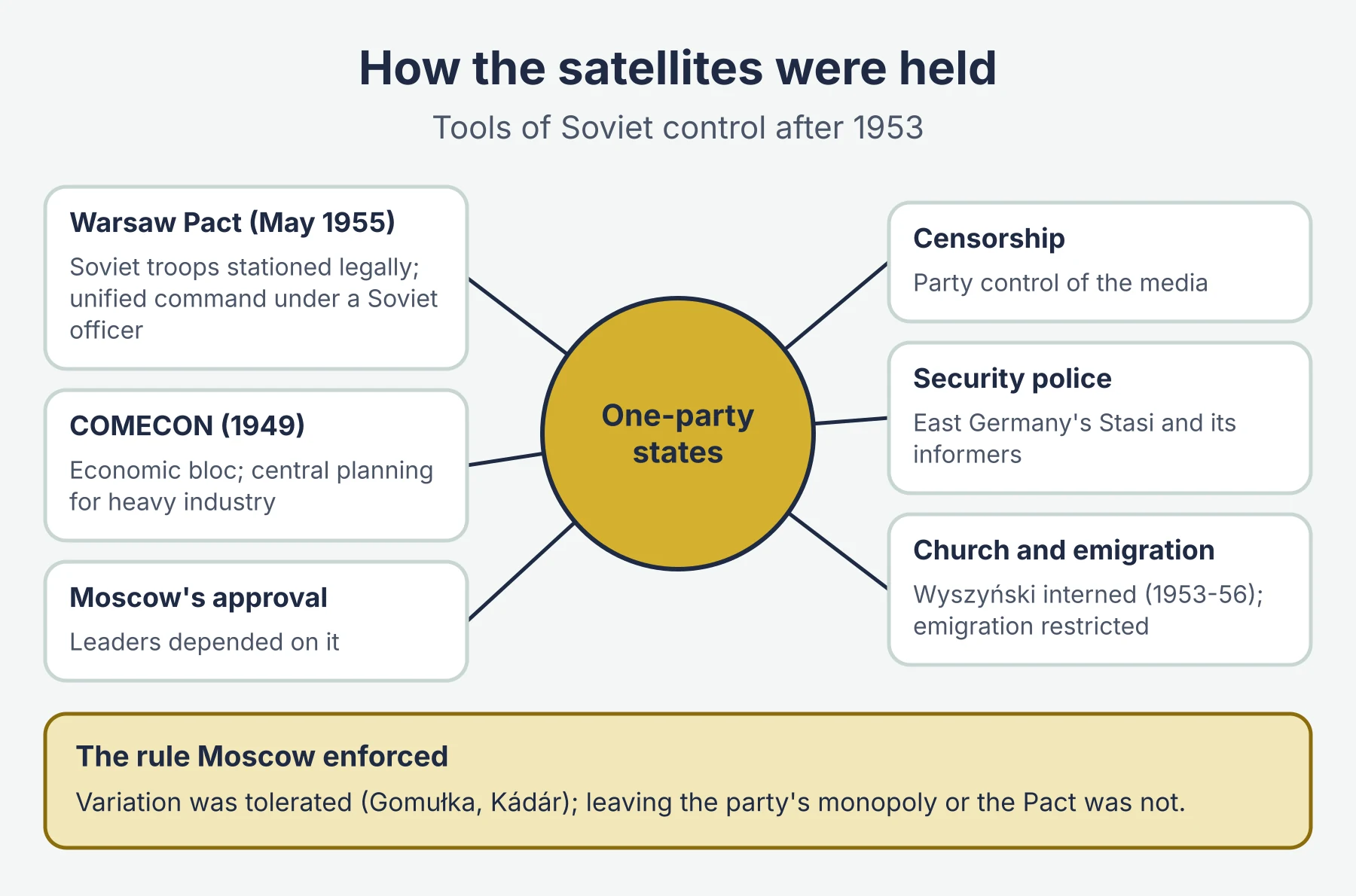
Timeline to learn
| Date | Event |
|---|---|
| March 1953 | Stalin dies |
| June 1953 | East German uprising |
| May 1955 | Warsaw Pact formed |
| Feb 1956 | Khrushchev’s Secret Speech |
| June-Oct 1956 | Poznań riots; Gomułka returns |
| Oct-Nov 1956 | Hungarian uprising crushed |
| Aug 1961 | Berlin Wall built |
| Oct 1964 | Khrushchev removed; Brezhnev leads |
| Aug 1968 | Invasion of Czechoslovakia; Brezhnev Doctrine |
| 1972-75 | SALT I; Helsinki Accords |
| 1977 | Charter 77 |
| 1978-79 | John Paul II elected; visits Poland |
| Dec 1979 | Invasion of Afghanistan |
| Aug 1980 | Gdańsk strikes; 21 Demands; Solidarity |
| Dec 1981 | Martial law in Poland |
| 1982-85 | Andropov, then Chernenko |
| March 1985 | Gorbachev becomes General Secretary |
| April 1986 | Chernobyl |
| 1985-87 | Geneva, Reykjavik and Washington summits; riots in Kazakhstan (Dec 1986) |
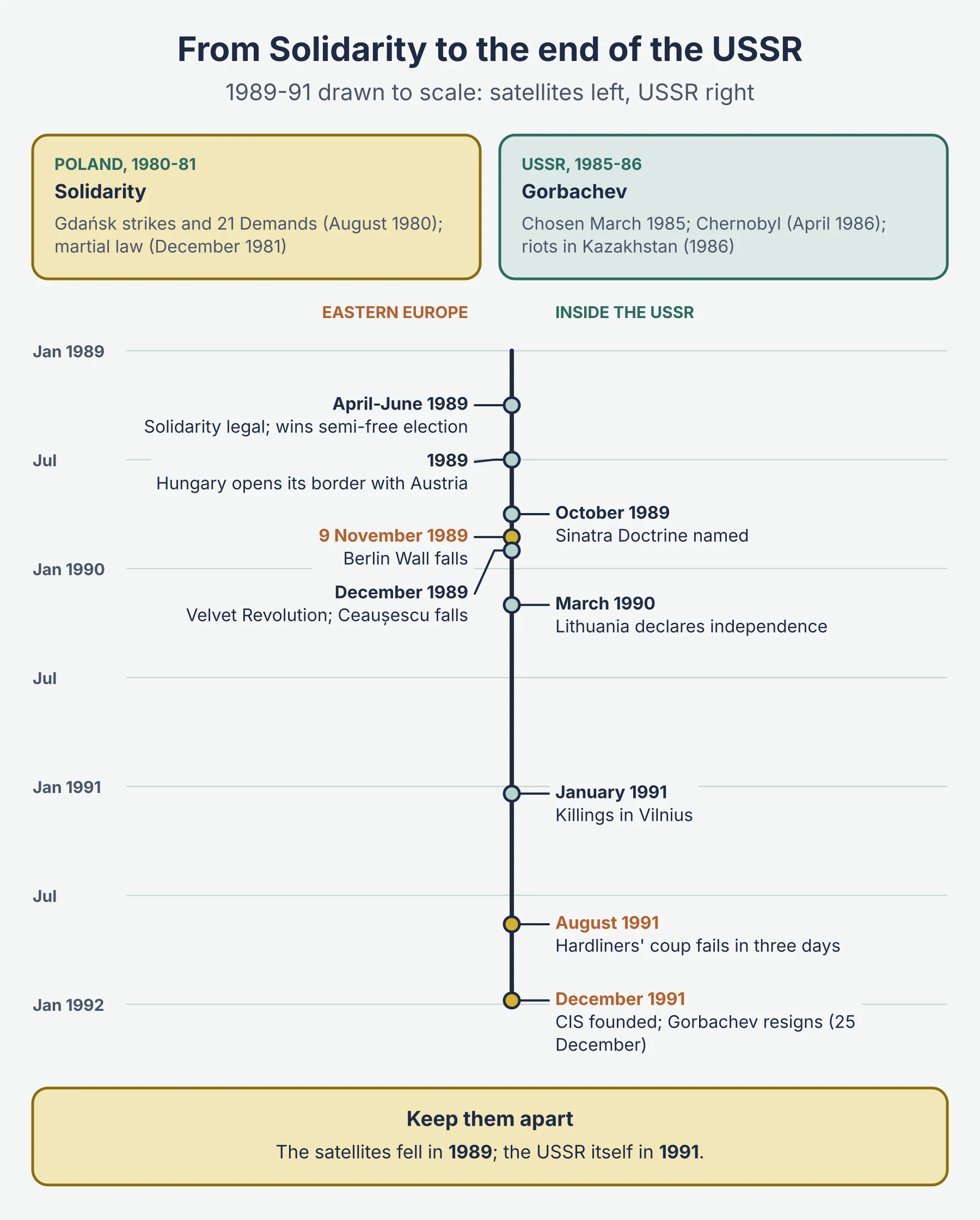
| 1989 | Afghanistan withdrawal completed (Feb); Solidarity re-legalised (April); Polish elections (June); Berlin Wall falls (9 Nov); Velvet Revolution; Ceaușescu overthrown (Dec) |
| March 1990 | Lithuania declares independence |
| Jan 1991 | Vilnius killings |
| Aug 1991 | Hardline coup fails |
| Dec 1991 | CIS formed; Gorbachev resigns (25 Dec) |
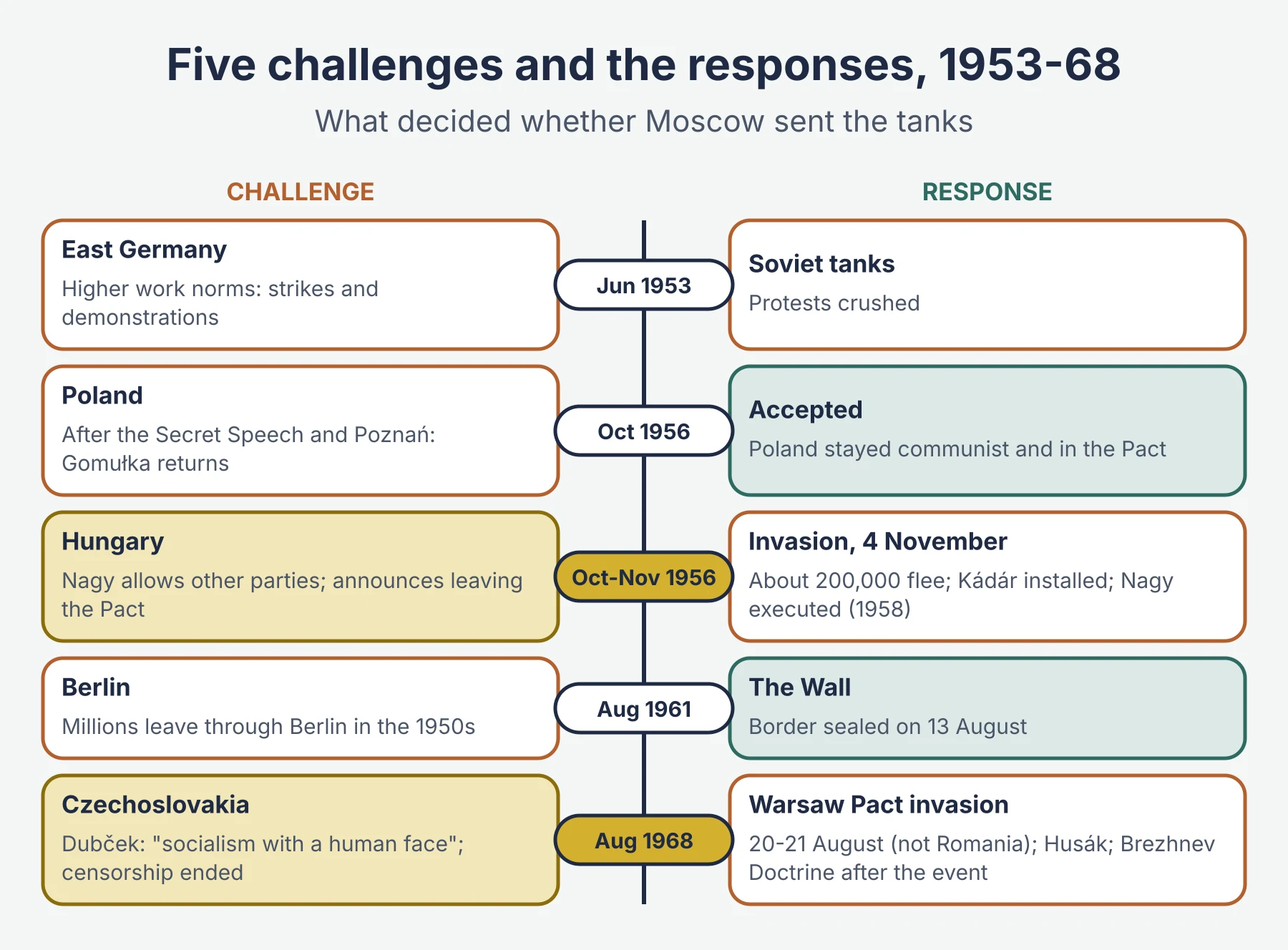
7.1 Crises to 1968 – compare them
| Crisis | Cause | Soviet response | Outcome |
|---|---|---|---|
| GDR 1953 | Higher work norms | Tanks | Uprising crushed |
| Poland 1956 | De-Stalinisation, Poznań | Negotiation | Gomułka accepted |
| Hungary 1956 | Nagy’s multi-party plans, Pact withdrawal | Invasion | Kádár installed; Nagy executed |
| Berlin 1961 | Mass emigration | Backed the Wall | Border sealed |
| Czechoslovakia 1968 | Dubček’s reforms | Warsaw Pact invasion | Husák; normalisation |
Pattern: reform tolerated within limits; leaving the Pact or ending the party’s monopoly brought force.
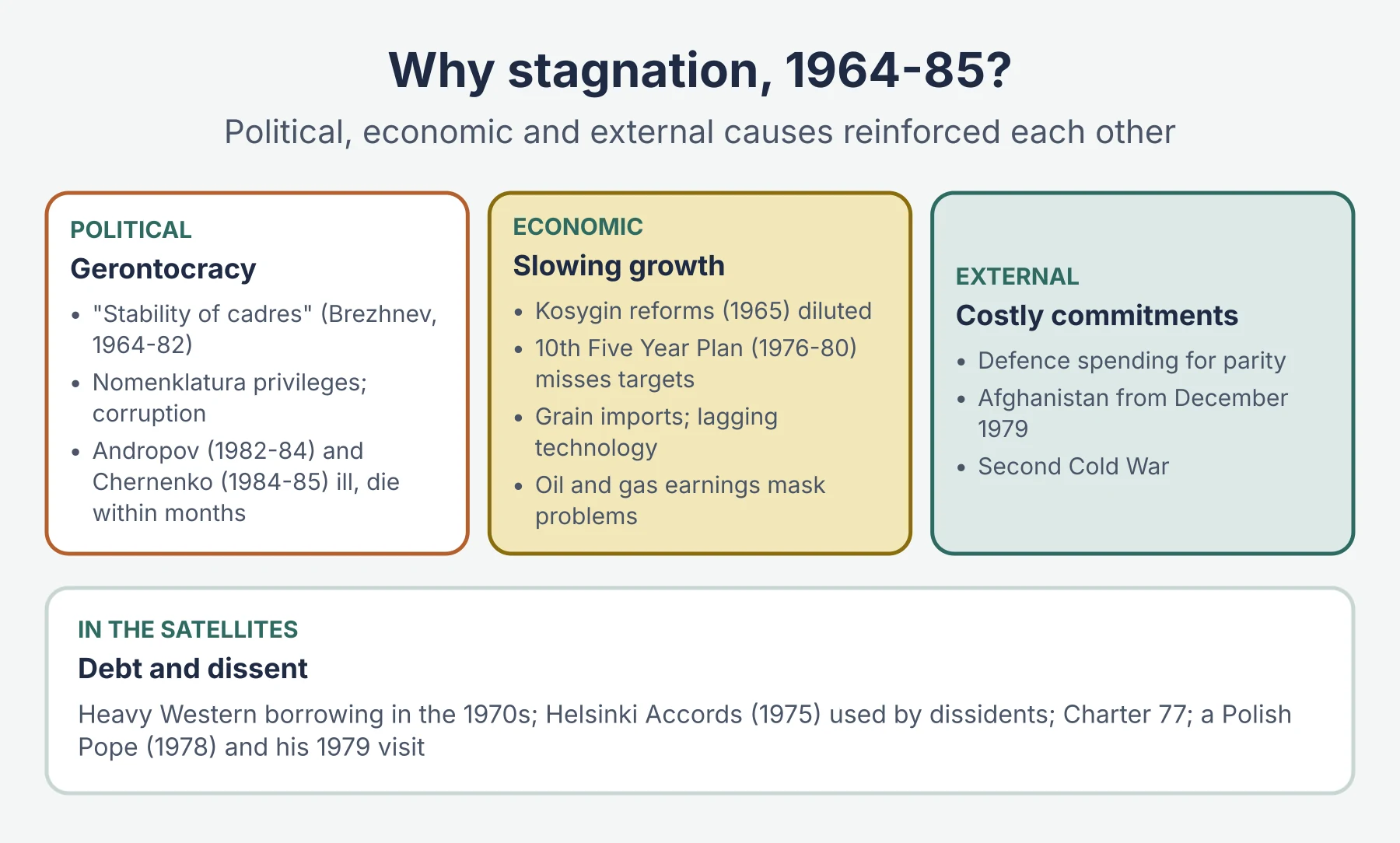
7.2 Stagnation – five causes
- Leadership: stability of cadres, ageing leaders.
- Corruption: nomenklatura privileges and regional scandals.
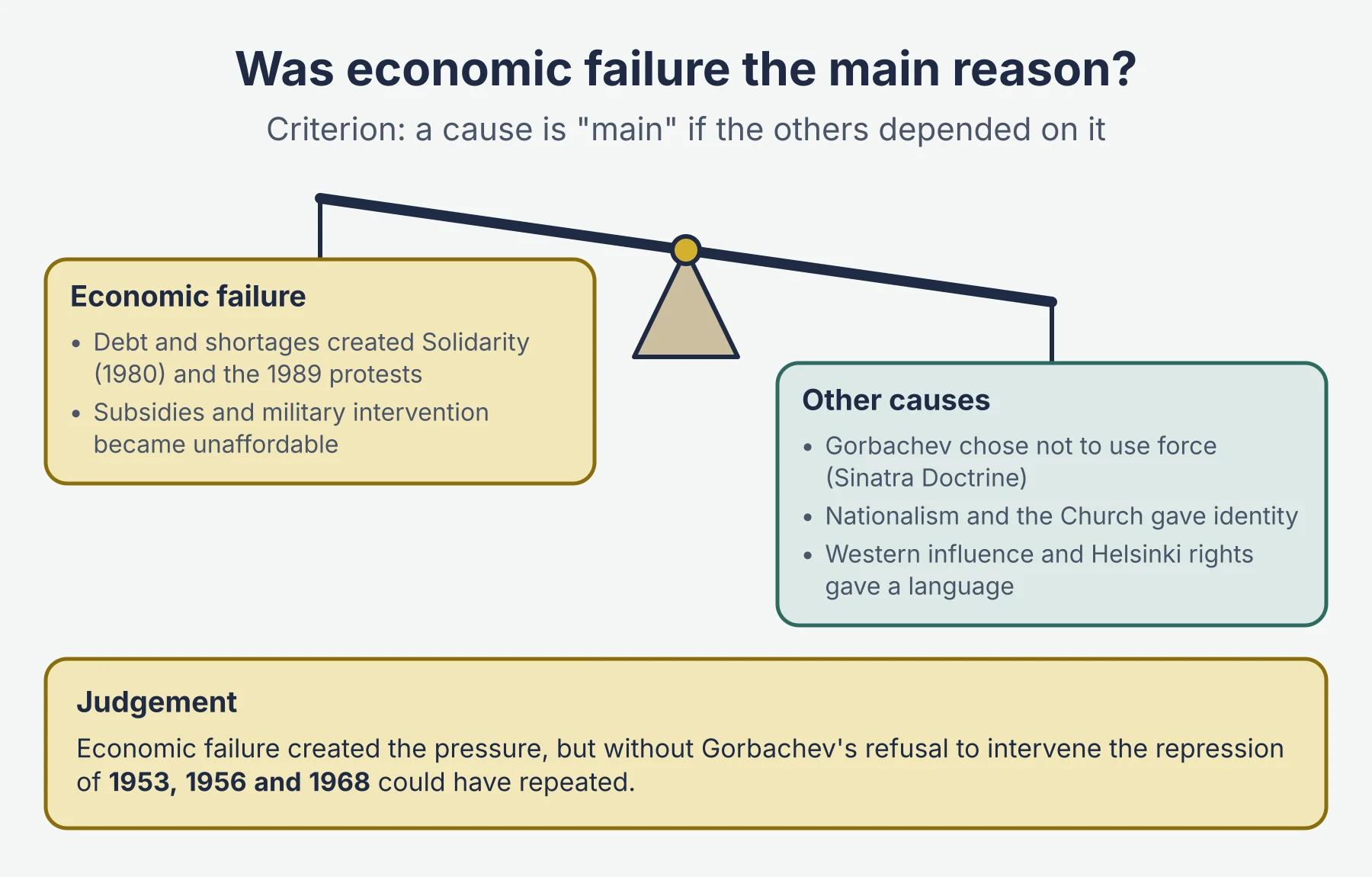
- Economy: diluted reforms, missed 10th Plan targets, technology gap, grain imports.
- Defence: arms race costs; Afghanistan.
- Satellites: Western debt, Helsinki rights, the Church and dissidents.
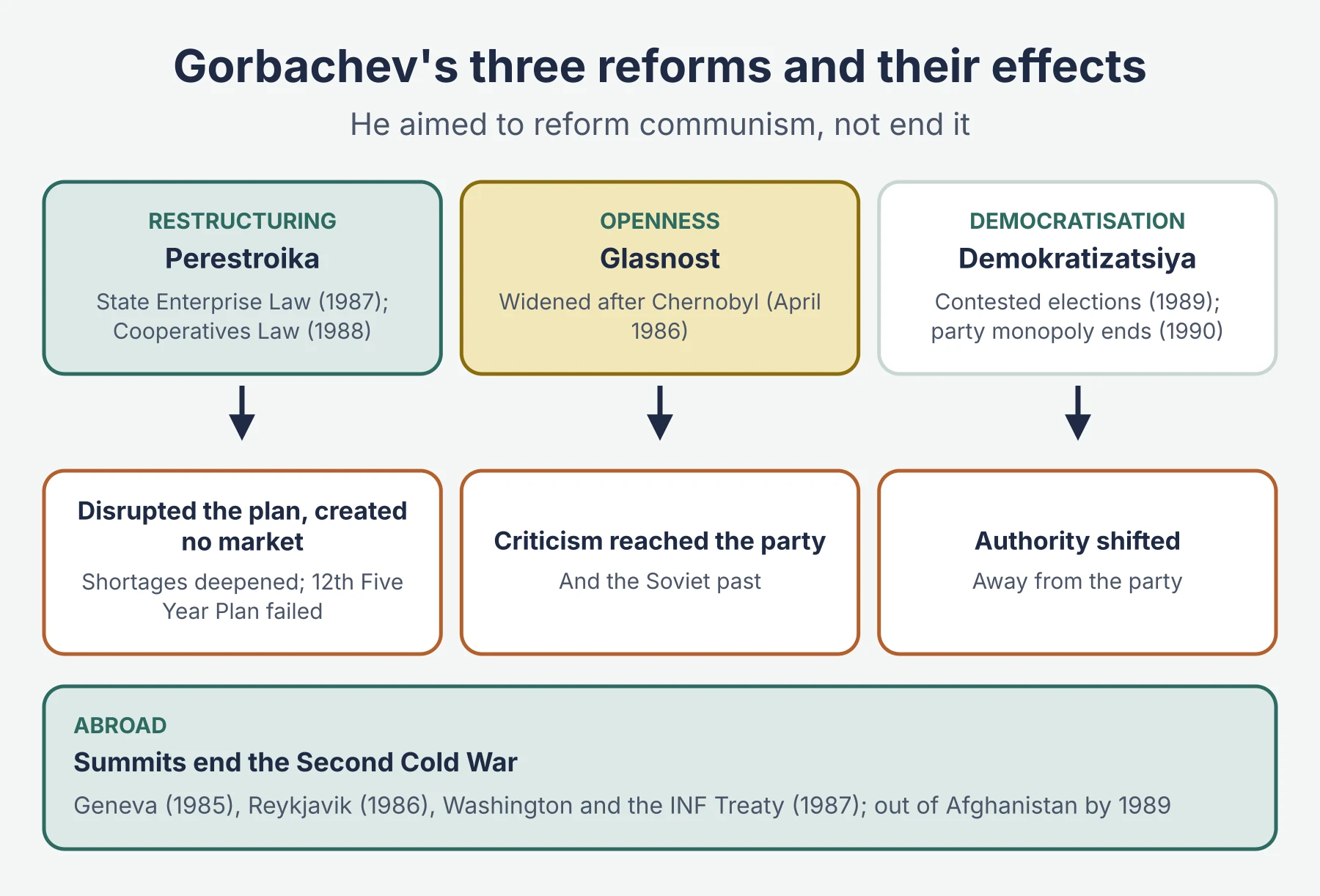
7.3 Gorbachev – aims and outcomes
| Policy | Aim | Outcome |
|---|---|---|
| Perestroika | Efficient socialist economy | Disrupted planning without a market; shortages |
| Glasnost | Expose corruption, win support | Criticism of the party and the past; nationalism |
| Demokratizatsiya | Revitalise the party | Rivals such as Yeltsin gained a platform |
| New thinking abroad | Cut defence costs | INF Treaty; end of the Second Cold War |
7.4 Collapse – the chain
- Poland first: Solidarity (1980), martial law (1981), re-legalisation and elections (1989).
- Sinatra Doctrine: no Soviet tanks in 1989.
- Domino of 1989: Hungary, the GDR and the Wall, Czechoslovakia, Romania.
- USSR: Baltic and other nationalisms, conservative resistance, the August 1991 coup, Yeltsin, independence of republics, resignation.
Exam traps
- 1989 and 1991: the satellites broke free in 1989; the USSR itself ended in 1991.
- Brezhnev Doctrine: announced after the invasion, as justification.
- Gorbachev’s aim: to save socialism through reform, not to dissolve it.
- Poland 1956 versus Hungary 1956: different responses because Gomułka kept Poland in the Pact.
- Martial law: imposed by Jaruzelski, not by Soviet troops.
Self-test
- What triggered the East German uprising of 1953? Increased work norms.
- Why did Khrushchev accept Gomułka in 1956? Poland remained communist and in the Warsaw Pact.
- What did Nagy announce on 1 November 1956? Hungary’s withdrawal from the Warsaw Pact.
- When was the Berlin Wall begun? 13 August 1961.
- Which Warsaw Pact member refused to join the 1968 invasion? Romania.
- What did the 10th Five Year Plan emphasise? Quality and efficiency.
- Name Brezhnev’s two successors before Gorbachev. Andropov and Chernenko.
- What was Charter 77? A Czechoslovak human rights group and declaration.
- Who led the Gdańsk strike of 1980? Lech Wałęsa.
- Which disaster in 1986 widened glasnost? Chernobyl.
- What was the Sinatra Doctrine? Gorbachev’s acceptance that satellite states could go their own way.
- What happened in August 1991? Hardliners attempted a coup against Gorbachev, which failed within three days.
Official syllabus
Cambridge International AS & A Level History (9489) syllabus for 2027, 2028 and 2029 – cambridgeinternational.org (Paper 4, International option, topic 7).
Related resources
-
Practice questions
Cambridge A Level World History (9489): International option: International history, 1909-94 – Practice Questions
Original Paper 4-style essays for Cambridge 9489 History on the Soviet bloc, apartheid and Zimbabwe, and Malaysia and Indonesia, with indicative content.
World History · Cambridge · A Level
Try questions -
Revision notes
Cambridge A Level World History (9489): International option: International history, 1909-94 – Revision Notes
Paper 4 revision notes for Cambridge 9489 History's International depth study: the Soviet bloc 1953-91, South Africa and Zimbabwe, and Malaysia and Indonesia.
World History · Cambridge · A Level
Revise topic -
Study guides
Cambridge A Level World History (9489): International option: International history, 1909-94 – Study Guide
Study guide to the Cambridge 9489 History Paper 4 International option: the Soviet empire, South Africa and Zimbabwe, and Malaysia and Indonesia.
World History · Cambridge · A Level
Read guide
Get free revision emails (optional)
Occasional emails with practice questions, worked explanations and links to free resources for the qualification and subjects you choose. No spam, and you can unsubscribe from any email. The free tools on this site never need an email.