
Study Guides
Cambridge A Level World History (9489): End of minority rule in South Africa and Zimbabwe, 1948-94
Study guide to Cambridge 9489 Paper 4 topic 8: apartheid's creation, resistance and repression, its end by 1994, and the end of white rule in Zimbabwe.
- Subject
- World History
- Level
- A LEVEL
- Topic
- Topic 7: International option: International history, 1909-94
- Author
- Marlbridge Academic Team
- Updated
- Reviewed by
- Azam Siddique (what this means)
Aligned to Cambridge A Level World History (9489), 2027-2029. Official specification .
Syllabus page (what it covers and how it is assessed): Cambridge A Level World History.
Syllabus points this page covers
9489 (A Level)
- 8 End of minority rule in South Africa and Zimbabwe, 1948–94
Found an error? Report a correction.
Need help with this topic? Request a free trial class for A Level World History (9489).
End of minority rule in South Africa and Zimbabwe, 1948-94 is the second topic of the International option on Cambridge 9489 Paper 4. Three key questions follow South Africa – how apartheid was established and its impact to 1959 (8.1), how resistance grew and the authorities responded, 1960-77 (8.2), and why apartheid and minority rule ended, 1978-94 (8.3) – and the fourth asks how white minority rule in Zimbabwe ended, 1965-80 (8.4). You write two 30-mark essays from your option in 1 hour 45 minutes. This guide adds depth to the International option study guide; for recall use the South Africa and Zimbabwe revision notes and for essays the South Africa and Zimbabwe practice questions.
Syllabus coverage
- 8.1 Life c.1948; the National Party’s 1948 victory; apartheid laws, passes, Bantustans and Bantu Education; the ANC and PAC, the Defiance Campaign, anti-pass protest, the Freedom Charter, suppression and the Treason Trial.
- 8.2 Resistance inside South Africa (Sharpeville and Langa, Mandela and Umkhonto we Sizwe, Rivonia, Biko and Black Consciousness, Soweto); international opposition; separate development under Verwoerd and Vorster; the state’s reaction.
- 8.3 Botha’s reform and repression; de Klerk’s dismantling of apartheid; the roles of leaders; continuing violence; the 1994 election.
- 8.4 UDI (1965); the war, ZAPU/ZIPRA and ZANU/ZANLA; the Internal Settlement; Lancaster House (1979) and the 1980 elections.
8.1 Establishing apartheid, 1948-59
South Africa c.1948. Gold mining, growing wartime manufacturing and white-owned commercial farming relied on cheap Black labour. Segregation already existed – land laws reserved a small share of land for Africans, and migrant labour, pass controls and job colour bars shaped Black lives – but wartime industry drew many Africans into the cities, where townships and squatter camps grew.
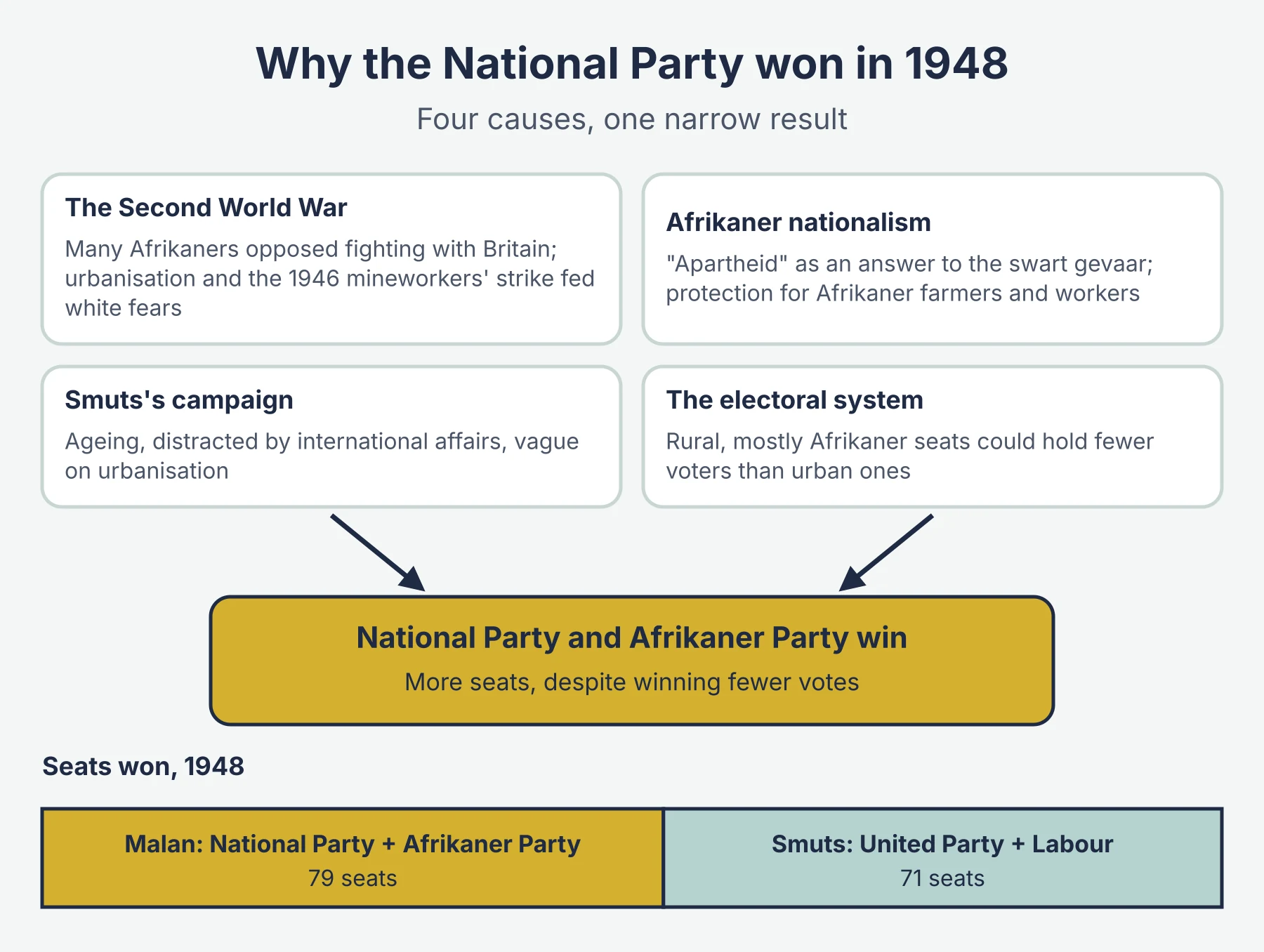
Why the National Party won in 1948. D.F. Malan’s National Party, with the Afrikaner Party, won 79 seats to 71 for Smuts’s United Party and its Labour allies, despite winning fewer votes.
- The Second World War: many Afrikaners had opposed fighting alongside Britain; wartime urbanisation and the 1946 African mineworkers’ strike fed white fears.
- Afrikaner nationalism: the party offered “apartheid” as a clear answer to the swart gevaar (“black danger”) and promised to protect Afrikaner farmers and workers.
- Smuts’s campaign: ageing, distracted by international affairs, vague on urbanisation and accused of complacency.
- The electoral system: rural constituencies, mostly Afrikaner, could contain fewer voters than urban ones.
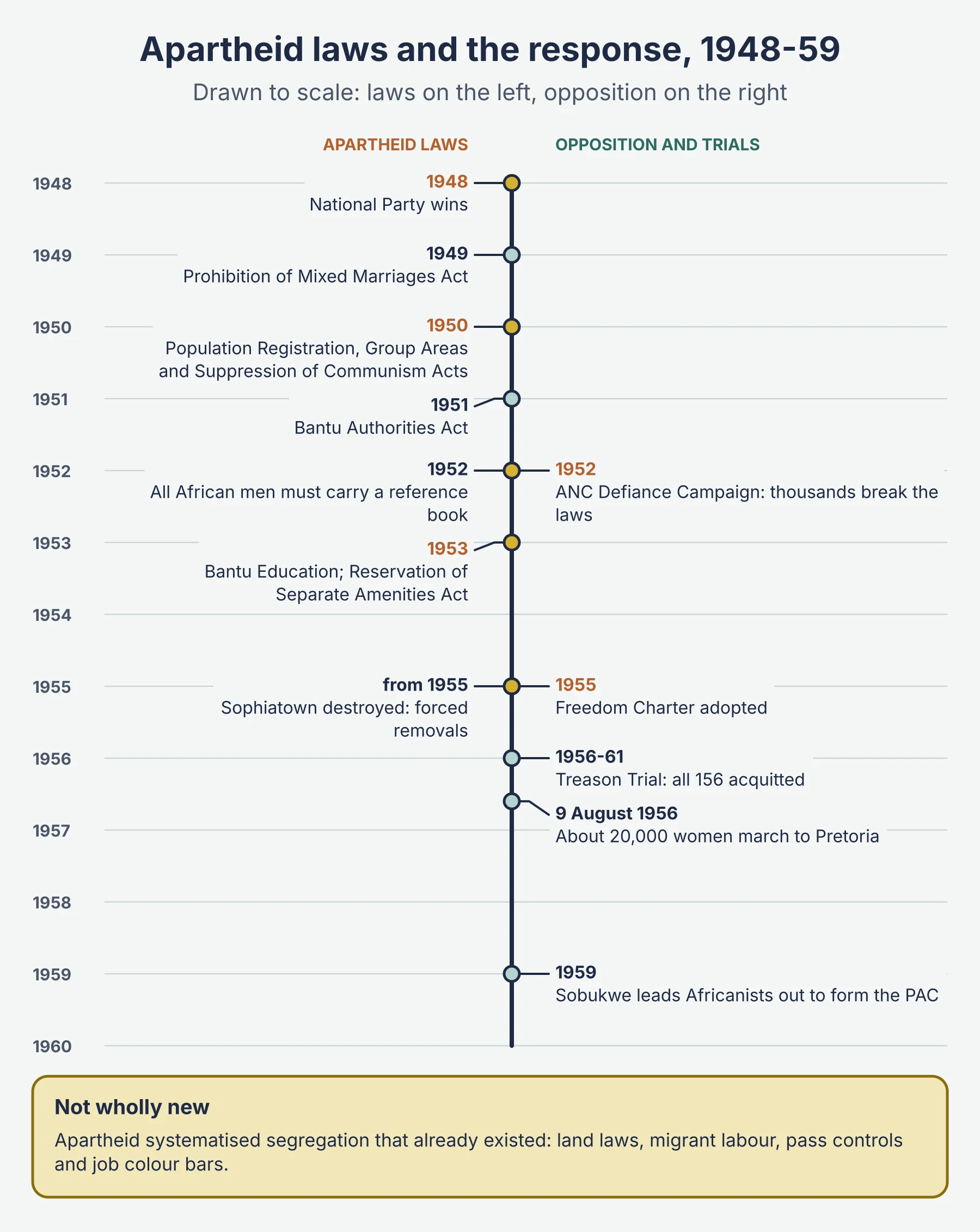
The apartheid laws systematised segregation: the Prohibition of Mixed Marriages Act (1949); the Population Registration Act and the Group Areas Act (both 1950); the Suppression of Communism Act (1950), defining communism so widely that it covered most opposition; the Bantu Authorities Act (1951); the Reservation of Separate Amenities Act (1953). The pass system was tightened in 1952 when all African men had to carry a reference book, later extended to women. Bantu Education (1953), designed by Hendrik Verwoerd, took African schools from mission control and prepared pupils for subordinate roles. Forced removals, such as the destruction of Sophiatown from 1955, uprooted communities.
Opposition and enforcement. The ANC, radicalised by its Youth League (Mandela, Sisulu, Tambo), launched the Defiance Campaign (1952), in which thousands deliberately broke apartheid laws and were arrested. The Congress of the People adopted the Freedom Charter (1955), declaring that South Africa belonged to all who lived in it. On 9 August 1956 about 20,000 women marched to Pretoria against passes for women. The government responded with bannings and the Treason Trial (1956-61), in which all 156 accused were eventually acquitted. In 1959 Robert Sobukwe led Africanists out of the ANC to form the PAC, rejecting co-operation with white and Indian allies.
8.2 Resistance and repression, 1960-77
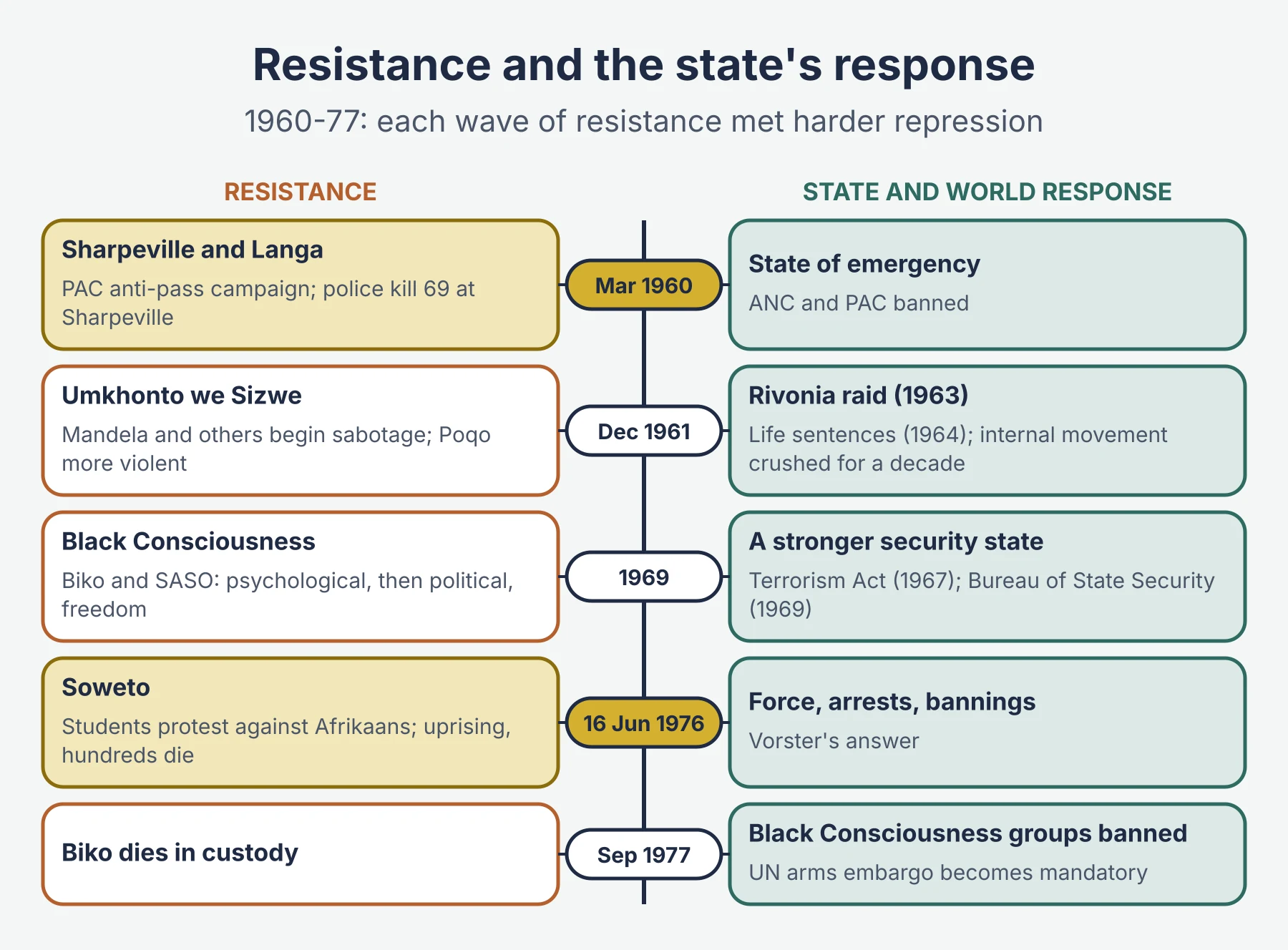
Sharpeville. The PAC launched an anti-pass campaign ahead of the ANC’s. On 21 March 1960 police at Sharpeville opened fire on a crowd, killing 69 people; protesters were also shot at Langa near Cape Town. The government declared a state of emergency and banned the ANC and PAC.
Armed struggle. Concluding that peaceful protest had been closed off, Mandela and others founded Umkhonto we Sizwe (MK) in December 1961, beginning a sabotage campaign; the PAC’s armed wing, Poqo, used more violent attacks. After the raid on Liliesleaf Farm at Rivonia (1963), Mandela and other leaders were sentenced to life imprisonment in 1964. The internal movement was crushed for a decade.
Black Consciousness. Steve Biko and the South African Students’ Organisation (founded 1969) argued that Black people must free themselves psychologically before politically. Black Consciousness inspired the students of Soweto, who protested on 16 June 1976 against compulsory teaching in Afrikaans; police shootings sparked an uprising across the country in which hundreds died. Biko died in police custody in September 1977, and the government banned Black Consciousness organisations.
International opposition. Sharpeville brought worldwide condemnation and capital flight. The Anti-Apartheid Movement (from 1959 in Britain) organised consumer and sports boycotts. The UN General Assembly called for sanctions, but Britain, the USA and France blocked mandatory economic sanctions in the Security Council because of trade, investment and Cold War concerns. A voluntary arms embargo (1963) became mandatory in 1977 after Biko’s death. The OAU (1963) supported the ANC and PAC, and once Mozambique and Angola became independent (1975), the buffer of white-ruled states began to disappear.
Separate development. Verwoerd (Prime Minister 1958-66) and Vorster (1966-78) presented apartheid as separate nations. The Promotion of Bantu Self-Government Act (1959) created ethnic homelands; Transkei received “independence” in 1976, followed by others, stripping their people of South African citizenship. The homelands were overcrowded, poor and dependent on migrant labour, and were not recognised internationally.
The state’s reaction. Detention without trial was extended, the police and Bureau of State Security (1969) were strengthened, the Terrorism Act (1967) allowed indefinite detention, and the army grew. Vorster’s government answered Soweto with force, arrests and bannings.
8.3 Why apartheid ended, 1978-94
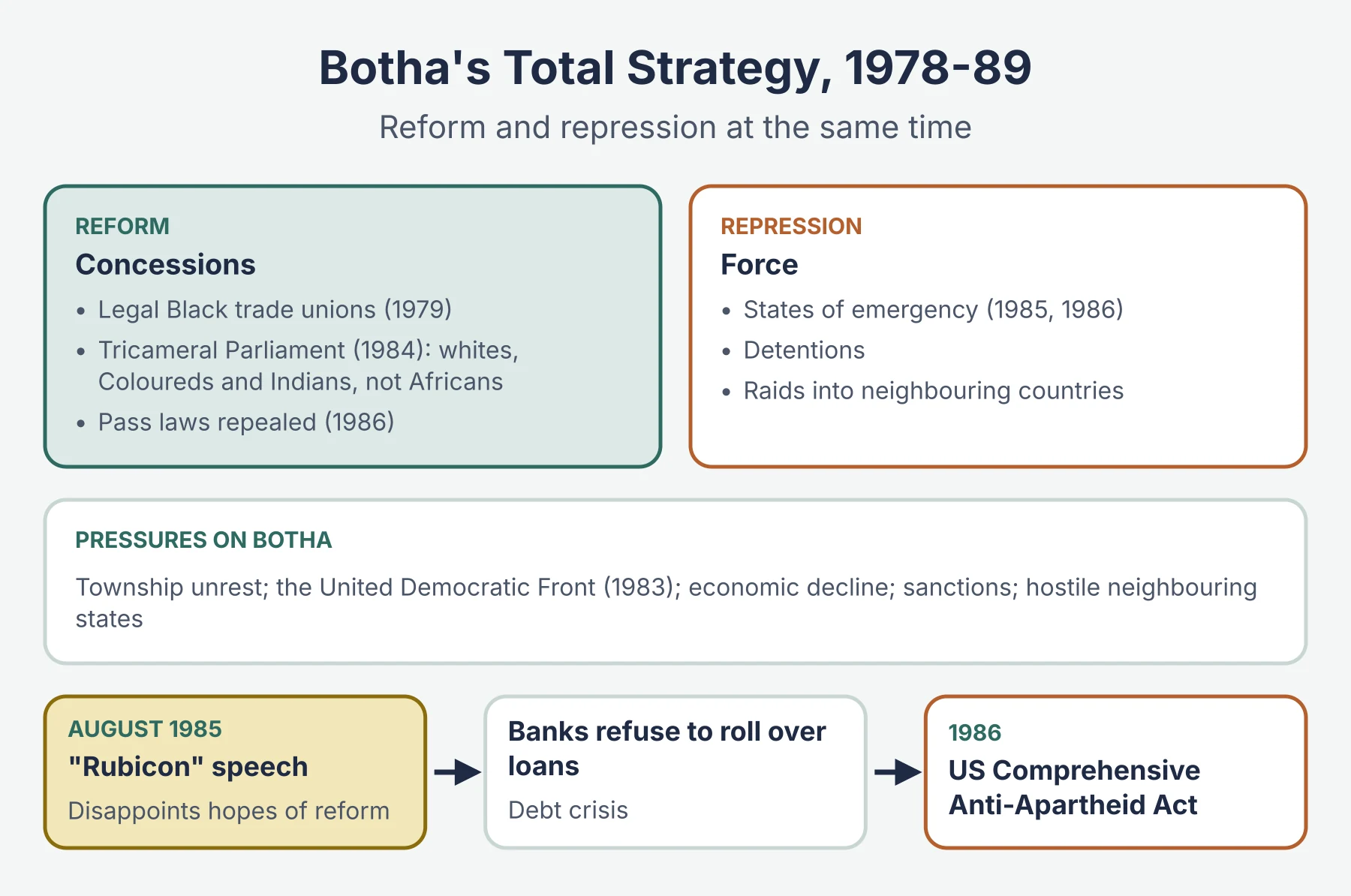
Botha (1978-89). P.W. Botha faced township unrest, the United Democratic Front (1983), which united hundreds of anti-apartheid groups, economic decline, sanctions and hostile neighbouring states. His Total Strategy combined reform – legal Black trade unions (1979), a Tricameral Parliament (1984) for whites, Coloureds and Indians but not Africans, the repeal of the pass laws (1986) – with repression: states of emergency (1985, 1986), detentions and raids into neighbouring countries. His “Rubicon” speech (August 1985) disappointed expectations of reform; banks refused to roll over loans and the US passed the Comprehensive Anti-Apartheid Act (1986).
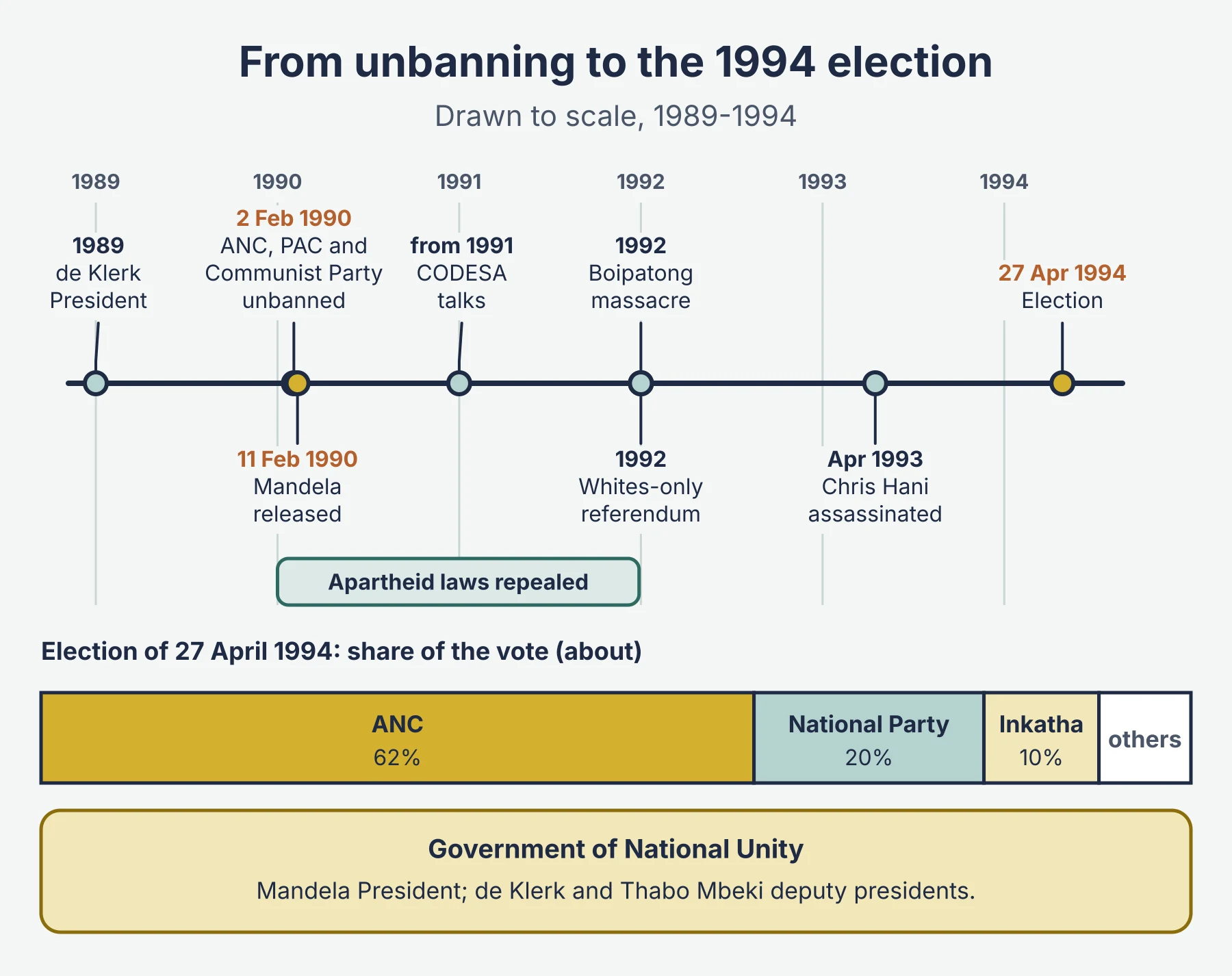
De Klerk. F.W. de Klerk became President in 1989 amid school boycotts, township unrest and economic stagnation, and as the end of the Cold War removed the “communist threat” argument. On 2 February 1990 he unbanned the ANC, PAC and Communist Party; Mandela was released on 11 February 1990. Remaining apartheid laws were repealed in 1990-91.
Leaders and violence. Mandela’s authority held the ANC to negotiation; de Klerk won a whites-only referendum in 1992 for reform. Negotiations (CODESA from 1991, then the Multi-Party Negotiating Forum) survived the Boipatong massacre (1992) and the assassination of Chris Hani (April 1993). Violence between ANC supporters and the Inkatha Freedom Party, evidence of a covert “Third Force” in the security services, and white extremists threatened the transition.
1994. In the election of 27 April 1994 the ANC won about 62 per cent, the National Party about 20 per cent and Inkatha about 10 per cent. Mandela became President of a Government of National Unity with de Klerk and Thabo Mbeki as deputy presidents.
8.4 Zimbabwe, 1965-80
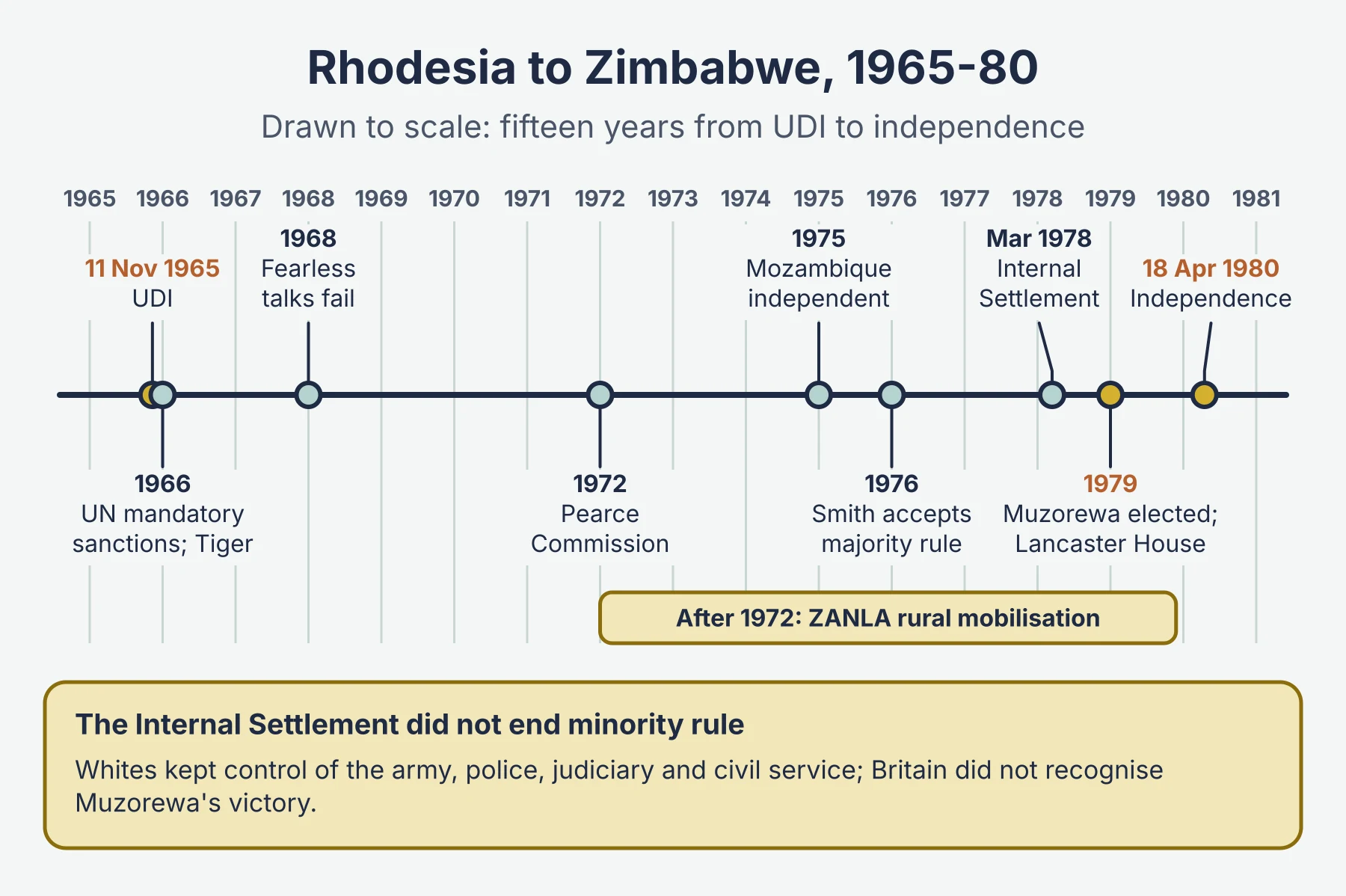
UDI. Ian Smith’s Rhodesian Front demanded independence under white minority rule, but Harold Wilson’s government insisted on progress towards majority rule. Talks in 1965 failed, and Smith declared UDI on 11 November 1965. Britain ruled out force and imposed sanctions; the UN imposed its first mandatory sanctions in 1966, but South Africa and Portuguese Mozambique helped Rhodesia evade them. Later talks on HMS Tiger (1966) and HMS Fearless (1968) failed, and the Pearce Commission (1972) found most Africans rejected a proposed settlement.
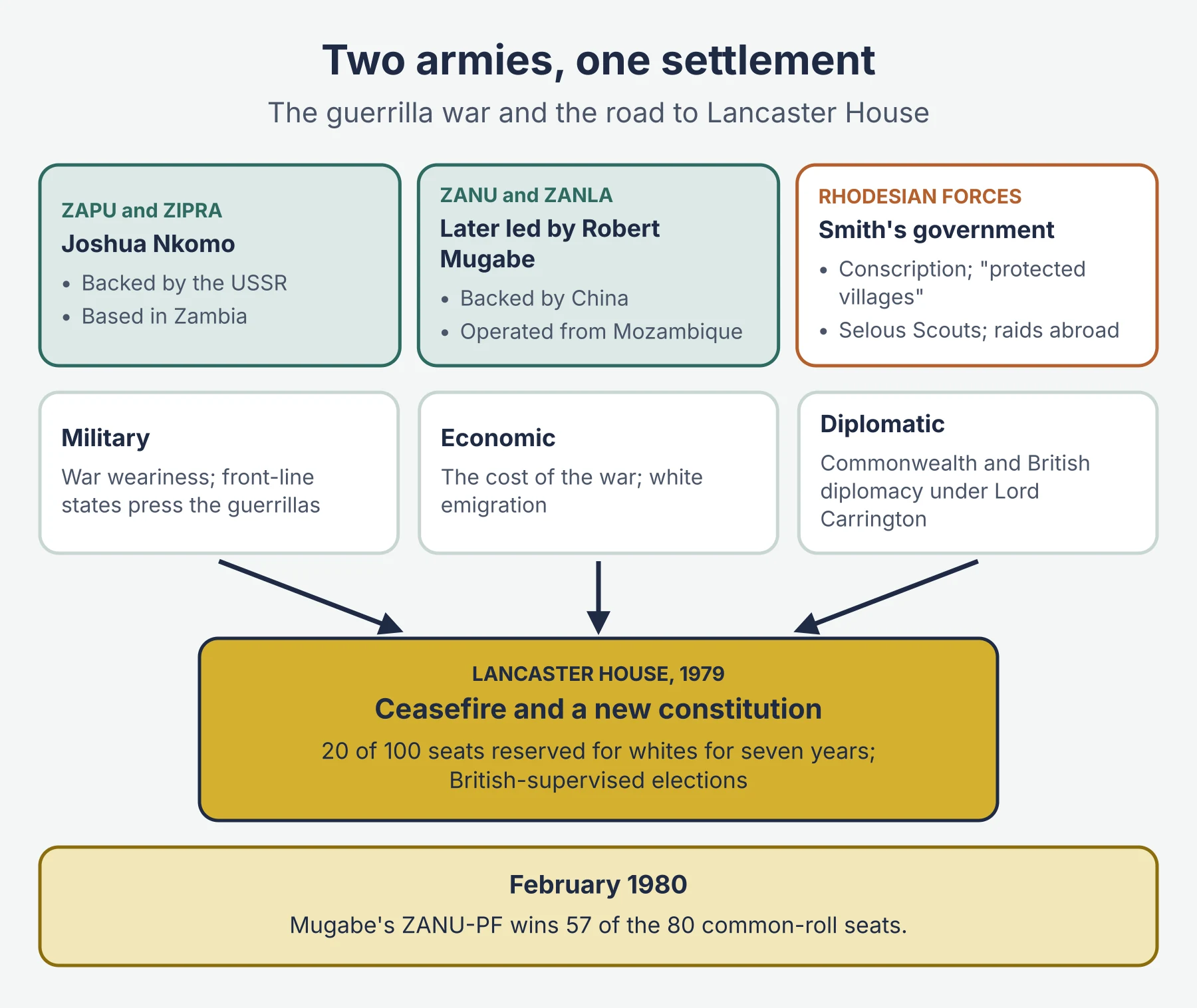
The war. ZAPU (Joshua Nkomo) and its army ZIPRA, backed by the USSR and based in Zambia, and ZANU (later led by Robert Mugabe) and ZANLA, backed by China and operating from Mozambique, fought the Rhodesian forces. ZANLA’s rural mobilisation after 1972, and Mozambique’s independence in 1975, stretched Rhodesian forces. The government used conscription, “protected villages”, the Selous Scouts and raids into Mozambique and Zambia.
The Internal Settlement (1978). Under pressure from South Africa and the USA, Smith had accepted majority rule in principle in 1976. In March 1978 he agreed a settlement with Bishop Muzorewa and others that kept white control of the army, police, judiciary and civil service. Muzorewa won the 1979 elections, but Britain did not recognise the result, and ZANU and ZAPU fought on.
Lancaster House (1979). War weariness, white emigration, the cost of the war, pressure on the guerrillas from the front-line states, and Commonwealth and British diplomacy under Lord Carrington brought all sides to London. The agreement provided a ceasefire, a new constitution reserving 20 of 100 seats for whites for seven years, protections for property, and British-supervised elections. In February 1980 Mugabe’s ZANU-PF won 57 of the 80 common-roll seats, and Zimbabwe became independent on 18 April 1980 with Mugabe as Prime Minister.
Worked example: an annotated conclusion
“Internal resistance was more important than international pressure in ending apartheid.” Assess this view. [30]
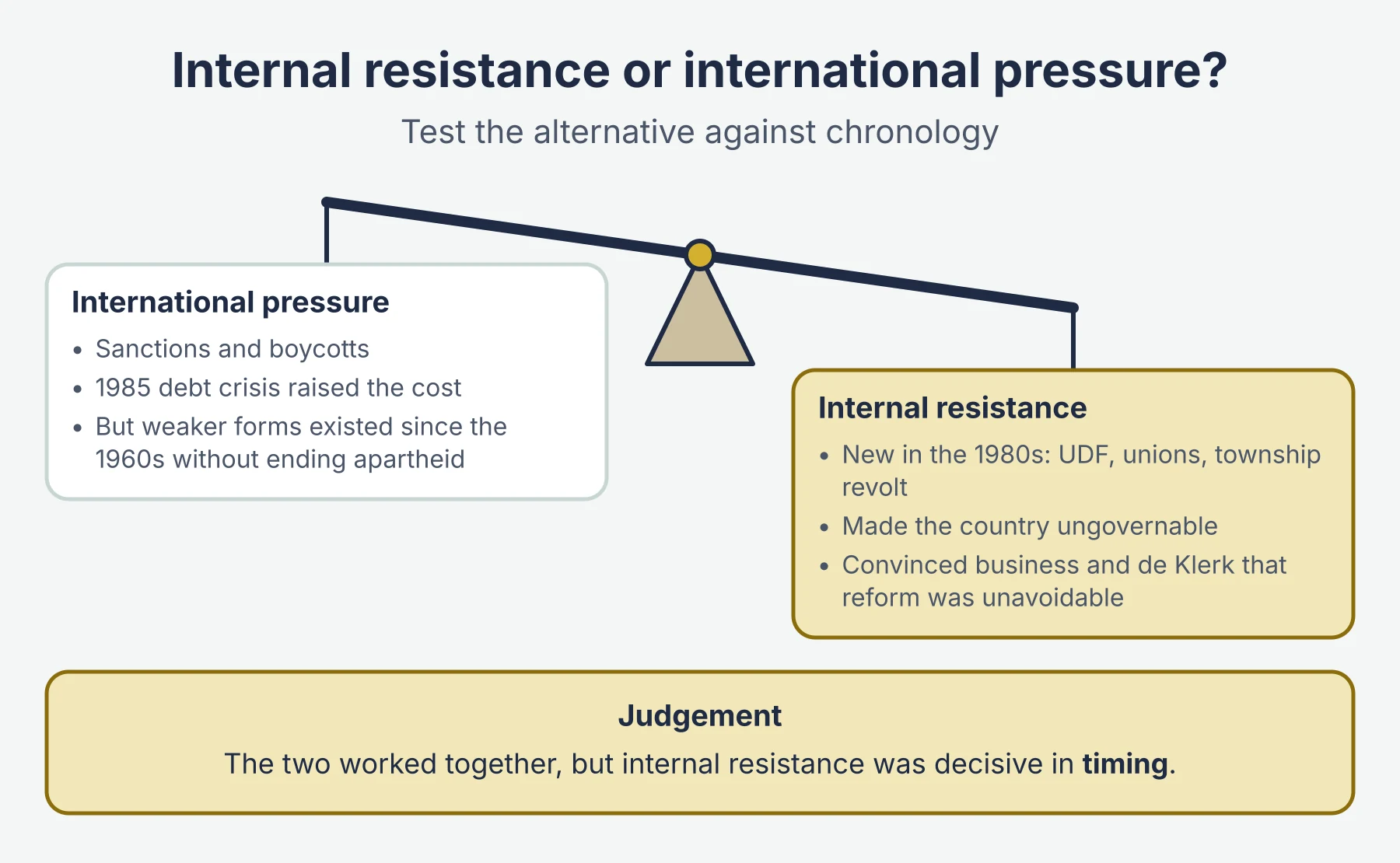
The two forces worked together, but internal resistance was decisive in timing. Sanctions and the 1985 debt crisis raised the cost of apartheid, yet they had existed in weaker forms since the 1960s without ending it. [tests the alternative against chronology] What changed in the 1980s was the UDF, the unions and township revolt, which made the country ungovernable and convinced business and de Klerk that reform was unavoidable. [supports the given factor with a causal link]
Common mistakes
- Treating apartheid as wholly new in 1948 rather than a systematisation of existing segregation.
- Confusing the PAC (Sharpeville campaign) with the ANC.
- Forgetting that Botha’s reforms coexisted with harsh repression.
- In Zimbabwe, treating the Internal Settlement as the end of minority rule.
Exam technique
For assess questions, define the factor in the question, test it against others with dates, and reach a comparative judgement. For Zimbabwe, separate military, economic and diplomatic causes.
Official syllabus
Cambridge International AS & A Level History (9489) syllabus for 2027, 2028 and 2029 – cambridgeinternational.org (Paper 4, International option, topic 8).
Related resources
-
Practice questions
Cambridge A Level World History (9489): End of minority rule in South Africa and Zimbabwe, 1948-94 – Practice Questions
Twelve original practice questions on Cambridge 9489 South Africa and Zimbabwe, 1948-94: recall items and Paper 4-style essays with mark-scheme style answers.
World History · Cambridge · A Level
Try questions -
Revision notes
Cambridge A Level World History (9489): End of minority rule in South Africa and Zimbabwe, 1948-94 – Revision Notes
Revision notes for Cambridge 9489 Paper 4, South Africa and Zimbabwe 1948-94: key terms, laws and dates, resistance, the end of white rule and a self-test.
World History · Cambridge · A Level
Revise topic -
Study guides
Cambridge A Level World History (9489): The route to independence: Malaysia and Indonesia, c.1909-67
Study guide to Cambridge 9489 Paper 4 topic 9: nationalism in Malaya and Indonesia, Japanese occupation, the formation of Malaysia, and Indonesia to Suharto.
World History · Cambridge · A Level
Read guide
Get free revision emails (optional)
Occasional emails with practice questions, worked explanations and links to free resources for the qualification and subjects you choose. No spam, and you can unsubscribe from any email. The free tools on this site never need an email.