
Revision Notes
Cambridge A Level World History (9489): End of minority rule in South Africa and Zimbabwe, 1948-94 – Revision Notes
Revision notes for Cambridge 9489 Paper 4, South Africa and Zimbabwe 1948-94: key terms, laws and dates, resistance, the end of white rule and a self-test.
- Subject
- World History
- Level
- A LEVEL
- Topic
- Topic 7: International option: International history, 1909-94
- Author
- Marlbridge Academic Team
- Updated
- Reviewed by
- Azam Siddique (what this means)
Aligned to Cambridge A Level World History (9489), 2027-2029. Official specification .
Syllabus page (what it covers and how it is assessed): Cambridge A Level World History.
Syllabus points this page covers
9489 (A Level)
- 8 End of minority rule in South Africa and Zimbabwe, 1948–94
Found an error? Report a correction.
Need help with this topic? Request a free trial class for A Level World History (9489).
These notes condense End of minority rule in South Africa and Zimbabwe, 1948-94, the second topic of the Paper 4 International option in Cambridge 9489. For explanation and an annotated conclusion see the South Africa and Zimbabwe study guide; for essays and short questions see the South Africa and Zimbabwe practice questions.
Syllabus coverage
- 8.1 How was the apartheid state established in South Africa and what was its impact from 1948 to 1959?
- 8.2 How did resistance grow in South Africa and how did the authorities respond in the period 1960-77?
- 8.3 Why did apartheid and minority rule in South Africa come to an end, 1978-94?
- 8.4 How was the ending of white minority rule in Zimbabwe achieved in the period 1965-80?
Key terms
| Term | Meaning |
|---|---|
| Apartheid | “Separateness”: the National Party’s system of racial separation from 1948 |
| Swart gevaar | “Black danger”: the fear the National Party exploited in 1948 |
| Pass laws | Laws requiring Africans to carry documents controlling movement and residence |
| Bantustans / homelands | Ethnic reserves given “self-government” or “independence” |
| Separate development | Verwoerd’s presentation of apartheid as separate nationhood |
| Freedom Charter | 1955 statement of the Congress Alliance’s aims |
| Umkhonto we Sizwe | “Spear of the Nation”: the ANC’s armed wing (1961) |
| Black Consciousness | Biko’s movement for Black psychological and political self-reliance |
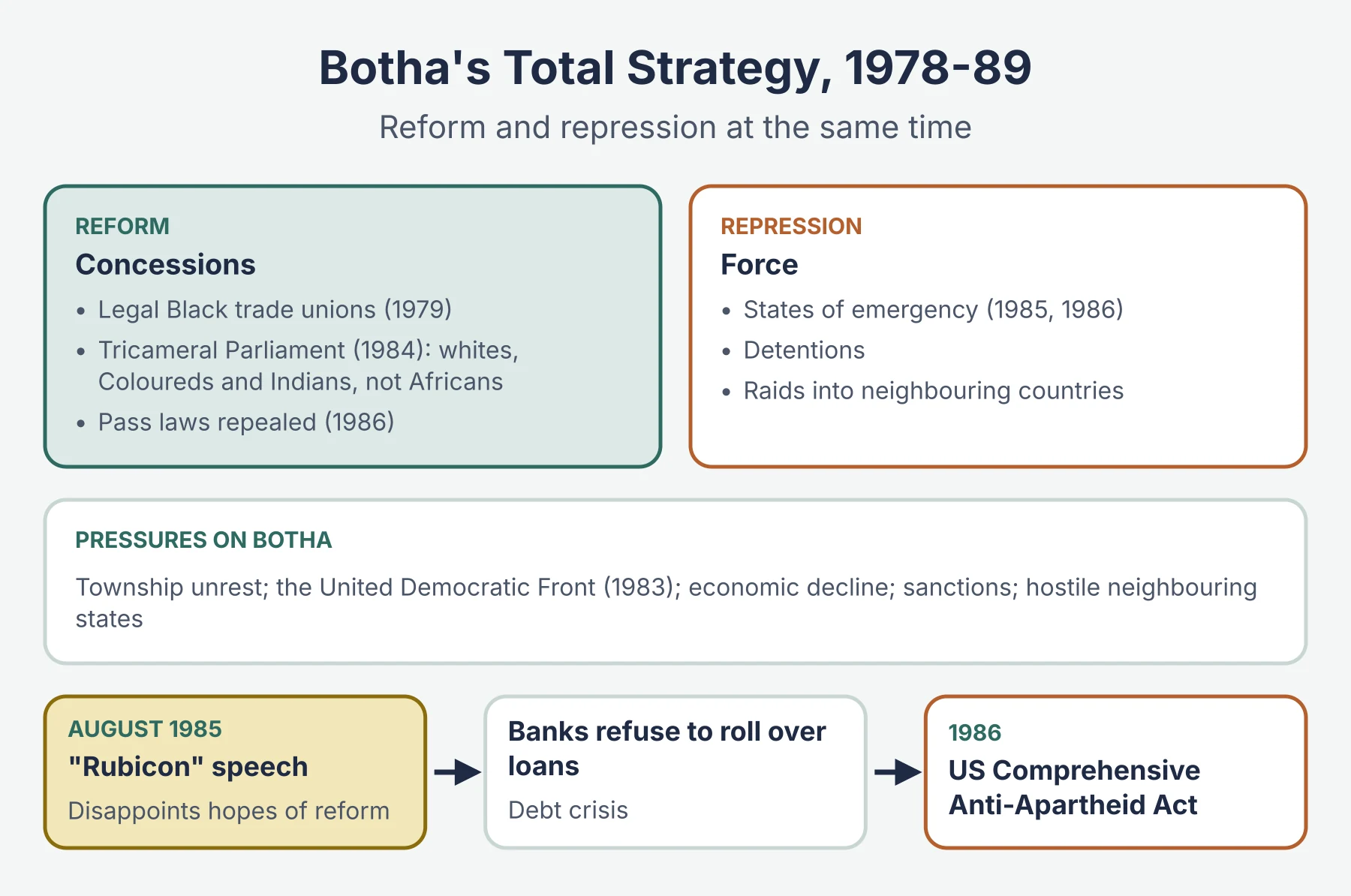
| Total Strategy | Botha’s combination of reform and repression against the “total onslaught” |
| UDF | United Democratic Front (1983), an alliance of anti-apartheid groups |
| Third Force | Covert security elements accused of stoking violence, 1990-94 |
| UDI | Rhodesia’s Unilateral Declaration of Independence, 1965 |
| Internal Settlement | 1978 agreement between Smith and moderate African leaders |
| Lancaster House | 1979 London agreement ending white minority rule in Zimbabwe |
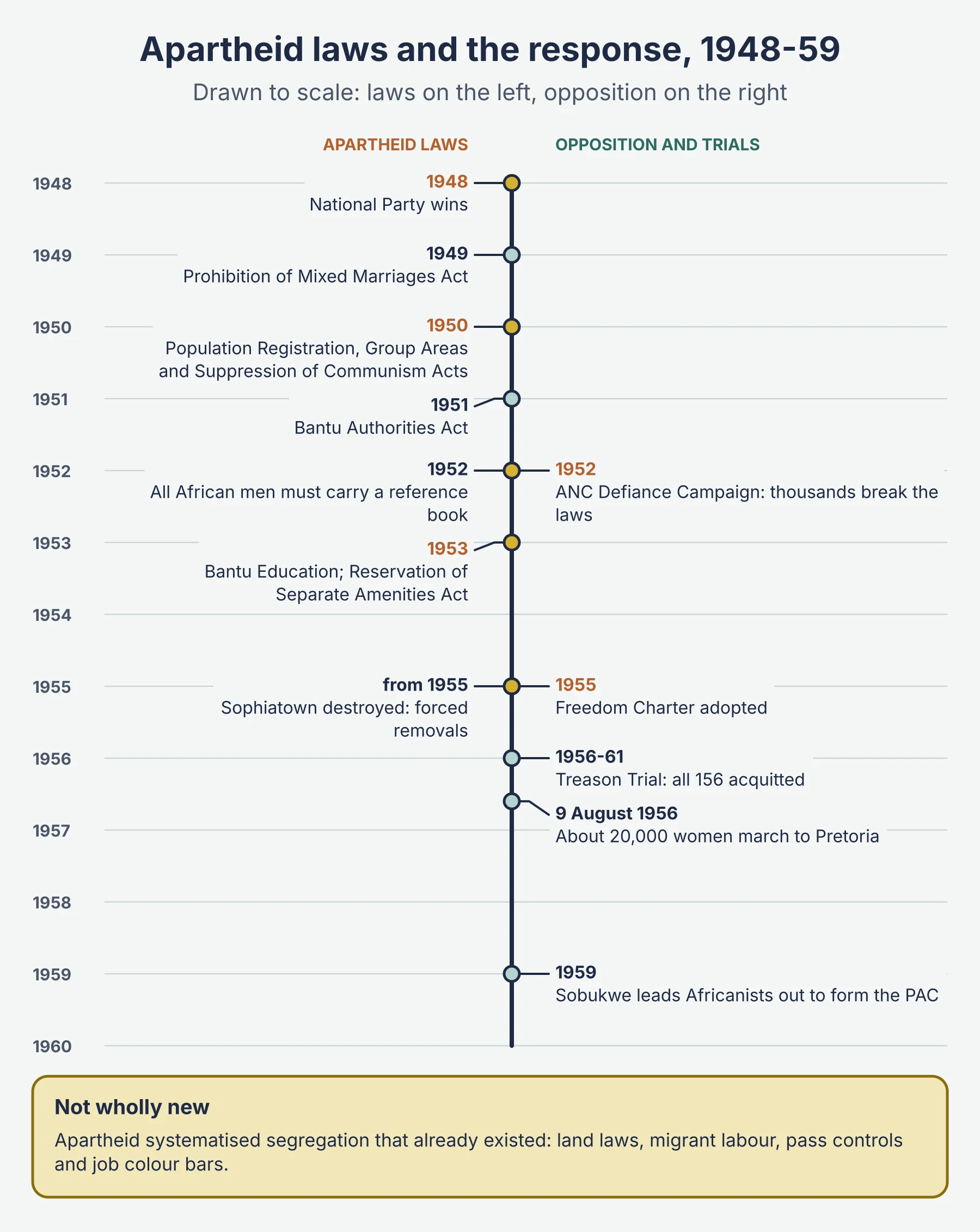
South Africa timeline
| Date | Event |
|---|---|
| May 1948 | National Party wins the election |
| 1949-53 | Mixed Marriages, Population Registration, Group Areas, Suppression of Communism, Separate Amenities and Bantu Education Acts |
| 1952 | Defiance Campaign; reference books for African men |
| June 1955 | Freedom Charter |
| Aug 1956 | Women’s march to Pretoria |
| 1956-61 | Treason Trial |
| 1959 | PAC founded; Promotion of Bantu Self-Government Act |
| March 1960 | Sharpeville and Langa; state of emergency; ANC and PAC banned |
| Dec 1961 | Umkhonto we Sizwe founded |
| 1963-64 | Rivonia arrests and trial; life sentences |
| 1966 | Verwoerd assassinated; Vorster Prime Minister |
| 1969 | SASO founded |
| 1976 | Soweto uprising (16 June); Transkei “independence” |
| 1977 | Biko dies in custody; mandatory UN arms embargo |
| 1978 | P.W. Botha becomes Prime Minister |
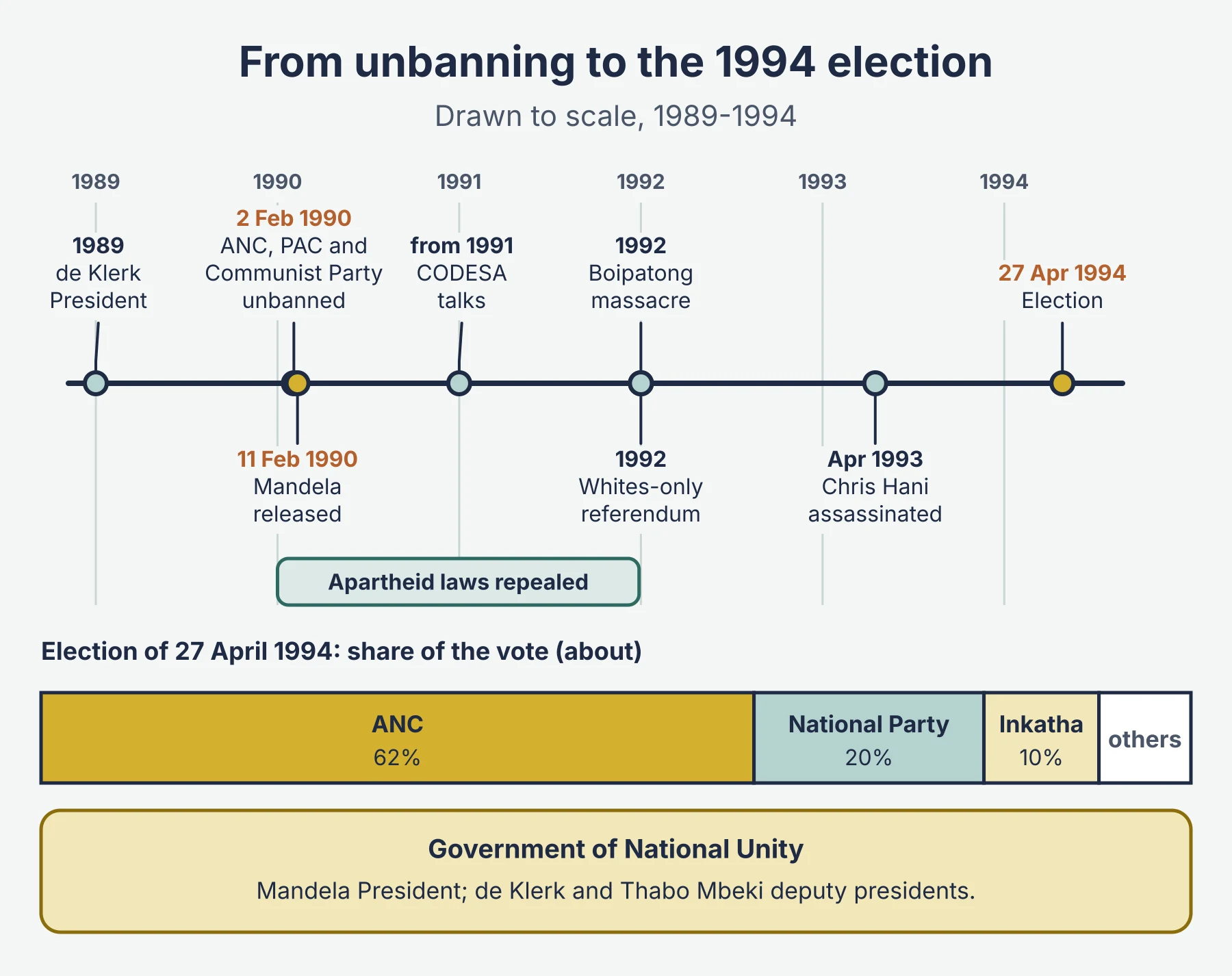
| 1983-84 | UDF founded; Tricameral Parliament |
| 1985-86 | States of emergency; Rubicon speech; pass laws repealed; US sanctions law |
| 1989 | De Klerk becomes President |
| Feb 1990 | ANC unbanned; Mandela released |
| 1992-93 | Referendum; Boipatong; Hani assassinated |
| April 1994 | First democratic election; Mandela President (May) |
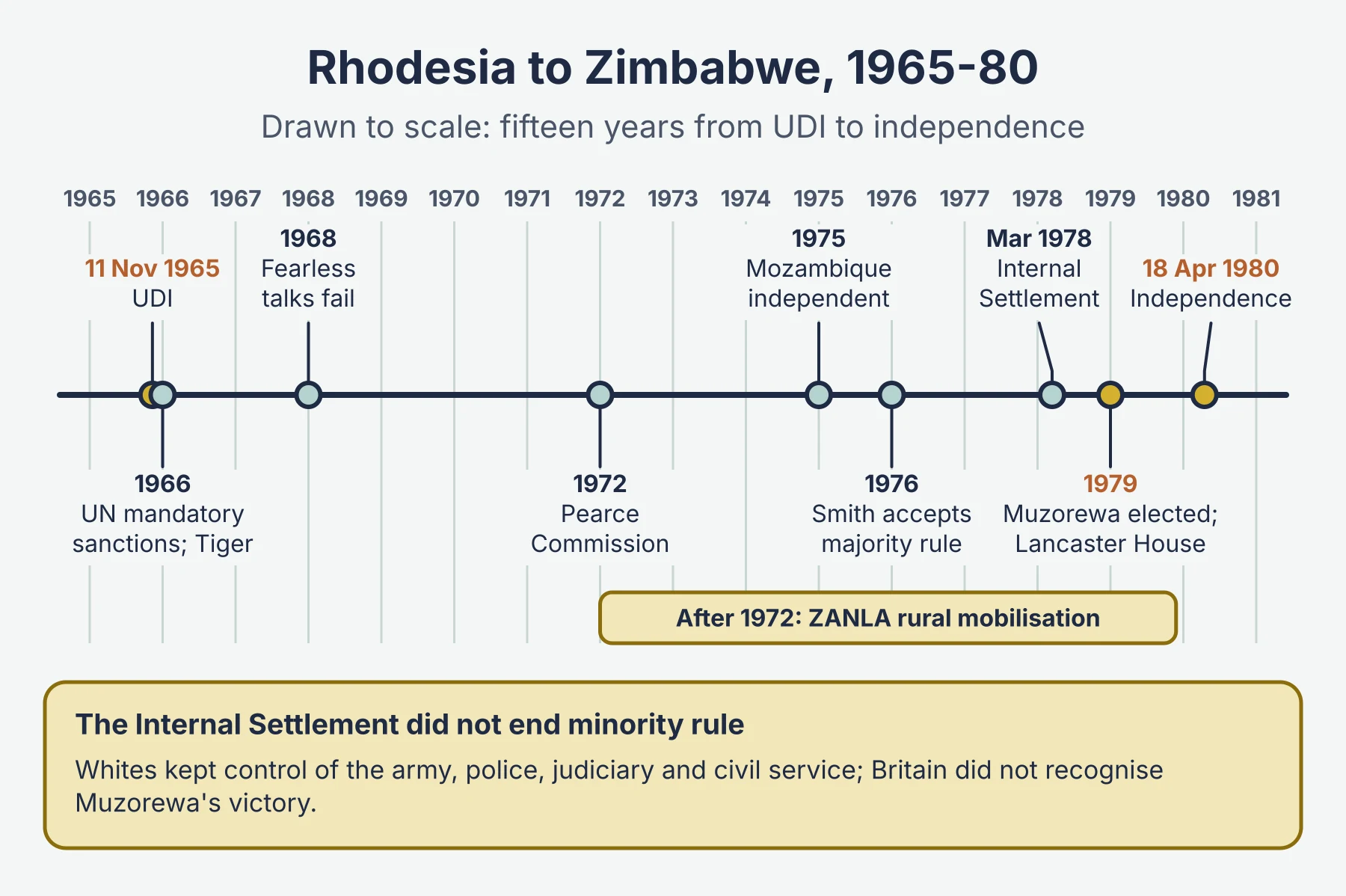
Zimbabwe timeline
| Date | Event |
|---|---|
| 1964 | Ian Smith becomes Prime Minister |
| Nov 1965 | UDI; British sanctions |
| 1966 | UN mandatory sanctions; HMS Tiger talks; fighting at Chinhoyi (Sinoia) |
| 1968 | HMS Fearless talks |
| 1972 | Pearce Commission; ZANLA offensive from the north-east |
| 1975 | Mozambique independent |
| 1976 | Smith accepts majority rule in principle; Geneva conference fails |
| March 1978 | Internal Settlement |
| 1979 | Muzorewa Prime Minister; Lancaster House Agreement (Dec) |
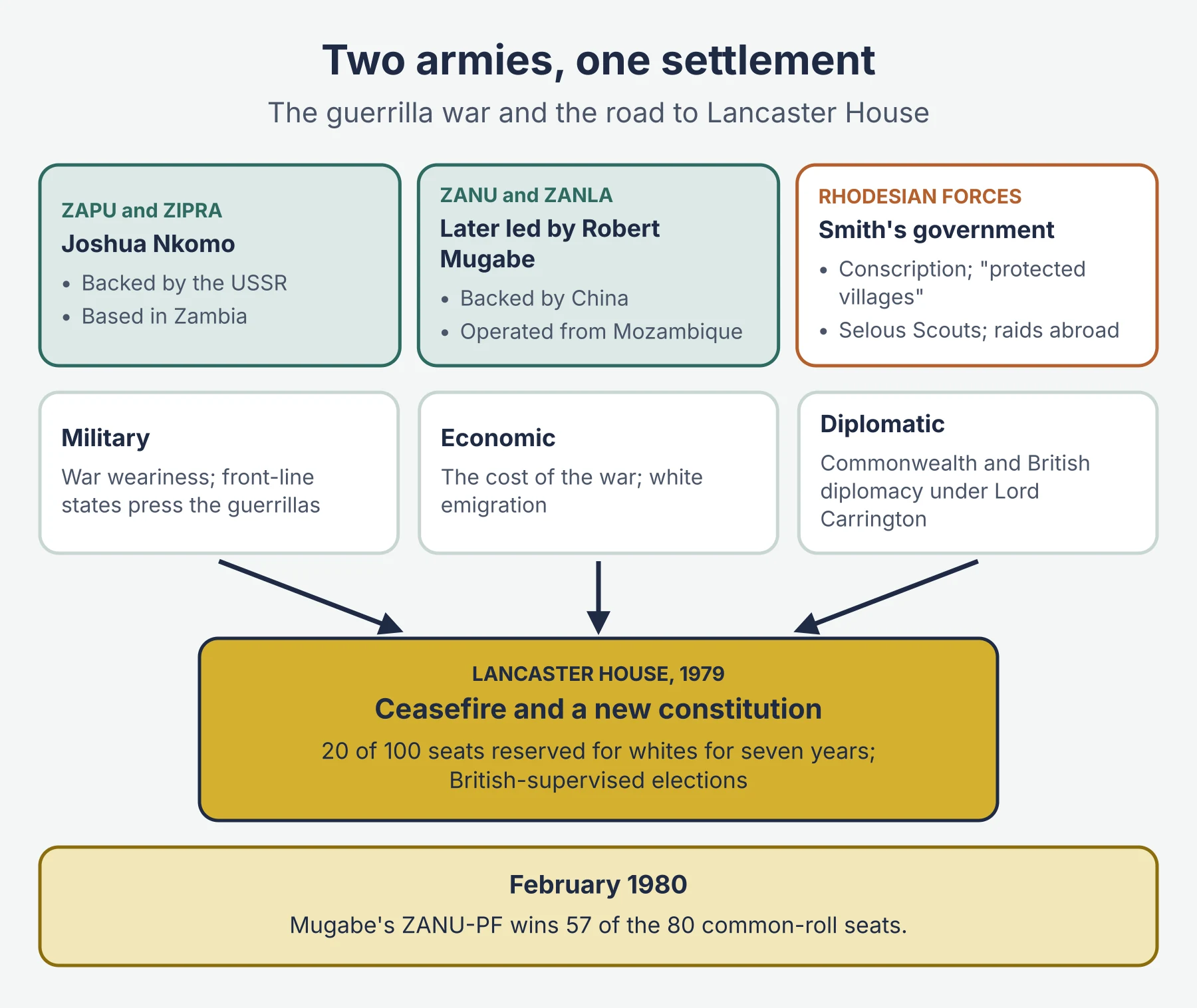
| Feb-April 1980 | Elections; ZANU-PF wins 57 of 80 common-roll seats; independence on 18 April |
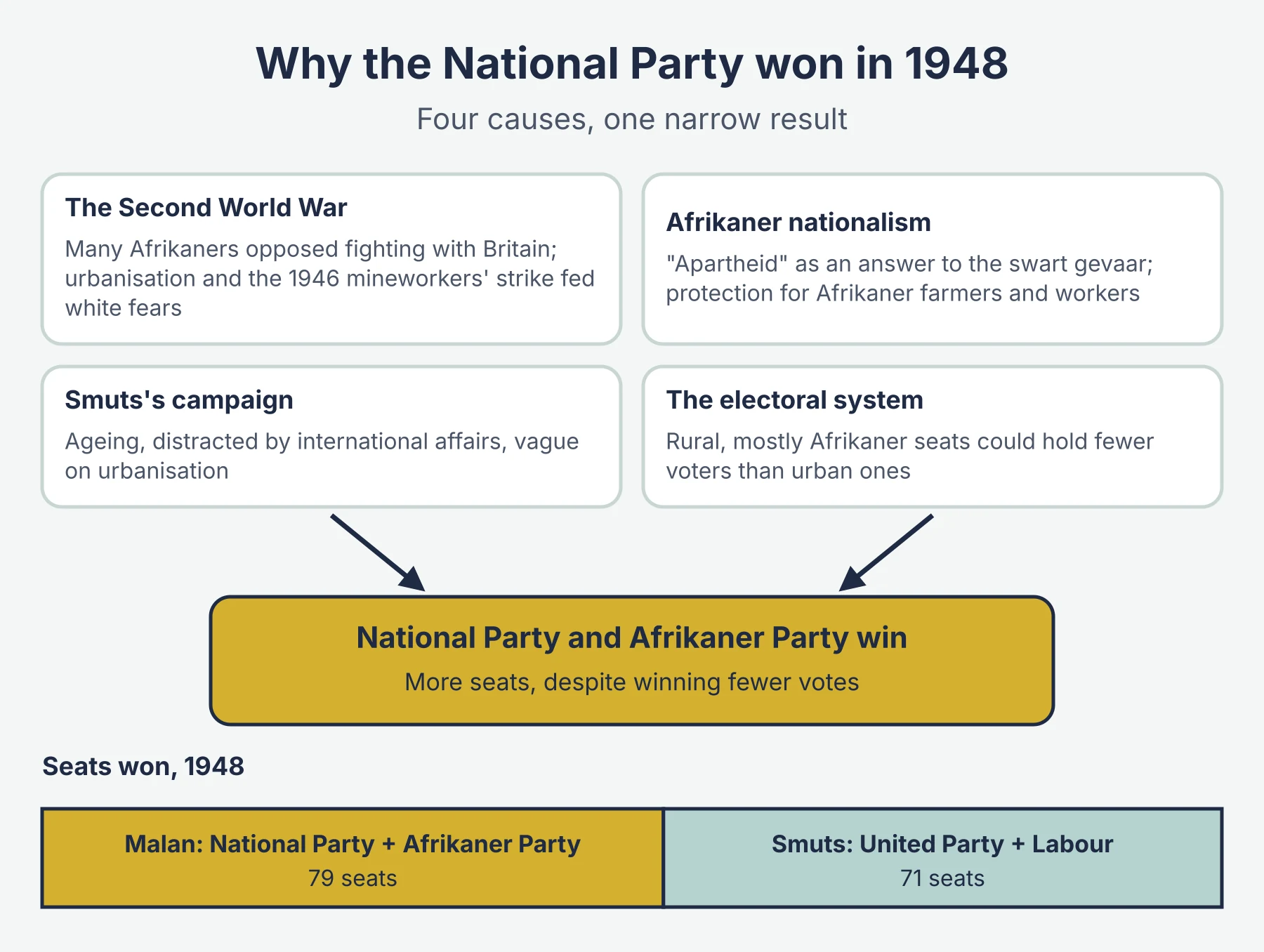
8.1 Why 1948? – four reasons
War and urbanisation; Afrikaner nationalism and swart gevaar; a weak United Party campaign; an electoral system weighted to rural seats.
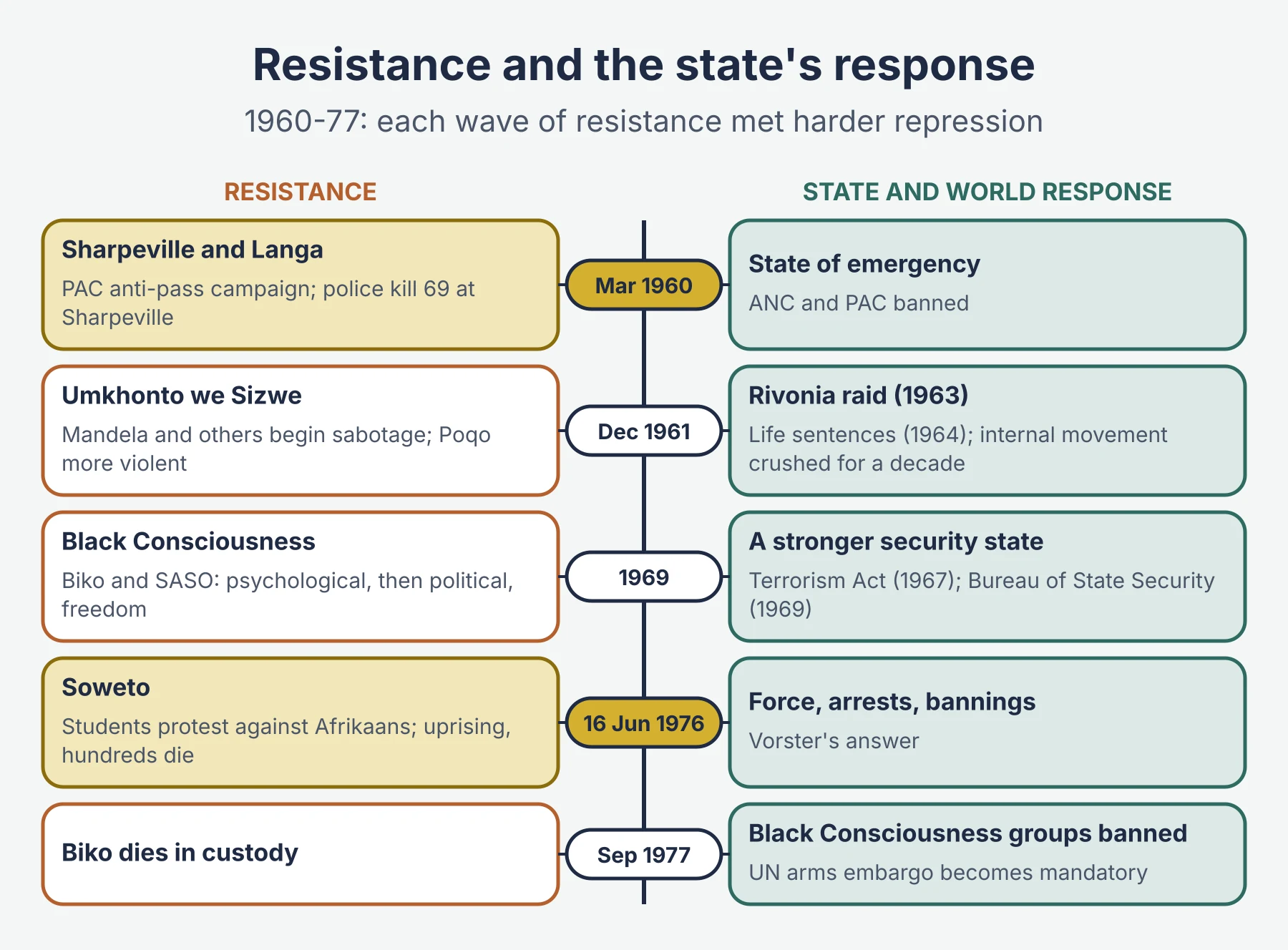
8.2 Resistance and response – three phases
- Non-violence to armed struggle (1960-64): Sharpeville, bannings, MK, Rivonia.
- Quiet decade (mid-1960s to early 1970s): leaders jailed or exiled; Bantustans expanded.
- New generation (1969-77): SASO, Black Consciousness, Soweto, Biko’s death.
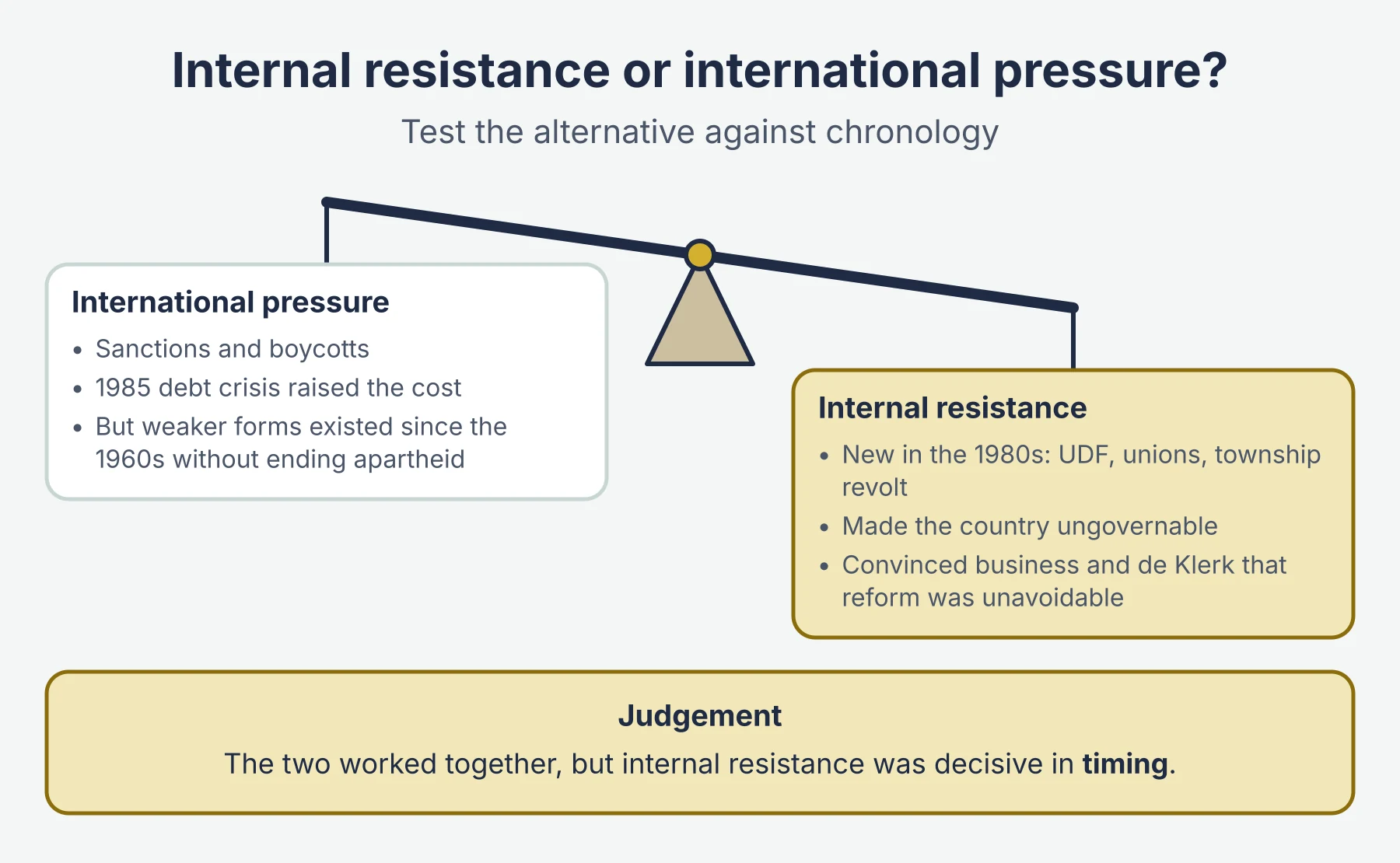
8.3 Why apartheid ended – weigh these
- Internal: UDF, unions, township revolt, school boycotts.
- Economic: recession, sanctions, the 1985 debt crisis, skills shortages.
- International: AAM boycotts, US sanctions law (1986), independence of neighbours.
- End of the Cold War: the communist threat argument collapsed.
- Leadership: de Klerk’s decision of 1990; Mandela’s commitment to negotiation.
8.4 Why white rule ended in Zimbabwe
Guerrilla war intensified after 1972; Mozambique’s independence opened a long front; South African and US pressure on Smith; sanctions and the war’s cost; white emigration; the failure of the Internal Settlement to win recognition or end the war; front-line states’ pressure on the guerrillas; Carrington’s diplomacy.
Exam traps
- Sharpeville was a PAC campaign, not an ANC one.
- Tricameral Parliament excluded Africans.
- Muzorewa’s government was not majority rule in practice.
- 1994 results: ANC about 62 per cent, not two-thirds.
- International pressure: mandatory economic sanctions never passed the UN Security Council.
Self-test
- Which party won the 1948 election? The National Party, led by D.F. Malan, with the Afrikaner Party.
- What did the Group Areas Act (1950) do? It assigned racial groups to separate residential and business areas.
- Who designed Bantu Education? Hendrik Verwoerd.
- Where was the Freedom Charter adopted? At the Congress of the People, Kliptown, 1955.
- Why did the PAC break from the ANC? Africanists rejected co-operation with white and Indian allies.
- How many were killed at Sharpeville? 69.
- What triggered the Soweto uprising? Compulsory use of Afrikaans as a medium of instruction.
- What was Botha’s Total Strategy? Combining limited reform with repression against a supposed “total onslaught”.
- What did de Klerk announce on 2 February 1990? The unbanning of the ANC, PAC and Communist Party and Mandela’s coming release.
- When did Smith declare UDI? 11 November 1965.
- Which outside powers backed ZIPRA and ZANLA? The USSR backed ZIPRA; China backed ZANLA.
- How many seats did Lancaster House reserve for whites? 20 of 100, for seven years.
Official syllabus
Cambridge International AS & A Level History (9489) syllabus for 2027, 2028 and 2029 – cambridgeinternational.org (Paper 4, International option, topic 8).
Related resources
-
Study guides
Cambridge A Level World History (9489): The route to independence: Malaysia and Indonesia, c.1909-67
Study guide to Cambridge 9489 Paper 4 topic 9: nationalism in Malaya and Indonesia, Japanese occupation, the formation of Malaysia, and Indonesia to Suharto.
World History · Cambridge · A Level
Read guide -
Practice questions
Cambridge A Level World History (9489): The route to independence: Malaysia and Indonesia, c.1909-67 – Practice Questions
Twelve original practice questions on Cambridge 9489 Malaysia and Indonesia, c.1909-67: recall items and Paper 4-style essays with mark-scheme style answers.
World History · Cambridge · A Level
Try questions -
Revision notes
Cambridge A Level World History (9489): The route to independence: Malaysia and Indonesia, c.1909-67 – Revision Notes
Revision notes for Cambridge 9489 Paper 4, Malaysia and Indonesia c.1909-67: key terms, two timelines, the four key questions condensed, traps and a self-test.
World History · Cambridge · A Level
Revise topic
Get free revision emails (optional)
Occasional emails with practice questions, worked explanations and links to free resources for the qualification and subjects you choose. No spam, and you can unsubscribe from any email. The free tools on this site never need an email.