
Study Guides
Cambridge A Level World History (9489): The route to independence: Malaysia and Indonesia, c.1909-67
Study guide to Cambridge 9489 Paper 4 topic 9: nationalism in Malaya and Indonesia, Japanese occupation, the formation of Malaysia, and Indonesia to Suharto.
- Subject
- World History
- Level
- A LEVEL
- Topic
- Topic 7: International option: International history, 1909-94
- Author
- Marlbridge Academic Team
- Updated
- Reviewed by
- Azam Siddique (what this means)
Aligned to Cambridge A Level World History (9489), 2027-2029. Official specification .
Syllabus page (what it covers and how it is assessed): Cambridge A Level World History.
Syllabus points this page covers
9489 (A Level)
- 9 The route to independence: Malaysia and Indonesia, c.1909–67
Found an error? Report a correction.
Need help with this topic? Request a free trial class for A Level World History (9489).
The route to independence: Malaysia and Indonesia, c.1909-67 is the third topic of the International option on Cambridge 9489 Paper 4. Two key questions cover Malaya – how widespread nationalism and hostility to colonial rule were up to 1945 (9.1) and what led to the formation of Malaysia (9.2) – and two cover Indonesia: how the nationalist movement developed up to 1945 (9.3) and what led to independence and the challenges faced up to the mid-1960s (9.4). You write two 30-mark essays from your option in 1 hour 45 minutes. This guide deepens the International option study guide; for recall use the Malaysia and Indonesia revision notes and for essays the Malaysia and Indonesia practice questions.
Syllabus coverage
- 9.1 Colonial rule (the Bangkok Treaty of 1909, divide and rule, immigration, Clementi); nationalism (KMM, English-educated Malays, Kaum Muda, Malay associations); the Japanese occupation and resistance (MPAJA, KMM, PETA, KRIS).
- 9.2 The Malayan Union, Dato Onn and UMNO, the Federation of 1948 and non-Malay opposition; the Emergency; parties and the 1955 election; the Reid Commission, Merdeka, Tunku Abdul Rahman, Singapore’s merger and separation.
- 9.3 The Ethical Policy and Volksraad, Chinese trade, language, religion and education; nationalist parties and leaders; the Soetardjo Petition and Gapi; the Japanese occupation and its encouragement of nationalism.
- 9.4 Japanese-sponsored moves to independence and Pancasila; the revolution and Dutch failure; the challenges of the 1950s; the transition to Suharto’s New Order.
9.1 Malaya to 1945: a divided society
Extending British rule. By the Bangkok Treaty (1909) Siam transferred Kedah, Perlis, Kelantan and Terengganu to British protection. Britain secured its northern frontier against rival European influence and gained rich rubber and rice lands; Siam received the end of British extraterritorial rights and a loan for railway building. With Johor accepting a British General Adviser in 1914, these became the Unfederated Malay States, alongside the Federated Malay States and the Straits Settlements.
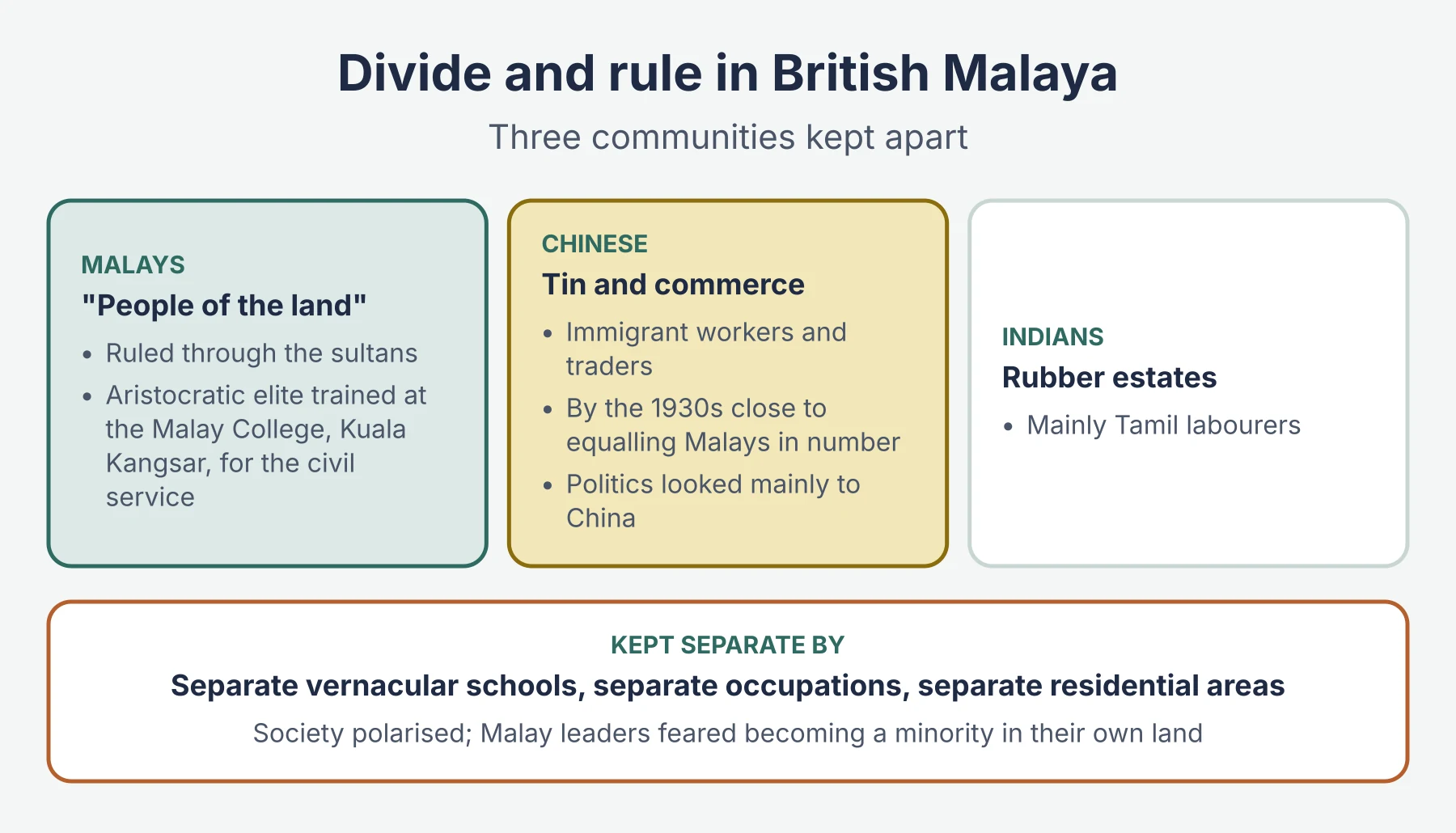
Divide and rule. Britain governed through the sultans and treated Malays as the “people of the land”, training an aristocratic elite at the Malay College, Kuala Kangsar, for the civil service. Chinese immigrants worked in tin and commerce, Indian (mainly Tamil) labourers on rubber estates. Separate vernacular schools, separate occupations and separate residential areas polarised society; by the 1930s the Chinese were close to equalling the Malays in number, and Malay leaders feared becoming a minority in their own land.
Clementi. Sir Cecil Clementi (High Commissioner 1930-34) tried to decentralise power from the Federated Malay States’ central government to the states, hoping to draw the Unfederated States into a wider union. Chinese and European business interests and many officials resisted, and the scheme achieved little.
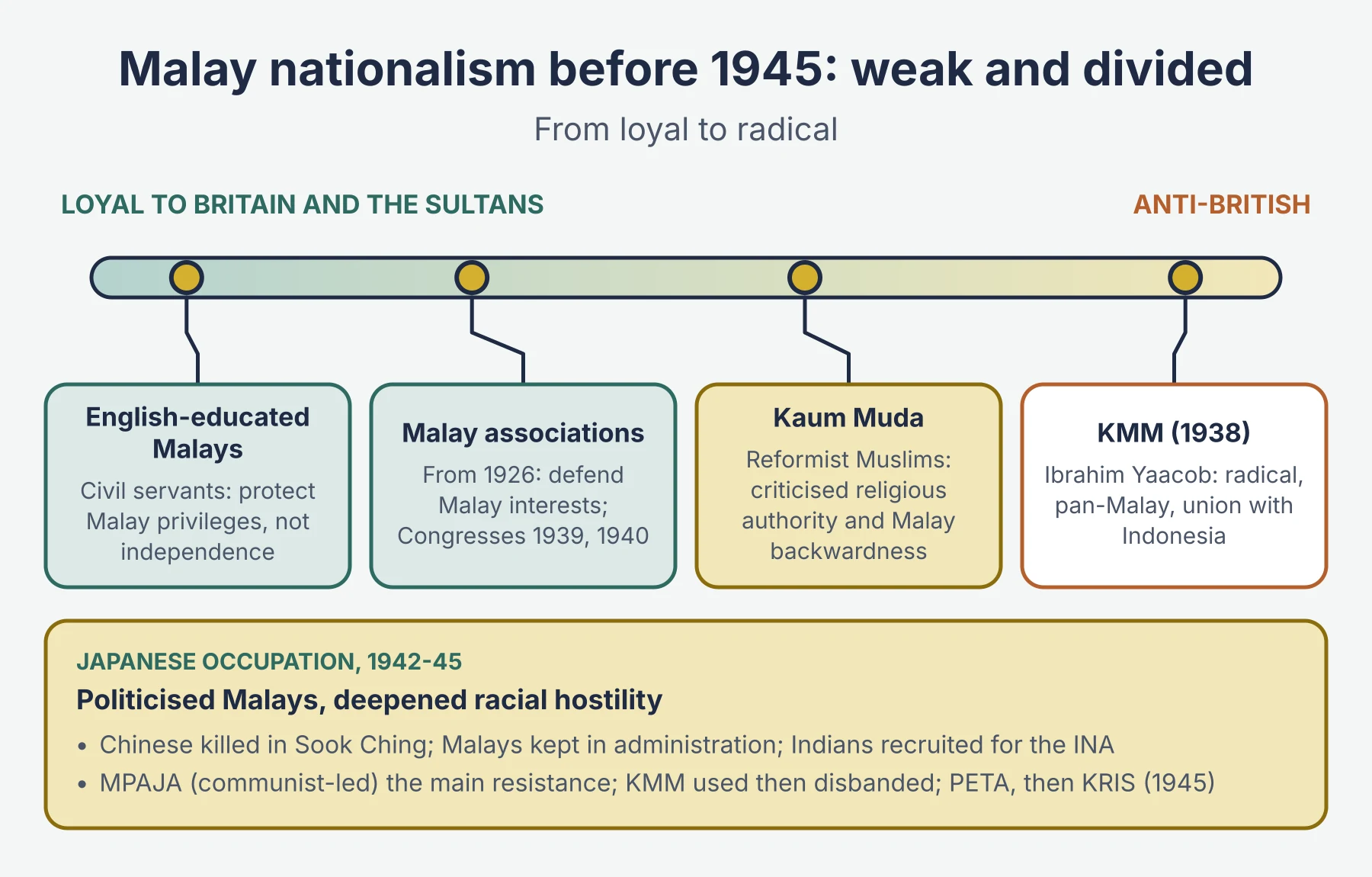
Early nationalism was weak and fragmented:
- Kaum Muda (“Young Group”), reformist Muslims influenced by Islamic modernism in Egypt, criticised traditional religious authority and Malay backwardness.
- English-educated Malays in the civil service were loyal to the sultans and to Britain; they wanted Malay privileges protected, not independence.
- Malay associations, beginning with the Kesatuan Melayu Singapura (1926), defended Malay interests against immigrants and met in Pan-Malayan Malay Congresses in 1939 and 1940.
- Kesatuan Melayu Muda (KMM, 1938), led by Ibrahim Yaacob, was radical, anti-British and pan-Malay, looking to union with Indonesia.
Chinese politics looked mainly to China.
The Japanese occupation (1942-45). Japan conquered Malaya by February 1942 and ruled through a military administration, the Malayan Military Administration named in the syllabus (not to be confused with the British Military Administration that governed briefly after the Japanese surrender in 1945). It treated the races differently: thousands of Chinese were killed in the Sook Ching purges, while Malays were kept in the administration and Indians were recruited for the Indian National Army. The communist-led Malayan People’s Anti-Japanese Army (MPAJA), supplied by the British Force 136, became the main resistance and hoped to rule after the war. The KMM was first used then disbanded; Ibrahim Yaacob led a Japanese-sponsored Malay volunteer force (PETA), and in 1945 formed KRIS to seek independence with Indonesia, which collapsed with Japan’s surrender. The occupation shattered British prestige, politicised Malays and deepened racial hostility – the MPAJA’s reprisals against “collaborators” in 1945 led to Sino-Malay clashes.
9.2 Forming Malaysia
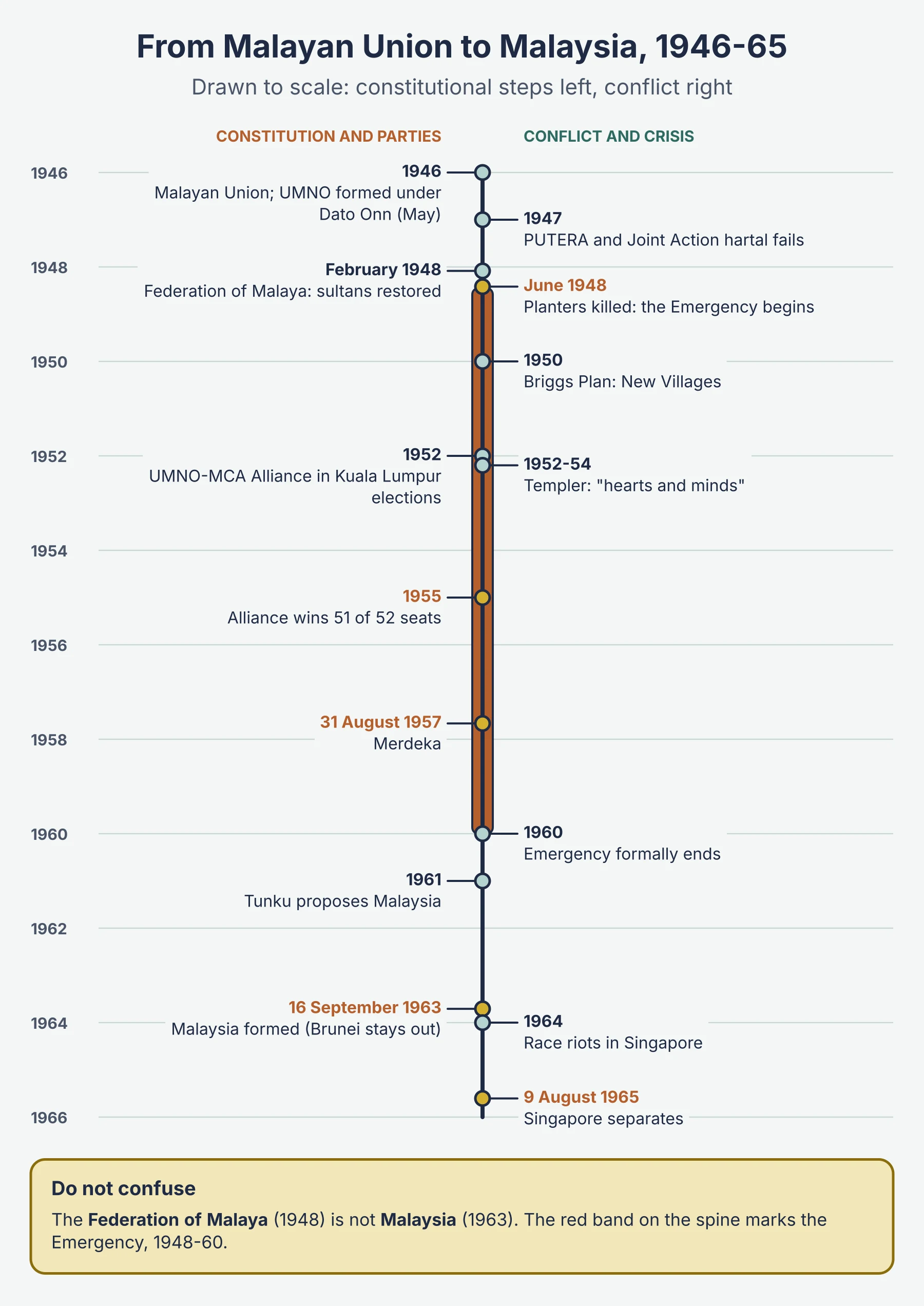
Malayan Union (1946). Britain’s plan unified the peninsula, reduced the sultans’ powers and offered citizenship to non-Malays on easy terms. Malay protest, led by Dato Onn bin Jaafar, produced UMNO (May 1946), and Britain replaced the Union with the Federation of Malaya (February 1948), restoring the sultans and tightening citizenship. Non-Malays opposed it through the Pan-Malayan Council of Joint Action and its Malay left-wing partner PUTERA, whose hartal (general strike) of 1947 failed to change the outcome.
The Emergency (1948-60). The communist leader Lai Teck had secretly worked for the British and the Japanese; after he vanished with party funds in 1947, Chin Peng led the MCP into revolt. The killing of three European planters in June 1948 led to the Emergency. The Briggs Plan (1950) resettled more than half a million Chinese squatters into guarded New Villages, cutting guerrillas off from food and information. General Sir Gerald Templer (1952-54) combined harsh military pressure with “hearts and minds”, citizenship for more Chinese and steps towards self-government. The communists were driven into the jungle, and the Emergency ended formally in 1960.
Parties and the 1955 election. The Malayan Chinese Association (1949) and the Malayan Indian Congress (1946) represented communities. When Onn failed to open UMNO to non-Malays and left, Tunku Abdul Rahman led UMNO into an Alliance with the MCA (from the 1952 Kuala Lumpur elections), later joined by the MIC. In 1955 the Alliance won 51 of 52 seats, proving that inter-communal co-operation could deliver stable government – Britain’s condition for independence.
Merdeka. The Reid Commission drafted a constitution: a federal monarchy with an elected king, Islam as the religion of the federation, Malay as national language, a special position for Malays, and citizenship by birth for non-Malays born after independence. Malaya became independent on 31 August 1957.
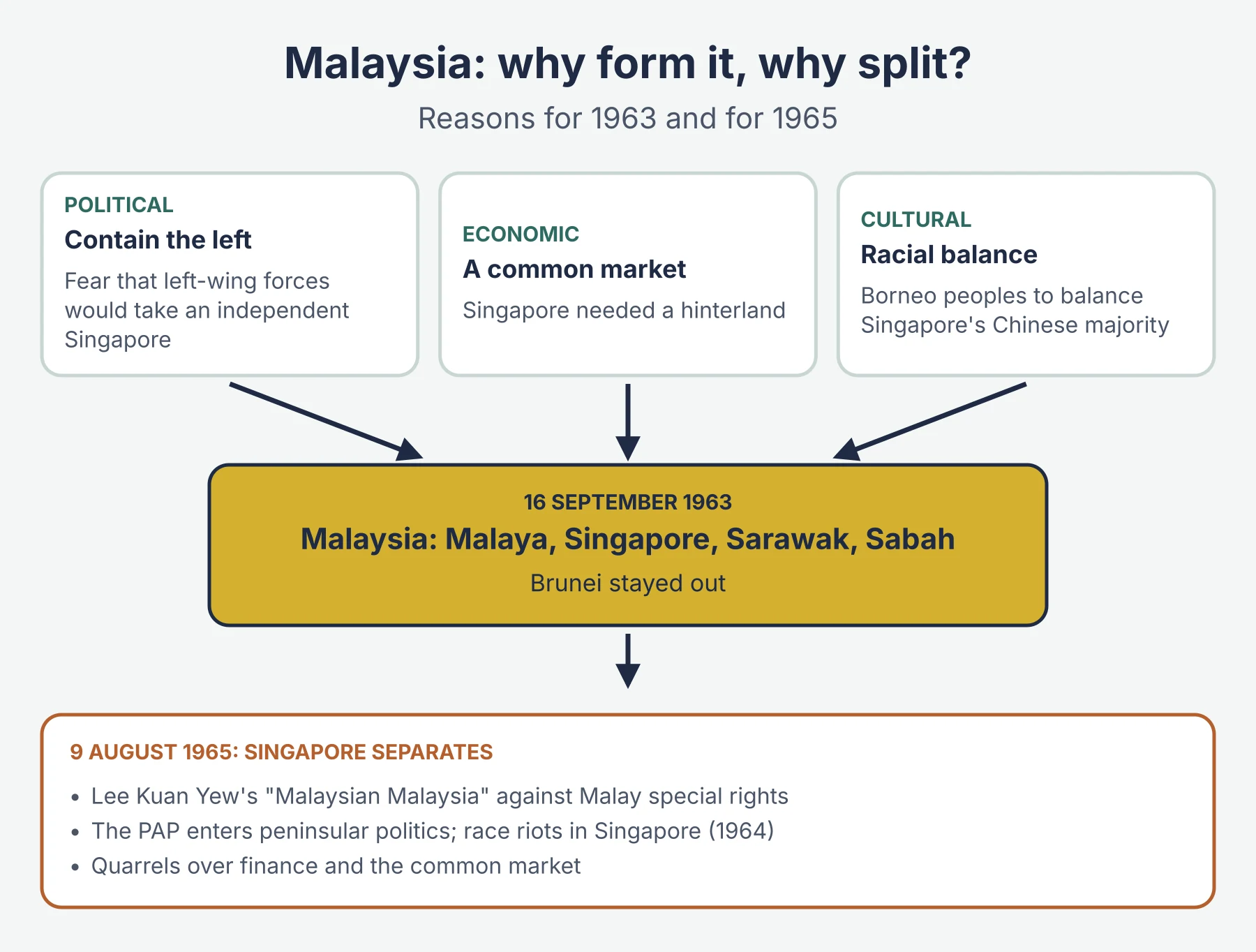
Malaysia (1963). In 1961 the Tunku proposed a federation with Singapore, Sarawak, North Borneo (Sabah) and Brunei. Political reasons: fear that left-wing forces would take over an independent Singapore. Economic reasons: a common market and Singapore’s need for a hinterland. Cultural reasons: the Borneo peoples would balance Singapore’s Chinese majority. Brunei stayed out. Malaysia was formed on 16 September 1963. Separation came on 9 August 1965 after disputes over Lee Kuan Yew’s call for a “Malaysian Malaysia” against Malay special rights, the PAP’s entry into peninsular politics, race riots in Singapore in 1964, and quarrels over finance and the common market.
9.3 Indonesian nationalism to 1945
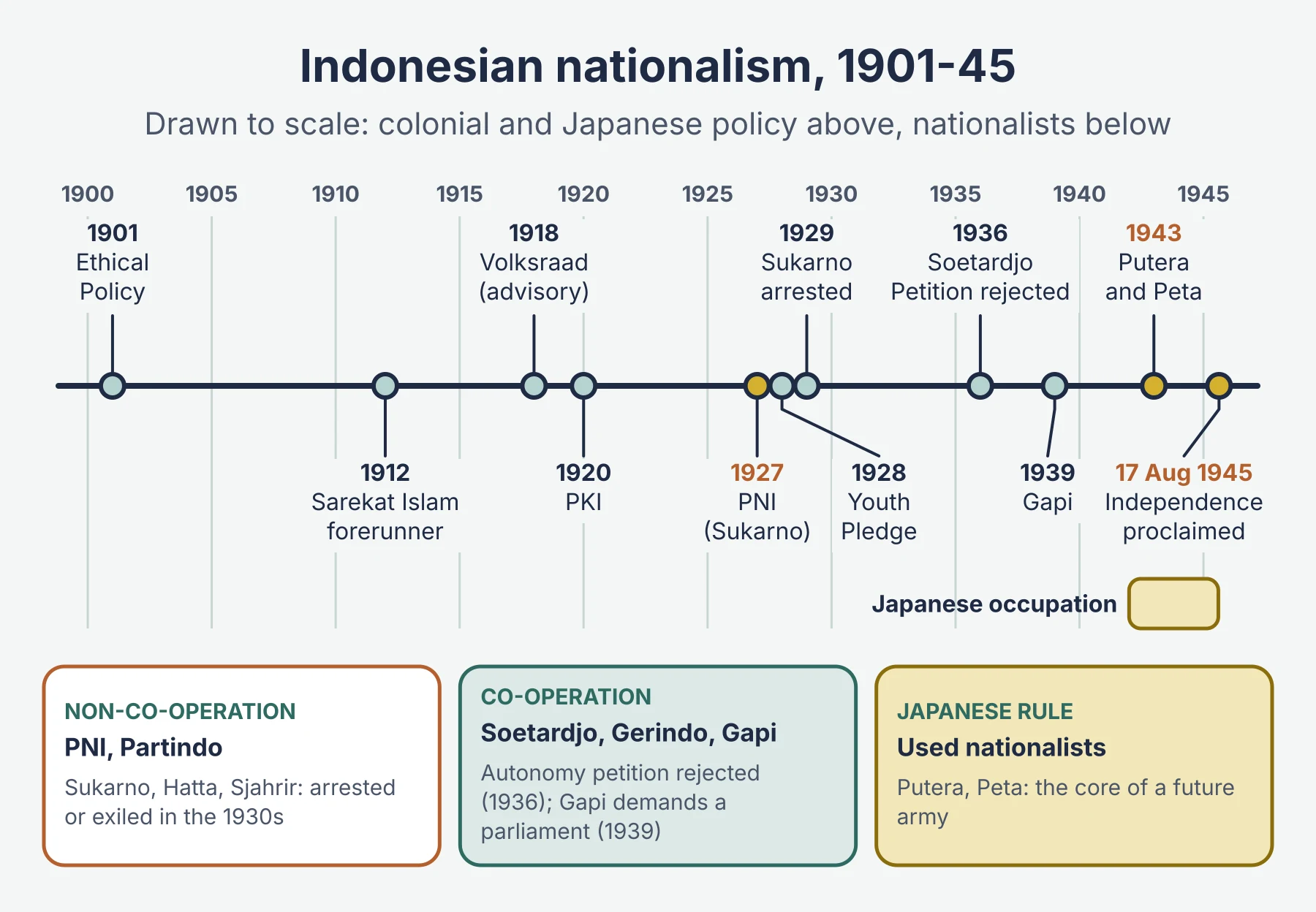
Colonial rule. The Dutch Ethical Policy (from 1901) promised education, irrigation and welfare; it produced a small Western-educated elite who learned European ideas of nationhood. The Volksraad (1918) was only advisory. Chinese merchants dominated retail trade and credit, provoking Muslim traders to form the forerunner of Sarekat Islam (1912). A common language, Malay, became Bahasa Indonesia, proclaimed in the Youth Pledge of 1928, and Islam gave a shared identity across islands.
Parties. The PKI (1920) led revolts in 1926-27 that the Dutch crushed. The PNI (1927), led by Sukarno, demanded independence through non-co-operation; Sukarno was arrested in 1929. After the PNI dissolved, Sartono formed Partindo (1931), while Hatta and Sjahrir formed a cadre-training Pendidikan Nasional Indonesia; leaders were exiled in the 1930s. Moderates tried co-operation: the Soetardjo Petition (1936) asked for autonomy within ten years and was rejected; Gapi (1939) united parties to demand an Indonesian parliament. Gerindo (1937) took a co-operative, anti-fascist line.
The Japanese occupation (1942-45) brought Indonesia into the Greater East Asia Co-Prosperity Sphere: forced deliveries of rice, labour conscription (romusha), hardship and famine. Japan replaced Dutch officials with Indonesians and banned Dutch. After the failed Triple A movement (1942), Japan used nationalists: Putera (1943) under Sukarno and Hatta mobilised support, and Peta (1943) trained Indonesian volunteers, creating the core of a future army. Underground resistance, associated with Sjahrir, kept independent links, and Peta troops revolted at Blitar in February 1945.
9.4 Independence and its challenges
Towards independence. As defeat approached, Japan promised independence (September 1944) and in 1945 set up committees to prepare it. On 1 June 1945 Sukarno set out the five principles, Pancasila: belief in God, humanitarianism, national unity, democracy and social justice. Radical student youth (pemuda) pressed Sukarno and Hatta to act, and on 17 August 1945 they proclaimed independence.
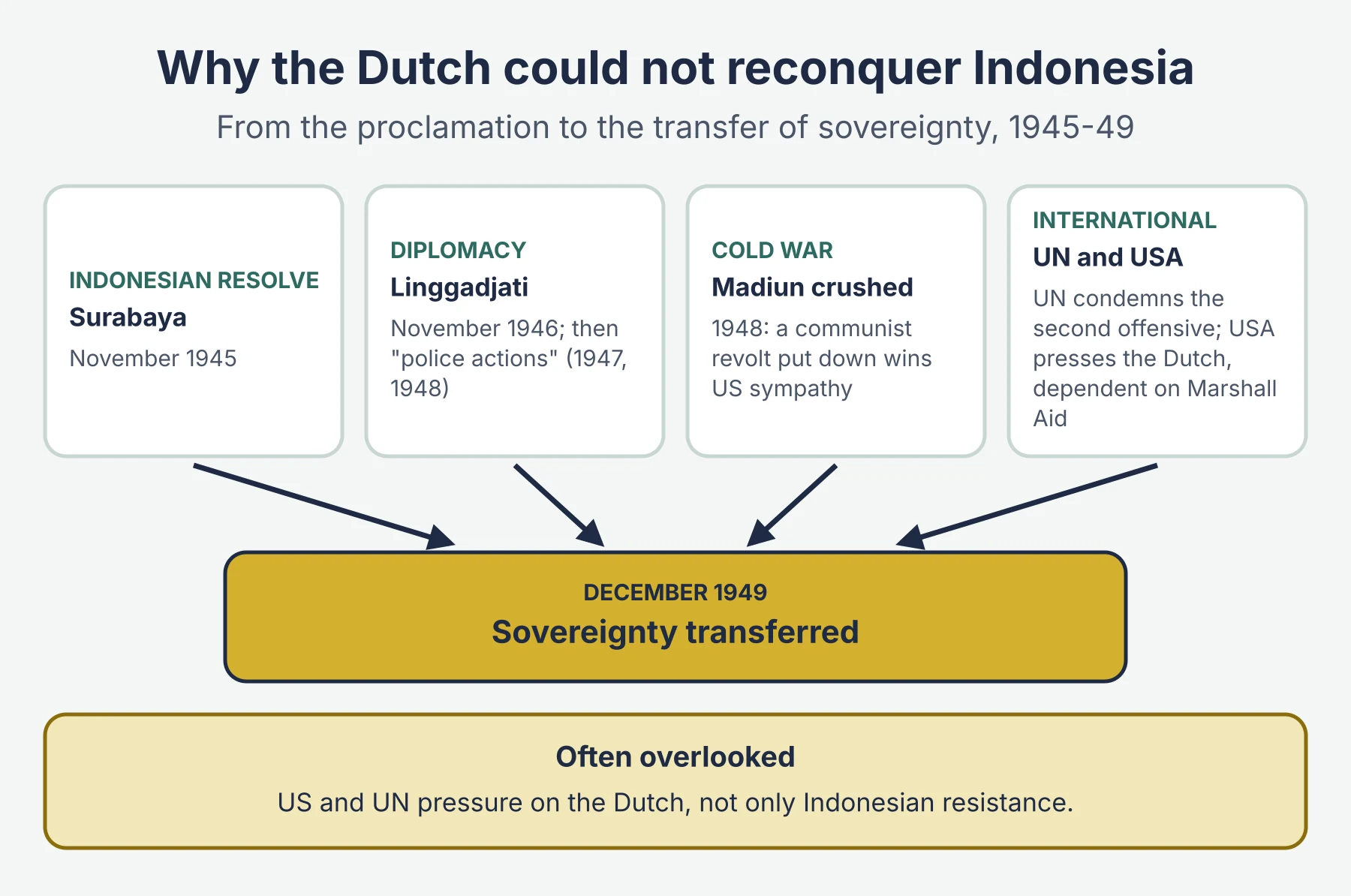
The revolution. British-led forces arrived to accept the Japanese surrender; fighting in Surabaya (November 1945) showed Indonesian resolve. A 1946 attempt by radical opponents of negotiation to force the cabinet out failed. The Linggadjati Agreement (November 1946) recognised Republican authority in Java, Sumatra and Madura within a future federal state, but collapsed amid disagreement over its meaning, and the Dutch launched “police actions” in 1947 and 1948. The Republic’s crushing of a communist revolt at Madiun (1948) won American sympathy; the UN condemned the second Dutch offensive, and the USA pressed the Netherlands, which depended on Marshall Aid. Sovereignty was transferred in December 1949.
The 1950s. Parliamentary democracy produced short-lived cabinets; the 1955 election split votes between nationalist, Muslim and communist parties, and the Constituent Assembly deadlocked over the role of Islam. Regional rebellions in Sumatra and Sulawesi (1957-58), inflation, falling export prices and the nationalisation of Dutch businesses strained the state; ethnic tension with the Chinese grew. Sukarno introduced Guided Democracy and restored the 1945 constitution by decree in 1959.
Transition to the New Order. Konfrontasi with Malaysia (from 1963) drained the economy. The 30 September Movement (1965) killed six generals; General Suharto crushed it and blamed the PKI, and hundreds of thousands of alleged communists were killed in 1965-66. Students in KAMI demonstrated against Sukarno, and the Order of Eleventh March (Supersemar, 1966) transferred authority to Suharto, who became acting president in 1967.
Worked example: an annotated plan
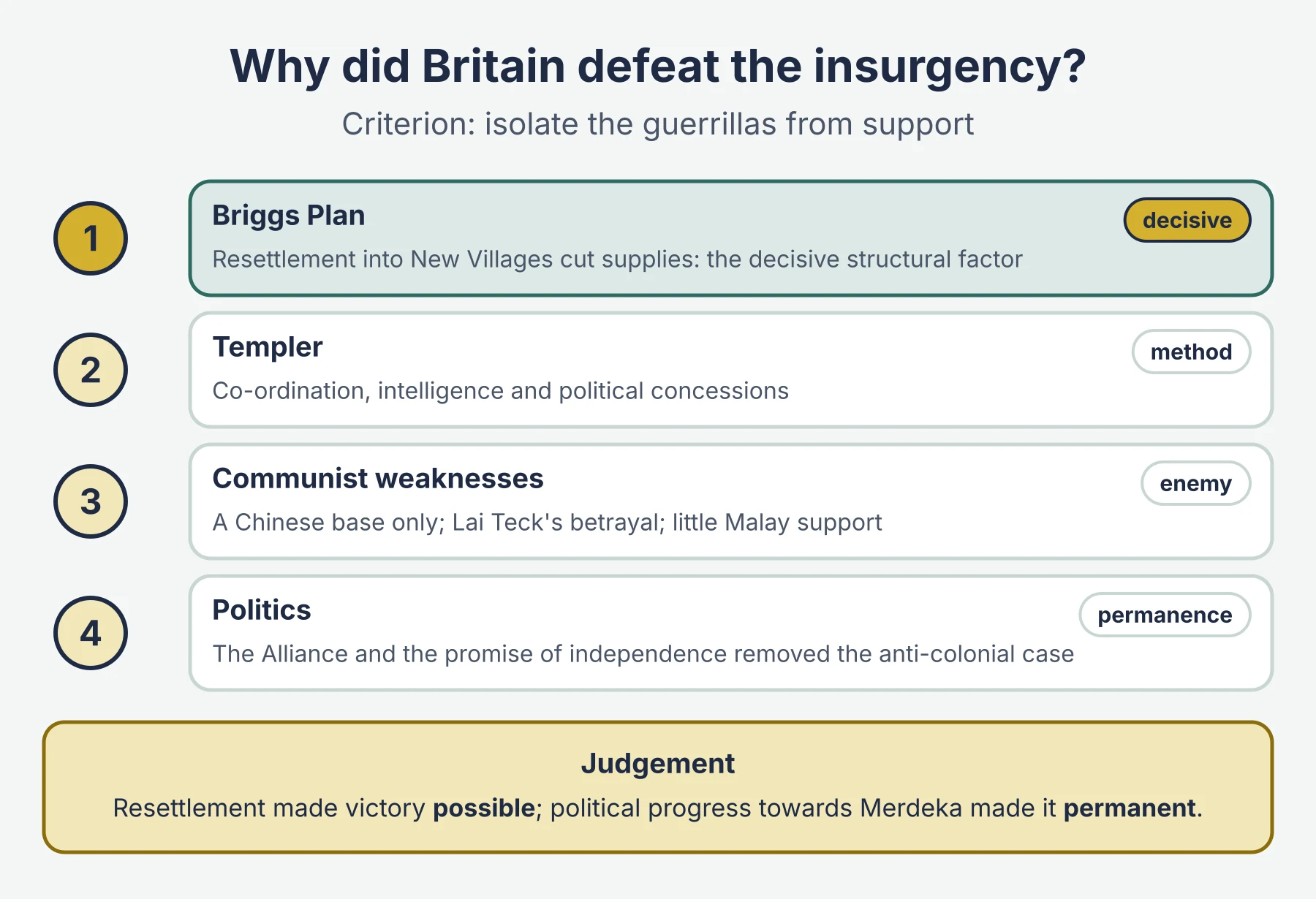
Assess the reasons why Britain was able to defeat the communist insurgency in Malaya. [30]
- Criterion: “defeat” means isolating the guerrillas from support.
- Briggs Plan: resettlement cut supplies – the decisive structural factor.
- Templer: coordination, intelligence and political concessions.
- Communist weaknesses: a Chinese base only, Lai Teck’s betrayal, little Malay support.
- Politics: the Alliance and the promise of independence removed the anti-colonial case.
- Judgement: resettlement made victory possible; political progress towards Merdeka made it permanent.
Common mistakes
- Treating Malayan nationalism before 1945 as a single movement.
- Confusing the Federation of Malaya (1948) with Malaysia (1963).
- Overlooking US and UN pressure on the Dutch.
Exam technique
For assess questions, rank factors and show how they interacted – for example, how Japanese rule both encouraged and controlled nationalism.
Official syllabus
Cambridge International AS & A Level History (9489) syllabus for 2027, 2028 and 2029 – cambridgeinternational.org (Paper 4, International option, topic 9).
Related resources
-
Practice questions
Cambridge A Level World History (9489): The route to independence: Malaysia and Indonesia, c.1909-67 – Practice Questions
Twelve original practice questions on Cambridge 9489 Malaysia and Indonesia, c.1909-67: recall items and Paper 4-style essays with mark-scheme style answers.
World History · Cambridge · A Level
Try questions -
Revision notes
Cambridge A Level World History (9489): The route to independence: Malaysia and Indonesia, c.1909-67 – Revision Notes
Revision notes for Cambridge 9489 Paper 4, Malaysia and Indonesia c.1909-67: key terms, two timelines, the four key questions condensed, traps and a self-test.
World History · Cambridge · A Level
Revise topic -
Study guides
Cambridge A Level World History (9489): The Soviet Empire in Eastern Europe, 1953-91
Study guide to Cambridge 9489 Paper 4 topic 7, the Soviet Empire 1953-91: the satellite states to 1968, Brezhnev's stagnation, Gorbachev and the collapse.
World History · Cambridge · A Level
Read guide
Get free revision emails (optional)
Occasional emails with practice questions, worked explanations and links to free resources for the qualification and subjects you choose. No spam, and you can unsubscribe from any email. The free tools on this site never need an email.