
Revision Notes
Cambridge A Level World History (9489): The route to independence: Malaysia and Indonesia, c.1909-67 – Revision Notes
Revision notes for Cambridge 9489 Paper 4, Malaysia and Indonesia c.1909-67: key terms, two timelines, the four key questions condensed, traps and a self-test.
- Subject
- World History
- Level
- A LEVEL
- Topic
- Topic 7: International option: International history, 1909-94
- Author
- Marlbridge Academic Team
- Updated
- Reviewed by
- Azam Siddique (what this means)
Aligned to Cambridge A Level World History (9489), 2027-2029. Official specification .
Syllabus page (what it covers and how it is assessed): Cambridge A Level World History.
Syllabus points this page covers
9489 (A Level)
- 9 The route to independence: Malaysia and Indonesia, c.1909–67
Found an error? Report a correction.
Need help with this topic? Request a free trial class for A Level World History (9489).
These notes condense The route to independence: Malaysia and Indonesia, c.1909-67, the third topic of the Paper 4 International option in Cambridge 9489. For explanation and an annotated plan see the Malaysia and Indonesia study guide; for essays and short questions see the Malaysia and Indonesia practice questions.
Syllabus coverage
- 9.1 How widespread was the growth of nationalism and hostility to colonial rule in Malaya in the period up to 1945?
- 9.2 What factors led to the formation of Malaysia?
- 9.3 In what ways, and for what reasons, did the nationalist movement develop in Indonesia up to 1945?
- 9.4 What factors led to the formation of Indonesia and what challenges did it face up to the mid-1960s?
Key terms
| Term | Meaning |
|---|---|
| Unfederated Malay States | Kedah, Perlis, Kelantan, Terengganu (from Siam, 1909) and Johor (1914) |
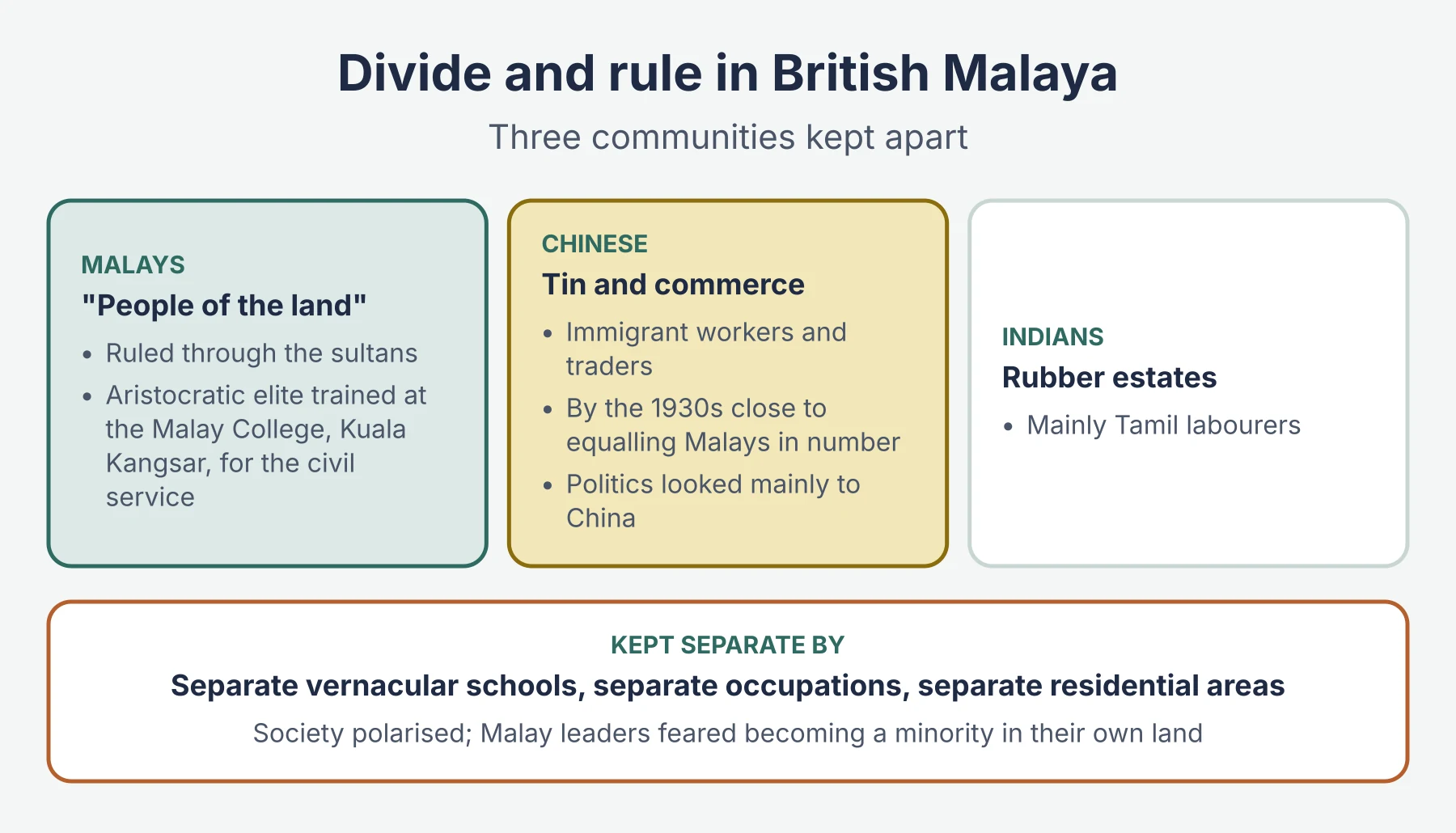
| Divide and rule | Governing communities separately so they did not unite against Britain |
| Kaum Muda | Reformist Islamic “Young Group” |
| KMM | Kesatuan Melayu Muda (1938), radical pan-Malay nationalists |
| MPAJA | Communist-led Malayan People’s Anti-Japanese Army |
| KRIS | 1945 body seeking Malayan independence within a greater Indonesia |
| Malayan Union | Britain’s 1946 unitary scheme, abandoned after Malay protest |
| UMNO | United Malays National Organisation (1946) |
| Briggs Plan | 1950 resettlement of Chinese squatters into New Villages |
| Alliance | UMNO-MCA (later MIC) coalition |
| Merdeka | “Independence”: Malaya, 31 August 1957 |
| Ethical Policy | Dutch welfare and education policy from 1901 |
| Volksraad | Advisory People’s Council in the Dutch East Indies (1918) |
| Putera / Peta | Japanese-sponsored mass organisation (1943) / Indonesian volunteer army (1943) |
| Pancasila | Sukarno’s five principles of the state (1945) |
| Konfrontasi | Indonesia’s confrontation with Malaysia, 1963-66 |
| Supersemar | Order of Eleventh March 1966 transferring authority to Suharto |
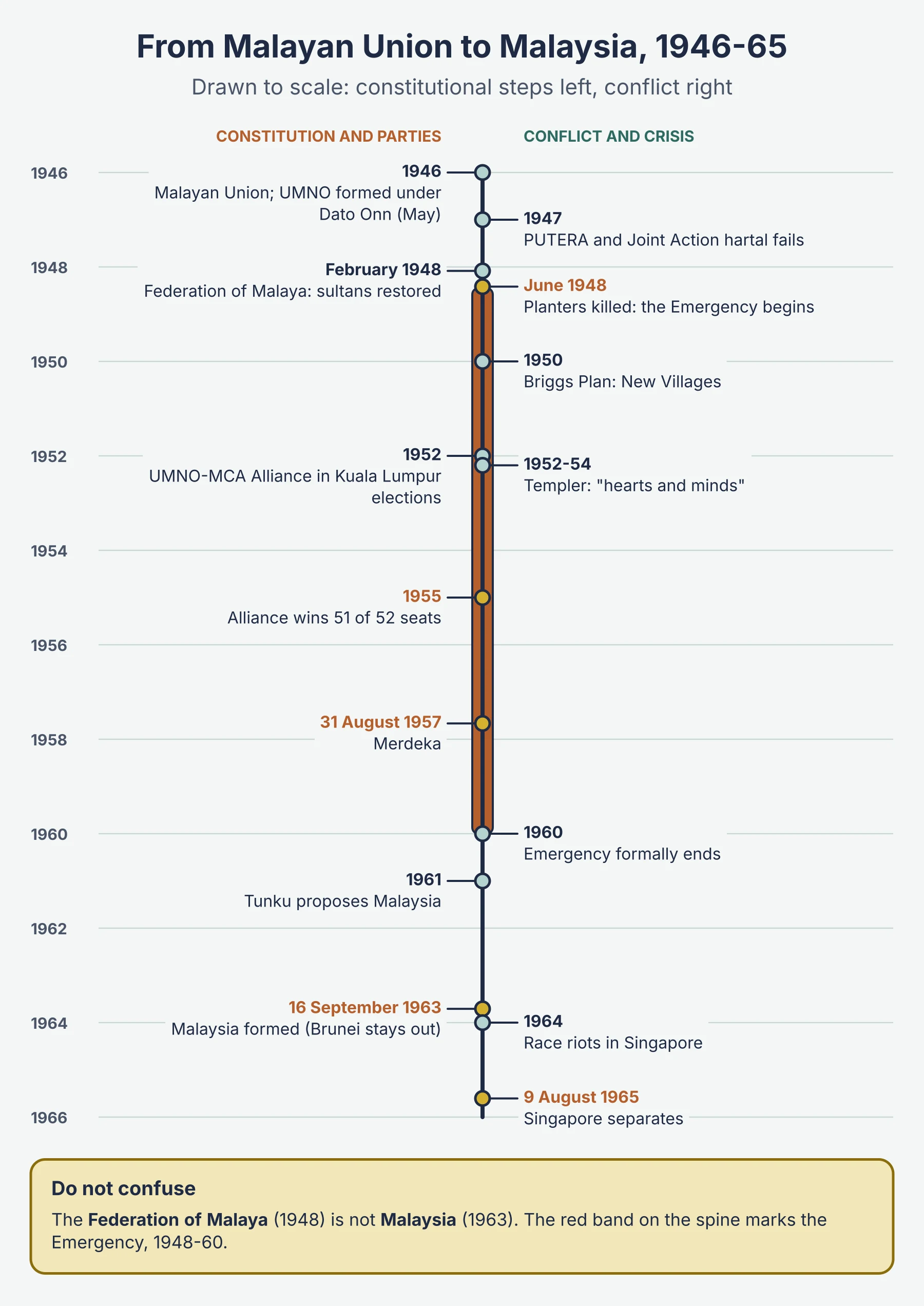
Malaya and Malaysia timeline
| Date | Event |
|---|---|
| 1909 | Bangkok Treaty |
| 1926 | Kesatuan Melayu Singapura |
| 1930-34 | Clementi’s decentralisation scheme |
| 1938 | KMM founded |
| 1942-45 | Japanese occupation |
| April 1946 | Malayan Union; UMNO founded in May |
| Feb 1948 | Federation of Malaya |
| June 1948 | Emergency declared |
| 1950 | Briggs Plan |
| 1952-54 | Templer as High Commissioner |
| July 1955 | Alliance wins 51 of 52 seats |
| 31 Aug 1957 | Merdeka |
| 1960 | Emergency ends |
| 1961 | Tunku proposes Malaysia |
| 16 Sept 1963 | Malaysia formed |
| 9 Aug 1965 | Singapore separates |
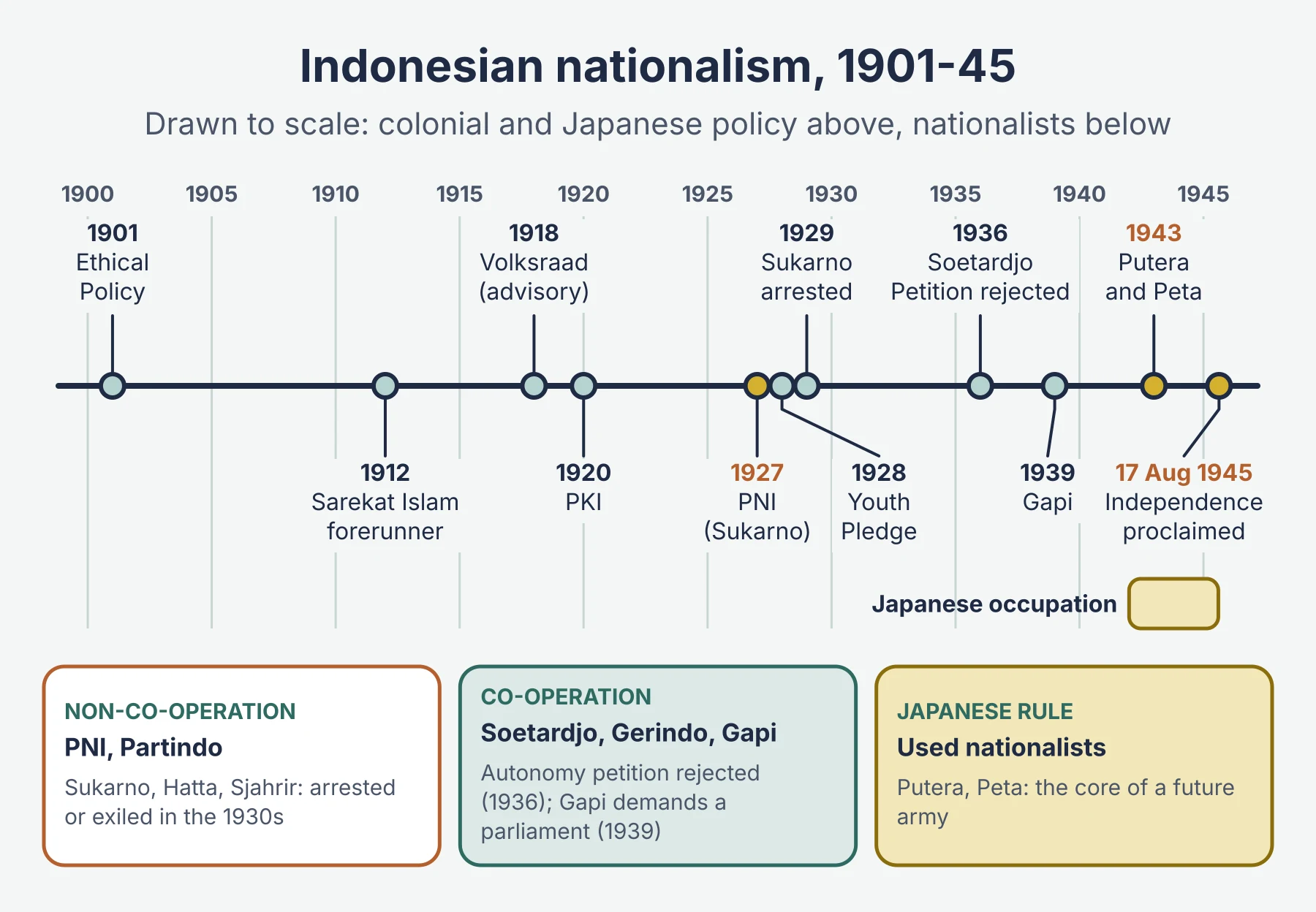
Indonesia timeline
| Date | Event |
|---|---|
| 1901 | Ethical Policy announced |
| 1912 | Sarekat Islam |
| 1918 | Volksraad opens |
| 1920 | PKI founded |
| 1926-27 | Communist revolts crushed |
| 1927 | PNI founded by Sukarno |
| 1928 | Youth Pledge |
| 1931 | Partindo; Hatta’s Pendidikan Nasional Indonesia |
| 1936 | Soetardjo Petition |
| 1939 | Gapi formed |
| March 1942 | Japanese occupation begins |
| 1943 | Putera and Peta |
| Sept 1944 | Japan promises independence |
| June 1945 | Pancasila speech |
| 17 Aug 1945 | Independence proclaimed |
| Nov 1945 | Battle of Surabaya |
| Nov 1946 | Linggadjati Agreement |
| 1947-48 | Dutch “police actions”; Madiun revolt crushed (1948) |
| Dec 1949 | Transfer of sovereignty |
| 1955 | General election |
| 1957-59 | Regional rebellions; Guided Democracy; 1945 constitution restored (1959) |
| 1963 | Konfrontasi begins |
| 1965 | 30 September Movement |
| March 1966 | Supersemar |
| 1967 | Suharto acting president |
9.1 Malayan nationalism – how widespread?
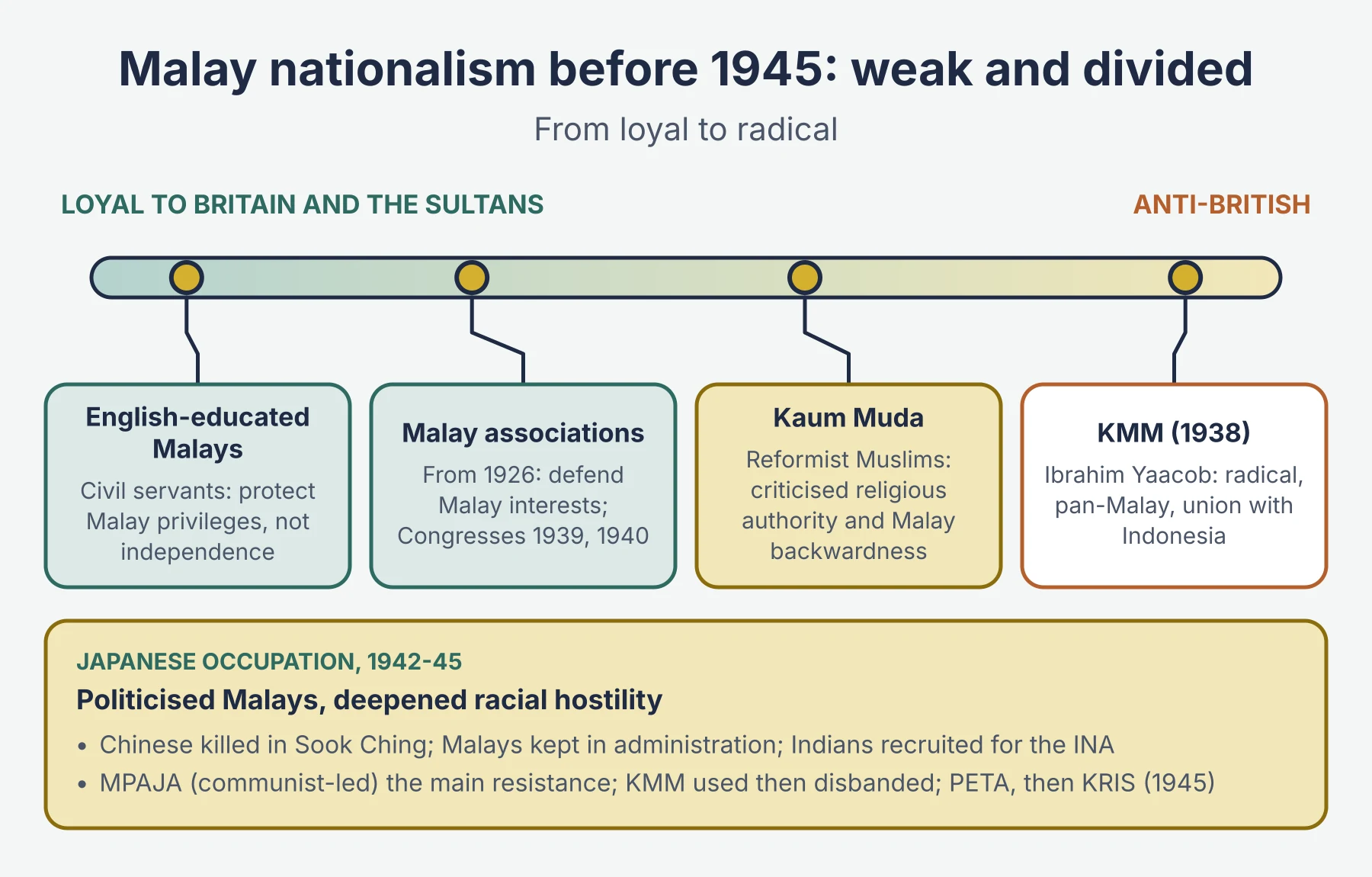
- Limited: divided communities; English-educated Malays loyal to Britain; Chinese politics focused on China.
- Growing: Kaum Muda, Malay associations and congresses, KMM radicalism.
- Japanese effect: British prestige destroyed; Malays politicised; MPAJA resistance; racial hostility deepened.
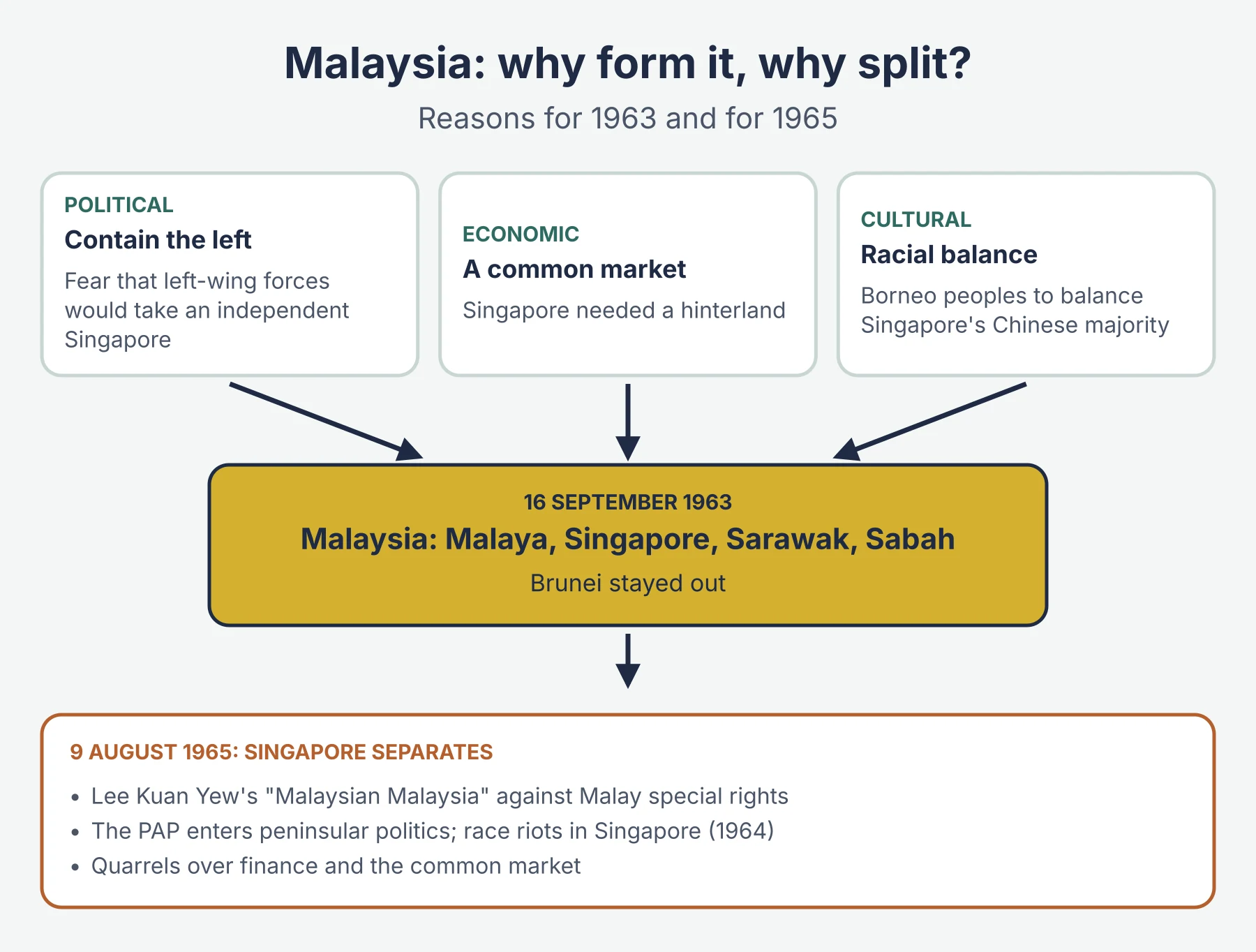
9.2 Malaysia – five factors
- Malay unity against the Malayan Union created UMNO.
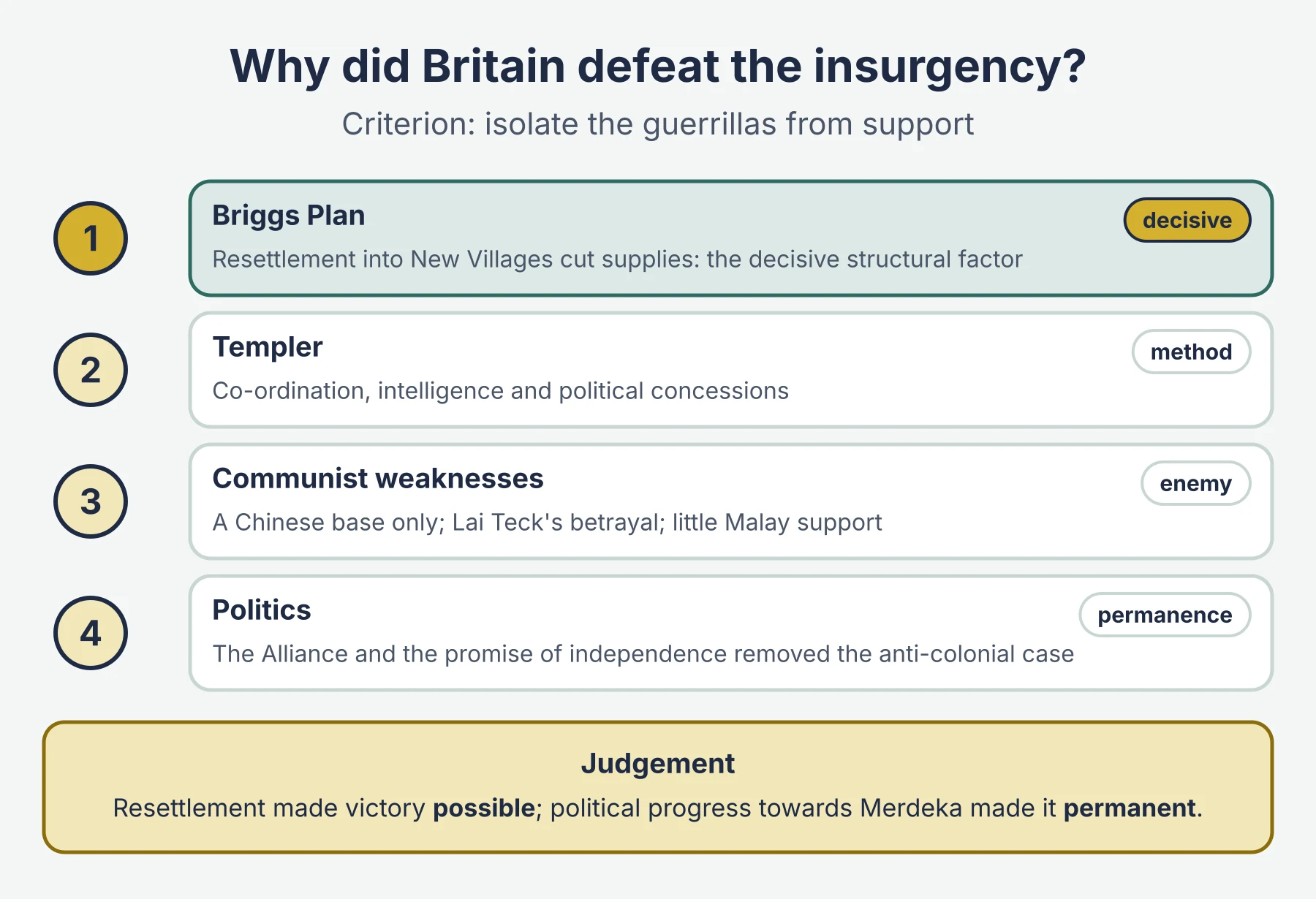
- Defeating communism in the Emergency removed the radical alternative.
- Inter-communal Alliance met Britain’s condition for independence.
- British willingness to decolonise on agreed terms (Reid Commission).
- Strategic, economic and racial calculations for the 1963 merger – and the disputes that ended it.
9.3 Indonesian nationalism – reasons and forms
- Reasons: Western education under the Ethical Policy; resentment of Chinese commercial dominance; a shared language and Islam; Dutch refusal of reform.
- Forms: religious (Sarekat Islam), communist (PKI), secular nationalist (PNI, Partindo), co-operative (Gerindo, Gapi).
- Japanese effect: mobilisation through Putera and Peta; leaders gained a mass platform; hardship deepened anti-colonial feeling.
9.4 Independence and challenges
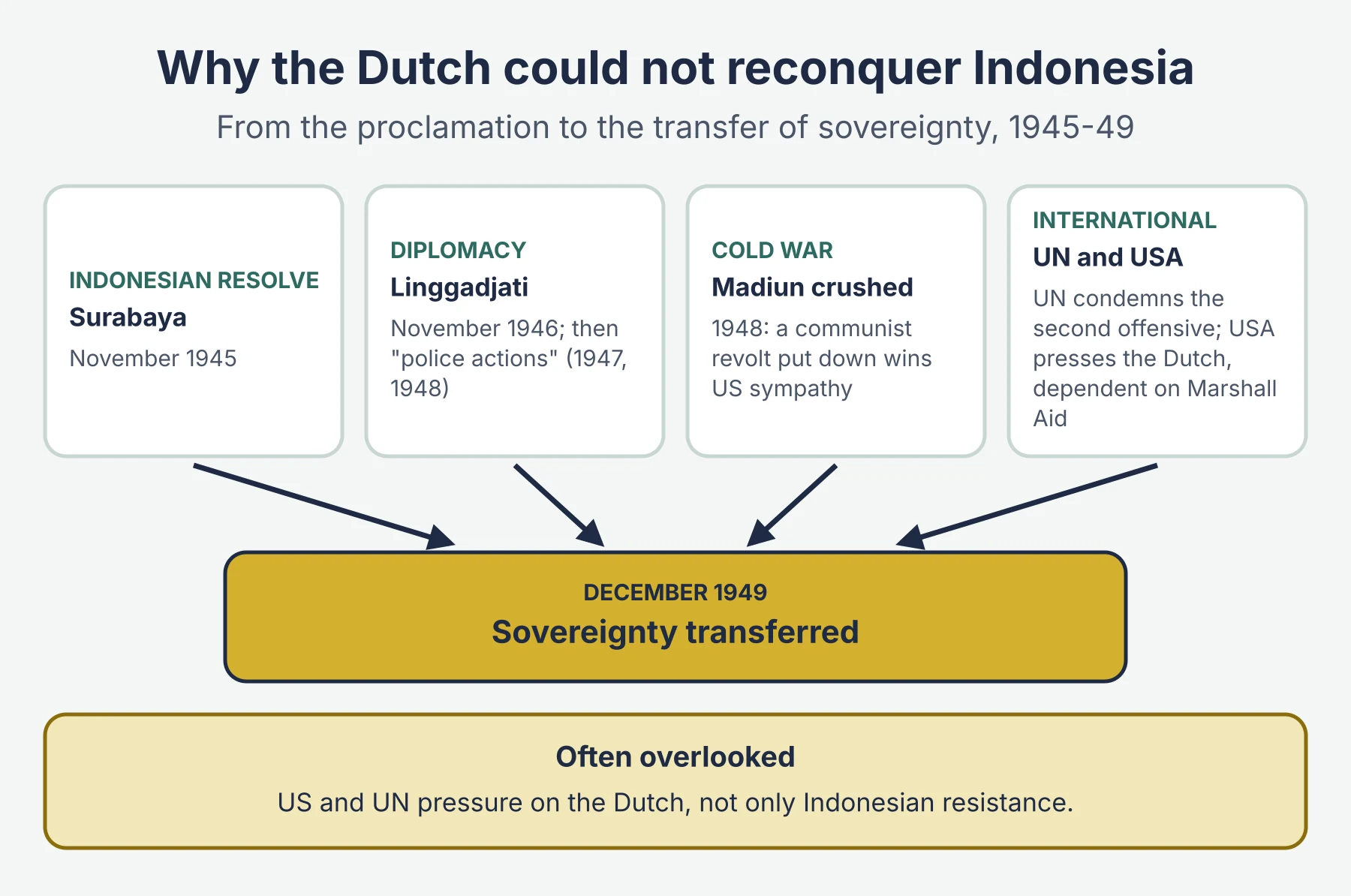
- Dutch failure: Republican resistance; Linggadjati’s collapse; Madiun reassuring the USA; UN and US pressure.
- 1950s challenges: unstable cabinets, constitutional deadlock, regional revolts, economic crisis, ethnic tension.
- New Order: Konfrontasi, the 30 September Movement, the anti-communist killings, KAMI, Supersemar.
Exam traps
- Federation of Malaya (1948) is not Malaysia (1963).
- Lai Teck betrayed the MCP; Chin Peng led the revolt.
- Templer came after Briggs; credit each correctly.
- Linggadjati failed over interpretation and Dutch force, not Indonesian refusal alone.
- Suharto’s rise was gradual, 1965-67.
Self-test
- Which states did Siam transfer in 1909? Kedah, Perlis, Kelantan and Terengganu.
- Who led the KMM? Ibrahim Yaacob.
- What did the Malayan Union propose that angered Malays? Reduced powers for the sultans and easy citizenship for non-Malays.
- Who founded UMNO? Dato Onn bin Jaafar.
- What was the main aim of the Briggs Plan? To cut guerrillas off from supplies by resettling Chinese squatters.
- Which parties formed the Alliance? UMNO, the MCA and later the MIC.
- Give one reason for Singapore’s separation in 1965. Disputes over Lee Kuan Yew’s “Malaysian Malaysia” against Malay special rights.
- What did the Soetardjo Petition ask for? Indonesian autonomy within the Dutch kingdom within ten years.
- Who led the PNI from 1927? Sukarno.
- What was Peta? A Japanese-trained Indonesian volunteer army.
- Which revolt in 1948 helped win US sympathy for the Republic? The communist revolt at Madiun, crushed by the Republic.
- What was Supersemar? Sukarno’s order of 11 March 1966 transferring authority to Suharto.
Official syllabus
Cambridge International AS & A Level History (9489) syllabus for 2027, 2028 and 2029 – cambridgeinternational.org (Paper 4, International option, topic 9).
Related resources
-
Study guides
Cambridge A Level World History (9489): The Soviet Empire in Eastern Europe, 1953-91
Study guide to Cambridge 9489 Paper 4 topic 7, the Soviet Empire 1953-91: the satellite states to 1968, Brezhnev's stagnation, Gorbachev and the collapse.
World History · Cambridge · A Level
Read guide -
Practice questions
Cambridge A Level World History (9489): The Soviet Empire in Eastern Europe, 1953-91 – Practice Questions
Twelve original practice questions on Cambridge 9489 Soviet Empire in Eastern Europe 1953-91: recall items and Paper 4-style essays with mark-scheme answers.
World History · Cambridge · A Level
Try questions -
Revision notes
Cambridge A Level World History (9489): The Soviet Empire in Eastern Europe, 1953-91 – Revision Notes
Revision notes for Cambridge 9489 Paper 4, the Soviet Empire 1953-91: key terms, a timeline, the four key questions condensed, exam traps and a self-test.
World History · Cambridge · A Level
Revise topic
Get free revision emails (optional)
Occasional emails with practice questions, worked explanations and links to free resources for the qualification and subjects you choose. No spam, and you can unsubscribe from any email. The free tools on this site never need an email.