
Study Guides
Cambridge A Level World History (9489): Truman, Eisenhower and post-war USA, 1945-61
Study guide to Cambridge 9489 Paper 4 topic 4, the USA 1945-61: Truman's Fair Deal and McCarthyism, Eisenhower's presidency, 1950s society and containment.
- Subject
- World History
- Level
- A LEVEL
- Topic
- Topic 6: American option: The USA, 1945-93
- Author
- Marlbridge Academic Team
- Updated
- Reviewed by
- Azam Siddique (what this means)
Aligned to Cambridge A Level World History (9489), 2027-2029. Official specification .
Syllabus page (what it covers and how it is assessed): Cambridge A Level World History.
Syllabus points this page covers
9489 (A Level)
- 4 Truman, Eisenhower and post-war USA, 1945–61
Found an error? Report a correction.
Need help with this topic? Request a free trial class for A Level World History (9489).
Truman, Eisenhower and post-war USA, 1945-61 is the first topic of the American option on Cambridge 9489 Paper 4. Its key questions ask how well Truman dealt with internal issues (4.1), how effective Eisenhower was as President (4.2), how far 1945-61 brought economic and social change (4.3) and how different the two presidents’ foreign policies were (4.4). Paper 4 sets two 30-mark essays from your option in 1 hour 45 minutes. This guide goes beyond the American option study guide; for recall use the 1945-61 revision notes and for essays the 1945-61 practice questions.
Syllabus coverage
- 4.1 The Fair Deal (welfare, economy, employment, infrastructure); McCarthyism and the Red Scare; the 1948 election; Truman and civil rights.
- 4.2 Eisenhower’s 1952 and 1956 victories; Modern Republicanism; civil rights and the federal response.
- 4.3 Consumerism and urbanisation; women; youth culture; prosperity and poverty.
- 4.4 Containment; Germany and Berlin; Korea; Eisenhower’s foreign policy – a change of direction?
4.1 Truman at home: ambition against obstruction
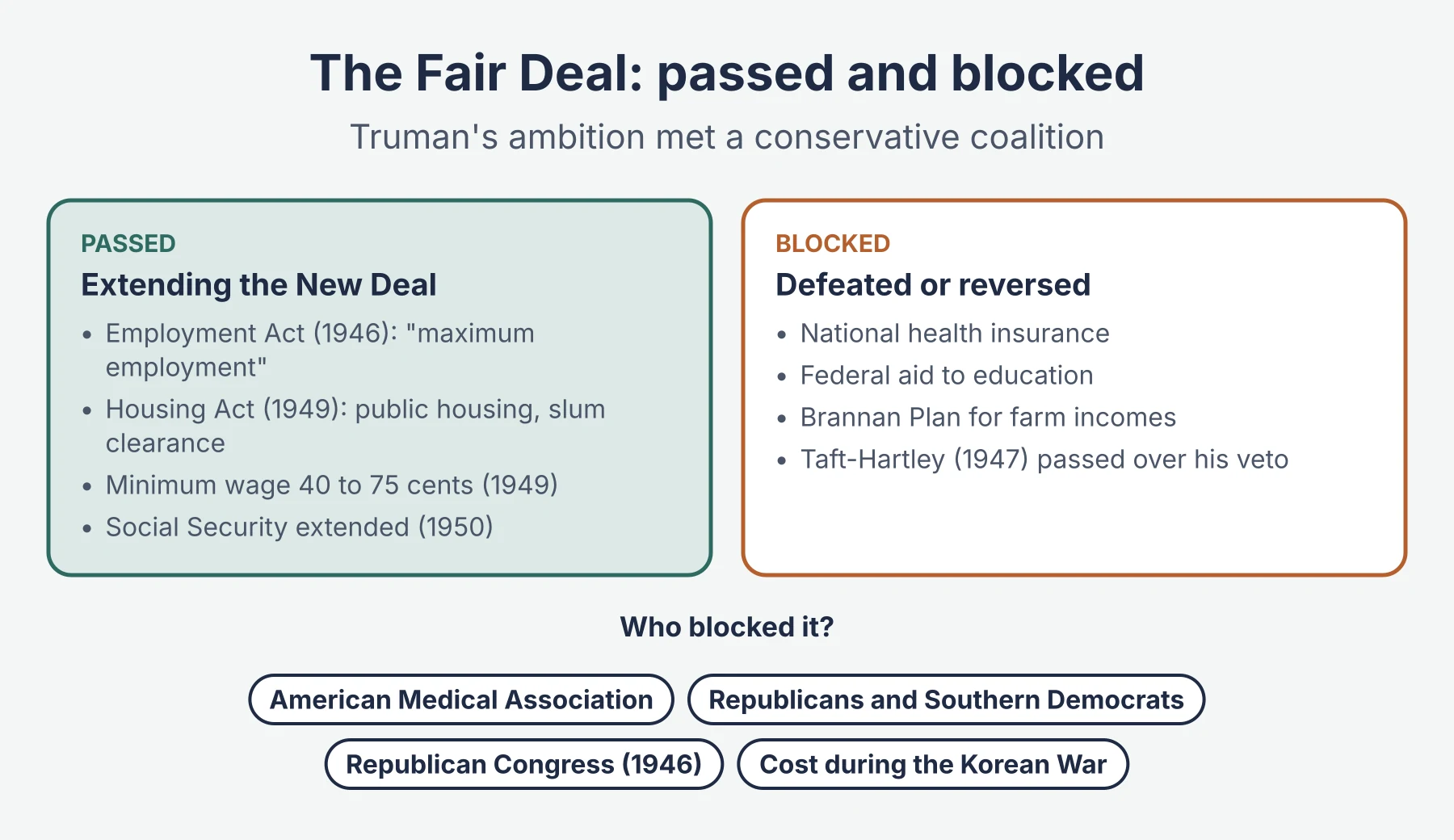
Reconversion. Truman inherited the presidency on 12 April 1945 and faced rapid demobilisation, inflation once price controls lapsed in 1946, and a wave of strikes. The Employment Act (1946) committed the federal government to promoting “maximum employment” and created the Council of Economic Advisers, but dropped the guarantee of full employment. Republicans won Congress in 1946 and passed the Taft-Hartley Act (1947) over Truman’s veto, restricting union power.
The Fair Deal. Named in January 1949, it extended the New Deal: the Housing Act (1949) funded public housing and slum clearance; the minimum wage rose from 40 to 75 cents an hour (1949); Social Security was extended in 1950 to millions more workers. Proposals for national health insurance, federal aid to education and the Brannan Plan for farm incomes failed, defeated by the American Medical Association, a conservative coalition of Republicans and Southern Democrats, and cost concerns during the Korean War.
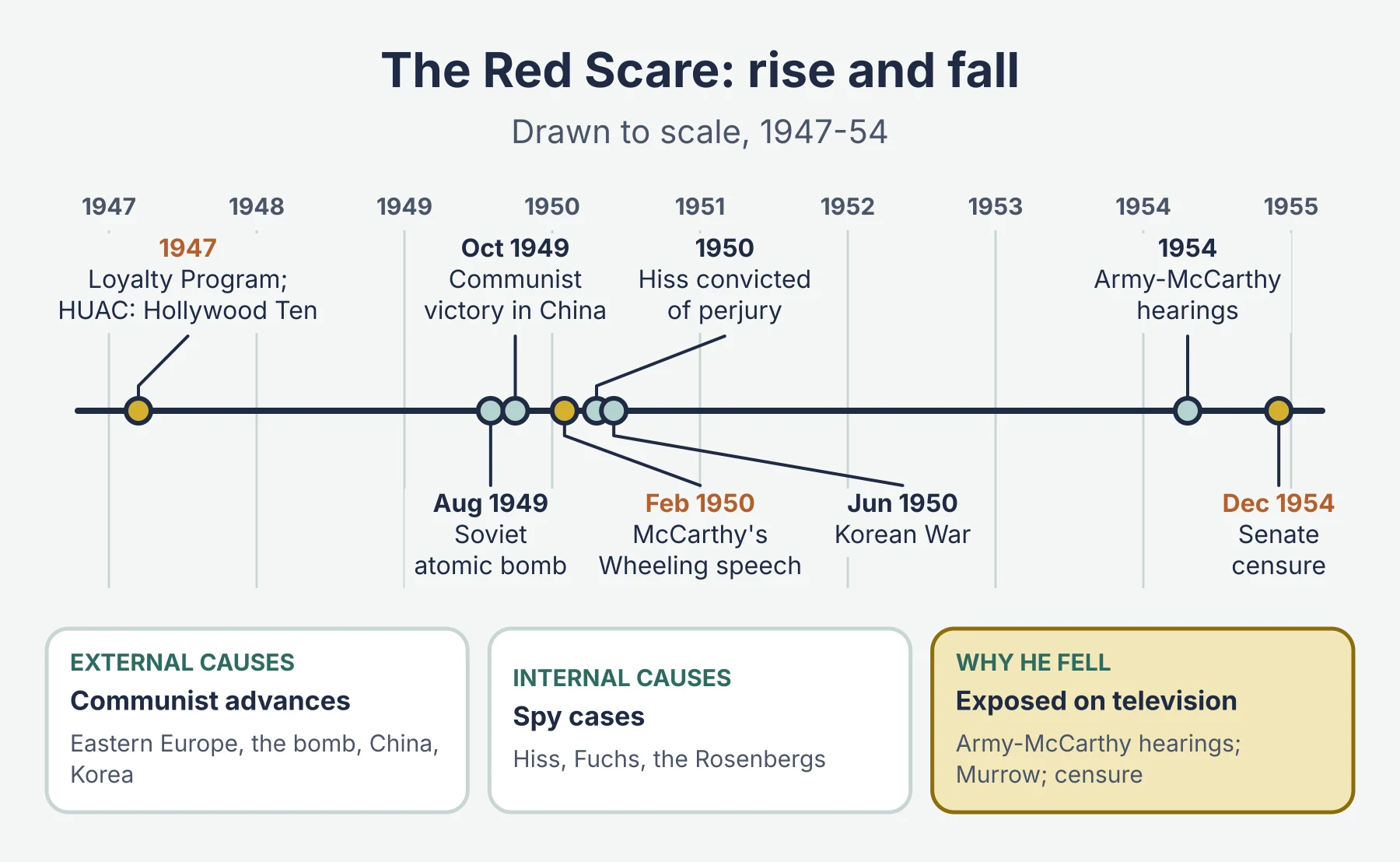
The Red Scare. Fear had external causes – Soviet control of Eastern Europe, the Soviet atomic bomb (August 1949), the communist victory in China (October 1949), the Korean War (June 1950) – and internal ones: spy cases such as Alger Hiss (convicted of perjury in 1950), Klaus Fuchs and the Rosenbergs. Truman’s own Loyalty Program (1947) screened federal employees. HUAC investigated Hollywood in 1947, producing the “Hollywood Ten”. Senator Joseph McCarthy’s Wheeling speech (February 1950) claimed to name communists in the State Department. Republicans tolerated him because attacking “softness” on communism damaged Democrats. His decline came when the televised Army-McCarthy hearings (1954) exposed his bullying, Edward R. Murrow criticised him on television, and the Senate censured him in December 1954.
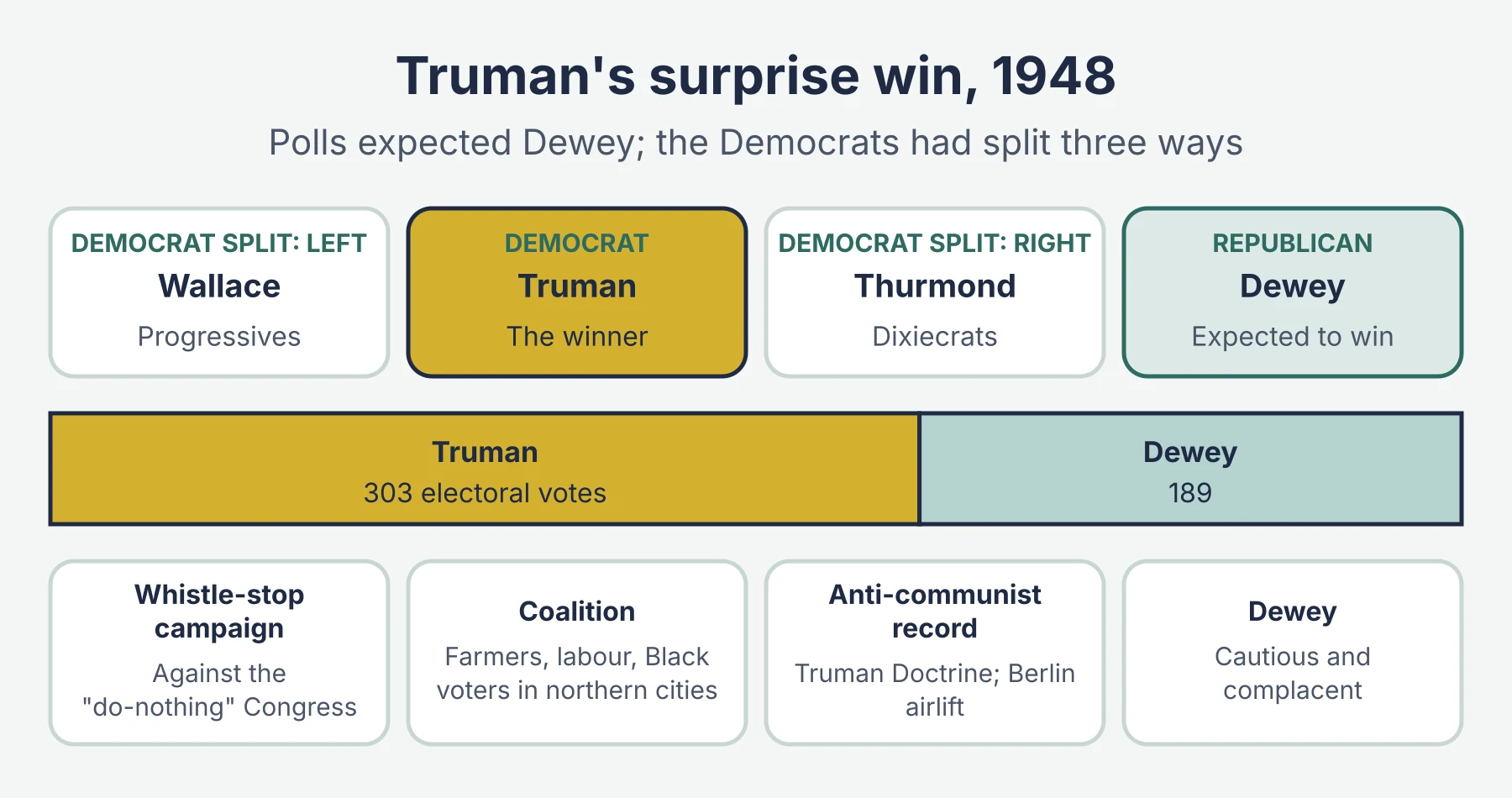
The 1948 election. Polls expected Thomas Dewey to win, and the Democrats split: Strom Thurmond’s Dixiecrats on the right and Henry Wallace’s Progressives on the left. Truman won 303 electoral votes to Dewey’s 189 because of a vigorous whistle-stop campaign attacking the “do-nothing” Republican Congress, support from farmers, labour and African American voters in northern cities, anti-communist credentials from the Truman Doctrine and Berlin airlift, and Dewey’s cautious, complacent campaign.
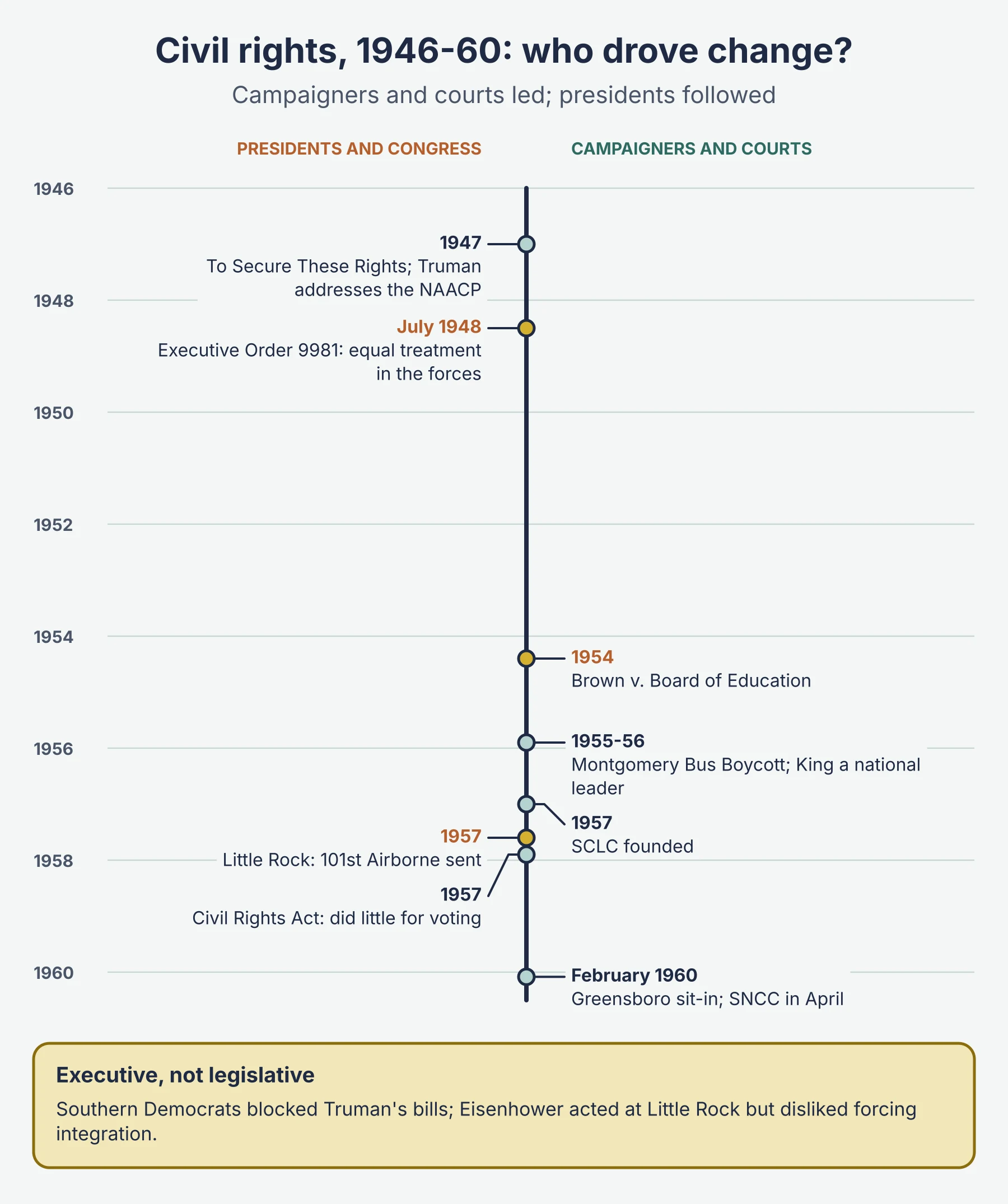
Civil rights. Violence against Black veterans in 1946 prompted the President’s Committee on Civil Rights, whose report To Secure These Rights (1947) proposed anti-lynching and anti-poll-tax laws. Truman addressed the NAACP in 1947 – the first president to do so – and in July 1948 issued Executive Order 9981, ordering equal treatment in the armed forces, and another on fair federal employment. Southern Democrats blocked legislation, so his achievements were executive rather than legislative.
4.2 Eisenhower: the “hidden-hand” president?
Elections. In 1952 Eisenhower’s war-hero appeal, slogans (“I like Ike”), television advertising, the promise “I shall go to Korea”, and attacks on Democratic “Korea, communism and corruption” beat Adlai Stevenson; Richard Nixon survived a funding scandal with the televised “Checkers” speech. In 1956 prosperity, peace in Korea, firmness and restraint over Suez and Hungary, and an increased share of African American votes produced a larger victory over Stevenson.
Modern Republicanism accepted the New Deal while restraining spending. Social Security was extended (1954) to about ten million more people; the minimum wage reached $1 (1955); the Department of Health, Education and Welfare was created (1953); the Federal-Aid Highway Act (1956) funded about 41,000 miles of interstates. Eisenhower balanced several budgets and, in his farewell address (January 1961), warned against the “military-industrial complex”.
Civil rights advanced mainly through campaigners and the courts. The NAACP’s legal strategy won Brown v. Board of Education (1954), though the 1955 ruling’s “all deliberate speed” allowed delay. Rosa Parks’s arrest began the Montgomery Bus Boycott (1955-56), which made Martin Luther King Jr a national leader and led to the SCLC (1957). Eisenhower privately disliked forcing integration, but at Little Rock (1957), when Governor Faubus defied a court order, he sent the 101st Airborne Division to protect nine Black students. The Civil Rights Act (1957) created a Civil Rights Division and Commission but did little to secure votes. The Greensboro sit-in (February 1960) led to SNCC, founded that April.
4.3 Affluence and its limits
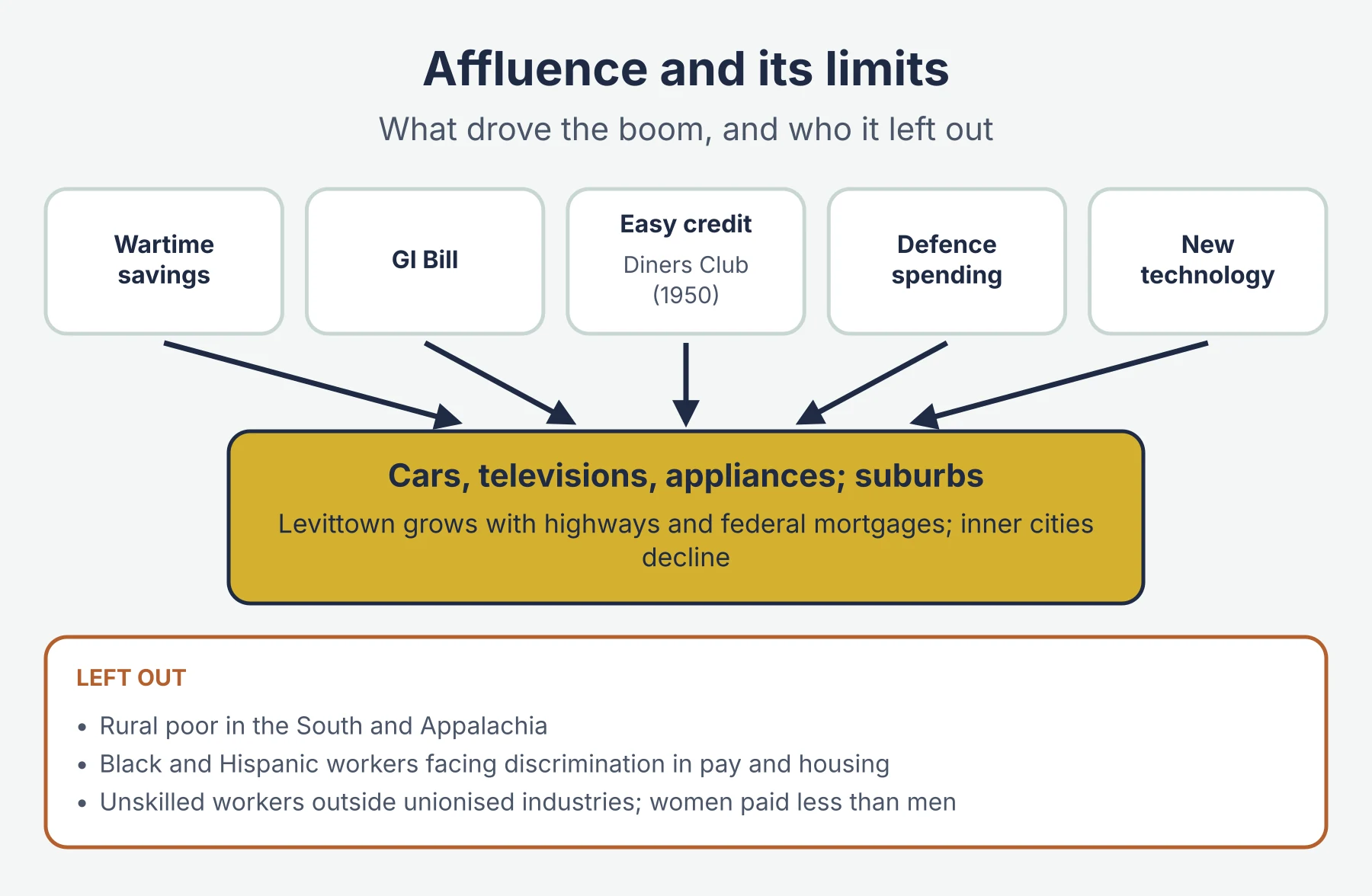
Consumerism. Pent-up wartime savings, the GI Bill, easier credit (the Diners Club charge card appeared in 1950, and instalment buying spread), defence spending and new technology drove demand for cars, televisions and household appliances. Suburbs such as Levittown grew with highway building and federal mortgage support, while inner cities declined.
Women. Many women left wartime jobs, and suburban culture and advertising celebrated domesticity and an early-marriage “baby boom”. Yet more women, especially married women, were in paid work by 1960 than in 1945, and more attended college – the tension that Betty Friedan’s writing exposed in the early 1960s.
Youth culture grew from affluence, a market aimed at teenagers, television and cinema (Rebel Without a Cause, 1955) and rock and roll (Elvis Presley, Chuck Berry), which crossed racial lines and alarmed many parents.
Poverty. Prosperity left out many: rural poor in the South and Appalachia, Black and Hispanic workers facing discrimination in pay and housing, unskilled workers outside unionised industries, and women paid less than men.
4.4 Foreign policy: continuity or change?
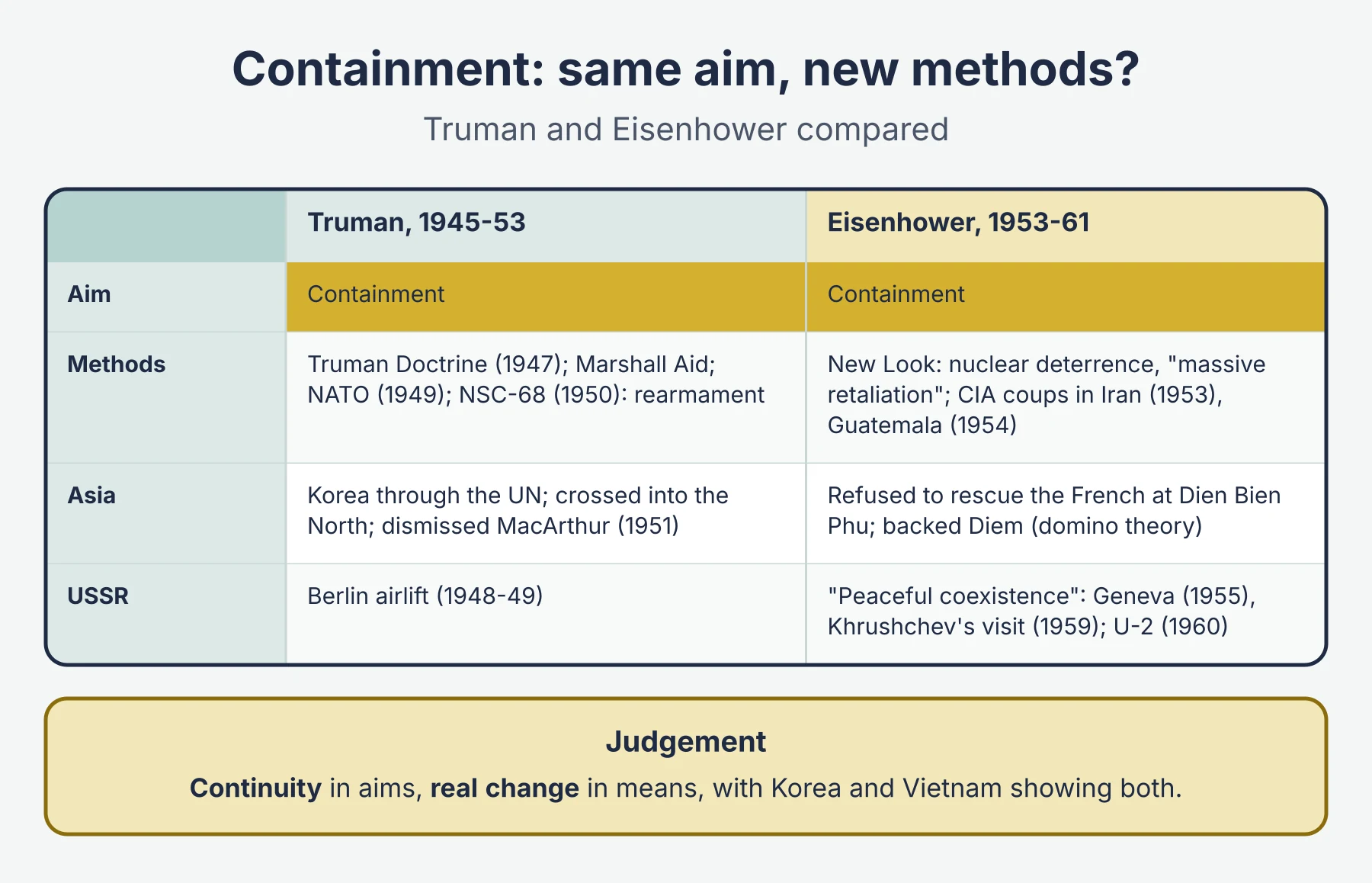
Truman moved from Potsdam (July 1945) to containment: the Truman Doctrine (March 1947) for Greece and Turkey; Marshall Aid for Western European recovery (1948-52); the Berlin airlift (1948-49); two German states (1949); NATO (1949); and NSC-68 (1950) calling for rearmament. In Korea, divided at the 38th parallel in 1945, he responded to the North’s invasion (June 1950) through the UN, then authorised crossing into the North after Inchon, provoking Chinese intervention, and dismissed MacArthur (April 1951). Korea globalised containment and tied the USA to Taiwan and Japan.
Eisenhower kept containment but changed methods: the New Look relied on nuclear deterrence (“massive retaliation”) to cut costs; the CIA backed coups in Iran (1953) and Guatemala (1954); he refused to rescue the French at Dien Bien Phu but backed Diem’s South Vietnam under the domino theory. He sought “peaceful coexistence” after Stalin’s death – the Geneva Summit (1955), Khrushchev’s visit (1959) – but did not intervene in Hungary (1956), opposed the Anglo-French invasion of Suez (1956), faced Khrushchev’s Berlin ultimatum (1958-59), and saw the Paris summit collapse after the U-2 incident (May 1960). Relations with Castro’s Cuba broke down by January 1961.
Worked example: setting a criterion
“Eisenhower’s foreign policy marked a significant change from Truman’s.” Assess this view. [30]
A strong introduction defines “significant change” as a change in aims or in methods. It argues that aims stayed the same – containing communism – while methods shifted from conventional rearmament and alliances to nuclear deterrence, covert action and summit diplomacy. Paragraphs then test each method, ending with a judgement: continuity in aims, real change in means, with Korea and Vietnam showing both.
Common mistakes
- Treating McCarthyism as starting with McCarthy: Truman’s Loyalty Program and HUAC came first.
- Crediting Eisenhower with Brown: it was a Supreme Court ruling.
- Describing the 1950s as prosperous for all.
- Forgetting that Taft-Hartley passed over Truman’s veto.
Exam technique
Assess and evaluate questions need a criterion, both sides, and a judgement. In “how different” questions, compare aims, methods and outcomes separately.
Official syllabus
Cambridge International AS & A Level History (9489) syllabus for 2027, 2028 and 2029 – cambridgeinternational.org (Paper 4, American option, topic 4).
Related resources
-
Practice questions
Cambridge A Level World History (9489): Truman, Eisenhower and post-war USA, 1945-61 – Practice Questions
Twelve original practice questions on Cambridge 9489 USA 1945-61, Truman and Eisenhower: short recall items and Paper 4-style essays with mark-scheme answers.
World History · Cambridge · A Level
Try questions -
Revision notes
Cambridge A Level World History (9489): Truman, Eisenhower and post-war USA, 1945-61 – Revision Notes
Revision notes for Cambridge 9489 Paper 4, the USA 1945-61: key terms, a timeline, Truman and Eisenhower compared, 1950s society, exam traps and a self-test.
World History · Cambridge · A Level
Revise topic -
Practice questions
Cambridge A Level World History (9489): American option: The USA, 1945-93 – Practice Questions
Original Paper 4-style essays for Cambridge 9489 History on the USA, 1945-93, from Truman to Bush, with indicative content and the AO1/AO2 level descriptors.
World History · Cambridge · A Level
Try questions
Get free revision emails (optional)
Occasional emails with practice questions, worked explanations and links to free resources for the qualification and subjects you choose. No spam, and you can unsubscribe from any email. The free tools on this site never need an email.