
Revision Notes
Cambridge A Level World History (9489): Truman, Eisenhower and post-war USA, 1945-61 – Revision Notes
Revision notes for Cambridge 9489 Paper 4, the USA 1945-61: key terms, a timeline, Truman and Eisenhower compared, 1950s society, exam traps and a self-test.
- Subject
- World History
- Level
- A LEVEL
- Topic
- Topic 6: American option: The USA, 1945-93
- Author
- Marlbridge Academic Team
- Updated
- Reviewed by
- Azam Siddique (what this means)
Aligned to Cambridge A Level World History (9489), 2027-2029. Official specification .
Syllabus page (what it covers and how it is assessed): Cambridge A Level World History.
Syllabus points this page covers
9489 (A Level)
- 4 Truman, Eisenhower and post-war USA, 1945–61
Found an error? Report a correction.
Need help with this topic? Request a free trial class for A Level World History (9489).
These notes condense Truman, Eisenhower and post-war USA, 1945-61, the first topic of the Paper 4 American option in Cambridge 9489. For explanation see the 1945-61 study guide; for essays and short questions see the 1945-61 practice questions.
Syllabus coverage
- 4.1 How well did Truman deal with the internal issues facing post-war US?
- 4.2 How effective was Eisenhower as President?
- 4.3 How far were the years 1945-61 ones of economic and social change?
- 4.4 How different were the foreign policies of Truman and Eisenhower?
Key terms
| Term | Meaning |
|---|---|
| Fair Deal | Truman’s programme (named 1949) extending the New Deal |
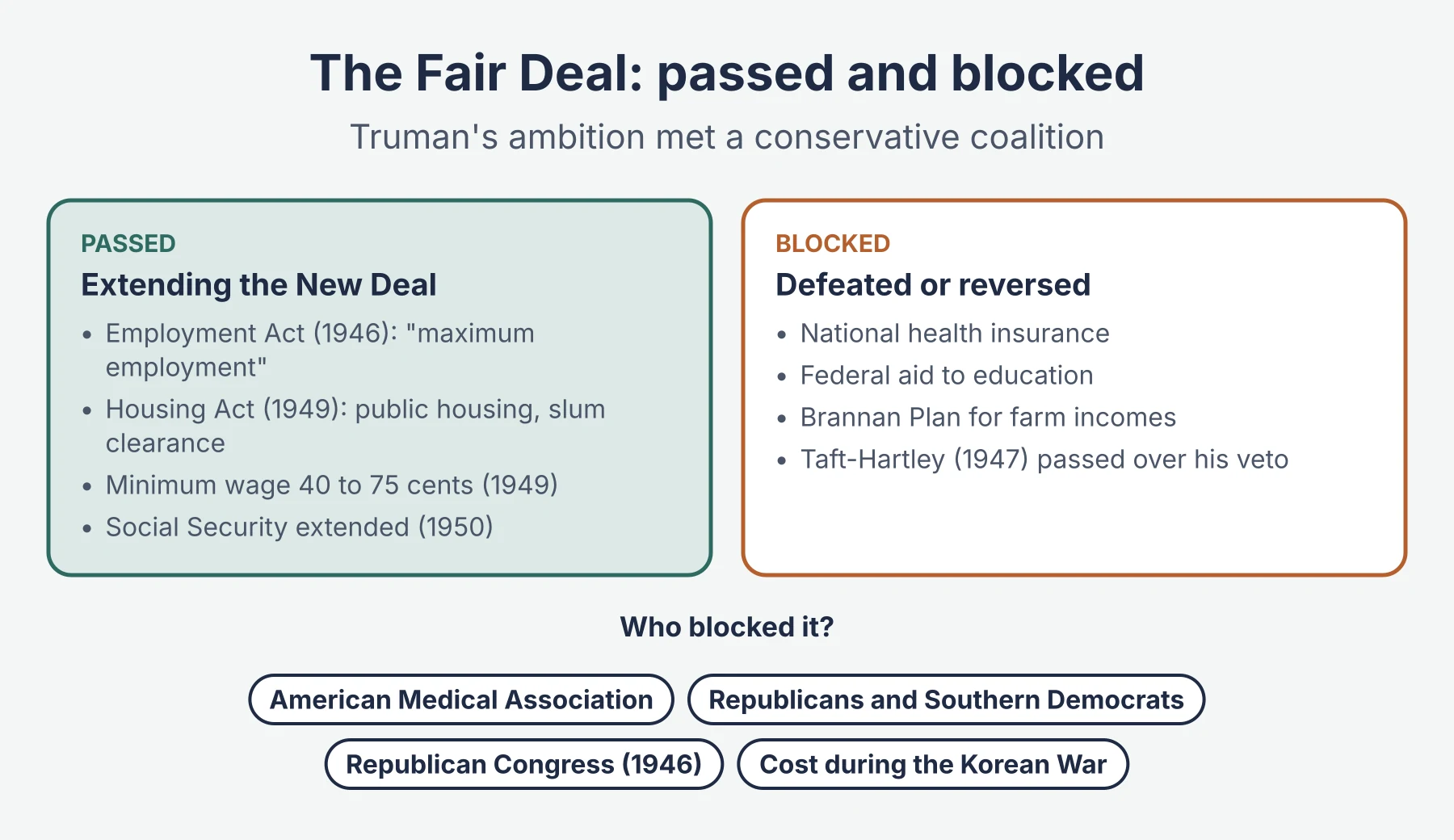
| Taft-Hartley Act | 1947 law restricting unions, passed over Truman’s veto |
| Loyalty Program | Truman’s 1947 screening of federal employees for disloyalty |
| HUAC | House Un-American Activities Committee |
| McCarthyism | Reckless accusations of communist sympathy without evidence |
| Dixiecrats | Southern Democrats who backed Strom Thurmond in 1948 |
| Modern Republicanism | Eisenhower’s acceptance of the New Deal with fiscal restraint |
| Military-industrial complex | Eisenhower’s 1961 warning about defence industries and the military gaining influence |
| Containment | Policy of stopping the spread of communism |
| New Look | Eisenhower’s defence policy relying on nuclear deterrence |
| Massive retaliation | Threat of nuclear response to communist aggression (Dulles, 1954) |
| Domino theory | Belief that one country’s fall to communism would lead its neighbours to fall |
| Baby boom | High post-war birth rate, c.1946-64 |
| Suburbanisation | Movement of families to new suburbs such as Levittown |
Timeline to learn
| Date | Event |
|---|---|
| April 1945 | Truman becomes President |
| July-Aug 1945 | Potsdam Conference |
| 1946 | Employment Act; strike wave; Republicans win Congress |
| March 1947 | Truman Doctrine; Loyalty Program |
| June 1947 | Taft-Hartley Act passed over veto |
| Oct 1947 | HUAC Hollywood hearings; To Secure These Rights published |
| June 1948-May 1949 | Berlin blockade and airlift |
| July 1948 | Executive Order 9981 |
| Nov 1948 | Truman defeats Dewey |
| 1949 | Fair Deal named; Housing Act; NATO; Soviet bomb; communist China |
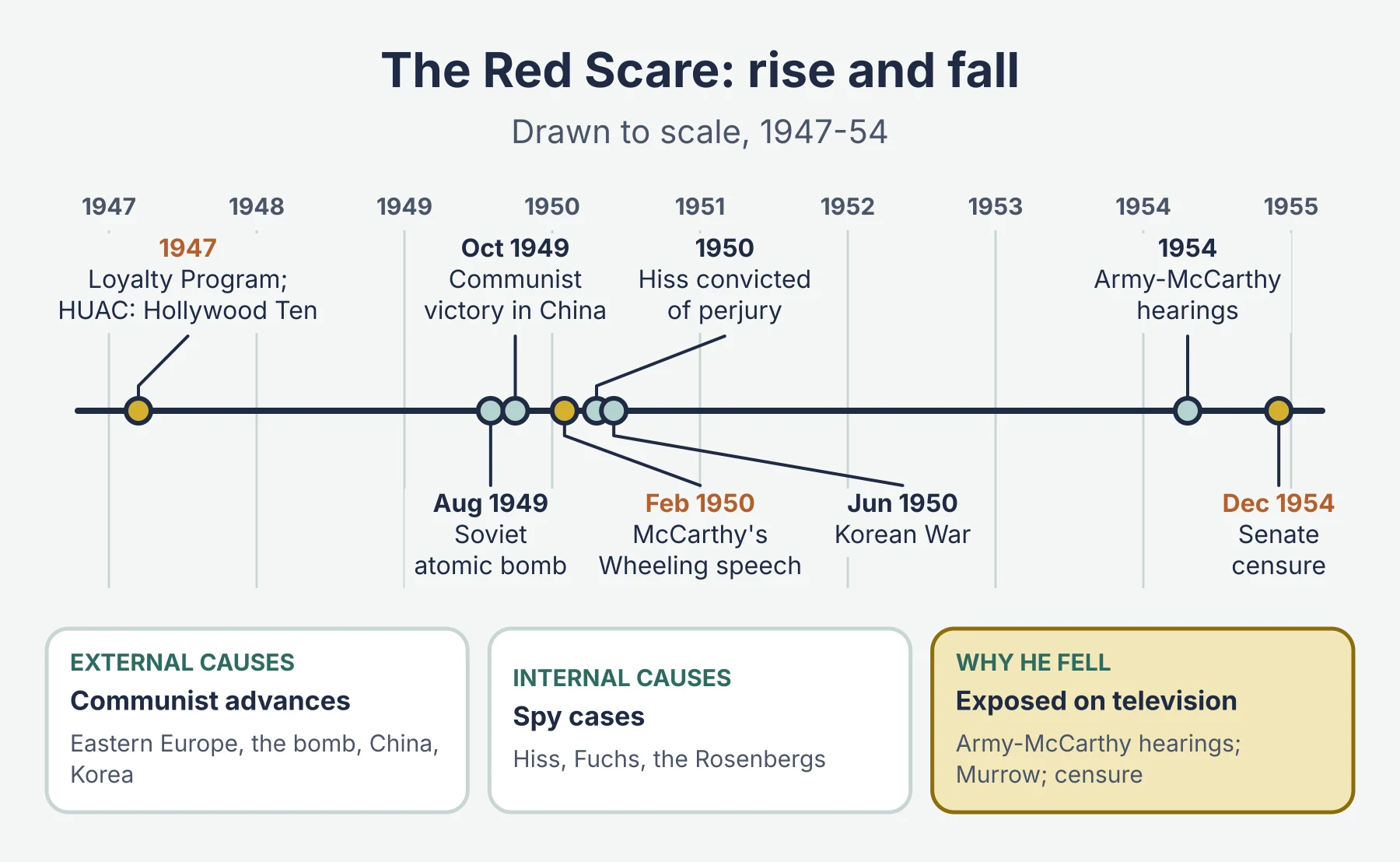
| Feb 1950 | McCarthy’s Wheeling speech |
| June 1950 | North Korea invades the South |
| April 1951 | MacArthur dismissed |
| Nov 1952 | Eisenhower elected |
| July 1953 | Korean armistice; Iran coup in August |
| 1954 | Brown v. Board; Guatemala coup; Army-McCarthy hearings; McCarthy censured |
| 1955-56 | Montgomery Bus Boycott; Geneva Summit (1955) |
| 1956 | Highway Act; Suez and Hungary; Eisenhower re-elected |
| 1957 | Little Rock; Civil Rights Act; SCLC founded |
| 1958-59 | Berlin crisis; Castro takes power (Jan 1959) |
| 1960 | Greensboro sit-in; SNCC; U-2 incident |
| Jan 1961 | Farewell address; break with Cuba |
4.1 Truman at home – verdict grid
| Issue | Achieved | Not achieved |
|---|---|---|
| Economy | Employment Act; reconversion without depression | Inflation 1946; Taft-Hartley |
| Welfare | Housing Act 1949; minimum wage 75 cents; Social Security extended 1950 | Health insurance; aid to education; Brannan Plan |
| Red Scare | Loyalty Program; vetoed McCarran Act (overridden) | McCarthy’s rise damaged his administration |
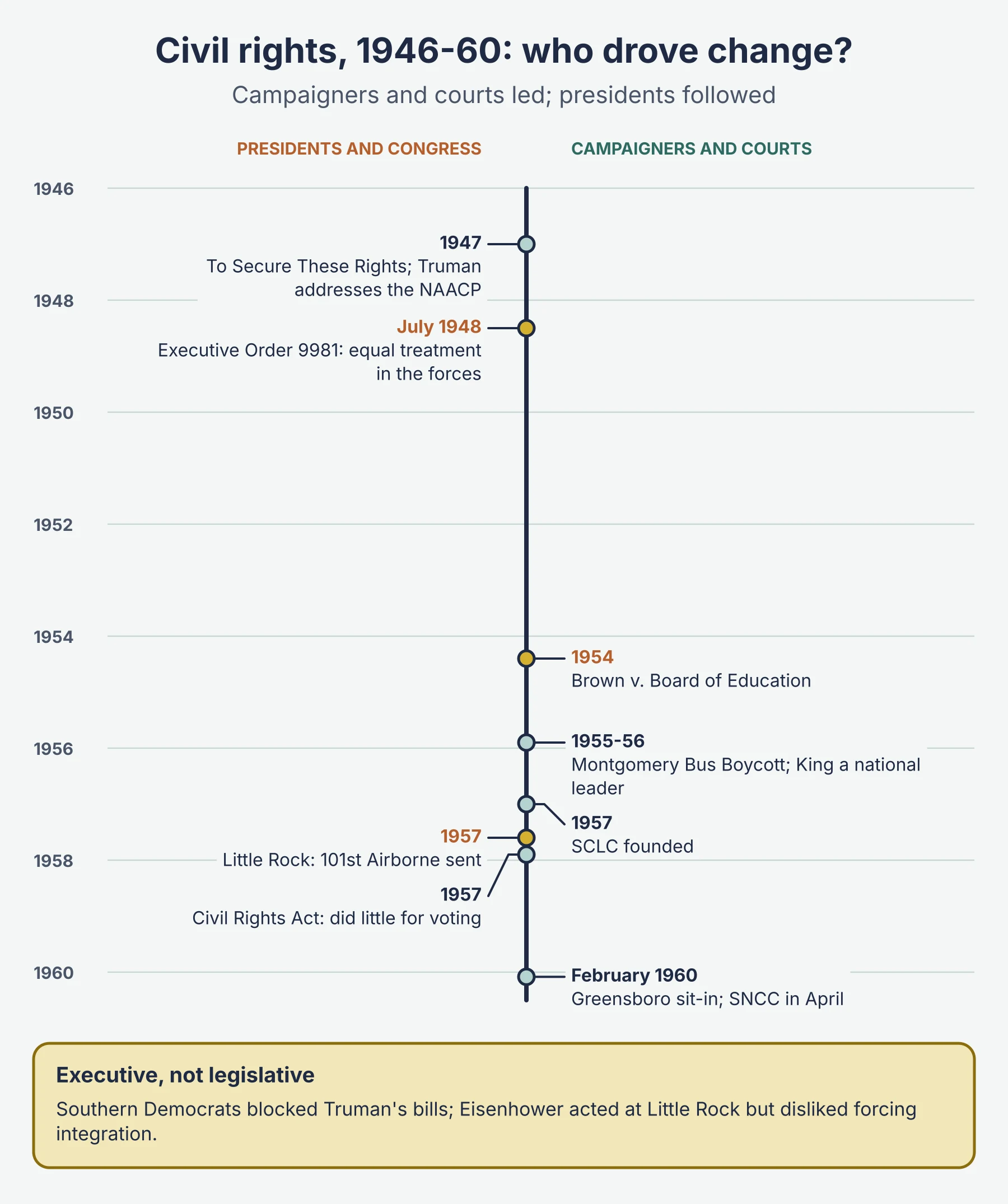
| Civil rights | EO 9981; To Secure These Rights; NAACP speech | No legislation through Congress |
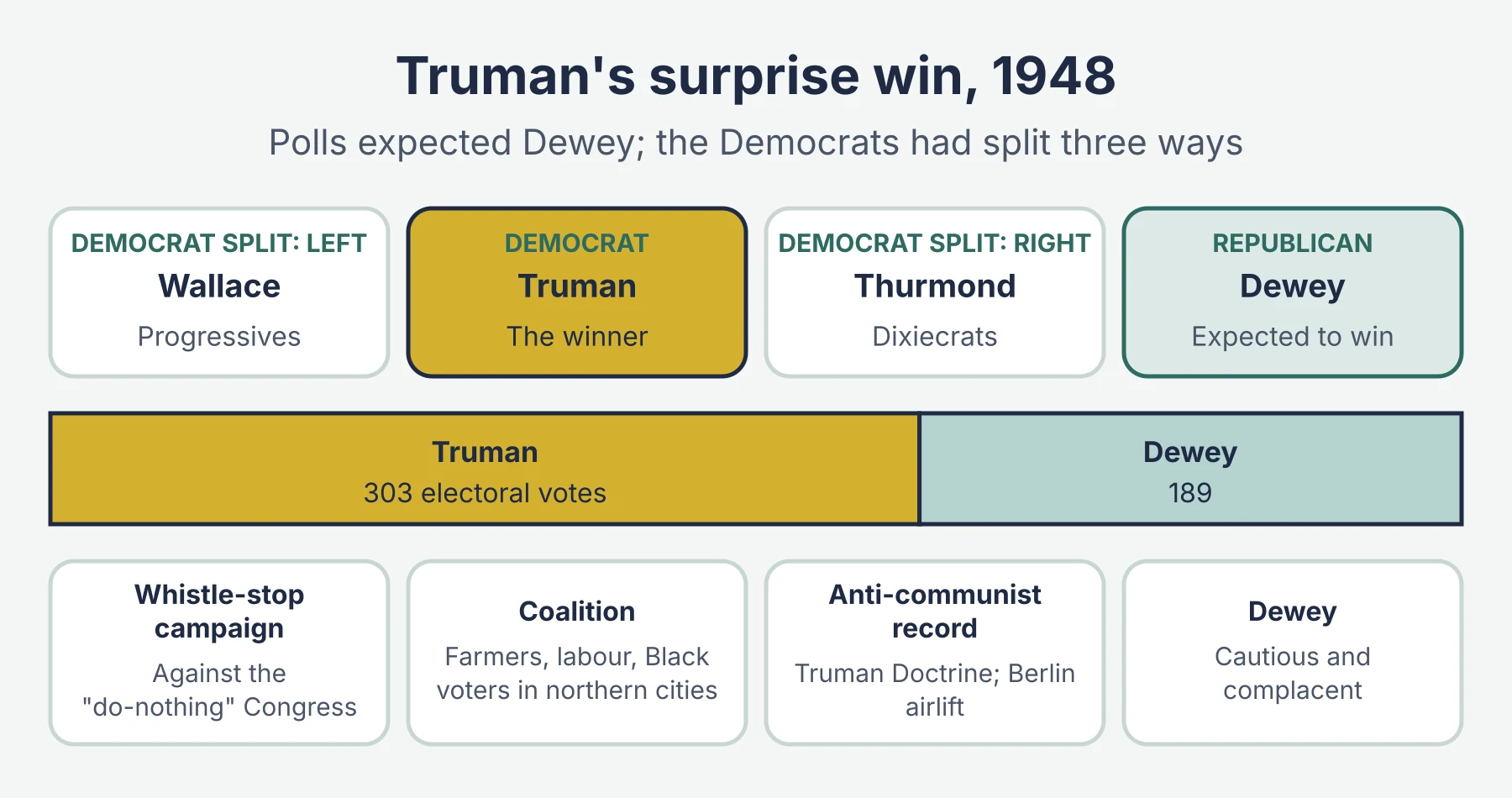
Why he won in 1948: whistle-stop campaign, “do-nothing Congress”, New Deal coalition held (farmers, labour, Black voters in the north), anti-communist record, Dewey’s complacency.
4.2 Eisenhower – effective or passive?
- Effective: two landslide wins; HEW; Social Security extended; interstate highways; balanced budgets; ended the Korean War; troops to Little Rock; 1957 Civil Rights Act.
- Passive: slow to confront McCarthy publicly; lukewarm on Brown; the 1957 Act was weak; recession in 1957-58.
4.3 Society – four themes
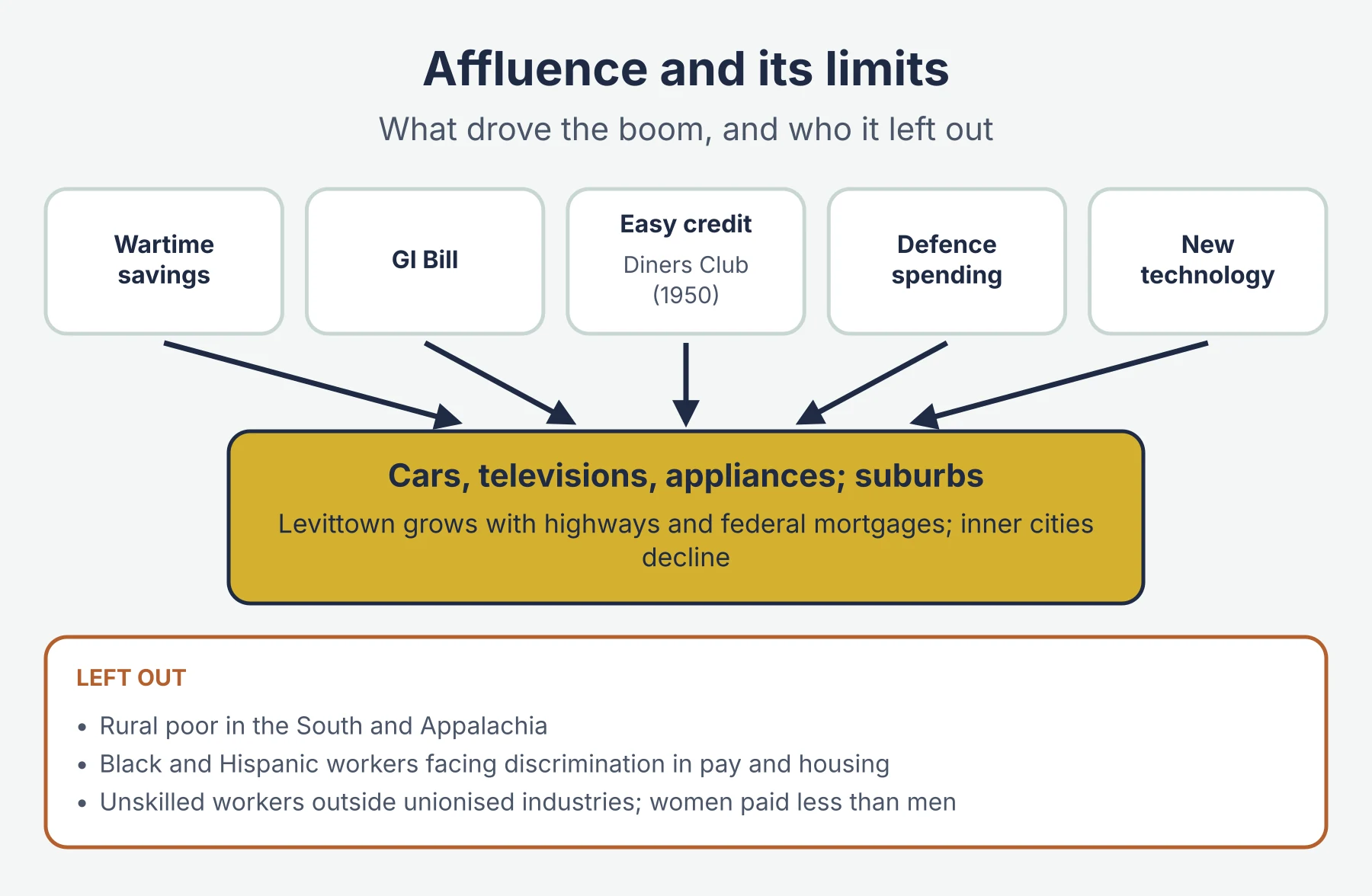
- Consumerism: cars, TVs, appliances; credit and debt; suburbs and inner-city decline.
- Women: domestic ideal, yet more married women working and studying.
- Youth: teenage market, TV and film, rock and roll.
- Poverty: rural South and Southwest, inner cities, unskilled workers, women and ethnic minorities.
4.4 Foreign policy – continuity and change
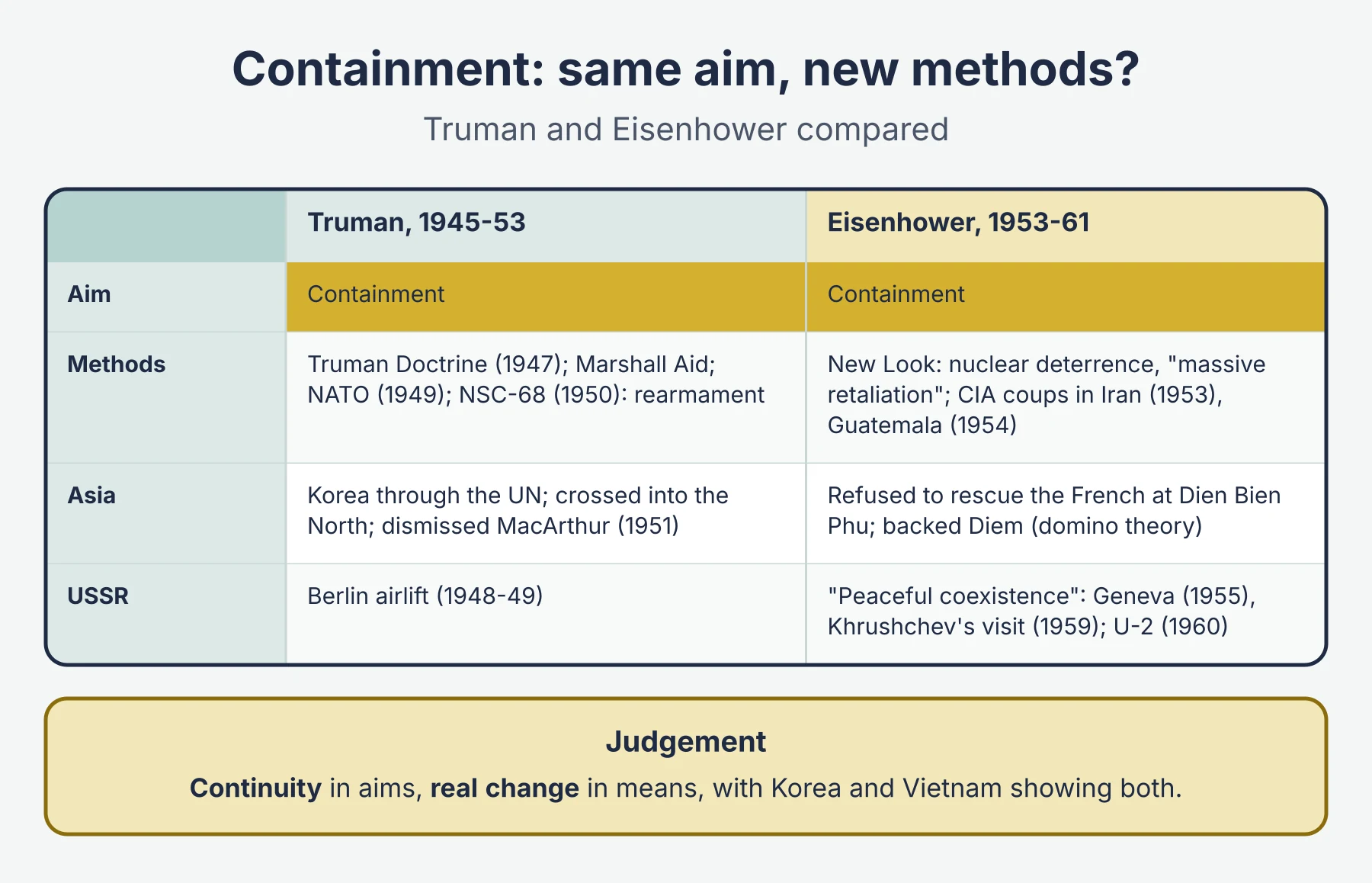
| Truman | Eisenhower | |
|---|---|---|
| Aim | Containment | Containment |
| Main method | Aid, alliances, conventional rearmament (NSC-68) | Nuclear deterrence, covert action, summitry |
| Asia | Korean War; crossing the 38th parallel | Armistice; domino theory; backing Diem |
| Europe | Marshall Aid, Berlin airlift, NATO | Berlin ultimatum 1958-59; no action over Hungary |
| Middle East / Latin America | Truman Doctrine (Greece, Turkey) | Iran 1953; Suez 1956; Guatemala 1954; Cuba |
Exam traps
- Brown v. Board was a court decision; Eisenhower’s role was enforcement at Little Rock.
- McCarthy was a senator, not a member of HUAC.
- 1948: Truman beat a three-way split in his own party, not just Dewey.
- Prosperity: always set growth against persistent poverty.
- Difference questions: compare aims and methods separately.
Self-test
- What did the Employment Act of 1946 create? The Council of Economic Advisers.
- Which 1947 law restricted unions? The Taft-Hartley Act.
- Who led the Dixiecrats in 1948? Strom Thurmond.
- What did Executive Order 9981 do? Ordered equal treatment and opportunity in the armed forces.
- Which spy case led to a perjury conviction in 1950? Alger Hiss.
- What brought McCarthy down in 1954? The televised Army-McCarthy hearings, Murrow’s criticism and Senate censure.
- Name two Eisenhower slogans or promises of 1952. “I like Ike”; “I shall go to Korea”.
- Which department did Eisenhower create in 1953? Health, Education and Welfare.
- Where did Eisenhower send federal troops in 1957? Little Rock, Arkansas.
- Which organisation grew out of the 1960 sit-ins? SNCC.
- Where did the CIA back coups in 1953 and 1954? Iran and Guatemala.
- What ended the 1960 Paris summit? The shooting down of a U-2 spy plane over the USSR.
Official syllabus
Cambridge International AS & A Level History (9489) syllabus for 2027, 2028 and 2029 – cambridgeinternational.org (Paper 4, American option, topic 4).
Related resources
-
Practice questions
Cambridge A Level World History (9489): American option: The USA, 1945-93 – Practice Questions
Original Paper 4-style essays for Cambridge 9489 History on the USA, 1945-93, from Truman to Bush, with indicative content and the AO1/AO2 level descriptors.
World History · Cambridge · A Level
Try questions -
Revision notes
Cambridge A Level World History (9489): American option: The USA, 1945-93 – Revision Notes
Paper 4 revision notes for Cambridge 9489 History's American depth study, the USA 1945-93: presidents, civil rights, Vietnam, the New Right and the Cold War.
World History · Cambridge · A Level
Revise topic -
Study guides
Cambridge A Level World History (9489): American option: The USA, 1945-93 – Study Guide
The USA from 1945 to 1993: Truman and Eisenhower, civil rights, Vietnam and Watergate, then Carter, Reagan and Bush, with a worked chronology and exam guidance.
World History · Cambridge · A Level
Read guide
Get free revision emails (optional)
Occasional emails with practice questions, worked explanations and links to free resources for the qualification and subjects you choose. No spam, and you can unsubscribe from any email. The free tools on this site never need an email.