
Study Guides
Cambridge A Level World History (9489): A time of challenges: the USA, 1961-74
Study guide to Cambridge 9489 Paper 4 topic 5, the USA 1961-74: Kennedy, Johnson and Nixon, Cuba and Vietnam, civil rights and the challenges to authority.
- Subject
- World History
- Level
- A LEVEL
- Topic
- Topic 6: American option: The USA, 1945-93
- Author
- Marlbridge Academic Team
- Updated
- Reviewed by
- Azam Siddique (what this means)
Aligned to Cambridge A Level World History (9489), 2027-2029. Official specification .
Syllabus page (what it covers and how it is assessed): Cambridge A Level World History.
Syllabus points this page covers
9489 (A Level)
- 5 A time of challenges: the USA, 1961–74
Found an error? Report a correction.
Need help with this topic? Request a free trial class for A Level World History (9489).
A time of challenges: the USA, 1961-74 is the second topic of the American option on Cambridge 9489 Paper 4. The key questions ask how significant the presidencies of Kennedy, Johnson and Nixon were (5.1), how well US governments dealt with Cuba and Vietnam (5.2), how much progress was made on civil rights for African Americans (5.3) and why there were challenges to authority (5.4). You write two 30-mark essays from your option in 1 hour 45 minutes. This guide builds on the American option study guide; for quick recall use the 1961-74 revision notes and for essays the 1961-74 practice questions.
Syllabus coverage
- 5.1 Kennedy’s 1960 victory and the New Frontier; Johnson’s Great Society, its opposition and impact; Nixon’s 1968 victory, New Economic Policy, New Federalism, environment, civil rights, Watergate and resignation.
- 5.2 The Cuban Missile Crisis; reasons for involvement in Vietnam; escalation under Johnson; withdrawal and the end of the war.
- 5.3 Civil rights methods and campaigns; opposition; federal institutions.
- 5.4 Feminism; Black Power; identity politics; popular protest and the authorities’ reaction.
5.1 Three presidencies
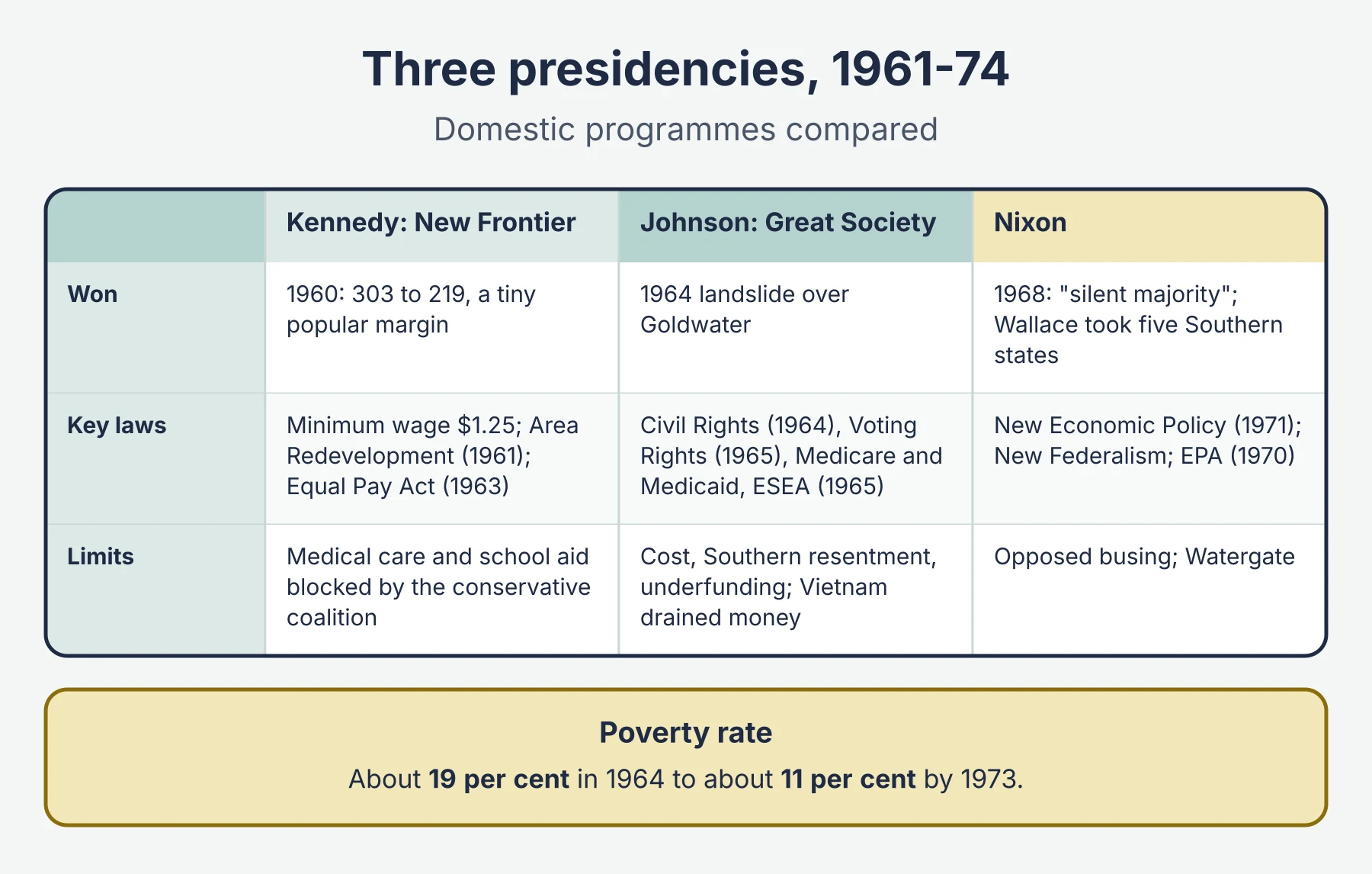
Kennedy’s victory, 1960. Kennedy won narrowly – 303 electoral votes to Nixon’s 219, with a tiny popular margin. Factors: youth and charisma, especially in the first televised debate (September 1960); the promise of a “New Frontier”; an organised campaign that addressed fears about his Catholicism; Lyndon Johnson as running mate, helping carry Texas and the South; and his phone call to Coretta Scott King after Martin Luther King’s arrest in October 1960, which helped win Black votes. Nixon was linked to an administration that had suffered a recession and the U-2 humiliation.
The New Frontier. Kennedy raised the minimum wage to $1.25, passed the Area Redevelopment Act (1961) for depressed regions, a Housing Act (1961) and the Manpower Development and Training Act (1962), and created the President’s Commission on the Status of Women, leading to the Equal Pay Act (1963). Medical care for the elderly and federal aid to education were blocked by the conservative coalition in Congress. On civil rights he moved cautiously until Birmingham, then proposed a major bill in June 1963. His tax cut passed only after his death.
Johnson’s Great Society. Using Kennedy’s memory, legislative skill and the 1964 landslide over Goldwater, Johnson passed the Civil Rights Act (1964), the Economic Opportunity Act (1964) launching the War on Poverty (Job Corps, VISTA, community action, Head Start), the Voting Rights Act (1965), Medicare and Medicaid (1965), the Elementary and Secondary Education Act (1965), immigration reform (1965), the Department of Housing and Urban Development, Model Cities, and environmental laws such as the Wilderness Act (1964). The official poverty rate fell from about 19 per cent in 1964 to about 11 per cent by 1973. Opposition: conservatives attacked cost and federal power; Southern whites resented civil rights; radicals said programmes were underfunded; Vietnam drained money and Johnson’s authority.
Nixon. He won in 1968 by appealing to the “silent majority”, law and order, and Southern white voters, against a Democratic Party split over Vietnam and after the assassination of Robert Kennedy, with George Wallace taking five Southern states. In office he was more pragmatic than his rhetoric: the New Economic Policy (August 1971) froze wages and prices and ended the dollar’s convertibility into gold; New Federalism shared federal revenue with states; he created the Environmental Protection Agency (1970) and signed the Clean Air Act (1970) and Endangered Species Act (1973); school desegregation in the South advanced rapidly, and the Philadelphia Plan set targets for minority hiring, though he opposed busing.
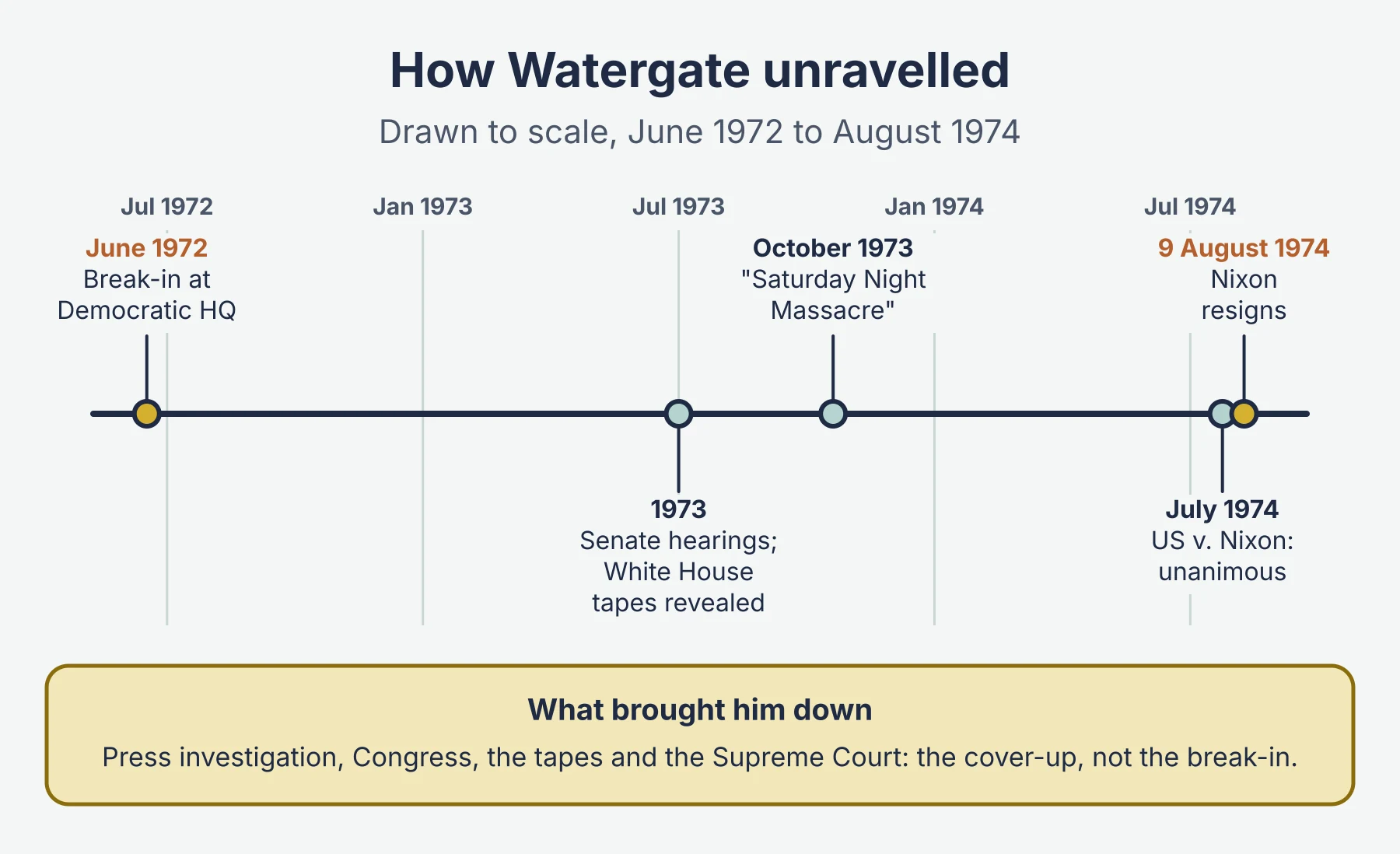
Watergate. After the June 1972 break-in at the Democratic headquarters, Nixon’s cover-up unravelled through press investigation, the Senate hearings (1973), the revelation of White House tapes, the “Saturday Night Massacre” (October 1973) and the Supreme Court’s unanimous ruling in United States v. Nixon (July 1974). Facing impeachment, he resigned on 9 August 1974.
5.2 Cuba and Vietnam
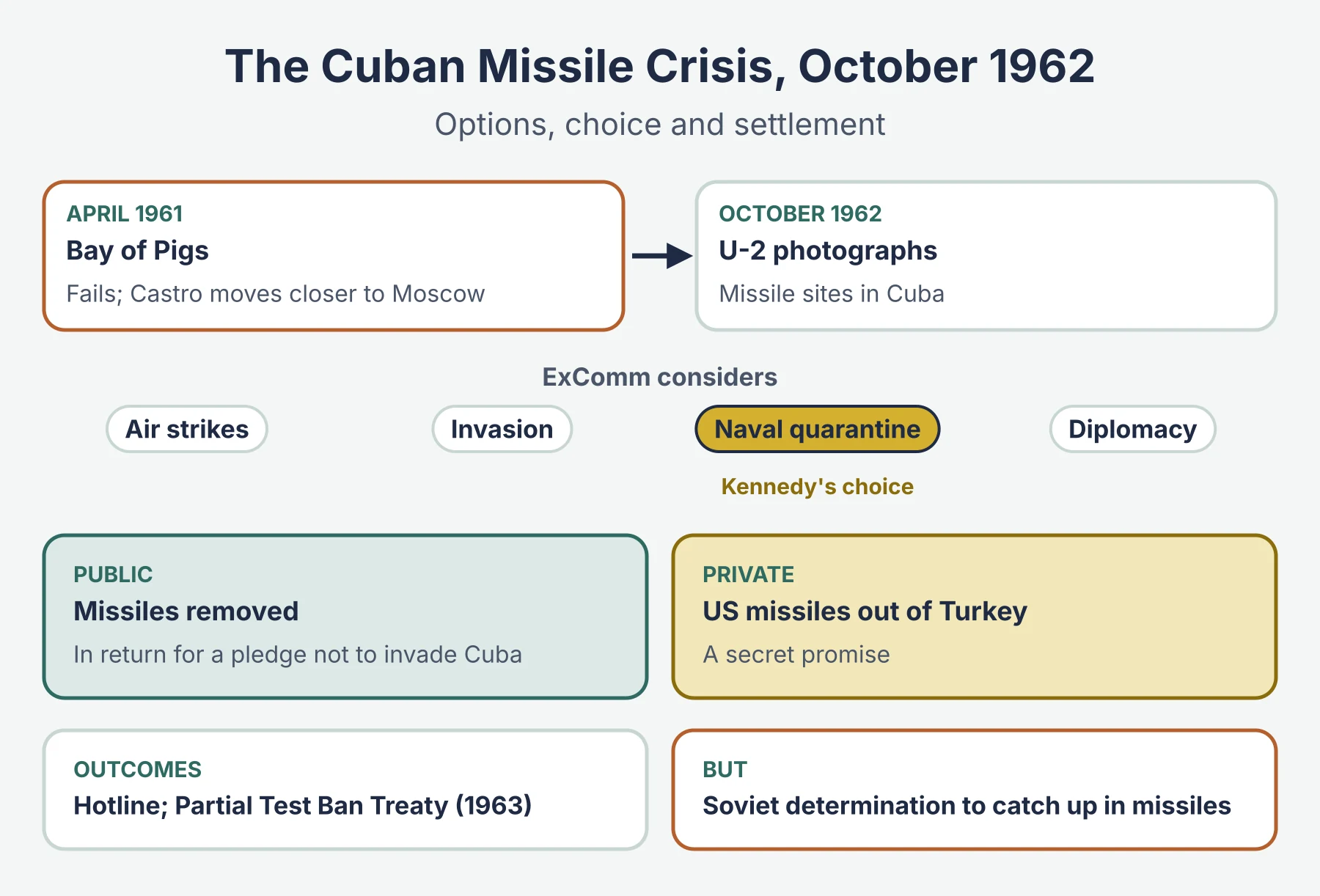
Cuba. Kennedy saw Castro’s regime as a Soviet foothold. The failed Bay of Pigs invasion (April 1961) humiliated him and pushed Castro closer to Moscow. When U-2 photographs revealed missile sites in October 1962, the ExComm considered air strikes, invasion and diplomacy; Kennedy chose a naval quarantine. Khrushchev’s two letters and secret talks led to the removal of the missiles in return for a public pledge not to invade Cuba and a private promise to withdraw US missiles from Turkey. Outcomes: the hotline (1963) and the Partial Test Ban Treaty (1963), but also a Soviet determination to catch up in missiles.
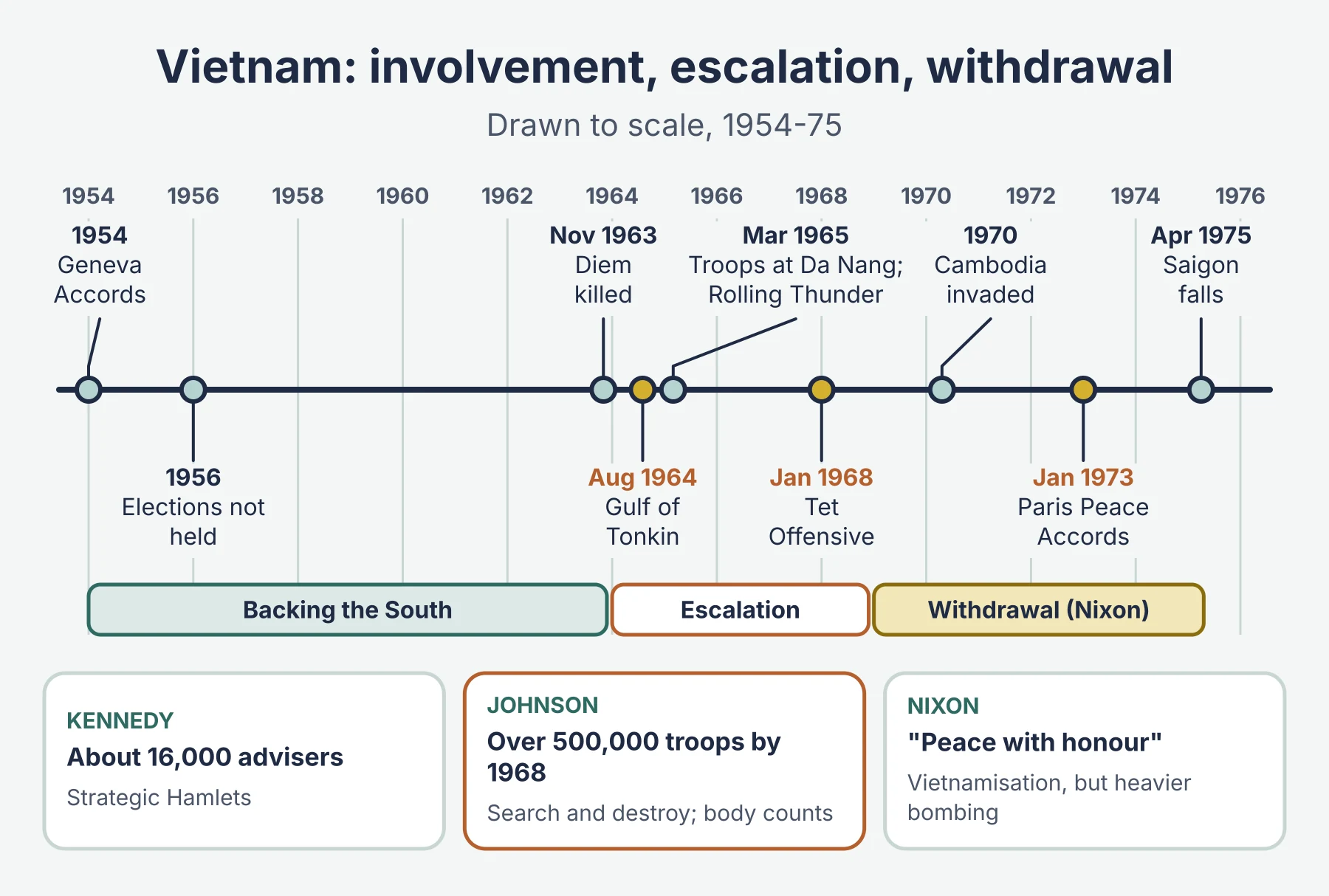
Why involvement grew. The Geneva Accords (1954) divided Vietnam at the 17th parallel pending elections in 1956 that never took place. Eisenhower’s domino theory justified backing Ngo Dinh Diem, whose Catholic-dominated, repressive regime alienated Buddhists and peasants. Kennedy raised the number of advisers to about 16,000 and backed the Strategic Hamlet programme, then accepted the coup that killed Diem (November 1963).
Escalation under Johnson. The Gulf of Tonkin incidents (August 1964) led Congress to pass a resolution giving the President broad powers. Operation Rolling Thunder bombing began in 1965, and combat troops landed at Da Nang in March 1965; numbers passed 500,000 by 1968. Search-and-destroy missions, body counts and chemical defoliants failed against a guerrilla enemy supplied along the Ho Chi Minh trail, and alienated villagers.
Withdrawal. The Tet Offensive (January 1968) was a military defeat for the communists but a political disaster for Johnson; television coverage and the later revelation of the My Lai massacre deepened division. Johnson withdrew from the 1968 election. Nixon promised “peace with honour”: Vietnamisation and troop withdrawals, but also the invasion of Cambodia (1970) and heavier bombing, including Christmas 1972. The Paris Peace Accords (January 1973) ended US combat involvement; Saigon fell in April 1975.
5.3 Civil rights: how much progress?
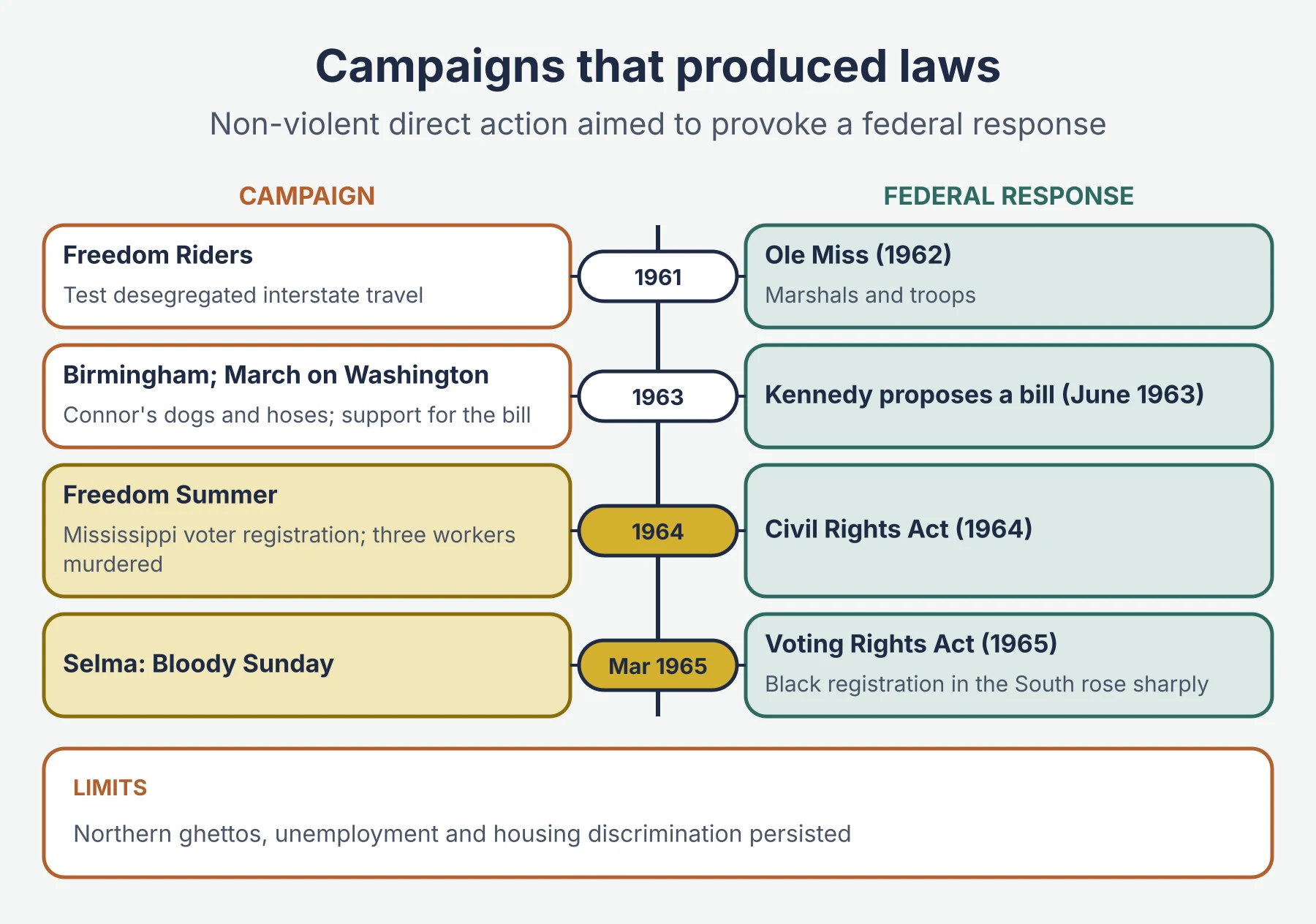
Methods and campaigns. King’s non-violent direct action aimed to provoke a federal response. The Freedom Riders (1961) tested desegregated interstate travel; Birmingham (1963) exposed Bull Connor’s dogs and fire hoses; the March on Washington (August 1963) built support for the civil rights bill; Freedom Summer (1964) registered voters in Mississippi despite the murder of three workers; Bloody Sunday at Selma (March 1965) led directly to the Voting Rights Act.
Opposition. Literacy tests and intimidation kept Black voters off the rolls; Governor George Wallace stood in the schoolhouse door (1963); Southern Congressmen filibustered; White Citizens’ Councils and the Ku Klux Klan used economic pressure and violence, including the Birmingham church bombing (September 1963).
Federal action. Before 1964 the executive used marshals and troops (Ole Miss, 1962). Then came the Civil Rights Act (1964), Voting Rights Act (1965), Fair Housing (Civil Rights) Act (1968) and Equal Employment Opportunity Act (1972); the Supreme Court in Loving v. Virginia (1967) struck down bans on interracial marriage. Progress: legal segregation ended and Black voter registration in the South rose sharply. Limits: northern ghettos, unemployment and housing discrimination persisted.
5.4 Challenges to authority
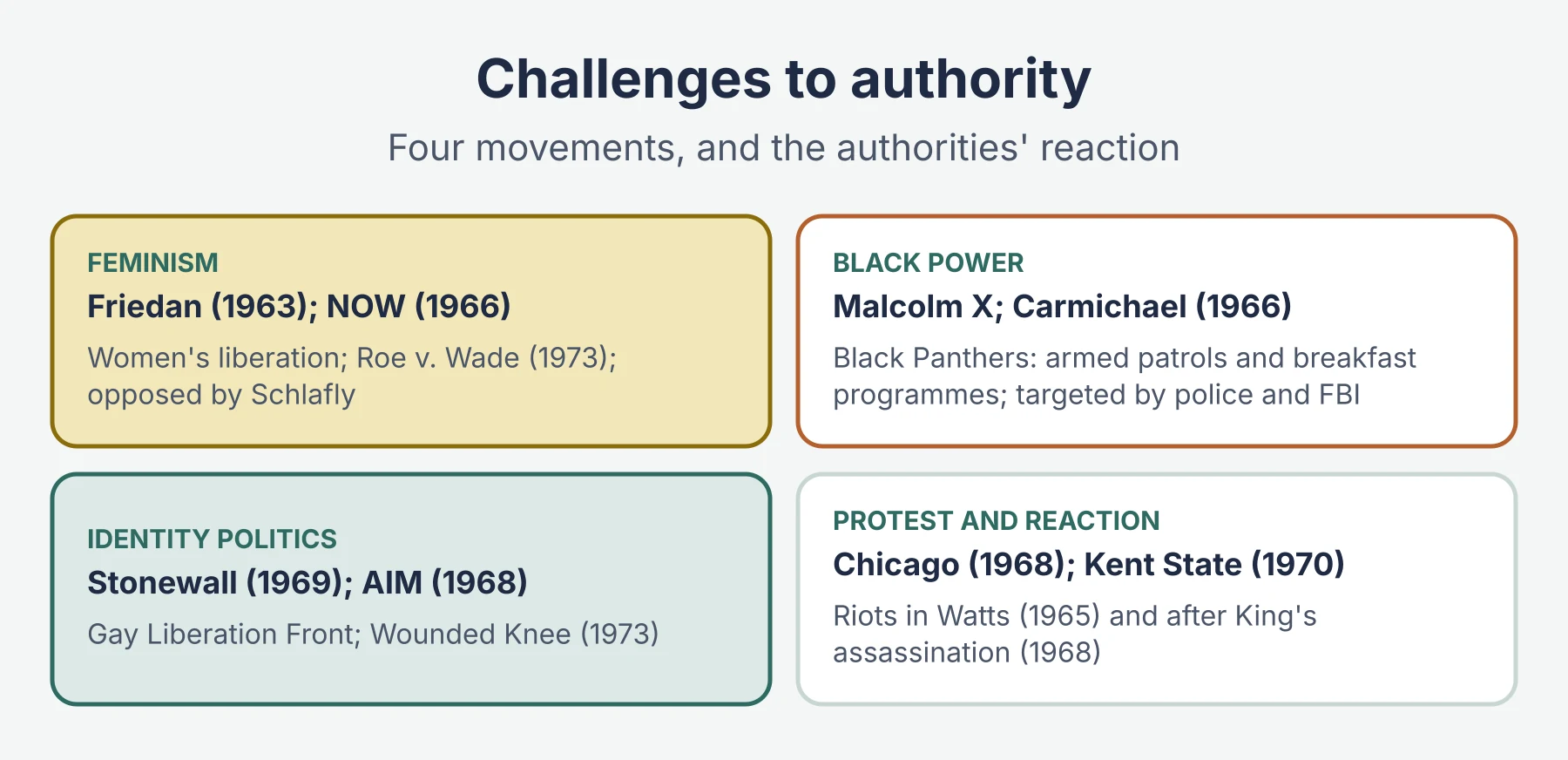
- Feminism: Betty Friedan’s The Feminine Mystique (1963); NOW (1966); women’s liberation groups; Roe v. Wade (1973); opposition from conservatives such as Phyllis Schlafly.
- Black Power: Malcolm X and the Nation of Islam; Stokely Carmichael’s call for “Black Power” (1966); the Black Panthers (Bobby Seale, Huey Newton), who combined armed patrols with breakfast programmes and were targeted by police and the FBI.
- Identity politics: the Stonewall riots (1969), the Gay Liberation Front and Gay Activists Alliance; the American Indian Movement (1968), the occupation of Wounded Knee (1973).
- Protest and reaction: the Democratic National Convention in Chicago (1968), where Mayor Daley’s police clashed with protesters; the Kent State shootings (May 1970); riots in Watts (1965) and after King’s assassination (1968).
Worked example: an introduction
“Johnson’s Great Society was a failure.” Assess this view. [30]
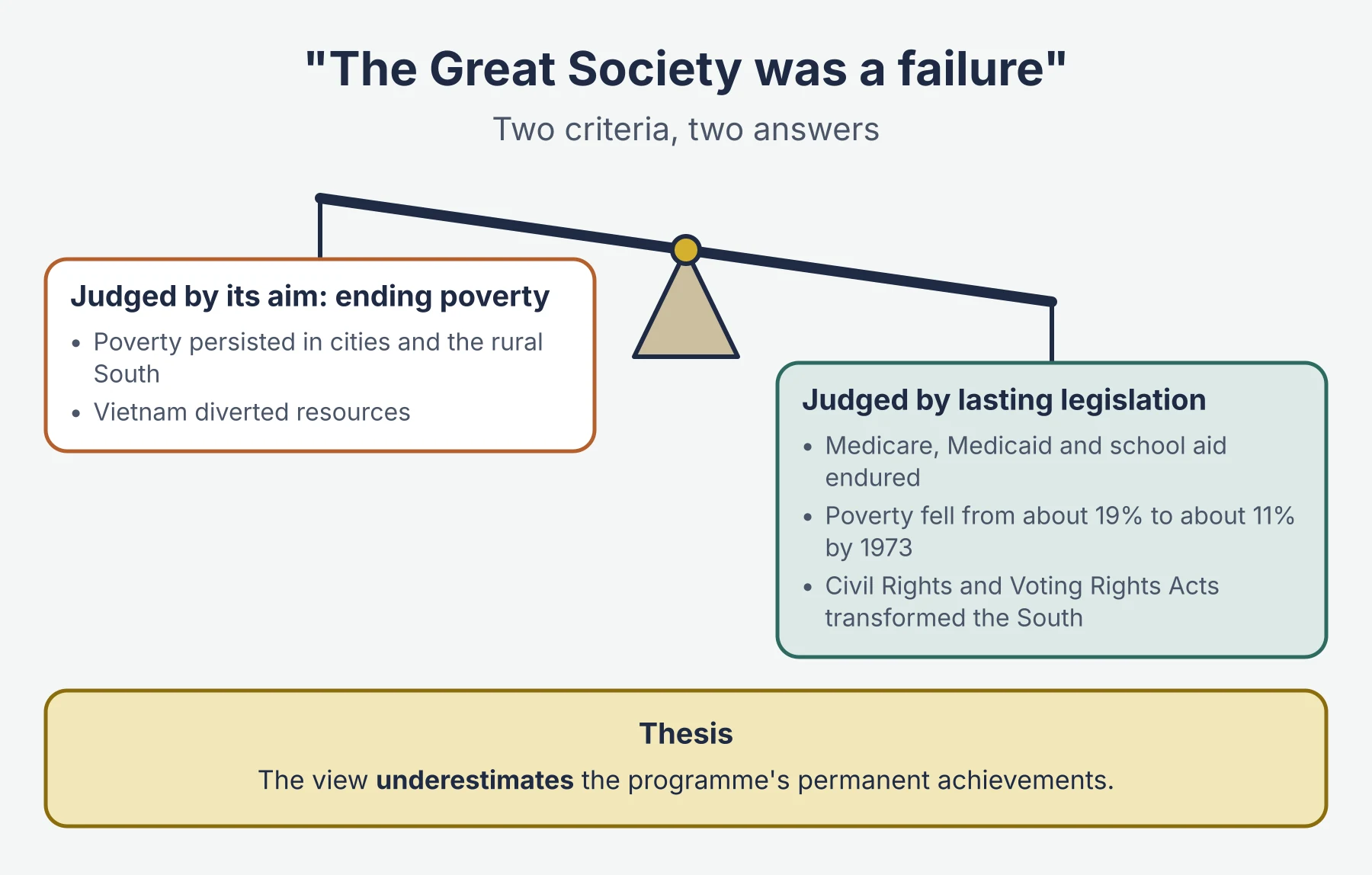
Judged by its aim of ending poverty, the Great Society fell short: poverty persisted in cities and the rural South, and Vietnam diverted resources. Judged by its lasting legislation, it was the greatest expansion of federal social policy since the New Deal: Medicare, Medicaid and federal aid to schools endured, the poverty rate fell substantially by 1973, and the Civil Rights and Voting Rights Acts transformed Southern politics. This essay argues that the view underestimates the programme’s permanent achievements.
Common mistakes
- Treating Nixon as purely conservative at home.
- Describing Tet as a communist military victory.
- Forgetting Kennedy’s caution on civil rights before 1963.
Exam technique
Evaluate and assess need a stated criterion – intended aims, long-term impact, or who benefited – and a judgement that weighs evidence on both sides.
Official syllabus
Cambridge International AS & A Level History (9489) syllabus for 2027, 2028 and 2029 – cambridgeinternational.org (Paper 4, American option, topic 5).
Related resources
-
Practice questions
Cambridge A Level World History (9489): A time of challenges: the USA, 1961-74 – Practice Questions
Twelve original practice questions on Cambridge 9489 USA 1961-74: recall items and Paper 4-style essays on presidents, Vietnam and civil rights, with answers.
World History · Cambridge · A Level
Try questions -
Revision notes
Cambridge A Level World History (9489): A time of challenges: the USA, 1961-74 – Revision Notes
Revision notes for Cambridge 9489 Paper 4, the USA 1961-74: key terms, a timeline, presidents, Vietnam and civil rights condensed, exam traps and a self-test.
World History · Cambridge · A Level
Revise topic -
Study guides
Cambridge A Level World History (9489): Truman, Eisenhower and post-war USA, 1945-61
Study guide to Cambridge 9489 Paper 4 topic 4, the USA 1945-61: Truman's Fair Deal and McCarthyism, Eisenhower's presidency, 1950s society and containment.
World History · Cambridge · A Level
Read guide
Get free revision emails (optional)
Occasional emails with practice questions, worked explanations and links to free resources for the qualification and subjects you choose. No spam, and you can unsubscribe from any email. The free tools on this site never need an email.