
Study Guides
Cambridge IGCSE Commerce (0715): Commercial enterprises
Private and public sector enterprises, ownership types, multinationals, franchises and location factors for Cambridge IGCSE Commerce 0715 section 2.1.
- Subject
- Commerce
- Level
- IGCSE
- Topic
- Topic 2 – Commercial Operations
- Author
- Marlbridge Academic Team
- Updated
- Reviewed by
- Salman Ahmad (what this means)
Aligned to Cambridge IGCSE Commerce (0715), 2028. Official specification .
Syllabus page (what it covers and how it is assessed): Cambridge IGCSE Commerce.
Syllabus points this page covers
0715
- 2.1 Commercial enterprises
Found an error? Report a correction.
Need help with this topic? Request a free trial class for IGCSE Commerce (0715).
Section 2.1 of the Cambridge IGCSE Commerce (0715) syllabus asks who owns commercial enterprises, how big they can grow, and where they choose to operate. It has five parts: private and public sector enterprises, the types of ownership, multinational companies (MNCs), franchises and physical and ecommerce location factors. Several statements ask for “appropriateness in given situations”, so the skill being tested is judgement, not just recall. This page goes further into 2.1 than the Commercial Operations study guide, which covers all six parts of Topic 2.
How do private and public sector enterprises differ? (2.1.1)
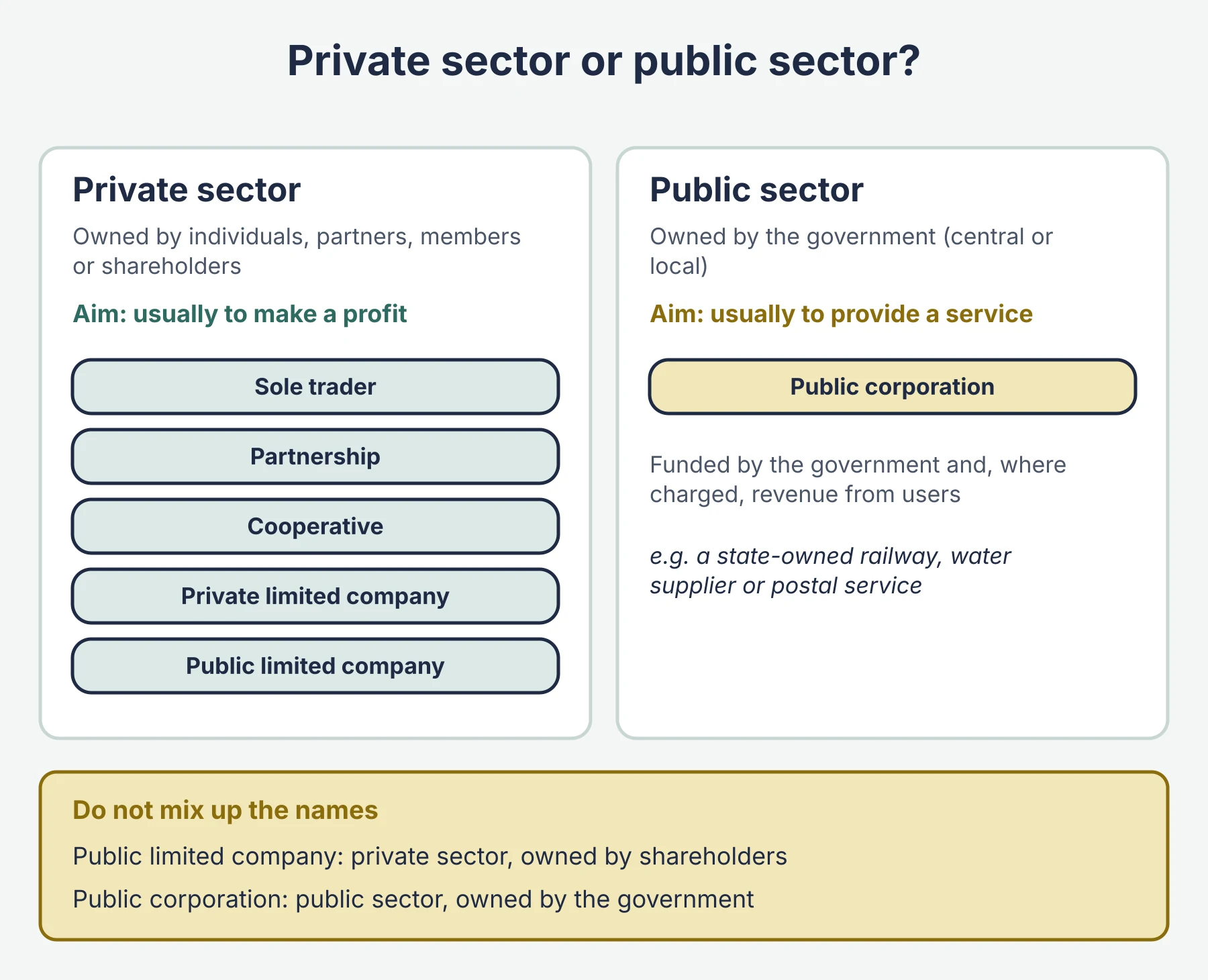
| Private sector | Public sector | |
|---|---|---|
| Owned by | Individuals, partners, members or shareholders | The government (central or local) |
| Main aim | Usually to make a profit | Usually to provide a service to the public |
| Finance from | Owners’ capital, loans, retained profit, shares | Government funding and, where charged, revenue from users |
| Examples | A family shop, a bank, a car maker | A state-owned railway, water supplier or postal service |
What are the features of each type of private sector enterprise? (2.1.2)
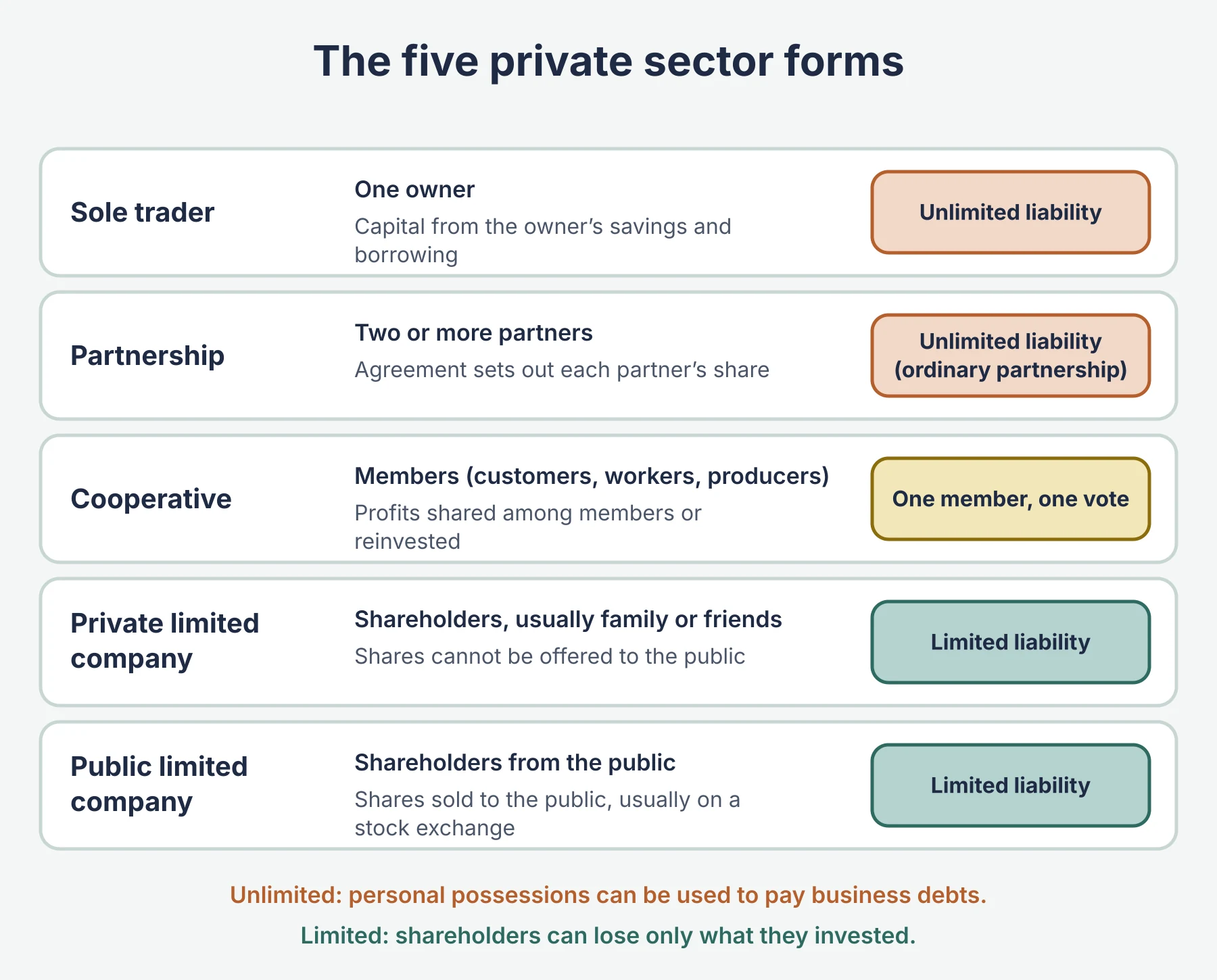
Sole trader. One owner who provides the capital, makes all decisions and keeps all the profit. Easy and cheap to set up. The owner has unlimited liability: if the business cannot pay its debts, the owner’s personal possessions can be used to pay them. Capital is limited to savings and borrowing, and the business may struggle if the owner is ill.
Partnership. Two or more people who share ownership, capital, decisions and profits, usually under a written partnership agreement setting out each partner’s share. More capital and more skills than a sole trader. In an ordinary partnership, partners have unlimited liability, disagreements can slow decisions, and each partner is bound by the others’ business decisions.
Cooperative. Owned and controlled by its members, who may be customers, workers or producers. Each member usually has one vote, however much they have invested, and profits are shared among members or reinvested. Farmers often form producer cooperatives to buy seed in bulk and sell their crops together, gaining bargaining power they lack alone.
Private limited company. Owned by shareholders, but shares cannot be offered to the general public and are usually held by family or friends. It is a separate legal entity, so shareholders have limited liability and can lose only what they invested. It must be registered, which costs more than starting a sole trader business, and some information must be made available publicly.
Public limited company. Shares can be sold to the public, usually through a stock exchange, so very large amounts of capital can be raised. Shareholders have limited liability. Setting up is costly, accounts must be published, outside investors can buy enough shares to take control, and the owners (shareholders) are often separate from the managers who run the company.
What are public corporations and why do they exist? (2.1.2)
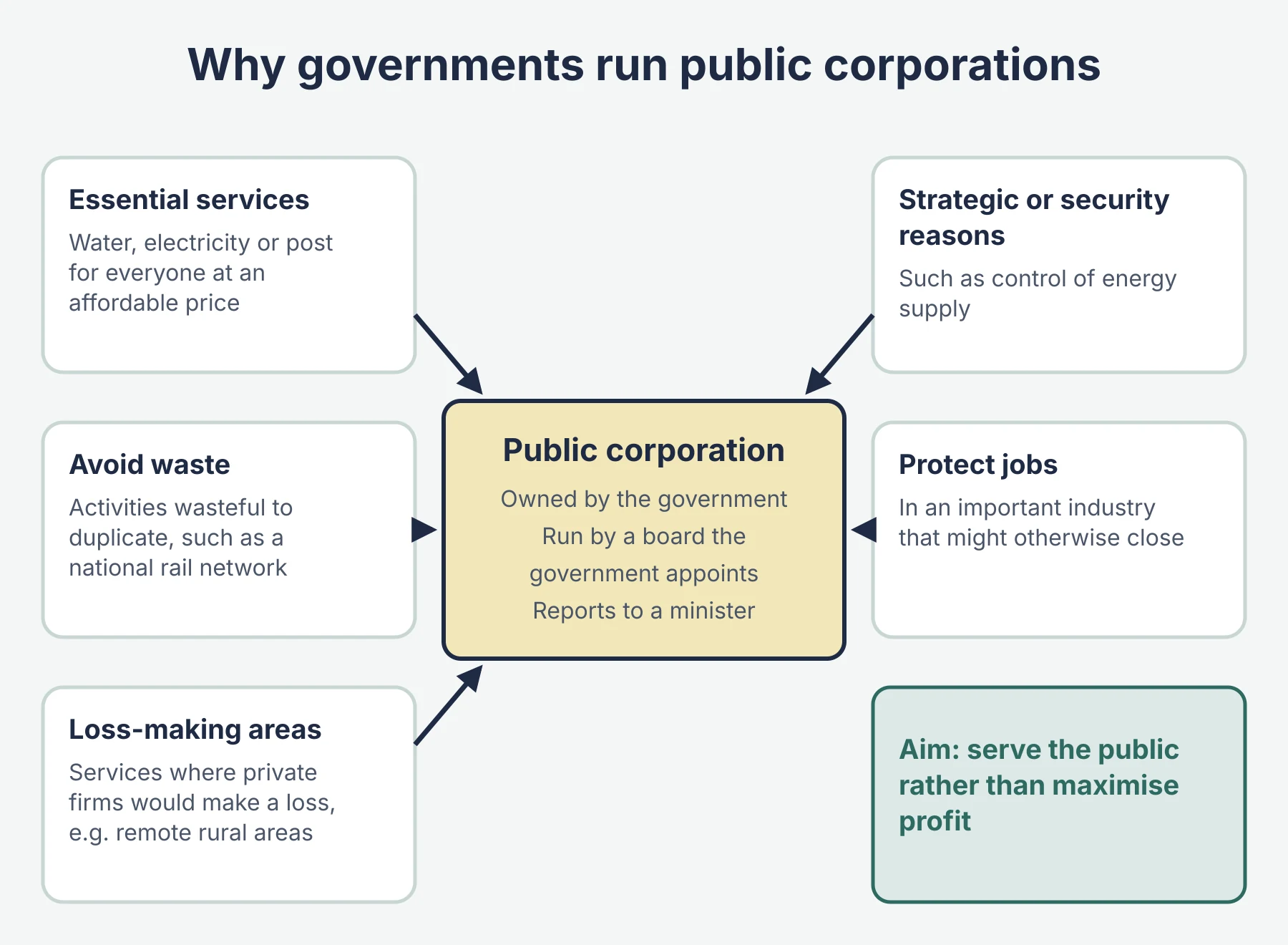
A public corporation is a business in the public sector, owned by the government and run by a board appointed by the government. It may sell its services, but its aim is to serve the public rather than to maximise profit, and it reports to a government minister or department.
Reasons governments give for public corporations:
- To provide essential services, such as water, electricity or postal delivery, to everyone at an affordable price.
- To run activities that would be wasteful to duplicate, such as a national rail network.
- To provide services in areas where private firms would make a loss, such as remote rural communities.
- For strategic or security reasons, such as control of energy supply.
- To protect jobs in an important industry that might otherwise close.
Which type of ownership suits which situation? (2.1.2)
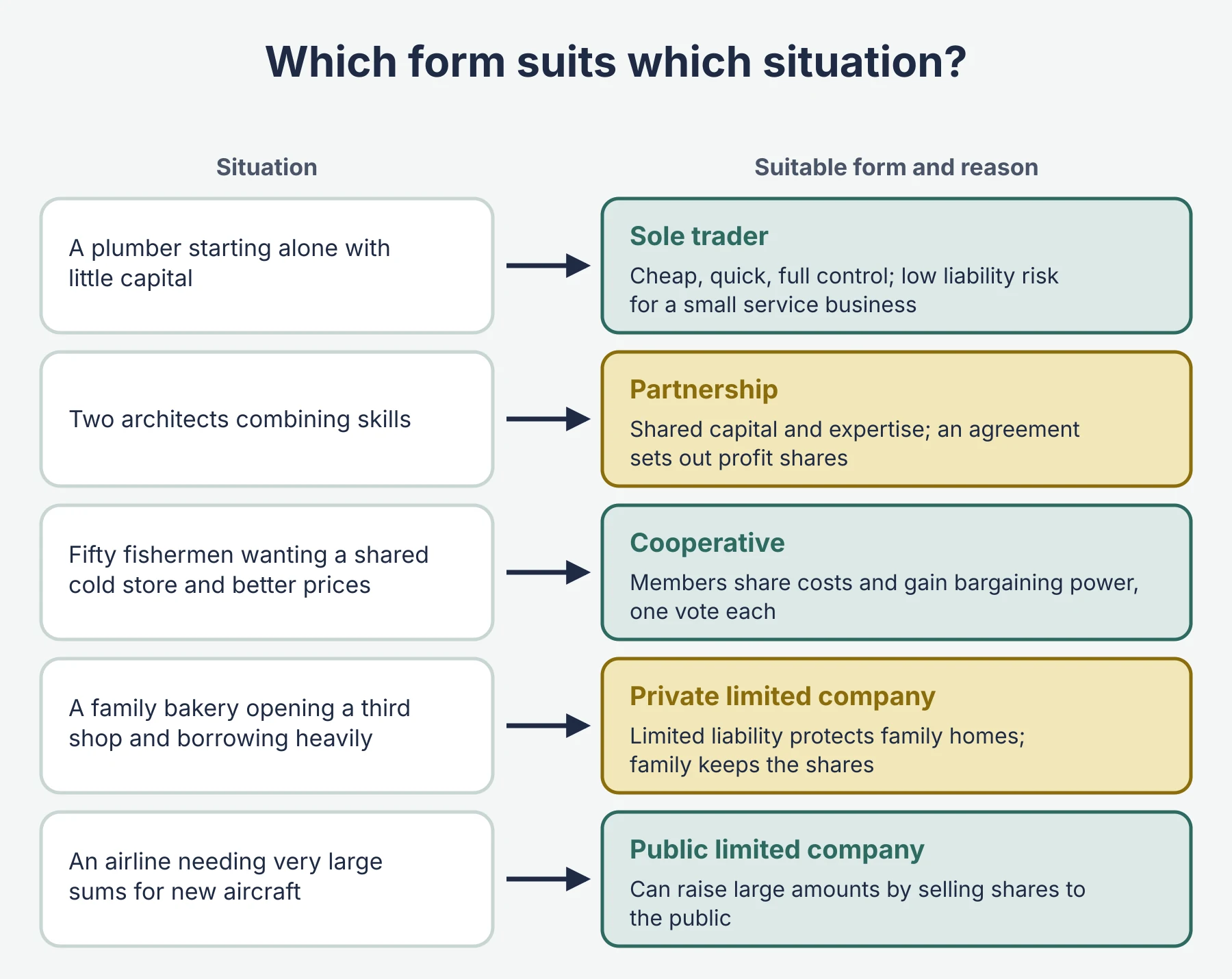
| Situation | Suitable form | Reason |
|---|---|---|
| A plumber starting alone with little capital | Sole trader | Cheap, quick, full control; liability risk is low for a small service business |
| Two architects combining skills | Partnership | Shared capital and expertise; a partnership agreement sets out profit shares |
| Fifty fishermen wanting a shared cold store and better prices | Cooperative | Members share costs and gain bargaining power, each with one vote |
| A family bakery opening a third shop and borrowing heavily | Private limited company | Limited liability protects family homes; family keeps control of shares |
| An airline needing very large sums for new aircraft | Public limited company | Can raise large amounts by selling shares to the public |
Annotated model answer
Question: Kemi and Tobi plan to open a car repair workshop. Assess whether they should form a partnership or a private limited company. [6]
A partnership is cheaper and simpler to set up, and Kemi and Tobi would share decisions and profits under a partnership agreement [1]. However, they would have unlimited liability, so if a customer’s car were damaged and the workshop could not pay, their homes could be at risk [1]. A private limited company would give them limited liability, protecting personal possessions [1], and as a separate legal entity it may find it easier to borrow to buy equipment [1]. The drawbacks are the registration cost and the need to make some information public [1]. Because a workshop handles expensive vehicles and needs costly equipment, a private limited company is the better choice, as the protection of limited liability outweighs the extra cost [1].
Why it scores: both sides, applied to the workshop, and a conclusion with a reason.
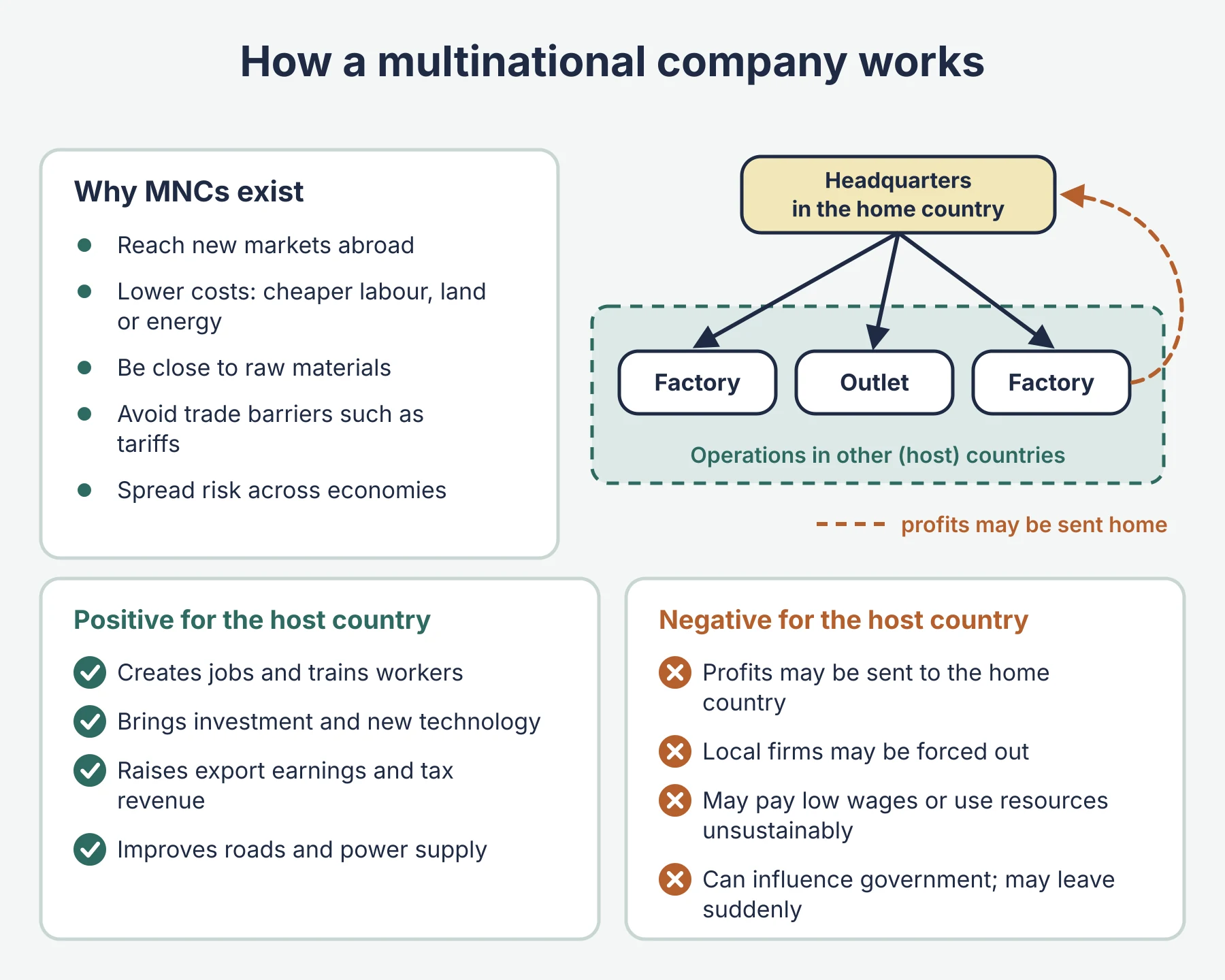
What are multinational companies? (2.1.3)
A multinational company (MNC) has its headquarters in one country and production or service operations in at least one other.
Features: very large scale; operations, factories or outlets in several countries; well-known brands; large capital and spending on research; often listed as a public limited company.
Reasons MNCs exist in the global economy:
- To reach new markets and customers abroad.
- To lower costs by locating where labour, land or energy is cheaper.
- To be close to raw materials.
- To avoid trade barriers: producing inside a country avoids tariffs on imports into it.
- To spread risk across several economies.
| Positive impacts on a host country | Negative impacts on a host country |
|---|---|
| Creates jobs and trains workers | Profits may be sent back to the home country |
| Brings investment and new technology | Local firms may be forced out by competition |
| Raises export earnings and tax revenue | May pay low wages or use resources unsustainably |
| Improves infrastructure such as roads and power | Can influence government decisions; may leave suddenly if costs rise |
What are franchises? (2.1.4)
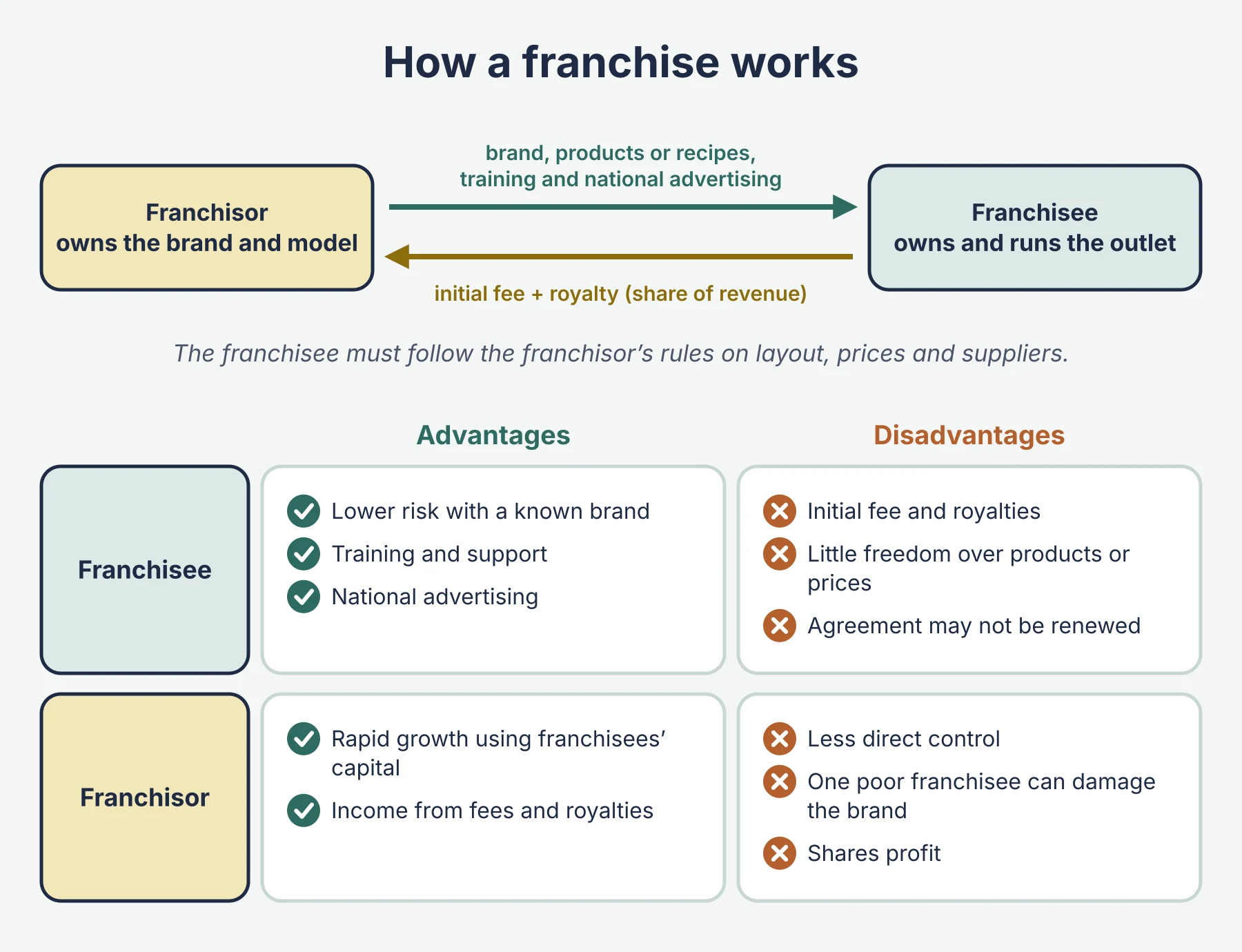
A franchise is an agreement in which a franchisor (the owner of a brand and business model) allows a franchisee to trade under its name, in return for an initial fee and usually a continuing royalty or share of revenue.
Features: the franchisee owns and runs the outlet; the franchisor supplies the brand, products or recipes, training and national advertising; the franchisee must follow the franchisor’s rules on layout, prices and suppliers.
| Advantages | Disadvantages | |
|---|---|---|
| Franchisee | Lower risk with a known brand; training and support; national advertising | Initial fee and royalties; little freedom to choose products or prices; the agreement may not be renewed |
| Franchisor | Rapid growth using franchisees’ capital; income from fees and royalties | Less direct control; one poor franchisee can damage the whole brand; shares profit |
How do enterprises choose a location? (2.1.5)
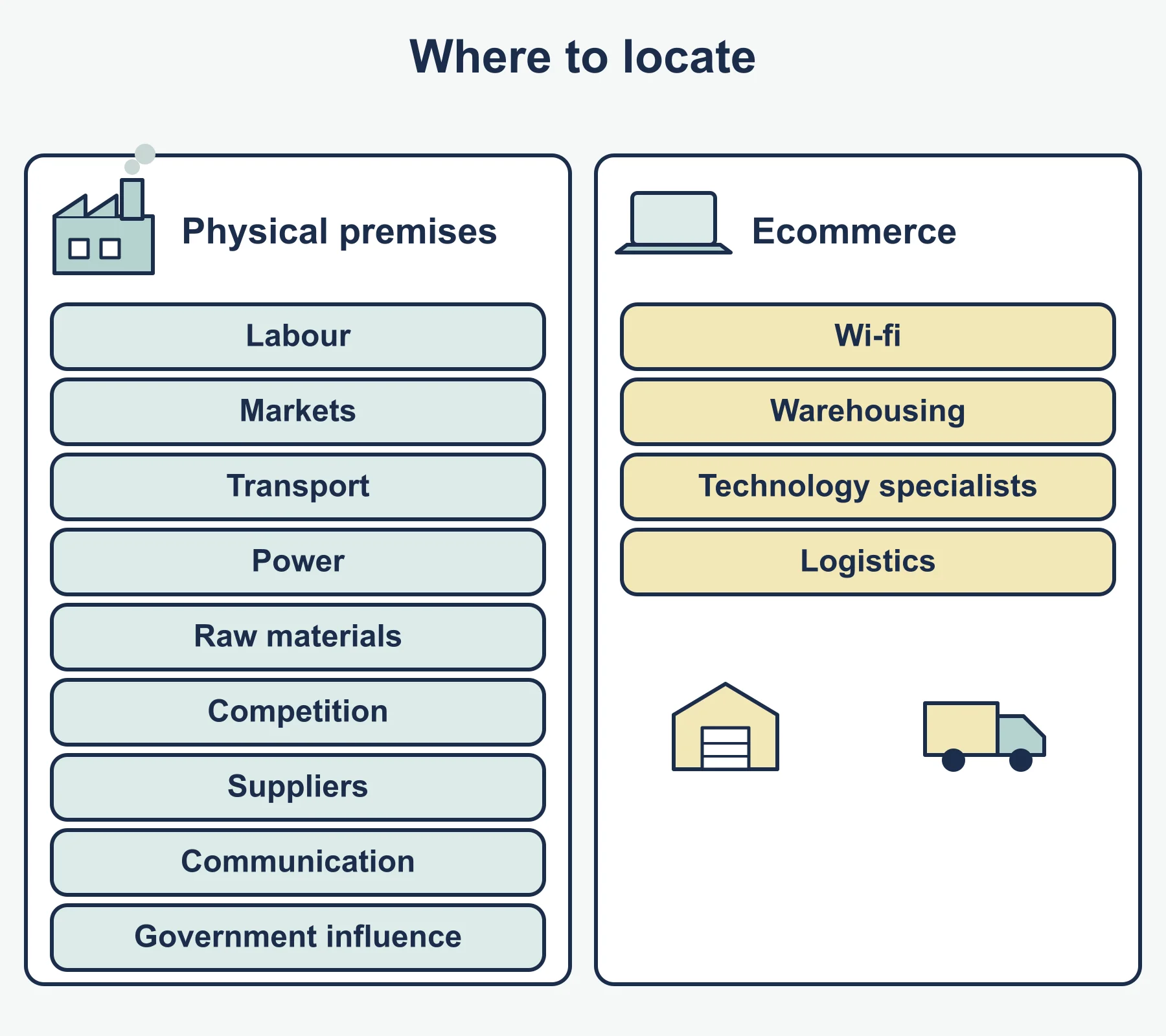
Physical location factors: labour, markets, transport, power, raw materials, competition, suppliers, communication and government influence (such as grants, tax incentives or planning rules).
Ecommerce location factors: wi-fi (reliable, fast internet), warehousing (space to store and dispatch stock), technology specialists (staff to build and maintain the website and systems) and logistics (access to couriers and delivery networks).
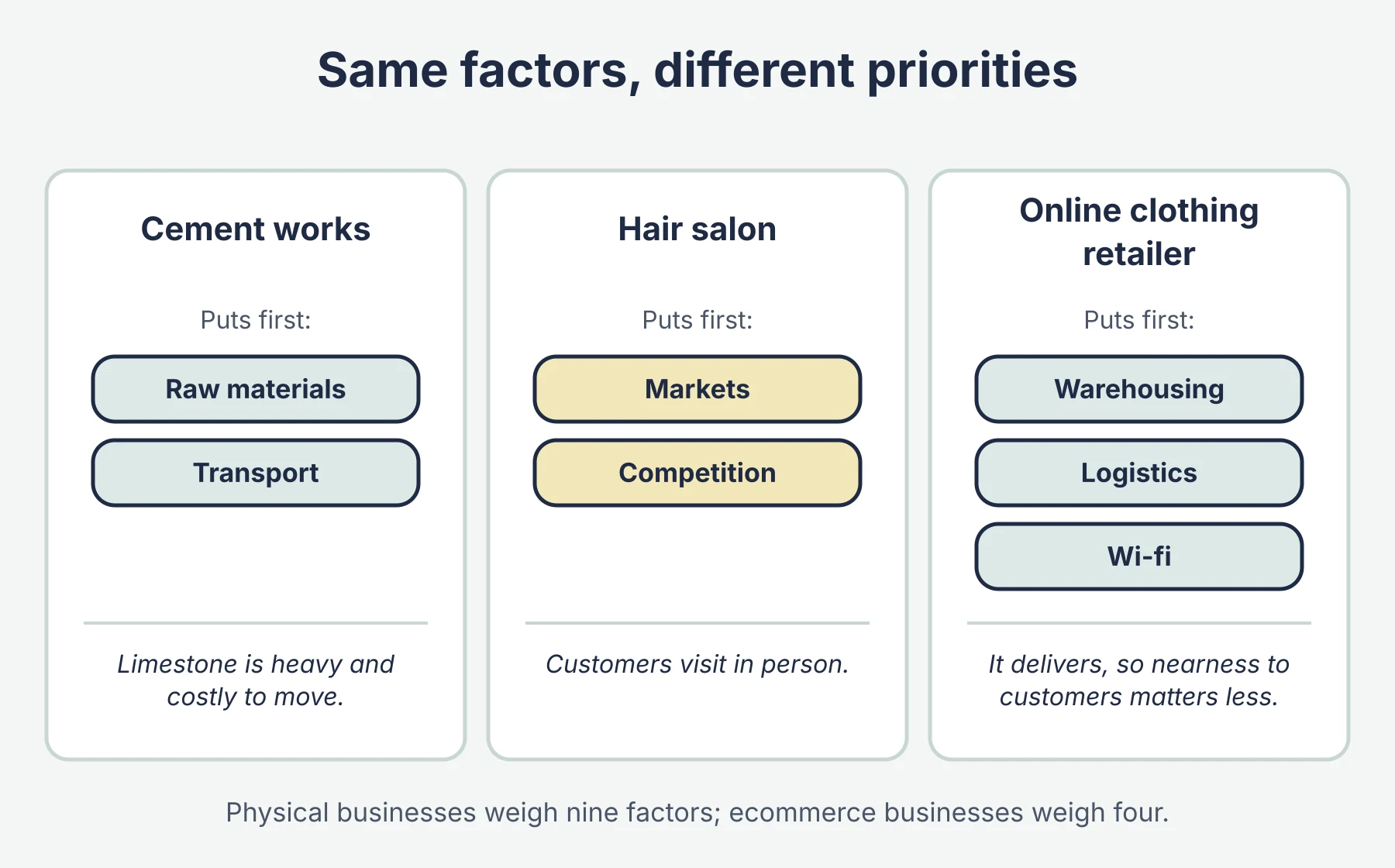
The appropriate factors depend on the business:
- A cement works puts raw materials and transport first, because limestone is heavy and costly to move.
- A hair salon puts markets and competition first, because customers visit in person.
- An online clothing retailer puts warehousing, logistics and wi-fi first; nearness to customers matters less because it delivers.
What are the common mistakes in 2.1?
- Saying all partners have limited liability; in an ordinary partnership they do not.
- Confusing a public limited company (private sector, owned by shareholders) with a public corporation (public sector, owned by government).
- Saying cooperative members vote by number of shares instead of one member, one vote.
- Listing MNC impacts on one side only.
- Describing franchise advantages without saying whether they are for the franchisor or the franchisee.
- Mixing physical and ecommerce location factors.
Exam technique
- Identify or state: name the form of ownership or the factor.
- Explain: give the feature and its consequence for the business named.
- Assess, evaluate or justify: compare at least two options against the scenario and finish with a clear recommendation and a reason.
Where can I practise?
Recall the key points with the commercial enterprises revision notes, then try the commercial enterprises practice questions.
Official syllabus
Cambridge IGCSE Commerce (0715) syllabus for 2028, section 2.1 Commercial enterprises: official syllabus PDF.
Related resources
-
Practice questions
Cambridge IGCSE Commerce (0715): Commercial enterprises – Practice Questions
Original Cambridge IGCSE Commerce 0715 questions with answers on business ownership, public corporations, multinationals, franchises and location factors.
Commerce · Cambridge · IGCSE
Try questions -
Revision notes
Cambridge IGCSE Commerce (0715): Commercial enterprises – Revision Notes
Recall notes for Cambridge IGCSE Commerce 0715 section 2.1: ownership comparison table, public corporations, MNC impacts, franchises and location factors.
Commerce · Cambridge · IGCSE
Revise topic -
Study guides
Cambridge IGCSE Commerce (0715): Communication
Types and methods of communication and the six factors that decide which method suits a situation, for Cambridge IGCSE Commerce 0715 section 2.6.
Commerce · Cambridge · IGCSE
Read guide
Get free revision emails (optional)
Occasional emails with practice questions, worked explanations and links to free resources for the qualification and subjects you choose. No spam, and you can unsubscribe from any email. The free tools on this site never need an email.