
Study Guides
Cambridge IGCSE Commerce (0715): Communication
Types and methods of communication and the six factors that decide which method suits a situation, for Cambridge IGCSE Commerce 0715 section 2.6.
- Subject
- Commerce
- Level
- IGCSE
- Topic
- Topic 2 – Commercial Operations
- Author
- Marlbridge Academic Team
- Updated
- Reviewed by
- Salman Ahmad (what this means)
Aligned to Cambridge IGCSE Commerce (0715), 2028. Official specification .
Syllabus page (what it covers and how it is assessed): Cambridge IGCSE Commerce.
Syllabus points this page covers
0715
- 2.6 Communication
Found an error? Report a correction.
Need help with this topic? Request a free trial class for IGCSE Commerce (0715).
Communication is the first aid to trade named in Topic 1: buyers and sellers cannot trade until they can exchange information. Section 2.6 of the Cambridge IGCSE Commerce (0715) syllabus has three parts: the types of communication (written, oral, electronic and visual), the methods (letter, telephone, face to face, videoconferencing, email, web-based chat including chatbots, social media and posters) and the factors that decide which method is appropriate (urgency, cost, security, distance, availability of networks and importance of the message). Paper 2 questions usually describe a situation and ask you to recommend a method, so the skill is matching. This page goes further than the communication section of the Commercial Operations study guide, with more on each method and worked recommendations.
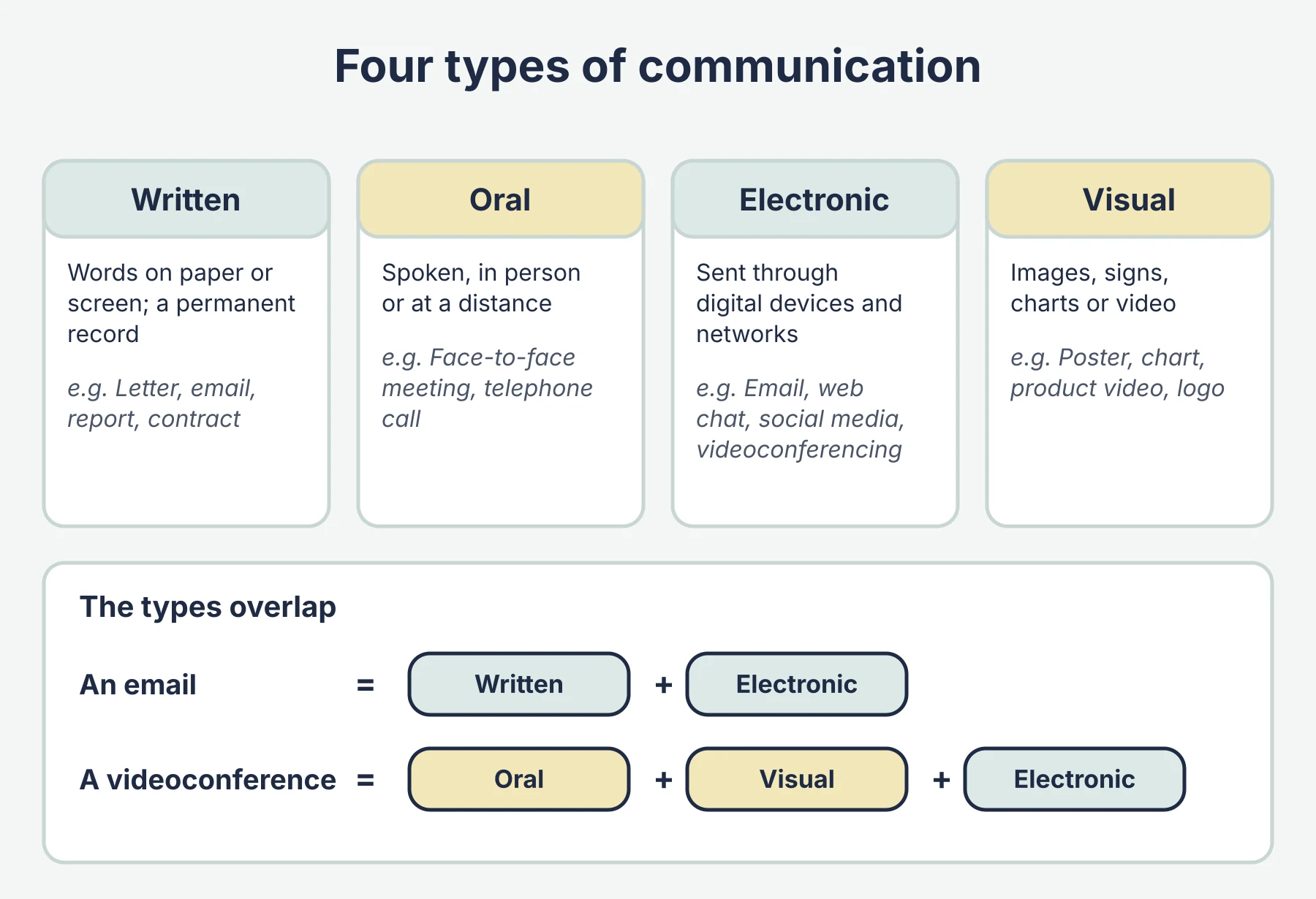
What are the four types of communication? (2.6.1)
| Type | Meaning | Examples |
|---|---|---|
| Written | Words set down on paper or screen, giving a permanent record | Letter, email, report, contract |
| Oral | Spoken communication, in person or at a distance | Face-to-face meeting, telephone call |
| Electronic | Communication sent through digital devices and networks | Email, web-based chat, social media, videoconferencing |
| Visual | Information given through images, signs, charts or video | Poster, chart, product video, logo |
The types overlap. An email is both written and electronic; a videoconference is oral, visual and electronic. If a question asks you to distinguish types, give the main feature of each type and an example that fits it best.
What methods of communication are there? (2.6.2)
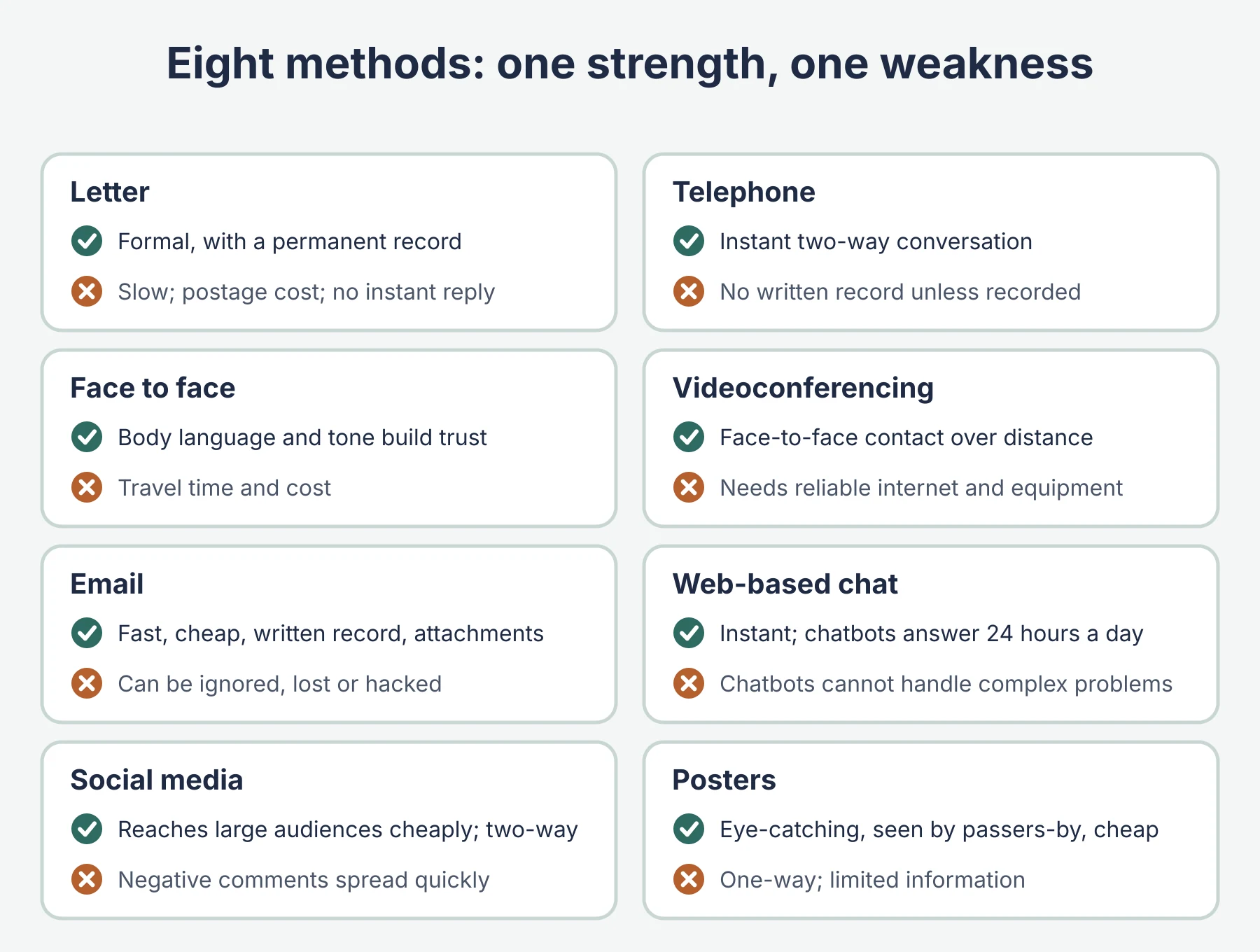
| Method | Advantages | Disadvantages |
|---|---|---|
| Letter | Formal; permanent record; can include signatures and enclosures; suits people without internet | Slow; postage cost; no instant reply |
| Telephone | Instant two-way conversation; tone of voice helps understanding; questions answered at once | No written record unless recorded; both people must be available; time zones |
| Face to face | Body language and tone show meaning; builds trust; best for sensitive or complex issues | Travel time and cost; must meet in one place; no record unless notes are taken |
| Videoconferencing | Face-to-face contact over distance; several people in different places; screens and documents shared | Needs reliable internet and equipment; delays or dropped connections; harder to read body language |
| Fast and cheap; written record; attachments; one message to many people | Can be ignored or lost among other emails; risk of hacking or sending to the wrong person | |
| Web-based chat (including chatbots) | Instant help on a website; chatbots answer common questions 24 hours a day at low cost | Chatbots cannot handle unusual or complex problems; customers may find them frustrating |
| Social media | Reaches very large audiences cheaply; two-way, so customers can reply and share | Negative comments spread quickly; messages are public; hard to control |
| Posters | Visual and eye-catching; seen by everyone passing; cheap to produce | One-way; limited information; only seen in one place |
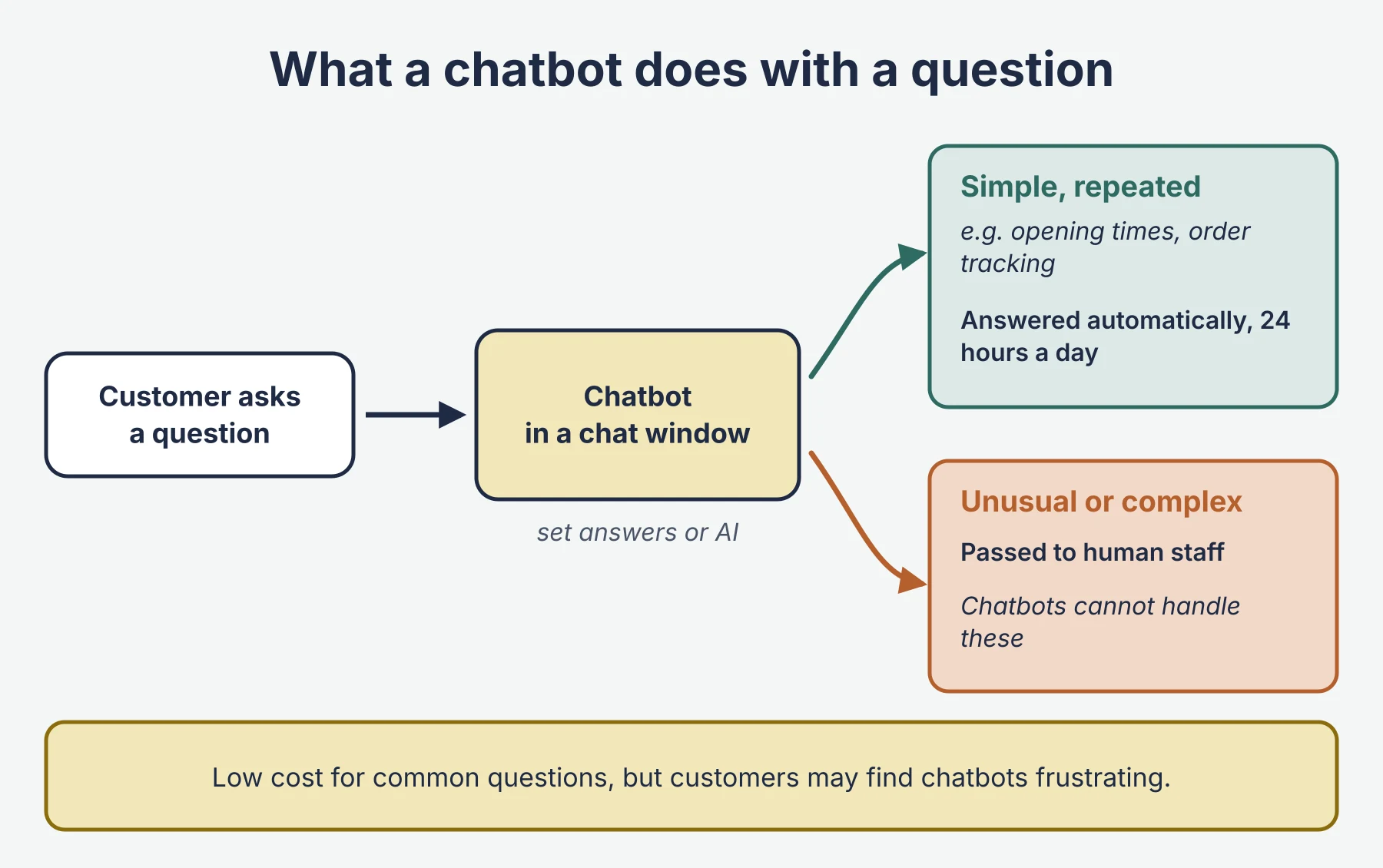
A chatbot is a computer program that answers customer questions automatically in a chat window, using set answers or artificial intelligence. Businesses use chatbots to handle simple, repeated questions (opening times, order tracking) and pass complex ones to human staff.
Which factors affect the choice of method? (2.6.3)
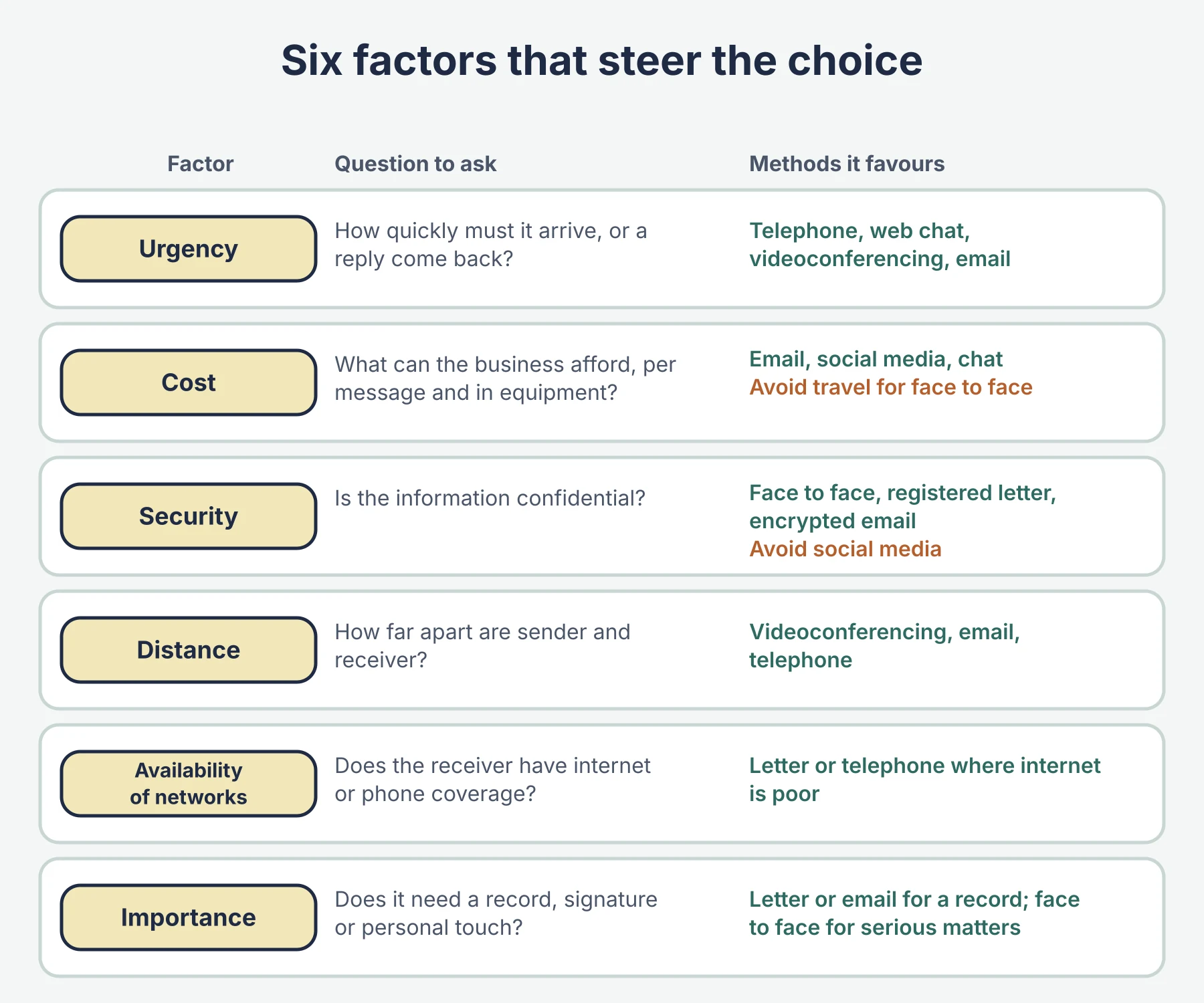
The syllabus names six factors. Each one pushes the choice in a particular direction:
| Factor | Question to ask | Methods it favours |
|---|---|---|
| Urgency | How quickly must the message arrive, or a reply come back? | Telephone, web-based chat, videoconferencing, email |
| Cost | What can the business afford, per message and in equipment? | Email, social media, chat; avoid travel for face to face |
| Security | Is the information confidential? | Face to face, registered letter, encrypted email; avoid social media |
| Distance | How far apart are sender and receiver? | Videoconferencing, email, telephone for long distances |
| Availability of networks | Does the receiver have internet or phone coverage? | Letter or telephone where internet is poor |
| Importance of the message | Does it need a record, signature or personal touch? | Letter or email for a record; face to face for serious matters |
Most situations involve two or three factors, sometimes pulling in opposite directions. A strong answer names the factors in the scenario, recommends a method and says why it beats an alternative.
Worked example: matching method to situation
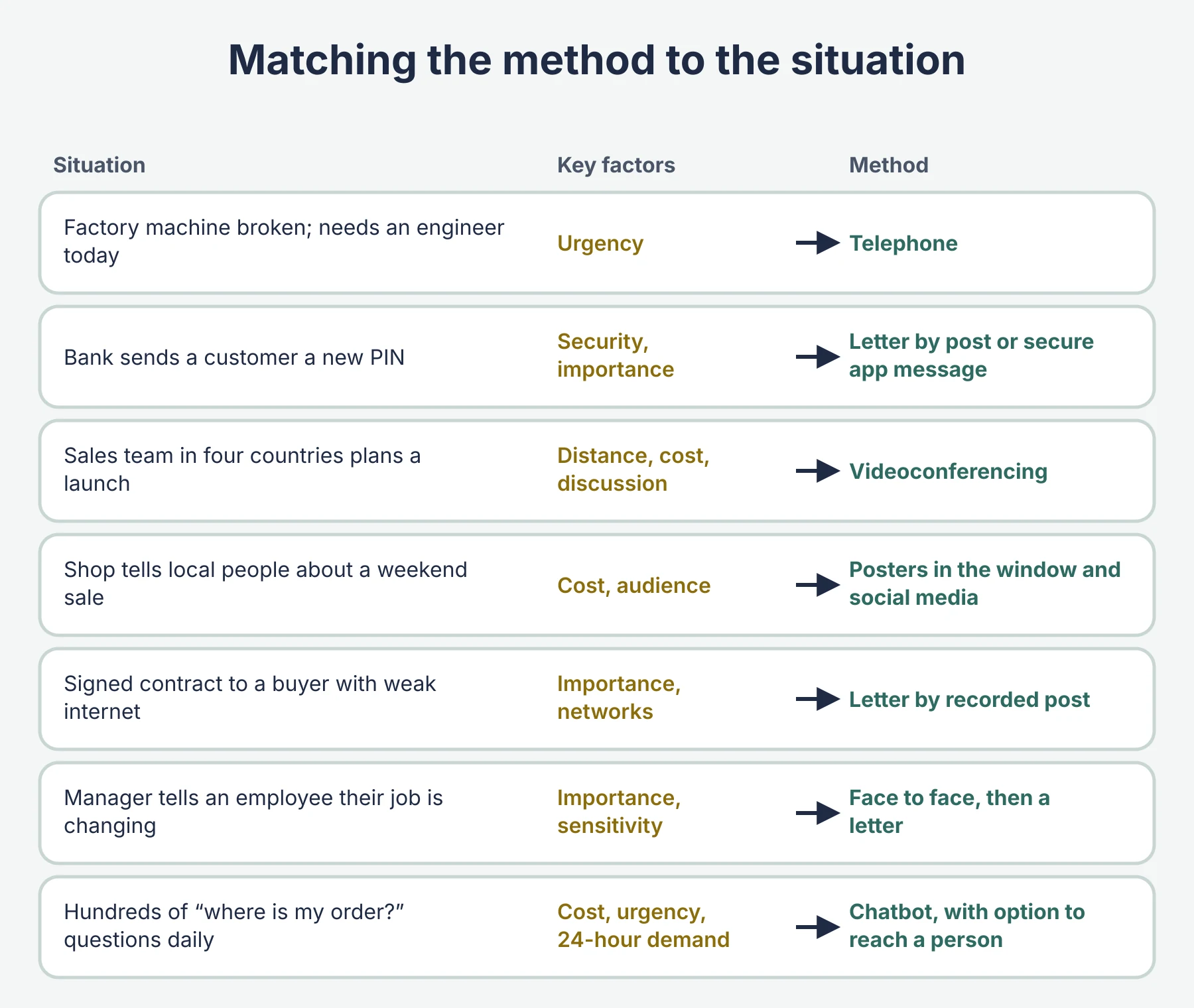
| Situation | Key factors | Recommended method | Why not the obvious alternative? |
|---|---|---|---|
| A factory’s machine has broken and it needs an engineer today | Urgency | Telephone | Email may not be read in time |
| A bank must send a customer a new PIN | Security, importance | Letter by post or a secure app message | Social media or ordinary email could be seen by others |
| A sales team in four countries needs to plan a product launch | Distance, cost, need for discussion | Videoconferencing | Face to face would cost a lot in flights and time |
| A shop wants to tell local people about a weekend sale | Cost, audience | Posters in the shop window and social media | A letter to every household is slow and costly |
| A supplier must send a signed contract to a buyer in a rural area with weak internet | Importance, availability of networks | Letter by recorded post | Email depends on a reliable connection |
| A manager must tell an employee that their job is changing | Importance, sensitivity | Face to face, followed by a letter | Email feels impersonal and cannot respond to the employee’s reaction |
| An online shop receives hundreds of “where is my order?” questions daily | Cost, urgency, 24-hour demand | Web-based chatbot, with option to reach a person | Telephone staff for every query would be expensive |
Annotated model answer
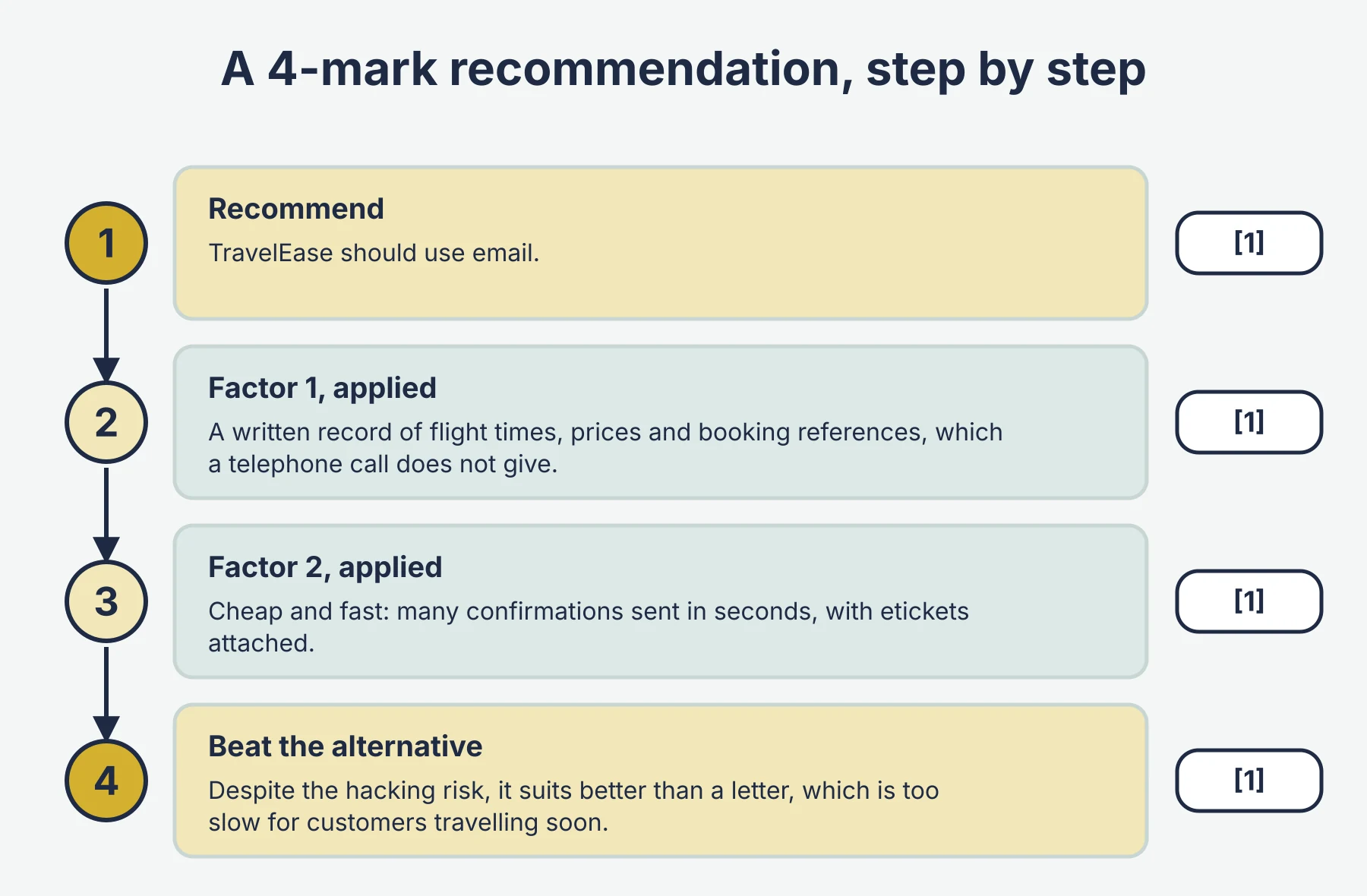
Question: TravelEase, a travel agency, wants to confirm flight bookings for its customers. Recommend a method of communication and justify your choice. [4]
TravelEase should use email [1]. Bookings need a written record of flight times, prices and booking references that the customer can keep and show at the airport, which a telephone call does not give [1]. Email is also cheap and fast, so many confirmations can be sent in seconds, and attachments such as etickets can be included [1]. Although email could be hacked, the importance of a permanent record and its low cost make it more suitable than a letter, which would be too slow for customers travelling soon [1].
Why it scores: a clear recommendation, two factors from the syllabus applied to TravelEase, and a comparison with alternatives.
What are the common mistakes in 2.6?
- Confusing types (written, oral, electronic, visual) with methods (letter, email and so on).
- Recommending a method without naming the factor that makes it suitable.
- Saying email is always the best because it is cheap; security, urgency or importance may point elsewhere.
- Treating videoconferencing as having no costs; it needs equipment and reliable networks.
- Forgetting that a chatbot cannot deal with complex or sensitive queries.
Exam technique for the command words
- Identify: name the type or method.
- Explain: give one advantage or disadvantage and link it to the situation.
- Recommend or justify: choose one method, apply two factors from the scenario, and explain why it beats an alternative.
- Evaluate: weigh the benefits and drawbacks of a method, such as replacing call-centre staff with a chatbot, and reach a judgement.
Where can I practise?
Review the communication revision notes, then try the communication practice questions. Communication as an aid to trade is introduced in the trade and commerce study guide.
Official syllabus
Cambridge IGCSE Commerce (0715) syllabus for 2028, section 2.6 Communication: official syllabus PDF.
Related resources
-
Practice questions
Cambridge IGCSE Commerce (0715): Communication – Practice Questions
Original Cambridge IGCSE Commerce 0715 questions with answers on types and methods of communication and choosing the right method for a situation.
Commerce · Cambridge · IGCSE
Try questions -
Revision notes
Cambridge IGCSE Commerce (0715): Communication – Revision Notes
Recall notes for Cambridge IGCSE Commerce 0715 section 2.6: four types of communication, eight methods, six choice factors and a recommendation method.
Commerce · Cambridge · IGCSE
Revise topic -
Study guides
Cambridge IGCSE Commerce (0715): Outsourcing
Why outsourcing has grown, how contract manufacturing and contract logistics work, and cost comparisons, for Cambridge IGCSE Commerce 0715 section 2.2.
Commerce · Cambridge · IGCSE
Read guide
Get free revision emails (optional)
Occasional emails with practice questions, worked explanations and links to free resources for the qualification and subjects you choose. No spam, and you can unsubscribe from any email. The free tools on this site never need an email.