
Study Guides
Cambridge IGCSE Commerce (0715): Trade and commerce
Trade versus commerce, home and international trade, aids to trade, logistics and the four types of commerce, for Cambridge IGCSE Commerce 0715 section 1.1.
- Subject
- Commerce
- Level
- IGCSE
- Topic
- Topic 1 – Commerce and Production
- Author
- Marlbridge Academic Team
- Updated
- Reviewed by
- Salman Ahmad (what this means)
Aligned to Cambridge IGCSE Commerce (0715), 2028. Official specification .
Syllabus page (what it covers and how it is assessed): Cambridge IGCSE Commerce.
Syllabus points this page covers
0715
- 1.1 Trade and commerce
Found an error? Report a correction.
Need help with this topic? Request a free trial class for IGCSE Commerce (0715).
Section 1.1 of the Cambridge IGCSE Commerce (0715) syllabus is where the subject’s vocabulary begins. It asks you to separate trade from commerce, to split trade into home and international trade, to name the six aids to trade, to explain logistics, to tell four types of commerce apart and to show how production, trade and commerce depend on each other. Almost every later topic assumes you can use these words precisely, so marks lost here tend to be lost again in Topics 2 to 6.
This page goes deeper into 1.1 than the Commerce and Production study guide, which introduces the whole of Topic 1.
What does 1.1 contain?
| Section | Syllabus content |
|---|---|
| 1.1.1 Trade | Meaning of trade and commerce and the differences between them; home trade (retail and wholesale); international trade (exports and imports) |
| 1.1.2 Aids to trade and logistics | Meaning and six types of aids to trade; meaning of logistics; its elements in a supply chain: transport, freight forwarders and warehousing |
| 1.1.3 Types of commerce | Traditional commerce, ecommerce, mcommerce and scommerce |
| 1.1.4 Production, trade and commerce | How the three are interdependent |
How is trade different from commerce? (1.1.1)
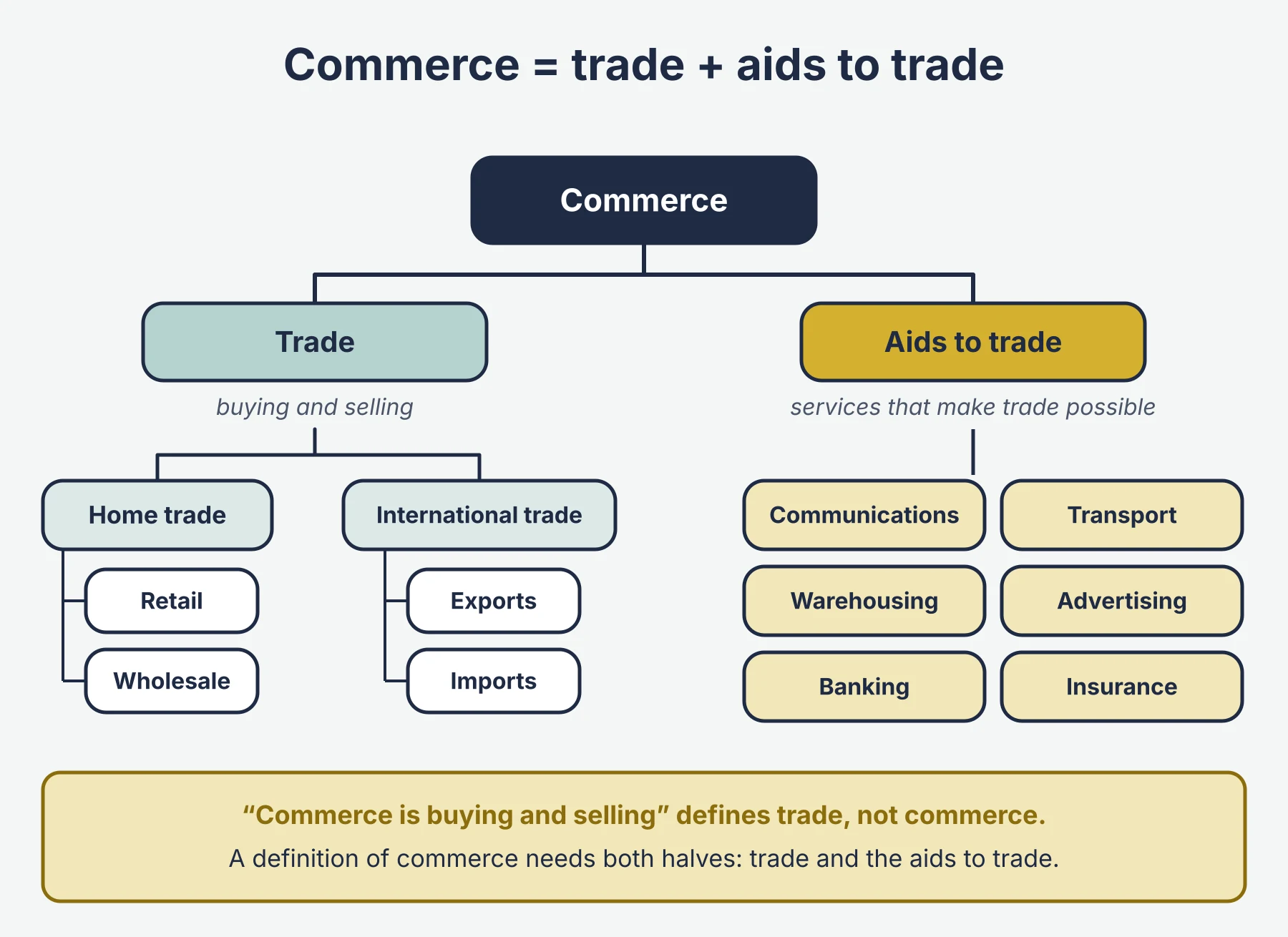
Trade is the buying and selling of goods and services. It is the exchange itself: a shop selling a phone, a farmer selling rice to a mill, a firm buying cleaning services.
Commerce is wider. It is trade plus all the services that make trade possible, the aids to trade. Commerce covers every activity involved in getting goods and services from the producer to the consumer.
Three differences are worth learning as a set:
- Scope. Trade is one part of commerce; commerce includes trade and the aids to trade.
- Activity. Trade is the transfer of ownership in return for payment. Commerce also includes moving, storing, insuring, financing, advertising and communicating about the goods, none of which transfers ownership.
- Who is involved. Trade involves a buyer and a seller. Commerce also involves banks, insurers, transport firms, warehouses, advertising agencies and communication providers.
A definition question (“Define commerce”) needs both halves: buying and selling and the services that support it. “Commerce is buying and selling” describes trade, not commerce, and does not earn the mark.
What are home trade and international trade? (1.1.1)
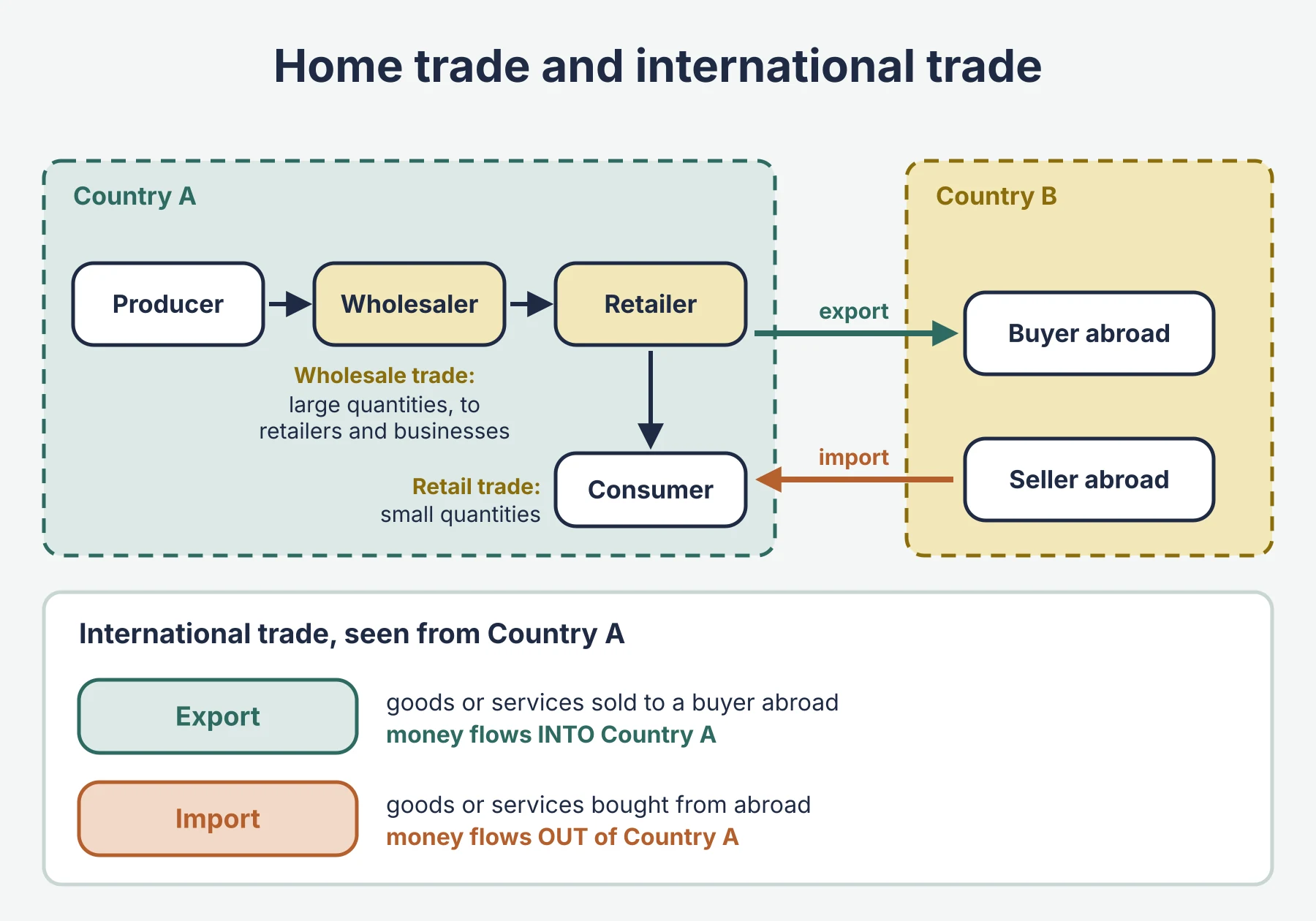
Home trade (domestic trade) is buying and selling within one country. The syllabus divides it into two kinds:
- Retail trade: selling goods in small quantities to the final consumer, who buys for personal use.
- Wholesale trade: buying goods in large quantities from producers and selling them in smaller quantities to retailers or other businesses.
International trade is buying and selling between countries. Exports are goods and services sold to buyers in other countries, so money flows into the exporting country. Imports are goods and services bought from other countries, so money flows out.
A quick test: ask where the buyer and seller are. A tea grower selling to a packer in the same country is home trade; selling to a buyer abroad is an export for the grower’s country and an import for the buyer’s.
What are aids to trade? (1.1.2)
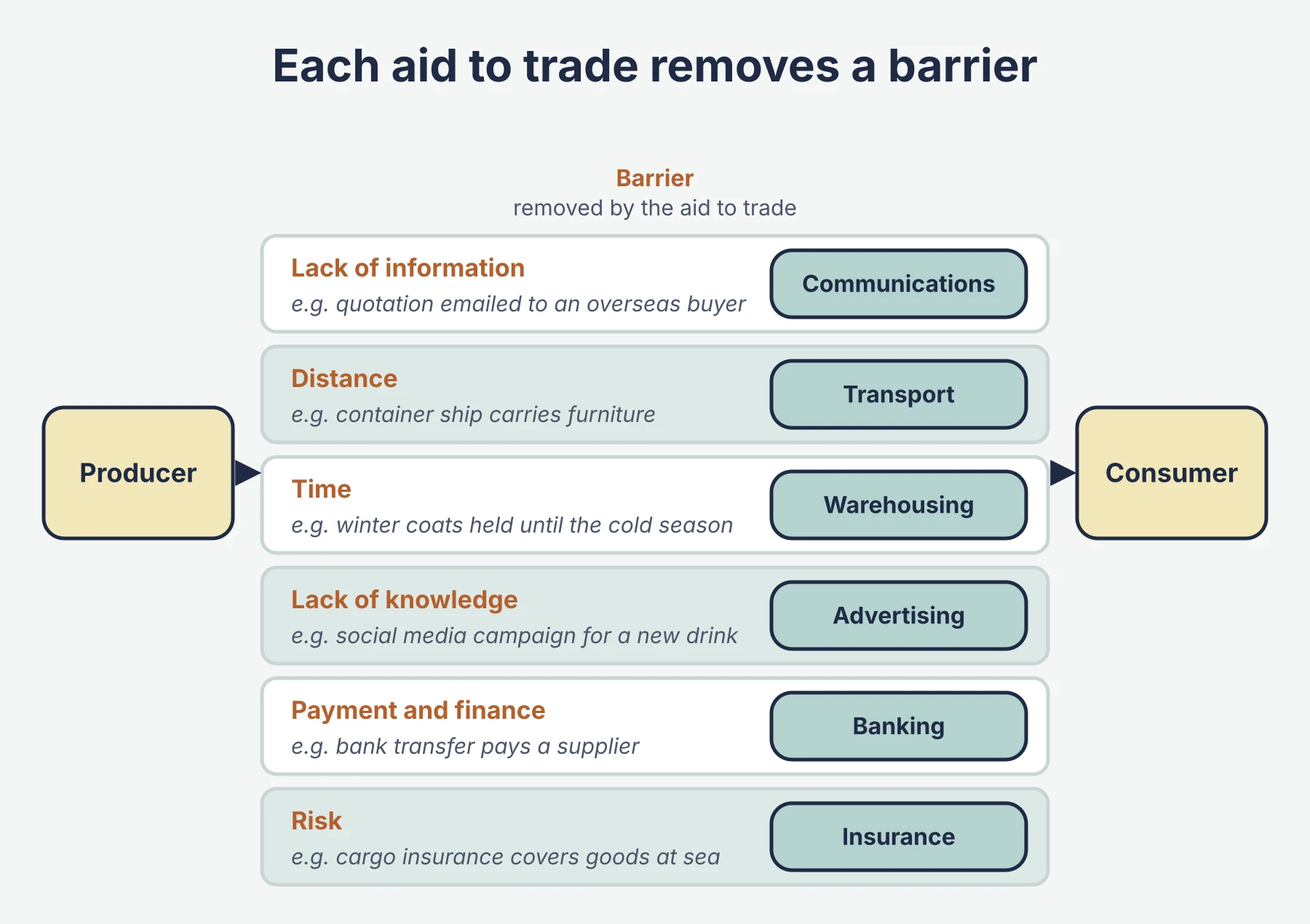
Aids to trade are services that help trade to take place by removing the barriers between producers and consumers. They do not make or sell the goods themselves. The syllabus names six, and each one deals with a different barrier:
| Aid to trade | Barrier it removes | Example |
|---|---|---|
| Communications | Lack of information between buyer and seller | An exporter emails a quotation to an overseas buyer |
| Transport | Distance: goods are made in one place and wanted in another | A container ship carries furniture between continents |
| Warehousing | Time: goods are made before they are needed | A store of winter coats is held until the cold season |
| Advertising | Lack of knowledge: consumers do not know the product exists | A social media campaign for a new drink |
| Banking | Payment and finance: buyers need a safe way to pay and firms need funds | A bank transfer pays a supplier |
| Insurance | Risk: goods may be lost, stolen or damaged | Cargo insurance covers goods at sea |
Linking each aid to its barrier turns a list into an explanation. The aids are studied in depth later: communication in 2.6, transport and warehousing in Topic 4, the other three in Topic 5.
What is logistics? (1.1.2)
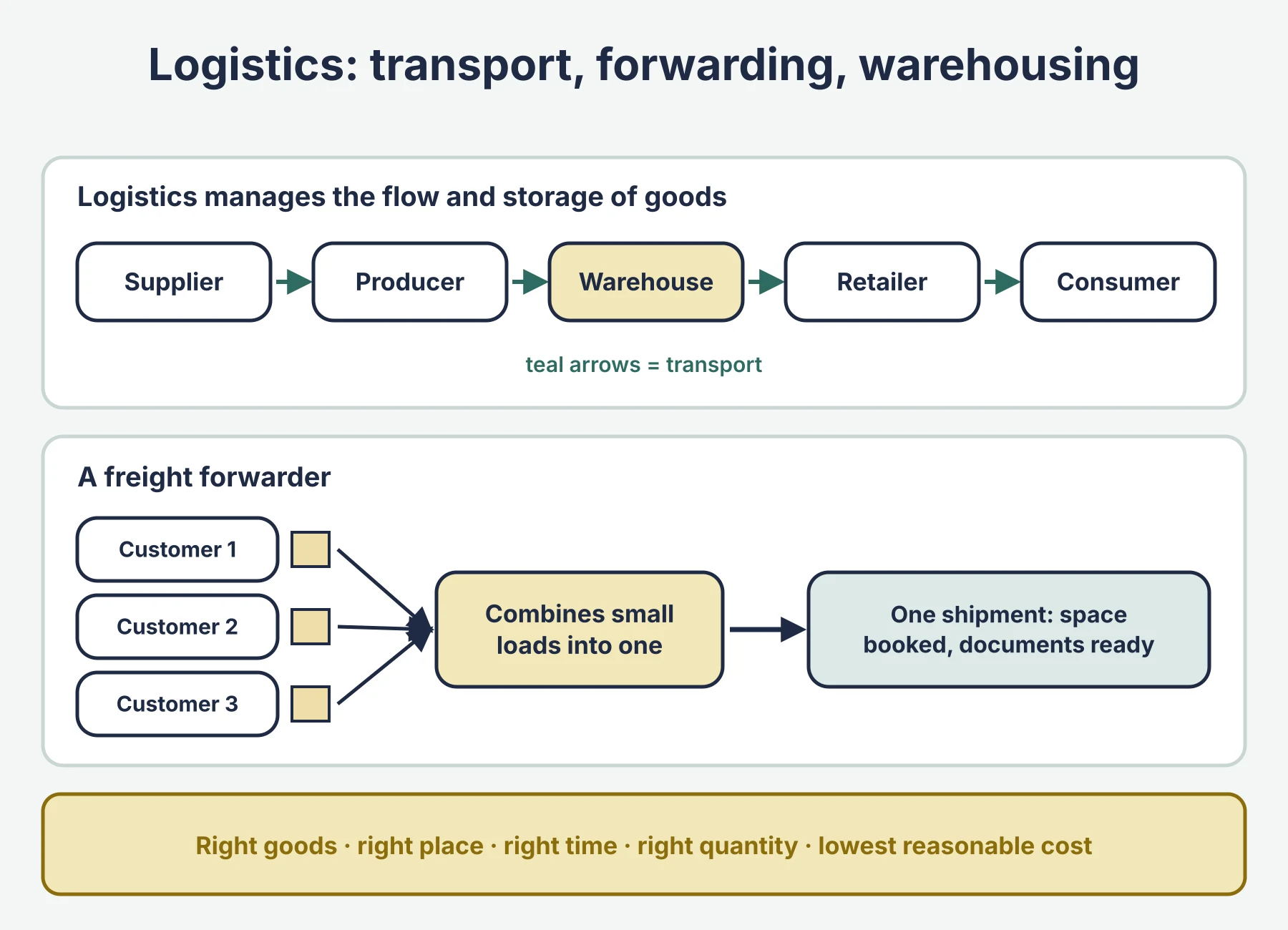
Logistics is the planning and management of the movement and storage of goods through a supply chain, so that the right goods arrive at the right place, at the right time, in the right quantity and at the lowest reasonable cost.
The syllabus names three elements of logistics in a supply chain:
- Transport: physically moving goods between supplier, producer, warehouse, retailer and consumer.
- Freight forwarders: specialist firms that arrange transport for other businesses, especially exporters. They book space on ships, aircraft or trucks, often combine small loads from several customers into one larger shipment, and help prepare the documents needed to send goods abroad.
- Warehousing: storing goods safely until they are needed, so that supply can meet demand.
Transport and warehousing are also aids to trade; logistics is the idea of managing them, with the freight forwarder, as one flow.
What are the four types of commerce? (1.1.3)
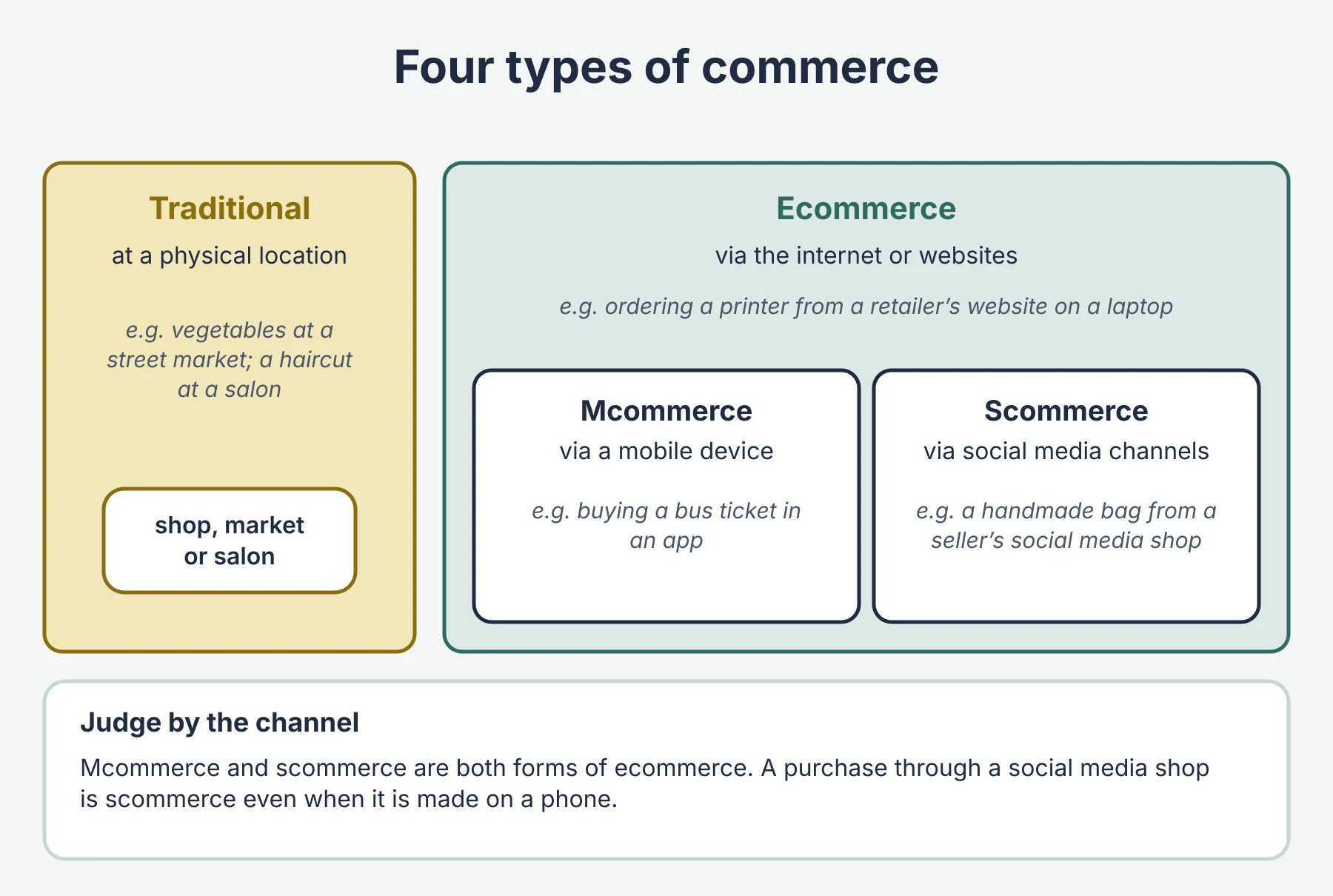
The syllabus defines each type by where or how the buying and selling happens.
| Type | Syllabus meaning | Example |
|---|---|---|
| Traditional commerce | Buying and selling goods and/or services at a physical location | Buying vegetables at a street market or a haircut at a salon |
| Ecommerce (electronic commerce) | Buying and selling goods and/or services via the internet or websites | Ordering a printer from an online retailer’s website on a laptop |
| Mcommerce (mobile commerce) | Buying and selling goods and/or services via a mobile device, such as a smartphone or tablet | Booking a taxi or buying a bus ticket in an app |
| Scommerce (social commerce) | Buying and selling goods and/or services via social media channels | Buying a handmade bag directly through a seller’s social media shop |
Mcommerce and scommerce are both forms of ecommerce, because they use the internet. The distinction an examiner looks for is the channel: a website (ecommerce), a mobile device (mcommerce) or a social media platform (scommerce). A purchase through a social media shop is scommerce even when it is made on a phone.
How are production, trade and commerce interdependent? (1.1.4)
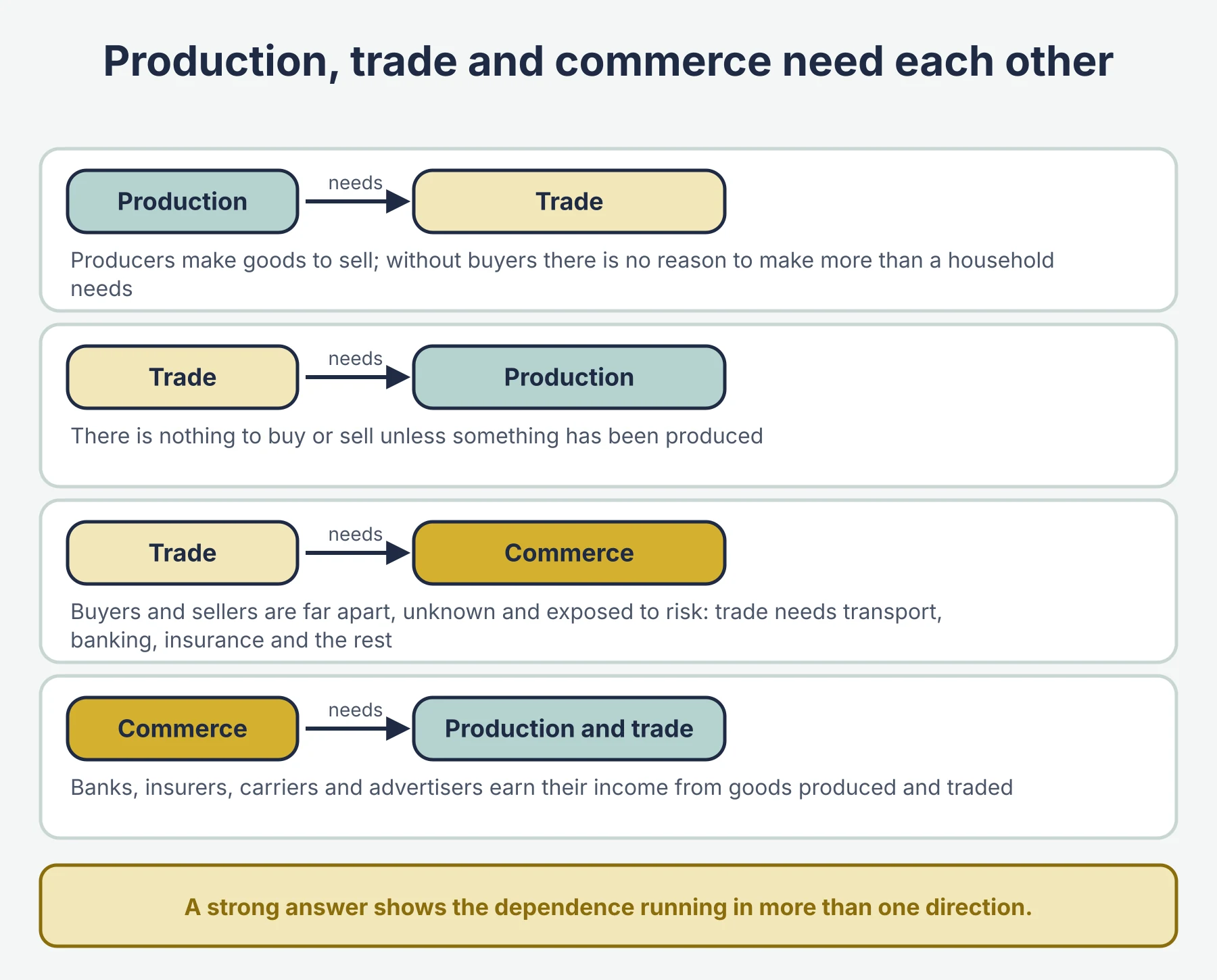
Interdependent means each depends on the others. A strong answer shows the dependence running in more than one direction:
- Production depends on trade. Producers make goods to sell, not just for their own use. Without trade there would be no buyers and no reason to produce more than a household needs.
- Trade depends on production. There is nothing to buy or sell unless something has been produced.
- Trade depends on commerce. Buyers and sellers are usually far apart, unknown to each other and exposed to risk. Without transport, banking, insurance, advertising, warehousing and communication, most trade could not happen.
- Commerce depends on production and trade. Banks, insurers, carriers and advertisers earn their income from the goods that are produced and traded.
Worked example: an annotated model answer
Question: Explain how production, trade and commerce are interdependent, using the example of a chocolate manufacturer. [4]
A chocolate manufacturer produces bars in its factory, but it produces far more than it could use, so it depends on trade, selling to wholesalers and retailers, to earn revenue [1]. The retailers depend on the manufacturer’s production because without it they would have nothing to sell [1]. Trade itself relies on commerce: the bars must be transported in refrigerated trucks and stored in warehouses before sale, and the manufacturer needs insurance against damage in transit [1]. In turn, the transport firms and insurers earn their income only because chocolate is being produced and traded, so all three depend on each other [1].
Worked example: classifying transactions
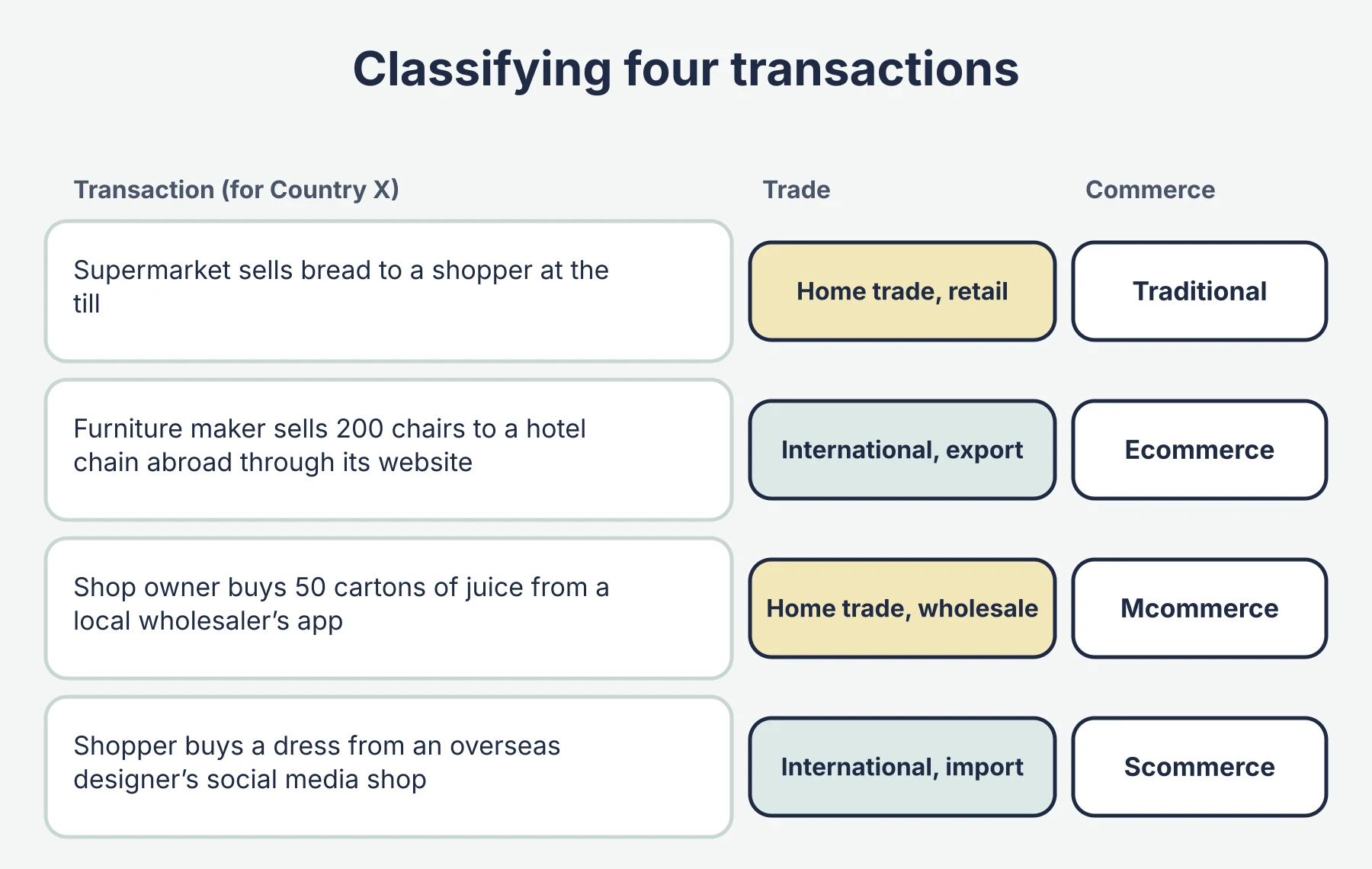
Classify each transaction as home trade (retail or wholesale) or international trade (export or import) for Country X, and name the type of commerce.
| Transaction | Classification | Type of commerce |
|---|---|---|
| A supermarket in Country X sells bread to a shopper at the till | Home trade, retail | Traditional |
| A furniture maker in Country X sells 200 chairs to a hotel chain abroad through its website | International trade, export | Ecommerce |
| A shop owner in Country X buys 50 cartons of juice from a local wholesaler using the wholesaler’s app | Home trade, wholesale | Mcommerce |
| A shopper in Country X buys a dress from an overseas designer through a social media shop | International trade, import | Scommerce |
What are the common mistakes in 1.1?
- Defining commerce as buying and selling only, which is the definition of trade.
- Saying wholesale trade is selling to consumers; wholesalers sell mainly to retailers and other businesses.
- Reversing exports and imports, or forgetting that money flows in for an export.
- Listing aids to trade without saying what barrier each removes.
- Treating logistics as a single aid to trade; it is the management of transport, freight forwarding and warehousing together.
- Calling every online purchase “ecommerce” when the scenario clearly points to a mobile device or a social media channel.
- Describing interdependence in one direction only (“production needs commerce”) without the reverse links.
Exam technique for the command words
- Define: give a precise meaning in one sentence. For commerce, include both trade and aids to trade.
- Identify: name the item, such as the type of commerce in a scenario. No explanation is needed.
- Explain: give the reason or the link and support it, for example how insurance removes the barrier of risk for an exporter.
- Analyse: show the relationship between elements, such as how a freight forwarder, transport and warehousing work together in one supply chain.
- Discuss: write in a structured way about more than one side, for example whether scommerce will replace traditional commerce for a small clothing shop, ending with a reasoned view.
Where can I practise?
Use the trade and commerce revision notes for quick recall, then test yourself with the trade and commerce practice questions. Section 1.2 continues in the production study guide.
Official syllabus
Cambridge IGCSE Commerce (0715) syllabus for 2028, section 1.1 Trade and commerce: official syllabus PDF.
Related resources
-
Practice questions
Cambridge IGCSE Commerce (0715): Trade and commerce – Practice Questions
Original practice questions with mark-scheme answers on trade, commerce, aids to trade, logistics and types of commerce for Cambridge IGCSE Commerce 0715.
Commerce · Cambridge · IGCSE
Try questions -
Revision notes
Cambridge IGCSE Commerce (0715): Trade and commerce – Revision Notes
Condensed recall for Cambridge IGCSE Commerce 0715 section 1.1: trade and commerce, home and international trade, aids to trade, logistics and ecommerce types.
Commerce · Cambridge · IGCSE
Revise topic -
Practice questions
Commerce and Production: Practice Questions
Original exam-style practice questions with full worked answers on production, commerce, trade, aids to trade and the chain of distribution.
Commerce · Cambridge · IGCSE
Try questions
Get free revision emails (optional)
Occasional emails with practice questions, worked explanations and links to free resources for the qualification and subjects you choose. No spam, and you can unsubscribe from any email. The free tools on this site never need an email.