
Revision Notes
Cambridge IGCSE Commerce (0715): Trade and commerce – Revision Notes
Condensed recall for Cambridge IGCSE Commerce 0715 section 1.1: trade and commerce, home and international trade, aids to trade, logistics and ecommerce types.
- Subject
- Commerce
- Level
- IGCSE
- Topic
- Topic 1 – Commerce and Production
- Author
- Marlbridge Academic Team
- Updated
- Reviewed by
- Salman Ahmad (what this means)
Aligned to Cambridge IGCSE Commerce (0715), 2028. Official specification .
Syllabus page (what it covers and how it is assessed): Cambridge IGCSE Commerce.
Syllabus points this page covers
0715
- 1.1 Trade and commerce
Found an error? Report a correction.
Need help with this topic? Request a free trial class for IGCSE Commerce (0715).
Quick-recall notes for section 1.1 of Cambridge IGCSE Commerce (0715). For full explanations and worked answers, use the trade and commerce study guide.
The four parts of 1.1 at a glance
- 1.1.1 Trade: trade versus commerce; home trade (retail, wholesale); international trade (exports, imports).
- 1.1.2 Aids to trade and logistics: six aids; logistics and its three supply chain elements.
- 1.1.3 Types of commerce: traditional, ecommerce, mcommerce, scommerce.
- 1.1.4 Interdependence of production, trade and commerce.
Trade versus commerce
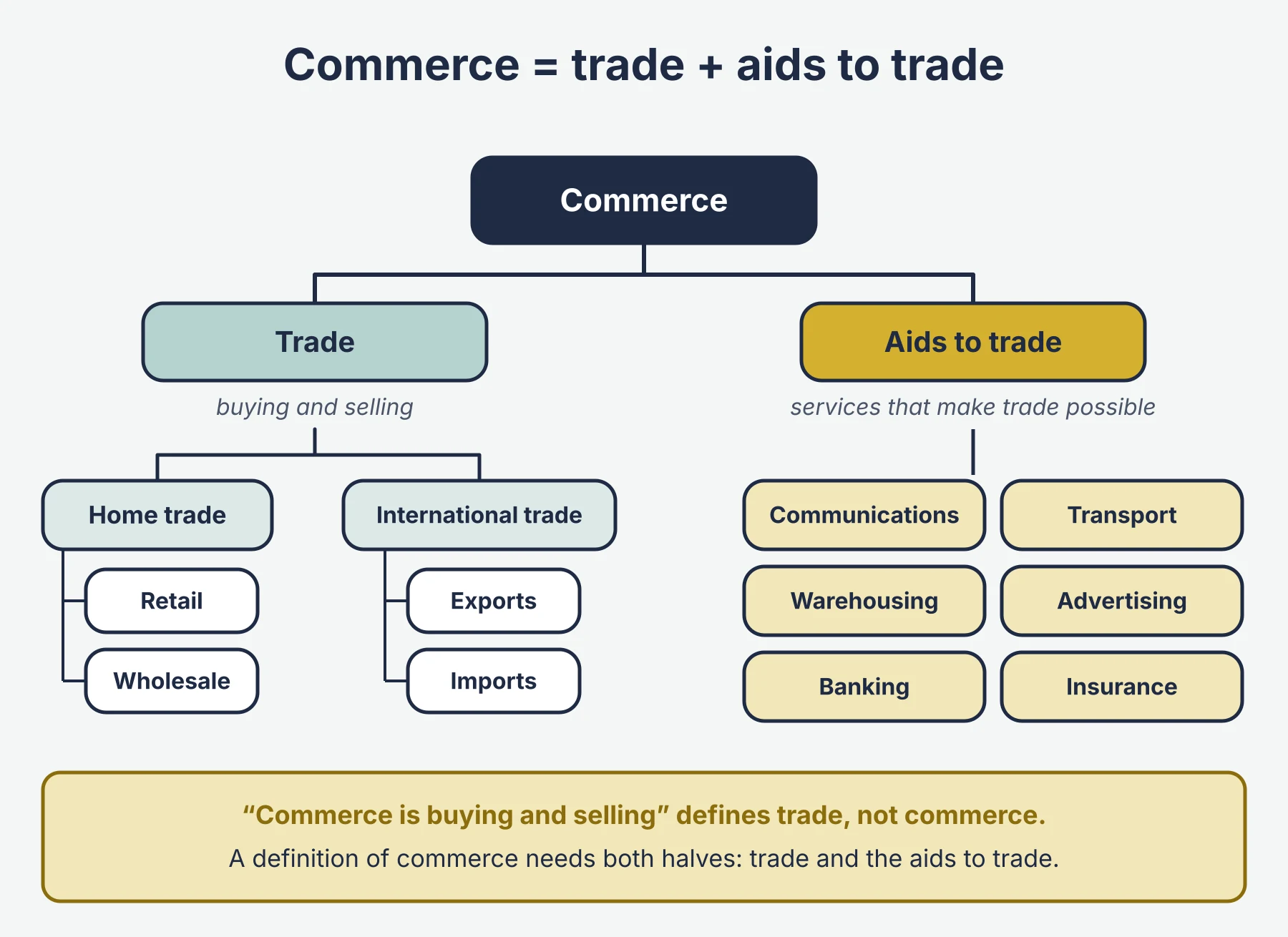
- Trade = buying and selling goods and services.
- Commerce = trade + aids to trade: every activity that gets goods and services from producer to consumer.
- Trade is a part of commerce. Commerce includes activities that do not transfer ownership: moving, storing, insuring, financing, advertising and communicating.
Memory hook: all trade is commerce, but not all commerce is trade. A bank paying a supplier is commerce; the bank is not buying or selling the goods.
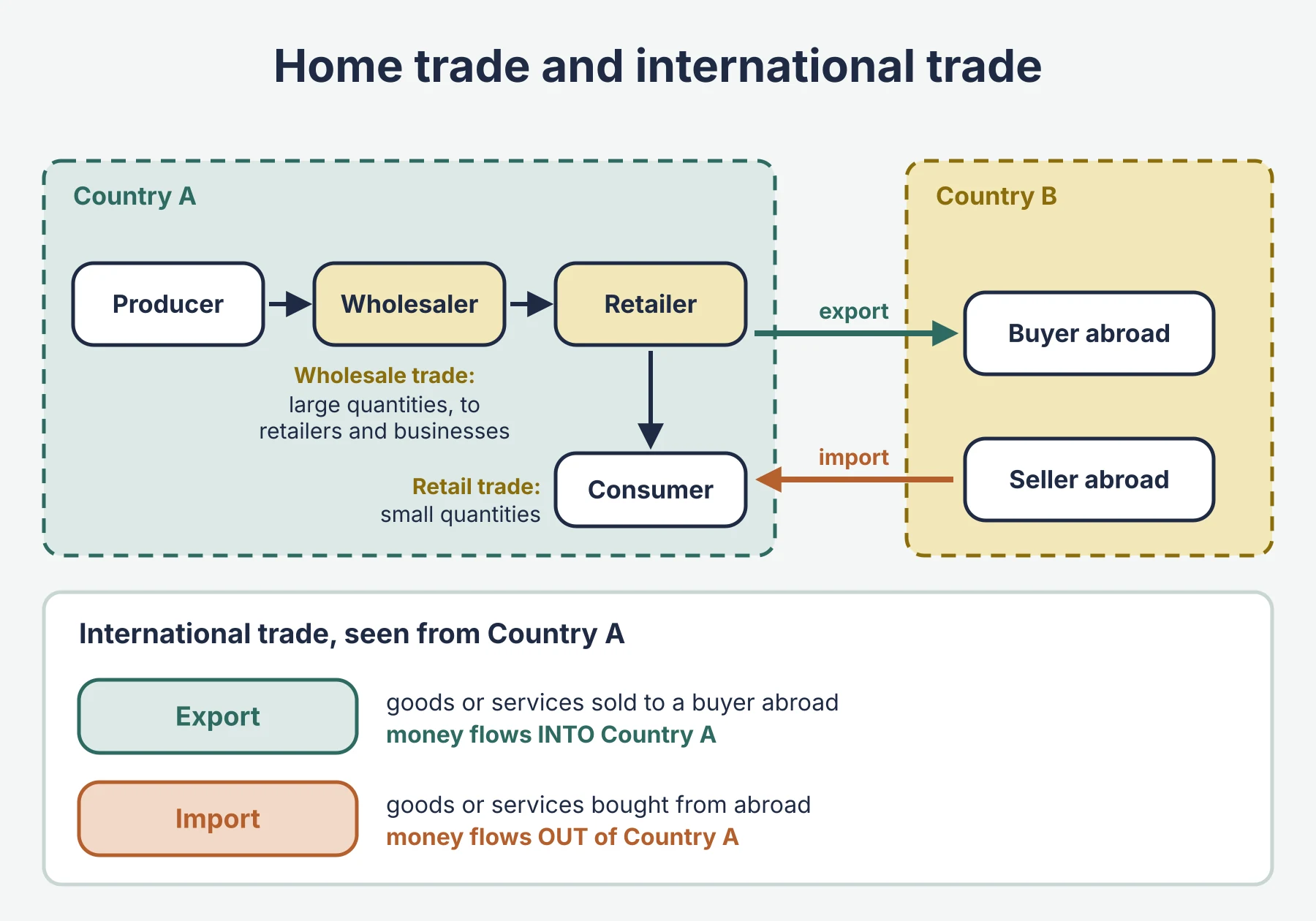
Home trade and international trade
| Term | Meaning | Direction of money |
|---|---|---|
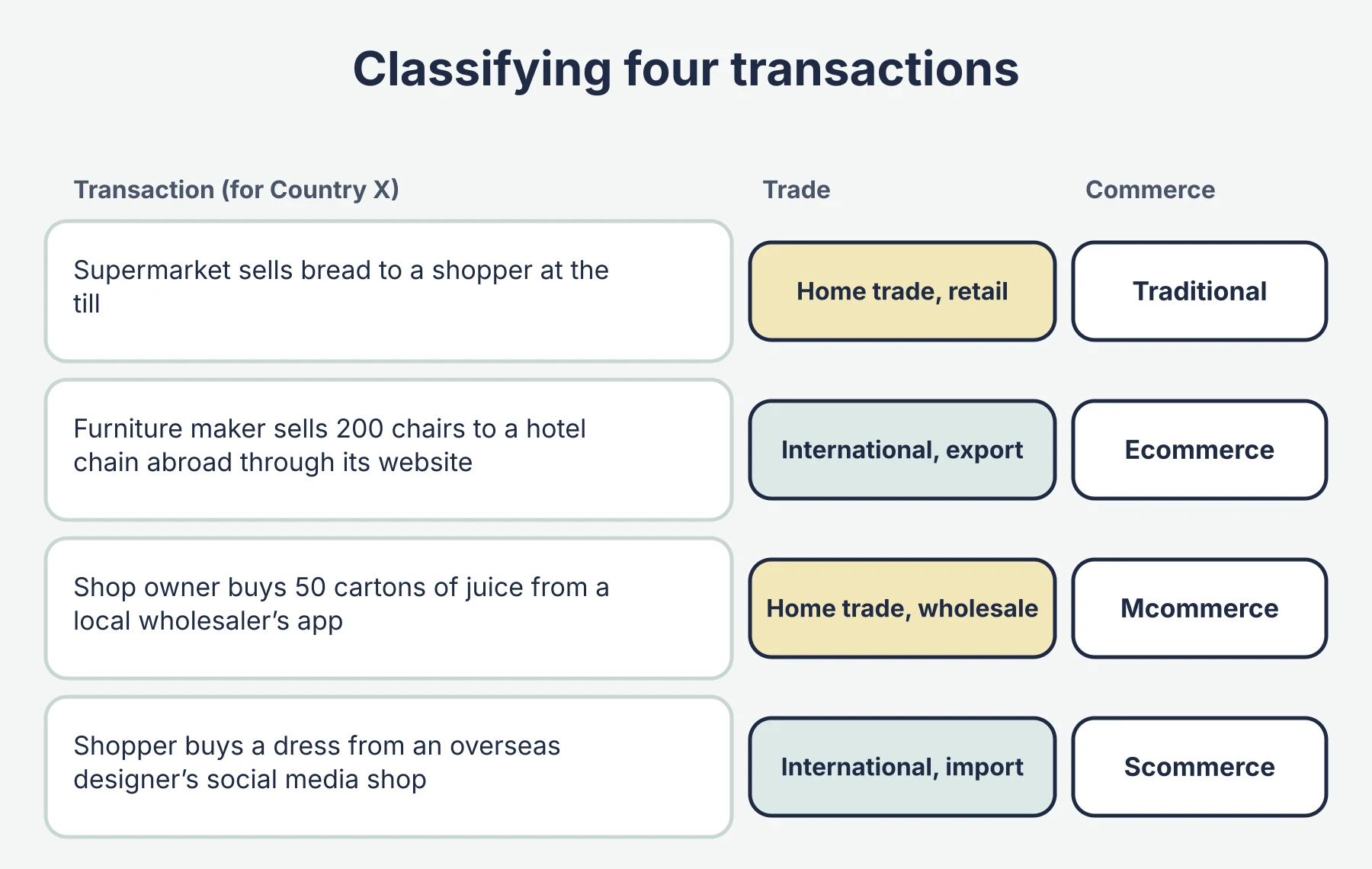
| Home trade | Buying and selling within one country | Stays within the country |
| Retail trade | Selling small quantities to final consumers | Consumer to retailer |
| Wholesale trade | Buying in bulk from producers, selling smaller quantities to retailers and other businesses | Retailer to wholesaler |
| International trade | Buying and selling between countries | Crosses borders |
| Export | Goods or services sold to another country | Flows in |
| Import | Goods or services bought from another country | Flows out |
One international sale is always an export for the seller’s country and an import for the buyer’s country.
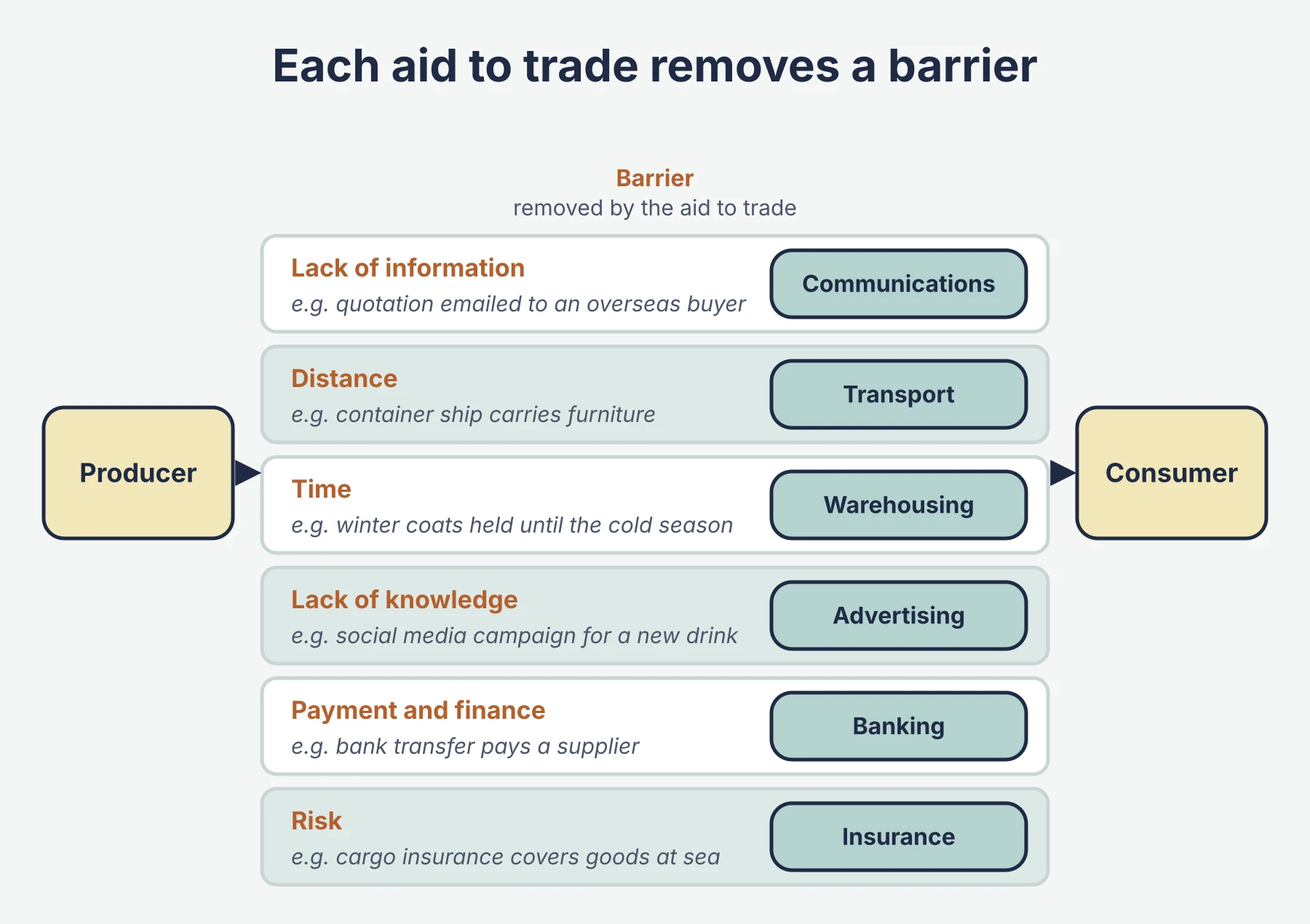
The six aids to trade and the barrier each removes
| Aid | Barrier |
|---|---|
| Communications | Information: buyer and seller cannot exchange details |
| Transport | Distance (place) |
| Warehousing | Time: production and demand happen at different times |
| Advertising | Knowledge: consumers do not know the product exists |
| Banking | Payment and finance |
| Insurance | Risk of loss or damage |
Mnemonic for the list: Can Traders Work Apart By Internet? (Communications, Transport, Warehousing, Advertising, Banking, Insurance).
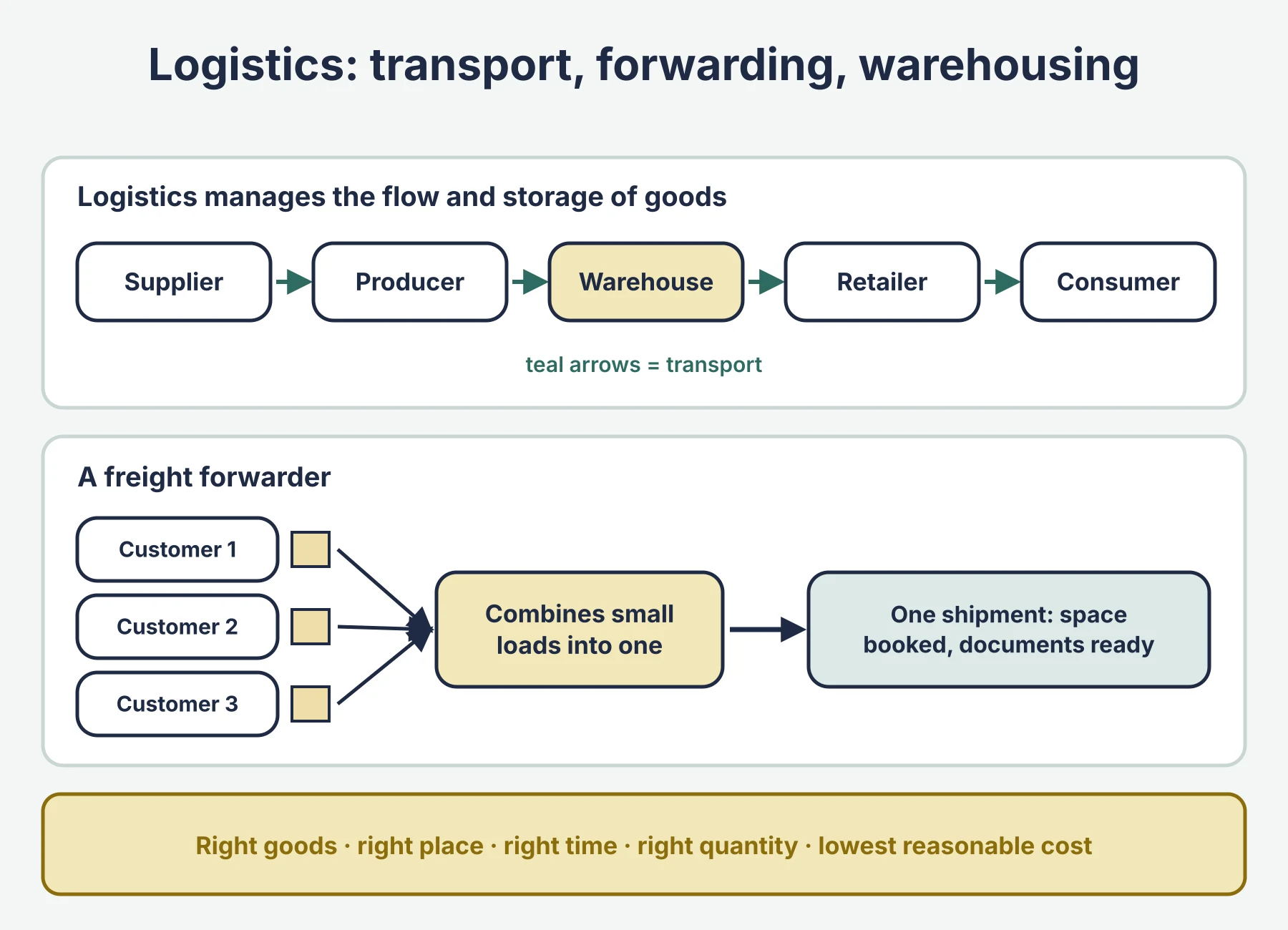
Logistics
Logistics: planning and managing the movement and storage of goods through the supply chain so the right goods reach the right place at the right time and quantity, at the lowest reasonable cost.
Three elements named in the syllabus:
- Transport: moves the goods.
- Freight forwarders: arrange transport for other firms; book space with carriers, combine small loads into larger shipments, help with export documents.
- Warehousing: stores goods until needed.
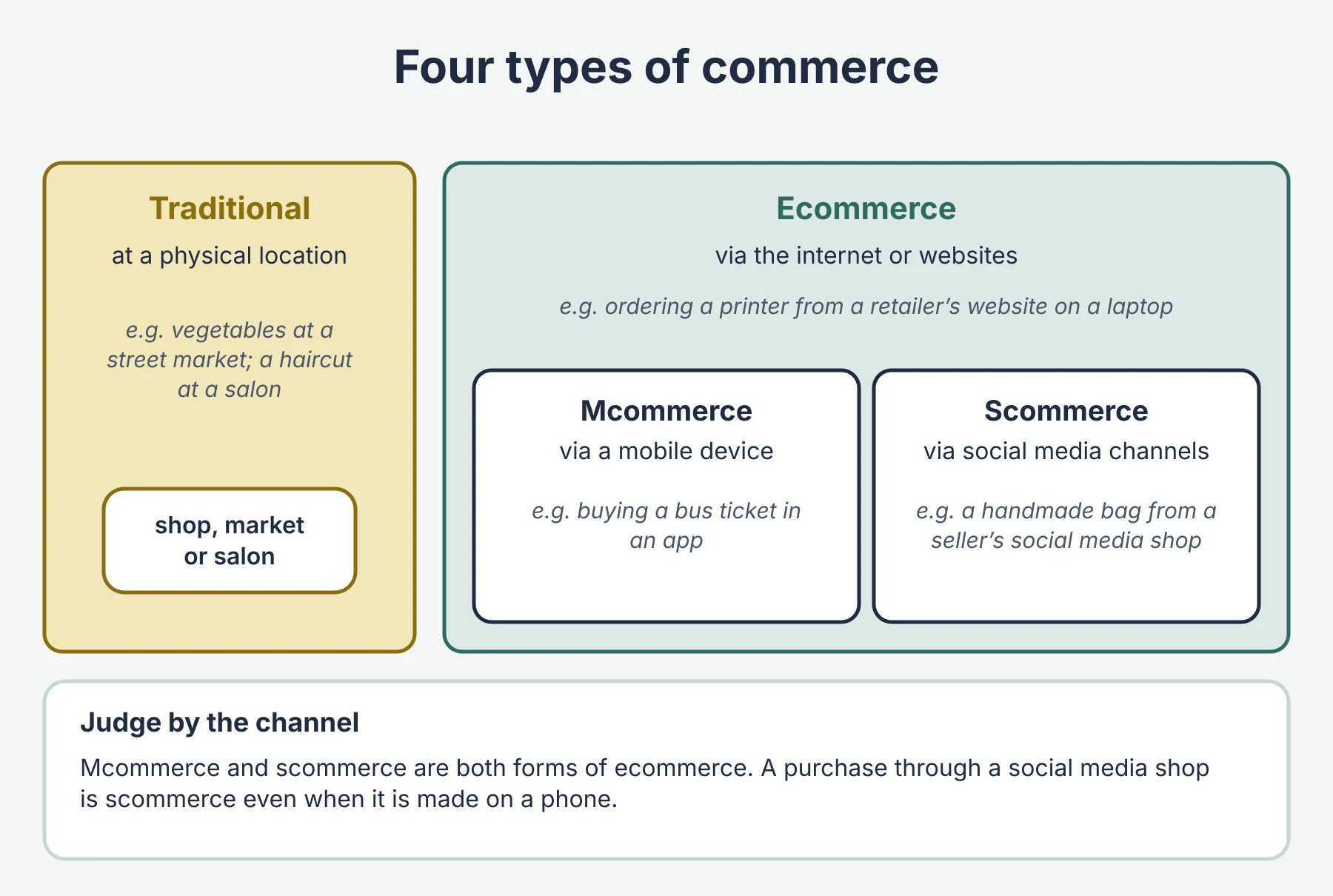
Types of commerce: defined by the channel
| Type | Channel | Quick example |
|---|---|---|
| Traditional | Physical location | Shop, market stall, salon |
| Ecommerce | Internet or websites | Online store on a laptop |
| Mcommerce | Mobile device (smartphone, tablet) | Shopping or ticket app |
| Scommerce | Social media channels | Buying through a social media shop |
Mcommerce and scommerce are both kinds of ecommerce. Choose the most specific label the scenario supports.
Interdependence in four links
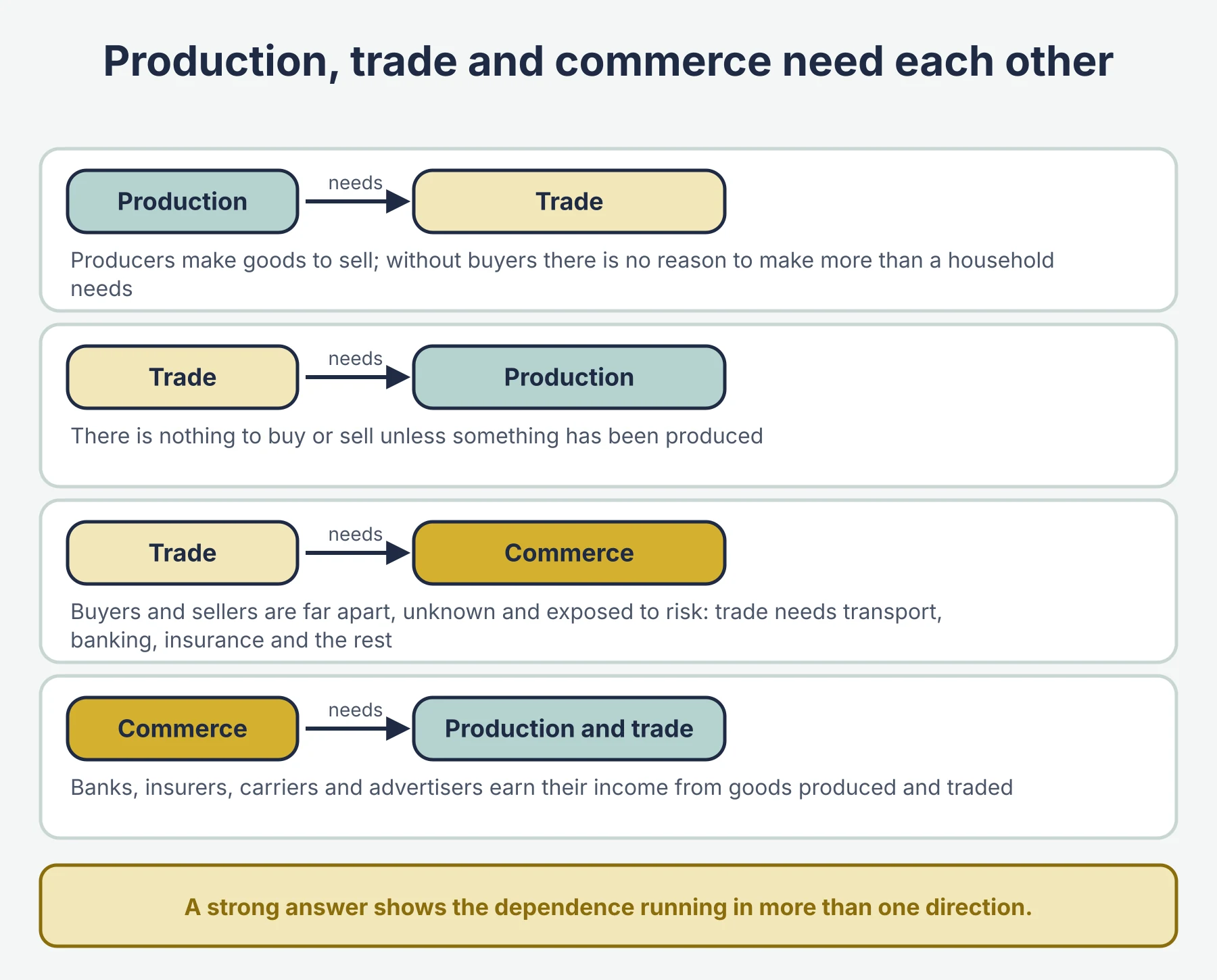
- Production needs trade: goods are made to be sold.
- Trade needs production: nothing to sell otherwise.
- Trade needs commerce: aids to trade remove distance, time, risk, payment and information barriers.
- Commerce needs production and trade: carriers, banks, insurers and advertisers earn income from them.
A four-mark “explain” answer: one link per mark, each applied to the business in the question.
Key terms
| Term | Definition |
|---|---|
| Trade | The buying and selling of goods and services |
| Commerce | Trade together with the aids to trade |
| Home trade | Trade within the borders of one country |
| Retailer | Business that sells to the final consumer |
| Wholesaler | Business that buys in bulk and sells in smaller quantities to retailers |
| Export | A good or service sold to a buyer in another country |
| Import | A good or service bought from a seller in another country |
| Aids to trade | Services that help trade take place by removing barriers between producer and consumer |
| Logistics | Management of the movement and storage of goods through a supply chain |
| Freight forwarder | Firm that arranges transport and paperwork for other businesses’ goods |
| Supply chain | The sequence of businesses and activities that take a product from raw materials to the consumer |
| Interdependent | Each part relies on the others |
Exam traps
- “Commerce is buying and selling” scores nothing as a definition of commerce. Add the aids to trade.
- Wholesale is not selling to consumers. The wholesaler’s customers are mainly retailers.
- Exports bring money in. Students often reverse this in balance of trade questions later in Topic 3.
- A freight forwarder does not have to own ships or trucks. It arranges space with carriers.
- Logistics is not just transport. Name all three elements when asked.
- One-way interdependence (“production needs commerce”) earns limited marks. Show links in both directions.
- Over-general labels. A purchase through a social media shop is scommerce, not just “online”.
Self-test
- Define trade.
- Define commerce.
- State two differences between trade and commerce.
- What is the difference between retail trade and wholesale trade?
- A Ghanaian cocoa firm sells beans to a buyer in Belgium. Is this an export or an import for Ghana?
- Name the six aids to trade.
- Which aid to trade removes the barrier of time?
- State the three elements of logistics in a supply chain named in the syllabus.
- What does a freight forwarder do?
- A customer buys concert tickets in an app on her tablet. Which type of commerce is this?
- A student buys trainers at a sports shop in a shopping centre. Which type of commerce is this?
- Give one way in which commerce depends on production.
Answers
- The buying and selling of goods and services.
- Trade together with the aids to trade; all the activities involved in getting goods and services from producer to consumer.
- Any two: trade is only one part of commerce; commerce includes aids to trade such as banking and transport; trade transfers ownership while many commercial activities (storing, insuring) do not; commerce involves more organisations than just buyer and seller.
- Retail trade sells small quantities to final consumers; wholesale trade buys in bulk from producers and sells smaller quantities to retailers.
- An export (it would be an import for Belgium).
- Communications, transport, warehousing, advertising, banking and insurance.
- Warehousing.
- Transport, freight forwarders and warehousing.
- Arranges transport of goods for other businesses, books space with carriers, combines small loads and helps with export documents.
- Mcommerce.
- Traditional commerce.
- Transport firms, banks and insurers earn their income from handling, financing and insuring goods that have been produced; without production they would have no work.
Related resources
-
Practice questions
Commerce and Production: Practice Questions
Original exam-style practice questions with full worked answers on production, commerce, trade, aids to trade and the chain of distribution.
Commerce · Cambridge · IGCSE
Try questions -
Study guides
Cambridge IGCSE Commerce: Commerce and Production (0715)
Guide to Topic 1 of Cambridge IGCSE Commerce 0715, exams from 2028: trade and commerce, sectors of production, specialisation, supply chains, aids to trade.
Commerce · Cambridge · IGCSE
Read guide -
Revision notes
IGCSE Commerce: Commerce and Production — Revision Notes
Condensed recall notes on the chain of production, direct and indirect services, trade and aids to trade for Cambridge IGCSE Commerce 0715.
Commerce · Cambridge · IGCSE
Revise topic
Get free revision emails (optional)
Occasional emails with practice questions, worked explanations and links to free resources for the qualification and subjects you choose. No spam, and you can unsubscribe from any email. The free tools on this site never need an email.