
Study Guides
Cambridge IGCSE Commerce (0715): Production
Sectors of production, specialisation, in-house versus outsourcing, intermediaries, digital technology and costs for Cambridge IGCSE Commerce 0715 section 1.2.
- Subject
- Commerce
- Level
- IGCSE
- Topic
- Topic 1 – Commerce and Production
- Author
- Marlbridge Academic Team
- Updated
- Reviewed by
- Salman Ahmad (what this means)
Aligned to Cambridge IGCSE Commerce (0715), 2028. Official specification .
Syllabus page (what it covers and how it is assessed): Cambridge IGCSE Commerce.
Syllabus points this page covers
0715
- 1.2 Production
Found an error? Report a correction.
Need help with this topic? Request a free trial class for IGCSE Commerce (0715).
Section 1.2 of the Cambridge IGCSE Commerce (0715) syllabus looks at how goods and services are made and how producers connect to their markets. It has six parts: the sectors of production and specialisation, in-house and outsourced production, global supply chains, intermediaries, the effects of digital technology, and the costs of trade, commerce and production, including simple calculations. This page goes deeper into 1.2 than the Commerce and Production study guide, which surveys the whole of Topic 1.
What does 1.2 contain?
| Section | Syllabus content |
|---|---|
| 1.2.1 | Features of primary, secondary, tertiary and quaternary activities; meaning of specialisation; its advantages and disadvantages for an individual, a factory and a country |
| 1.2.2 | Meaning of in-house and outsourced production; benefits of each over the other |
| 1.2.3 | Meaning of a global supply chain and a domestic supply chain |
| 1.2.4 | Home trade intermediaries (wholesaler, retailer) and international trade intermediaries (agent, factor) |
| 1.2.5 | Impact of automation and of digital communication with suppliers, such as EDI |
| 1.2.6 | Ten types of cost and simple cost calculations |
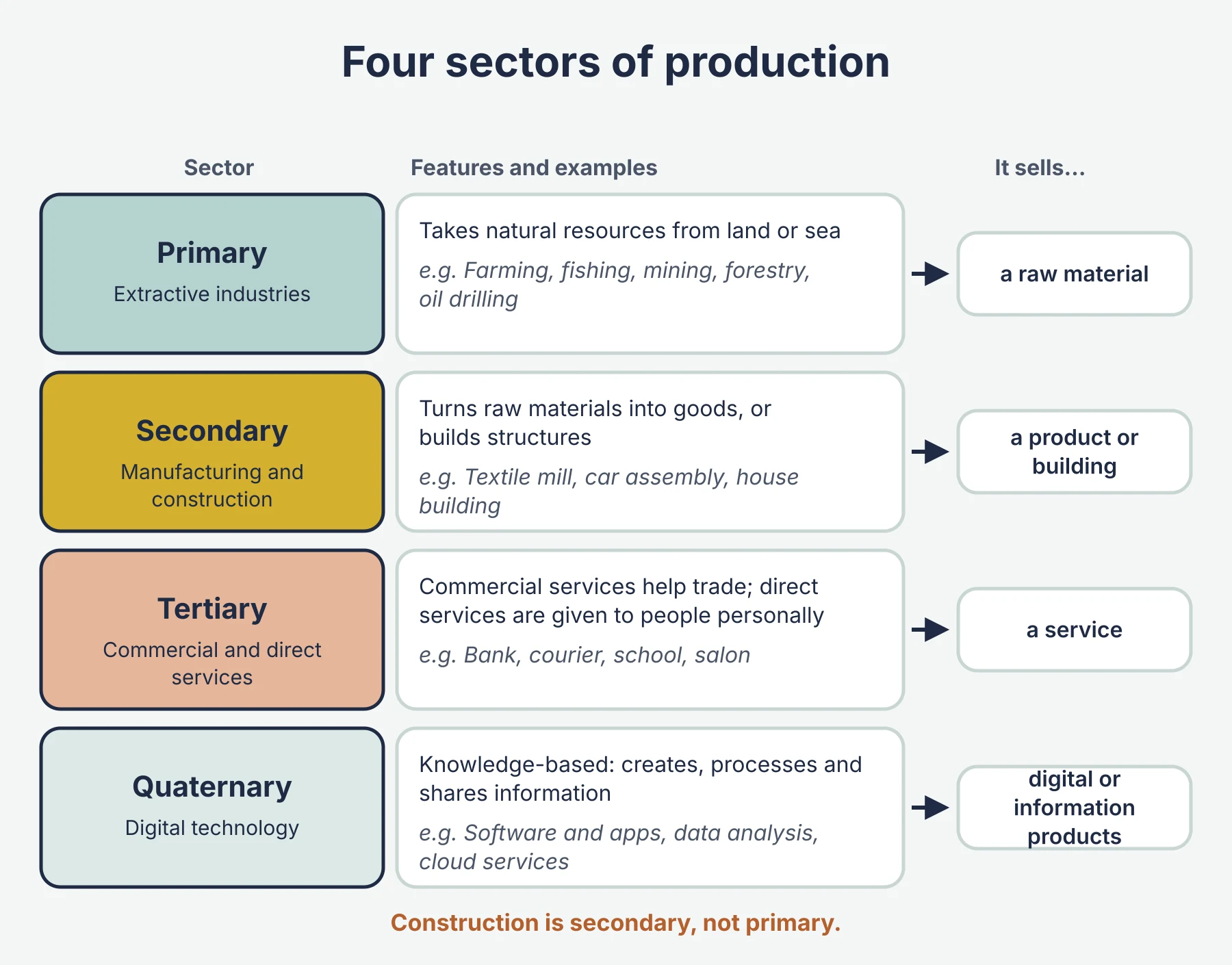
What are the sectors of production? (1.2.1)
| Sector | Syllabus description | Features | Examples |
|---|---|---|---|
| Primary | Extractive industries | Takes natural resources from land or sea; output is often a raw material for other firms | Farming, fishing, mining, forestry, oil drilling |
| Secondary | Manufacturing and construction | Turns raw materials into finished or part-finished goods, or builds structures | Textile mill, car assembly, house building |
| Tertiary | Commercial services and direct services | Provides services, not goods. Commercial services help trade (banking, insurance, transport, retailing); direct services are given to people personally (teaching, nursing, hairdressing) | Bank, courier, school, salon |
| Quaternary | Digital technology | Knowledge-based activities using digital technology to create, process and share information | Software and app development, data analysis, cloud services |
A useful check: ask what the business sells. A raw material points to primary; a manufactured product or building to secondary; a service to tertiary; and a digital or information-based product to quaternary.
What is specialisation? (1.2.1)
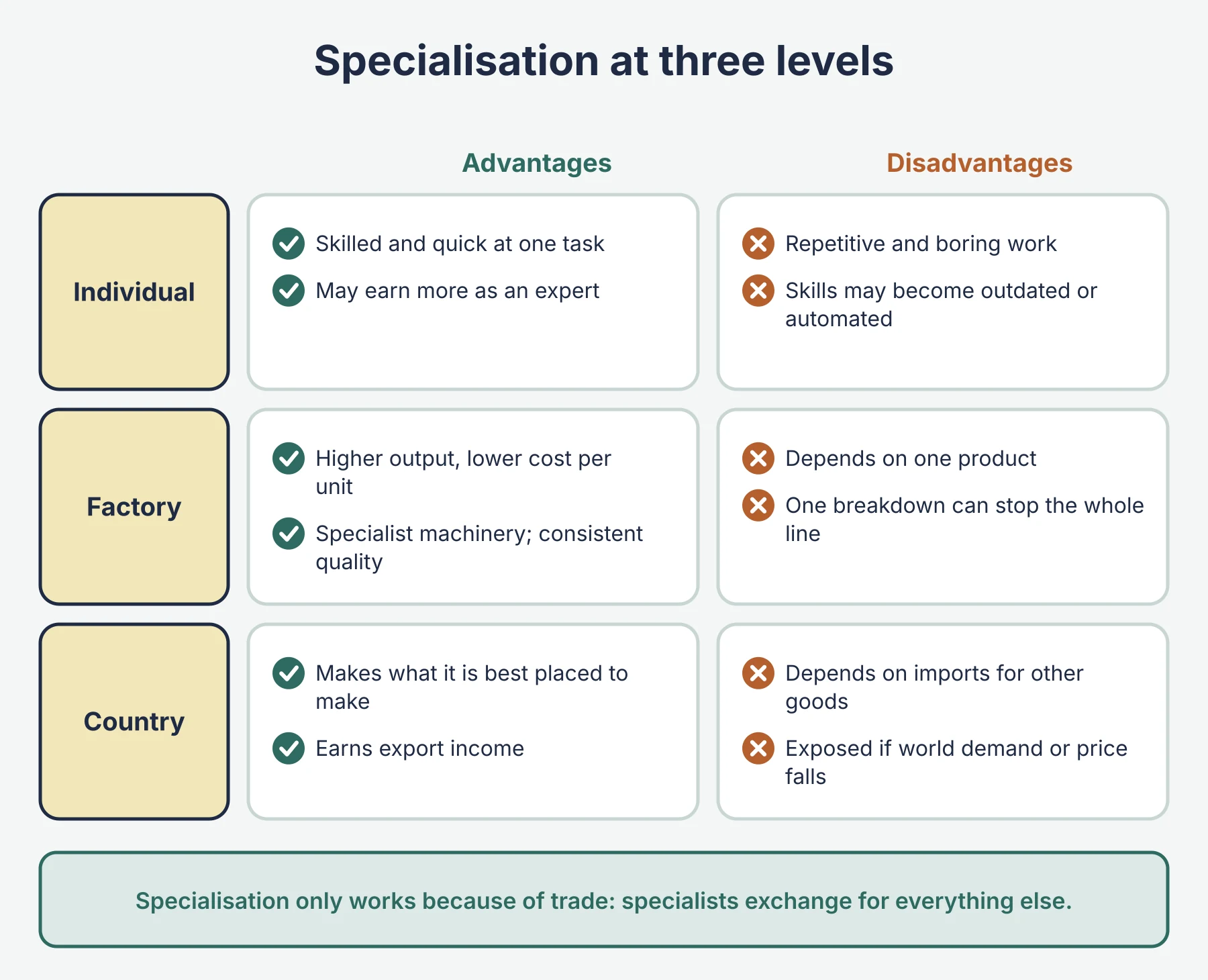
Specialisation is concentrating on producing a limited range of goods or services, or on one task within a production process, instead of trying to do everything. The syllabus asks for advantages and disadvantages at three levels, so learn them as a grid.
| Level | Advantages | Disadvantages |
|---|---|---|
| Individual | Becomes skilled and quick at one task; may earn more as an expert | Work can become repetitive and boring; skills may become outdated if demand changes or the job is automated |
| Factory | Higher output and lower cost per unit; can invest in specialist machinery; quality can be more consistent | Depends on one product, so a fall in demand hits hard; a breakdown in one stage can stop the whole line |
| Country | Produces what it is best placed to make, using its climate, resources or skills; earns export income to buy what it does not make | Depends on imports for other goods; exposed if world demand or price for its main product falls |
Specialisation only works because of trade: a specialist must exchange its output for everything else it needs. This links 1.2 back to the interdependence in 1.1.
In-house or outsourced production? (1.2.2)
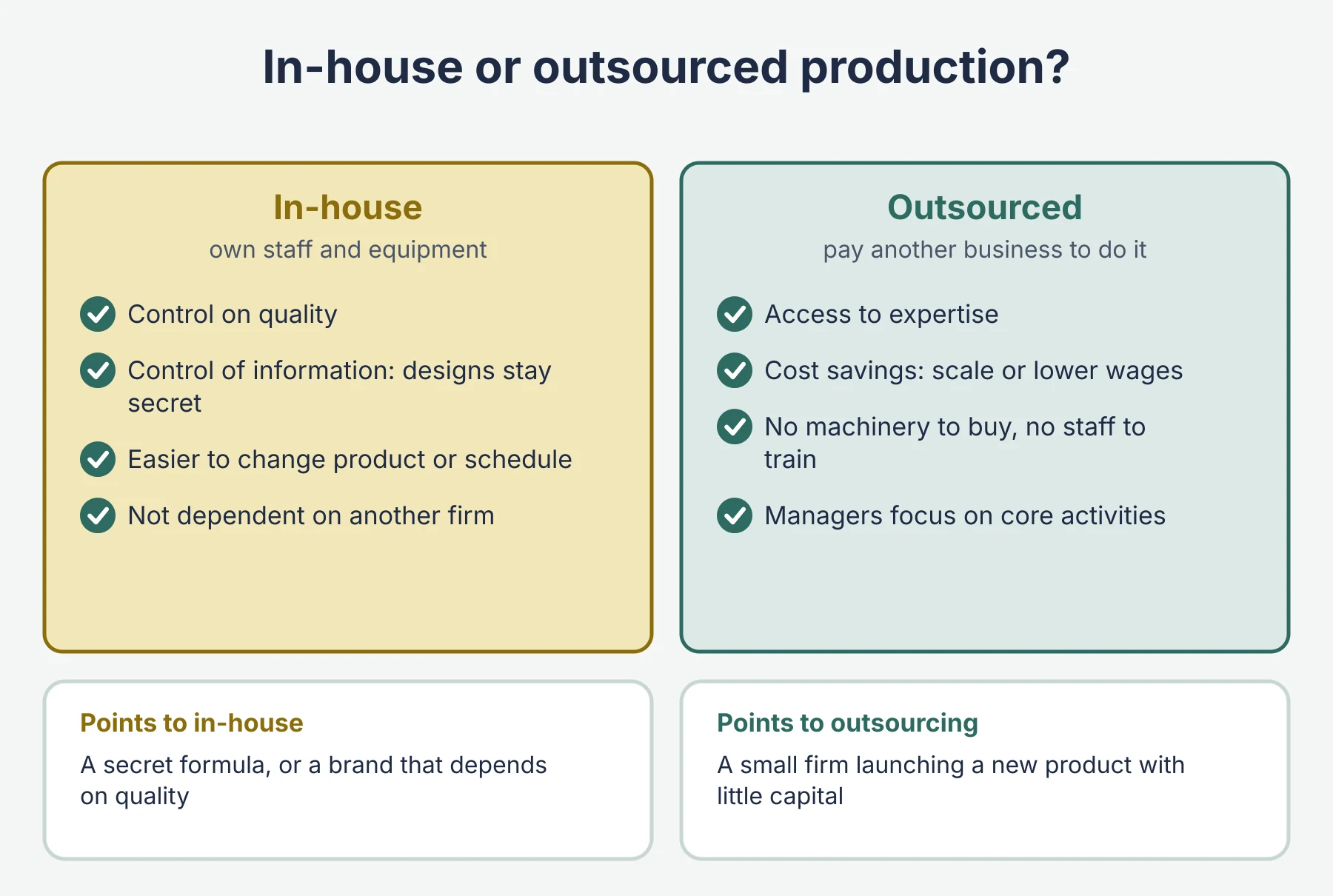
In-house production means a business makes the product or carries out the activity itself, using its own staff and equipment. Outsourced production means it pays another business to make the product or carry out the activity.
| Benefits of in-house over outsourced | Benefits of outsourced over in-house |
|---|---|
| Control on quality: the business checks every stage itself | Access to expertise: specialists may do the job better |
| Control of information: designs and recipes stay confidential | Cost savings: the specialist may produce more cheaply, for example through scale or lower wages |
| Easier to change the product or schedule quickly | No need to buy machinery or hire and train extra staff |
| Not dependent on another firm’s reliability | Managers can focus on the business’s core activities |
Judgement depends on the situation. A firm with a secret formula, or one whose brand depends on quality, has strong reasons to keep production in-house. A small firm launching a new product with little capital may gain more from outsourcing. Section 2.2 returns to the growth of outsourcing through contract manufacturing and logistics.
What is a global supply chain? (1.2.3)
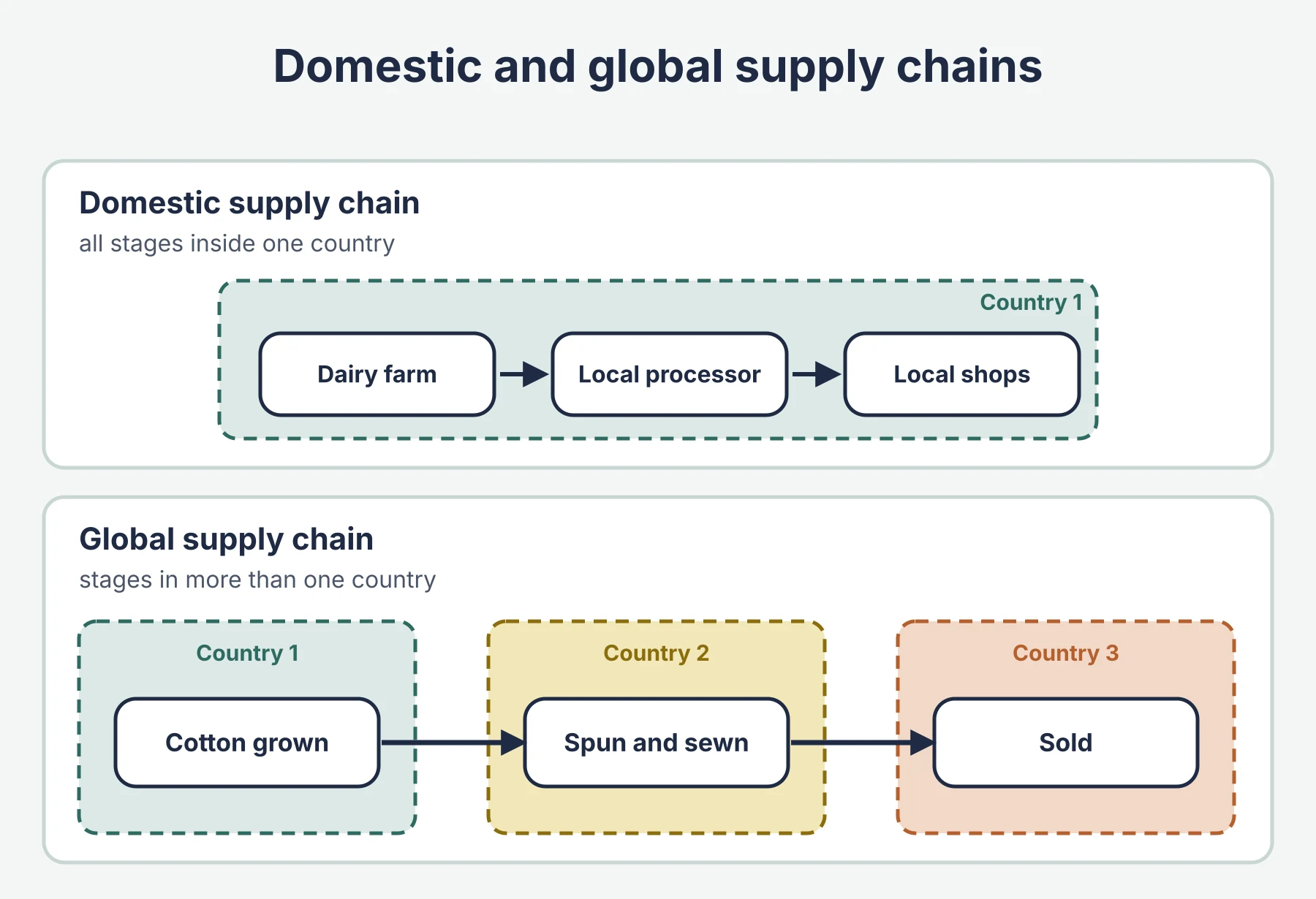
A supply chain is the sequence of businesses and activities that turn raw materials into a product and deliver it to the consumer.
- A domestic supply chain has all its stages inside one country, for example a dairy farm, a local processor and local shops.
- A global supply chain has stages in more than one country, for example cotton grown in one country, spun and sewn in another, and sold in a third.
Topic 3 (section 3.2) develops how global supply chains are managed and what risks they face.
Who are the intermediaries in a supply chain? (1.2.4)
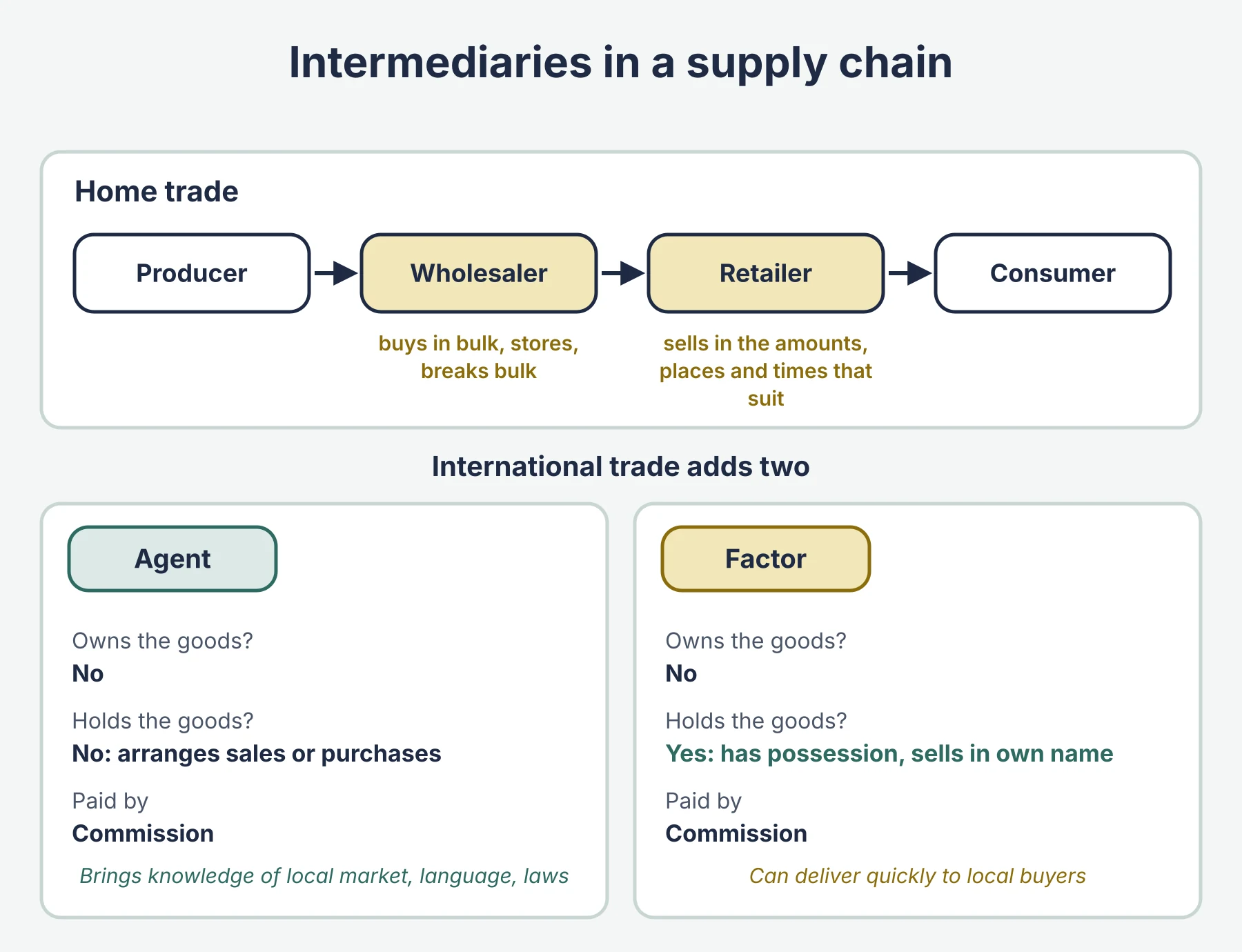
An intermediary is a business that stands between the producer and the consumer and helps goods move along the chain.
Home trade intermediaries
- Wholesaler: buys in bulk from producers, stores the goods and sells in smaller quantities to retailers. This breaks bulk and saves producers from dealing with thousands of small shops.
- Retailer: buys from wholesalers or producers and sells to the final consumer, in the quantities, location and times that suit the consumer.
International trade intermediaries
- Agent: a business or person that arranges sales or purchases in another country on behalf of a producer or buyer (the principal). The agent does not own the goods and is usually paid commission. An agent’s knowledge of the local market, language and laws helps an exporter enter a new country.
- Factor: an agent that is given possession of the goods and sells them on the principal’s behalf, usually in its own name, also for commission. Holding the goods lets the factor deliver quickly to local buyers. Do not confuse this with debt factoring, a source of finance in Topic 5.
How does digital technology affect production? (1.2.5)
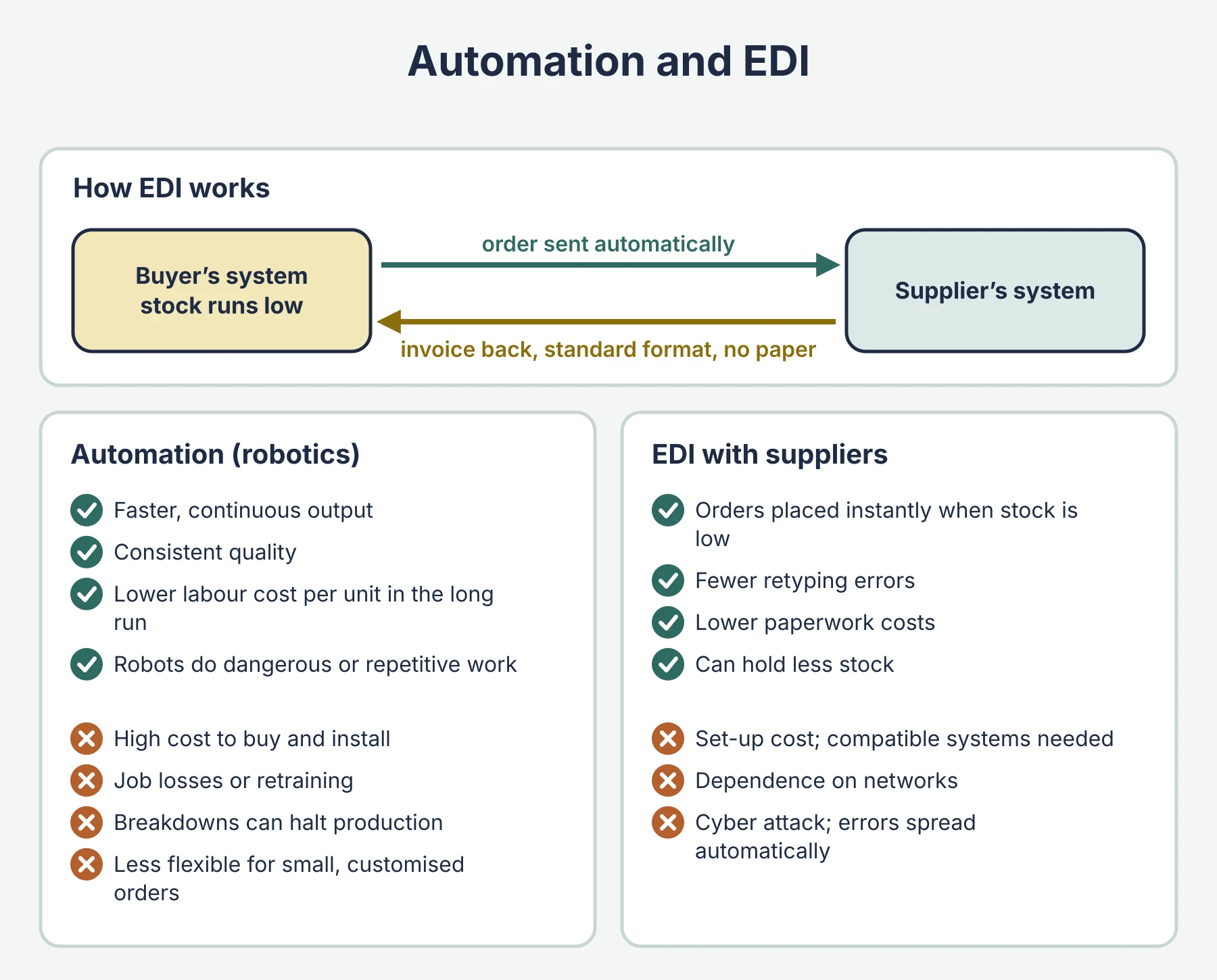
Automation means using machines and computer-controlled systems, such as robotics, to carry out tasks once done by people.
- Positive impacts: faster and continuous output; consistent quality; lower labour cost per unit in the long run; robots can do dangerous or repetitive work.
- Negative impacts: high cost to buy and install; some workers lose jobs or need retraining; breakdowns can halt production; less flexible for small, customised orders.
Digital communication with suppliers, for example electronic data interchange (EDI), means business documents such as orders and invoices are sent automatically from one firm’s computer system to another’s in a standard format, without paper.
- Positive impacts: orders are placed instantly when stock runs low; fewer errors from retyping; lower paperwork costs; easier to hold less stock because supplies arrive when needed.
- Negative impacts: set-up cost and the need for compatible systems; dependence on networks; risk of cyber attack or data errors spreading automatically.
Which costs are involved in trade, commerce and production? (1.2.6)
The syllabus names ten types of cost:
| Cost | What it is |
|---|---|
| Advertising | Paying to promote the product |
| Bank charges | Fees for accounts, transfers and payment services |
| Commission | Payment to an agent, usually a percentage of the value of sales |
| Customs duties | Tax on imported goods, often a percentage of their value |
| Inventory | The cost of buying and holding stock |
| Labour | Wages and salaries of workers |
| Packaging | Materials to protect and present goods |
| Transport | Moving goods between stages of the chain |
| Utilities | Electricity, water, gas and internet |
| Warehousing | Storing goods, such as rent of warehouse space |
Worked example: calculating costs (invented figures)
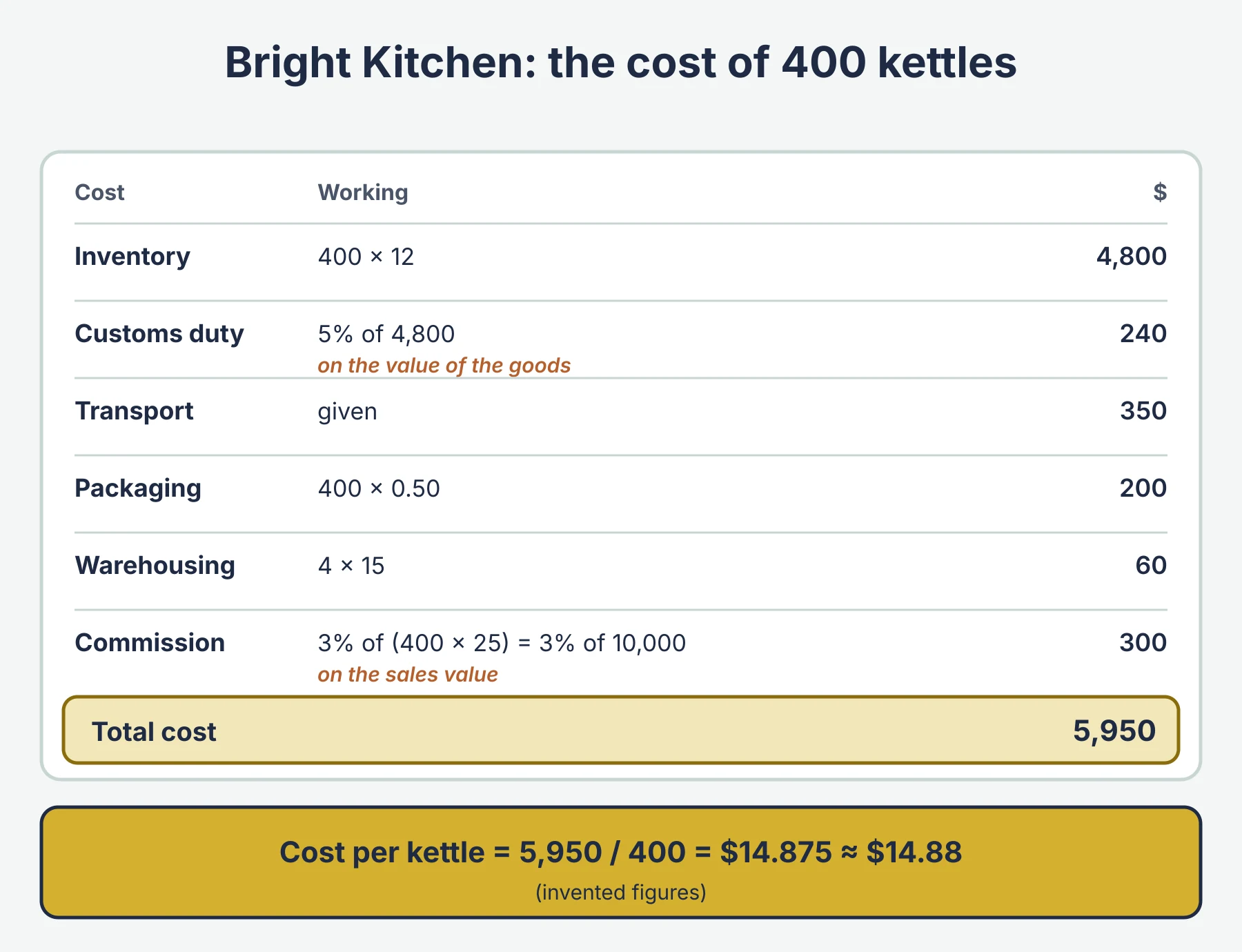
Bright Kitchen imports 400 kettles at $12 each. Customs duty is 5% of the value of the kettles. Transport costs $350 and packaging costs $0.50 per kettle. The kettles are stored for 4 weeks at $15 a week. An agent sells all 400 at $25 each and is paid 3% commission on the sales value. Calculate the total cost and the cost per kettle.
| Cost | Working | $ |
|---|---|---|
| Inventory | 400 x 12 | 4,800 |
| Customs duty | 5% of 4,800 | 240 |
| Transport | given | 350 |
| Packaging | 400 x 0.50 | 200 |
| Warehousing | 4 x 15 | 60 |
| Commission | 3% of (400 x 25) = 3% of 10,000 | 300 |
| Total cost | 5,950 |
Cost per kettle = 5,950 / 400 = $14.875, about $14.88.
Method points: work out each percentage on the correct base (duty on the value of the goods, commission on the sales value), show each line, and give the unit.
What are the common mistakes in 1.2?
- Putting construction in the primary sector; the syllabus places it in secondary.
- Calling all services “tertiary” without separating commercial and direct services.
- Giving specialisation points for “a worker” and “a business” when the question names the individual, the factory or the country.
- Saying outsourcing always lowers quality; it can raise quality where the specialist has more expertise.
- Treating an agent as the owner of the goods, or confusing a factor with debt factoring.
- Calculating commission on cost instead of on sales value, or duty on the selling price.
Exam technique for the command words
- State or identify: one sector, one cost, one intermediary; no explanation needed.
- Describe: give the main features, for example of secondary industry.
- Explain: give a reason and its effect, for example why automation lowers cost per unit.
- Calculate: show the working line by line, then the answer with $.
- Assess or evaluate: weigh in-house against outsourced production for the named business and reach a judgement.
Where can I practise?
Review the production revision notes, then attempt the production practice questions. Section 1.1 is covered in the trade and commerce study guide.
Official syllabus
Cambridge IGCSE Commerce (0715) syllabus for 2028, section 1.2 Production: official syllabus PDF.
Related resources
-
Practice questions
Cambridge IGCSE Commerce (0715): Production – Practice Questions
Original Cambridge IGCSE Commerce 0715 questions with answers on sectors, specialisation, outsourcing, intermediaries, automation, EDI and cost calculations.
Commerce · Cambridge · IGCSE
Try questions -
Revision notes
Cambridge IGCSE Commerce (0715): Production – Revision Notes
Quick recall for Cambridge IGCSE Commerce 0715 section 1.2: four sectors, specialisation grid, in-house versus outsourcing, agents and factors, EDI and costs.
Commerce · Cambridge · IGCSE
Revise topic -
Study guides
Cambridge IGCSE Commerce (0715): Trade and commerce
Trade versus commerce, home and international trade, aids to trade, logistics and the four types of commerce, for Cambridge IGCSE Commerce 0715 section 1.1.
Commerce · Cambridge · IGCSE
Read guide
Get free revision emails (optional)
Occasional emails with practice questions, worked explanations and links to free resources for the qualification and subjects you choose. No spam, and you can unsubscribe from any email. The free tools on this site never need an email.