
Revision Notes
Cambridge IGCSE Commerce (0715): Production – Revision Notes
Quick recall for Cambridge IGCSE Commerce 0715 section 1.2: four sectors, specialisation grid, in-house versus outsourcing, agents and factors, EDI and costs.
- Subject
- Commerce
- Level
- IGCSE
- Topic
- Topic 1 – Commerce and Production
- Author
- Marlbridge Academic Team
- Updated
- Reviewed by
- Salman Ahmad (what this means)
Aligned to Cambridge IGCSE Commerce (0715), 2028. Official specification .
Syllabus page (what it covers and how it is assessed): Cambridge IGCSE Commerce.
Syllabus points this page covers
0715
- 1.2 Production
Found an error? Report a correction.
Need help with this topic? Request a free trial class for IGCSE Commerce (0715).
Condensed notes for section 1.2 of Cambridge IGCSE Commerce (0715). For explanations and a full worked cost calculation, use the production study guide.
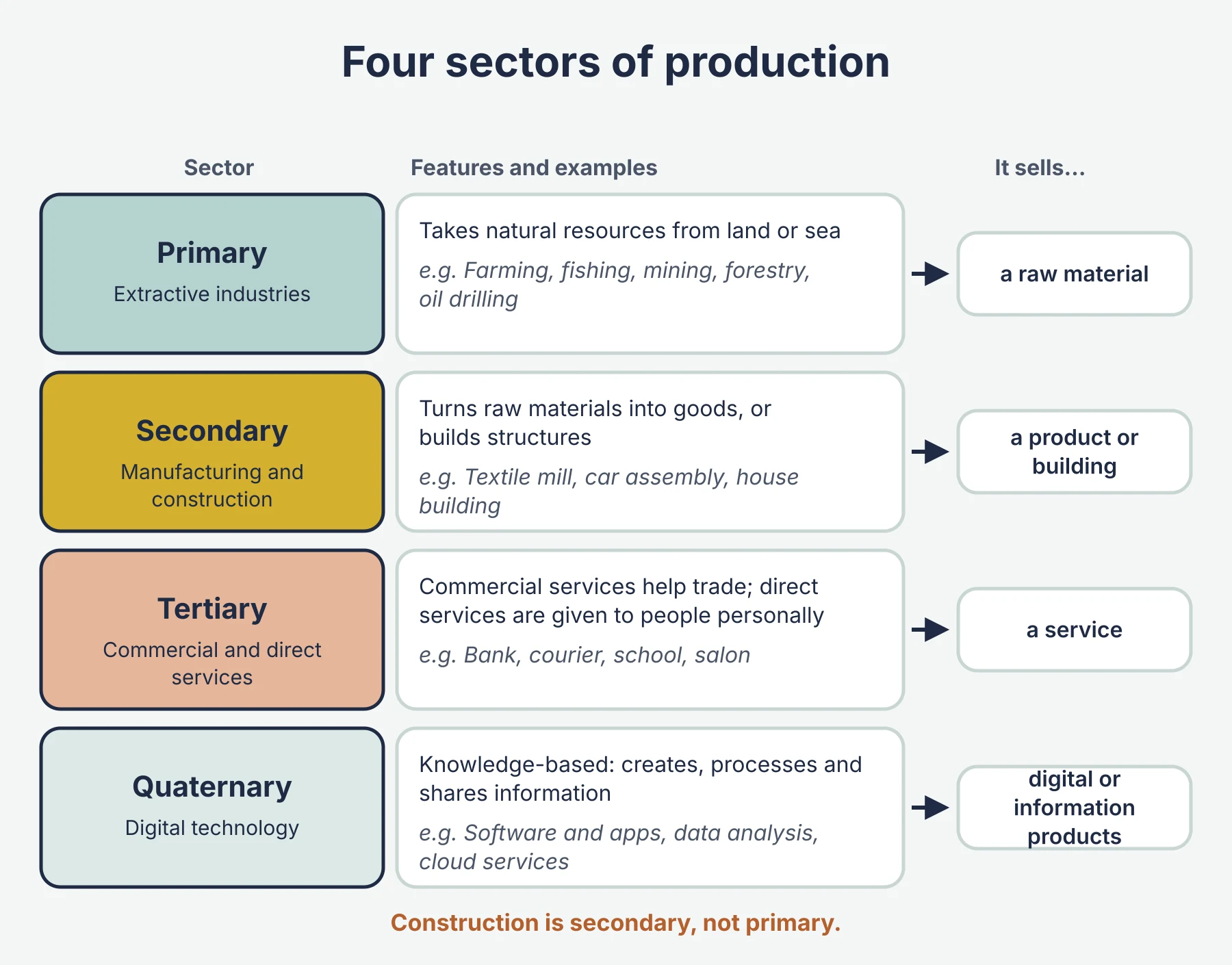
Four sectors in one line each
- Primary (extractive): takes natural resources from land or sea. Farming, fishing, mining, forestry.
- Secondary (manufacturing and construction): turns raw materials into goods or builds structures. Factories, building firms.
- Tertiary (commercial services and direct services): provides services. Commercial services help trade (banking, insurance, transport, retail); direct services are for people personally (doctor, teacher, hairdresser).
- Quaternary (digital technology): knowledge and information services using digital technology. Software, apps, data analysis, cloud services.
Classify by what the business sells: raw material, finished good or building, service, or digital information.
Specialisation
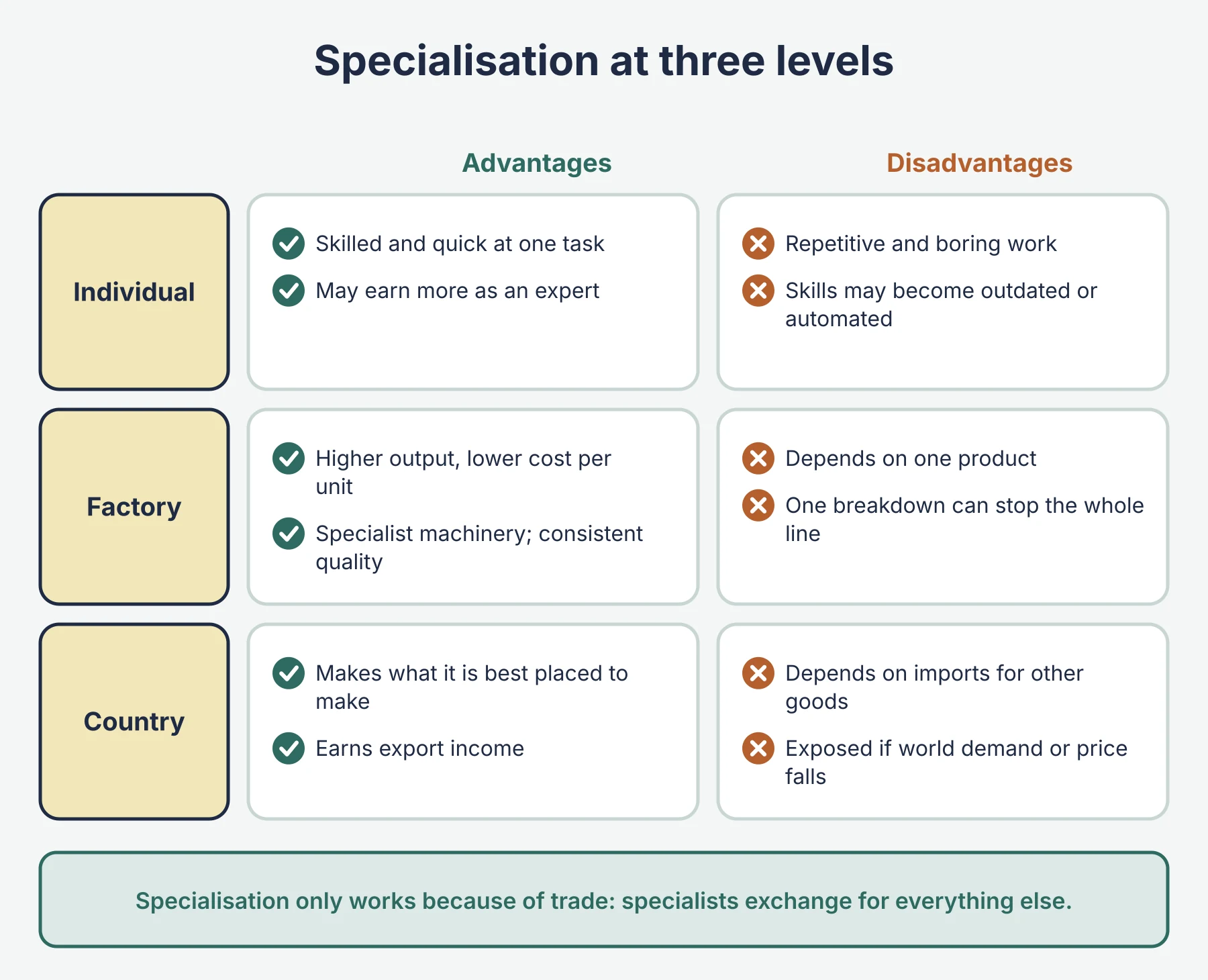
Meaning: concentrating on a limited range of products, or one task in a process.
| Advantage | Disadvantage | |
|---|---|---|
| Individual | Greater skill and speed; expert pay | Boredom; skills can become outdated |
| Factory | More output, lower unit cost, specialist machinery | Reliance on one product; one breakdown stops the line |
| Country | Uses its natural or acquired strengths; earns exports | Relies on imports; hit hard if demand for its main product falls |
Specialisation requires trade: specialists swap their output for what they do not make.
In-house versus outsourced
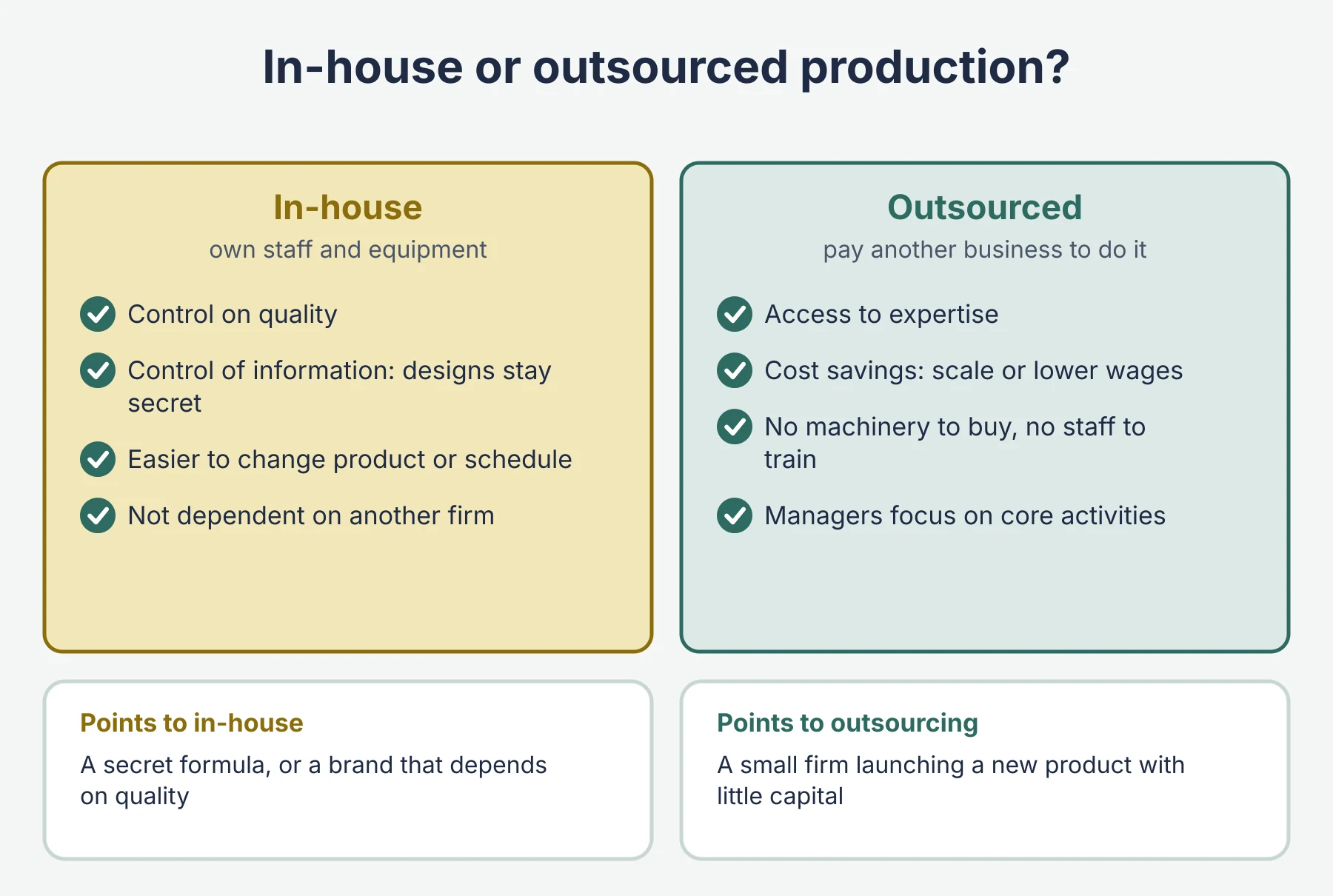
| In-house (make it yourself) | Outsourced (pay another firm) |
|---|---|
| Control on quality | Access to expertise |
| Control of information (secrets stay private) | Cost savings |
| Flexible to change quickly | No spending on extra machines or staff |
| No dependence on a supplier’s reliability | Managers focus on the core activity |
The syllabus highlights quality and information for in-house, and expertise and cost savings for outsourcing. Lead with these.
Supply chains
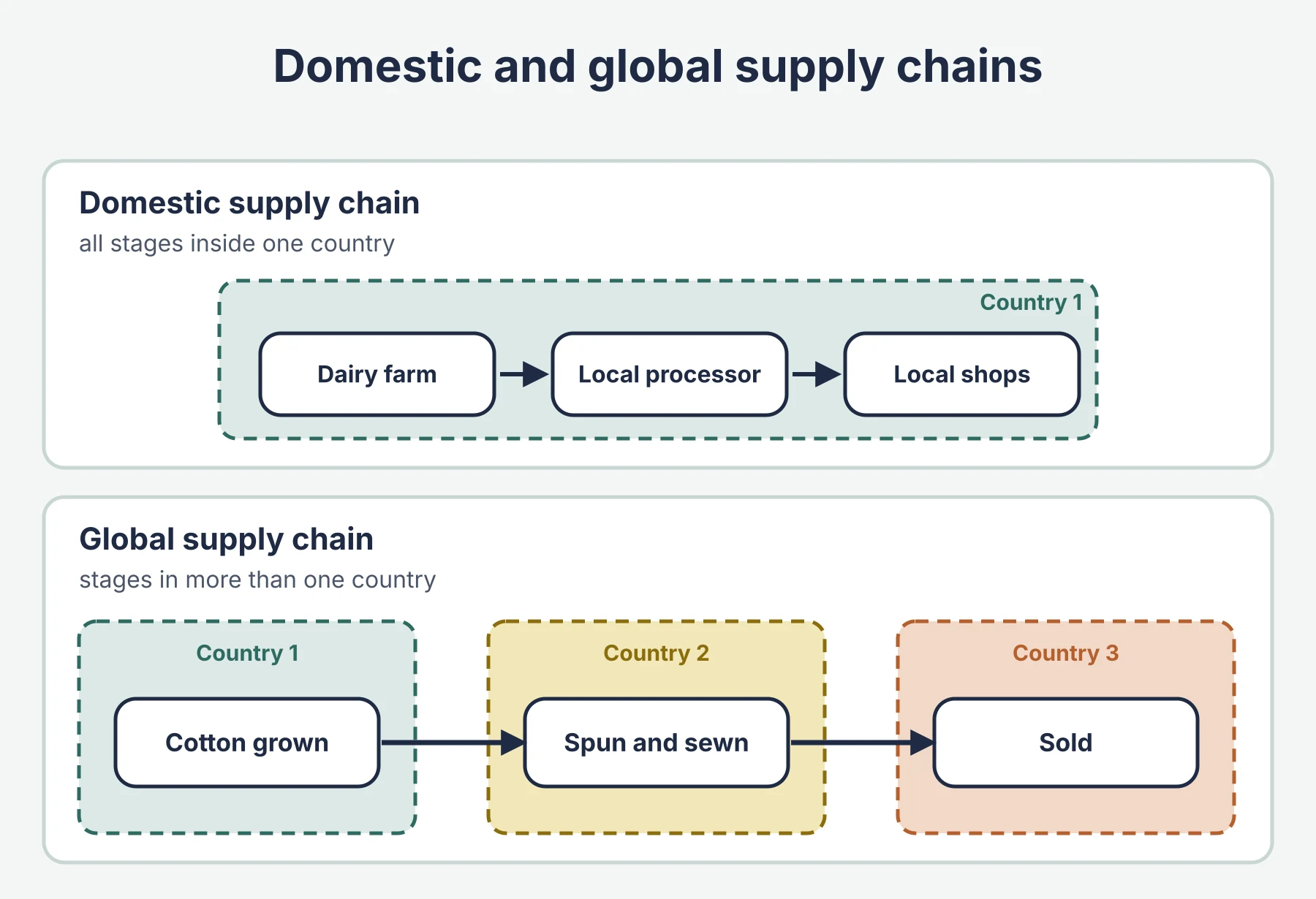
- Domestic supply chain: every stage in one country.
- Global supply chain: stages in two or more countries.
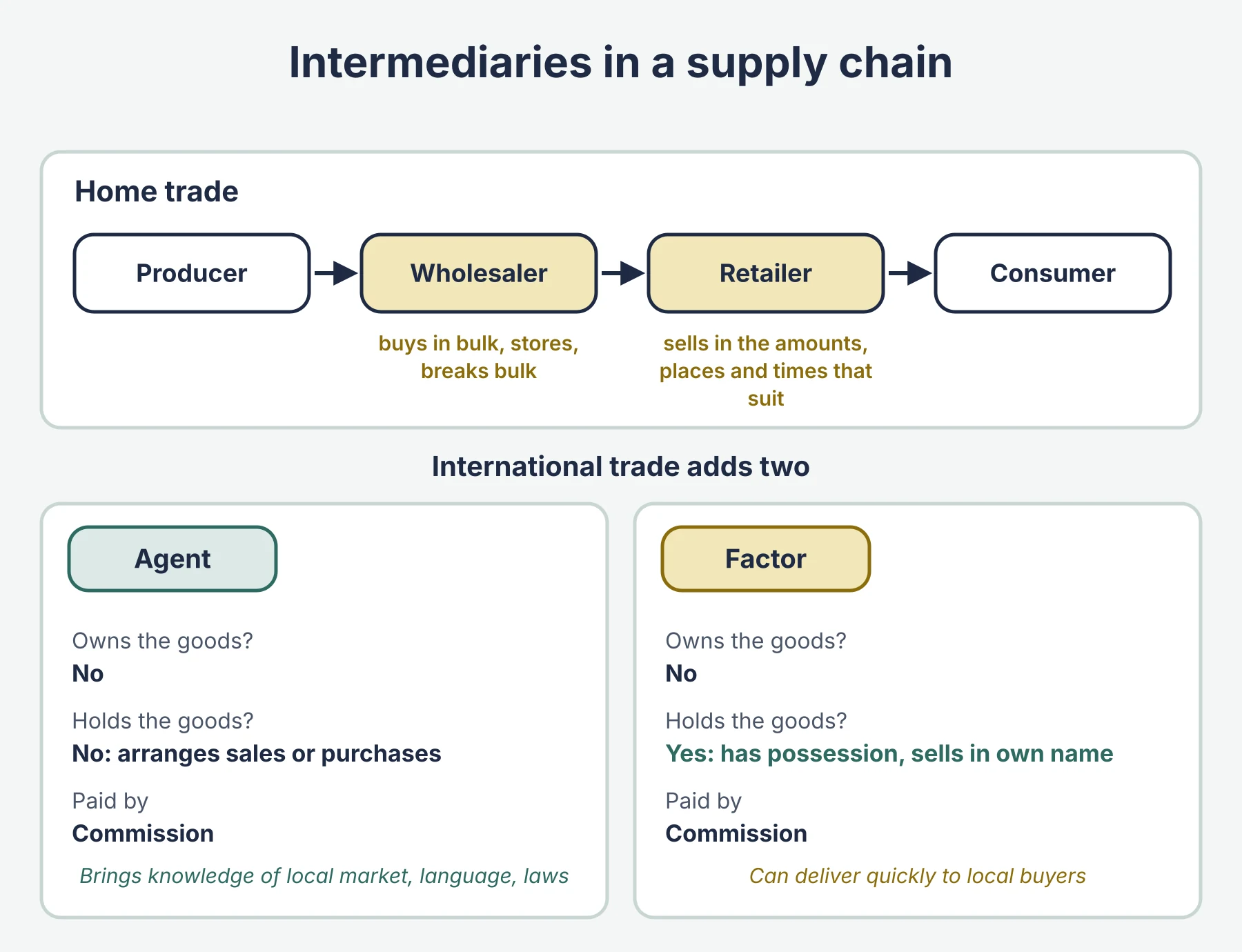
Intermediaries
| Home trade | International trade |
|---|---|
| Wholesaler: buys in bulk, stores, breaks bulk, sells to retailers | Agent: arranges sales or purchases abroad for a principal; does not own the goods; earns commission |
| Retailer: sells to the final consumer in convenient quantities and places | Factor: agent given possession of the goods; sells them, usually in its own name, for commission |
Difference between agent and factor: possession of the goods.
Digital technology and production
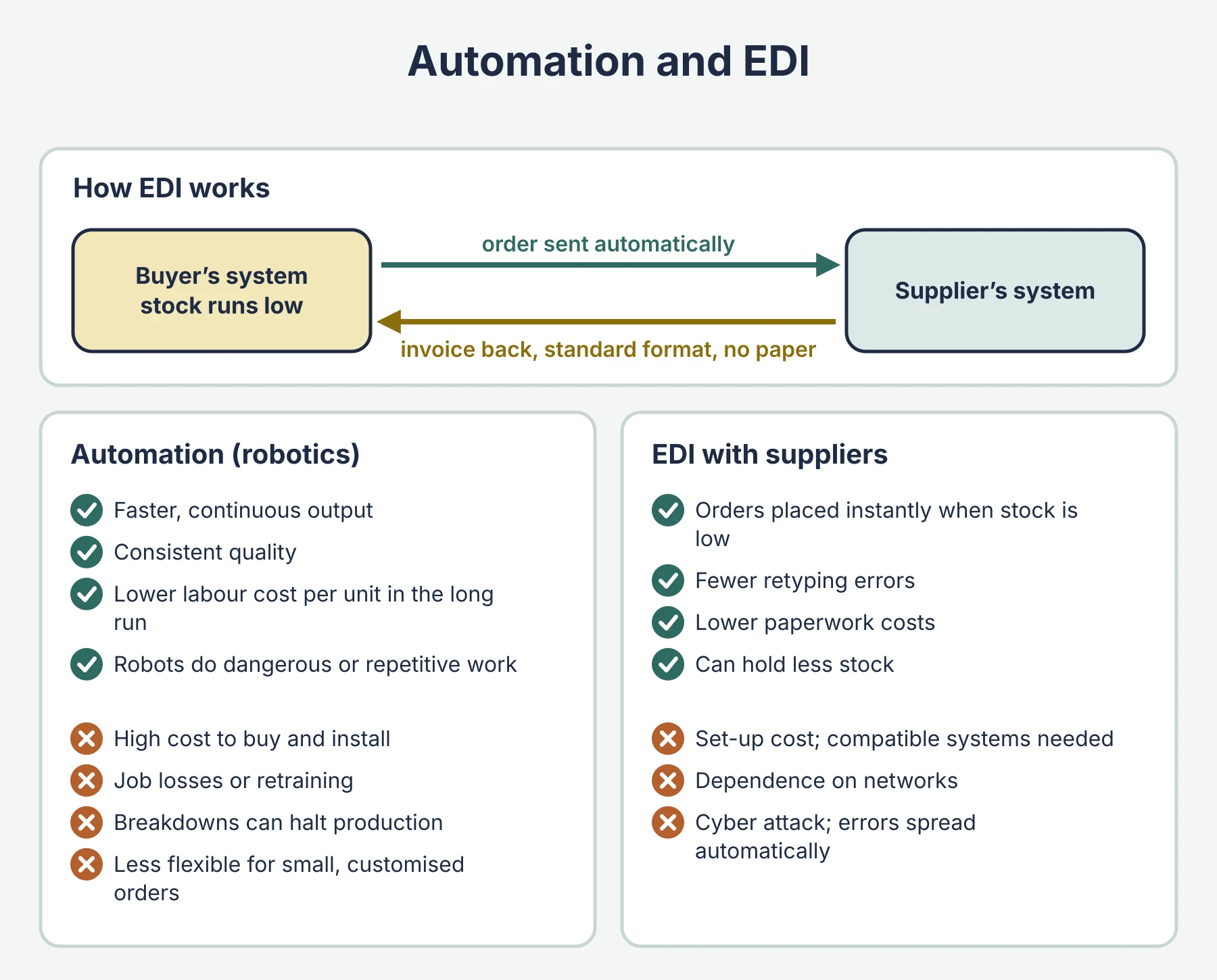
| Positive | Negative | |
|---|---|---|
| Automation (robotics) | Faster, continuous, consistent output; lower labour cost per unit; safer for dangerous tasks | High set-up cost; job losses or retraining; breakdowns stop output; less flexible |
| EDI with suppliers | Instant automatic orders; fewer errors; less paperwork; lower stock needed | Set-up cost and compatible systems; network dependence; cyber risk |
Ten costs to name
Advertising, bank charges, commission, customs duties, inventory, labour, packaging, transport, utilities, warehousing.
Mnemonic: A B C C I L P T U W follows the alphabet, so write the letters down first in the exam and fill in the words.
Calculation reminders:
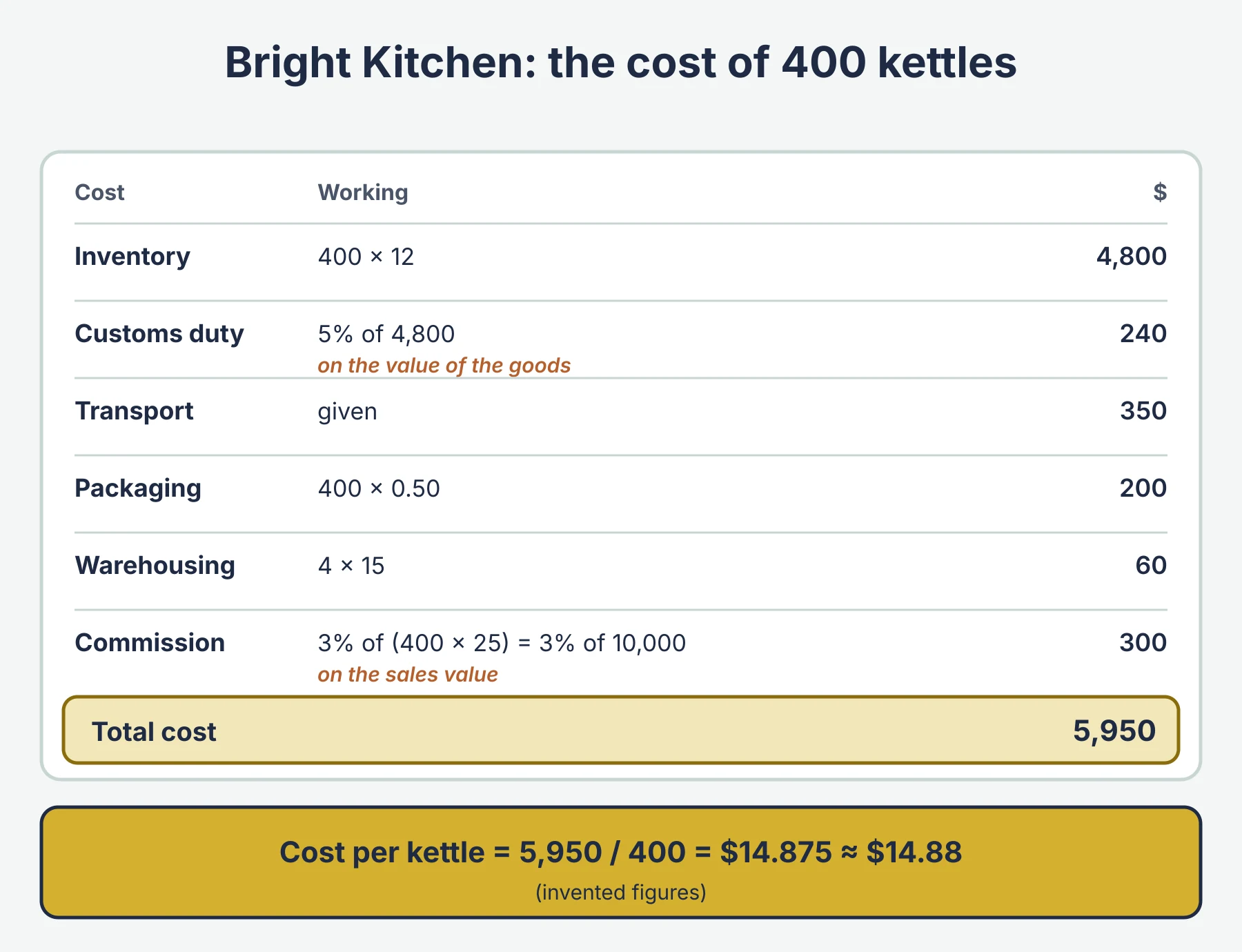
- Percentage cost = rate / 100 x the correct base value.
- Customs duty is on the value of the imported goods.
- Commission is on the value of sales the agent makes.
- Cost per unit = total cost / number of units.
Mini example (invented figures): 250 bags at $8 = $2,000 inventory; duty 10% = $200; transport $150; total = $2,350; cost per bag = 2,350 / 250 = $9.40.
Key terms
| Term | Meaning |
|---|---|
| Extractive industry | Primary production that takes natural resources from the earth or sea |
| Construction | Secondary activity of building houses, roads and other structures |
| Direct service | A service provided personally to people, not to help trade |
| Commercial service | A service that helps trade take place |
| Specialisation | Concentrating on a limited range of goods, services or tasks |
| In-house production | A business makes the product itself |
| Outsourced production | A business pays another firm to make the product |
| Intermediary | A business between producer and consumer in the chain |
| Agent | Arranges trade abroad for a principal for commission, without owning the goods |
| Factor | Agent with possession of the goods, selling them for commission |
| Automation | Use of machines and computer control, such as robots, in production |
| Electronic data interchange (EDI) | Automatic computer-to-computer exchange of business documents with suppliers |
Exam traps
- Construction is secondary, not primary.
- “Tertiary” alone is incomplete if the question asks about types of service; say commercial or direct.
- Answer specialisation questions at the level asked: individual, factory or country.
- Do not say an agent buys the goods; it acts for the principal.
- A factor in 1.2.4 is an intermediary, not the debt factoring of Topic 5.
- Commission on sales value, duty on goods value. Check the base before multiplying.
Self-test
- Name the sector that includes construction.
- Give one example of a commercial service and one of a direct service.
- Which sector does the syllabus describe as “digital technology”?
- Define specialisation.
- State one disadvantage of specialisation for a country.
- Give the two benefits of in-house production that the syllabus highlights.
- Give the two benefits of outsourced production that the syllabus highlights.
- What is the difference between a domestic and a global supply chain?
- What is the key difference between an agent and a factor?
- State one negative impact of automation on workers.
- What does EDI allow a business to do with its suppliers?
- An agent sells goods worth $6,000 and receives 4% commission. Calculate the commission.
Answers
- Secondary.
- Commercial: banking, insurance, transport or retailing. Direct: teaching, nursing, hairdressing or similar.
- Quaternary.
- Concentrating on producing a limited range of goods or services, or on one task within a process.
- Dependence on imports for other goods, or vulnerability if world demand or price for its main product falls.
- Control on quality and control of information.
- Access to expertise and cost savings.
- A domestic supply chain has all stages in one country; a global one has stages in more than one country.
- A factor has possession of the goods; an agent does not.
- Job losses, or the need to retrain for new roles.
- Exchange documents such as orders and invoices automatically between computer systems, without paper.
- 4 / 100 x 6,000 = $240.
Related resources
-
Study guides
Cambridge IGCSE Commerce (0715): Trade and commerce
Trade versus commerce, home and international trade, aids to trade, logistics and the four types of commerce, for Cambridge IGCSE Commerce 0715 section 1.1.
Commerce · Cambridge · IGCSE
Read guide -
Practice questions
Cambridge IGCSE Commerce (0715): Trade and commerce – Practice Questions
Original practice questions with mark-scheme answers on trade, commerce, aids to trade, logistics and types of commerce for Cambridge IGCSE Commerce 0715.
Commerce · Cambridge · IGCSE
Try questions -
Revision notes
Cambridge IGCSE Commerce (0715): Trade and commerce – Revision Notes
Condensed recall for Cambridge IGCSE Commerce 0715 section 1.1: trade and commerce, home and international trade, aids to trade, logistics and ecommerce types.
Commerce · Cambridge · IGCSE
Revise topic
Get free revision emails (optional)
Occasional emails with practice questions, worked explanations and links to free resources for the qualification and subjects you choose. No spam, and you can unsubscribe from any email. The free tools on this site never need an email.