
Study Guides
Cambridge IGCSE Commerce (0715): Outsourcing
Why outsourcing has grown, how contract manufacturing and contract logistics work, and cost comparisons, for Cambridge IGCSE Commerce 0715 section 2.2.
- Subject
- Commerce
- Level
- IGCSE
- Topic
- Topic 2 – Commercial Operations
- Author
- Marlbridge Academic Team
- Updated
- Reviewed by
- Salman Ahmad (what this means)
Aligned to Cambridge IGCSE Commerce (0715), 2028. Official specification .
Syllabus page (what it covers and how it is assessed): Cambridge IGCSE Commerce.
Syllabus points this page covers
0715
- 2.2 Outsourcing
Found an error? Report a correction.
Need help with this topic? Request a free trial class for IGCSE Commerce (0715).
Section 2.2 of the Cambridge IGCSE Commerce (0715) syllabus has a single statement: the growth of outsourcing: contract manufacturing and logistics. It is short, but examiners can ask you to explain why outsourcing has grown, to describe how each type works, to compare costs, and to judge whether a named business should outsource. It builds directly on 1.2.2, where you met the benefits of in-house and outsourced production. The Outsourcing and Wholesaling study guide gives the core definitions and reasons; this page works through the processes, the numbers and the decisions in more depth.
What exactly is being outsourced?
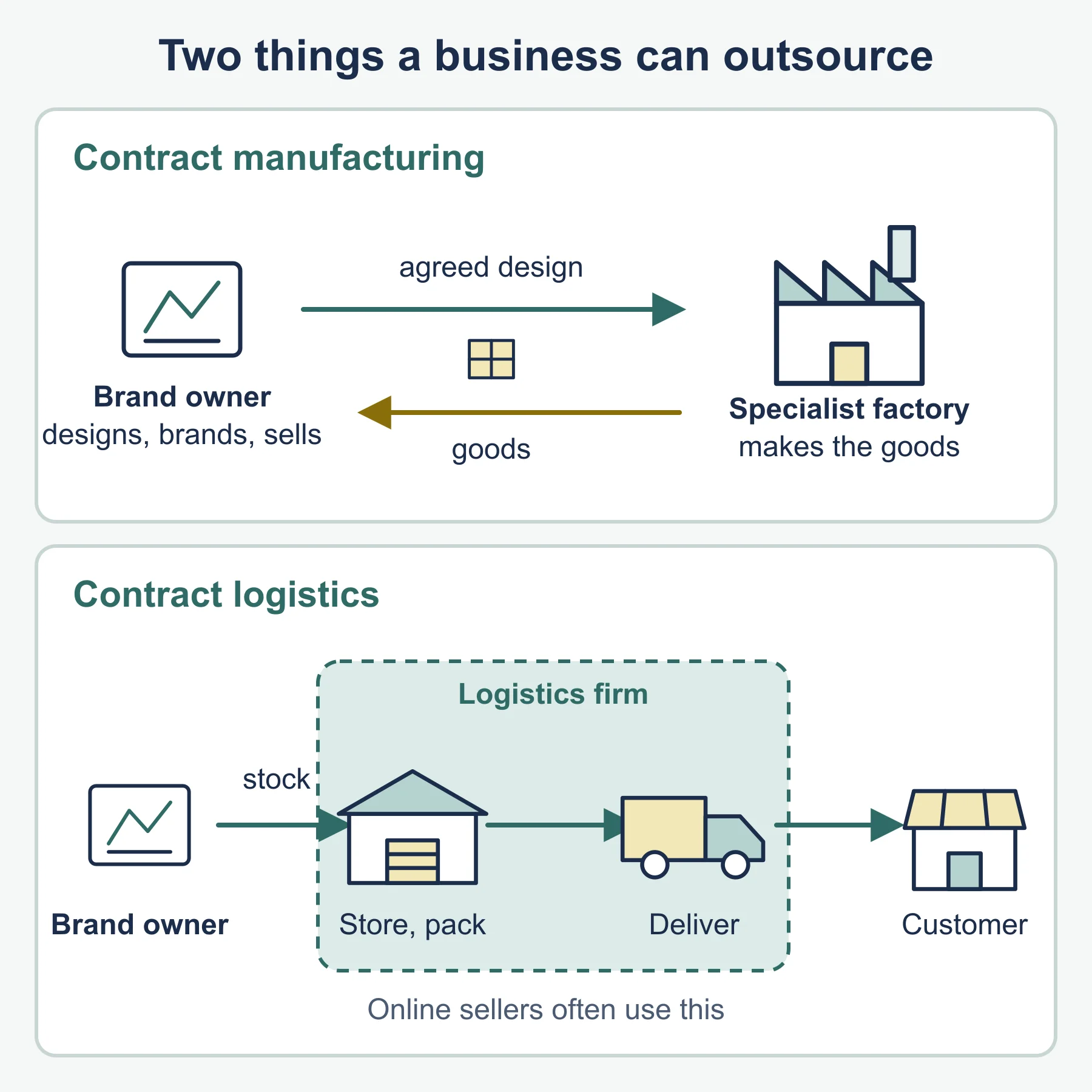
Outsourcing is paying another business to carry out an activity that a business could do itself. Two areas are named in 2.2:
- Contract manufacturing: another firm produces the goods, or components, to the business’s own design and specification.
- Contract logistics: another firm stores, handles and moves the business’s goods, often called a third-party logistics provider.
In both cases the business keeps ownership of its brand and its relationship with customers. What it hands over is a process.
How does contract manufacturing work in practice?
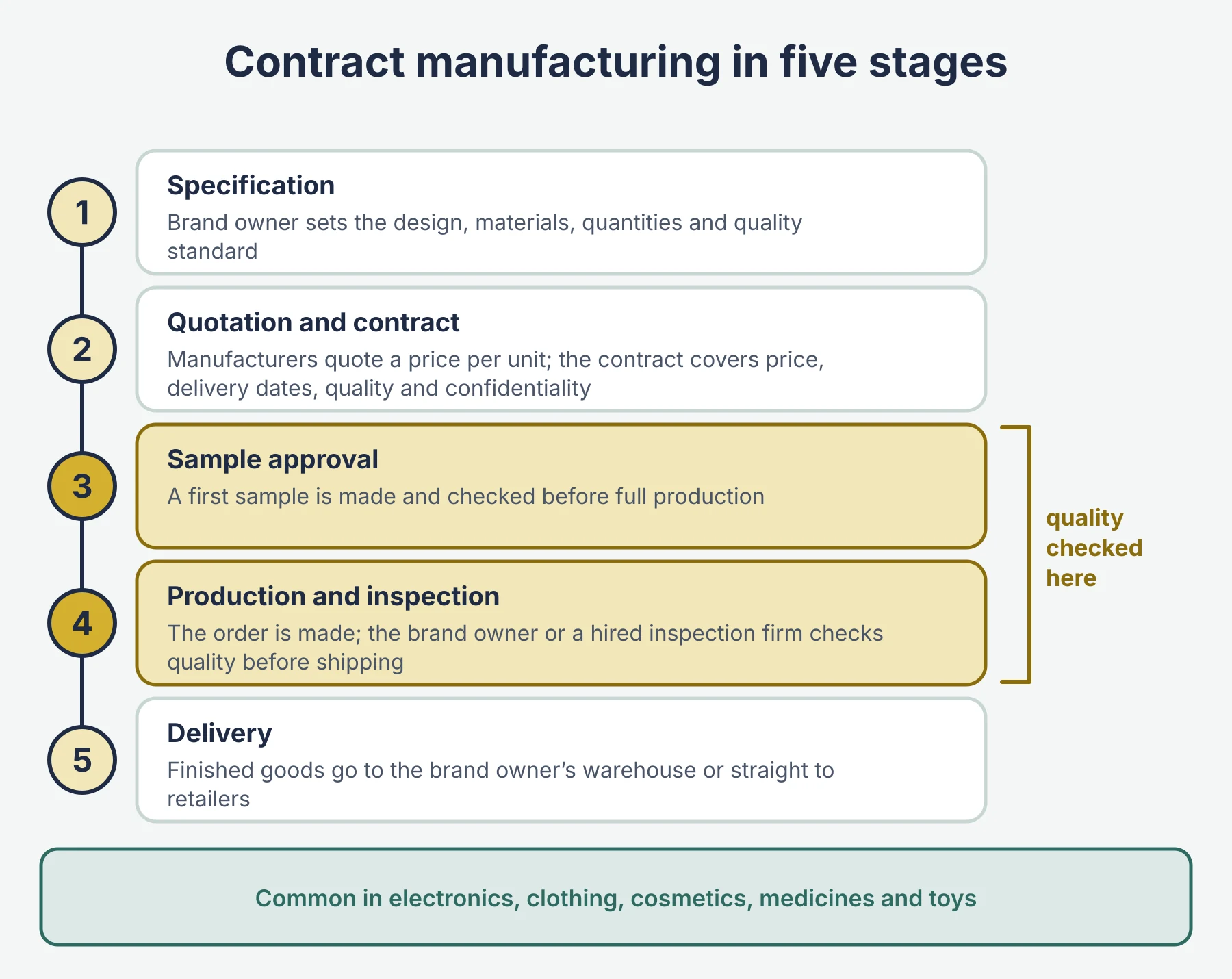
A typical arrangement runs through five stages:
- Specification. The brand owner sets out the design, materials, quantities and quality standard.
- Quotation and contract. Manufacturers quote a price per unit; the chosen one signs a contract covering price, delivery dates, quality and confidentiality.
- Sample approval. A first sample is made and checked before full production starts.
- Production and inspection. The manufacturer produces the order; the brand owner, or an inspection firm it hires, checks quality before goods are shipped.
- Delivery. Finished goods are sent to the brand owner’s warehouse or directly to retailers.
Contract manufacturing is common where production needs expensive specialist equipment or large-scale factories, such as electronics, clothing, cosmetics, medicines and toys. A small brand may design a product in one country and have it made in another where a manufacturer has the machinery and skilled staff.
How does contract logistics work in practice?
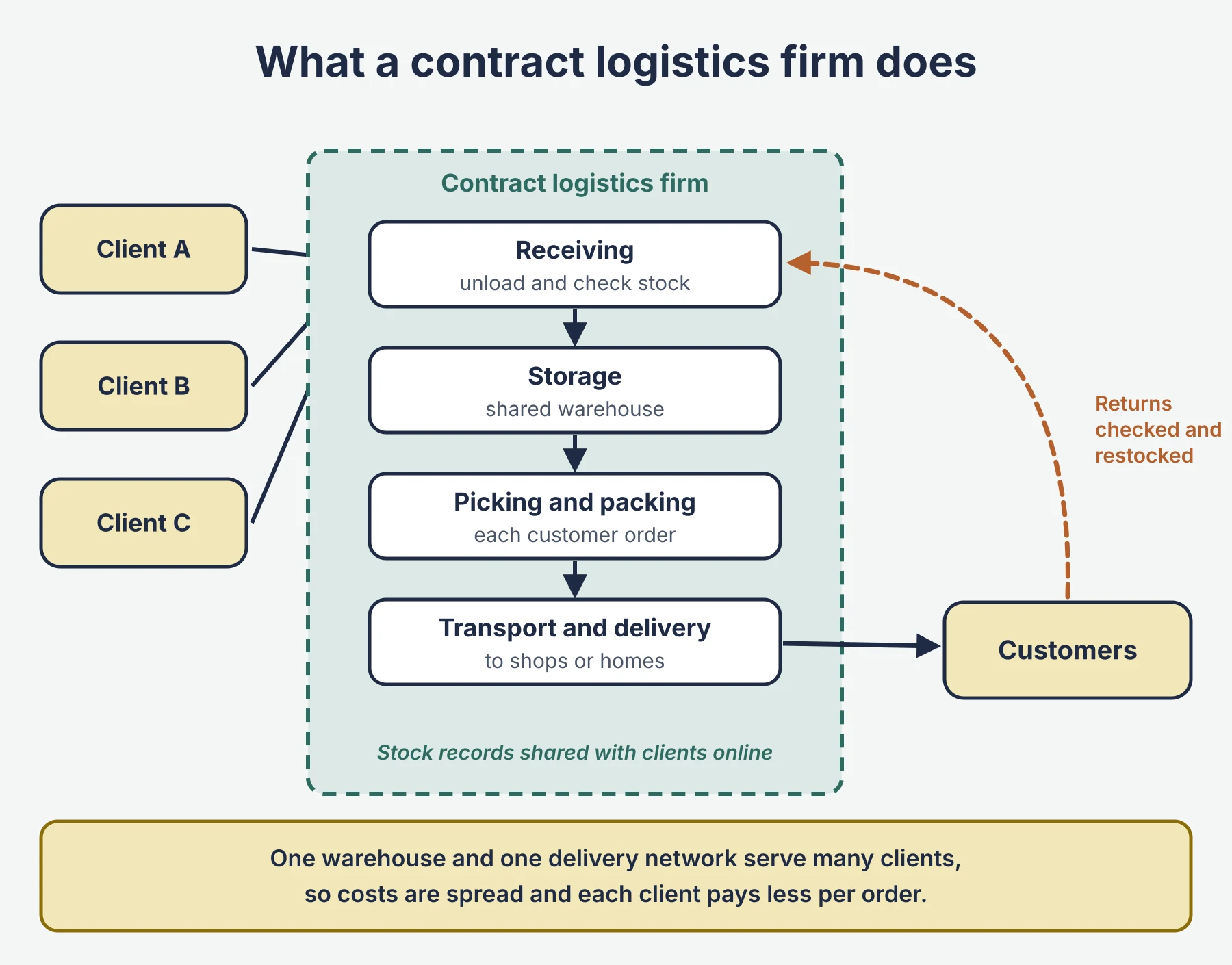
A contract logistics firm can take over some or all of these activities:
| Activity | What the logistics firm does |
|---|---|
| Receiving | Unloads and checks incoming stock |
| Storage | Holds stock in its warehouse, often shared by several client firms |
| Order picking and packing | Collects items for each customer order and packs them |
| Transport and delivery | Moves goods to shops or to customers’ homes |
| Returns | Receives, checks and restocks goods sent back by customers |
| Stock records | Tracks stock levels and shares the data with the client online |
Because one warehouse and one delivery network serve many clients, the logistics firm spreads its costs and can offer each client a lower cost per order than the client could achieve alone, especially when orders are small or uneven.
Why has outsourcing grown?
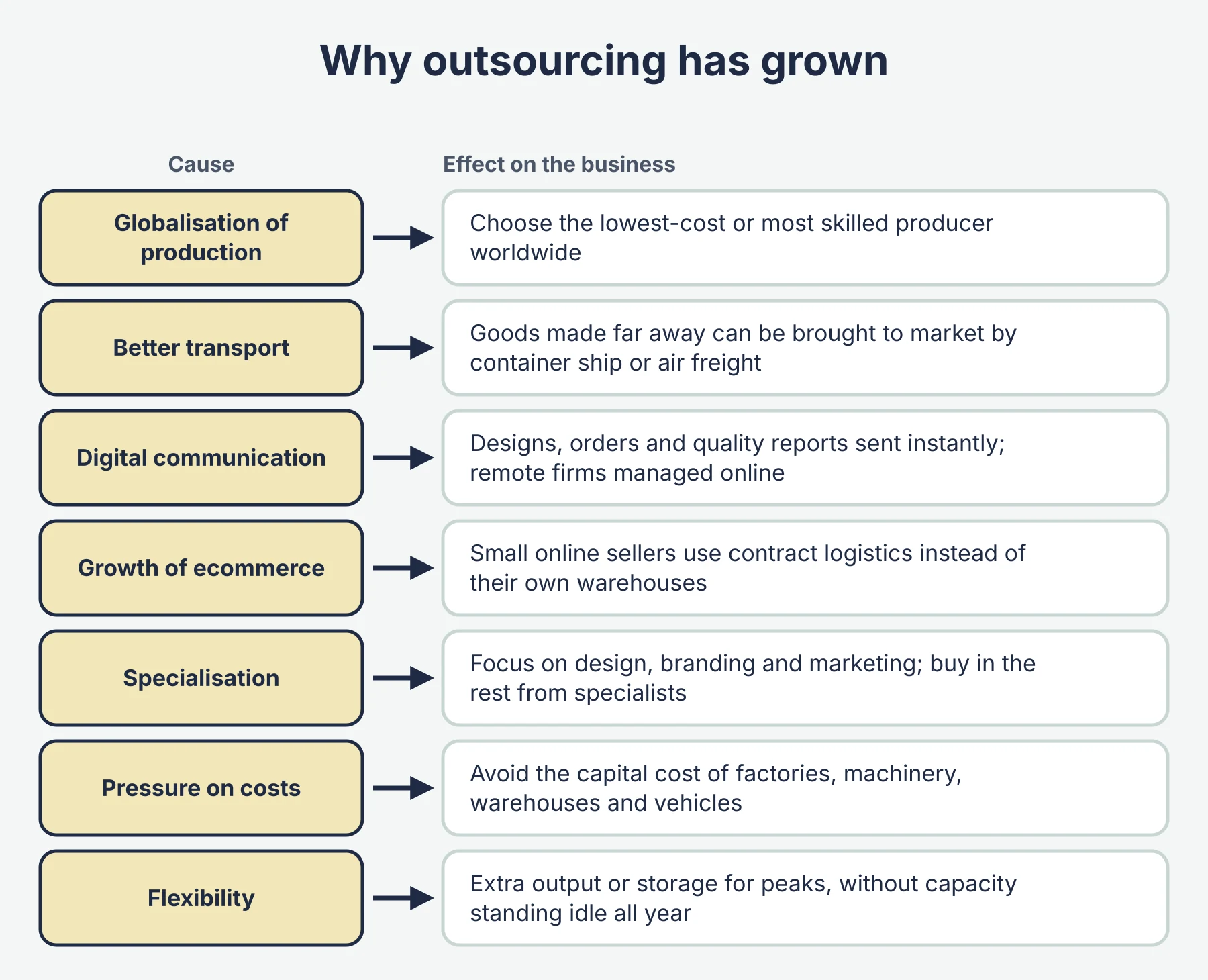
Each reason below explains part of the growth. A strong answer explains the cause and its effect on the business.
- Globalisation of production. Manufacturers in many countries now compete for contracts, so brand owners can choose the lowest-cost or most skilled producer.
- Better transport. Container shipping and air freight make it practical to have goods made far away and brought to market.
- Digital communication. Designs, orders and quality reports can be sent instantly; video calls and shared online systems let a business manage a manufacturer or warehouse in another place.
- Growth of ecommerce. Online sellers need fast picking, packing and home delivery. Many small sellers cannot afford their own warehouses, so they use contract logistics.
- Specialisation. Businesses concentrate on what they do best, such as design, branding and marketing, and buy in the rest from specialists.
- Pressure on costs. Competition pushes firms to cut costs; outsourcing avoids the capital cost of factories, machinery, warehouses and vehicles.
- Flexibility. Demand can rise sharply at festivals or in sales periods. Contractors can supply extra output or storage for a few weeks, instead of the business owning capacity that stands idle for the rest of the year.
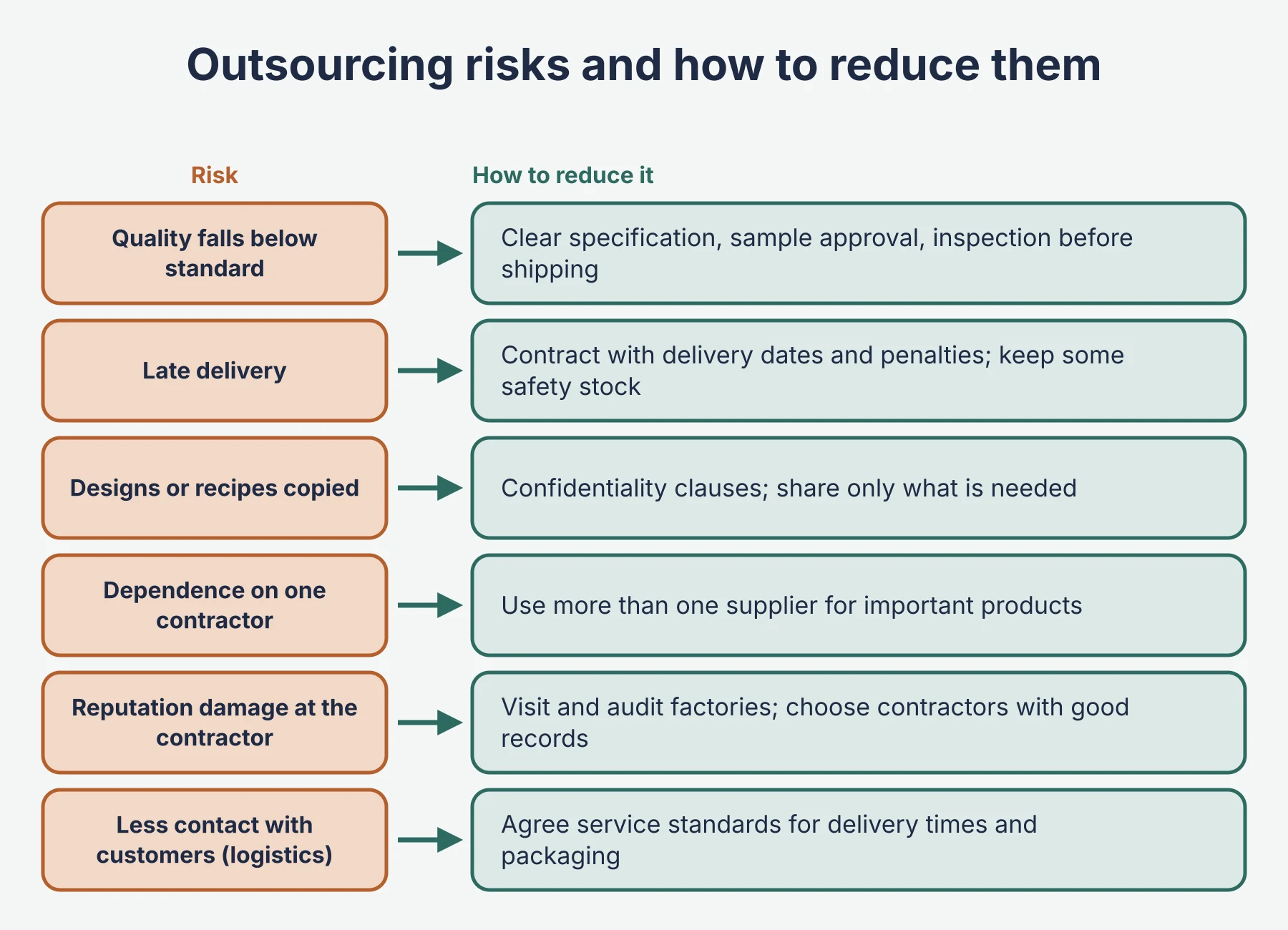
What are the risks of outsourcing, and how can they be reduced?
| Risk | How a business can reduce it |
|---|---|
| Quality falls below standard | Clear specification, sample approval, inspection before shipping |
| Late delivery | Contract with delivery dates and penalties; keep some safety stock |
| Designs or recipes copied | Confidentiality clauses; share only what is needed |
| Dependence on one contractor | Use more than one supplier for important products |
| Reputation damage from poor working conditions or pollution at the contractor | Visit and audit factories; choose contractors with good records |
| Less direct contact with customers (logistics) | Agree service standards for delivery times and packaging |
Worked example 1: should a brand outsource manufacturing? (invented figures)
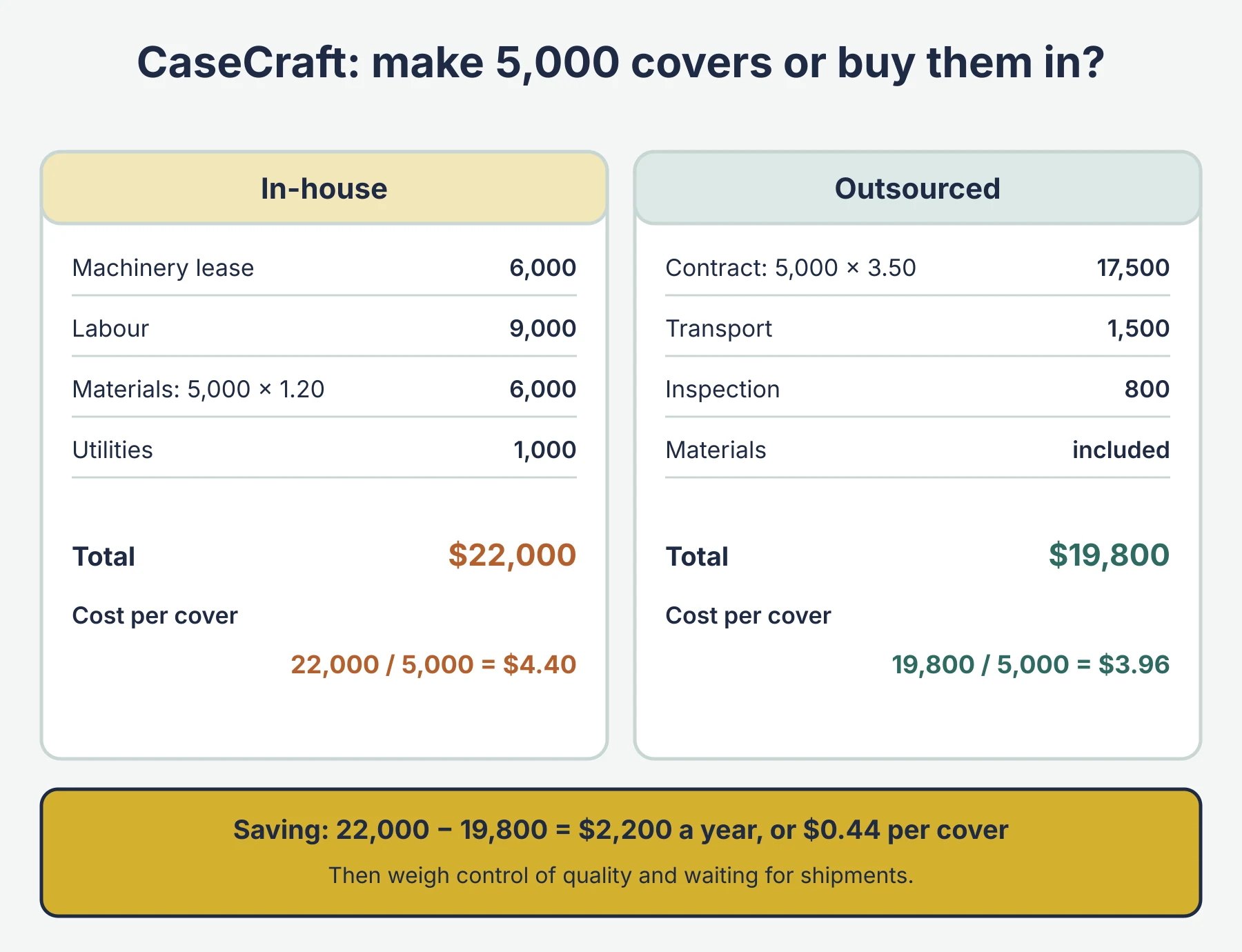
CaseCraft sells 5,000 phone covers a year. Making them in-house would cost $6,000 a year to lease machinery, $9,000 for labour, $1.20 per cover for materials and $1,000 for utilities. A contract manufacturer quotes $3.50 per cover, including materials. Transport from the manufacturer costs $1,500 a year and quality inspections cost $800.
| In-house | Outsourced | |
|---|---|---|
| Machinery lease | 6,000 | - |
| Labour | 9,000 | - |
| Materials | 5,000 x 1.20 = 6,000 | included |
| Utilities | 1,000 | - |
| Contract price | - | 5,000 x 3.50 = 17,500 |
| Transport | - | 1,500 |
| Inspection | - | 800 |
| Total | $22,000 | $19,800 |
| Cost per cover | 22,000 / 5,000 = $4.40 | 19,800 / 5,000 = $3.96 |
Outsourcing saves 22,000 - 19,800 = $2,200 a year, or $0.44 per cover. A full answer then weighs the non-cost factors: CaseCraft loses direct control of quality and must wait for shipments, but avoids tying up money in machinery and can change designs without retraining staff.
Worked example 2: in-house warehouse or contract logistics? (invented figures)
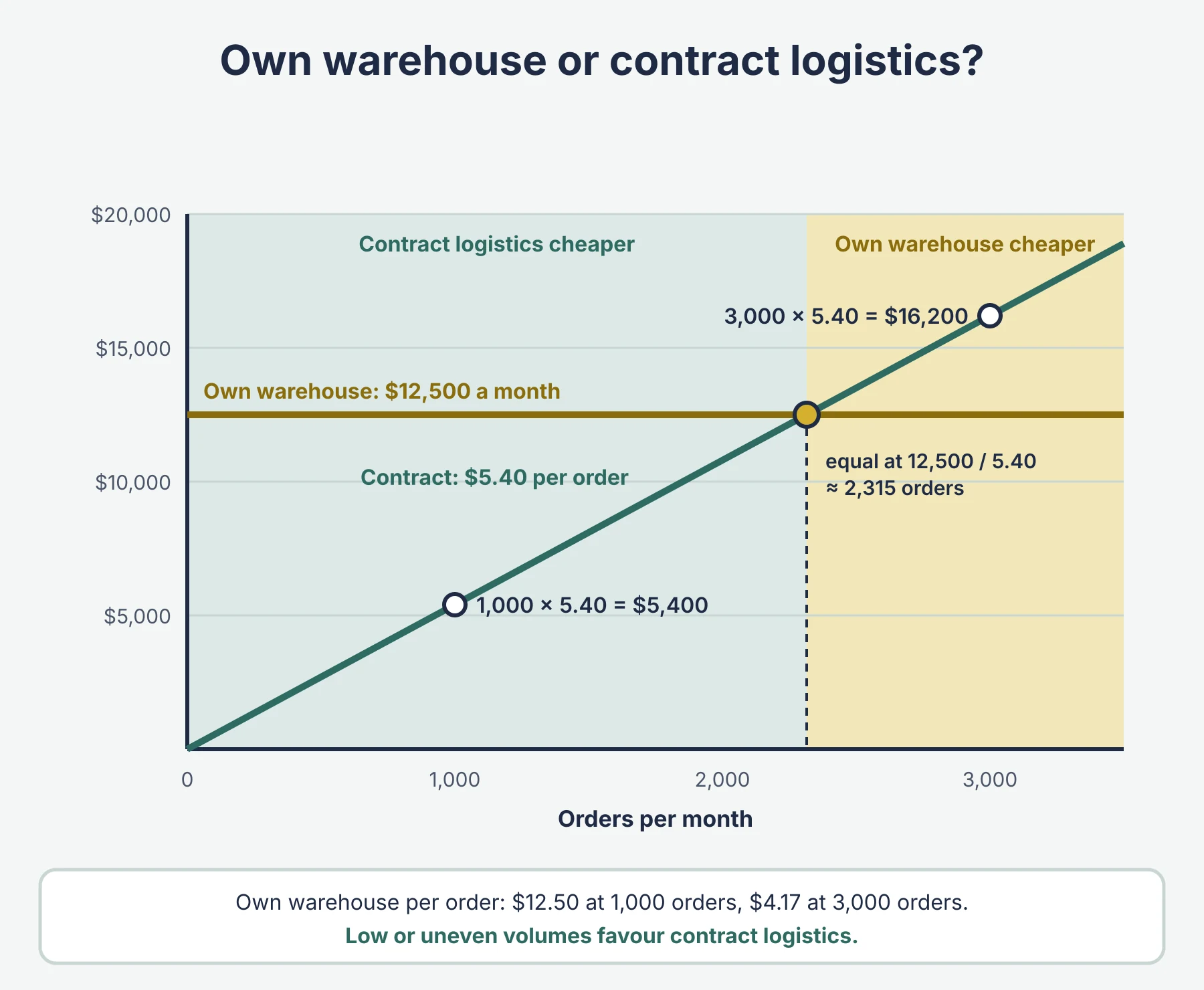
An online shop could run its own warehouse at a cost of $12,500 a month (rent $4,000, staff $6,000, delivery van $2,500). A contract logistics firm charges $5.40 per order for storage, picking, packing and delivery.
- At 3,000 orders a month: in-house = $12,500, or 12,500 / 3,000 = $4.17 per order; contract logistics = 3,000 x 5.40 = $16,200. In-house is cheaper.
- At 1,000 orders a month: in-house is still $12,500, or $12.50 per order; contract logistics = 1,000 x 5.40 = $5,400. Outsourcing is much cheaper.
- Costs are equal at 12,500 / 5.40, about 2,315 orders a month.
The lesson: contract logistics suits businesses with low or uneven order numbers, because they pay only for the orders they send. Once volumes are high and steady, running their own warehouse may cost less per order.
What are the common mistakes in 2.2?
- Defining outsourcing as “moving a business abroad”. The contractor can be in the same town; what matters is that another business does the work.
- Treating contract manufacturing and contract logistics as the same thing.
- Explaining growth with “it is cheaper” and no reason why it is cheaper, such as economies of scale or lower labour costs.
- Ignoring the costs that outsourcing adds, such as transport and inspection, in a cost comparison.
- Recommending outsourcing in every case. Volume, quality needs and confidentiality can point the other way.
Exam technique for the command words
- Explain why outsourcing has grown: name a cause and link it to the business benefit.
- Calculate: set out both options in columns, show each working, and compare totals or cost per unit.
- Analyse: show how one change, such as rising ecommerce orders, affects the outsourcing decision.
- Evaluate or justify: compare cost and non-cost factors for the named business and finish with a recommendation.
Where can I practise?
Use the outsourcing revision notes for recall, then try the outsourcing practice questions. The in-house versus outsourced comparison from Topic 1 is in the production study guide.
Official syllabus
Cambridge IGCSE Commerce (0715) syllabus for 2028, section 2.2 Outsourcing: official syllabus PDF.
Related resources
-
Practice questions
Cambridge IGCSE Commerce (0715): Outsourcing – Practice Questions
Original Cambridge IGCSE Commerce 0715 questions with answers on the growth of outsourcing, contract manufacturing, contract logistics and cost comparisons.
Commerce · Cambridge · IGCSE
Try questions -
Revision notes
Cambridge IGCSE Commerce (0715): Outsourcing – Revision Notes
Recall notes for Cambridge IGCSE Commerce 0715 section 2.2: contract manufacturing, contract logistics, reasons for growth, risks and cost comparison method.
Commerce · Cambridge · IGCSE
Revise topic -
Study guides
Cambridge IGCSE Commerce (0715): Retailing
Types of retailer, selling techniques, digital retail trends and effects of ecommerce on traditional commerce, for Cambridge IGCSE Commerce 0715 section 2.3.
Commerce · Cambridge · IGCSE
Read guide
Get free revision emails (optional)
Occasional emails with practice questions, worked explanations and links to free resources for the qualification and subjects you choose. No spam, and you can unsubscribe from any email. The free tools on this site never need an email.