
Revision Notes
Cambridge IGCSE Commerce (0715): Outsourcing – Revision Notes
Recall notes for Cambridge IGCSE Commerce 0715 section 2.2: contract manufacturing, contract logistics, reasons for growth, risks and cost comparison method.
- Subject
- Commerce
- Level
- IGCSE
- Topic
- Topic 2 – Commercial Operations
- Author
- Marlbridge Academic Team
- Updated
- Reviewed by
- Salman Ahmad (what this means)
Aligned to Cambridge IGCSE Commerce (0715), 2028. Official specification .
Syllabus page (what it covers and how it is assessed): Cambridge IGCSE Commerce.
Syllabus points this page covers
0715
- 2.2 Outsourcing
Found an error? Report a correction.
Need help with this topic? Request a free trial class for IGCSE Commerce (0715).
Condensed notes for section 2.2 of Cambridge IGCSE Commerce (0715): the growth of outsourcing through contract manufacturing and logistics. For the worked cost comparisons, use the outsourcing study guide.
The syllabus statement
2.2.1 names one idea, the growth of outsourcing, in two forms: contract manufacturing and logistics. Link it back to 1.2.2: in-house gives control of quality and information; outsourcing gives expertise and cost savings.
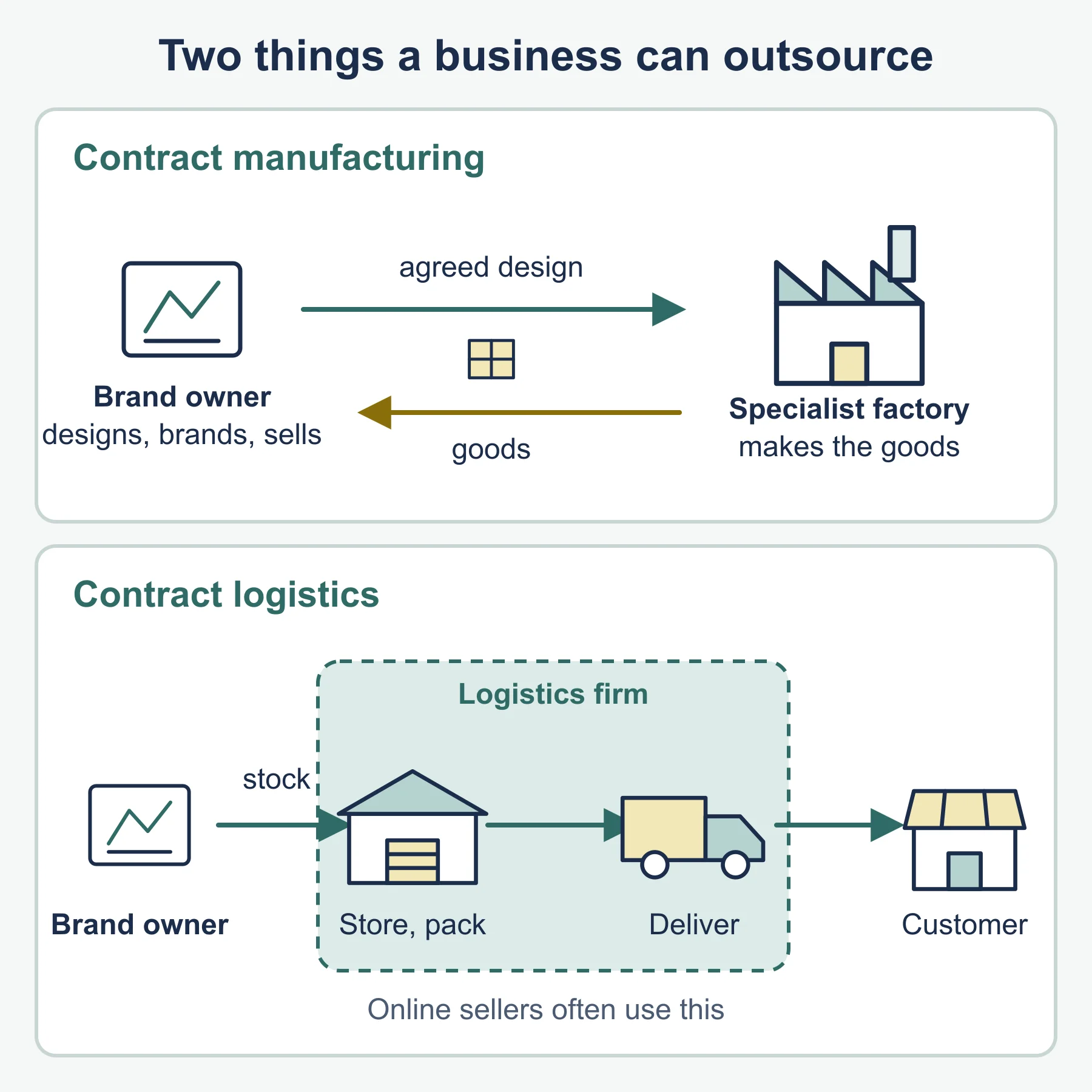
Two forms side by side
| Contract manufacturing | Contract logistics | |
|---|---|---|
| What is handed over | Making the product or its parts | Storing, handling and moving the goods |
| What the business keeps | Design, brand, marketing, selling | Products, brand, customer relationship |
| Typical users | Electronics, clothing, cosmetics, toy brands | Online sellers, retailers, manufacturers shipping goods |
| Main appeal | No factory or machinery needed; specialist skills | No warehouse or vehicles needed; pay per order |
| Main worry | Quality and confidentiality | Delivery standards and customer experience |
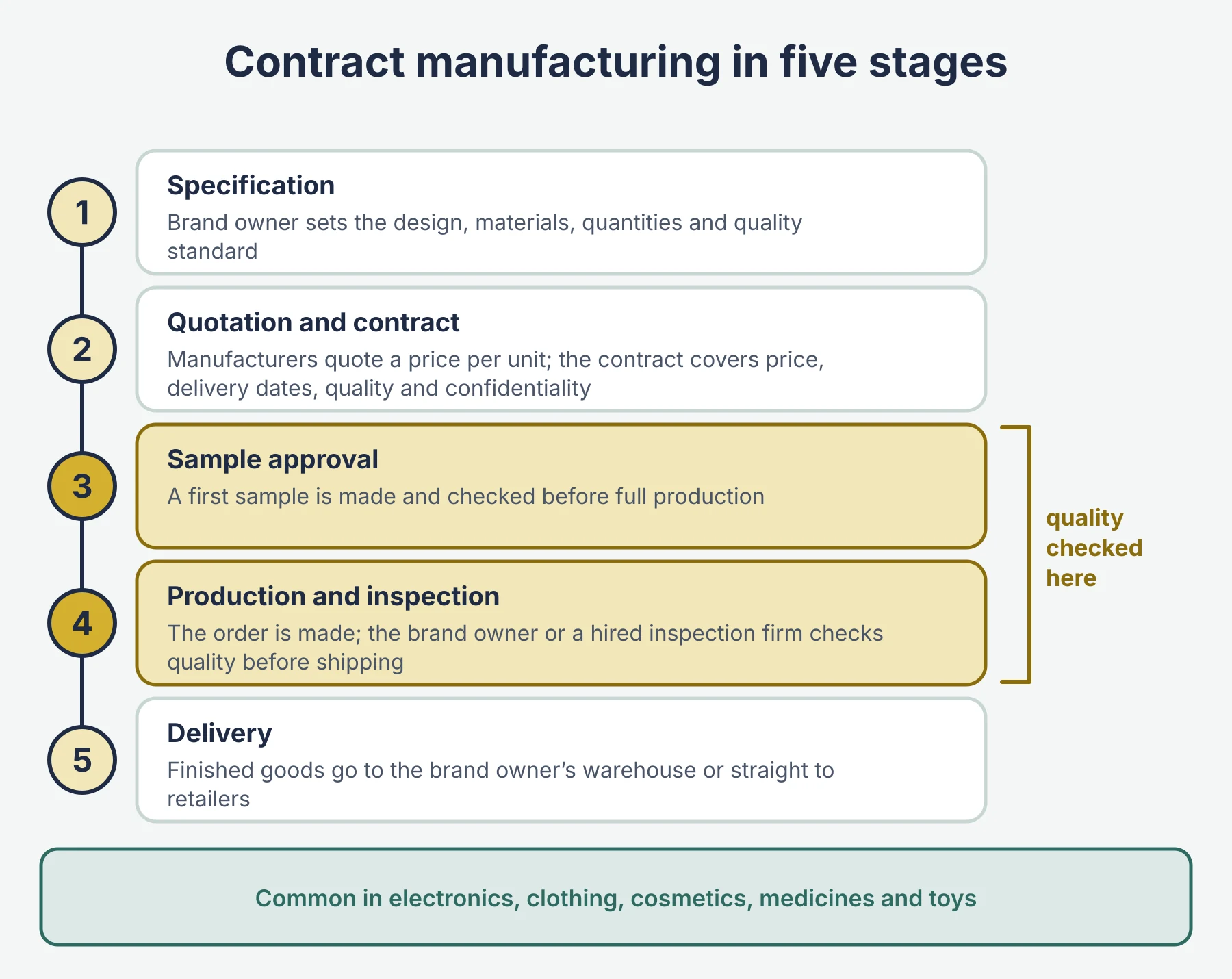
Process of contract manufacturing
Specification, then quotation and contract, then sample approval, then production and inspection, then delivery.
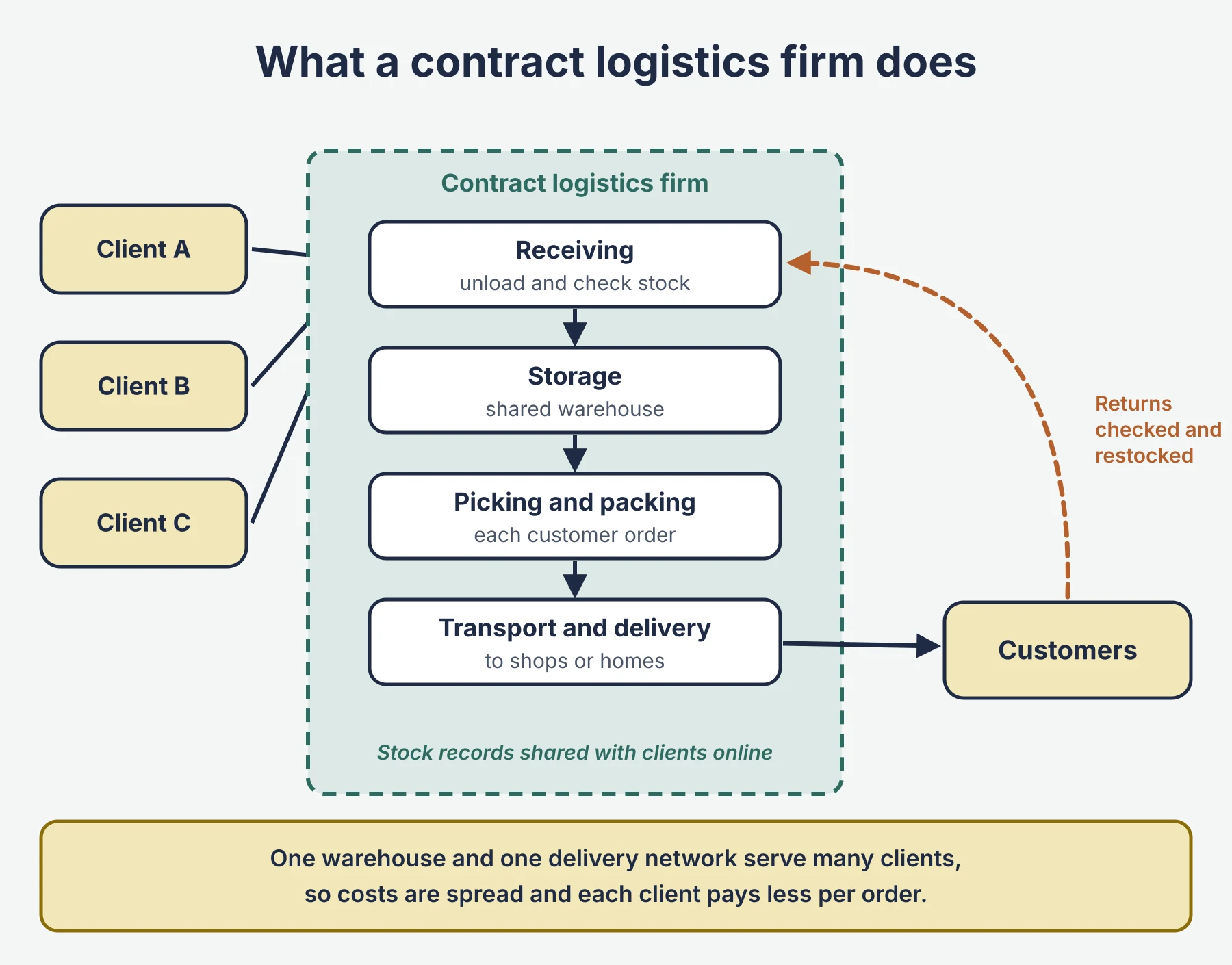
Services in contract logistics
Receiving, storage, picking and packing, transport and delivery, returns handling, stock records shared online.
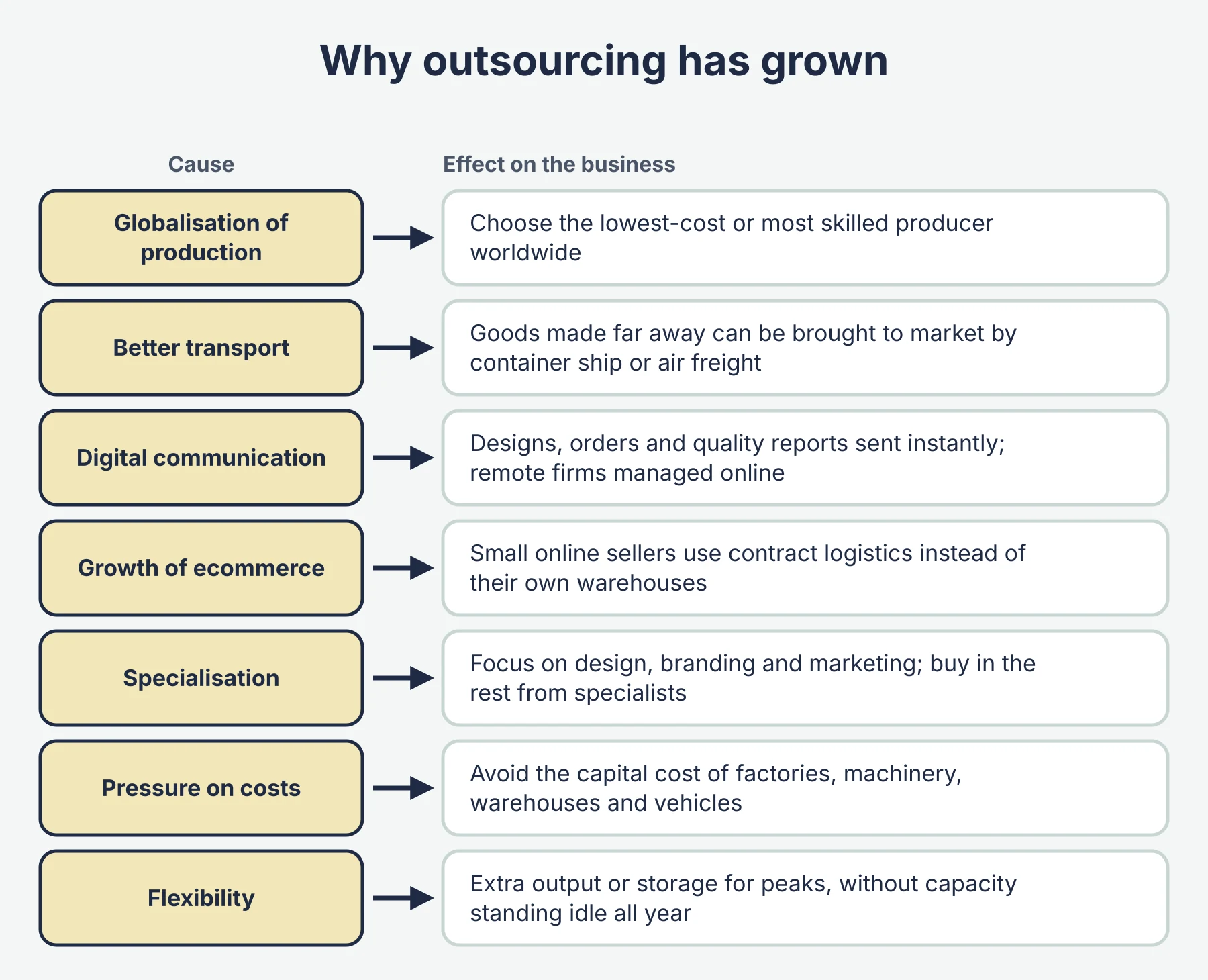
Seven reasons for growth (cause, then effect)
- Globalisation of production: many manufacturers compete for contracts, so prices fall and choice rises.
- Better transport: container ships and air freight make distant production practical.
- Digital communication: designs, orders and reports are shared instantly, so contractors can be managed remotely.
- Ecommerce growth: online sellers need fast picking, packing and delivery that specialists already provide.
- Specialisation: firms focus on core activities like design and marketing.
- Cost pressure: no capital tied up in factories, warehouses or vans.
- Flexibility: extra capacity can be bought for peak seasons only.
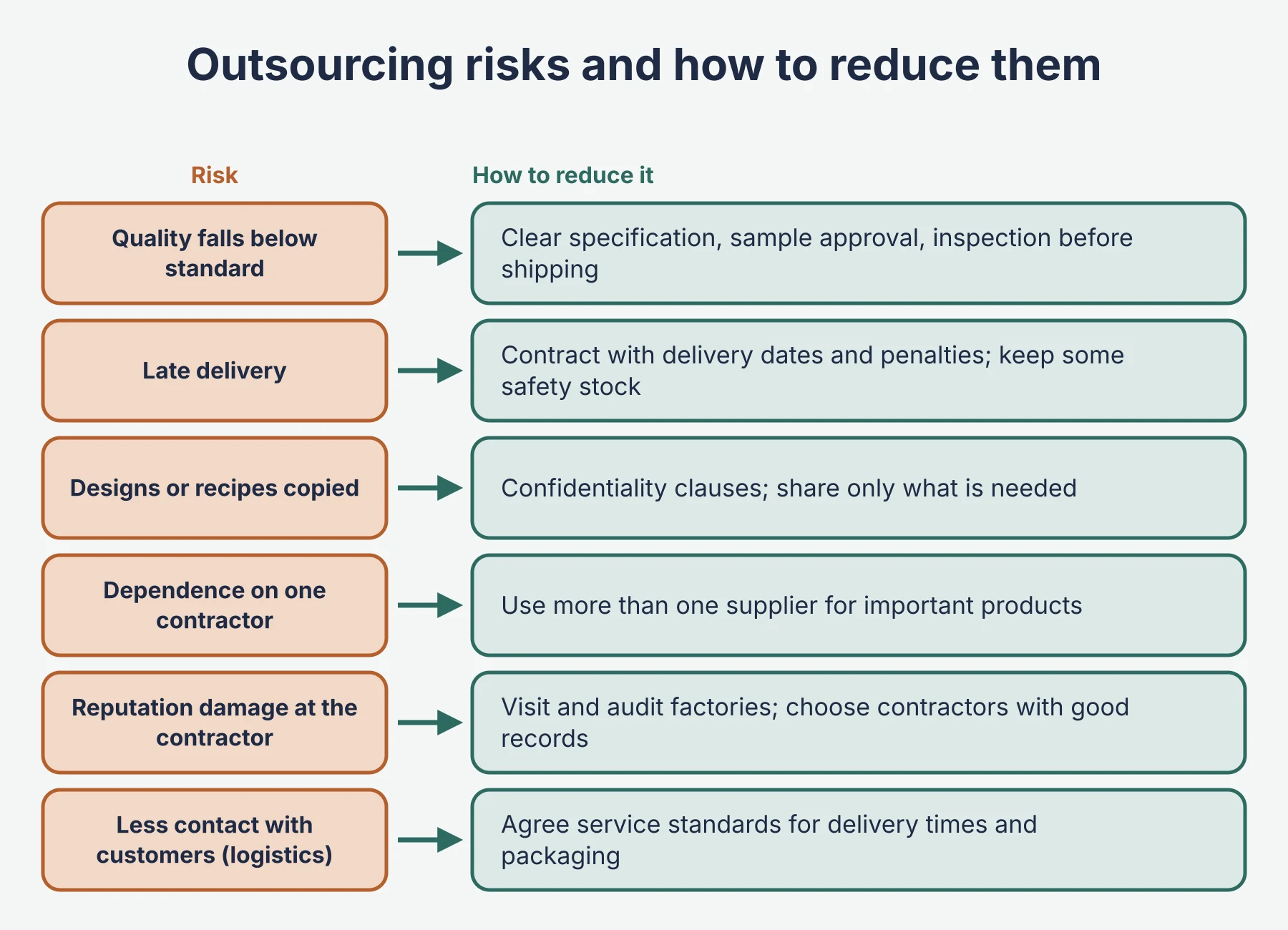
Risks and controls
| Risk | Control |
|---|---|
| Poor quality | Specification, sample approval, inspection |
| Late delivery | Contract dates, penalties, safety stock |
| Copying of designs | Confidentiality clauses |
| Reliance on one firm | Use more than one contractor |
| Ethical scandal at contractor | Factory audits, careful choice of contractor |
Cost comparison method
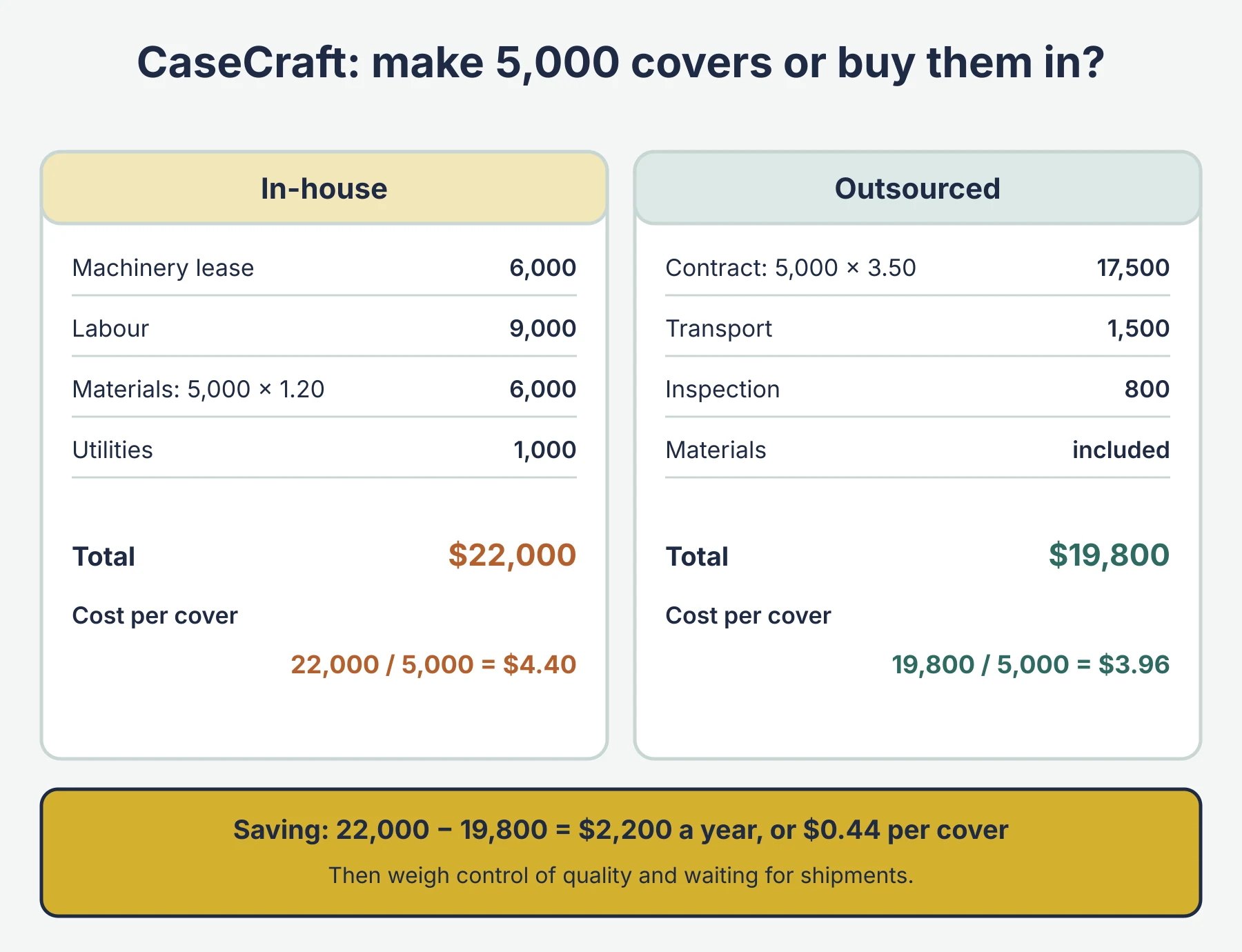
- List every in-house cost: equipment or rent, labour, materials, utilities.
- List every outsourcing cost: contract price, plus transport, inspection and any fees.
- Total each column.
- Divide by units or orders for cost per unit.
- State the saving, then weigh non-cost factors before recommending.
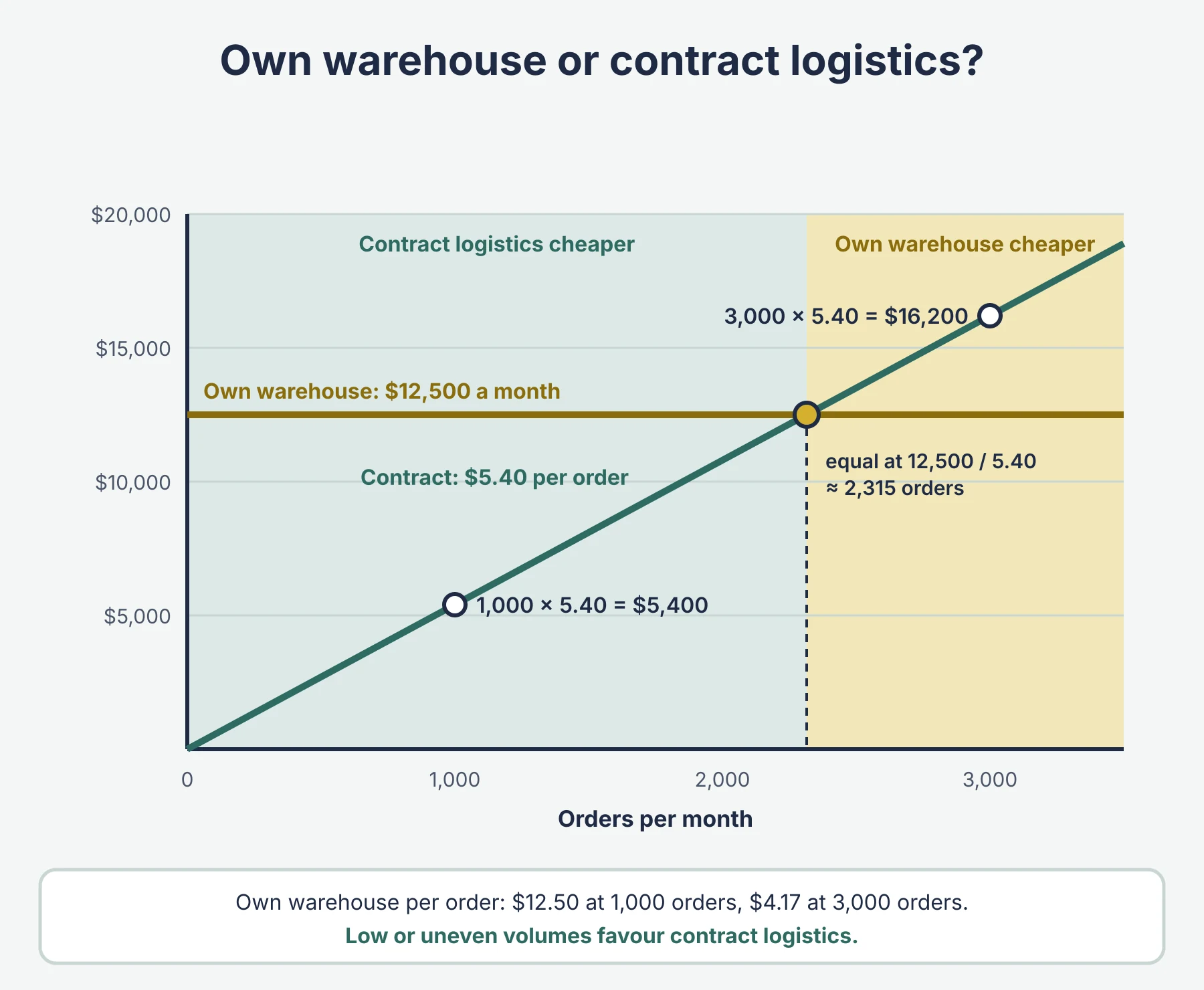
Pattern to remember: contract logistics charged per order suits low or uneven volumes; an in-house warehouse with fixed monthly costs becomes cheaper per order as volume rises.
Mini check (invented figures): own warehouse $9,000 a month; contract logistics $4.50 per order. Equal cost at 9,000 / 4.50 = 2,000 orders a month. Below 2,000, outsource; above 2,000, in-house is cheaper on cost alone.
Key terms
| Term | Meaning |
|---|---|
| Outsourcing | Paying another business to carry out an activity the business could do itself |
| Contract manufacturing | Another firm makes products to the business’s specification |
| Contract logistics | Another firm stores, handles and delivers the business’s goods |
| Third-party logistics provider | A specialist firm offering contract logistics to other businesses |
| Specification | Detailed description of the design, materials and quality required |
| Core activity | What the business does best and depends on, such as design or branding |
| Confidentiality clause | Part of a contract forbidding the contractor to share information |
| Safety stock | Extra stock held in case a delivery is late |
Exam traps
- Outsourcing is not the same as moving abroad; the contractor may be local.
- “Cheaper” is not an explanation. Say why: economies of scale, lower wages, shared warehouses.
- In calculations, include the hidden outsourcing costs: transport, inspection, fees.
- Do not mix up the two forms: making the goods versus storing and moving them.
- Evaluation needs a recommendation tied to the business’s volume, quality needs and secrets.
Self-test
- State the two forms of outsourcing named in 2.2.
- Define contract manufacturing.
- Define contract logistics.
- Give two activities a contract logistics firm can carry out.
- Explain how the growth of ecommerce has increased the use of contract logistics.
- Explain how digital communication has helped the growth of contract manufacturing.
- Give one risk of contract manufacturing and one way to reduce it.
- Why might a business with seasonal demand prefer contract logistics?
- Name two costs a business must add to a contract manufacturer’s price when comparing options.
- A firm’s own warehouse costs $7,200 a month. A logistics firm charges $4 per order. At how many orders a month are the costs equal?
- Which benefit of in-house production from 1.2.2 is most at risk when a secret recipe is outsourced?
- Give one reason a business with very high, steady order volumes might keep logistics in-house.
Answers
- Contract manufacturing and contract logistics.
- Paying another firm to make products or components to the business’s own design and specification.
- Paying a specialist firm to store, handle, transport and deliver the business’s goods.
- Any two: receiving stock, storage, picking and packing, delivery, handling returns, stock records.
- Online sellers must pick, pack and deliver many small orders quickly; specialists already have the warehouses and delivery networks, so it is cheaper than building their own.
- Designs, orders and quality reports can be sent instantly and video calls used, so a business can manage a manufacturer in another place.
- Risk: poor quality, late delivery, copied designs or an ethical scandal. Control: specification and inspection, delivery penalties, confidentiality clauses or audits.
- It pays only for the orders sent, so it does not own warehouse space that stands empty out of season.
- Any two: transport, inspection, fees, insurance.
- 7,200 / 4 = 1,800 orders.
- Control of information.
- Fixed warehouse costs are spread over many orders, giving a lower cost per order than the logistics firm’s charge; it also keeps control of delivery standards.
Related resources
-
Study guides
Cambridge IGCSE Commerce (0715): Retailing
Types of retailer, selling techniques, digital retail trends and effects of ecommerce on traditional commerce, for Cambridge IGCSE Commerce 0715 section 2.3.
Commerce · Cambridge · IGCSE
Read guide -
Practice questions
Cambridge IGCSE Commerce (0715): Retailing – Practice Questions
Original Cambridge IGCSE Commerce 0715 questions with answers on types of retailer, selling techniques, digital retail trends and ecommerce impacts.
Commerce · Cambridge · IGCSE
Try questions -
Revision notes
Cambridge IGCSE Commerce (0715): Retailing – Revision Notes
Recall notes for Cambridge IGCSE Commerce 0715 section 2.3: ten retailer types, small-shop survival, selling techniques, digital trends and ecommerce impacts.
Commerce · Cambridge · IGCSE
Revise topic
Get free revision emails (optional)
Occasional emails with practice questions, worked explanations and links to free resources for the qualification and subjects you choose. No spam, and you can unsubscribe from any email. The free tools on this site never need an email.