
Revision Notes
Cambridge IGCSE Commerce (0715): Commercial enterprises – Revision Notes
Recall notes for Cambridge IGCSE Commerce 0715 section 2.1: ownership comparison table, public corporations, MNC impacts, franchises and location factors.
- Subject
- Commerce
- Level
- IGCSE
- Topic
- Topic 2 – Commercial Operations
- Author
- Marlbridge Academic Team
- Updated
- Reviewed by
- Salman Ahmad (what this means)
Aligned to Cambridge IGCSE Commerce (0715), 2028. Official specification .
Syllabus page (what it covers and how it is assessed): Cambridge IGCSE Commerce.
Syllabus points this page covers
0715
- 2.1 Commercial enterprises
Found an error? Report a correction.
Need help with this topic? Request a free trial class for IGCSE Commerce (0715).
Condensed notes for section 2.1 of Cambridge IGCSE Commerce (0715). For full explanations and an annotated model answer, use the commercial enterprises study guide.
Private versus public sector
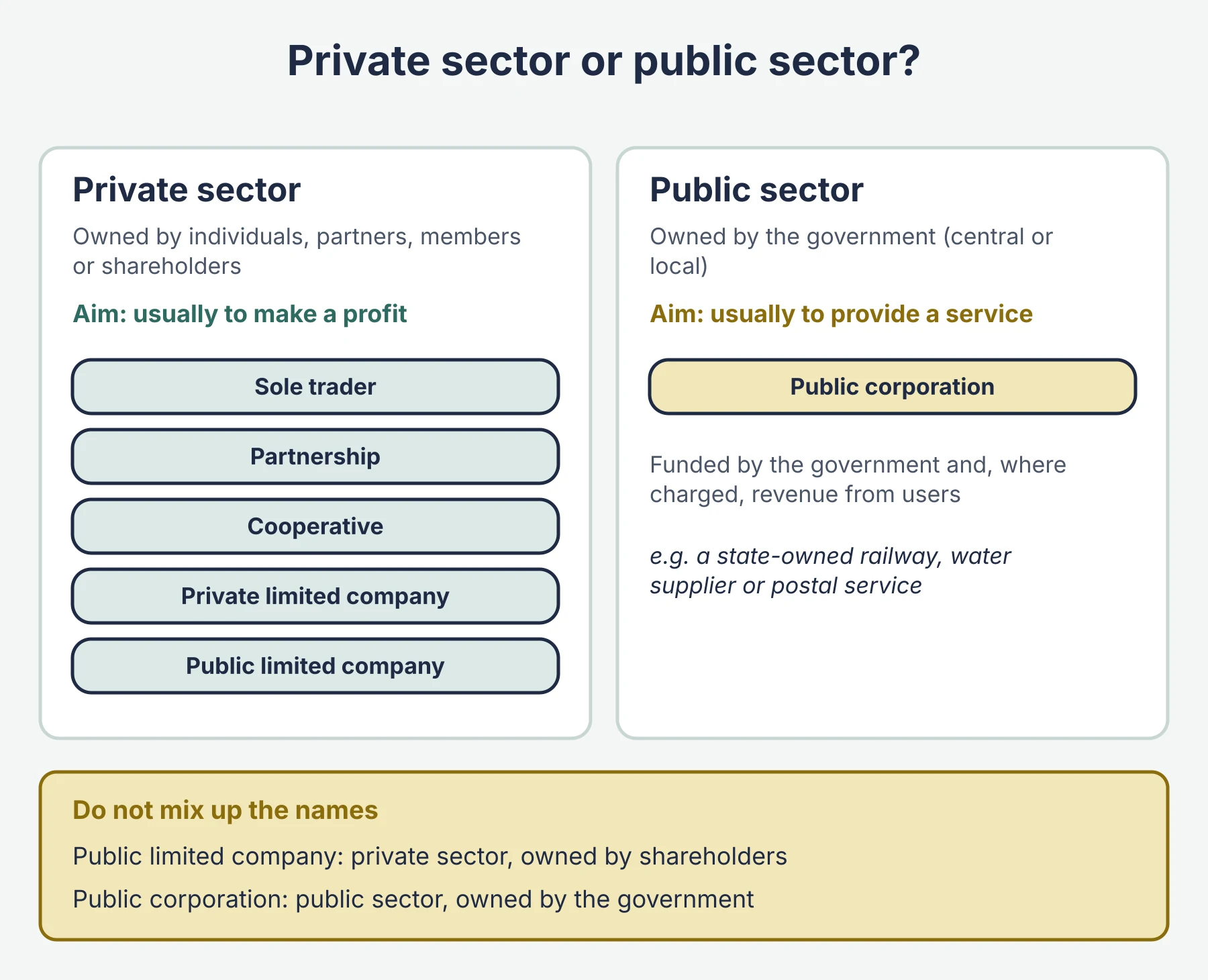
- Private sector: owned by individuals or shareholders; usually aims for profit.
- Public sector: owned by government; usually aims to provide a service.
Ownership comparison
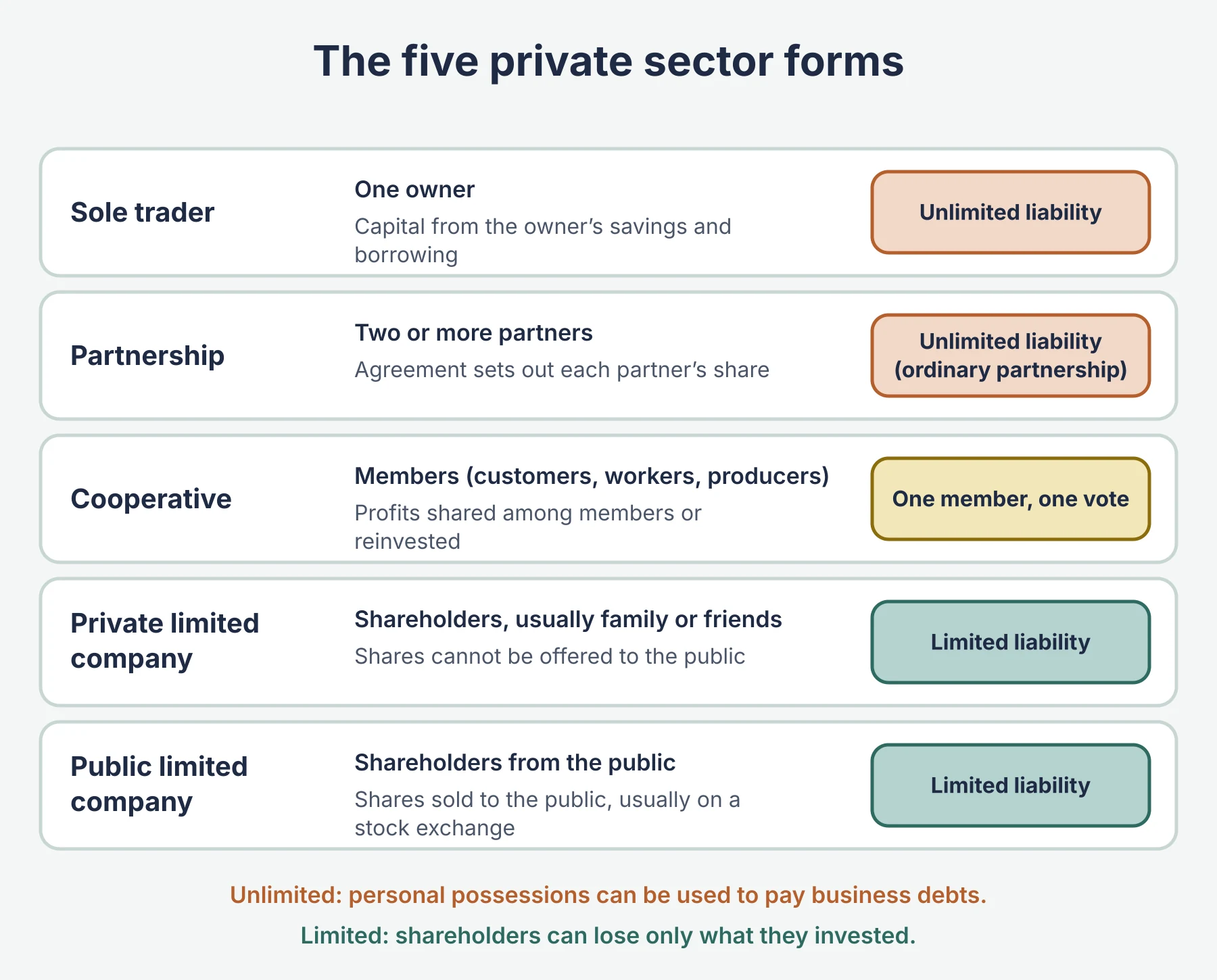
| Form | Owners | Liability | Capital | Control | Key drawback |
|---|---|---|---|---|---|
| Sole trader | One person | Unlimited | Owner’s savings and loans | Full control | Limited capital; all risk on one person |
| Partnership | Two or more partners | Unlimited (ordinary partnership) | Partners’ contributions | Shared, set by partnership agreement | Disagreements; bound by partners’ decisions |
| Cooperative | Members | Usually limited, depending on how it is registered | Members’ contributions | One member, one vote | Slow decisions; limited capital |
| Private limited company | Shareholders, shares not offered to the public | Limited | Sale of shares to family, friends, chosen investors | Shareholders, often family | Registration cost; some information public |
| Public limited company | Shareholders, shares sold to the public | Limited | Large: shares on a stock exchange | Board of directors; owners separate from managers | Costly to set up; must publish accounts; risk of takeover |
| Public corporation | Government | Government responsible | Government funds and charges to users | Board appointed by government | May be inefficient without the profit motive; cost to taxpayers |
Limited liability: owners can lose only the money they invested. Unlimited liability: owners’ personal possessions can be taken to pay business debts.
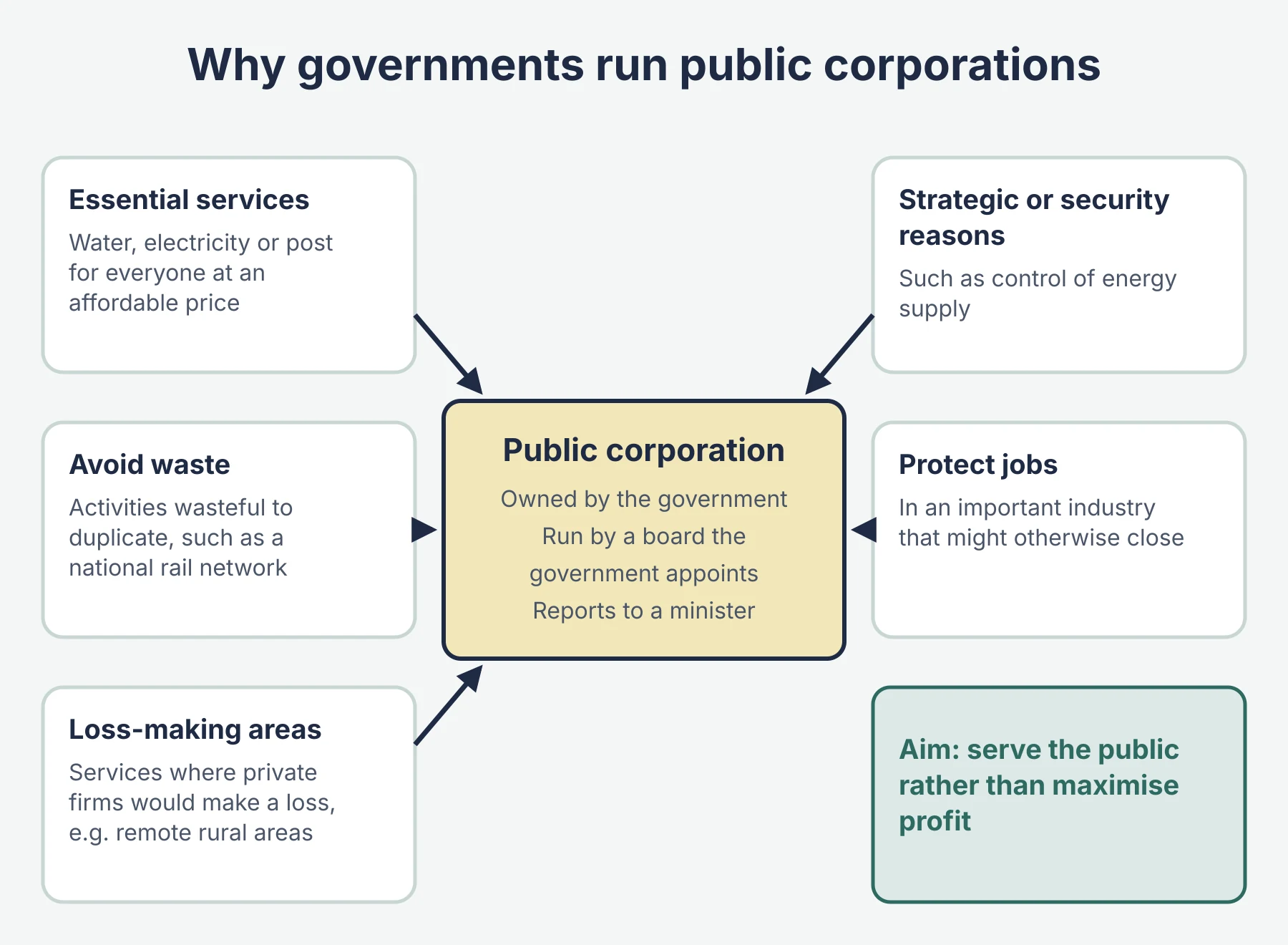
Reasons for public corporations
Essential services for all; avoiding wasteful duplication (rail, water networks); services in loss-making areas; strategic or security control; protecting jobs.
Multinational companies
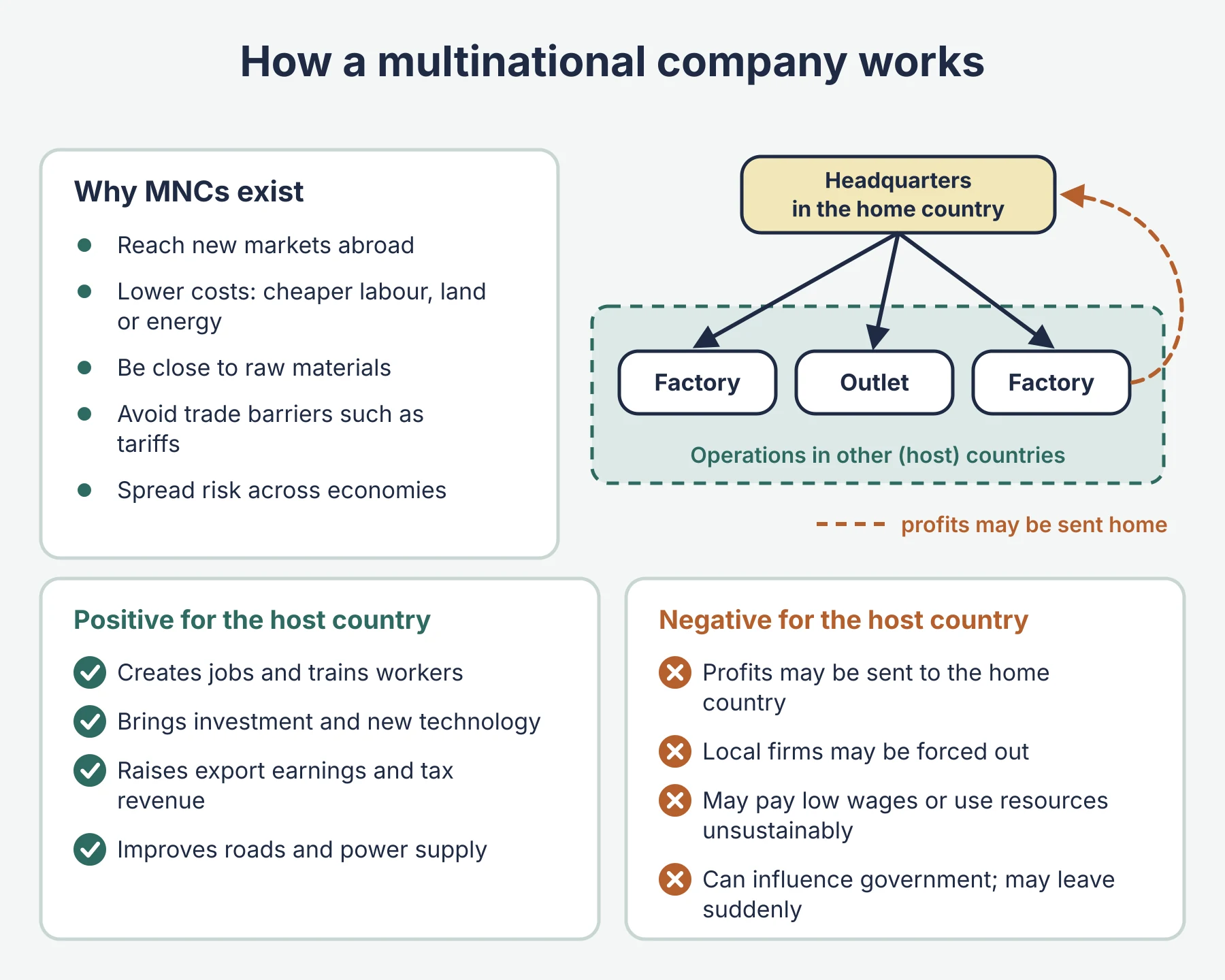
Meaning: headquarters in one country, operations in at least one other.
Why they exist: new markets; lower costs; nearness to raw materials; avoiding trade barriers; spreading risk.
| Host country gains | Host country losses |
|---|---|
| Jobs and training | Profits sent home |
| Investment and technology | Local firms squeezed out |
| Exports and tax revenue | Low wages, resource use, pollution |
| Better infrastructure | Influence on government; may leave suddenly |
Franchises
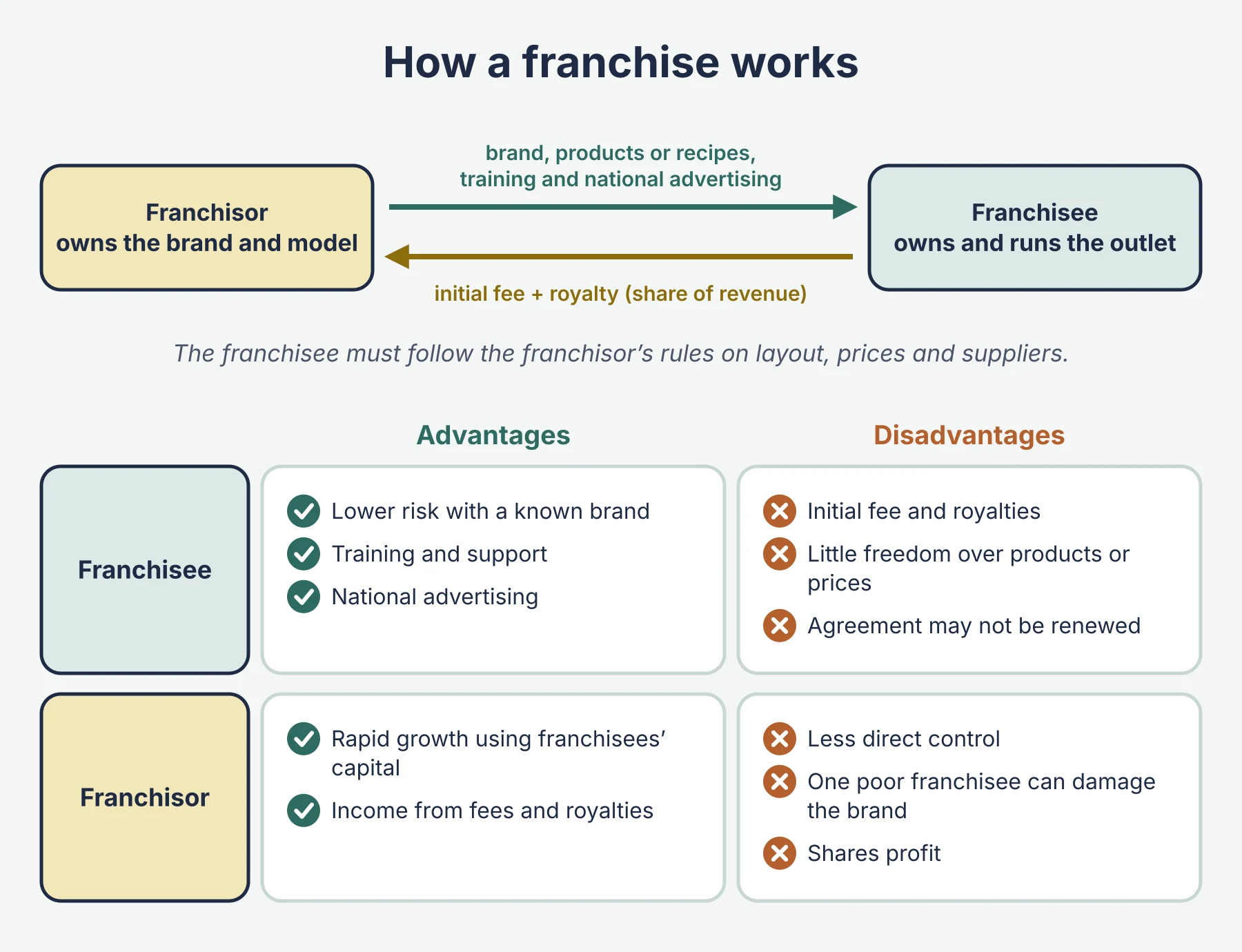
Franchisor owns the brand; franchisee buys the right to trade under it, paying a fee and royalties.
- Franchisee gains: proven brand, lower risk, training, national advertising.
- Franchisee loses: fees and royalties, little independence, possible non-renewal.
- Franchisor gains: fast growth with others’ capital, fee income.
- Franchisor loses: less control, reputation risk from a poor outlet.
Location factors
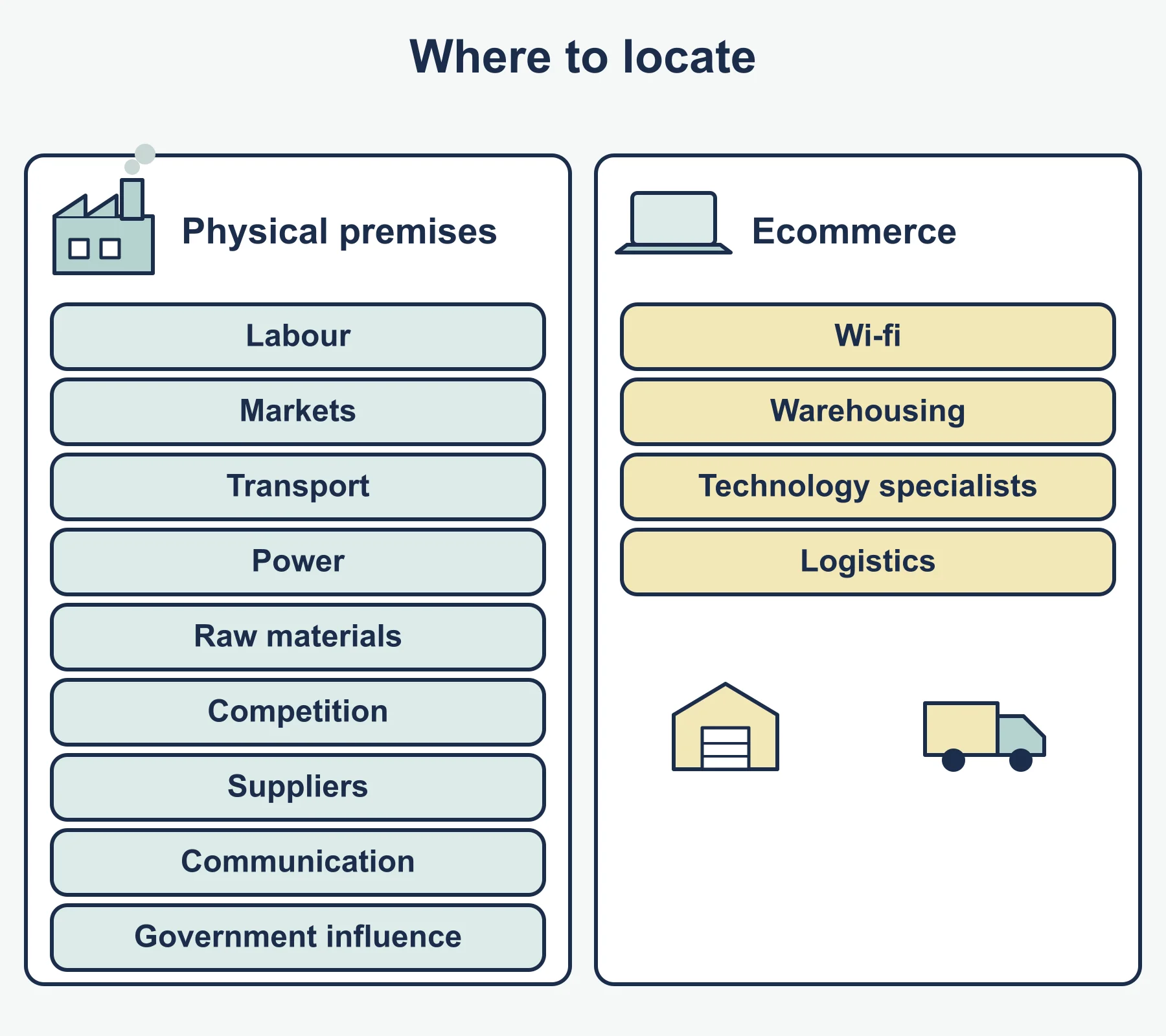
| Physical (9) | Ecommerce (4) |
|---|---|
| Labour, markets, transport, power, raw materials, competition, suppliers, communication, government influence | Wi-fi, warehousing, technology specialists, logistics |
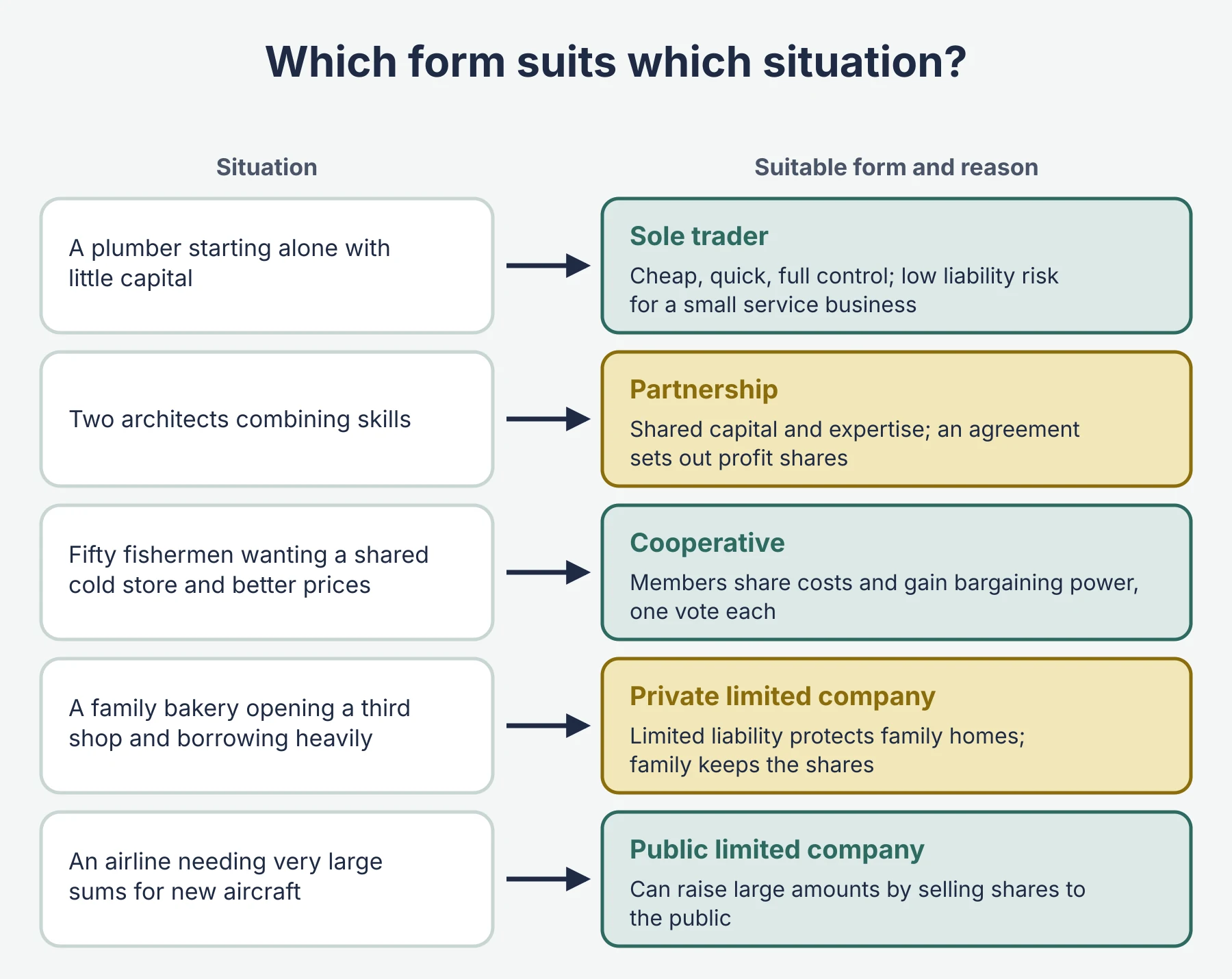
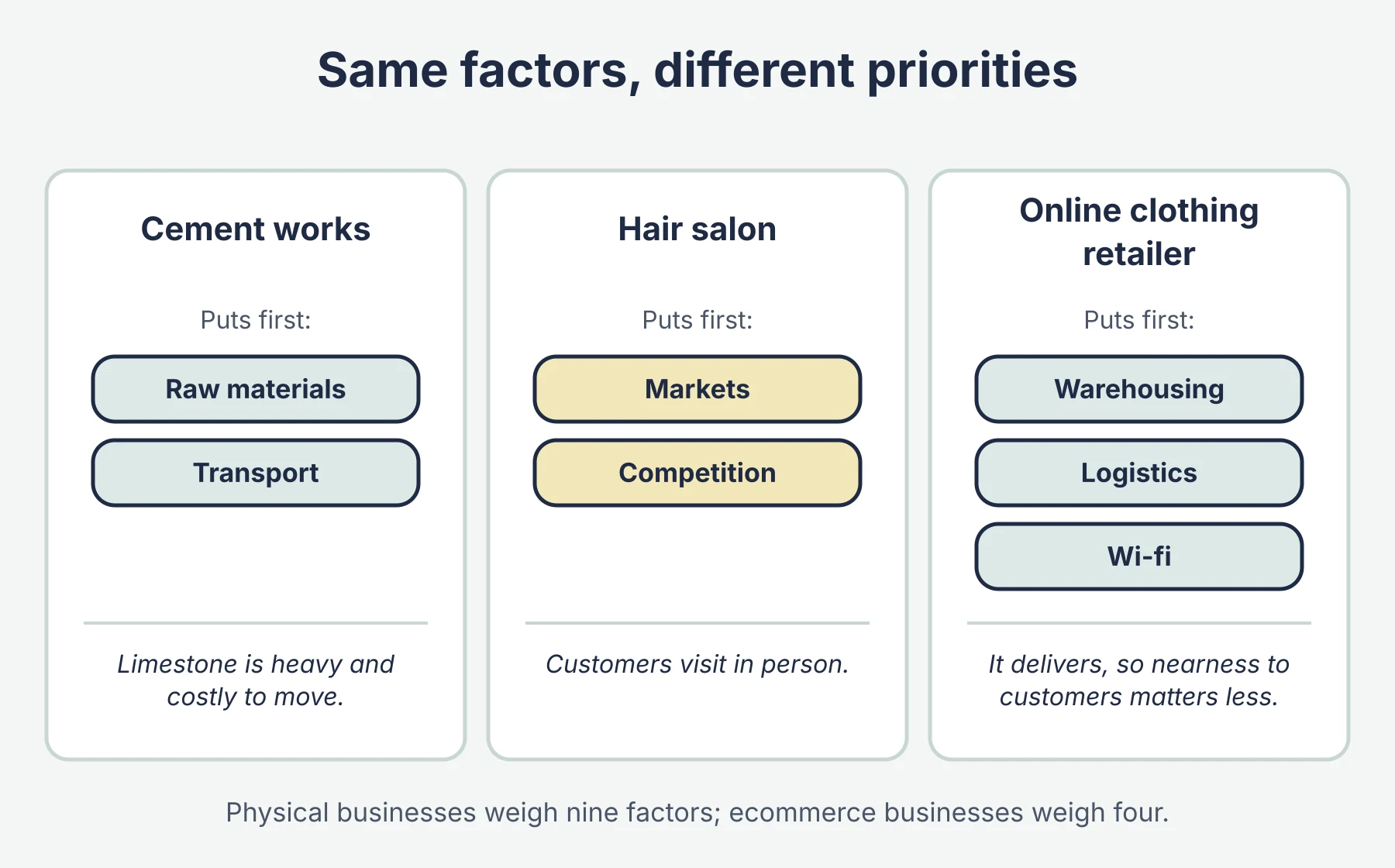
Match the factor to the business: heavy raw materials point to a site near the source; personal services need to be near customers; online sellers need warehousing, logistics and connectivity.
Key terms
| Term | Meaning |
|---|---|
| Private sector | Enterprises owned by private individuals or shareholders |
| Public sector | Enterprises owned and controlled by government |
| Unlimited liability | Owner is personally responsible for all business debts |
| Limited liability | Owner can lose only the amount invested |
| Separate legal entity | The company exists in law apart from its owners |
| Partnership agreement | Written terms of a partnership, such as profit shares |
| Cooperative | Enterprise owned and run by its members, one member one vote |
| Shareholder | Part-owner of a company through owning shares |
| Public corporation | Government-owned business run by an appointed board |
| Multinational company | Company with headquarters in one country and operations in others |
| Franchisor | Owner of the brand who sells the right to use it |
| Franchisee | Person or firm that buys the right to trade under the brand |
| Royalty | Continuing payment to the franchisor, often a share of revenue |
Exam traps
- Plc versus public corporation: a plc is private sector; a public corporation is public sector.
- Partners’ liability: unlimited in an ordinary partnership.
- Cooperative votes: one member, one vote, not one share, one vote.
- Franchise advantages: always say whose advantage it is.
- Location answers: choose factors that fit the scenario, not the whole list.
- MNC “discuss” questions: both sides and a conclusion about the named country.
Self-test
- What is the main aim of most public sector enterprises?
- Define unlimited liability.
- Which form of ownership can sell shares to the general public?
- How are votes allocated in a cooperative?
- Give two reasons why a government might run a public corporation.
- Define a multinational company.
- State one reason why an MNC might set up a factory inside a country instead of exporting to it.
- State two negative impacts of an MNC on a host country.
- What does a franchisee pay to the franchisor?
- Give one disadvantage of a franchise for the franchisor.
- Name the four ecommerce location factors.
- Which two location factors matter most for a quarry company, and why?
Answers
- To provide a service to the public.
- The owner is personally responsible for all the debts of the business, so personal possessions can be used to pay them.
- A public limited company.
- One member, one vote, however much each has invested.
- Any two: provide essential services to all; avoid wasteful duplication; serve loss-making areas; strategic or security control; protect jobs.
- A company with its headquarters in one country and operations in at least one other country.
- To avoid trade barriers such as tariffs, or to be closer to customers and cut transport costs.
- Any two: profits sent abroad; local firms forced out; low wages or poor conditions; pollution or overuse of resources; influence over government; may leave suddenly.
- An initial fee and continuing royalties or a share of revenue.
- Less direct control over outlets, or one poorly run outlet can damage the whole brand.
- Wi-fi, warehousing, technology specialists and logistics.
- Raw materials and transport, because stone is heavy and bulky, so it is cheaper to locate at the source with good road or rail links.
Related resources
-
Study guides
Cambridge IGCSE Commerce (0715): Communication
Types and methods of communication and the six factors that decide which method suits a situation, for Cambridge IGCSE Commerce 0715 section 2.6.
Commerce · Cambridge · IGCSE
Read guide -
Practice questions
Cambridge IGCSE Commerce (0715): Communication – Practice Questions
Original Cambridge IGCSE Commerce 0715 questions with answers on types and methods of communication and choosing the right method for a situation.
Commerce · Cambridge · IGCSE
Try questions -
Revision notes
Cambridge IGCSE Commerce (0715): Communication – Revision Notes
Recall notes for Cambridge IGCSE Commerce 0715 section 2.6: four types of communication, eight methods, six choice factors and a recommendation method.
Commerce · Cambridge · IGCSE
Revise topic
Get free revision emails (optional)
Occasional emails with practice questions, worked explanations and links to free resources for the qualification and subjects you choose. No spam, and you can unsubscribe from any email. The free tools on this site never need an email.