
Revision Notes
Cambridge IGCSE Commerce (0715): Communication – Revision Notes
Recall notes for Cambridge IGCSE Commerce 0715 section 2.6: four types of communication, eight methods, six choice factors and a recommendation method.
- Subject
- Commerce
- Level
- IGCSE
- Topic
- Topic 2 – Commercial Operations
- Author
- Marlbridge Academic Team
- Updated
- Reviewed by
- Salman Ahmad (what this means)
Aligned to Cambridge IGCSE Commerce (0715), 2028. Official specification .
Syllabus page (what it covers and how it is assessed): Cambridge IGCSE Commerce.
Syllabus points this page covers
0715
- 2.6 Communication
Found an error? Report a correction.
Need help with this topic? Request a free trial class for IGCSE Commerce (0715).
Condensed notes for section 2.6 of Cambridge IGCSE Commerce (0715). For full advantages and disadvantages and worked recommendations, use the communication study guide.
Three lists to learn
| 2.6.1 Types (4) | 2.6.2 Methods (8) | 2.6.3 Factors (6) |
|---|---|---|
| Written | Letter | Urgency |
| Oral | Telephone | Cost |
| Electronic | Face to face | Security |
| Visual | Videoconferencing | Distance |
| Availability of networks | ||
| Web-based chat (including chatbots) | Importance of the message | |
| Social media | ||
| Posters |
Factor mnemonic: U C S D A I: “Urgent Calls Should Definitely Arrive Immediately.”
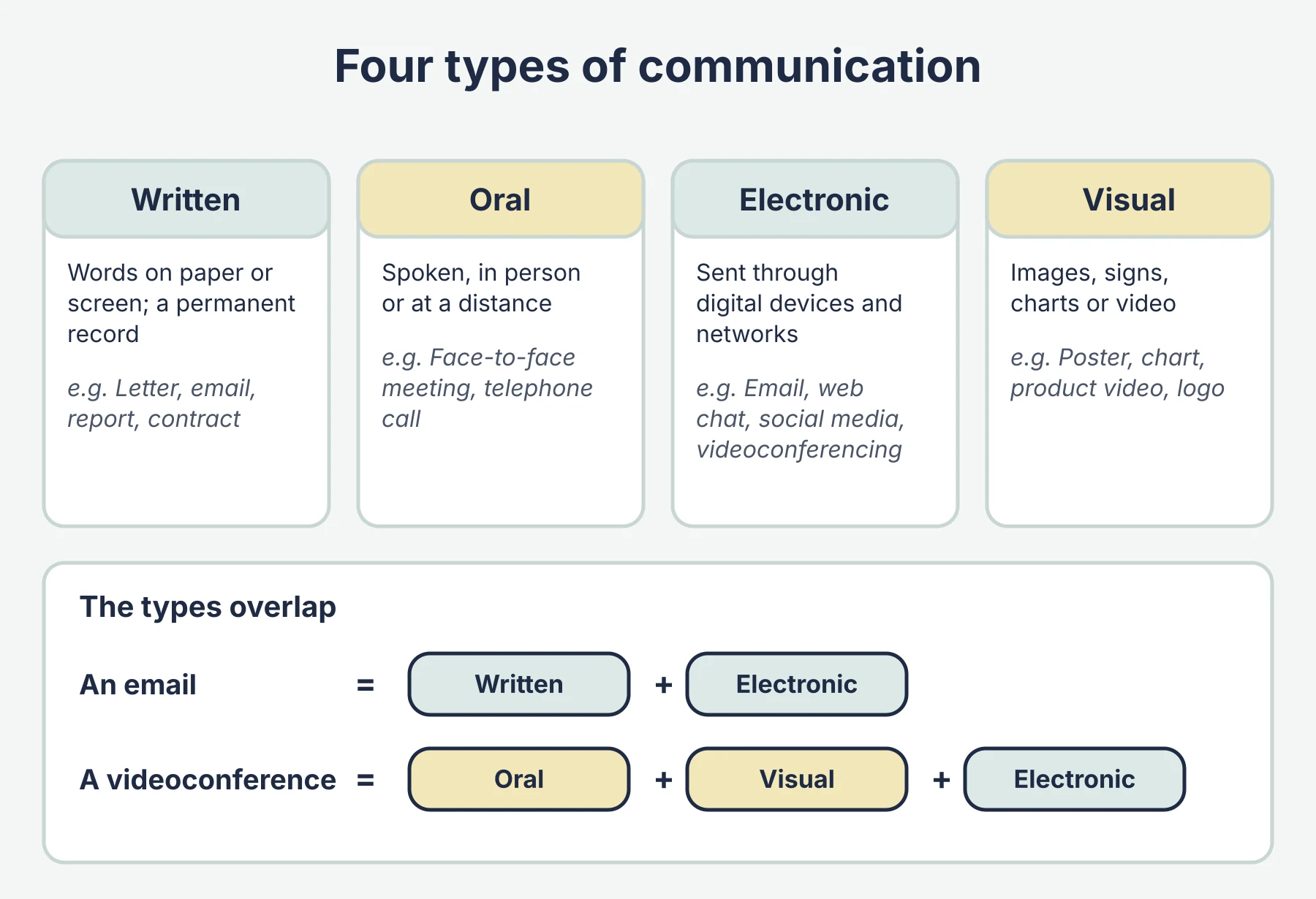
Types: main feature
- Written: permanent record.
- Oral: spoken; instant feedback.
- Electronic: through digital devices and networks.
- Visual: images, signs, charts, video.
Overlaps are normal: email = written + electronic; videoconference = oral + visual + electronic.
Methods: one strength, one weakness
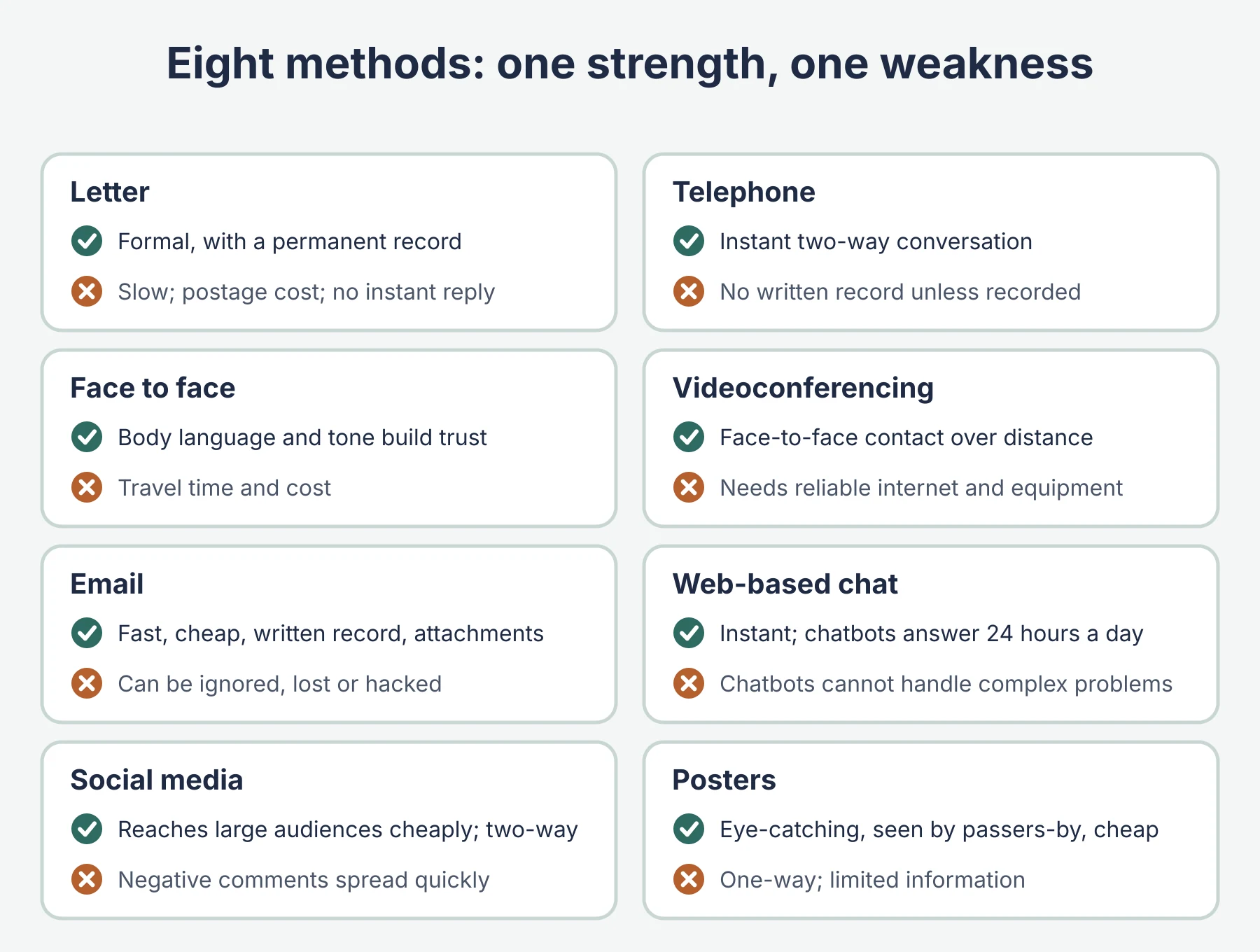
| Method | Strength | Weakness |
|---|---|---|
| Letter | Formal record, signatures | Slow |
| Telephone | Instant two-way | No written record |
| Face to face | Body language, trust | Travel time and cost |
| Videoconferencing | Faces across distance, many places | Needs good internet and equipment |
| Fast, cheap, attachments, record | Ignored, lost, hacked or misdirected | |
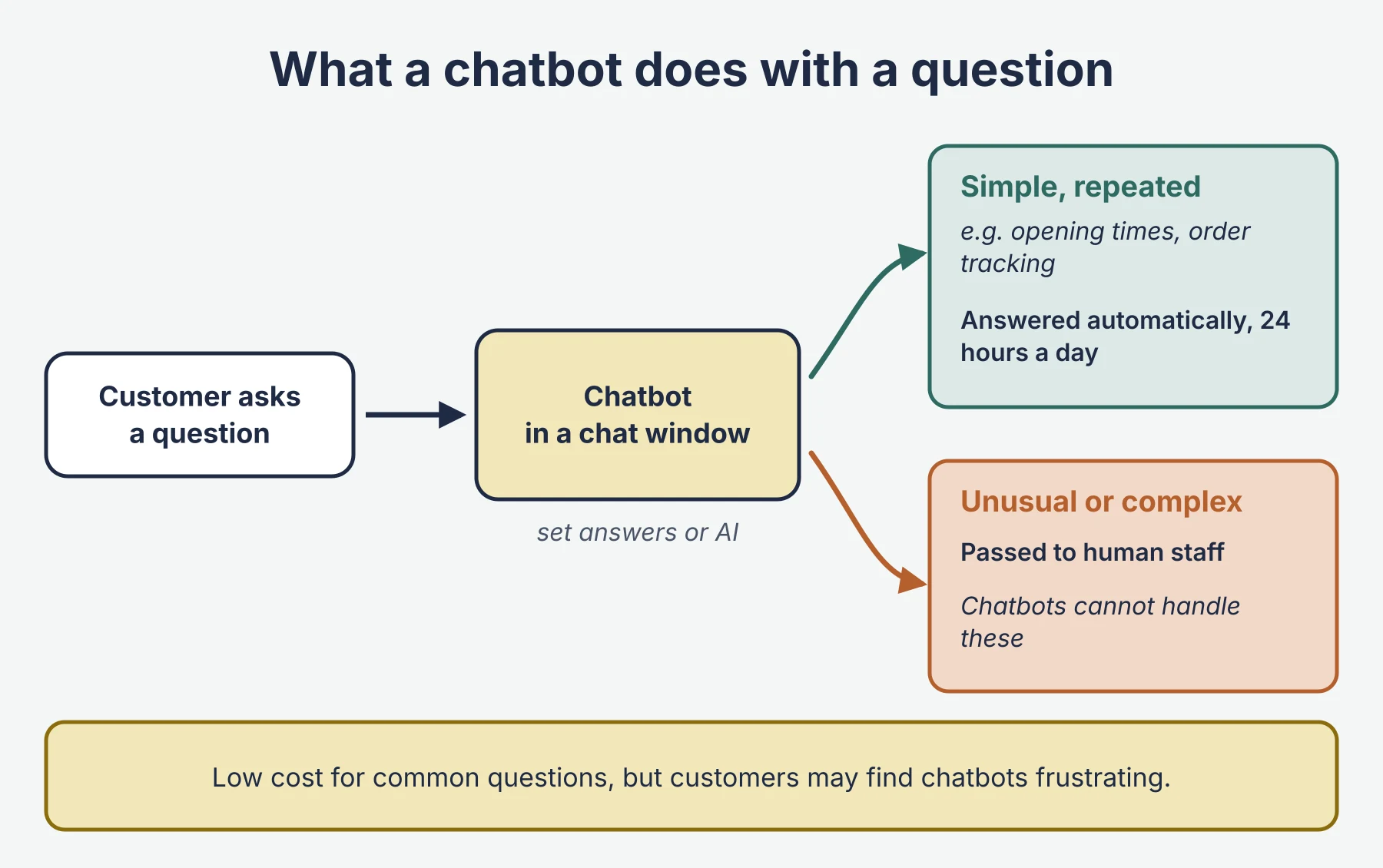
| Web-based chat / chatbots | Instant, 24-hour, low cost | Cannot solve complex problems |
| Social media | Huge cheap reach, two-way | Public; criticism spreads fast |
| Posters | Eye-catching, cheap | One-way; limited detail; one location |
Factors: what each points to
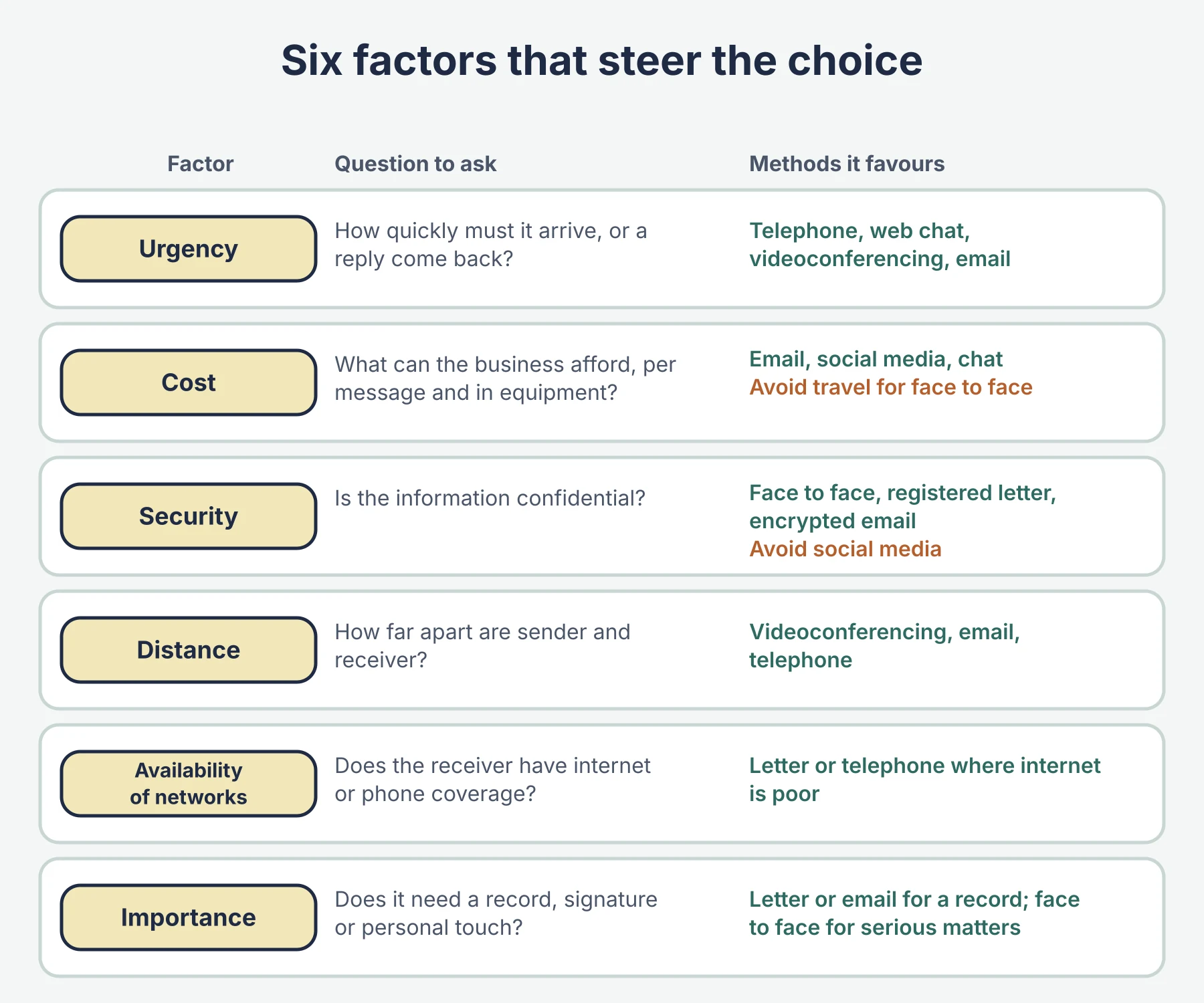
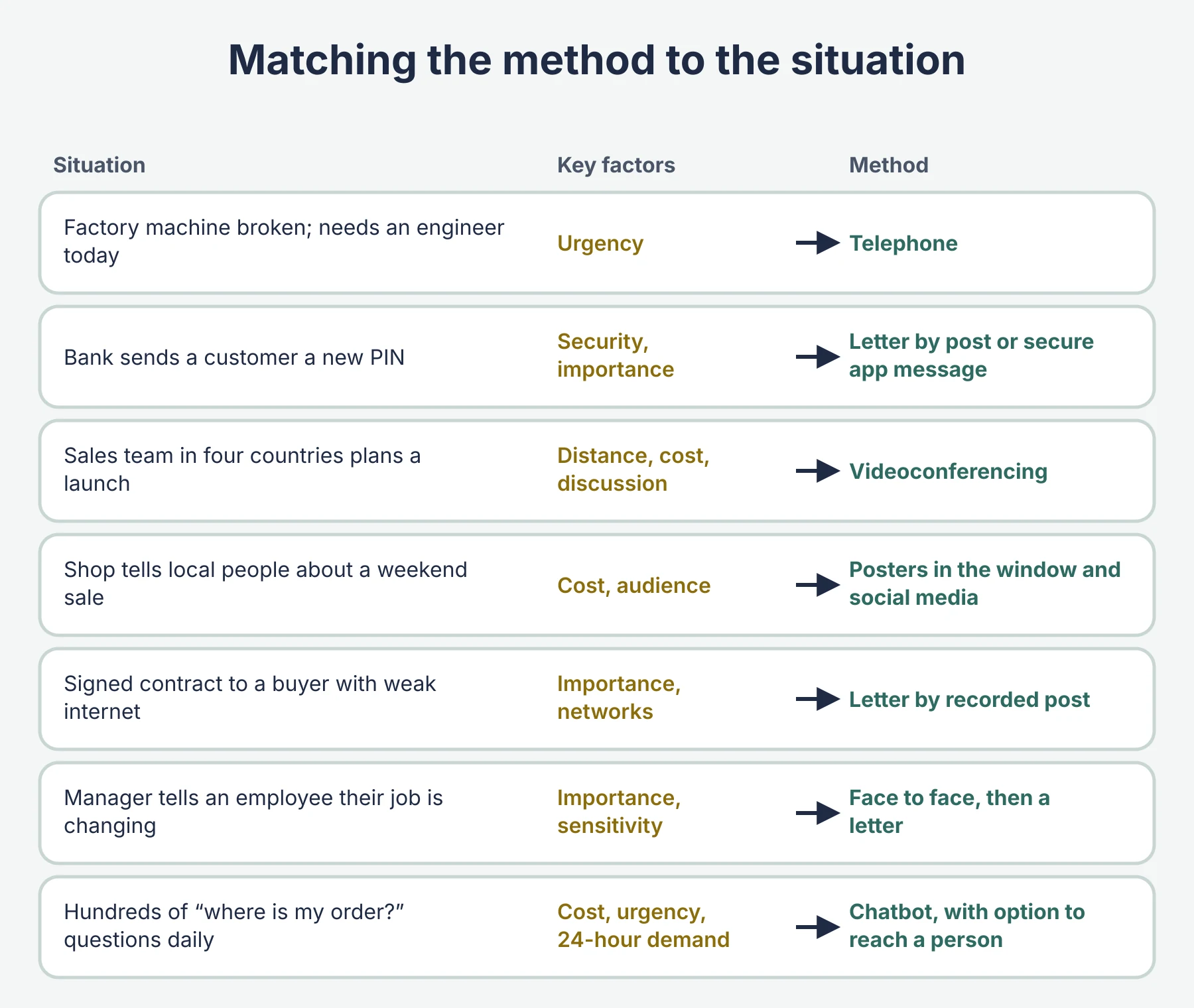
- Urgency → telephone, chat, videoconference.
- Cost → email, social media, chat.
- Security → face to face, registered letter, encrypted systems; not social media.
- Distance → videoconference, email, telephone.
- Availability of networks → letter or telephone where internet is weak.
- Importance of the message → letter or email for a record; face to face for sensitive news.
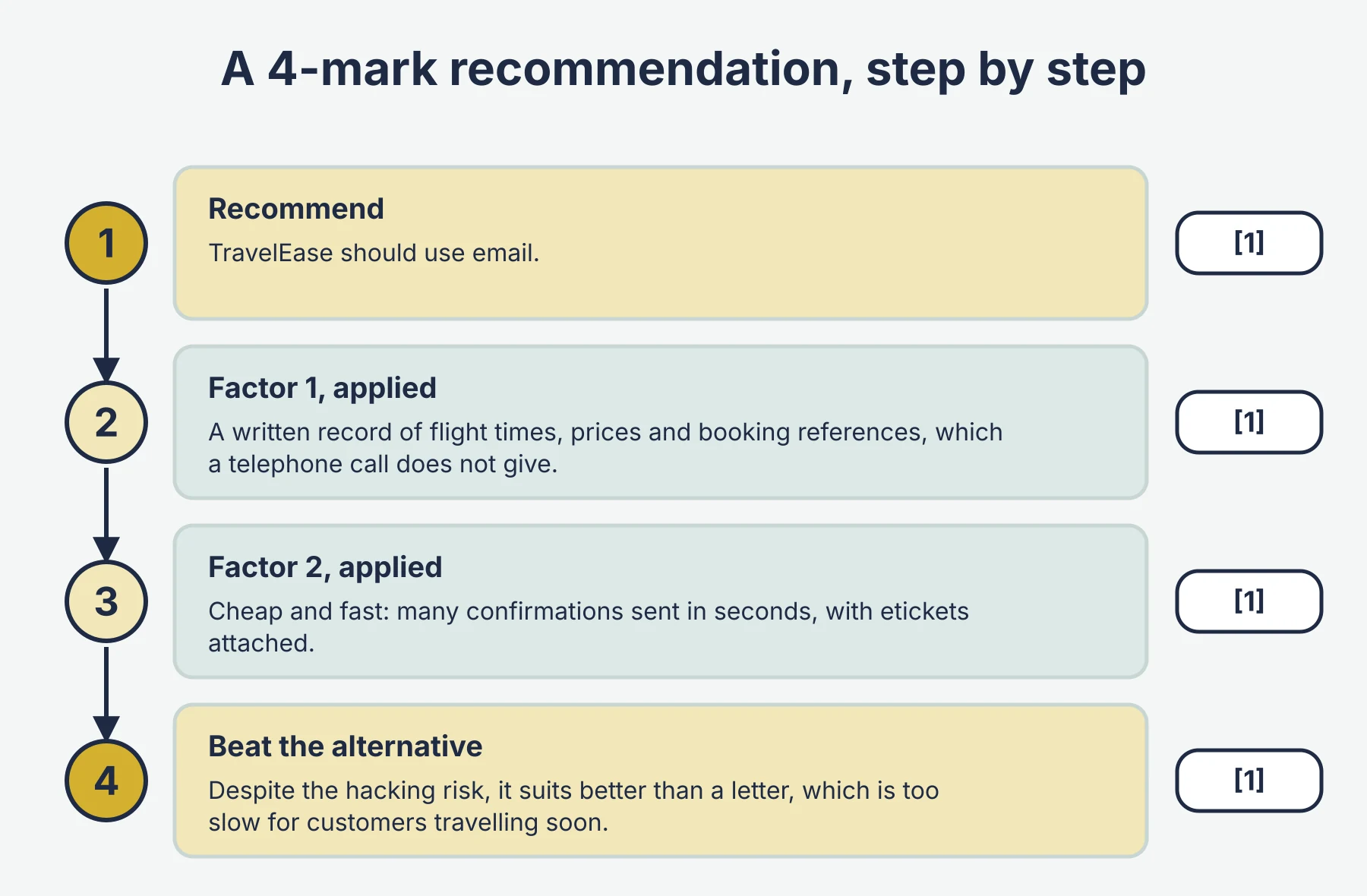
Recommendation formula (4-mark answers)
- Choose one method. [1]
- Factor one from the scenario, explained. [1]
- Factor two from the scenario, explained. [1]
- Compare with an alternative and say why yours is better. [1]
Example in four sentences: A jeweller must tell a customer that her repaired ring is ready. Use the telephone. The customer may want to collect it soon, so speed matters. A call also lets the jeweller confirm the collection time and answer questions at once. A letter would be slower, and a social media message would not be private.
Which type does each method belong to?
| Method | Main type(s) |
|---|---|
| Letter | Written |
| Telephone | Oral, electronic |
| Face to face | Oral, visual (body language) |
| Videoconferencing | Oral, visual, electronic |
| Written, electronic | |
| Web-based chat / chatbot | Written, electronic |
| Social media | Written, visual, electronic |
| Posters | Visual, written |
Use this when a question gives a method and asks which type it is: choose the type that matches the feature you explain.
When factors conflict
- Urgent but confidential (a bank detecting fraud on an account): telephone the customer, using security questions; do not email full details.
- Cheap but important (a new contract): email a scanned copy for speed, then post the signed original for the record.
- Far away but sensitive (a supplier dispute abroad): videoconference first, then a written summary by email.
Key terms
| Term | Meaning |
|---|---|
| Communication | Passing information from a sender to a receiver |
| Written communication | Information set down in words that can be kept |
| Oral communication | Spoken information, in person or by phone |
| Electronic communication | Information sent through digital devices and networks |
| Visual communication | Information given through images, charts, signs or video |
| Videoconferencing | Live meeting with sound and video between people in different places |
| Chatbot | Program that answers customer questions automatically in a chat window |
| Social media | Online platforms where users share content and messages |
| Urgency | How quickly the message must arrive or be answered |
| Security | Protection of confidential information from others |
| Availability of networks | Whether phone or internet coverage exists for sender and receiver |
Exam traps
- Types are not methods. “Electronic” is a type; “email” is a method.
- Email is not always right. Check security, network access and importance.
- Name the factor. “It is good” earns nothing; “it is fast, so suits an urgent order” earns credit.
- Social media is public. Do not recommend it for confidential messages.
- Chatbots have limits. Complex complaints need a person.
- Videoconferencing needs networks. It fails where internet is poor.
Self-test
- Name the four types of communication.
- Which type gives a permanent record?
- Give two types that describe a videoconference.
- State one advantage of face-to-face communication.
- State one disadvantage of a letter.
- What is a chatbot?
- Give one reason a business uses a chatbot on its website.
- Name the six factors affecting the choice of method.
- Which method suits an urgent request for a repair today?
- Why should social media not be used to send a customer’s account details?
- Which method suits sending a signed contract to a place with weak internet?
- Which two factors make videoconferencing suitable for a meeting of managers in three countries?
Answers
- Written, oral, electronic, visual.
- Written.
- Any two: oral, visual, electronic.
- Body language and tone help understanding; builds trust; good for sensitive or complex issues.
- Slow to arrive; postage cost; no instant reply.
- A computer program that answers questions automatically in a chat window.
- To answer common questions 24 hours a day at low cost, freeing staff for complex problems.
- Urgency, cost, security, distance, availability of networks, importance of the message.
- Telephone.
- Social media messages can be seen or shared by others, so the information would not be secure.
- A letter by recorded post.
- Distance and cost (it avoids expensive travel while allowing live discussion).
Related resources
-
Study guides
Cambridge IGCSE Commerce (0715): Outsourcing
Why outsourcing has grown, how contract manufacturing and contract logistics work, and cost comparisons, for Cambridge IGCSE Commerce 0715 section 2.2.
Commerce · Cambridge · IGCSE
Read guide -
Practice questions
Cambridge IGCSE Commerce (0715): Outsourcing – Practice Questions
Original Cambridge IGCSE Commerce 0715 questions with answers on the growth of outsourcing, contract manufacturing, contract logistics and cost comparisons.
Commerce · Cambridge · IGCSE
Try questions -
Revision notes
Cambridge IGCSE Commerce (0715): Outsourcing – Revision Notes
Recall notes for Cambridge IGCSE Commerce 0715 section 2.2: contract manufacturing, contract logistics, reasons for growth, risks and cost comparison method.
Commerce · Cambridge · IGCSE
Revise topic
Get free revision emails (optional)
Occasional emails with practice questions, worked explanations and links to free resources for the qualification and subjects you choose. No spam, and you can unsubscribe from any email. The free tools on this site never need an email.