
Revision Notes
Cambridge IGCSE Commerce (0715): Trading documents – Revision Notes
Recall notes for Cambridge IGCSE Commerce 0715 section 2.5: home trade document sequence, discounts, export documents, online ordering stages and digital tools.
- Subject
- Commerce
- Level
- IGCSE
- Topic
- Topic 2 – Commercial Operations
- Author
- Marlbridge Academic Team
- Updated
- Reviewed by
- Salman Ahmad (what this means)
Aligned to Cambridge IGCSE Commerce (0715), 2028. Official specification .
Syllabus page (what it covers and how it is assessed): Cambridge IGCSE Commerce.
Syllabus points this page covers
0715
- 2.5 Trading documents
Found an error? Report a correction.
Need help with this topic? Request a free trial class for IGCSE Commerce (0715).
Condensed notes for section 2.5 of Cambridge IGCSE Commerce (0715). For a full transaction with worked invoice, credit note and statement, use the trading documents study guide.
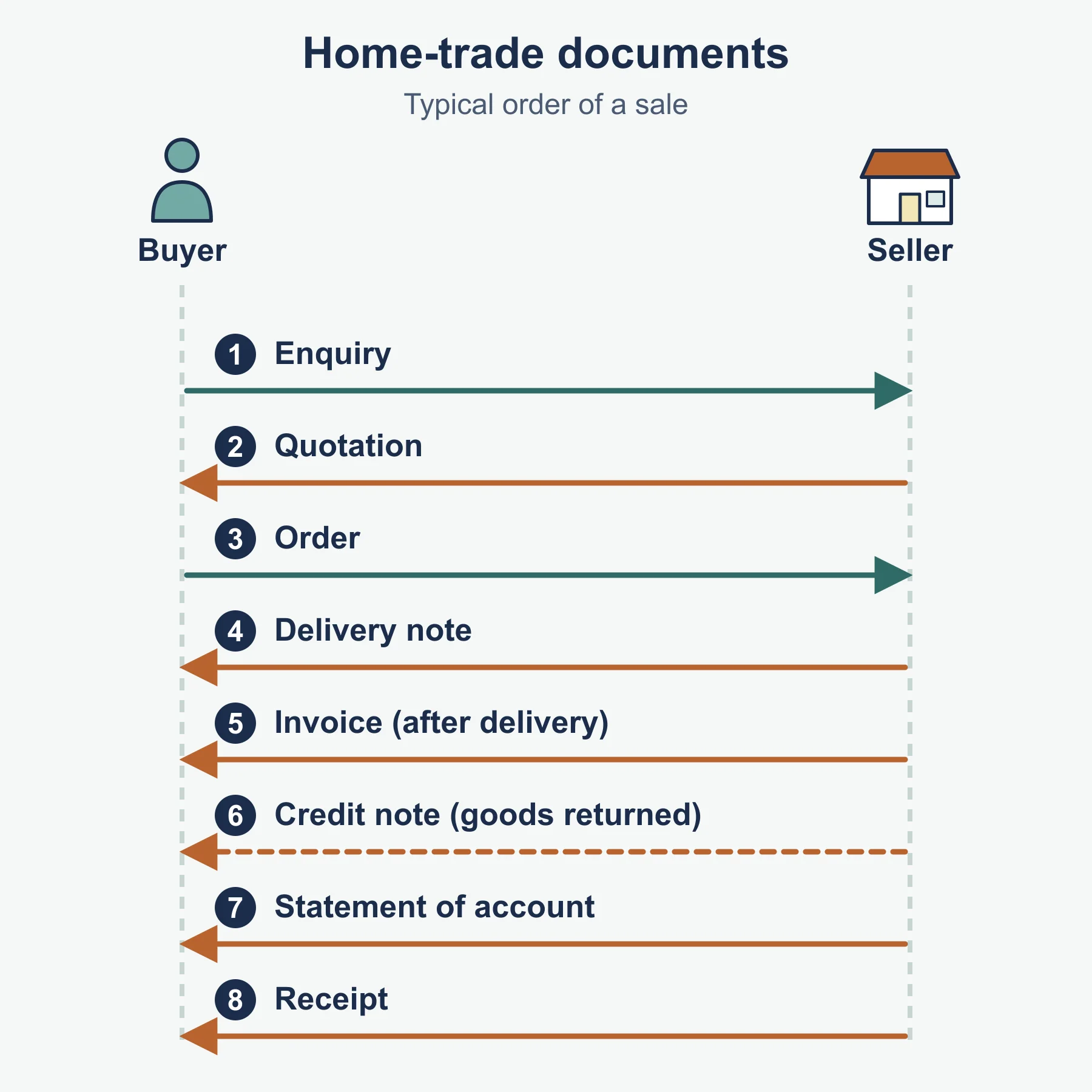
Home trade: the eight documents in order
| Step | Document | From → to | Key point |
|---|---|---|---|
| 1 | Enquiry | Buyer → sellers | Asks for prices and terms |
| 2 | Quotation | Seller → buyer | Prices, discounts, delivery, payment terms |
| 3 | Order | Buyer → seller | Exact items, quantities, prices |
| 4 | Delivery note | Seller, with goods | Buyer checks and signs: proof of delivery |
| 5 | Invoice | Seller → buyer | The bill: amount owed after trade discount |
| 6 | Credit note | Seller → buyer | Reduces amount owed: returns or overcharge |
| 7 | Statement of account | Seller → buyer | Summary of transactions and balance owed |
| 8 | Receipt | Seller → buyer | Proof of payment |
Steps 4 and 5 can swap or arrive together. Memory line: ask, offer, buy, deliver, bill, correct, summarise, pay.
Only two documents come from the buyer: the enquiry and the order.
Discounts on documents
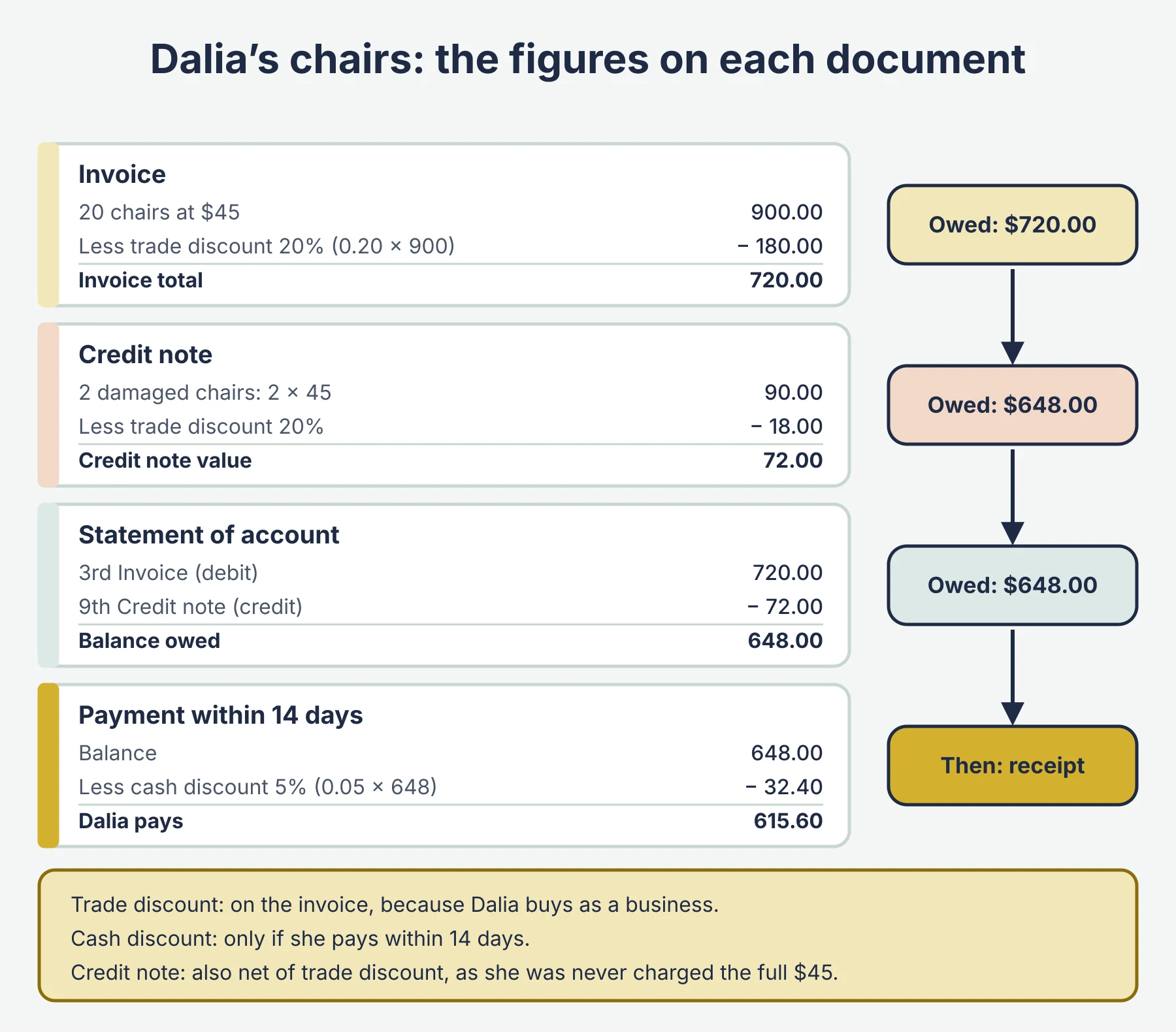
- Trade discount: given to businesses buying for resale or business use; deducted on the quotation and invoice.
- Cash discount: reward for paying within a stated time; deducted only if payment is on time.
- Order of working: list price, minus trade discount, equals invoice total; then minus cash discount if earned.
Mini example (invented figures): 50 lamps at $16 = $800; trade discount 25% = $200, invoice $600; cash discount 2% if paid in 7 days = $12, so pay $588.
Credit notes must use the same trade discount: one returned lamp = 16 - 25% = $12 credit.
International trade documents
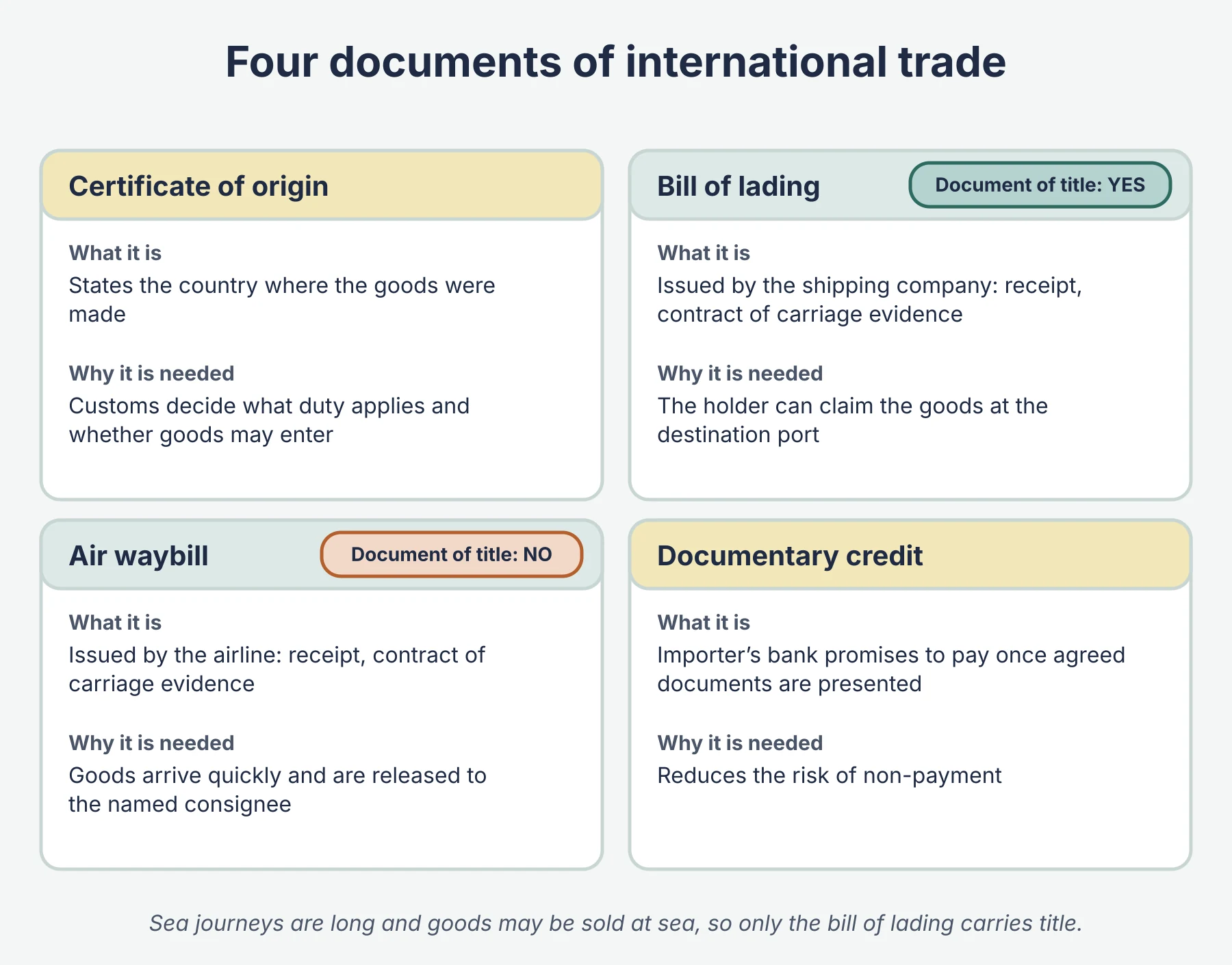
| Document | Issued by | Function |
|---|---|---|
| Certificate of origin | Exporter, usually certified by an official body | States where goods were made; customs set duty and entry rules |
| Bill of lading | Shipping company | Receipt, contract of carriage, document of title (sea) |
| Air waybill | Airline | Receipt and contract of carriage (air); not a document of title |
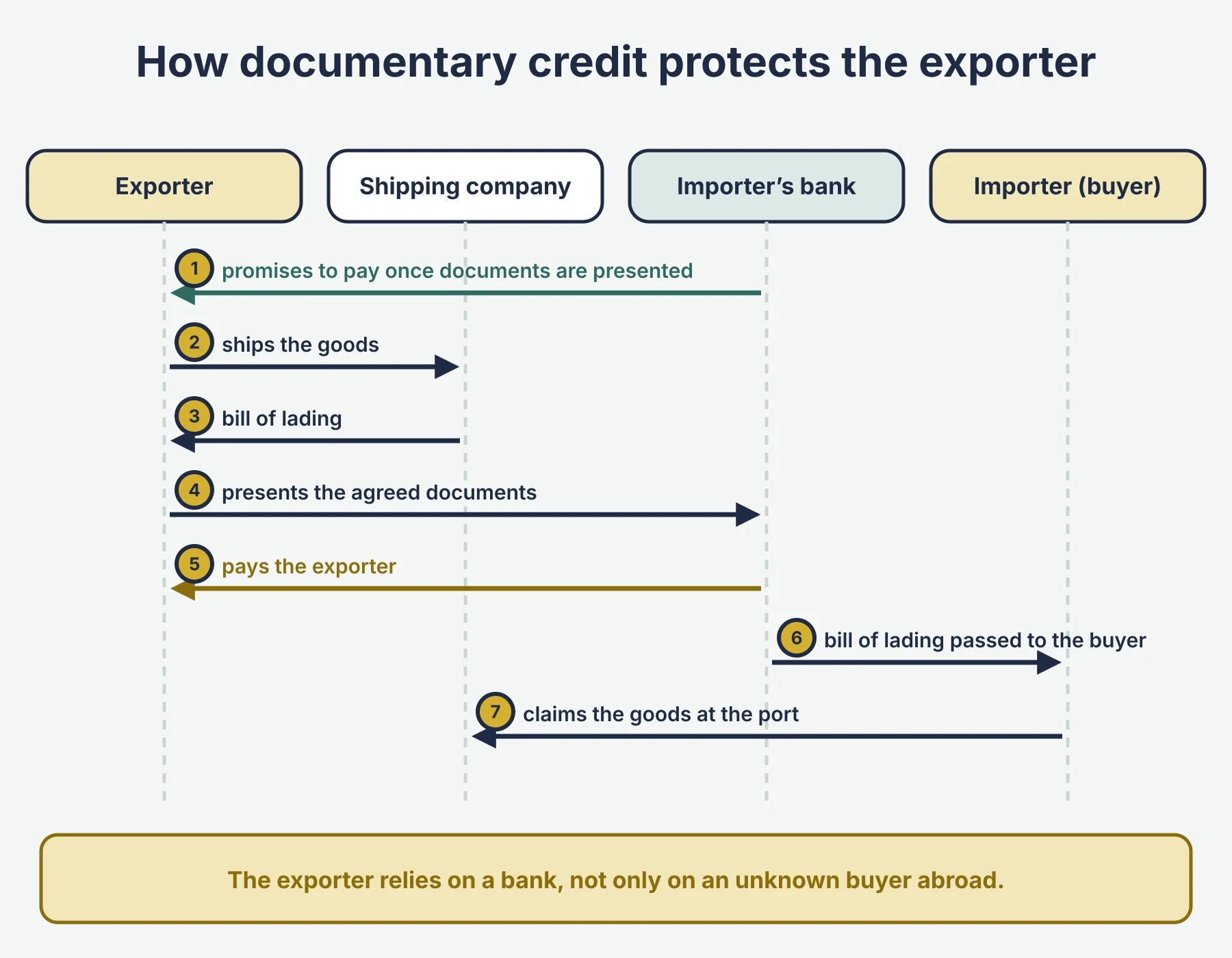
| Documentary credit (letter of credit) | Importer’s bank | Promise to pay exporter on presenting agreed documents; reduces non-payment risk |
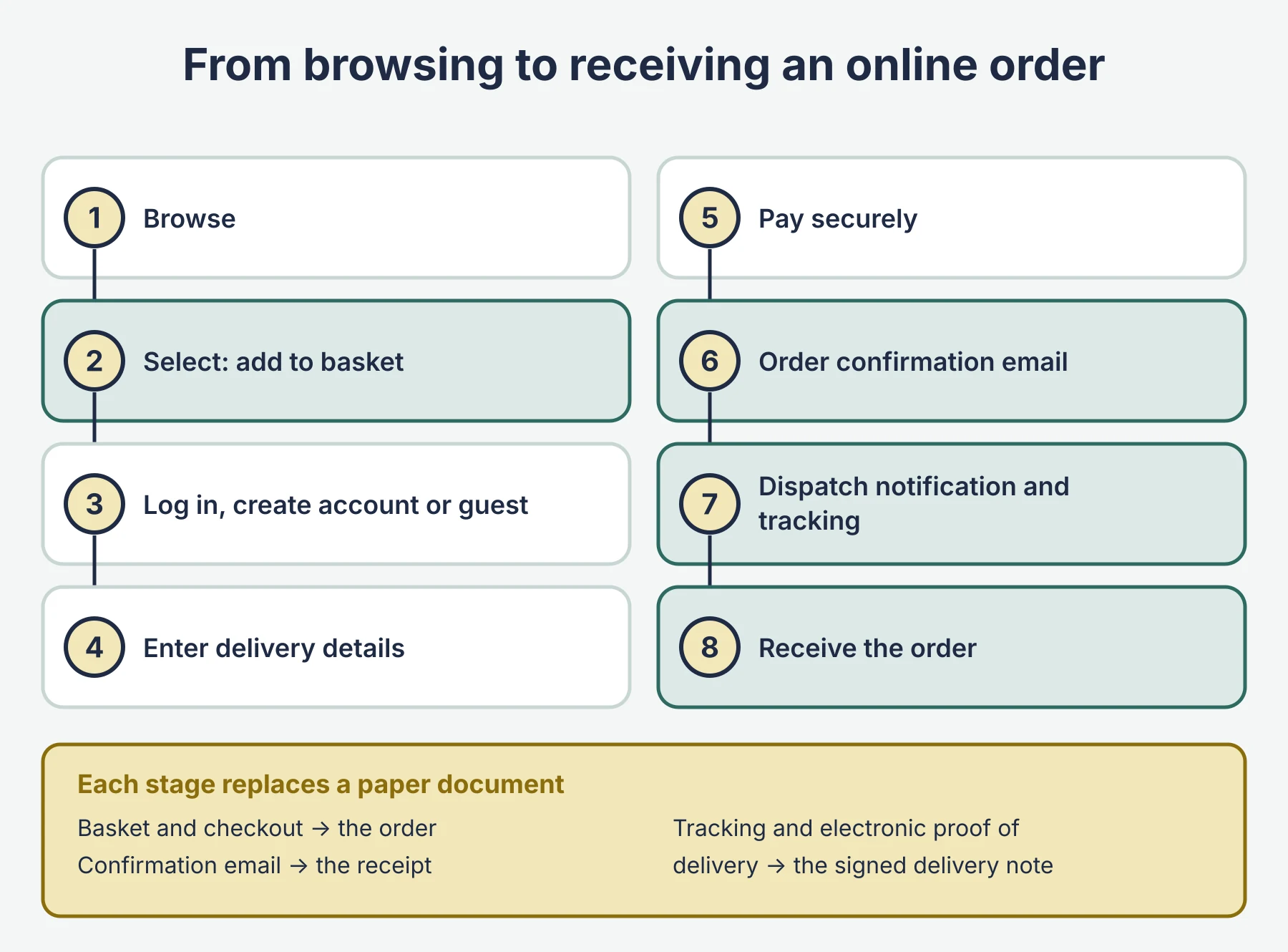
Online ordering: eight stages
- Browse
- Add to basket
- Log in or create account
- Enter delivery details and choose delivery
- Pay securely
- Order confirmation (electronic receipt)
- Dispatch notification and tracking
- Receive order
Paper equivalents: basket and checkout = order; confirmation = receipt; tracking and electronic proof = delivery note.
Digital technology in trading documents
- Digital signatures: prove who signed; show if changed.
- Secure access: passwords, encryption, two-step verification.
- Cloud-based storage: online, accessible anywhere, backed up.
- Electronic receipts: emailed or in-app.
- Etickets: phone-based tickets scanned at entry.
Benefits: faster, less paper, easier to search. Drawbacks: hacking or data loss, system cost, need for internet.
Key terms
| Term | Meaning |
|---|---|
| Enquiry | Buyer’s request for information about prices and terms |
| Quotation | Seller’s offer of prices and terms |
| Invoice | Bill showing amount owed for goods supplied |
| Delivery note | List of goods delivered, signed by the buyer |
| Credit note | Document reducing the amount owed |
| Statement of account | Periodic summary showing the balance owed |
| Receipt | Proof of payment |
| Trade discount | Reduction for trade buyers |
| Cash discount | Reduction for prompt payment |
| Document of title | Document that gives the holder the right to claim the goods |
| Consignee | The person or business the goods are sent to |
Exam traps
- The seller sends the quotation, invoice, credit note, statement and receipt.
- Invoice is a request for payment; receipt proves payment happened.
- Do not take a cash discount unless the question says payment was within the time allowed.
- Bill of lading (sea) is a document of title; air waybill (air) is not.
- A letter of credit is not a loan.
Self-test
- Which document does a buyer send first?
- What does a quotation contain?
- Why does the buyer sign the delivery note?
- When is a credit note issued?
- What is the purpose of a statement of account?
- Distinguish between a trade discount and a cash discount.
- Goods list price $1,200; trade discount 15%. Calculate the invoice total.
- On the invoice in Question 7, a 3% cash discount is offered for payment within 10 days. Calculate the amount paid if the buyer pays on day 6.
- Which international document helps customs decide the duty payable?
- Why is the bill of lading important to a buyer of goods shipped by sea?
- How does documentary credit reduce risk for an exporter?
- Name three examples of digital technology used in trading documents.
Answers
- An enquiry.
- Prices, discounts, delivery date and payment terms.
- As proof that the goods were received and match what was sent, noting any shortages or damage.
- When goods are returned or damaged, or the buyer has been overcharged.
- To summarise invoices, credit notes and payments over a period and show the balance still owed.
- Trade discount is given to trade buyers and deducted on the invoice; cash discount is given only for payment within a set time.
- 15% of 1,200 = $180; invoice total = $1,020.
- 3% of 1,020 = $30.60; amount paid = $989.40.
- Certificate of origin.
- It is a document of title: holding it allows the buyer to claim the goods at the destination port.
- The importer’s bank promises to pay once the exporter presents the agreed documents, so the exporter relies on the bank rather than an unknown buyer.
- Any three: digital signatures, secure access, cloud-based storage, electronic receipts, etickets.
Related resources
-
Study guides
Cambridge IGCSE Commerce (0715): Wholesaling
Wholesaler functions, importance to manufacturers and retailers, cash and carry and voluntary chains, for Cambridge IGCSE Commerce 0715 section 2.4.
Commerce · Cambridge · IGCSE
Read guide -
Practice questions
Cambridge IGCSE Commerce (0715): Wholesaling – Practice Questions
Original Cambridge IGCSE Commerce 0715 questions with answers on wholesaler functions and importance, cash and carry and voluntary chains.
Commerce · Cambridge · IGCSE
Try questions -
Revision notes
Cambridge IGCSE Commerce (0715): Wholesaling – Revision Notes
Recall notes for Cambridge IGCSE Commerce 0715 section 2.4: wholesaler functions, benefits to manufacturer and retailer, cash and carry and voluntary chains.
Commerce · Cambridge · IGCSE
Revise topic
Get free revision emails (optional)
Occasional emails with practice questions, worked explanations and links to free resources for the qualification and subjects you choose. No spam, and you can unsubscribe from any email. The free tools on this site never need an email.