
Revision Notes
Cambridge IGCSE Commerce (0715): International trade – Revision Notes
Recall notes for Cambridge IGCSE Commerce 0715 section 3.1: benefits, challenges, balance of trade and payments, trading blocs and trade restrictions.
- Subject
- Commerce
- Level
- IGCSE
- Topic
- Topic 3 – Globalisation of Trade
- Author
- Marlbridge Academic Team
- Updated
- Reviewed by
- Salman Ahmad (what this means)
Aligned to Cambridge IGCSE Commerce (0715), 2028. Official specification .
Syllabus page (what it covers and how it is assessed): Cambridge IGCSE Commerce.
Syllabus points this page covers
0715
- 3.1 International trade
Found an error? Report a correction.
Need help with this topic? Request a free trial class for IGCSE Commerce (0715).
Condensed notes for section 3.1 of Cambridge IGCSE Commerce (0715). For worked exchange rate and Balance of Payments examples, use the international trade study guide.
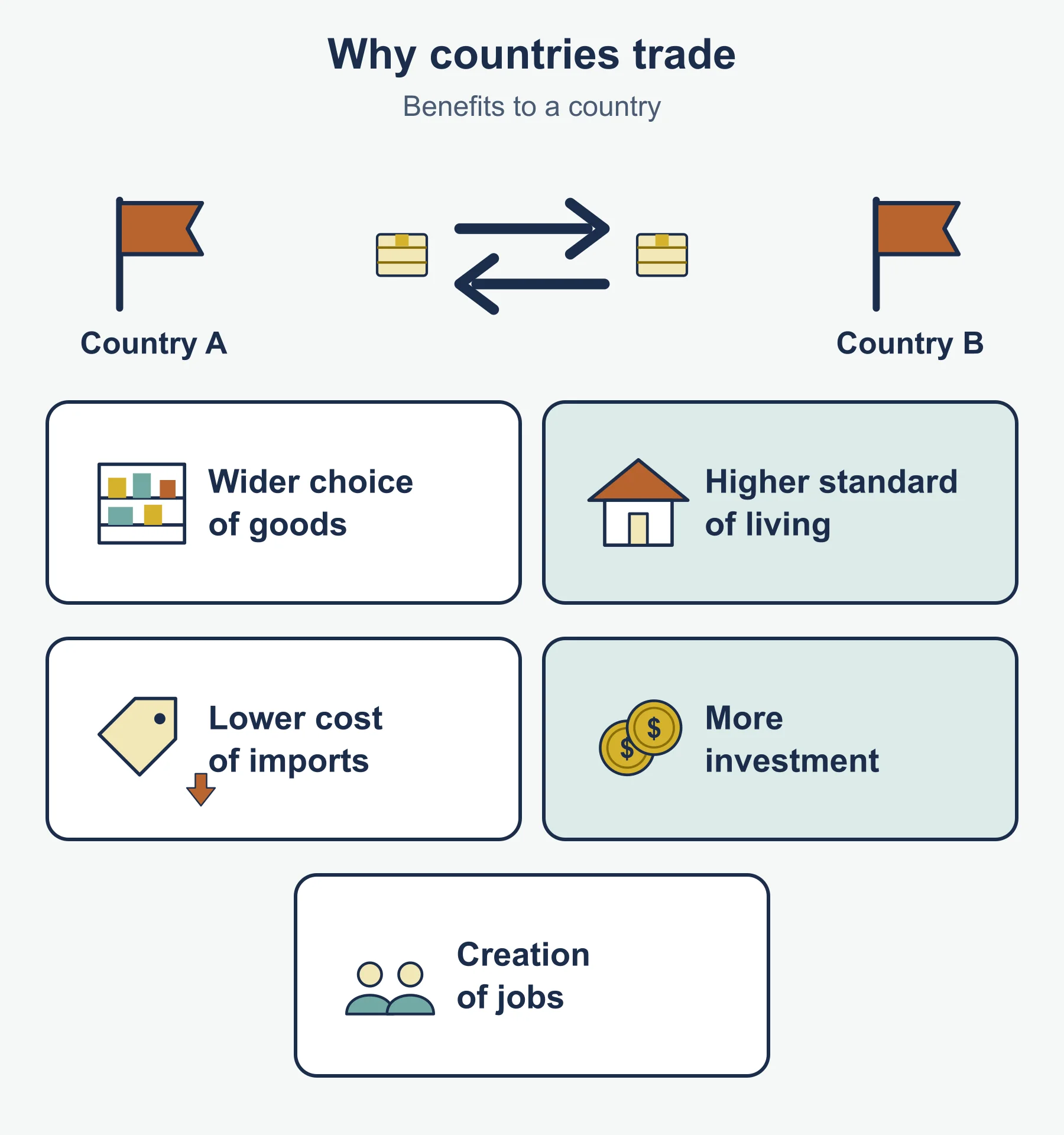
3.1.1 Five benefits to a country
- Wider choice of goods: products the country cannot make, and more brands.
- Higher standard of living: more and cheaper goods; export income.
- Lower cost of imports: other countries may produce more cheaply.
- More investment: foreign firms build factories, offices and warehouses.
- Creation of jobs: in export industries, ports, transport and retail.
Always add the because.
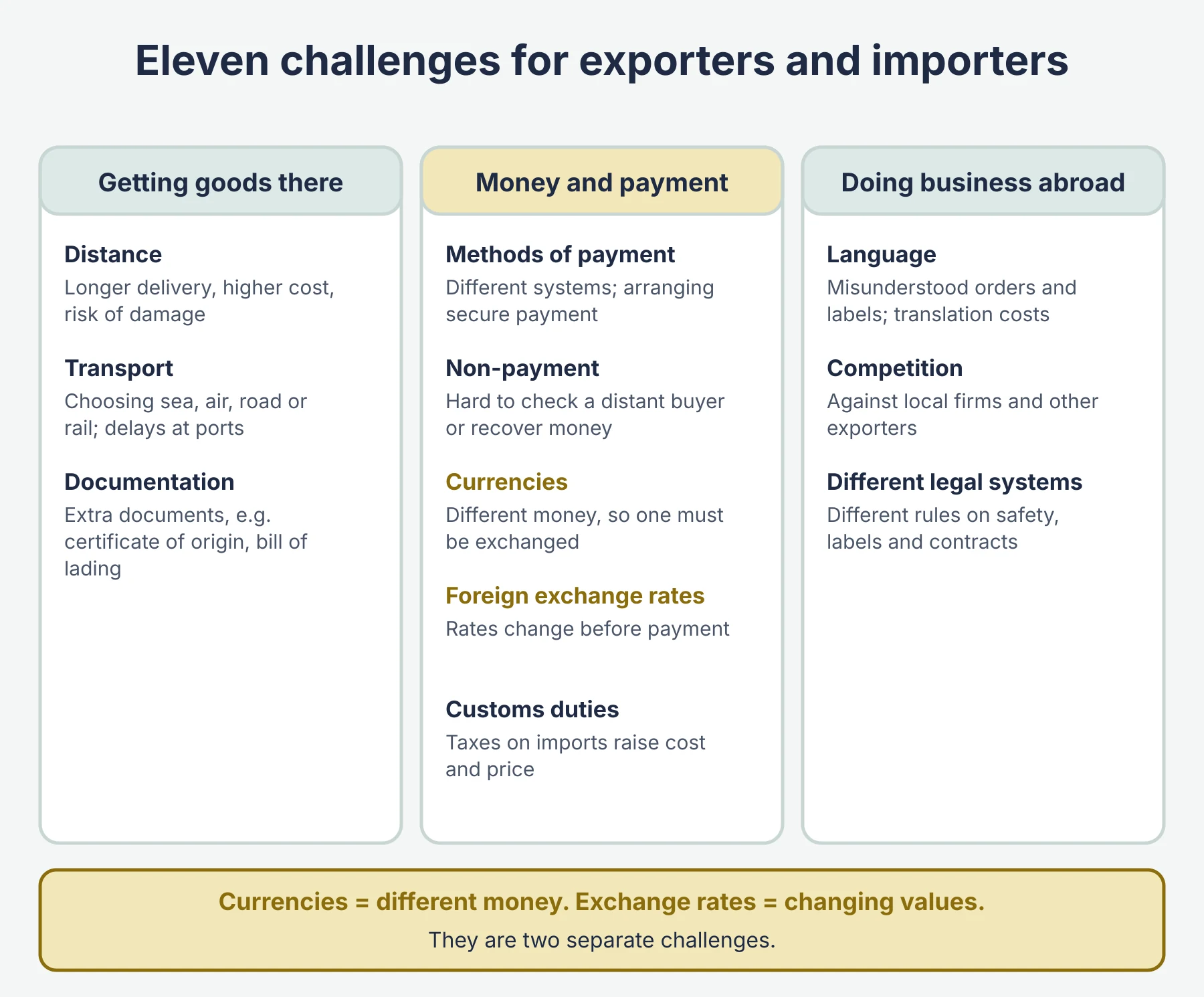
3.1.2 Eleven challenges to exporters and importers
| Group | Challenges |
|---|---|
| Getting goods there | Distance, transport, documentation |
| Understanding each other | Language, different legal systems |
| Getting paid | Methods of payment, non-payment, currencies, foreign exchange rates |
| Cost and rivals | Customs duties, competition |
Currencies vs exchange rates: “currencies” is the need to change money; “exchange rates” is the risk that the rate moves.
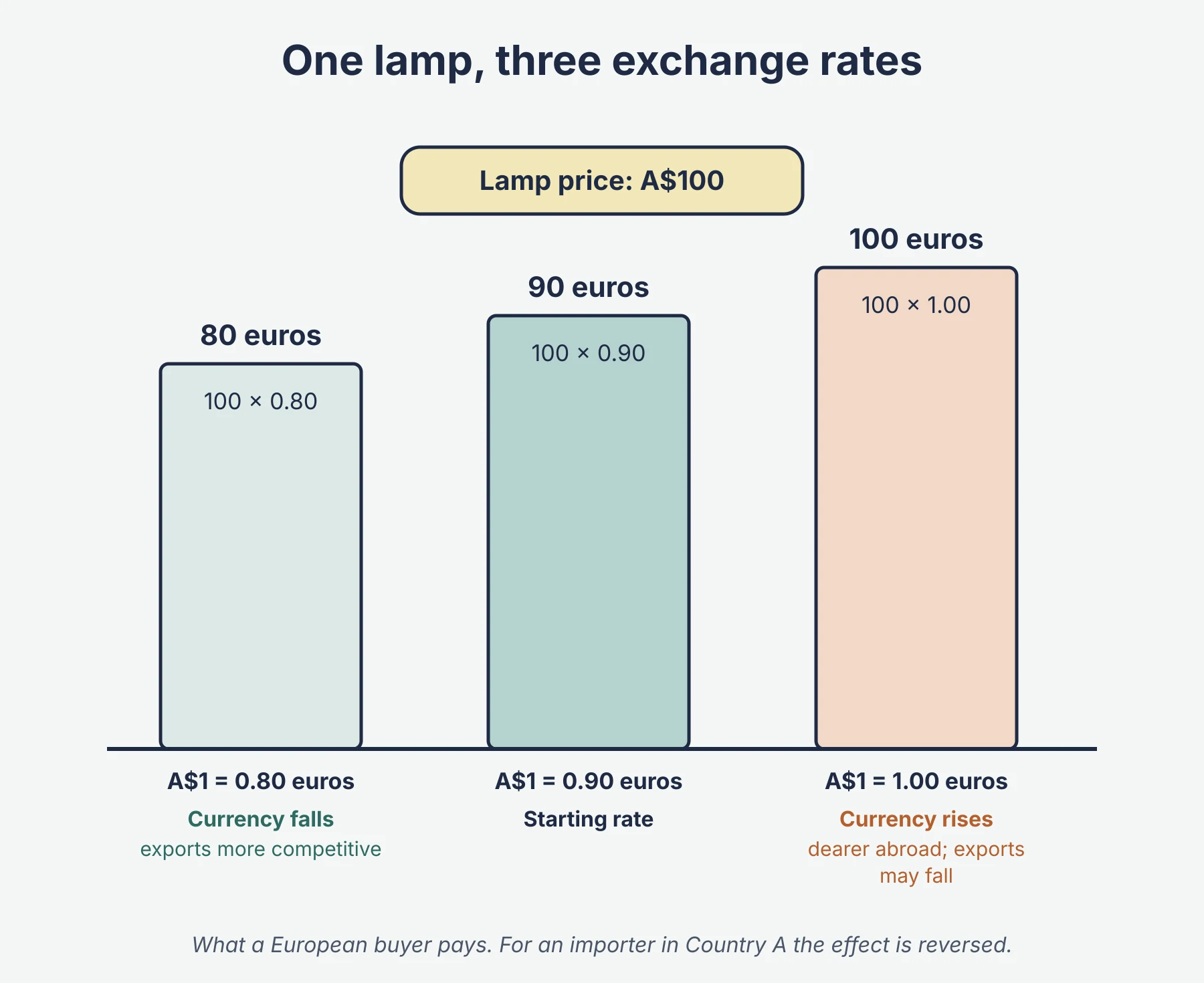
Exchange rate rule: a stronger home currency makes exports dearer abroad and imports cheaper at home. A weaker currency does the opposite.
3.1.3 Balance of Trade and Balance of Payments
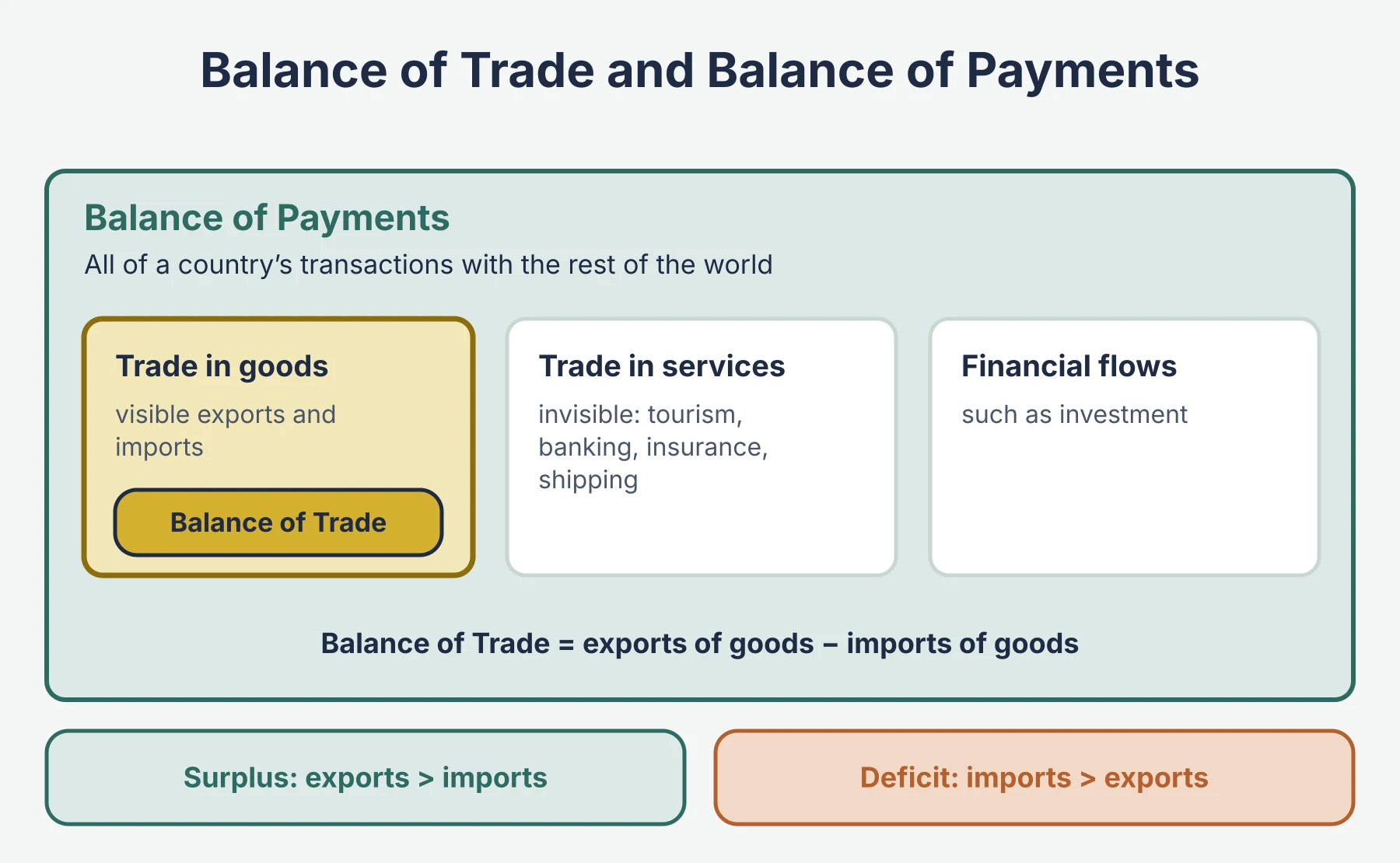
| Balance of Trade | Balance of Payments | |
|---|---|---|
| Covers | Goods only (visible trade) | All transactions: goods, services (invisible trade) and financial flows such as investment |
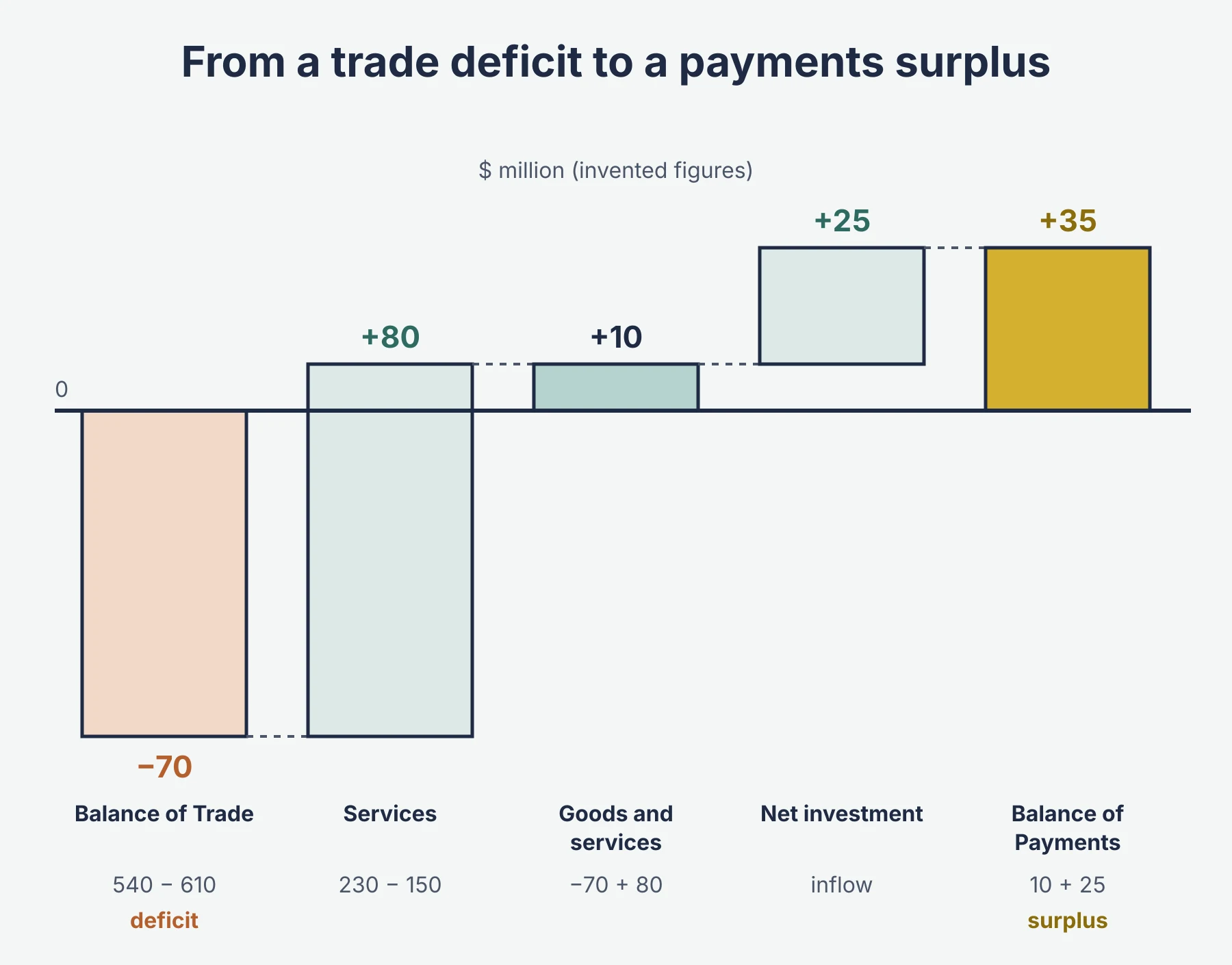
| Formula | Visible exports - visible imports | Balance of trade + balance on services + net financial flows (as given) |
- Positive = surplus; negative = deficit.
- Give the sign and the word.
Mini example (invented, $ million): goods exports 300, goods imports 360; services exports 90, services imports 50.
- Balance of Trade = 300 - 360 = -60 (deficit).
- Services = 90 - 50 = +40.
- Goods and services = -60 + 40 = -20 (deficit).
Commercial activities that affect them
| Activity | Effect |
|---|---|
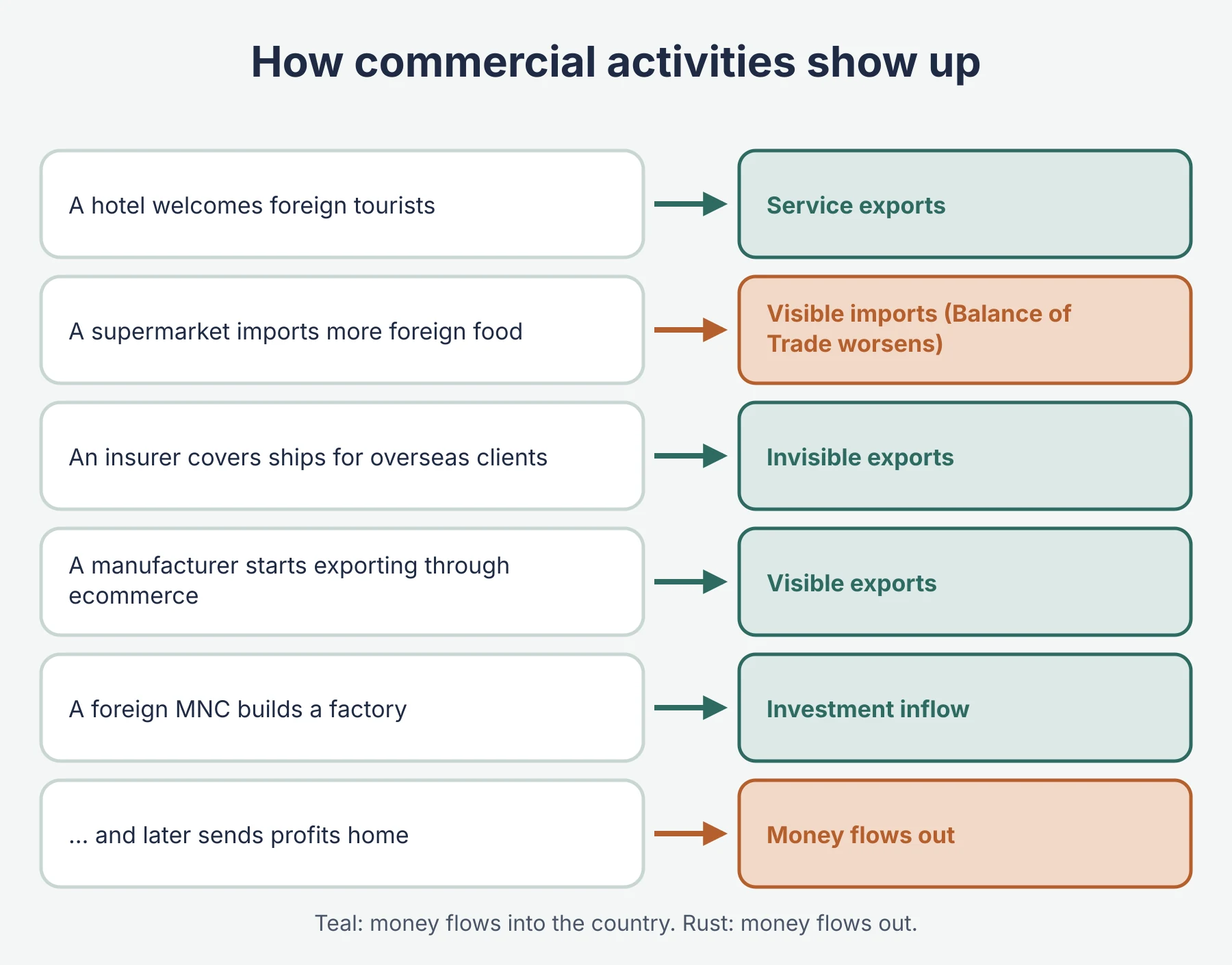
| Firms export goods | Visible exports rise; Balance of Trade improves |
| Retailers import more goods | Visible imports rise; Balance of Trade worsens |
| Foreign tourists stay in local hotels | Service exports rise |
| Local people holiday abroad | Service imports rise |
| Local insurers or banks serve foreign clients | Service exports rise |
| A foreign MNC invests in a factory | Financial inflow |
| The MNC sends profits home | Outflow |
3.1.4 Free trade, blocs, restrictions, support
- Free trade: trade between countries with no barriers.
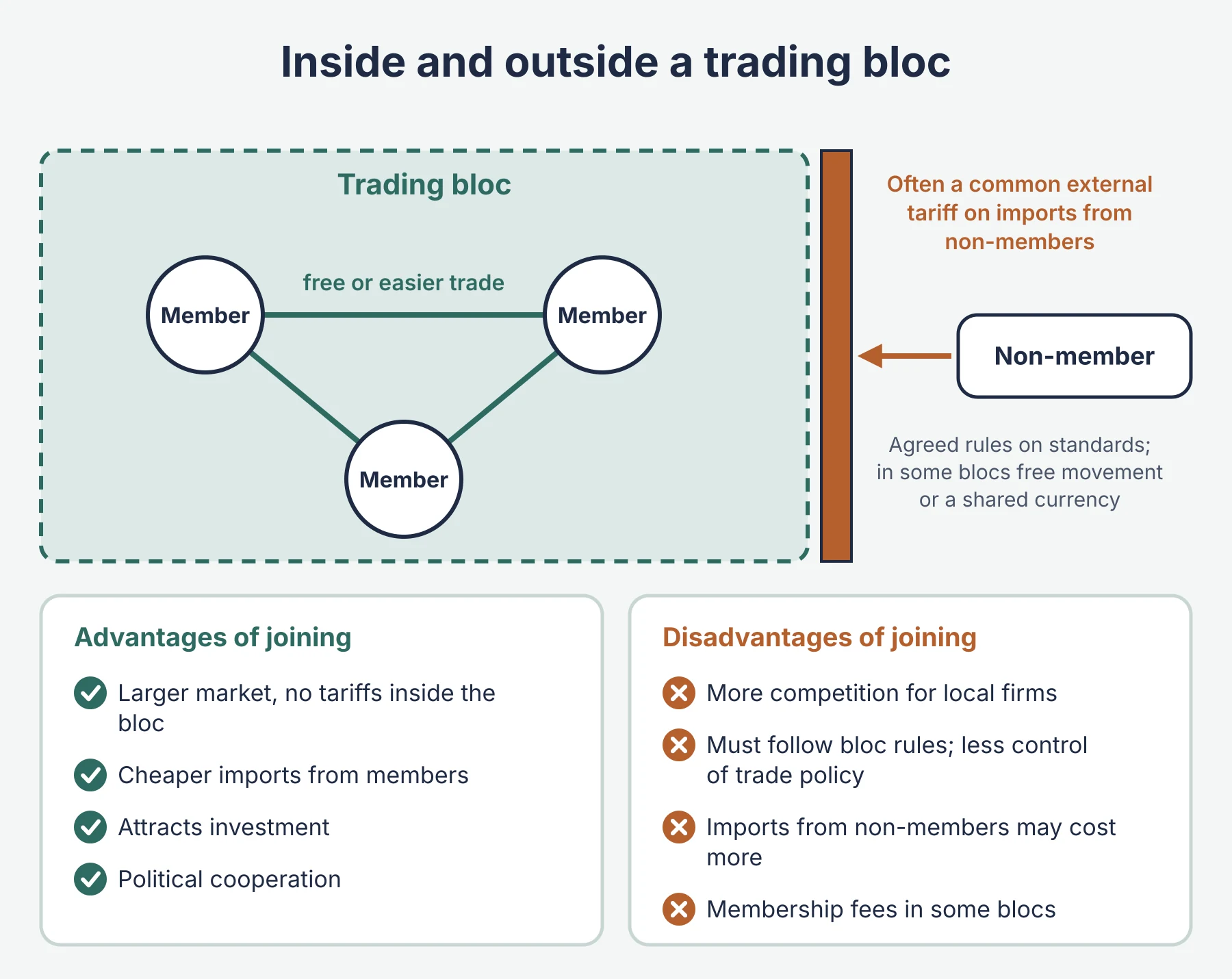
- Trading bloc features: members remove or reduce barriers between themselves; often a common external tariff on non-members; shared rules; sometimes free movement of people or capital, or a shared currency.
| Joining a bloc: for | Joining a bloc: against |
|---|---|
| Bigger tariff-free market | More competition at home |
| Cheaper imports from members | Loss of control over trade policy |
| Attracts investment | Dearer imports from non-members |
| Political cooperation | Possible membership costs |
| Restriction | Meaning | Key effect |
|---|---|---|
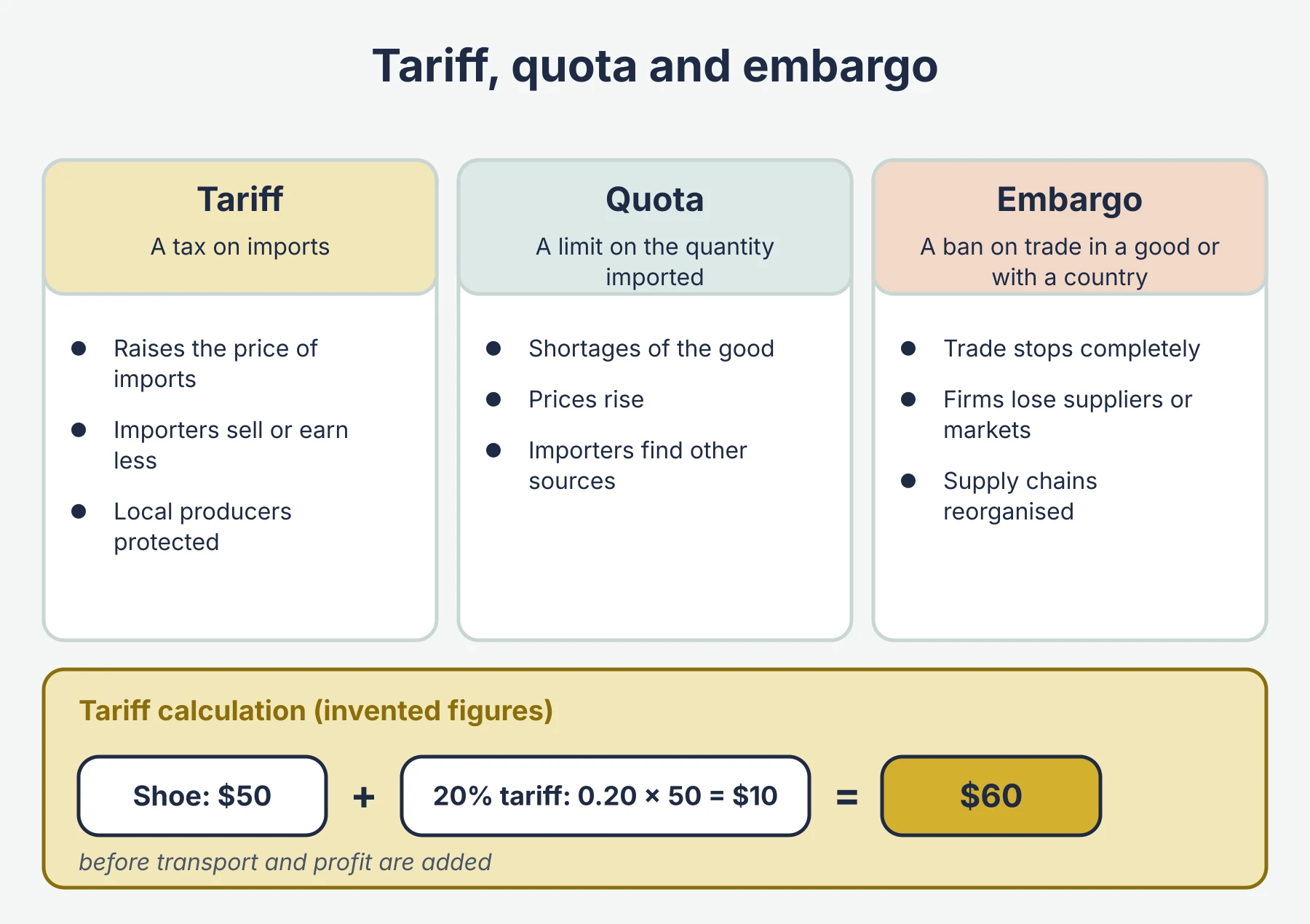
| Tariff | Tax on imports | Import prices rise |
| Quota | Limit on import quantity | Supply limited; prices rise |
| Embargo | Ban on trade | Trade stops; supply chains must change |
Tariff calculation: price x (1 + tariff rate). $80 good, 15% tariff = 80 + 12 = $92.
Support for exporters: international trade fairs; cheaper bank loans; insurance guarantees.
Key terms
| Term | Meaning |
|---|---|
| Visible trade | Trade in goods |
| Invisible trade | Trade in services |
| Balance of Trade | Visible exports minus visible imports |
| Balance of Payments | Record of all transactions with the rest of the world |
| Surplus | Exports exceed imports |
| Deficit | Imports exceed exports |
| Exchange rate | Price of one currency in terms of another |
| Free trade | Trade without tariffs, quotas or embargoes |
| Trading bloc | Group of countries that reduce trade barriers between themselves |
| Tariff | Tax on imported goods |
| Quota | Limit on the quantity imported |
| Embargo | Ban on trade |
Exam traps
- The Balance of Trade is goods only.
- Tourism by foreigners in your country is a service export, even though no goods leave.
- A quota is a quantity limit, not a tax.
- An embargo is a ban, not a limit.
- Joining a bloc: say who gains (exporters, consumers) and who loses (local firms facing competition).
Self-test
- State three benefits of international trade to a country.
- Give two challenges linked to getting paid.
- What is the difference between “currencies” and “foreign exchange rates” as challenges?
- Define the Balance of Trade.
- What does the Balance of Payments include that the Balance of Trade does not?
- Visible exports $420m, visible imports $395m. Calculate the Balance of Trade and state whether it is a surplus or deficit.
- Is a foreign student paying fees to a local university a visible or invisible export?
- Define a trading bloc.
- State one disadvantage of joining a trading bloc.
- Distinguish between a tariff and a quota.
- An import costs $250 and a 12% tariff is charged. Calculate the price including the tariff.
- Name the three sources of support for exporters in the syllabus.
Answers
- Any three: wider choice of goods; higher standard of living; lower cost of imports; more investment; creation of jobs.
- Any two: methods of payment; non-payment; currencies; foreign exchange rates.
- Currencies: buyer and seller use different money, which must be exchanged. Exchange rates: the rate can change, altering the value of the deal.
- The value of a country’s exports of goods minus the value of its imports of goods over a period.
- Trade in services (invisible trade) and financial flows such as investment.
- 420 - 395 = +$25m, a surplus.
- Invisible export (a service sold to a foreigner).
- A group of countries that agree to reduce or remove trade barriers between themselves.
- Any one: more competition for local firms; loss of control over trade policy; dearer imports from non-members; membership costs.
- A tariff is a tax on imports; a quota is a limit on the quantity that can be imported.
- 12% of 250 = $30; price = $280.
- International trade fairs, cheaper bank loans, insurance guarantees.
Related resources
-
Study guides
Cambridge IGCSE Commerce: Globalisation of Trade (0715)
Guide to Topic 3 of Cambridge IGCSE Commerce 0715, exams from 2028: benefits of trade, Balance of Payments, trading blocs, restrictions, supply chain risk.
Commerce · Cambridge · IGCSE
Read guide -
Practice questions
Cambridge IGCSE Commerce: Globalisation of Trade — Practice Questions (0715)
Original practice questions with worked answers for Cambridge IGCSE Commerce 0715 Topic 3: Balance of Trade, trading blocs, restrictions and supply chains.
Commerce · Cambridge · IGCSE
Try questions -
Revision notes
Cambridge IGCSE Commerce: Globalisation of Trade — Revision Notes
Recall notes for Cambridge IGCSE Commerce 0715 Topic 3: benefits and challenges of trade, Balance of Trade and Payments, trading blocs and supply chain risk.
Commerce · Cambridge · IGCSE
Revise topic
Get free revision emails (optional)
Occasional emails with practice questions, worked explanations and links to free resources for the qualification and subjects you choose. No spam, and you can unsubscribe from any email. The free tools on this site never need an email.