
Study Guides
Cambridge IGCSE Commerce (0715): Global supply chain management
Simple and complex global supply chains, upstream and downstream, benefits, six risk types and risk assessment, for Cambridge IGCSE Commerce 0715 section 3.2.
- Subject
- Commerce
- Level
- IGCSE
- Topic
- Topic 3 – Globalisation of Trade
- Author
- Marlbridge Academic Team
- Updated
- Reviewed by
- Salman Ahmad (what this means)
Aligned to Cambridge IGCSE Commerce (0715), 2028. Official specification .
Syllabus page (what it covers and how it is assessed): Cambridge IGCSE Commerce.
Syllabus points this page covers
0715
- 3.2 Global supply chain management
Found an error? Report a correction.
Need help with this topic? Request a free trial class for IGCSE Commerce (0715).
A global supply chain links businesses in different countries that together turn raw materials into a product and deliver it to consumers. Global supply chain management is the planning and control of that whole chain so that goods flow at the right cost, quality and time. Section 3.2 of the Cambridge IGCSE Commerce (0715) syllabus has two parts: global supply chains (3.2.1), covering types, features, suppliers and benefits, and global supply chain risks (3.2.2), covering six categories of risk and the importance of risk assessment. This page goes deeper than the supply chain section of the Globalisation of Trade study guide, with mapped examples and a worked risk assessment.
What types of global supply chain are there? (3.2.1)
| Type | Stages named in the syllabus | When it is used |
|---|---|---|
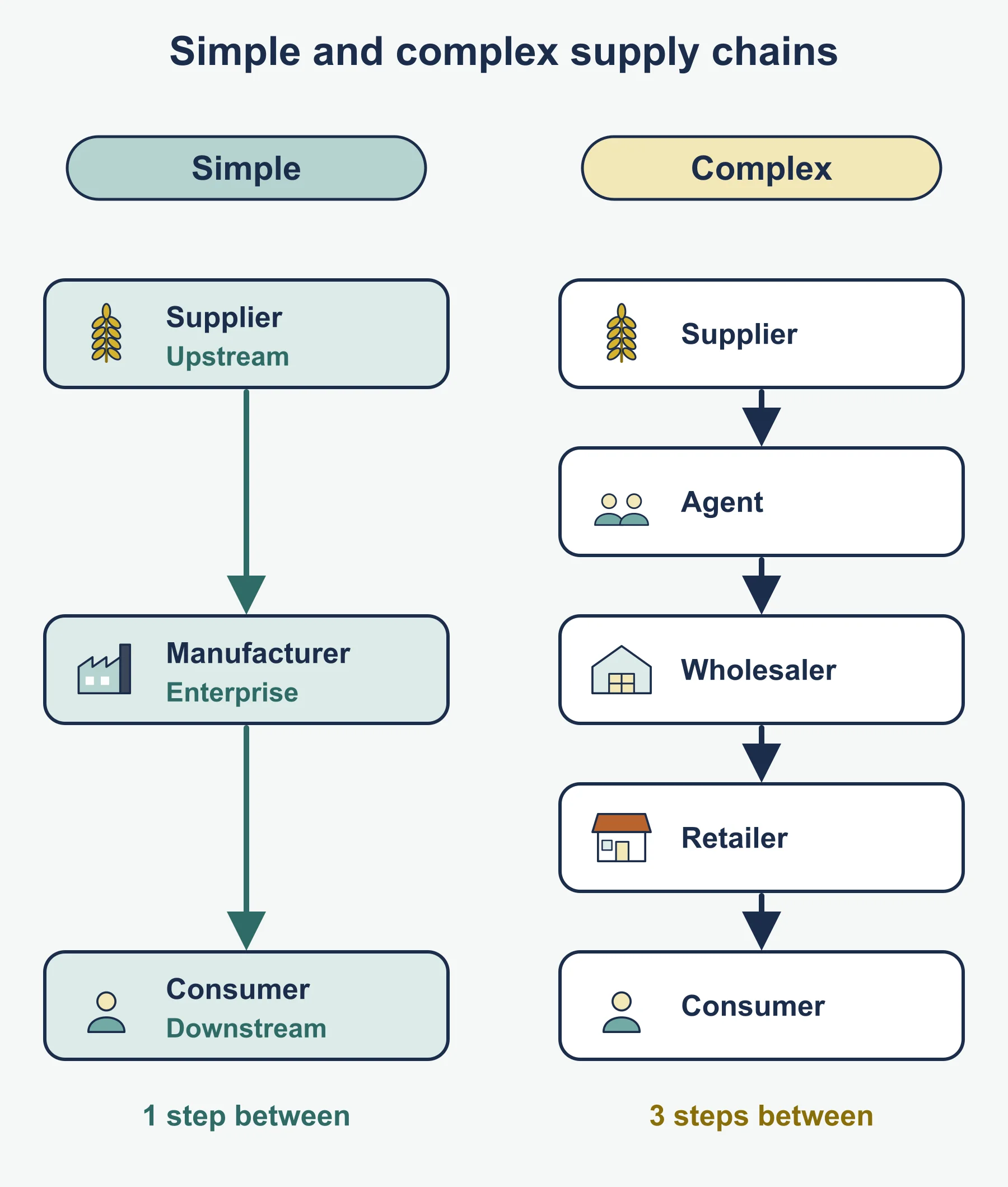
| Simple supply chain | Supplier, then manufacturer, then consumer | The manufacturer sells directly to consumers, for example a clothing brand selling online worldwide using fabric from an overseas supplier |
| Complex supply chain | Supplier, then agent, then wholesaler, then retailer, then consumer | Goods pass through several intermediaries, for example tinned fish caught and packed in one country, sold through an agent to a wholesaler in another, then to many shops |
A complex chain has more stages, so more businesses add cost and profit, and there are more points where something can go wrong. It also reaches many more consumers, because each intermediary brings its own market knowledge and customers.
What are upstream, the enterprise and downstream? (3.2.1)
The syllabus describes supply chain management in three parts, viewed from the business at the centre:
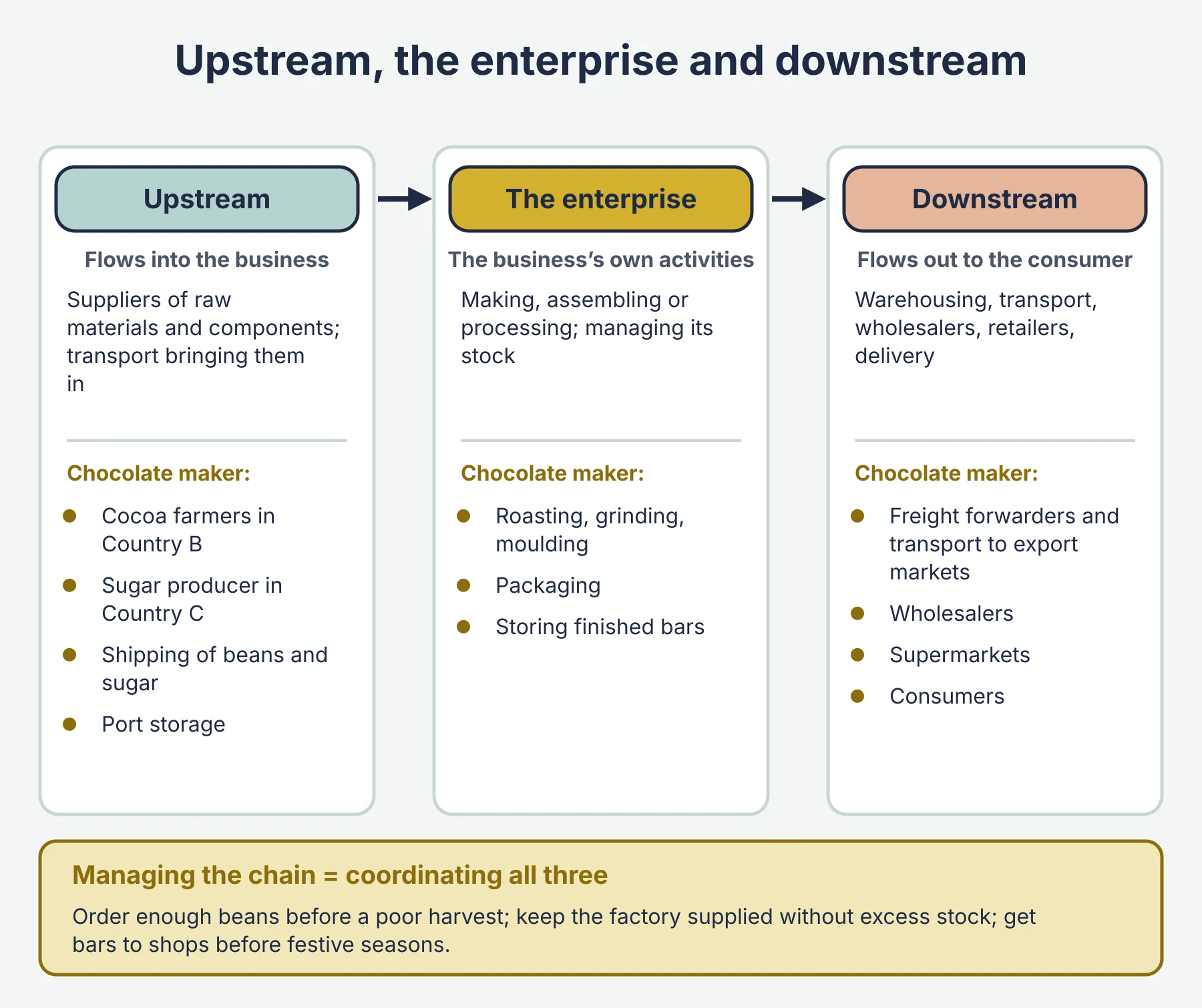
- Upstream: everything that flows into the business: suppliers of raw materials and components, and the transport bringing them in.
- The enterprise: the business’s own activities: making, assembling or processing the product, and managing its stock.
- Downstream: everything that flows out towards the consumer: warehousing, transport, wholesalers, retailers and delivery to the final buyer.
Worked example: mapping a chain
A chocolate manufacturer in Country A buys cocoa beans from farmers in Country B and sugar from Country C, makes chocolate bars in its factory, and sells through wholesalers and supermarkets in many countries.
| Part | Activities |
|---|---|
| Upstream | Cocoa farmers in Country B; sugar producer in Country C; shipping of beans and sugar; port storage |
| Enterprise | Roasting, grinding and moulding in the factory; packaging; storing finished bars |
| Downstream | Freight forwarders and transport to export markets; wholesalers; supermarkets; consumers |
Managing the chain means coordinating all three: ordering enough beans before a poor harvest, keeping the factory supplied without excess stock, and getting bars to shops before festive seasons.
Why are suppliers so important? (3.2.1)
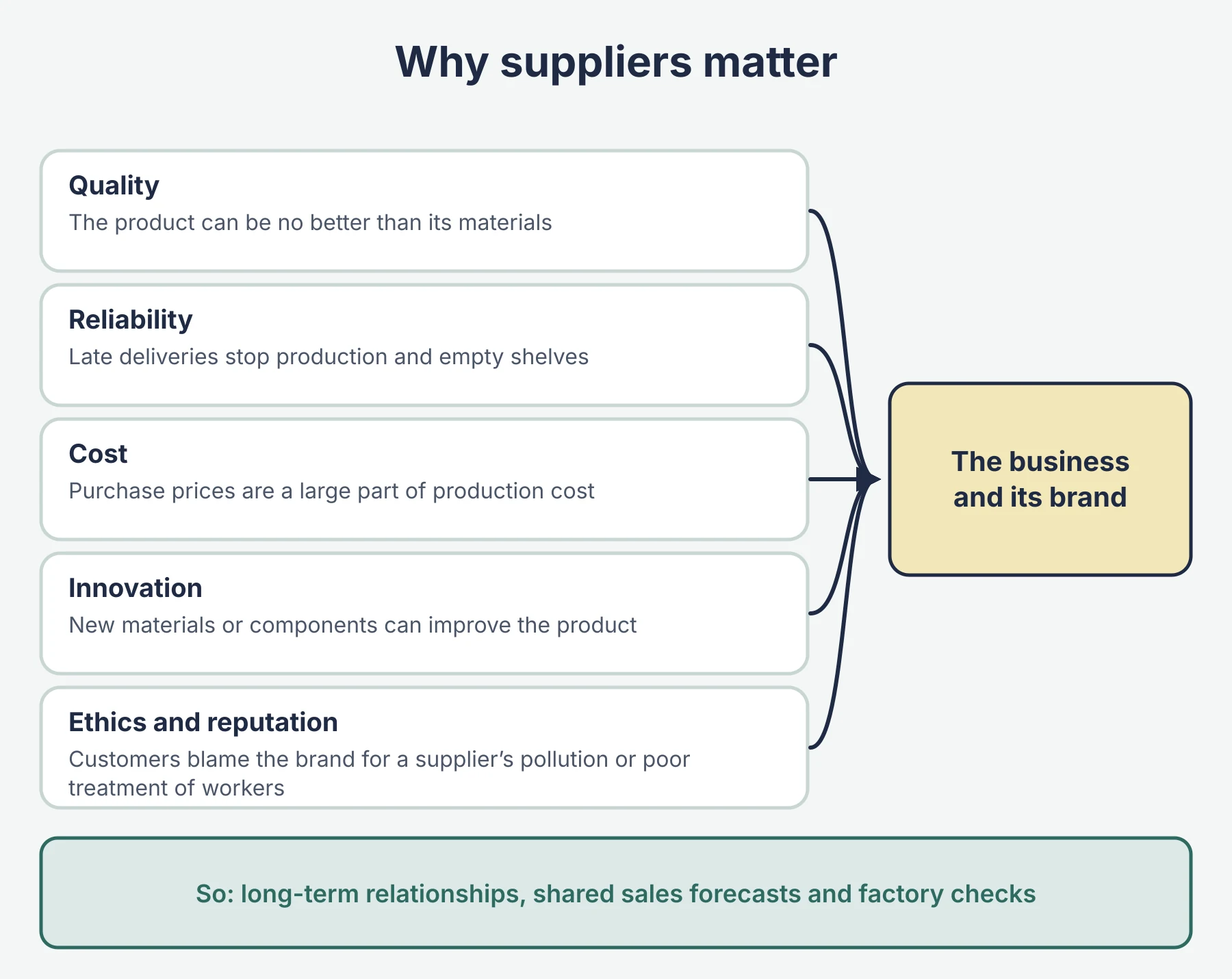
- Quality: the finished product can be no better than its materials and components.
- Reliability: late deliveries stop production and leave shelves empty.
- Cost: purchase prices form a large part of the cost of production.
- Innovation: suppliers may develop new materials or components that improve the product.
- Ethics and reputation: if a supplier pollutes or treats workers badly, customers blame the brand that sells the product.
For these reasons many businesses build long-term relationships with key suppliers, share sales forecasts with them, and check their factories.
What are the benefits of global supply chain management? (3.2.1)
| Benefit | Explanation |
|---|---|
| Lower cost of production | Each stage is carried out where it is cheapest or most efficient, and well-managed flows avoid waste and idle machinery |
| Lower labour costs | Labour-intensive stages, such as assembly or sewing, can be located in countries with lower wages |
| Lower cost of purchasing | Buying from the best-value suppliers worldwide, and in bulk, cuts the cost of materials |
| Advancement in logistics and communication | Containerisation, tracking systems and digital communication make it possible to coordinate suppliers in many countries quickly and reliably |
What risks do global supply chains face? (3.2.2)
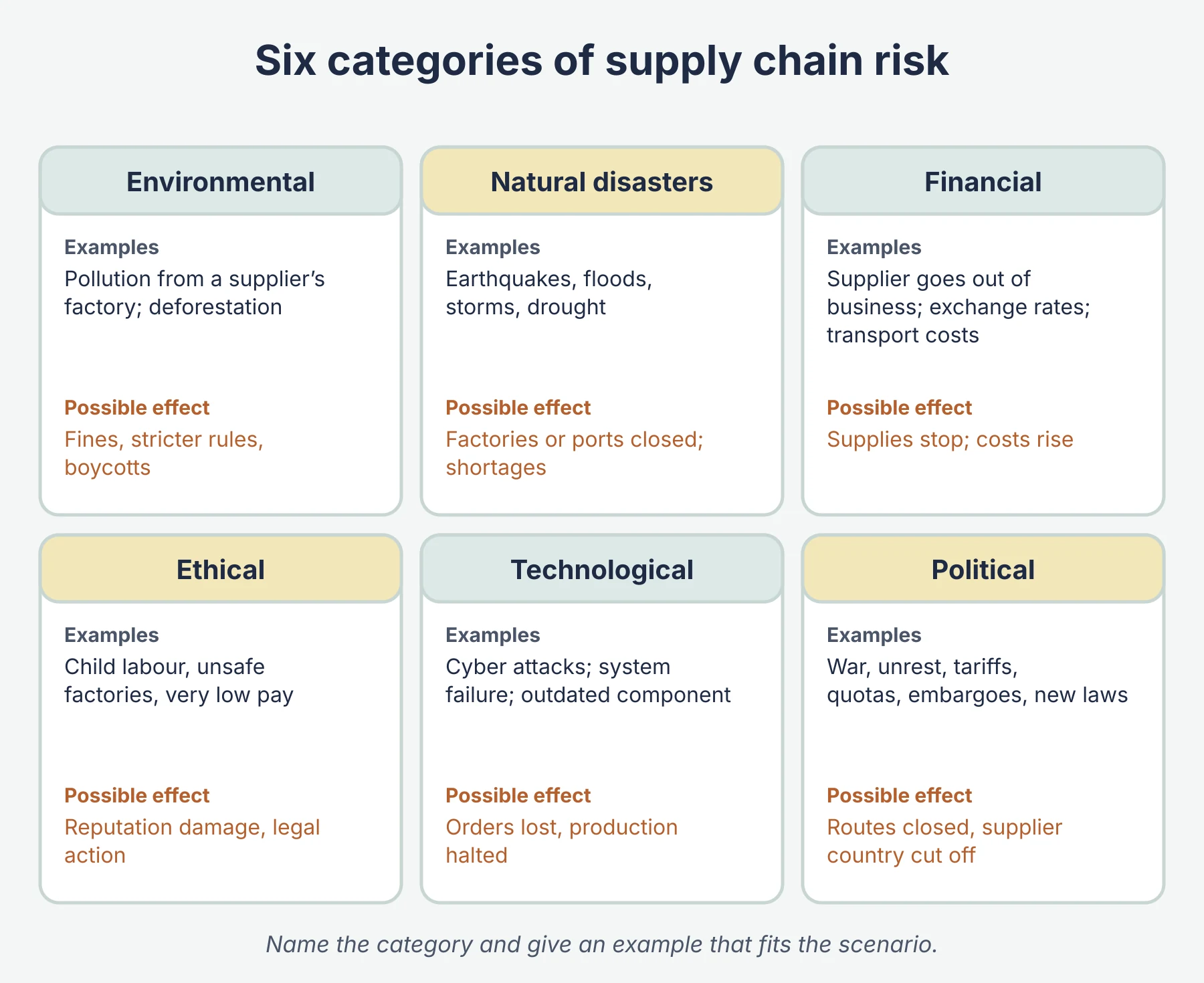
The syllabus names six categories. In exam answers, always name the category and give an example that fits the scenario.
| Risk | Examples | Possible effect on the business |
|---|---|---|
| Environmental | Pollution from a supplier’s factory; deforestation to grow crops | Fines, stricter rules, damage to reputation, consumer boycotts |
| Natural disasters | Earthquakes, floods, storms, drought | Factories or ports closed; harvests lost; shortages and higher prices |
| Financial | A supplier goes out of business; exchange rate changes; rising transport costs | Supplies stop suddenly; costs rise unexpectedly |
| Ethical | Child labour, unsafe factories, very low pay at a supplier | Reputation damage, loss of customers, legal action |
| Technological | Cyber attacks; failure of ordering or tracking systems; a component becoming outdated | Orders lost, deliveries delayed, production halted |
| Political | War, unrest, new tariffs, quotas or embargoes, sudden changes in law | Trade routes closed, extra costs, a supplier country cut off |
Notice the link with 3.1.4: a new tariff or embargo is both a trade restriction and a political supply chain risk.
Why is risk assessment important? (3.2.2)
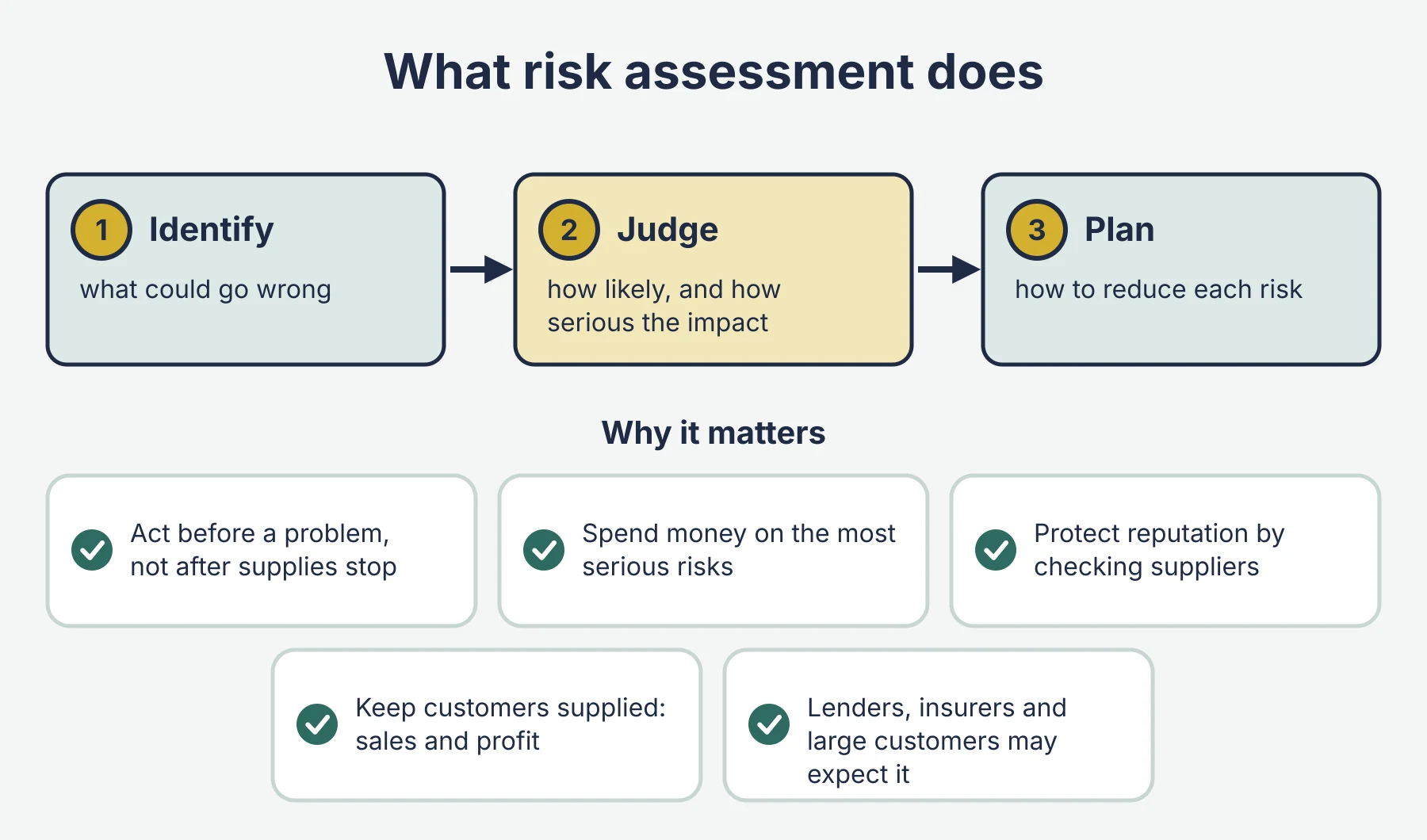
Risk assessment means identifying what could go wrong in the supply chain, judging how likely each risk is and how serious its impact would be, and planning how to reduce it. It matters because:
- It lets the business act before a problem occurs instead of reacting after supplies stop.
- It shows where to spend money on protection, focusing on the most serious risks.
- It protects reputation, by checking suppliers for ethical and environmental problems.
- It keeps customers supplied, protecting sales and profit.
- Lenders, insurers and large customers may expect it before they deal with the business.
Worked example: a simple risk assessment (invented scores)
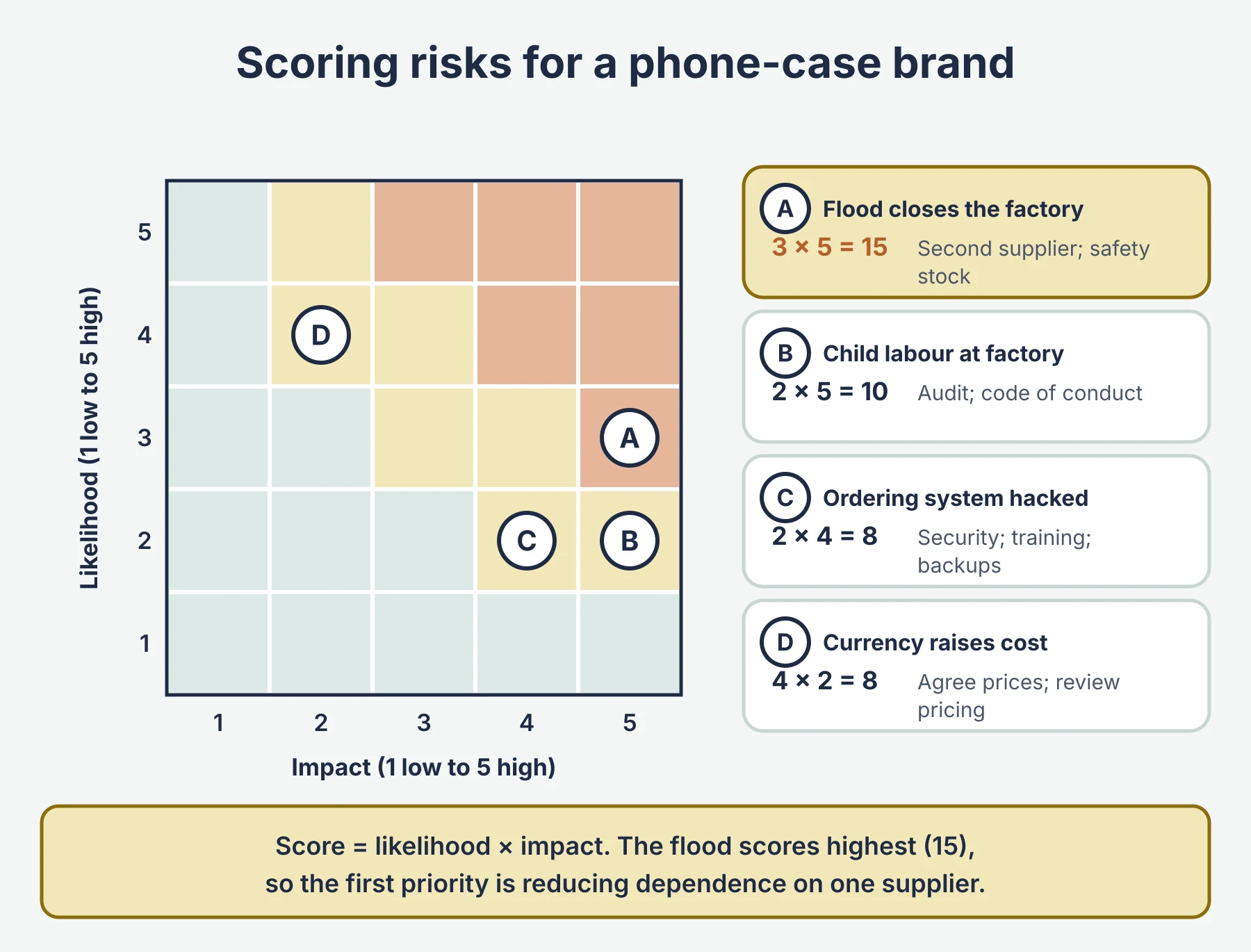
A phone-case brand buys all its cases from one factory in a country prone to flooding. Each risk is scored 1 (low) to 5 (high) for likelihood and impact; the risk score is likelihood x impact.
| Risk | Category | Likelihood | Impact | Score | Action |
|---|---|---|---|---|---|
| Flood closes the factory | Natural disaster | 3 | 5 | 15 | Find a second supplier in another region; hold safety stock |
| Factory uses child labour | Ethical | 2 | 5 | 10 | Audit the factory; require a code of conduct |
| Ordering system hacked | Technological | 2 | 4 | 8 | Security software; staff training; backups |
| Currency change raises cost | Financial | 4 | 2 | 8 | Agree prices in advance; review pricing |
The flood risk scores highest, so the first priority is reducing dependence on a single supplier. This is the kind of reasoning examiners reward when they ask why risk assessment matters: it ranks risks and leads to action.
What are the common mistakes in 3.2?
- Mixing up upstream (suppliers, inputs) and downstream (distribution, customers).
- Giving the complex chain in the wrong order; the syllabus order is supplier, agent, wholesaler, retailer, consumer.
- Writing “risks such as problems” instead of naming the category and an example.
- Treating environmental risk and natural disasters as the same. Environmental risk is harm the chain causes or faces from pollution and deforestation; natural disasters are events such as floods and earthquakes.
- Explaining risk assessment as a list of risks only, without saying how it helps the business plan.
Exam technique
- Identify the type of chain or the risk category from the scenario.
- Explain a benefit or risk: say how it affects costs, supply or reputation for the named business.
- Analyse: trace how one event, such as a port closure, moves along the chain from upstream to downstream.
- Evaluate: weigh the cost savings of a global chain against its risks and recommend, for example, whether to add a nearer supplier.
Where can I practise?
Review the global supply chain management revision notes, then attempt the global supply chain management practice questions. Section 3.1 is covered in the international trade study guide.
Official syllabus
Cambridge IGCSE Commerce (0715) syllabus for 2028, section 3.2 Global supply chain management: official syllabus PDF.
Related resources
-
Practice questions
Cambridge IGCSE Commerce (0715): Global supply chain management – Practice Questions
Original Cambridge IGCSE Commerce 0715 questions with answers on global supply chain types, upstream and downstream, benefits, risks and risk assessment.
Commerce · Cambridge · IGCSE
Try questions -
Revision notes
Cambridge IGCSE Commerce (0715): Global supply chain management – Revision Notes
Recall notes for Cambridge IGCSE Commerce 0715 section 3.2: chain types, upstream and downstream, suppliers, benefits, six risks and risk assessment steps.
Commerce · Cambridge · IGCSE
Revise topic -
Study guides
Cambridge IGCSE Commerce (0715): International trade
Benefits and challenges of international trade, balance of trade and payments, trading blocs and restrictions, for Cambridge IGCSE Commerce 0715 section 3.1.
Commerce · Cambridge · IGCSE
Read guide
Get free revision emails (optional)
Occasional emails with practice questions, worked explanations and links to free resources for the qualification and subjects you choose. No spam, and you can unsubscribe from any email. The free tools on this site never need an email.