
Revision Notes
Cambridge IGCSE Commerce (0715): Global supply chain management – Revision Notes
Recall notes for Cambridge IGCSE Commerce 0715 section 3.2: chain types, upstream and downstream, suppliers, benefits, six risks and risk assessment steps.
- Subject
- Commerce
- Level
- IGCSE
- Topic
- Topic 3 – Globalisation of Trade
- Author
- Marlbridge Academic Team
- Updated
- Reviewed by
- Salman Ahmad (what this means)
Aligned to Cambridge IGCSE Commerce (0715), 2028. Official specification .
Syllabus page (what it covers and how it is assessed): Cambridge IGCSE Commerce.
Syllabus points this page covers
0715
- 3.2 Global supply chain management
Found an error? Report a correction.
Need help with this topic? Request a free trial class for IGCSE Commerce (0715).
Condensed notes for section 3.2 of Cambridge IGCSE Commerce (0715). For a mapped chocolate supply chain and a scored risk assessment, use the global supply chain management study guide.
Definitions first
- Global supply chain: businesses in more than one country that together turn raw materials into a product and deliver it to consumers.
- Global supply chain management: planning and controlling the whole chain so goods flow at the right cost, quality and time.
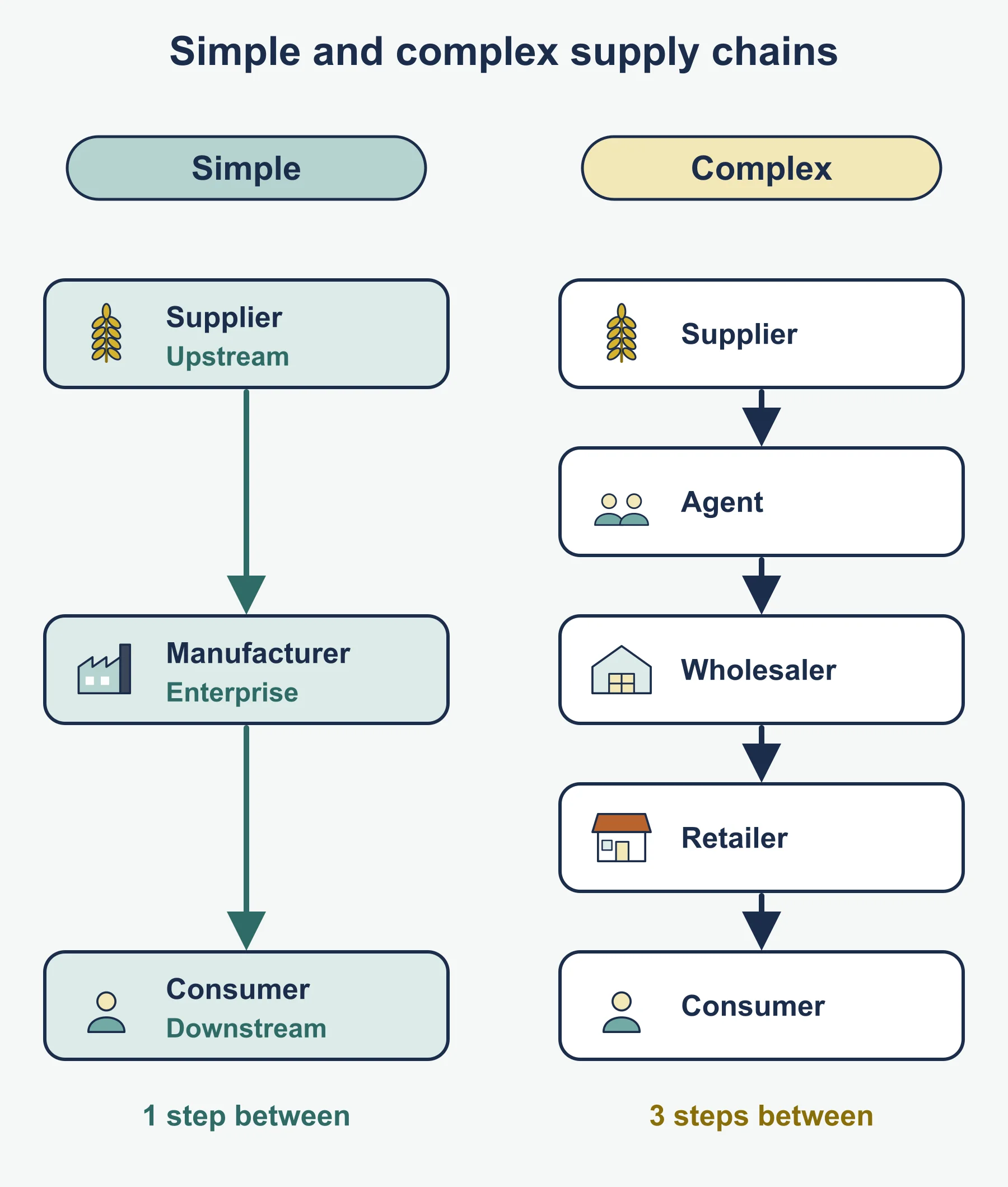
Two types (learn the exact order)
| Simple | Complex |
|---|---|
| Supplier → manufacturer → consumer | Supplier → agent → wholesaler → retailer → consumer |
| Fewer stages, lower added costs, more control | More stages, wider reach, more points of failure |
Three parts of the chain
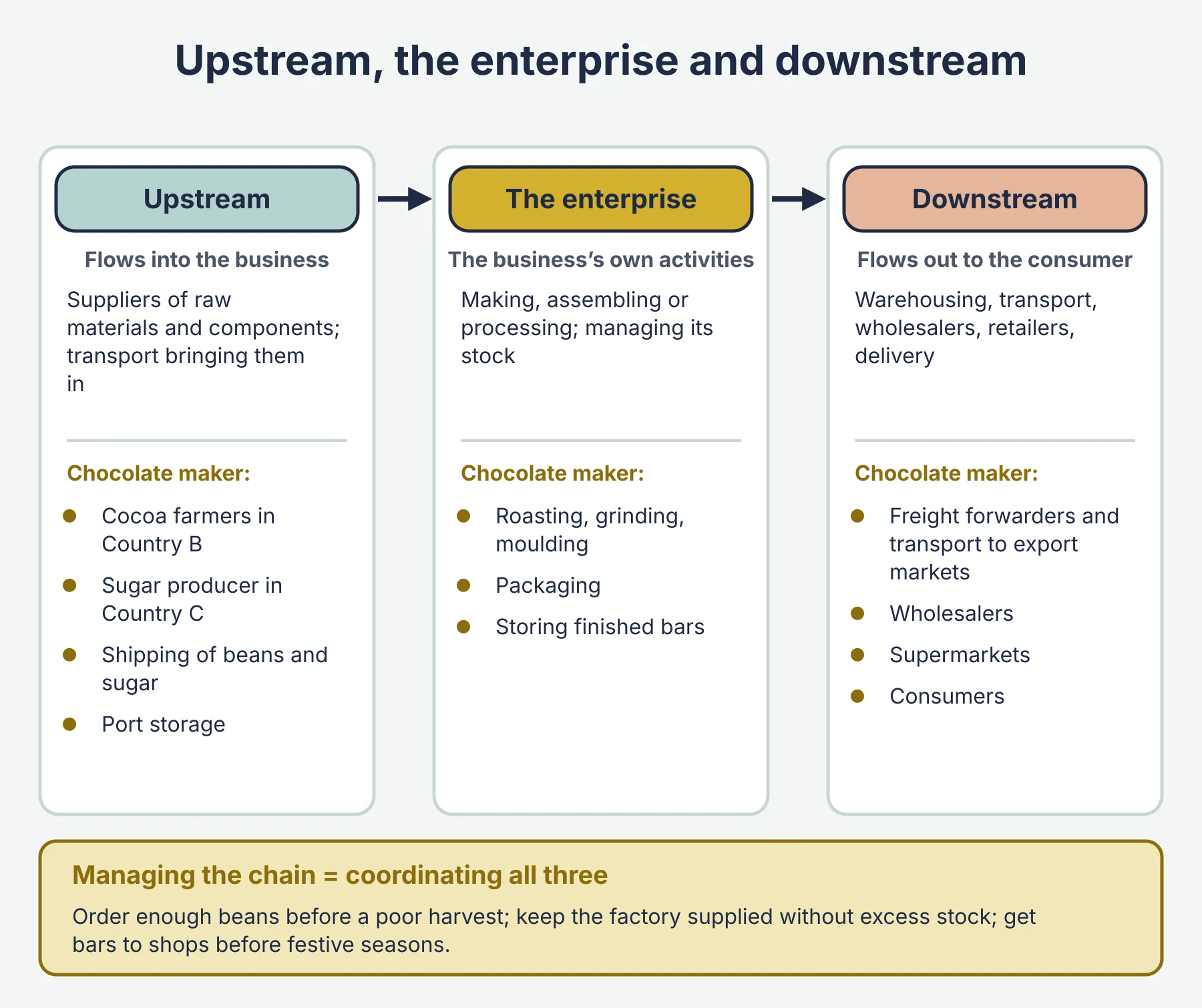
| Part | Direction | Contains |
|---|---|---|
| Upstream | Into the business | Suppliers of raw materials and components; inbound transport |
| The enterprise | Inside the business | Production, assembly, stock control |
| Downstream | Out to the consumer | Warehousing, outbound transport, wholesalers, retailers, delivery |
Memory hook: a river flows downstream to the sea, as goods flow down to the consumer.
Why suppliers matter
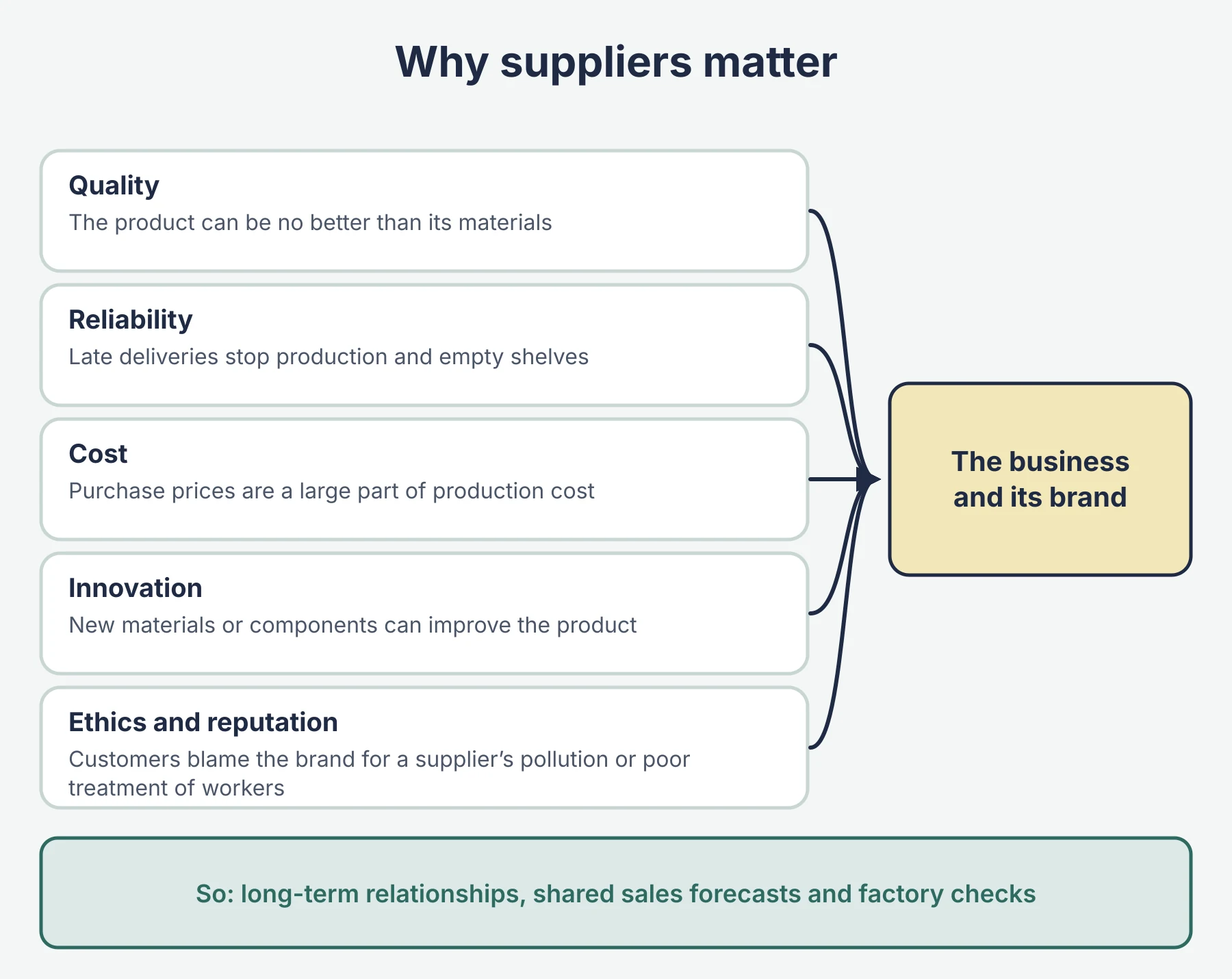
Quality of inputs, reliability of delivery, cost of purchases, new ideas, and the brand’s ethical reputation.
Four benefits (syllabus wording)
- Lower cost of production: each stage where it is most efficient; less waste.
- Lower labour costs: labour-intensive stages in lower-wage countries.
- Lower cost of purchasing: best-value suppliers worldwide; bulk buying.
- Advancement in logistics and communication: containers, tracking and digital systems make long chains workable.
Six risk categories with examples
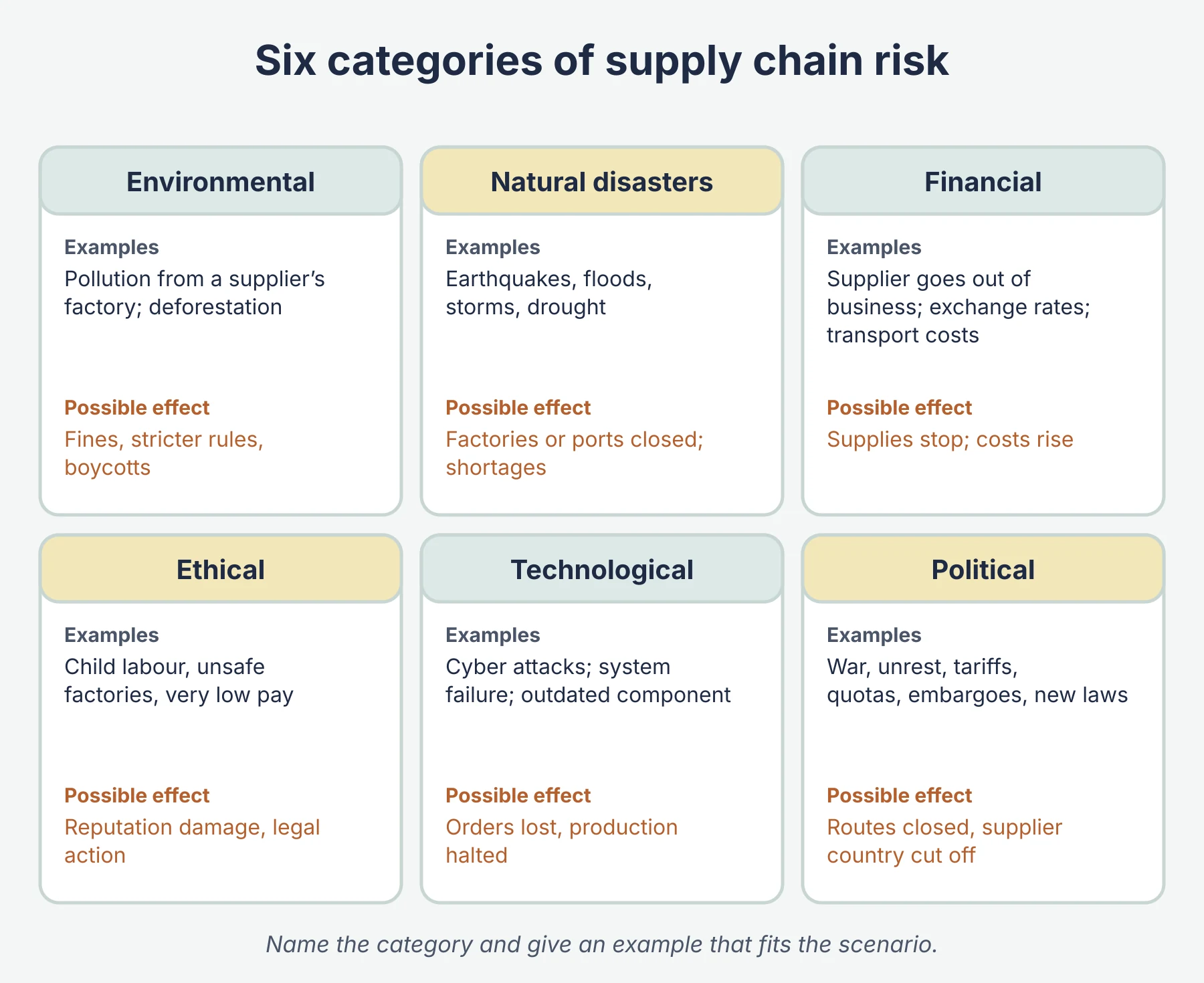
| Category | Examples |
|---|---|
| Environmental | Pollution, deforestation |
| Natural disasters | Floods, earthquakes, storms, drought |
| Financial | Supplier bankruptcy, exchange rate changes, rising costs |
| Ethical | Child labour, unsafe factories, very low pay |
| Technological | Cyber attacks, system failure, outdated components |
| Political | War, unrest, new tariffs, quotas, embargoes, law changes |
Mnemonic: “Every New Factory Expects Technical Problems”: Environmental, Natural disasters, Financial, Ethical, Technological, Political.
Risk assessment in four steps
- Identify what could go wrong at each stage.
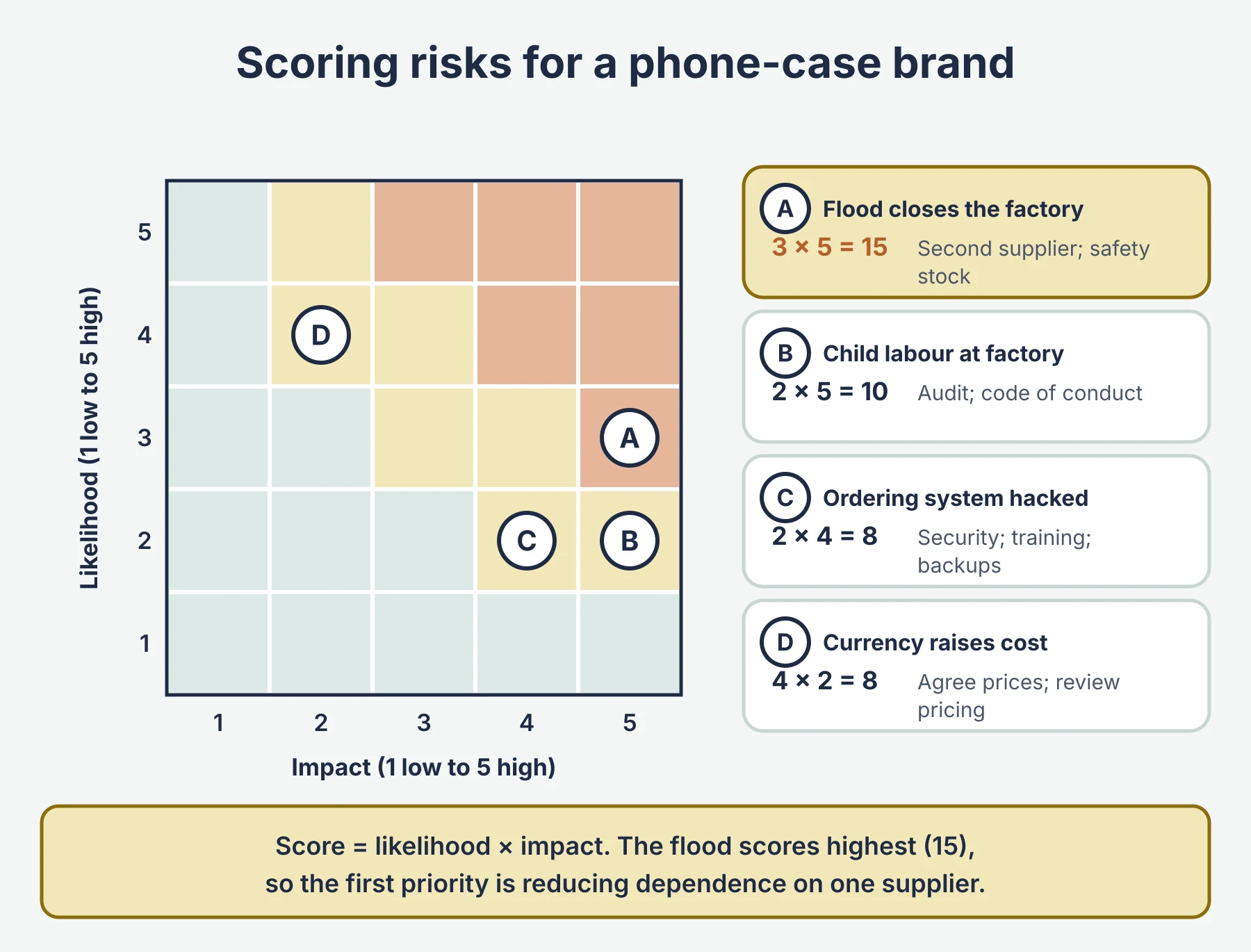
- Judge likelihood and impact (for example, score each 1 to 5 and multiply).
- Rank the risks to see which matter most.
- Plan actions: second supplier, safety stock, insurance, audits, cyber security, fixed-price contracts.
Why it is important: acts before problems happen; directs spending to the biggest risks; protects reputation; keeps customers supplied; reassures lenders, insurers and major customers.
Mini example (invented): risk A likelihood 4, impact 3 = 12; risk B likelihood 2, impact 5 = 10. Deal with risk A first.
Tracing one disruption along the chain
Analyse questions reward showing how a problem moves. Example: a flood closes a component supplier’s factory.
- Upstream: components stop arriving.
- Enterprise: the assembly line runs out of parts and stops; workers are idle; fixed costs continue.
- Downstream: wholesalers and retailers receive no stock; shelves empty.
- Consumer: buyers switch to rival brands; sales and reputation suffer.
The further upstream the problem, the more stages it affects.
Benefits versus risks: the trade-off
Long global chains bring the four cost benefits, but every extra country and stage adds distance, more suppliers to check and more exposure to the six risks. Evaluation answers should weigh the saving against the risk for the named business, then recommend a balance, such as keeping a low-cost distant supplier while adding a nearer back-up supplier.
Key terms
| Term | Meaning |
|---|---|
| Supply chain | Sequence of businesses and activities from raw materials to consumer |
| Global supply chain | Supply chain with stages in more than one country |
| Upstream | Suppliers and inputs flowing into the business |
| Downstream | Distribution of output to the consumer |
| The enterprise | The business’s own production and stock activities |
| Agent | Intermediary arranging trade for a principal for commission |
| Risk assessment | Identifying, judging and planning for possible problems |
| Safety stock | Extra stock kept in case supplies are delayed |
| Supplier audit | A check of a supplier’s working conditions, quality and environmental practice |
Exam traps
- Upstream = inputs; downstream = distribution. Do not reverse them.
- The complex chain includes the agent; candidates often omit it.
- Name the risk category and give a fitting example; “a problem in the chain” earns little.
- Environmental risk is not the same as natural disasters.
- A tariff or embargo is a political risk.
- “Why is risk assessment important” needs reasons (prevention, priorities, reputation), not just a definition.
Self-test
- Give the stages of a simple supply chain.
- Give the stages of a complex supply chain.
- Which part of the chain includes the suppliers of raw materials?
- Which part includes delivery to retailers?
- State two reasons why suppliers are important.
- Name the four benefits of global supply chain management in the syllabus.
- A supplier’s country introduces an embargo. Which category of risk is this?
- A supplier is found to employ children. Which category of risk is this?
- Give one example of a technological risk.
- Define risk assessment.
- Give two reasons why risk assessment is important.
- Risk C scores likelihood 3 and impact 4; risk D scores likelihood 5 and impact 2. Which should be dealt with first?
Answers
- Supplier, manufacturer, consumer.
- Supplier, agent, wholesaler, retailer, consumer.
- Upstream.
- Downstream.
- Any two: quality of inputs; reliable delivery; cost of purchases; innovation; ethical reputation.
- Lower cost of production, lower labour costs, lower cost of purchasing, advancement in logistics and communication.
- Political.
- Ethical.
- Any one: cyber attack; failure of ordering or tracking systems; a component becoming outdated.
- Identifying what could go wrong in the supply chain, judging how likely and serious each risk is, and planning how to reduce it.
- Any two: acts before problems occur; focuses spending on the most serious risks; protects reputation; keeps customers supplied; reassures lenders and customers.
- Risk C: 3 x 4 = 12, which is higher than risk D’s 5 x 2 = 10.
Related resources
-
Study guides
Cambridge IGCSE Commerce (0715): International trade
Benefits and challenges of international trade, balance of trade and payments, trading blocs and restrictions, for Cambridge IGCSE Commerce 0715 section 3.1.
Commerce · Cambridge · IGCSE
Read guide -
Practice questions
Cambridge IGCSE Commerce (0715): International trade – Practice Questions
Original Cambridge IGCSE Commerce 0715 questions with answers on international trade, balance of trade and payments, trading blocs and trade restrictions.
Commerce · Cambridge · IGCSE
Try questions -
Revision notes
Cambridge IGCSE Commerce (0715): International trade – Revision Notes
Recall notes for Cambridge IGCSE Commerce 0715 section 3.1: benefits, challenges, balance of trade and payments, trading blocs and trade restrictions.
Commerce · Cambridge · IGCSE
Revise topic
Get free revision emails (optional)
Occasional emails with practice questions, worked explanations and links to free resources for the qualification and subjects you choose. No spam, and you can unsubscribe from any email. The free tools on this site never need an email.