
Study Guides
Cambridge IGCSE Commerce (0715): International trade
Benefits and challenges of international trade, balance of trade and payments, trading blocs and restrictions, for Cambridge IGCSE Commerce 0715 section 3.1.
- Subject
- Commerce
- Level
- IGCSE
- Topic
- Topic 3 – Globalisation of Trade
- Author
- Marlbridge Academic Team
- Updated
- Reviewed by
- Salman Ahmad (what this means)
Aligned to Cambridge IGCSE Commerce (0715), 2028. Official specification .
Syllabus page (what it covers and how it is assessed): Cambridge IGCSE Commerce.
Syllabus points this page covers
0715
- 3.1 International trade
Found an error? Report a correction.
Need help with this topic? Request a free trial class for IGCSE Commerce (0715).
Section 3.1 of the Cambridge IGCSE Commerce (0715) syllabus takes the idea of exports and imports from Topic 1 and asks what international trade does for a country, what makes it hard for traders, how it is measured, and how governments encourage or restrict it. It has four parts: benefits to a country (3.1.1), challenges to exporters and importers (3.1.2), the Balance of Trade and Balance of Payments (3.1.3), and free trade, trading blocs, trade restrictions and support for exporters (3.1.4). This page goes deeper than the international trade section of the Globalisation of Trade study guide, with more worked figures and applied examples.
What are the benefits of international trade to a country? (3.1.1)
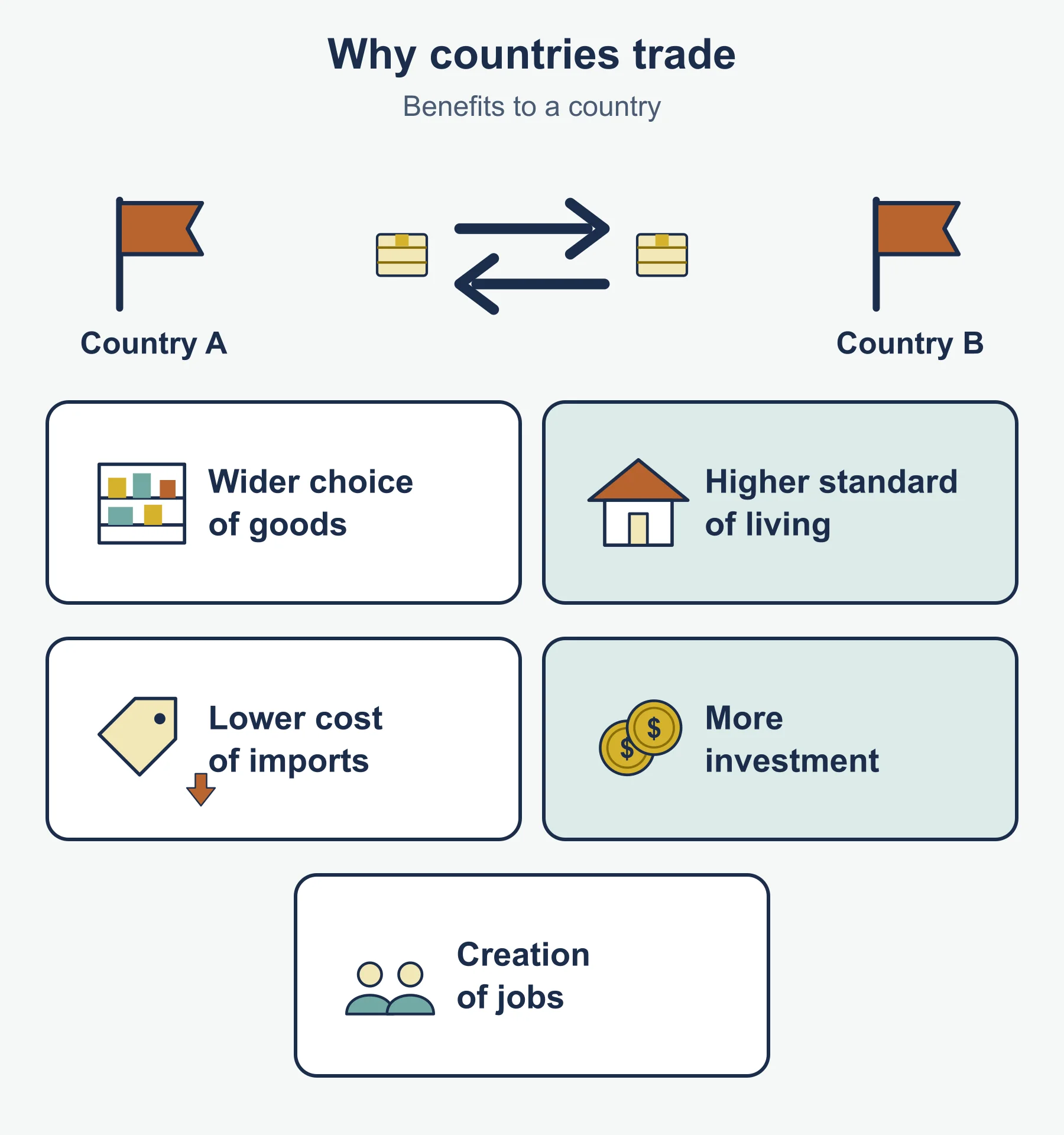
The syllabus names five. Each needs a reason, not just a label.
| Benefit | Why it happens |
|---|---|
| Wider choice of goods | Consumers can buy products their own country cannot make, such as tropical fruit in a cold country, or more brands and models |
| Higher standard of living | More choice and lower prices let people buy more with their income; exports also earn income for workers |
| Lower cost of imports | Another country may produce a good more cheaply because of its climate, resources, skills or scale |
| More investment | Foreign firms set up factories, offices and warehouses to trade with the country, bringing capital and technology |
| Creation of jobs | Export industries, ports, transport firms and shops selling imports all employ people |
What challenges do exporters and importers face? (3.1.2)
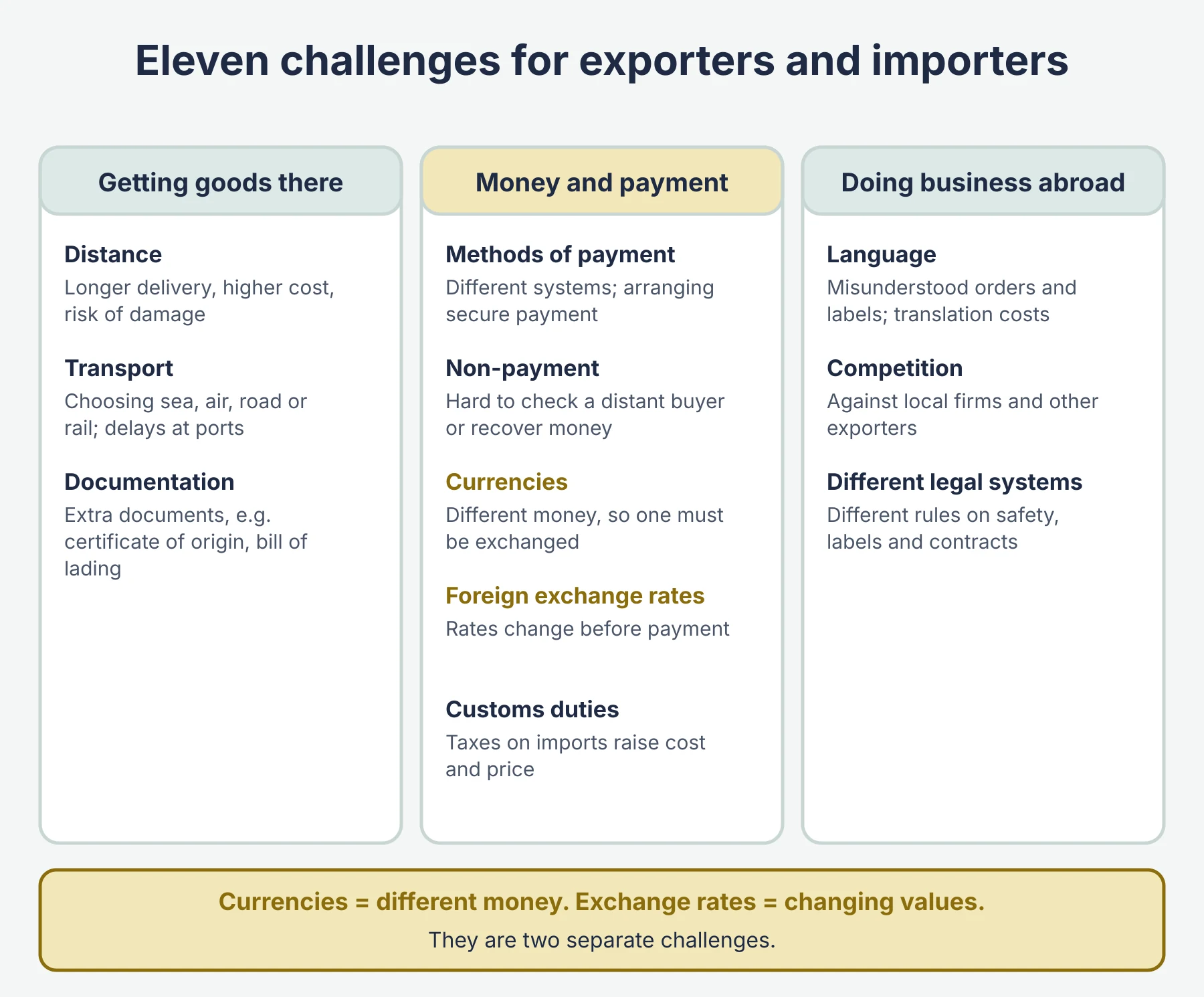
| Challenge | What it means for traders |
|---|---|
| Distance | Longer delivery times, higher transport costs, greater risk of damage |
| Language | Misunderstandings in orders, contracts and labels; translation costs |
| Methods of payment | Buyers and sellers may use different systems; arranging secure international payment |
| Documentation | Extra documents such as the certificate of origin and bill of lading |
| Transport | Choosing between sea, air, road and rail; booking space; delays at ports |
| Customs duties | Taxes on imports raise the cost and the selling price |
| Non-payment | Hard to check a distant buyer’s reliability or to recover money owed abroad |
| Currencies | The buyer and seller use different currencies, so one must be exchanged |
| Foreign exchange rates | Rates change, so the value of a sale or the cost of a purchase can change before payment |
| Competition | Exporters compete with local firms and other exporters in the foreign market |
| Different legal systems | Rules on product safety, labelling and contracts differ, and disputes are harder to settle |
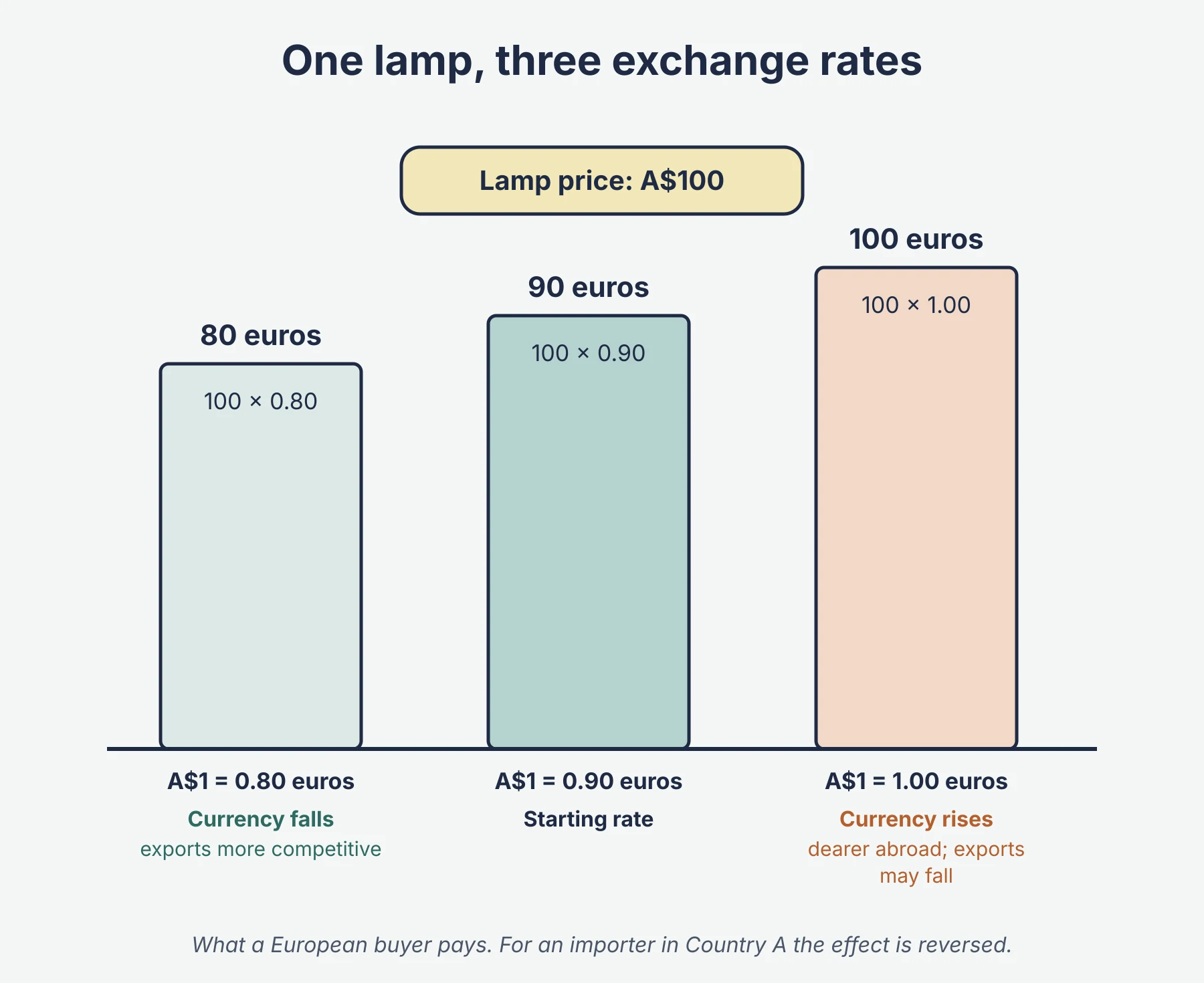
How does a change in exchange rate affect an exporter? (invented figures)
A manufacturer in Country A prices a lamp at A$100.
- When A$1 = 0.90 euros, a European buyer pays 100 x 0.90 = 90 euros.
- If Country A’s currency rises to A$1 = 1.00 euro, the buyer pays 100 euros, so the lamp is dearer abroad and exports may fall.
- If it falls to A$1 = 0.80 euros, the buyer pays 80 euros, so exports become more competitive.
For an importer in Country A, the effect is reversed: a stronger currency makes imports cheaper.
How do the Balance of Trade and Balance of Payments differ? (3.1.3)
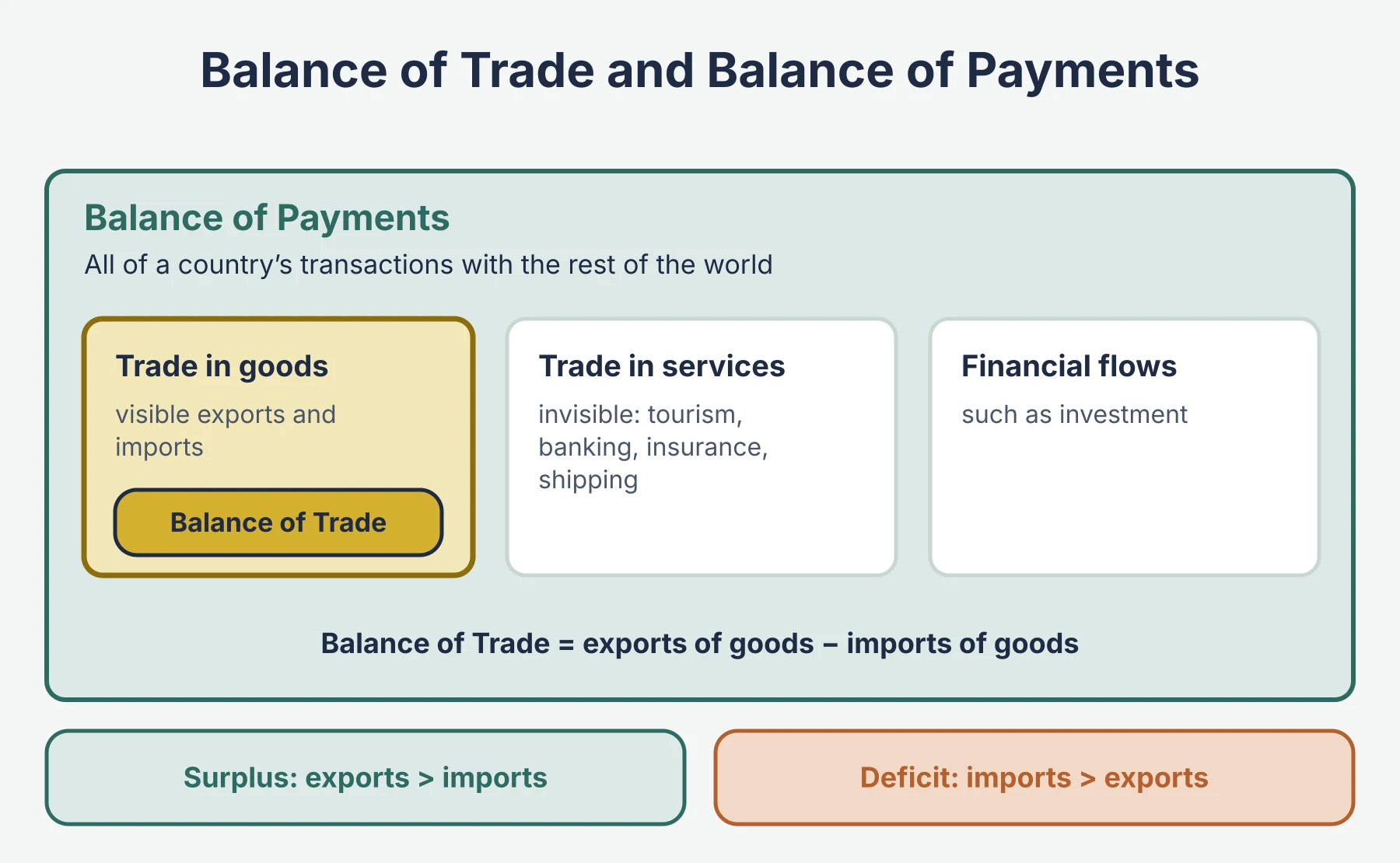
- Balance of Trade: the difference between the value of a country’s exports of goods (visible exports) and its imports of goods (visible imports) over a period, usually a year.
- Balance of Payments: the record of all a country’s transactions with the rest of the world: trade in goods, trade in services (invisible trade, such as tourism, banking, insurance and shipping), and financial flows such as investment.
Surplus: exports greater than imports. Deficit: imports greater than exports.
Worked example: calculation and interpretation (invented figures, $ million)
| Item | Exports | Imports |
|---|---|---|
| Goods | 540 | 610 |
| Services | 230 | 150 |
| Net investment flow into the country | +25 |
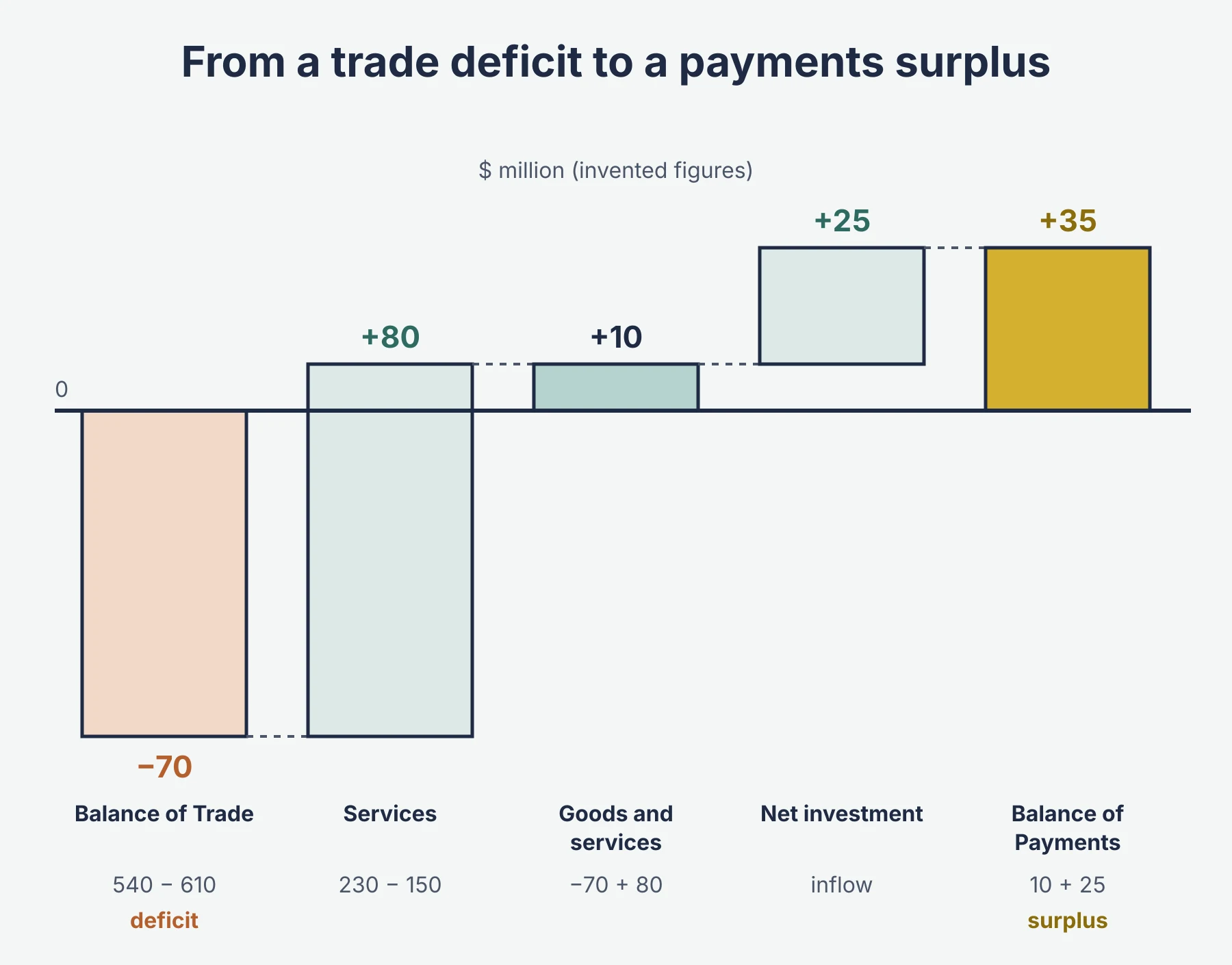
- Balance of Trade = 540 - 610 = -70, a deficit of $70 million on goods.
- Balance on services = 230 - 150 = +80, a surplus.
- Balance on goods and services = -70 + 80 = +10.
- Including the net investment inflow: 10 + 25 = +35, so the Balance of Payments figure from these data is a surplus of $35 million.
Interpretation: the country buys more goods than it sells, but earns more than enough from services, such as tourism or financial services, to cover the gap, and it is attracting investment. A question may ask what this suggests: for example, that the country’s strengths are in services rather than manufacturing.
How do commercial activities affect them?
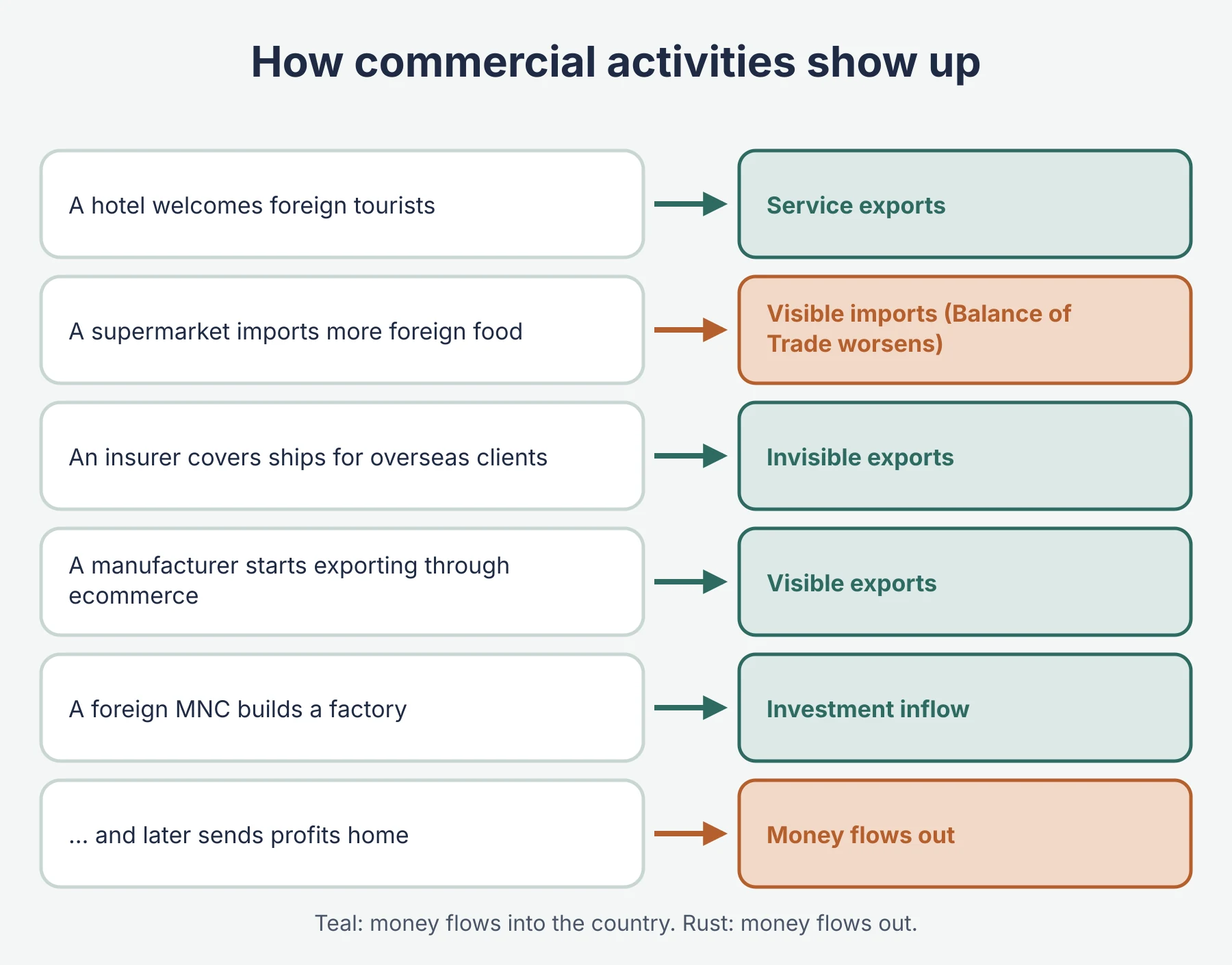
- A hotel welcoming foreign tourists earns service exports, improving the Balance of Payments.
- A supermarket importing more foreign food increases visible imports, worsening the Balance of Trade.
- A local insurance company covering ships for overseas clients earns invisible exports.
- A foreign MNC building a factory brings an investment inflow; when it later sends profits home, money flows out.
- A manufacturer that starts exporting through ecommerce raises visible exports.
Free trade, trading blocs and trade restrictions (3.1.4)
Free trade is international trade without barriers such as tariffs, quotas or embargoes.
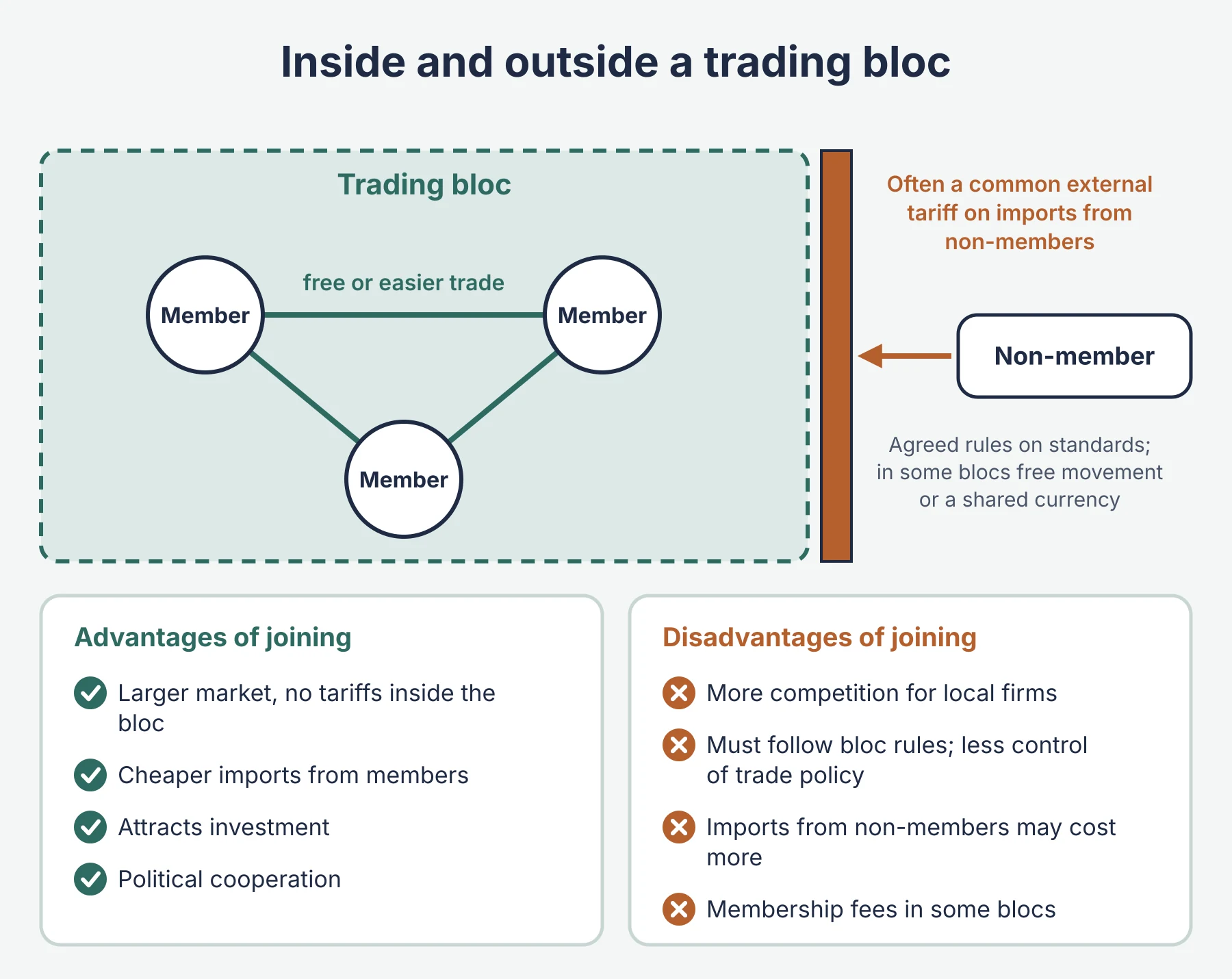
A trading bloc is a group of countries that agree to reduce or remove trade barriers between themselves. Features: free or easier trade between members; often a common external tariff charged on imports from non-members; agreed rules on standards; in some blocs, free movement of people or capital, or a shared currency.
| Advantages of joining | Disadvantages of joining |
|---|---|
| Larger market for exporters, with no tariffs inside the bloc | More competition for local firms from other members |
| Cheaper imports of goods and raw materials from members | Must follow the bloc’s rules and may lose control of trade policy |
| Attracts investment from firms wanting access to the whole bloc | Imports from non-members may become dearer if a common external tariff applies |
| Political cooperation between members | Membership fees or contributions in some blocs |
The three trade restrictions
| Restriction | Meaning | Effect on commercial activities |
|---|---|---|
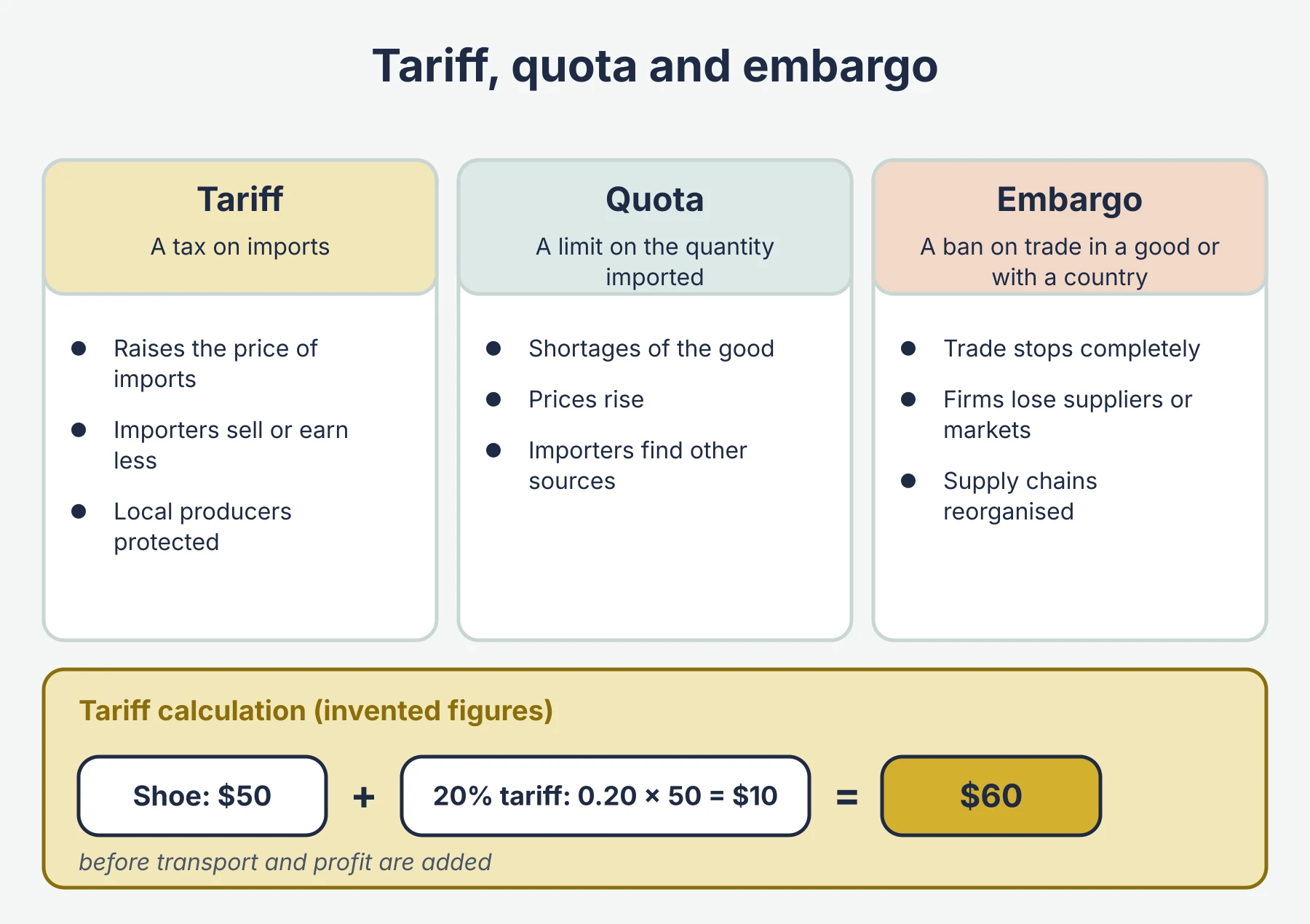
| Tariff | A tax on imports | Raises the price of imports; importers sell less or earn less; local producers gain protection |
| Quota | A limit on the quantity of a good that may be imported | Shortages of the imported good; prices rise; importers must find other sources |
| Embargo | A ban on trade in a good or with a country | Trade stops completely; firms lose suppliers or markets and must reorganise supply chains |
Tariff calculation (invented figures): a shoe imported at $50 with a 20% tariff costs 50 + (0.20 x 50) = $60 before transport and profit are added.
Sources of support for exporters
- International trade fairs: exhibitions where exporters meet foreign buyers, show products and learn about markets.
- Cheaper bank loans: finance at lower interest to help exporters fund production and wait for payment.
- Insurance guarantees: cover against the risk of a foreign buyer not paying, so exporters can sell to new markets with confidence.
What are the common mistakes in 3.1?
- Saying the Balance of Trade includes services; it covers goods only.
- Writing “deficit” for a positive figure, or giving the answer without a sign or the words surplus or deficit.
- Mixing up currencies (a challenge of different money) and exchange rates (a challenge of changing values).
- Describing a quota as a tax, or an embargo as a limit.
- Listing benefits of a trading bloc without the drawbacks.
Exam technique
- Calculate: write the formula, substitute, give the sign and say surplus or deficit.
- Interpret: say what the figure shows about the country’s trade.
- Explain a challenge: say how it affects cost, risk or sales for the trader named.
- Discuss joining a trading bloc: both sides, applied to the country or firm, then a conclusion.
Where can I practise?
Use the international trade revision notes, then try the international trade practice questions. Section 3.2 continues in the global supply chain management study guide.
Official syllabus
Cambridge IGCSE Commerce (0715) syllabus for 2028, section 3.1 International trade: official syllabus PDF.
Related resources
-
Practice questions
Cambridge IGCSE Commerce (0715): International trade – Practice Questions
Original Cambridge IGCSE Commerce 0715 questions with answers on international trade, balance of trade and payments, trading blocs and trade restrictions.
Commerce · Cambridge · IGCSE
Try questions -
Revision notes
Cambridge IGCSE Commerce (0715): International trade – Revision Notes
Recall notes for Cambridge IGCSE Commerce 0715 section 3.1: benefits, challenges, balance of trade and payments, trading blocs and trade restrictions.
Commerce · Cambridge · IGCSE
Revise topic -
Study guides
Cambridge IGCSE Commerce: Globalisation of Trade (0715)
Guide to Topic 3 of Cambridge IGCSE Commerce 0715, exams from 2028: benefits of trade, Balance of Payments, trading blocs, restrictions, supply chain risk.
Commerce · Cambridge · IGCSE
Read guide
Get free revision emails (optional)
Occasional emails with practice questions, worked explanations and links to free resources for the qualification and subjects you choose. No spam, and you can unsubscribe from any email. The free tools on this site never need an email.