
Revision Notes
Cambridge IGCSE Environmental Management (0680): Drought – Revision Notes
Recall notes for Cambridge IGCSE 0680 sub-topic 6.4: the drought definition, two causes, ten impacts, five strategies and their trade-offs, and a self-test.
- Subject
- Environmental Management
- Level
- IGCSE
- Topic
- Topic 6: Natural hazards
- Author
- Marlbridge Academic Team
- Updated
- Reviewed by
- Azam Siddique (what this means)
Aligned to Cambridge IGCSE Environmental Management (0680), 2027-2029. Official specification .
Syllabus page (what it covers and how it is assessed): Cambridge IGCSE Environmental Management.
Syllabus points this page covers
0680
- 6.4 Drought
Found an error? Report a correction.
Need help with this topic? Request a free trial class for IGCSE Environmental Management (0680).
Condensed recall for sub-topic 6.4 of Cambridge IGCSE Environmental Management (0680, 2027-2029). For explanations and two worked calculations, use the Drought study guide.
Definition (6.4.1): learn exactly
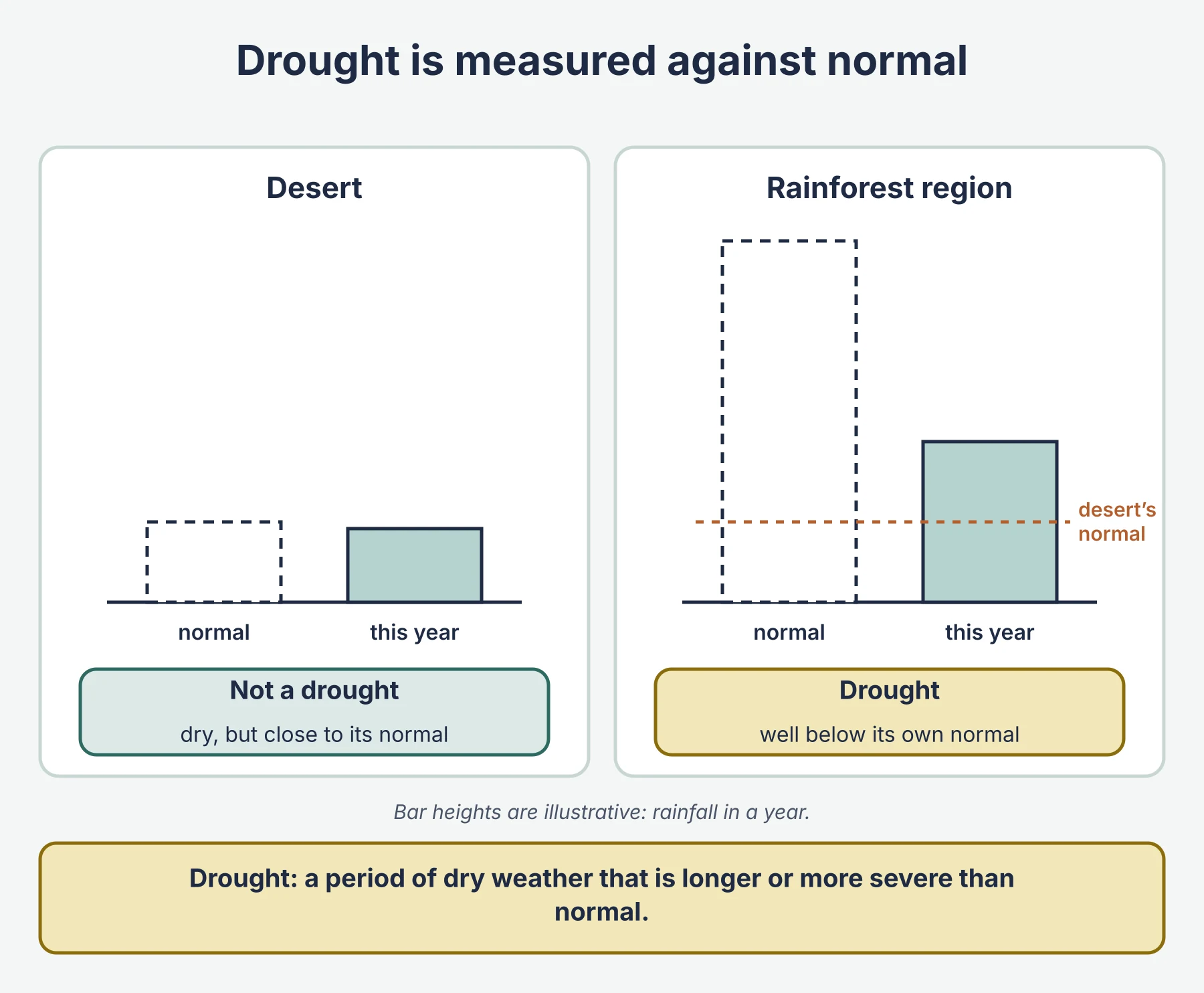
A drought is a period of dry weather that is longer or more severe than normal.
- “Normal” = compared with the usual amount for that place.
- So a desert is not automatically in drought; a wet region can be.
How drought differs from other hazards
| Feature | Drought | Earthquake, cyclone, flood |
|---|---|---|
| Onset | Slow, over months or years | Sudden, minutes to days |
| Start and end | Hard to pinpoint | Clear |
| Area | Very large regions | Usually more local |
| Warning | Long | Short or none |
This explains why monitoring is so useful for drought and why impacts such as famine build up gradually.
Causes (6.4.2): only two in the syllabus
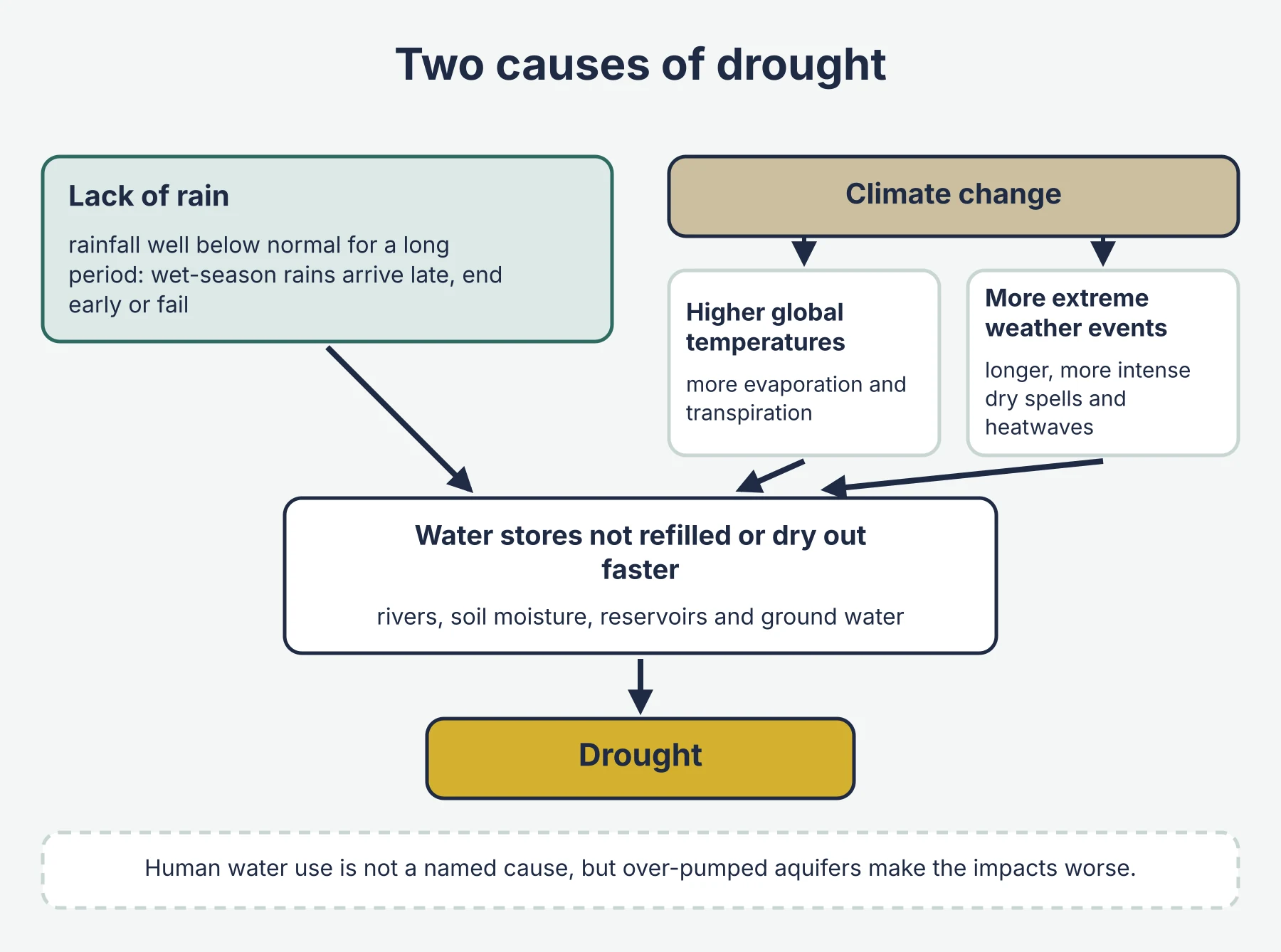
- Lack of rain: wet season late, short or failed; stores not refilled.
- Climate change:
- higher global temperatures → more evaporation and transpiration → stores dry faster;
- more extreme weather events → longer, more intense dry spells and heatwaves.
Human overuse of water worsens impacts but is not a named cause.
Impacts (6.4.3): ten
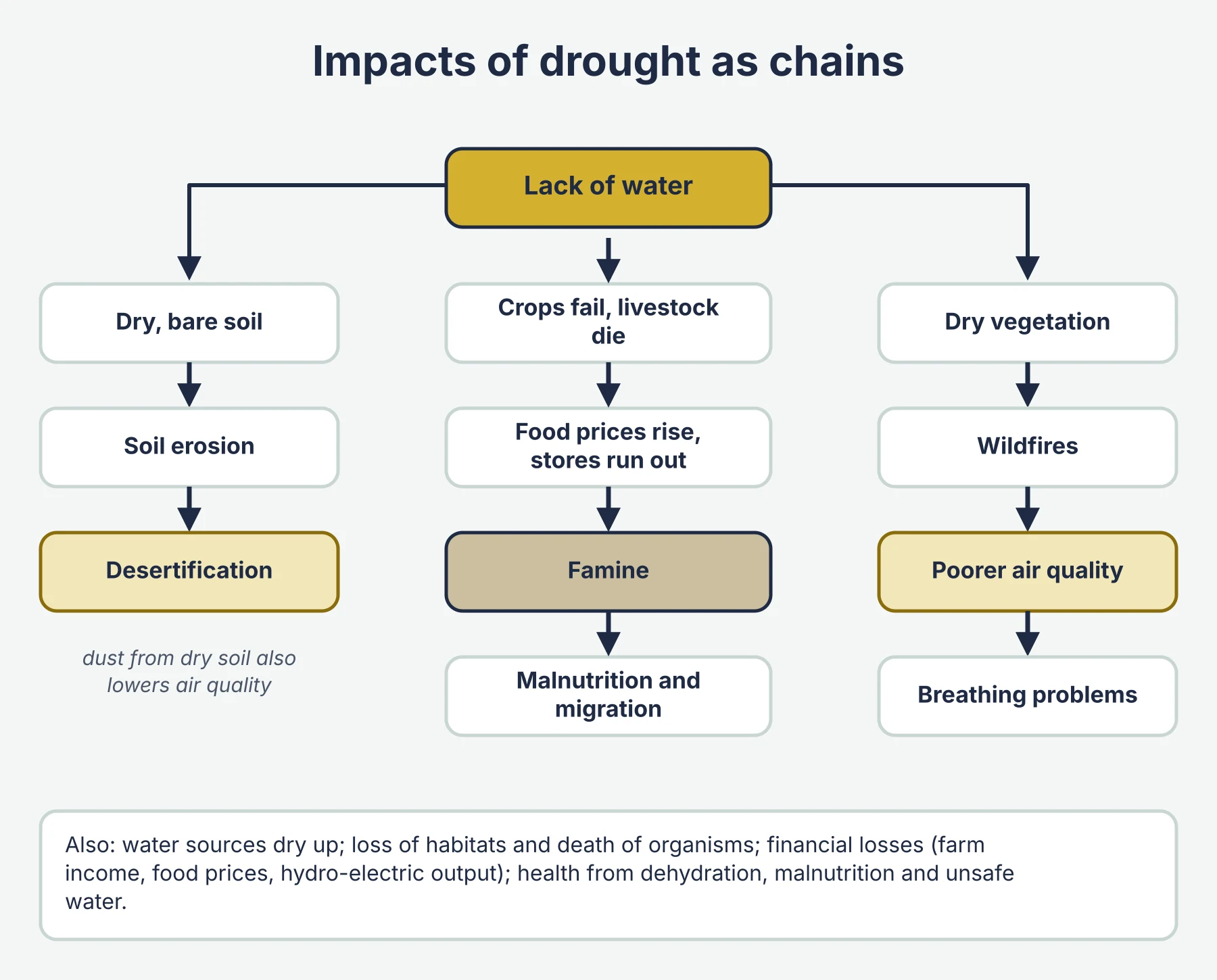
Water sources dry up · loss of crops, livestock and habitats · soil erosion · desertification · death of organisms · famine · increased risk of wildfires · decrease in air quality · financial losses · human health.
Chains:
- Lack of rain → crops fail → food stores run out, prices rise → famine → malnutrition, migration.
- Dry soil → loses structure → blown away by wind → erosion → desertification.
- Dry vegetation → wildfires → smoke → decrease in air quality → breathing problems.
Strategies (6.4.4): five, one with four parts
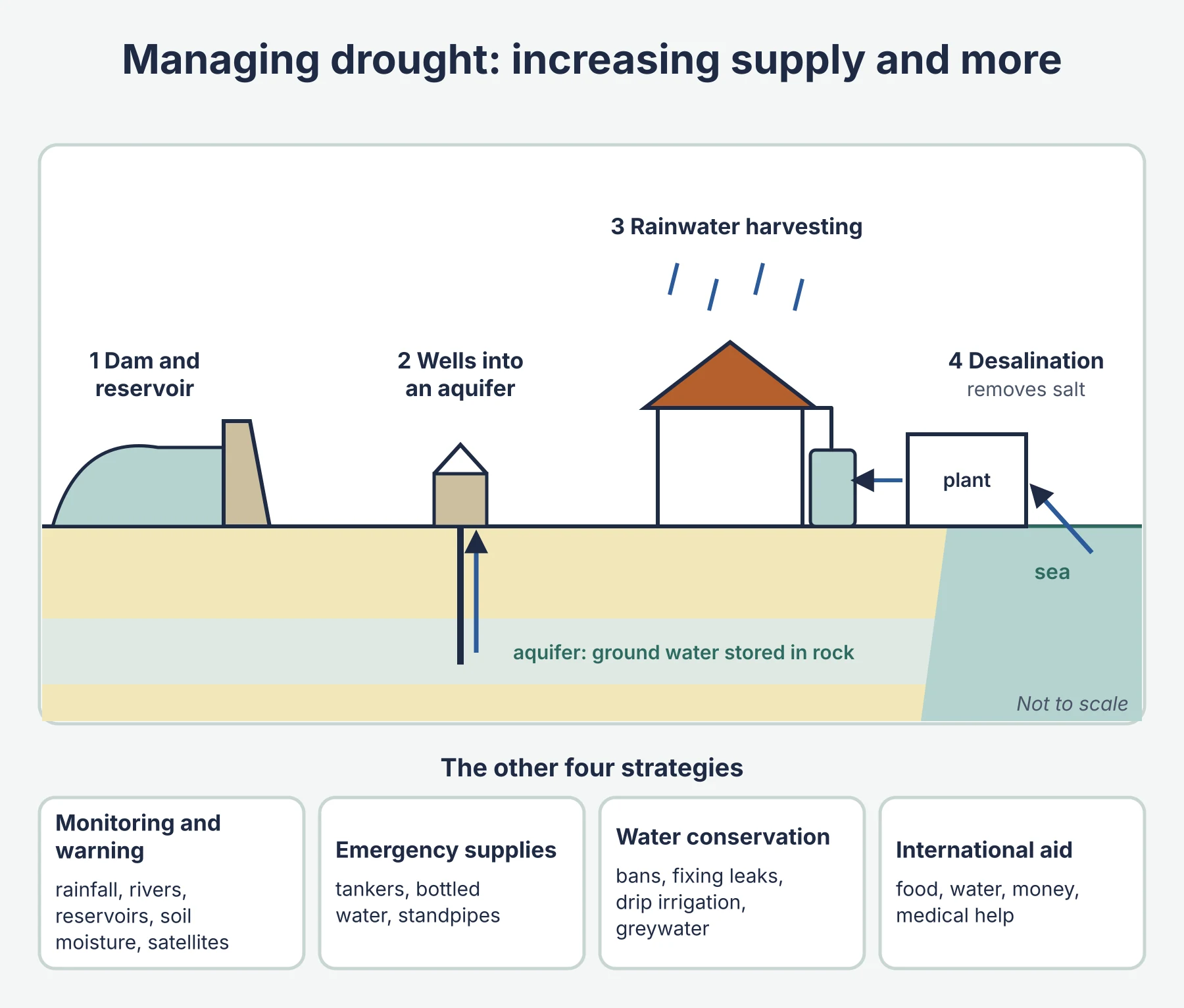
- Monitoring and warning: rainfall, river and reservoir levels, soil moisture, satellite images of vegetation.
- Emergency water supplies: tankers, bottled water, standpipes.
- Water conservation: restrictions, fixing leaks, drip irrigation, low-flush toilets, greywater reuse, less thirsty crops.
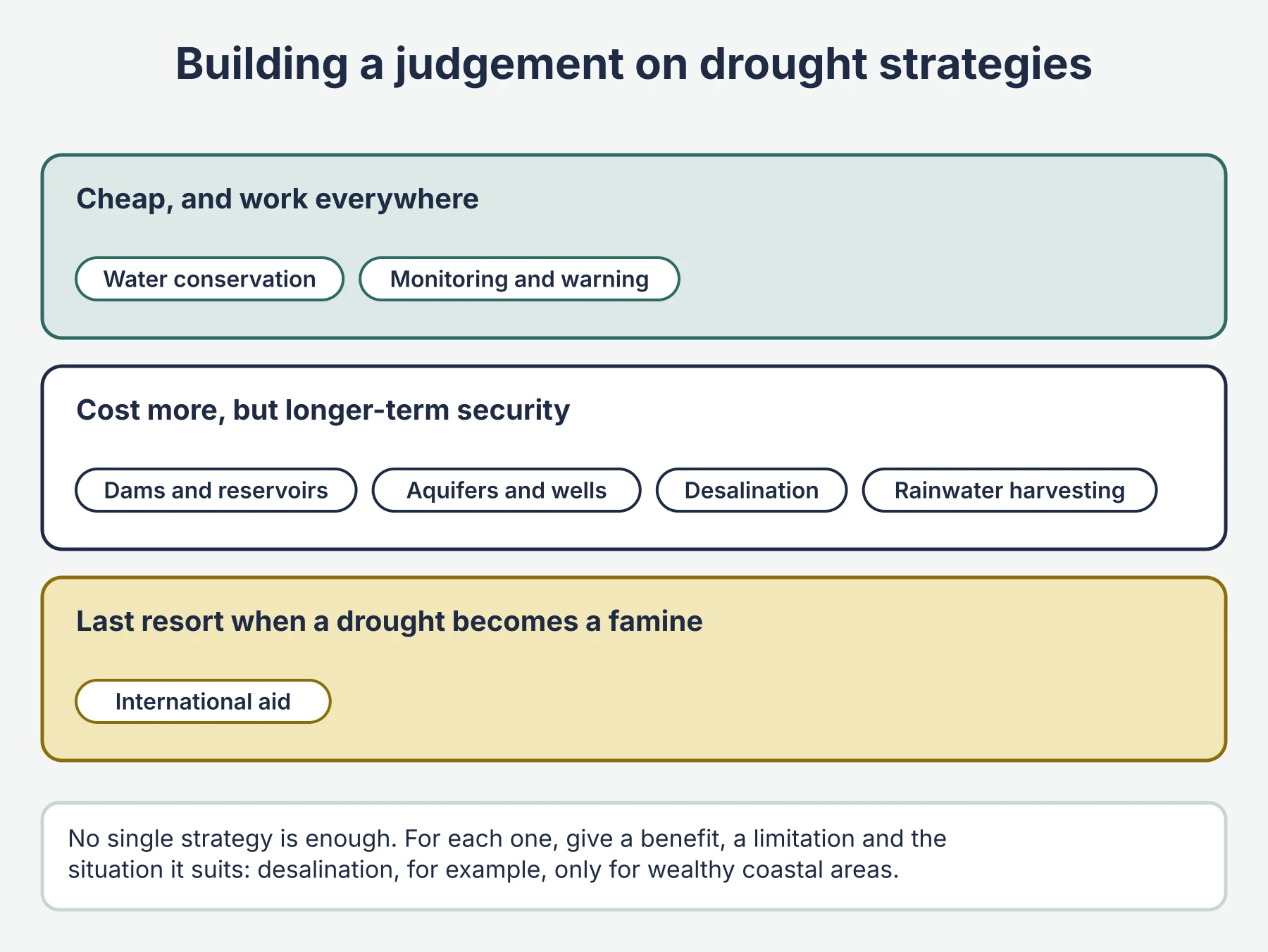
- Increasing water supply: dams and reservoirs · aquifers and wells · desalination · rainwater harvesting.
- International aid: food, water, money, medical help.
Benefit and limitation pairs (6.4.5)
| Strategy | Benefit | Limitation |
|---|---|---|
| Monitoring and warning | Long lead time | Does not create water |
| Emergency supplies | Fast life-saving | Costly, short-term, remote access |
| Conservation | Cheap; stretches supply | Needs behaviour change |
| Dams and reservoirs | Big stores; irrigation, power | Cost, flooded land, evaporation |
| Aquifers and wells | Protected from evaporation | Over-pumping; water table falls; sea water seeps in near coasts |
| Desalination | Independent of rain | Energy, cost, brine waste, coastal only |
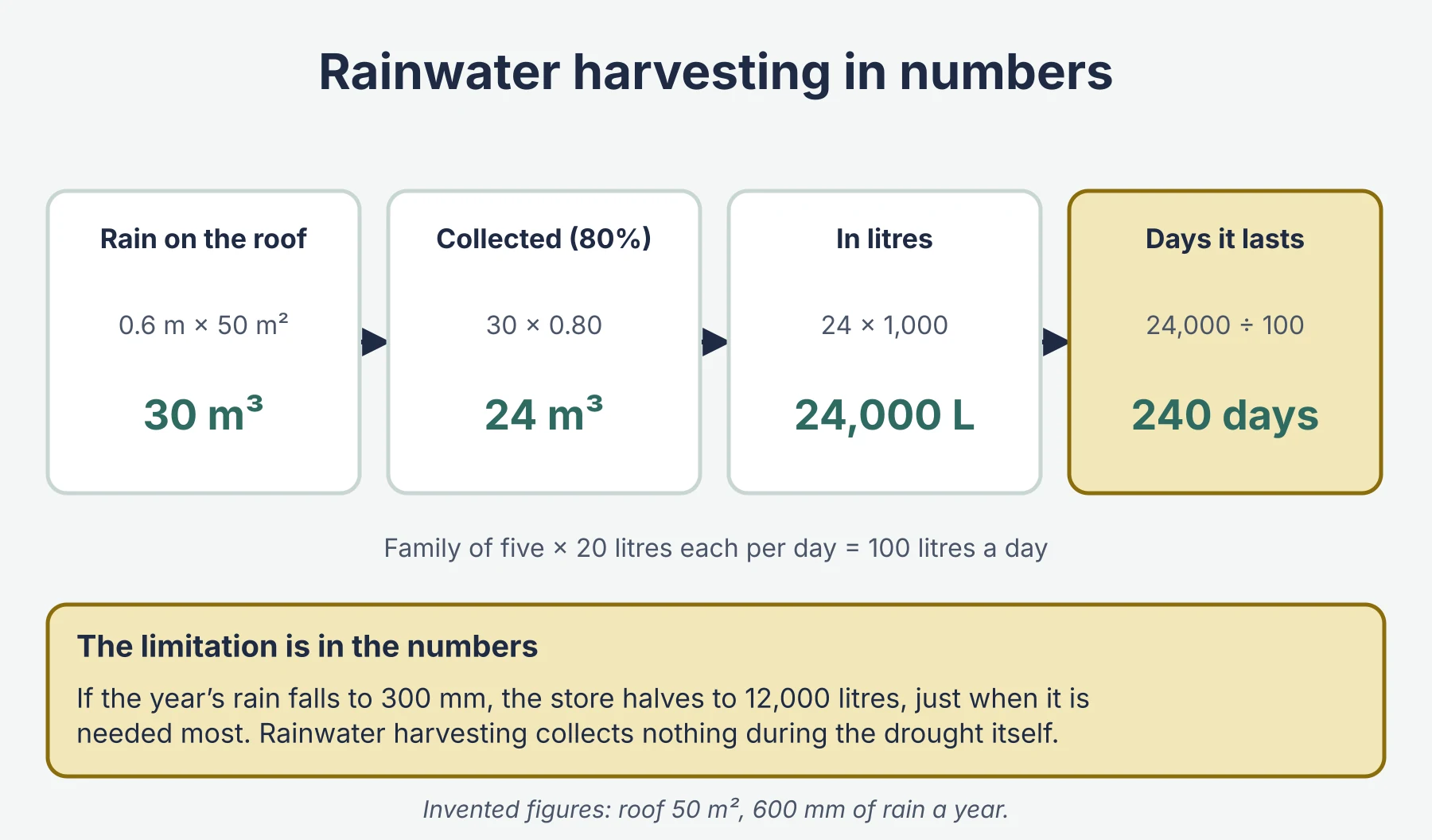
| Rainwater harvesting | Cheap, local | Nothing collected during drought |
| International aid | Food and water when all else fails | Late, dependency |
Key terms
| Term | Meaning |
|---|---|
| Drought | Dry weather longer or more severe than normal |
| Evaporation | Liquid water turning to water vapour |
| Transpiration | Water vapour lost from plant leaves |
| Aquifer | Underground rock that stores water |
| Water table | Upper level of saturated ground |
| Desalination | Removing salt from sea water |
| Brine | Very salty waste water from desalination |
| Rainwater harvesting | Collecting and storing rain from roofs and surfaces |
| Famine | Widespread severe food shortage causing hunger and death |
| Desertification | Dry land degrading to desert-like conditions |
| Greywater | Used water from sinks and showers that can be reused |
Quick calculations
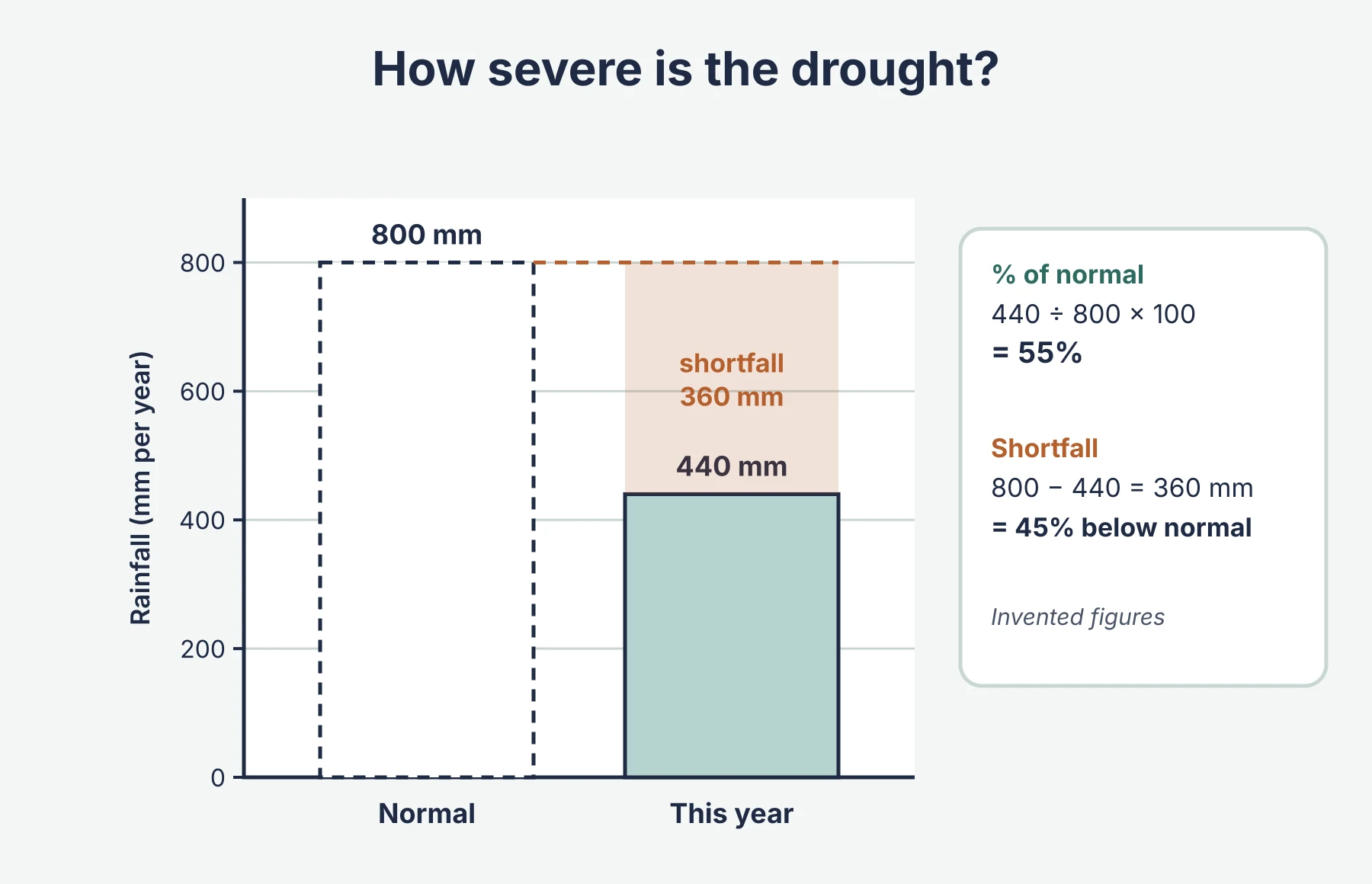
- Percentage of normal rainfall = actual ÷ normal × 100. Example: 300 mm in a place that usually gets 500 mm = 60% of normal, 40% below.
- Rainwater harvested = rainfall (m) × roof area (m²) × fraction collected; 1 m³ = 1,000 litres.
Exam traps
- “No rain at all” as the definition.
- Deforestation or overgrazing given as the cause, rather than as things that worsen impacts.
- Forgetting the four named parts of increasing water supply.
- Rainwater harvesting presented as a drought solution without its limitation.
- Desalination recommended for an inland or low-income area without discussing cost and access.
- Treating famine as the same as drought.
Self-test
- State the syllabus definition of a drought.
- Why can a rainforest region experience drought?
- Name the two syllabus causes of drought.
- How do higher global temperatures make drought worse?
- Explain how drought can lead to desertification.
- Why does drought increase the risk of wildfires?
- Give two ways of conserving water in a drought.
- Name the four ways of increasing water supply in the syllabus.
- Give one limitation of using aquifers and wells.
- Give one benefit and one limitation of desalination.
- Why is monitoring especially useful for drought?
- A town normally receives 900 mm a year but receives 360 mm. What percentage of normal is this?
Answers: 1. A period of dry weather that is longer or more severe than normal. 2. Drought is measured against the normal for that place, so rainfall well below its usual high amount counts. 3. Lack of rain; climate change. 4. More evaporation and transpiration, so soil and water stores dry faster. 5. Dry, bare soil is eroded by wind and water until the land degrades to desert-like conditions. 6. Dry vegetation ignites easily and fires spread fast. 7. Any two: hosepipe bans; fixing leaks; drip irrigation; low-flush toilets; greywater reuse. 8. Dams and reservoirs; aquifers and wells; desalination; rainwater harvesting. 9. Over-pumping lowers the water table so wells dry up (or sea water seeps in near coasts). 10. Supply independent of rainfall; high energy cost or brine waste. 11. Drought builds slowly, so warnings can be given well in advance. 12. 360 ÷ 900 × 100 = 40%.
Next step
Test yourself with the Drought practice questions.
Related resources
-
Revision notes
Cambridge IGCSE Environmental Management: Land — Revision Notes
Recall notes on soils and crop growth, food production and soil erosion for Topic 2 Land of Cambridge IGCSE Environmental Management 0680, 2027-2029 series.
Environmental Management · Cambridge · IGCSE
Revise topic -
Study guides
Cambridge IGCSE Environmental Management (0680): Earthquakes and volcanoes
Earth structure, plate boundaries, hotspots, quake and eruption features, impacts, management and volcanic opportunities for Cambridge IGCSE 0680 sub-topic 6.1.
Environmental Management · Cambridge · IGCSE
Read guide -
Practice questions
Cambridge IGCSE Environmental Management (0680): Earthquakes and volcanoes – Practice Questions
Twelve original questions with answers on plate boundaries, hotspots, quake and eruption features, impacts and management for Cambridge IGCSE 0680 6.1.
Environmental Management · Cambridge · IGCSE
Try questions
Get free revision emails (optional)
Occasional emails with practice questions, worked explanations and links to free resources for the qualification and subjects you choose. No spam, and you can unsubscribe from any email. The free tools on this site never need an email.