
Study Guides
Cambridge IGCSE Environmental Management (0680): Drought
Definition, causes and ten impacts of drought, and five strategies with their benefits and limitations, for Cambridge IGCSE 0680 sub-topic 6.4.
- Subject
- Environmental Management
- Level
- IGCSE
- Topic
- Topic 6: Natural hazards
- Author
- Marlbridge Academic Team
- Updated
- Reviewed by
- Azam Siddique (what this means)
Aligned to Cambridge IGCSE Environmental Management (0680), 2027-2029. Official specification .
Syllabus page (what it covers and how it is assessed): Cambridge IGCSE Environmental Management.
Syllabus points this page covers
0680
- 6.4 Drought
Found an error? Report a correction.
Need help with this topic? Request a free trial class for IGCSE Environmental Management (0680).
Sub-topic 6.4 of Cambridge IGCSE Environmental Management (0680, 2027-2029) has five statements: a definition (6.4.1), causes (6.4.2), impacts (6.4.3), strategies before, during and after a drought (6.4.4) and a discussion of those strategies (6.4.5). Drought differs from the other hazards in Topic 6 because it builds slowly over months or years, has no clear start or end, and affects huge areas. That changes how it is managed. For a comparison with the other hazards, see the Natural hazards study guide.
Definition (6.4.1)
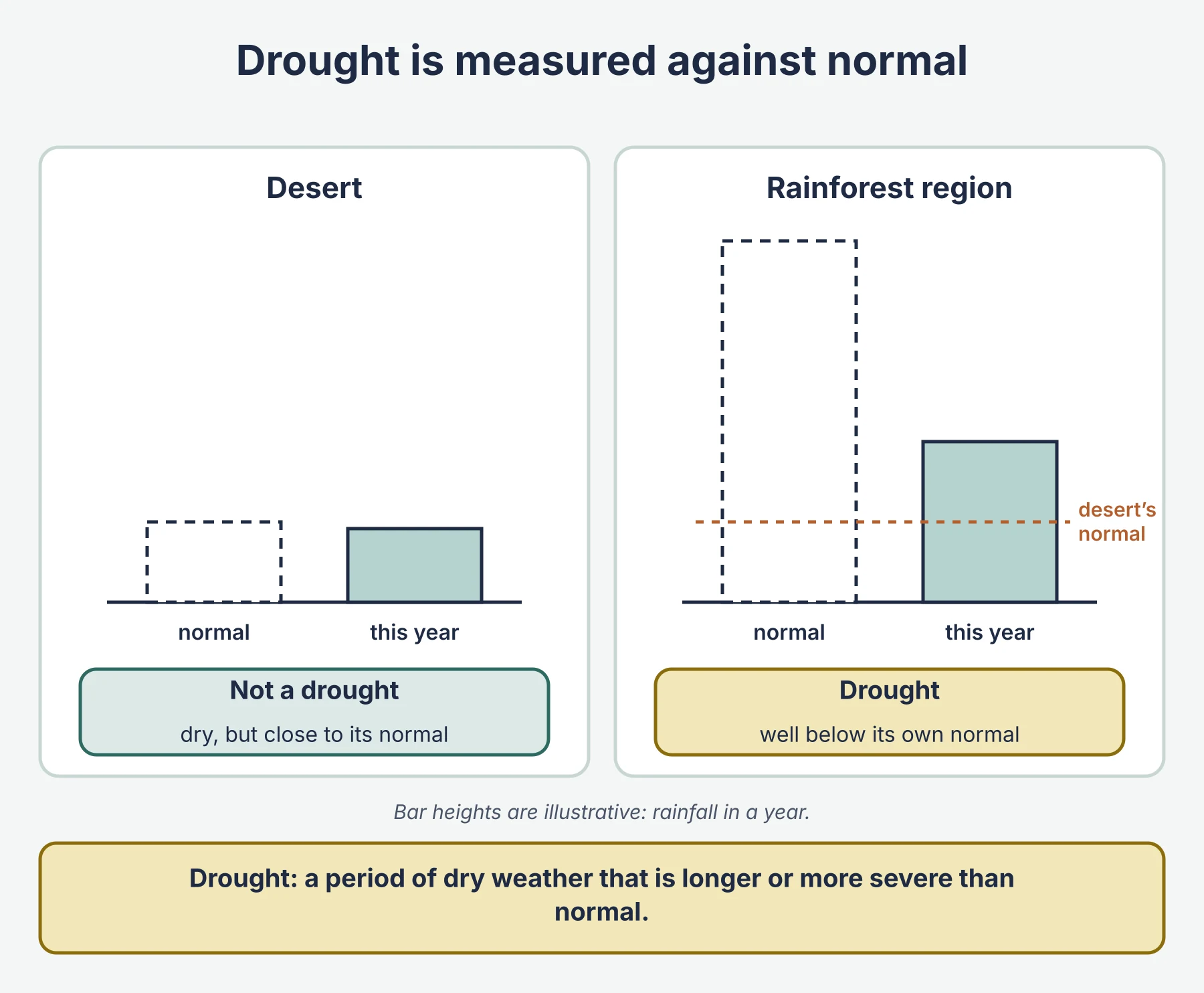
Learn the syllabus wording exactly: a drought is a period of dry weather that is longer or more severe than normal.
Two words matter. “Normal” means drought is measured against what a place usually receives, so a desert is not in drought simply because it is dry; a rainforest region can be in drought with more rain than a desert ever gets. “Longer or more severe” means a drought can be a dry spell that goes on for too long, or one that is unusually intense.
Causes (6.4.2)
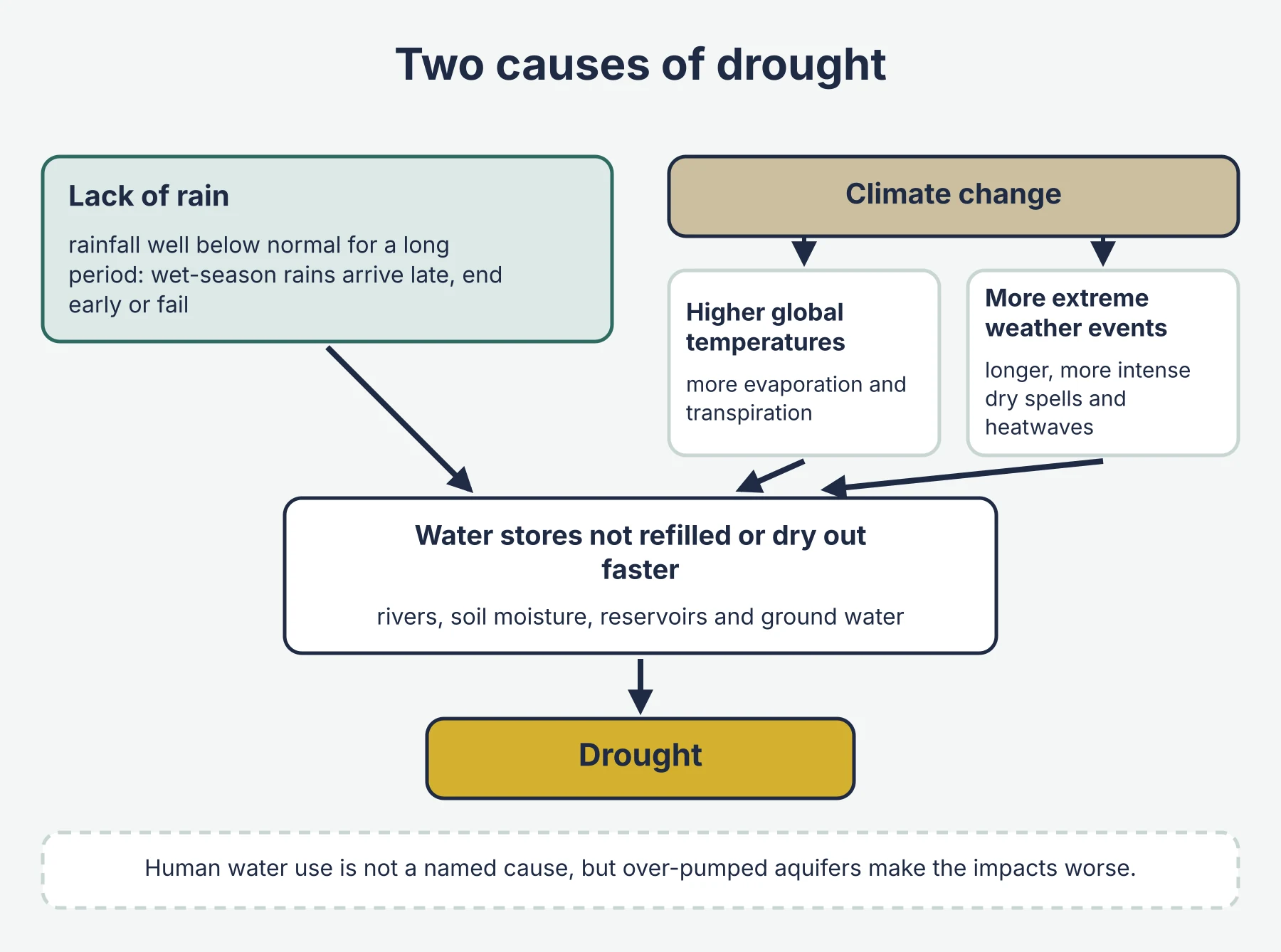
The syllabus limits causes to two.
(a) Lack of rain. Rainfall is well below the normal amount for a long period, for example because the rains of a wet season arrive late, end early or fail. Without rain, rivers, soil moisture, reservoirs and ground water are not replenished.
(b) Climate change. Two effects are named:
- Increase in global temperatures. Warmer air increases evaporation from soil, rivers and reservoirs and transpiration from plants, so water stores dry out faster even if rainfall stays the same.
- Increase in extreme weather events. Climate change is expected to make long dry spells and heatwaves more frequent and more intense in some regions.
Human water use is not a named cause, but it can make the impacts of a drought worse, for example when aquifers are already over-pumped.
Impacts on people and the environment (6.4.3)
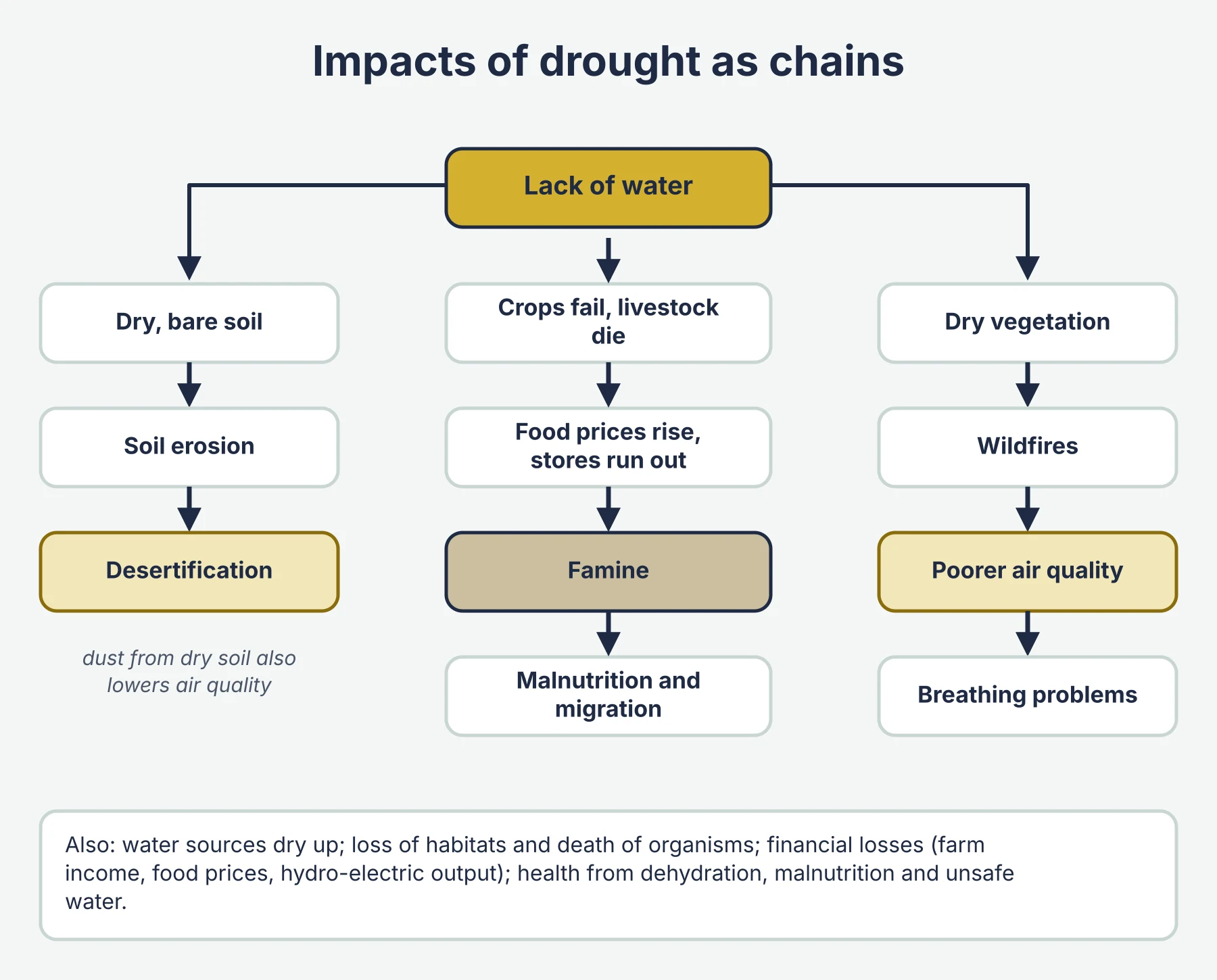
The syllabus lists ten. Several form chains, so explain the links.
- Water sources dry up: rivers, lakes, wells and reservoirs fall or empty.
- Loss of crops, livestock and habitats: crops wilt and fail; animals die of thirst or hunger; wetlands shrink.
- Soil erosion: dry, bare soil loses structure and is blown away by wind or washed away when rain returns.
- Desertification: repeated drought and erosion degrade dry land until it becomes desert-like.
- Death of organisms: plants, fish in drying rivers, and wild animals die.
- Famine: when harvests fail over a wide area and food cannot be bought or brought in, people starve.
- Increased risk of wildfires: dry vegetation ignites easily and fires spread quickly.
- Decrease in air quality: dust from dry soil and smoke from wildfires pollute the air.
- Financial losses: farmers lose income, food prices rise, hydro-electric output falls and businesses that depend on water suffer.
- Human health: dehydration, malnutrition, breathing problems from dust and smoke, and disease when people use unsafe water.
A useful chain: lack of rain → crops fail → food prices rise and stores run out → famine → malnutrition and migration.
Managing the impacts (6.4.4)
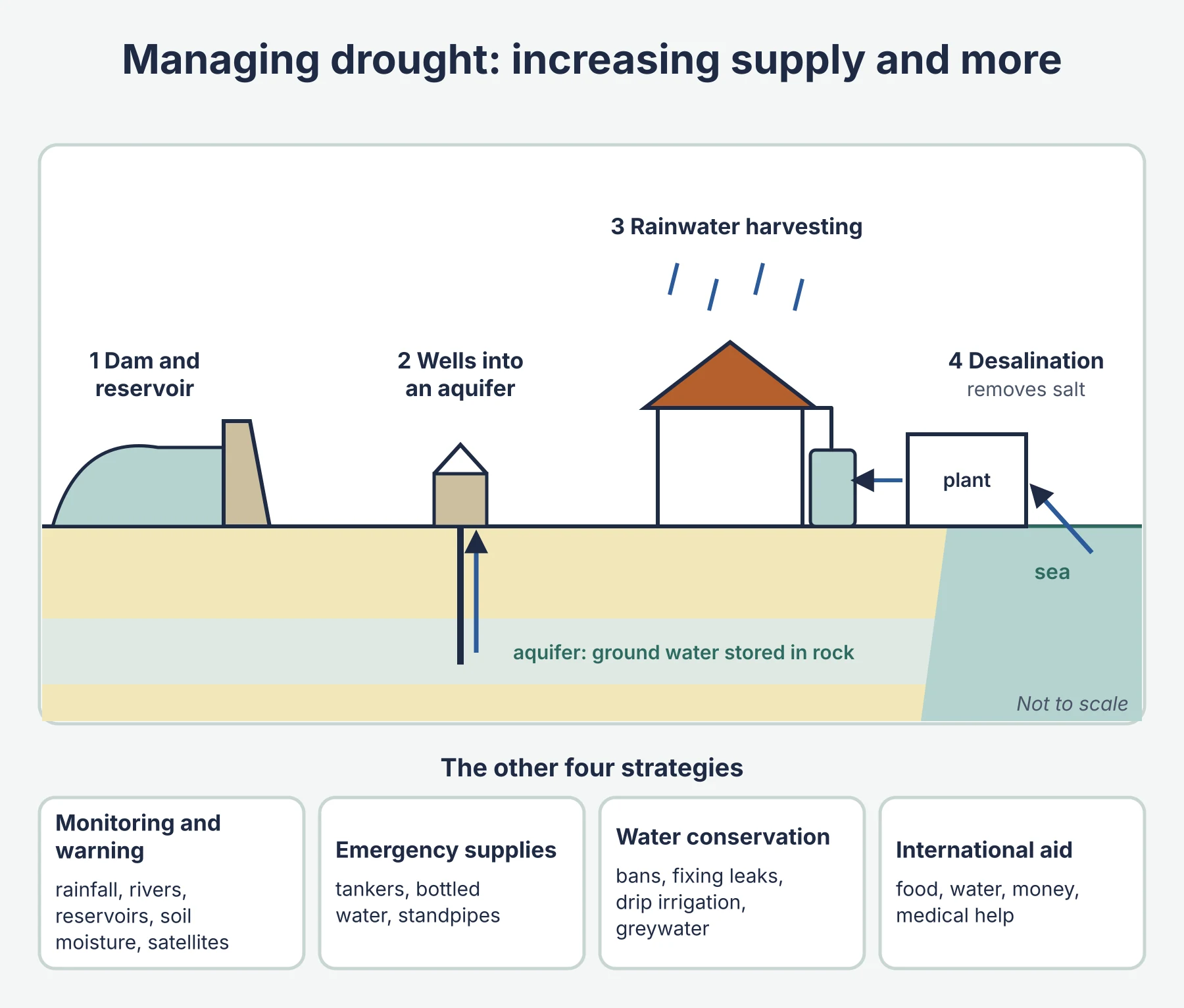
The syllabus names five strategies. Note that the fourth one has four parts.
(a) Monitoring and warning. Measuring rainfall, river and reservoir levels, soil moisture and the condition of vegetation (for example from satellite images) and comparing them with normal values. Because drought builds slowly, warnings can be given weeks or months ahead.
(b) Emergency water supplies. Water delivered by tanker, bottled water, or temporary standpipes when normal supplies fail.
(c) Water conservation. Using less water: restrictions such as hosepipe bans, fixing leaking pipes, drip irrigation, low-flush toilets, reusing greywater, and growing crops that need less water.
(d) Increasing water supply.
- Dams and reservoirs store water from wet seasons for use in dry ones.
- Use of aquifers and wells draws on ground water stored underground.
- Desalination removes salt from sea water to make fresh water.
- Rainwater harvesting collects rain from roofs and other surfaces into tanks.
(e) International aid. Food, water, money and medical help from other countries and organisations.
Discussing the strategies (6.4.5)
| Strategy | Benefit | Limitation |
|---|---|---|
| Monitoring and warning | Slow onset means long warning; time to conserve water and store food | Warning does not create water; poor communities may lack the means to act on it |
| Emergency water supplies | Saves lives quickly | Expensive; short-term only; hard to reach remote villages |
| Water conservation | Cheap; makes existing water last longer | Depends on people changing habits; restrictions are unpopular |
| Dams and reservoirs | Large stores for dry seasons; can also supply hydro-electric power and irrigation | Costly; flood land and habitats; lose water by evaporation; may run low in a long drought |
| Aquifers and wells | Ground water is protected from evaporation and often lasts through drought | Over-pumping lowers the water table so wells dry up; near coasts, sea water can seep in |
| Desalination | Unlimited sea water; does not depend on rainfall | Very high energy use and cost; salty brine waste can harm marine life; only for coastal areas |
| Rainwater harvesting | Cheap and simple; suits homes and villages | Collects nothing during the drought itself; tanks hold limited amounts |
| International aid | Food and water when local resources are exhausted | May arrive late, after famine begins; can create dependency |
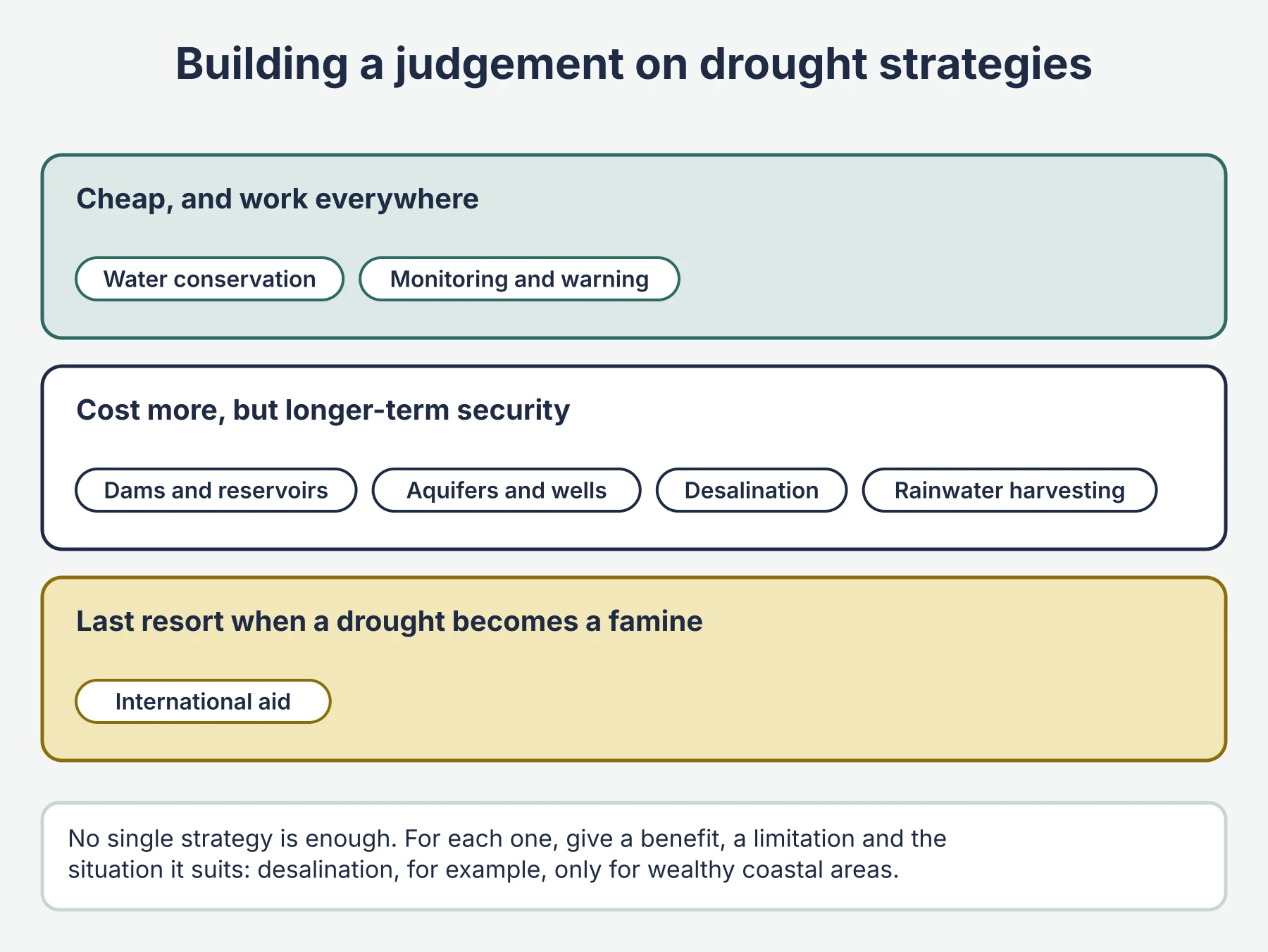
A good judgement: no single strategy is enough. Conservation and monitoring are cheap and work everywhere; increasing supply costs more but gives longer-term security; aid is a last resort when a drought becomes a famine.
Worked example 1: how severe is the drought?
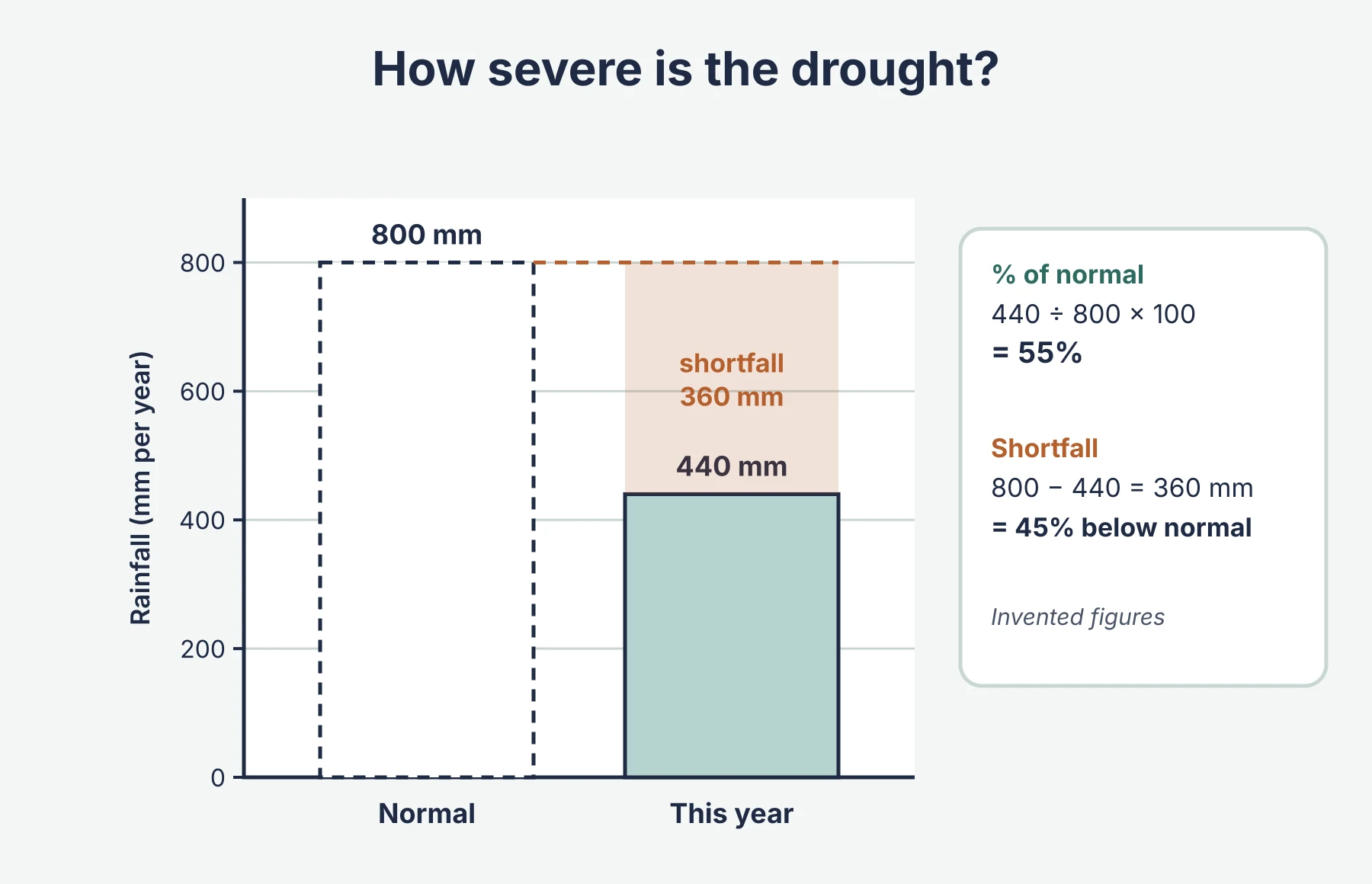
The figures are invented. A region normally receives 800 mm of rain a year. This year it received 440 mm.
- Percentage of normal = 440 ÷ 800 × 100 = 55%.
- Shortfall = 800 − 440 = 360 mm, which is 45% below normal.
Because the definition compares with normal, this is how a drought’s severity is described.
Worked example 2: rainwater harvesting
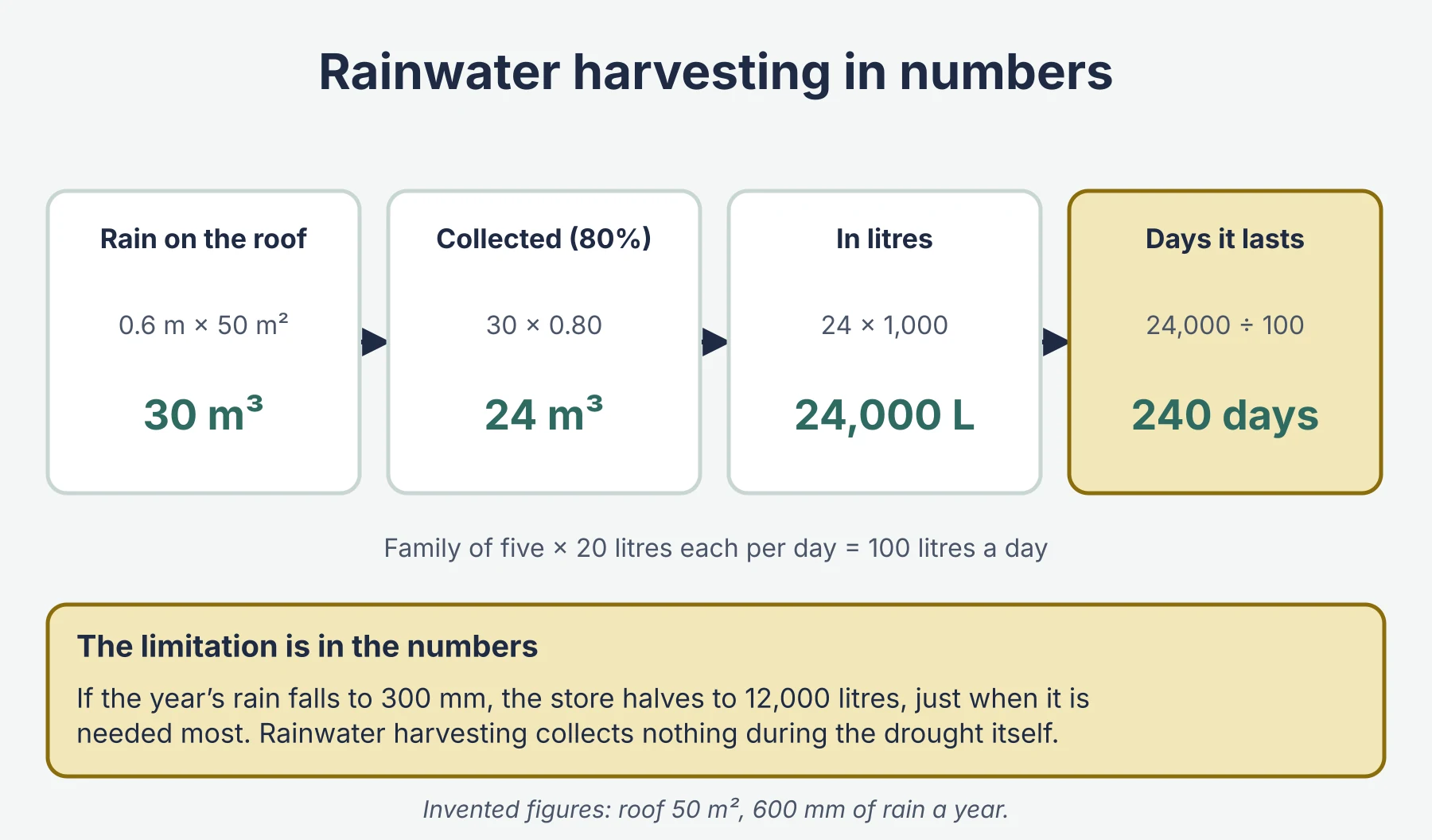
The figures are invented. A house has a roof area of 50 m², the area receives 600 mm of rain a year, and 80% can be collected.
- Rain on the roof = 0.6 m × 50 m² = 30 m³.
- Collected = 30 × 0.80 = 24 m³ = 24,000 litres (1 m³ = 1,000 litres).
- A family of five using 20 litres each per day uses 100 litres a day, so the store lasts 24,000 ÷ 100 = 240 days.
The limitation follows from the numbers: if the year’s rain falls to 300 mm, the store halves to 12,000 litres, just when it is needed most.
Common mistakes
- Defining drought as “no rain” or “a hot, dry place”; it is longer or more severe than normal.
- Giving deforestation or overgrazing as causes; they worsen the impacts but the syllabus causes are lack of rain and climate change.
- Treating famine as automatic; it happens when food cannot be grown, bought or brought in.
- Listing “build a dam” with no limitation, such as evaporation or cost.
- Forgetting that rainwater harvesting collects nothing during the drought itself.
Exam technique
- Define: give the syllabus wording.
- Explain an impact: show the chain from lack of water to the effect.
- Discuss: give a benefit and a limitation for each strategy and say which situations each suits, for example desalination only for wealthy coastal areas.
- Calculate: show units, and convert cubic metres to litres when asked.
Condense this with the Drought revision notes, then practise with the Drought practice questions.
Related resources
-
Revision notes
Cambridge IGCSE Environmental Management: Land — Revision Notes
Recall notes on soils and crop growth, food production and soil erosion for Topic 2 Land of Cambridge IGCSE Environmental Management 0680, 2027-2029 series.
Environmental Management · Cambridge · IGCSE
Revise topic -
Practice questions
Cambridge IGCSE Environmental Management (0680): Drought – Practice Questions
Twelve original questions with mark-scheme answers on the definition, causes, impacts and management of drought for Cambridge IGCSE 0680 sub-topic 6.4.
Environmental Management · Cambridge · IGCSE
Try questions -
Revision notes
Cambridge IGCSE Environmental Management (0680): Drought – Revision Notes
Recall notes for Cambridge IGCSE 0680 sub-topic 6.4: the drought definition, two causes, ten impacts, five strategies and their trade-offs, and a self-test.
Environmental Management · Cambridge · IGCSE
Revise topic
Get free revision emails (optional)
Occasional emails with practice questions, worked explanations and links to free resources for the qualification and subjects you choose. No spam, and you can unsubscribe from any email. The free tools on this site never need an email.