
Study Guides
Cambridge IGCSE Environmental Management (0680): Ecosystems
Ecosystem components, biotic interactions, pollination, photosynthesis, respiration, energy flow, pyramids and the carbon cycle for Cambridge IGCSE 0680.
- Subject
- Environmental Management
- Level
- IGCSE
- Topic
- Topic 5: Ecosystems, biodiversity and fieldwork
- Author
- Marlbridge Academic Team
- Updated
- Reviewed by
- Azam Siddique (what this means)
Aligned to Cambridge IGCSE Environmental Management (0680), 2027-2029. Official specification .
Syllabus page (what it covers and how it is assessed): Cambridge IGCSE Environmental Management.
Syllabus points this page covers
0680
- 5.1 Ecosystems
Found an error? Report a correction.
Need help with this topic? Request a free trial class for IGCSE Environmental Management (0680).
Sub-topic 5.1 of Cambridge IGCSE Environmental Management (0680) is the foundation of Topic 5. It has nine syllabus points: ecosystem components, biotic and abiotic components, biotic interactions, pollination, photosynthesis, energy flow, ecological pyramids, aerobic respiration and the carbon cycle. The Ecosystems, biodiversity and fieldwork study guide gives an overview of the whole topic; this page goes further into each point, with an emphasis on applying terms to unfamiliar ecosystems and interpreting pyramids.
Components of an ecosystem (5.1.1)
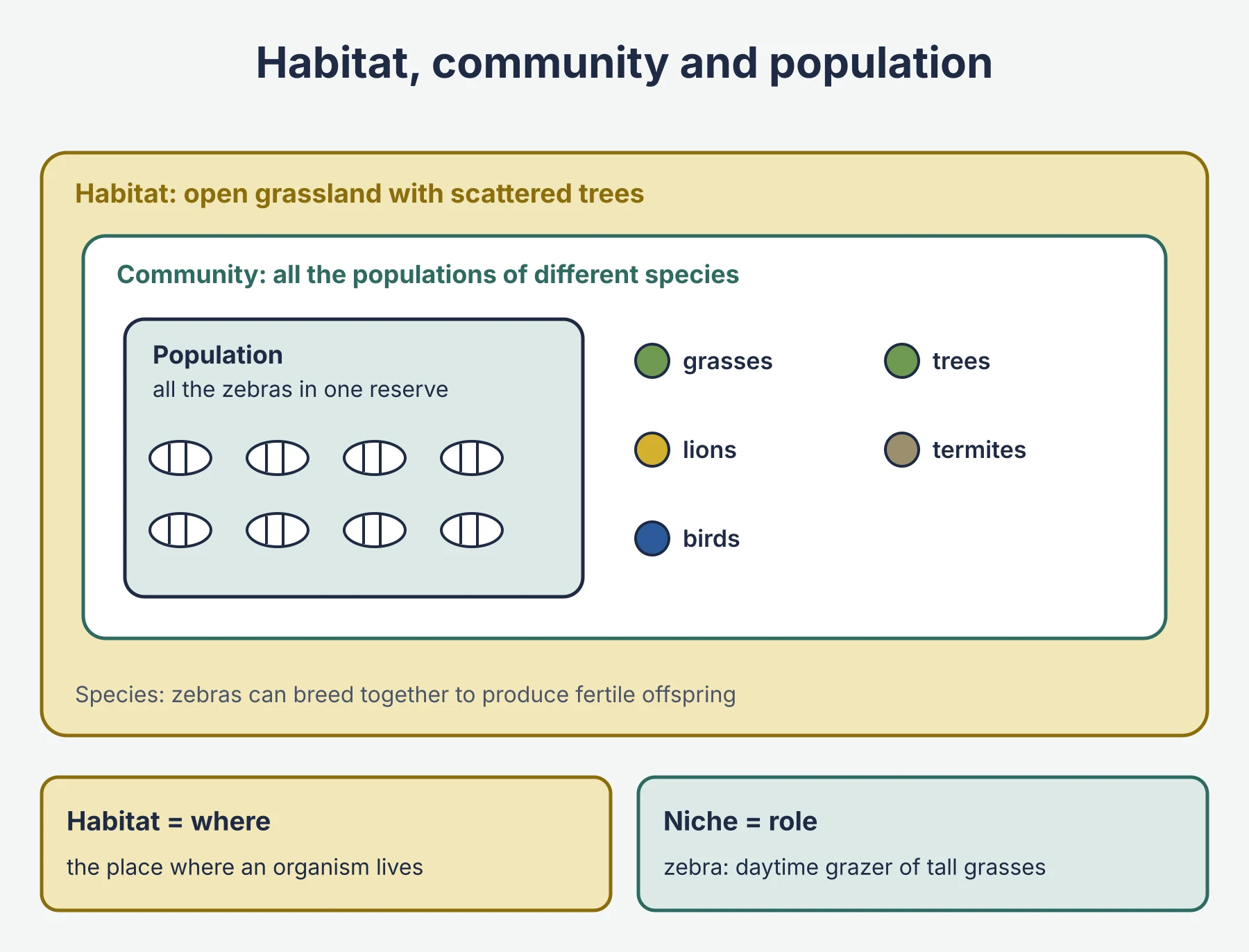
The syllabus lists eight terms. A useful way to fix them is to apply them to one example, here a savannah grassland.
| Term | Meaning | Savannah example |
|---|---|---|
| Habitat | The place where an organism lives | Open grassland with scattered trees |
| Species | A group of organisms that can breed together to produce fertile offspring | Zebras |
| Population | All the organisms of one species living in an area at the same time | All the zebras in one reserve |
| Community | All the populations of different species living in an area | Grasses, trees, zebras, lions, termites, birds |
| Niche | The role of a species in its ecosystem, including what it eats and where and when it feeds | Zebra: daytime grazer of tall grasses |
| Prey | An animal that is hunted and eaten | Zebra |
| Predator | An animal that hunts and eats other animals | Lion, hyena |
| Apex predator | A predator at the top of a food chain with no natural predators of its own | Lion |
Exam questions often give a short description of an ecosystem you have not studied and ask you to identify a population or a niche from it. Practise by applying the table to a pond, a coral reef or a rainforest.
Biotic and abiotic components (5.1.2)
- Biotic (living): producers, primary consumers, secondary consumers, tertiary consumers and decomposers.
- Abiotic (non-living): temperature, water, oxygen, carbon dioxide, salinity, light, pH.
Abiotic factors limit where species can live. Salinity controls which plants grow in an estuary; light controls how deep seaweeds grow; pH controls which invertebrates survive in a stream. When a question asks you to explain a distribution, link one abiotic factor to one biological need, such as light for photosynthesis.
Biotic interactions (5.1.3)
- Native and invasive species: a native species occurs naturally in an area; an invasive species has been introduced, spreads rapidly and harms native species, often because it has no natural predators there.
- Competition: organisms struggle for the same limited resource, such as food, light, water, space or mates. It can be between members of the same species or between different species.
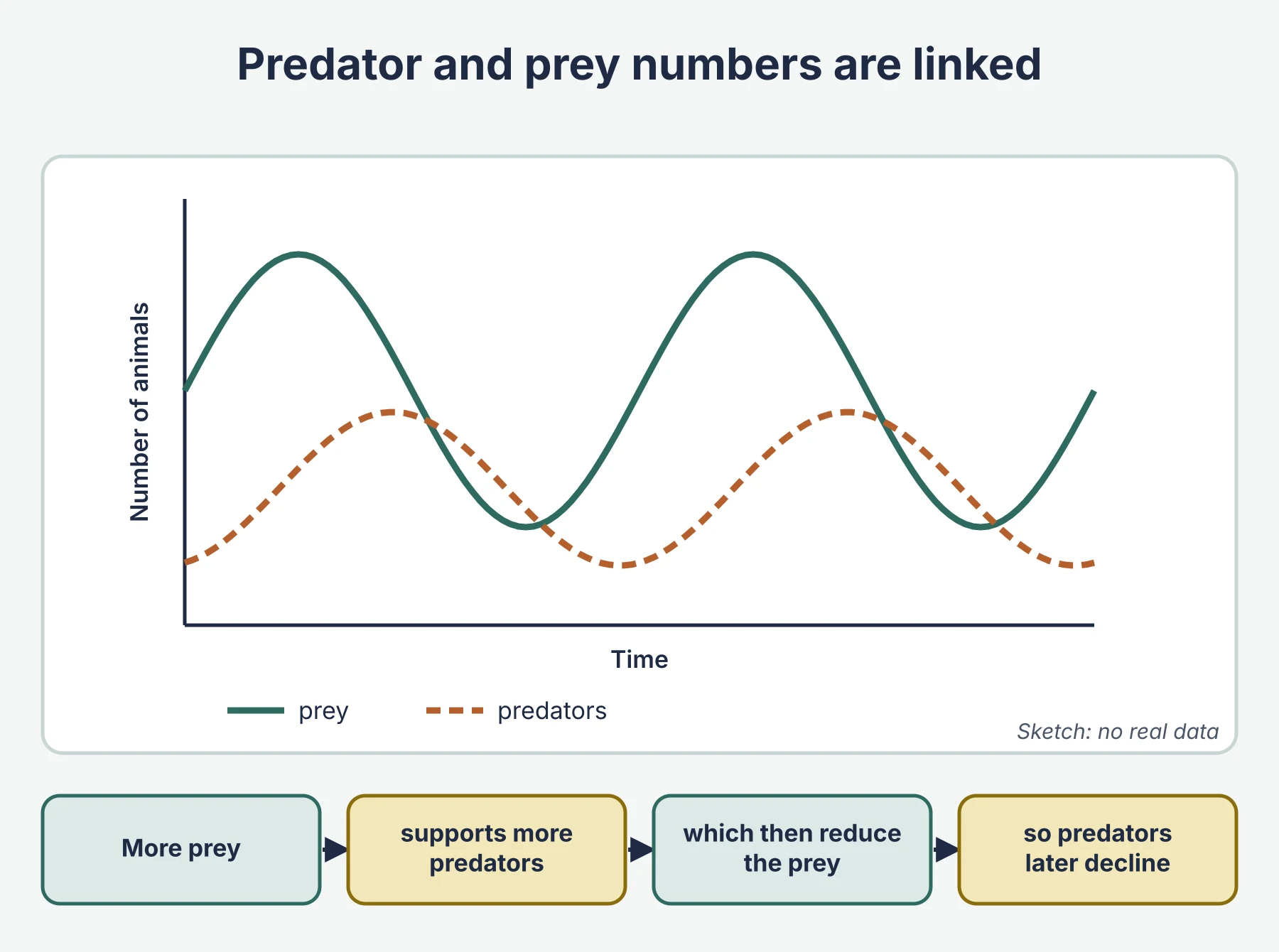
- Predation: one animal hunts and eats another. Predator and prey numbers are linked: more prey supports more predators, which then reduce prey, so predators later decline.
- Pollination: the interaction between plants and animal pollinators, described below.
Pollination (5.1.4)
Pollination is the transfer of pollen from an anther to a stigma. Knowledge of the structure and naming of other flower parts is not required.
- Insect pollination: an insect pollinator such as a bee visits a flower for nectar, picks up pollen on its body and carries it to the stigma of another flower. These flowers tend to be brightly coloured and scented.
- Wind pollination: pollen is light and produced in large amounts, and is blown by the wind to a stigma. Grasses are common examples.
Pollination leads to fertilisation, followed by seed and fruit formation. This is why pollinator decline matters to food production: many crops need pollinators to produce fruit and seeds.
Photosynthesis (5.1.5)
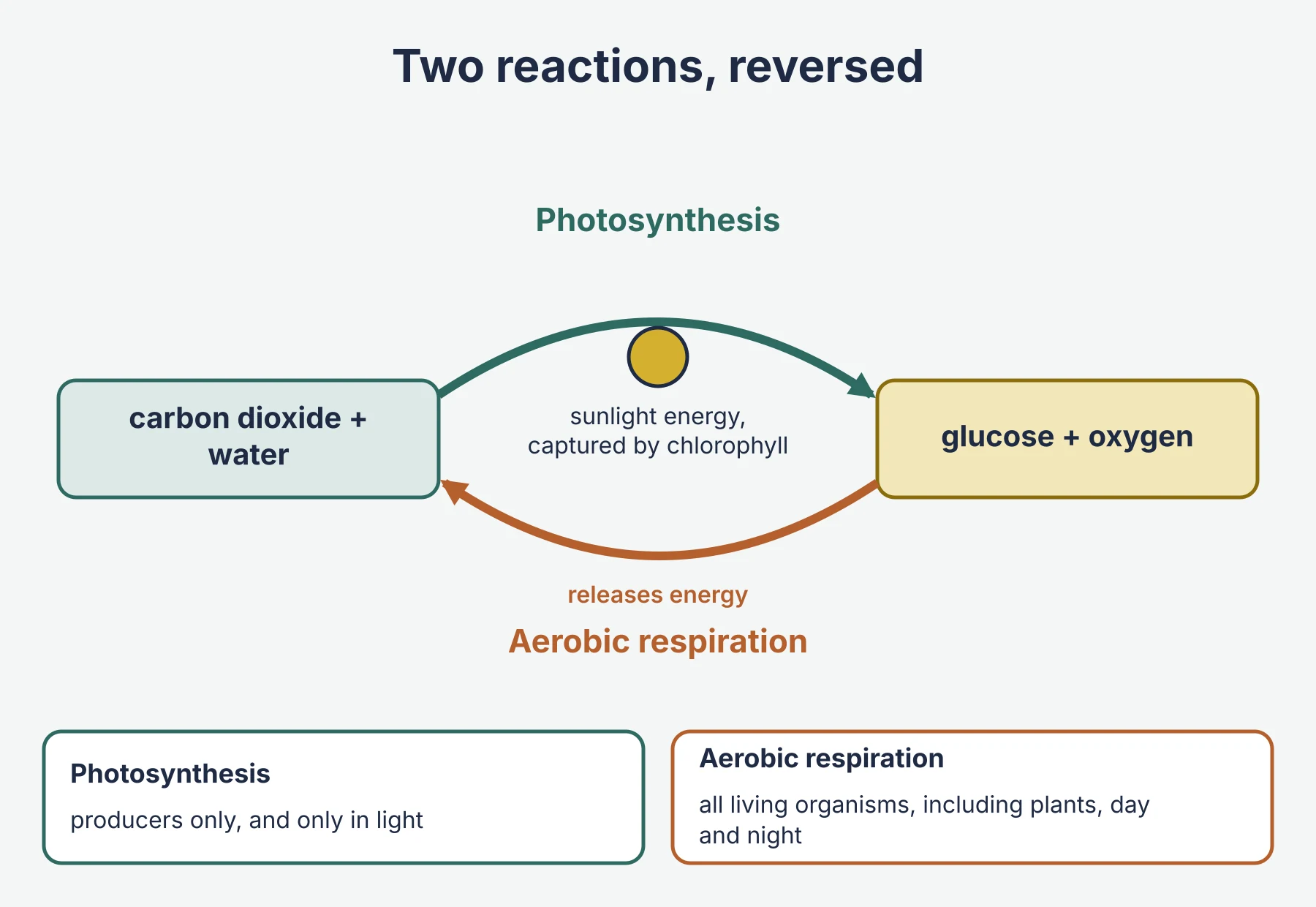
Photosynthesis is the synthesis of glucose using carbon dioxide and water, with sunlight as the source of energy. Chlorophyll, the green pigment in leaves, captures light energy.
Word equation: carbon dioxide + water → glucose + oxygen
Producers make all the food energy available to an ecosystem, so anything that reduces photosynthesis, such as shading, drought or loss of leaves, reduces the energy available to every consumer.
Aerobic respiration (5.1.8)
Aerobic respiration is the breakdown of glucose in the presence of oxygen to release energy, with carbon dioxide and water as waste products.
Word equation: glucose + oxygen → carbon dioxide + water
It is the reverse of photosynthesis in terms of reactants and products. All living organisms respire, including plants, day and night; photosynthesis happens only in light.
Energy flow (5.1.6)
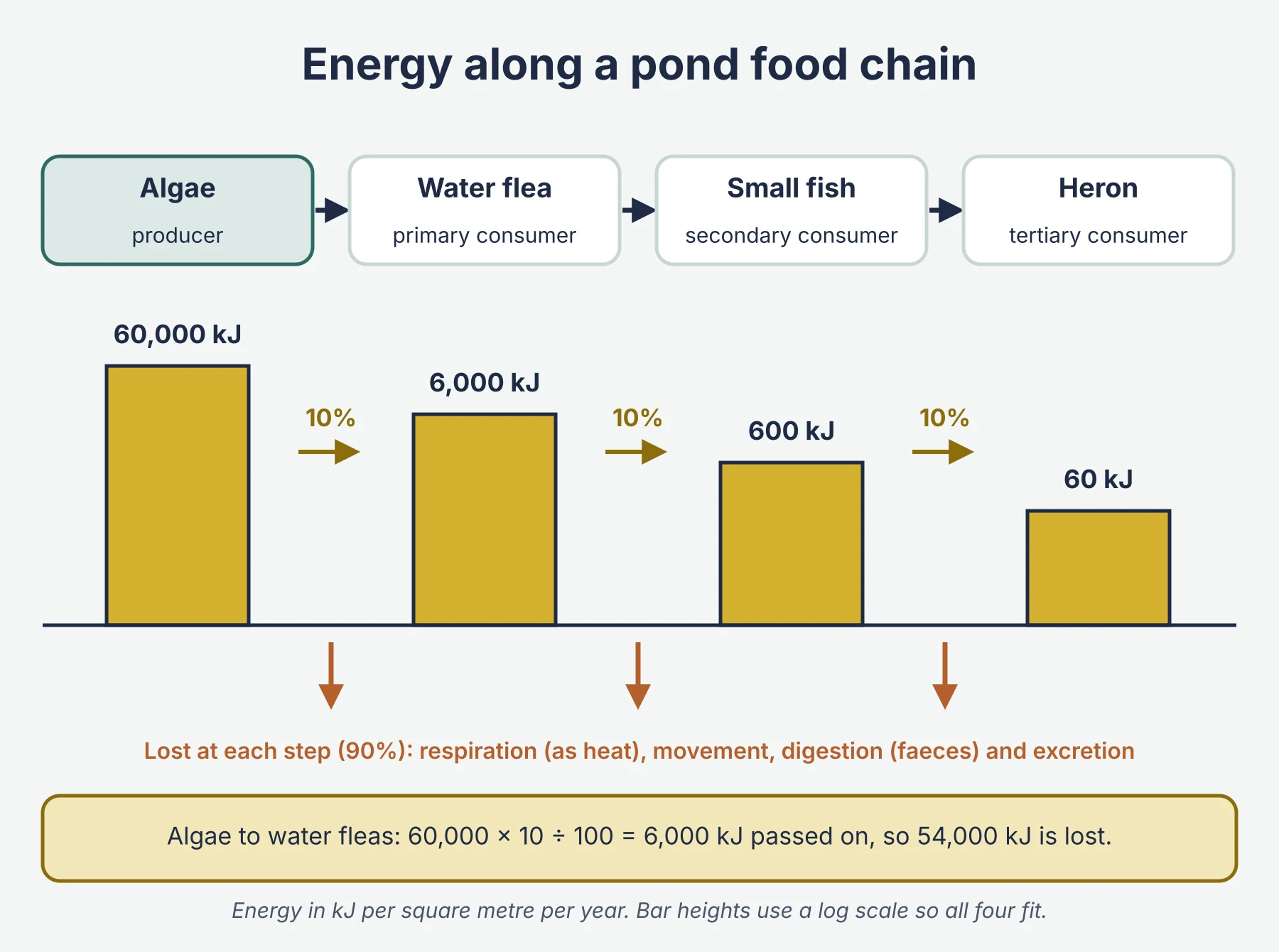
Energy enters as sunlight, is captured by producers, and passes along food chains through trophic levels: producer, primary consumer, secondary consumer, tertiary consumer. The syllabus figure is that 10% of energy is passed between trophic levels. The rest is lost during life processes: movement, respiration, digestion and excretion. Respiration releases energy that ends up as heat; undigested food leaves as faeces; excretion removes waste such as urine.
Ecological pyramids (5.1.7)
Pyramid of numbers
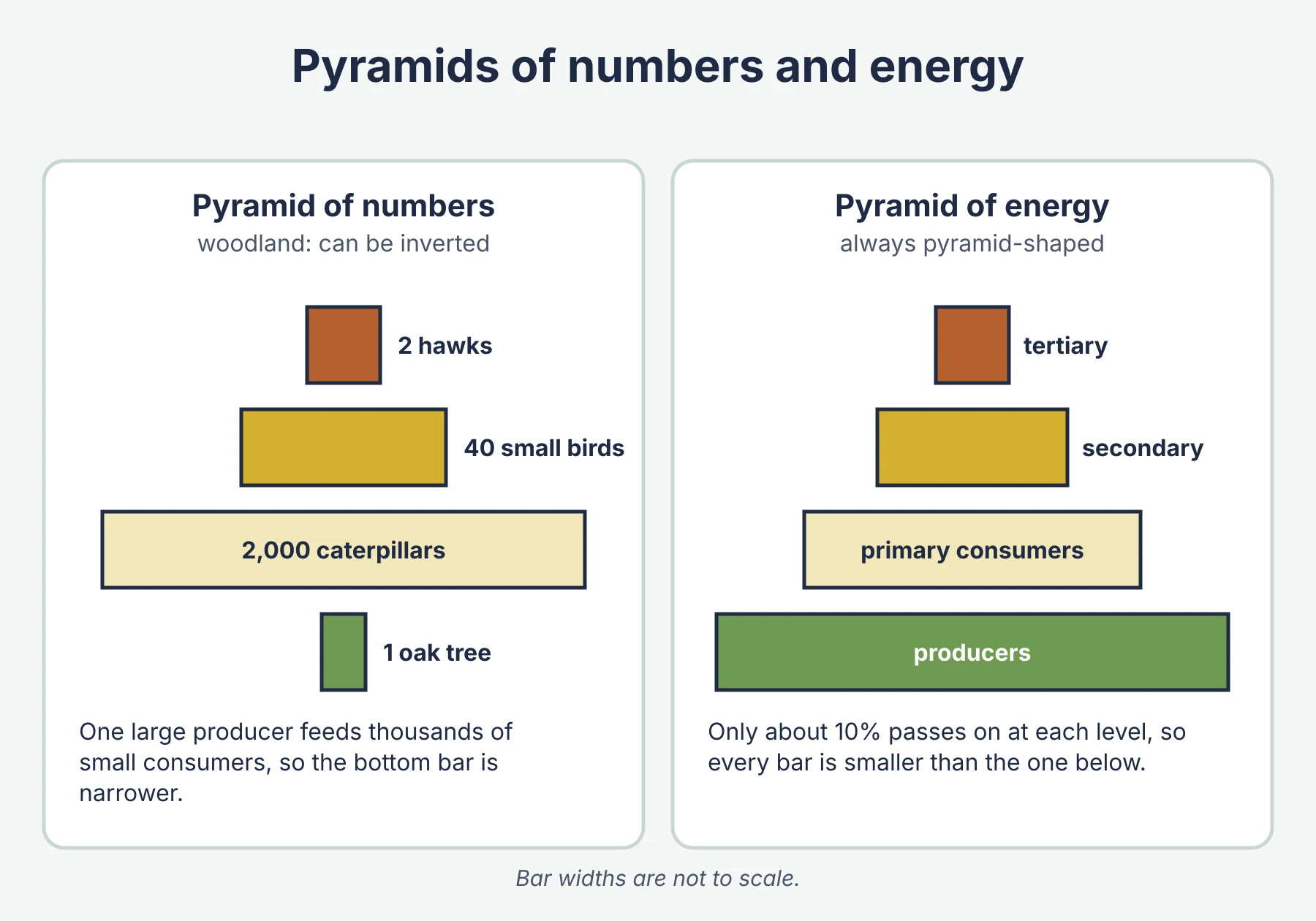
Each bar shows the number of organisms at a trophic level. Usually the bars get smaller upwards, but a pyramid of numbers can be inverted when a single large producer supports many small consumers. For example, one tree may feed thousands of caterpillars, which feed a few birds, so the producer bar is the narrowest at the bottom.
Pyramid of energy
Each bar shows the energy at a trophic level, usually per square metre per year. Because only about 10% passes on each time, a pyramid of energy is always pyramid-shaped; it cannot be inverted. This makes it the more reliable way to compare trophic levels.
The carbon cycle (5.1.9)
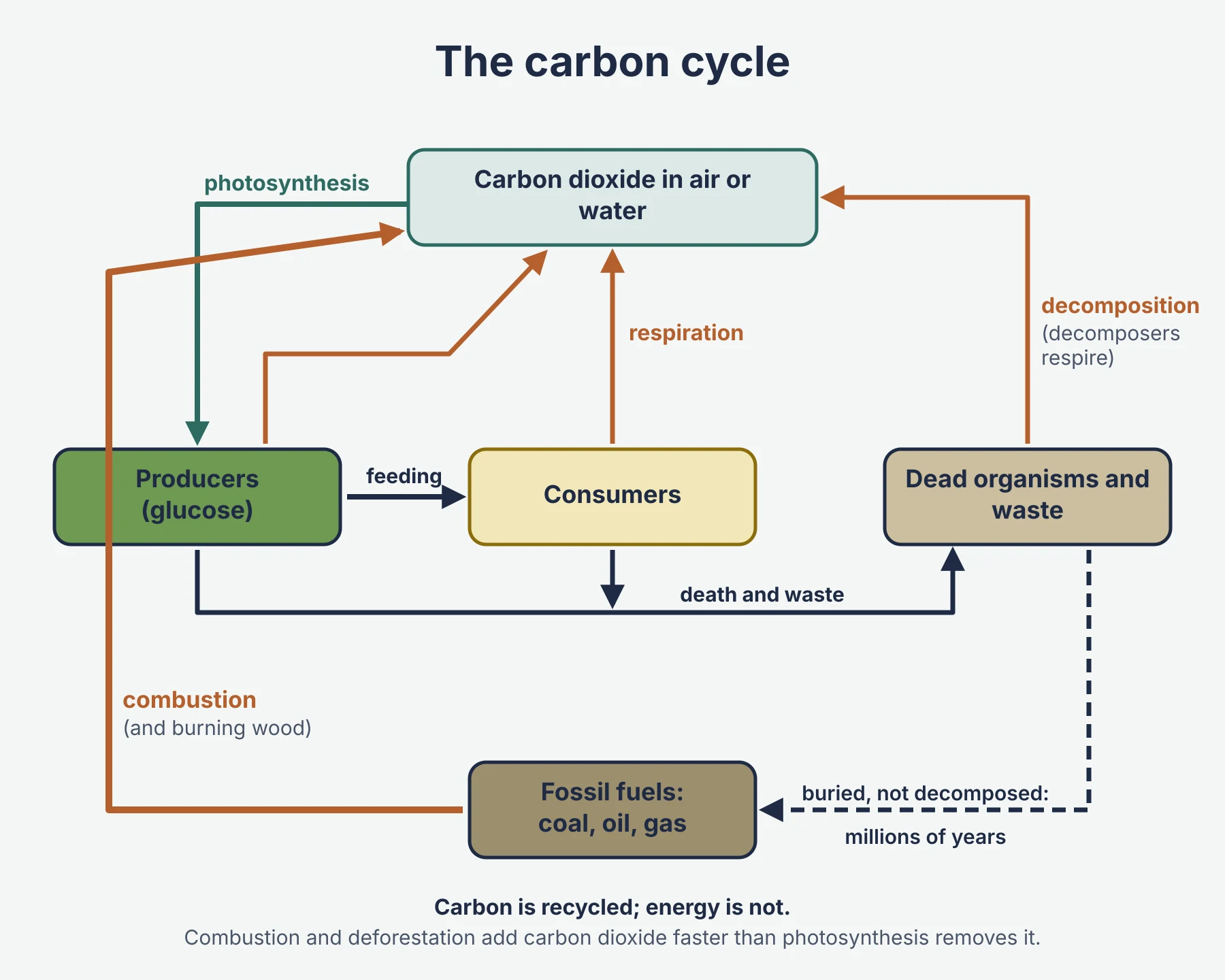
| Process | Carbon moves from | Carbon moves to |
|---|---|---|
| Photosynthesis | Carbon dioxide in air or water | Glucose in producers |
| Respiration | Glucose in all organisms | Carbon dioxide in air or water |
| Feeding | One organism | The organism that eats it |
| Decomposition | Dead organisms and waste | Carbon dioxide, via respiration of decomposers |
| Formation of fossil fuels | Dead organisms buried without decomposition over millions of years | Coal, oil, natural gas |
| Combustion | Fossil fuels and wood | Carbon dioxide in the air |
The cycle links Topic 5 to climate change in Topic 4: combustion and deforestation move carbon into the atmosphere faster than photosynthesis removes it.
Worked example 1: energy through a food chain
A food chain in a pond: algae → water flea → small fish → heron. The algae capture 60,000 kJ per square metre per year.
- Water fleas receive 60,000 × 10 / 100 = 6,000 kJ.
- Small fish receive 6,000 × 10 / 100 = 600 kJ.
- Herons receive 600 × 10 / 100 = 60 kJ.
- Energy lost between algae and water fleas = 60,000 − 6,000 = 54,000 kJ, through respiration, movement, digestion and excretion.
Worked example 2: calculating efficiency from data
The figures are invented for practice. In a grassland, primary consumers receive 3,200 kJ per square metre per year and secondary consumers receive 256 kJ.
Efficiency = 256 / 3,200 × 100 = 8%.
This is a little below the 10% guide figure. A sensible suggestion: the secondary consumers are active hunters that use a lot of energy in movement, or much of the prey (bones, fur) is not eaten or digested.
Worked example 3: interpreting a pyramid of numbers
A woodland pyramid of numbers shows 1 oak tree, 2,000 caterpillars, 40 small birds and 2 hawks. Question: explain why the bottom bar is narrower than the one above it, and what a pyramid of energy would show.
Answer: the oak is a single large producer that provides enough food for thousands of small caterpillars, so the number of producers is smaller than the number of primary consumers. A pyramid of energy would be a true pyramid, with the most energy in the oak, because energy is lost at each step.
Common mistakes
- Defining a population as “all the animals in an area”. It is one species.
- Describing a niche as a habitat. The habitat is where; the niche is the role.
- Saying energy is recycled. Carbon is recycled; energy flows through and is lost as heat.
- Writing that plants respire only at night. They respire all the time.
- Saying pyramids of energy can be inverted.
Exam technique
Describe questions on components want the term applied to the organisms in the question. Describe and interpret questions on food webs and pyramids reward reading values, calculating percentages and stating trends. Explain questions on pyramids want the reason, usually the 10% transfer and named energy losses. Always give units, such as kJ per square metre per year.
Revise with the ecosystems revision notes and practise with the ecosystems practice questions.
Related resources
-
Revision notes
Cambridge IGCSE Environmental Management: Land — Revision Notes
Recall notes on soils and crop growth, food production and soil erosion for Topic 2 Land of Cambridge IGCSE Environmental Management 0680, 2027-2029 series.
Environmental Management · Cambridge · IGCSE
Revise topic -
Practice questions
Cambridge IGCSE Environmental Management (0680): Ecosystems – Practice Questions
Original practice questions with answers on ecosystem terms, interactions, pollination, energy flow, pyramids and the carbon cycle for Cambridge IGCSE 0680.
Environmental Management · Cambridge · IGCSE
Try questions -
Revision notes
Cambridge IGCSE Environmental Management (0680): Ecosystems – Revision Notes
Recall notes on ecosystem terms, biotic interactions, photosynthesis, respiration, energy flow, pyramids and the carbon cycle, with a self-test, for IGCSE 0680.
Environmental Management · Cambridge · IGCSE
Revise topic
Get free revision emails (optional)
Occasional emails with practice questions, worked explanations and links to free resources for the qualification and subjects you choose. No spam, and you can unsubscribe from any email. The free tools on this site never need an email.