
Revision Notes
Cambridge IGCSE Environmental Management (0680): Ecosystems – Revision Notes
Recall notes on ecosystem terms, biotic interactions, photosynthesis, respiration, energy flow, pyramids and the carbon cycle, with a self-test, for IGCSE 0680.
- Subject
- Environmental Management
- Level
- IGCSE
- Topic
- Topic 5: Ecosystems, biodiversity and fieldwork
- Author
- Marlbridge Academic Team
- Updated
- Reviewed by
- Azam Siddique (what this means)
Aligned to Cambridge IGCSE Environmental Management (0680), 2027-2029. Official specification .
Syllabus page (what it covers and how it is assessed): Cambridge IGCSE Environmental Management.
Syllabus points this page covers
0680
- 5.1 Ecosystems
Found an error? Report a correction.
Need help with this topic? Request a free trial class for IGCSE Environmental Management (0680).
Condensed notes for sub-topic 5.1 of Cambridge IGCSE Environmental Management (0680). The ecosystems study guide explains each point with worked examples on energy flow and pyramids.
The nine syllabus points at a glance
5.1.1 components · 5.1.2 biotic and abiotic · 5.1.3 interactions · 5.1.4 pollination · 5.1.5 photosynthesis · 5.1.6 energy flow · 5.1.7 pyramids · 5.1.8 aerobic respiration · 5.1.9 carbon cycle.
Key terms (5.1.1 and 5.1.3)
| Term | Definition |
|---|---|
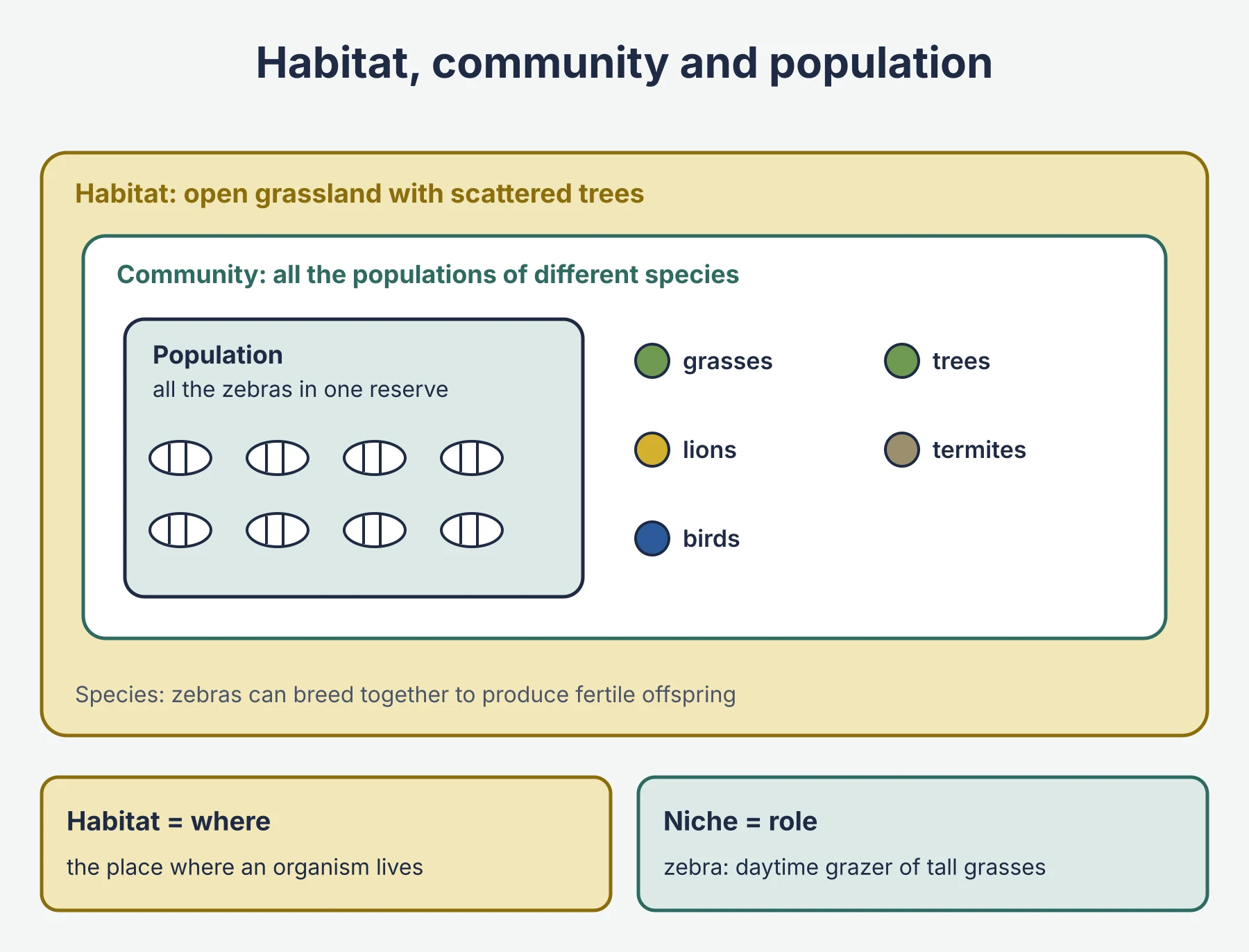
| Habitat | The place where an organism lives |
| Species | Organisms that can breed together to produce fertile offspring |
| Population | All the organisms of one species in an area at one time |
| Community | All the populations of different species in an area |
| Niche | The role of a species in its ecosystem |
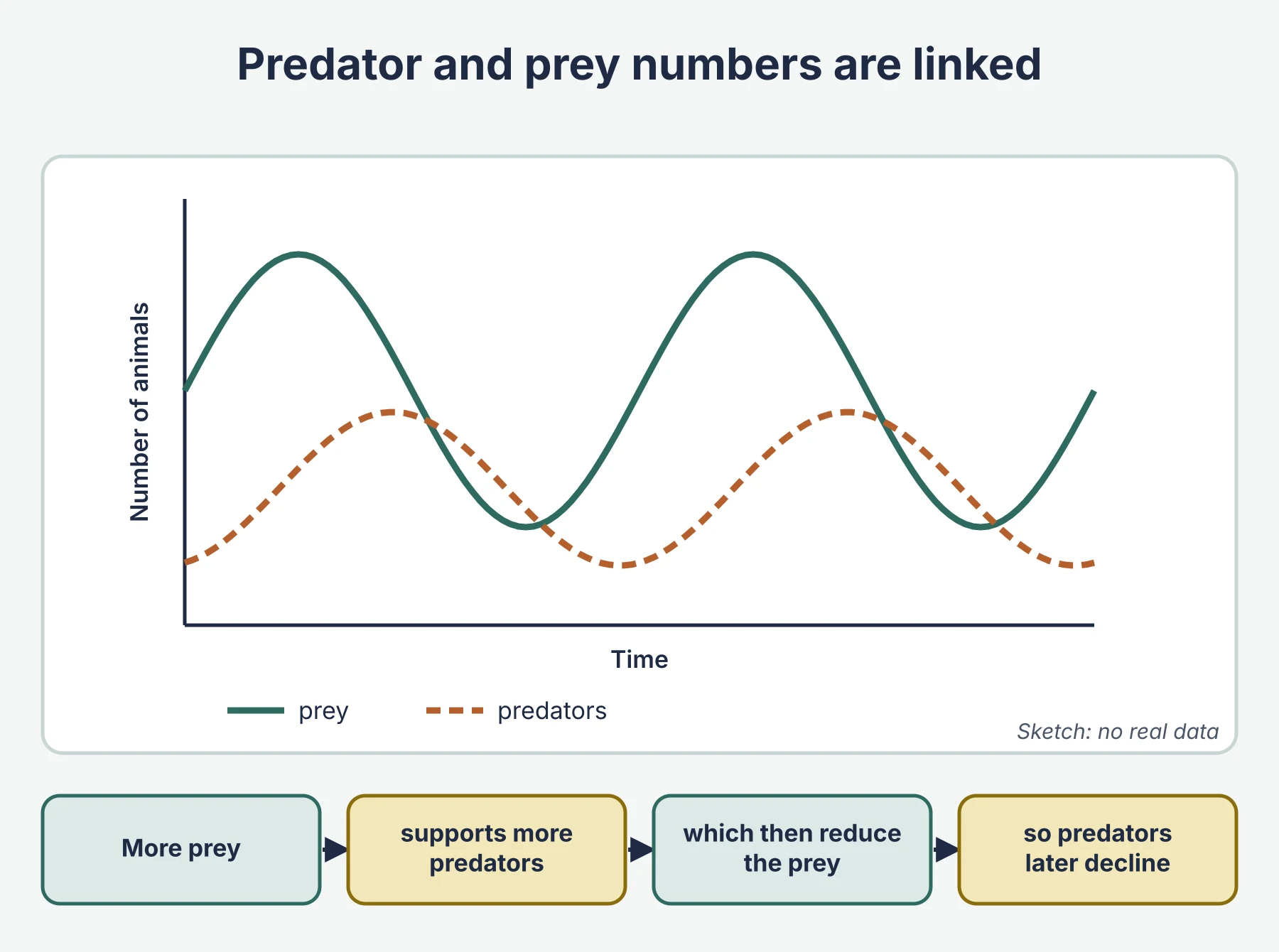
| Prey | An animal hunted and eaten by another |
| Predator | An animal that hunts and eats other animals |
| Apex predator | A predator at the top of a food chain, with no natural predators |
| Native species | One that occurs naturally in an area |
| Invasive species | An introduced species that spreads and harms native species |
| Competition | Struggle between organisms for the same limited resource |
| Predation | One animal hunting and eating another |
Hierarchy: individual → population → community → ecosystem (community plus abiotic environment).
Biotic and abiotic (5.1.2)
- Biotic: producers; primary, secondary and tertiary consumers; decomposers.
- Abiotic: temperature, water, oxygen, carbon dioxide, salinity, light, pH.
Link each abiotic factor to a need: light → photosynthesis; oxygen → respiration; salinity → water balance; pH → survival of invertebrates and fish.
Pollination (5.1.4)
- Transfer of pollen from an anther to a stigma.
- Insect pollination: insect carries pollen between flowers; flowers usually bright and scented, with nectar.
- Wind pollination: light pollen in large amounts carried by wind.
- Pollination → fertilisation → seed and fruit formation.
- Flower structure and naming of other parts are not required.
Photosynthesis and respiration (5.1.5 and 5.1.8)
| Photosynthesis | Aerobic respiration | |
|---|---|---|
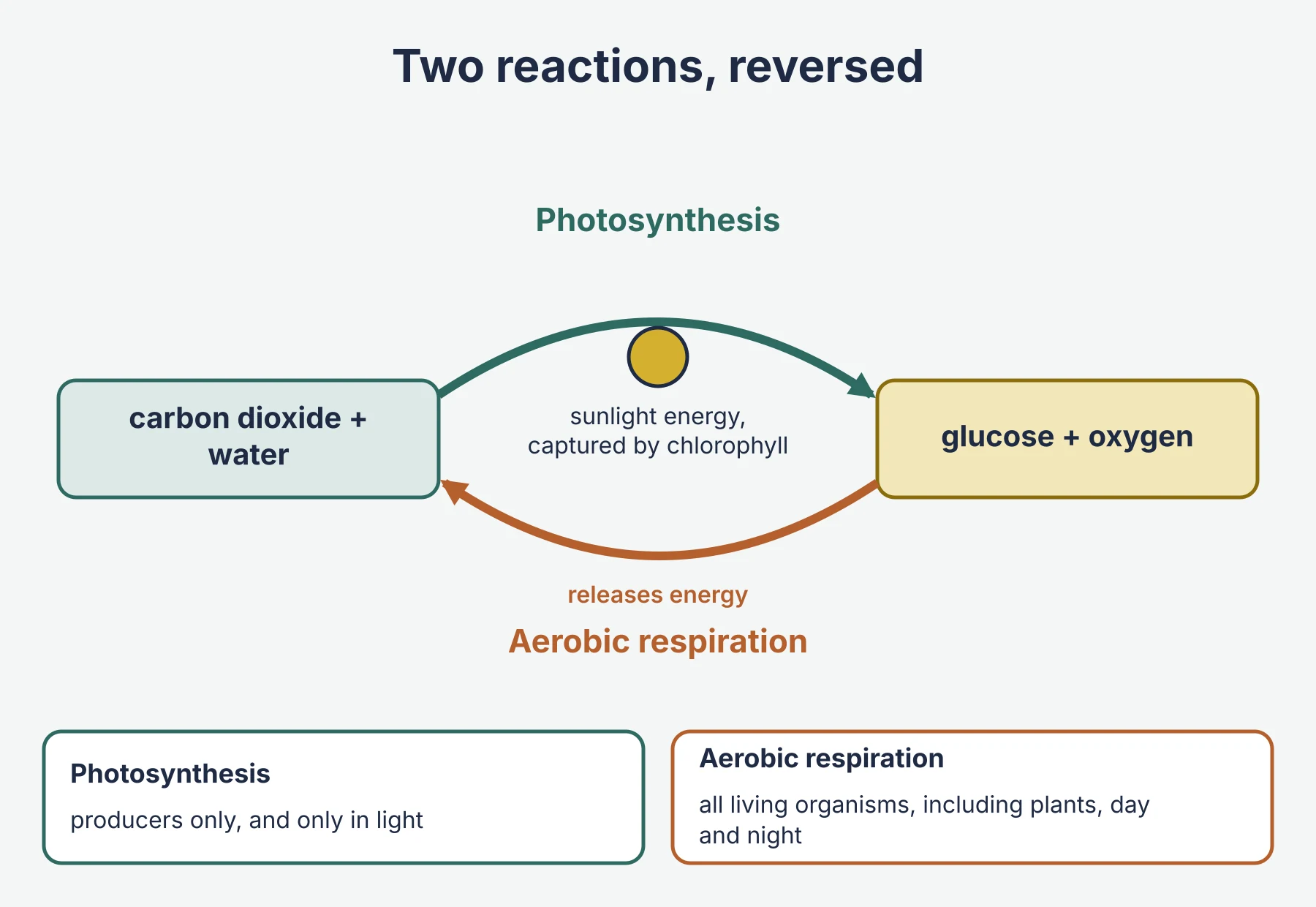
| Word equation | carbon dioxide + water → glucose + oxygen | glucose + oxygen → carbon dioxide + water |
| Energy | Sunlight is the source; chlorophyll captures it | Energy released from glucose |
| Where and when | Producers, in light | All organisms, all the time |
Energy flow (5.1.6)
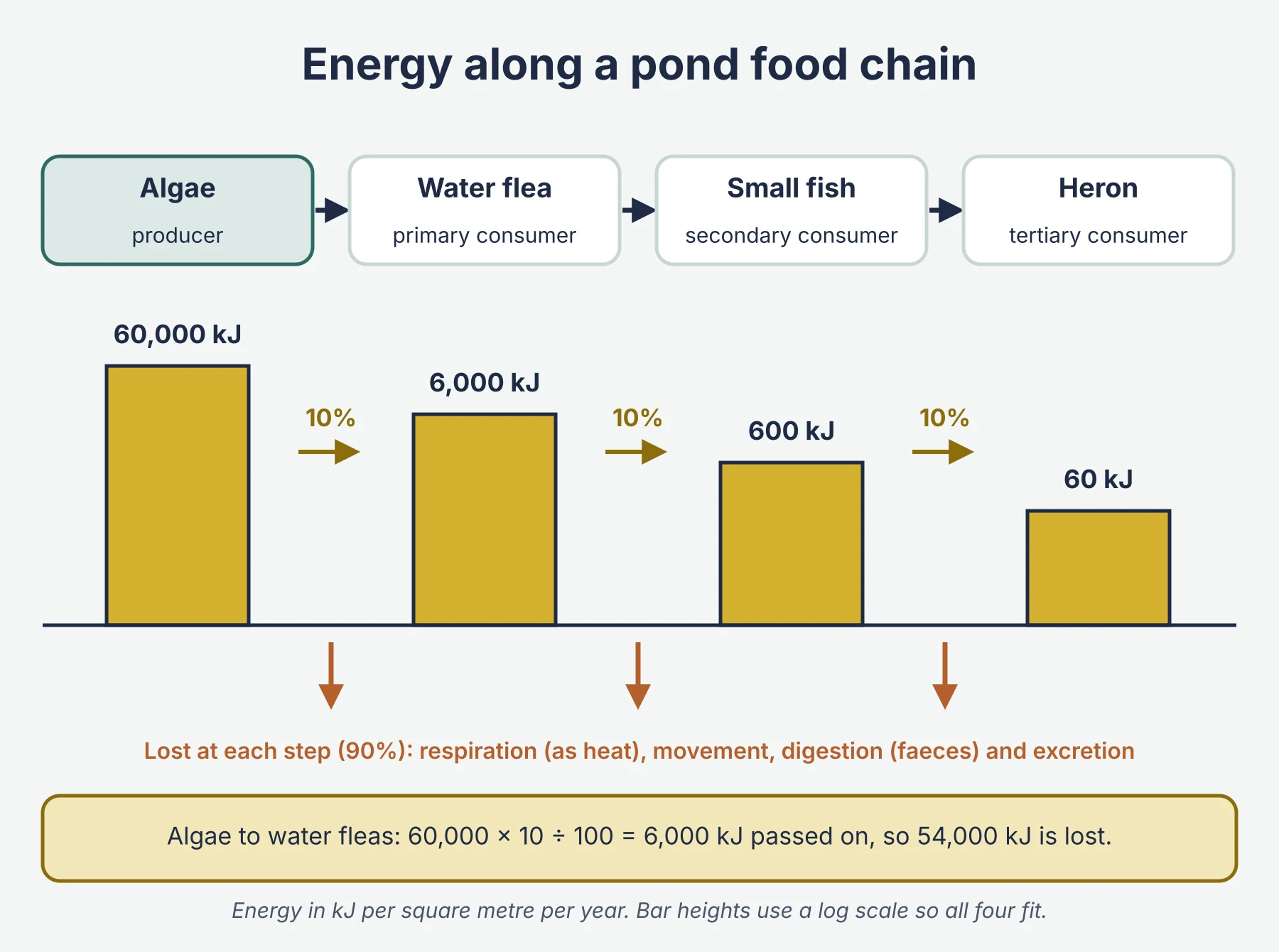
- Order: producer → primary → secondary → tertiary consumer.
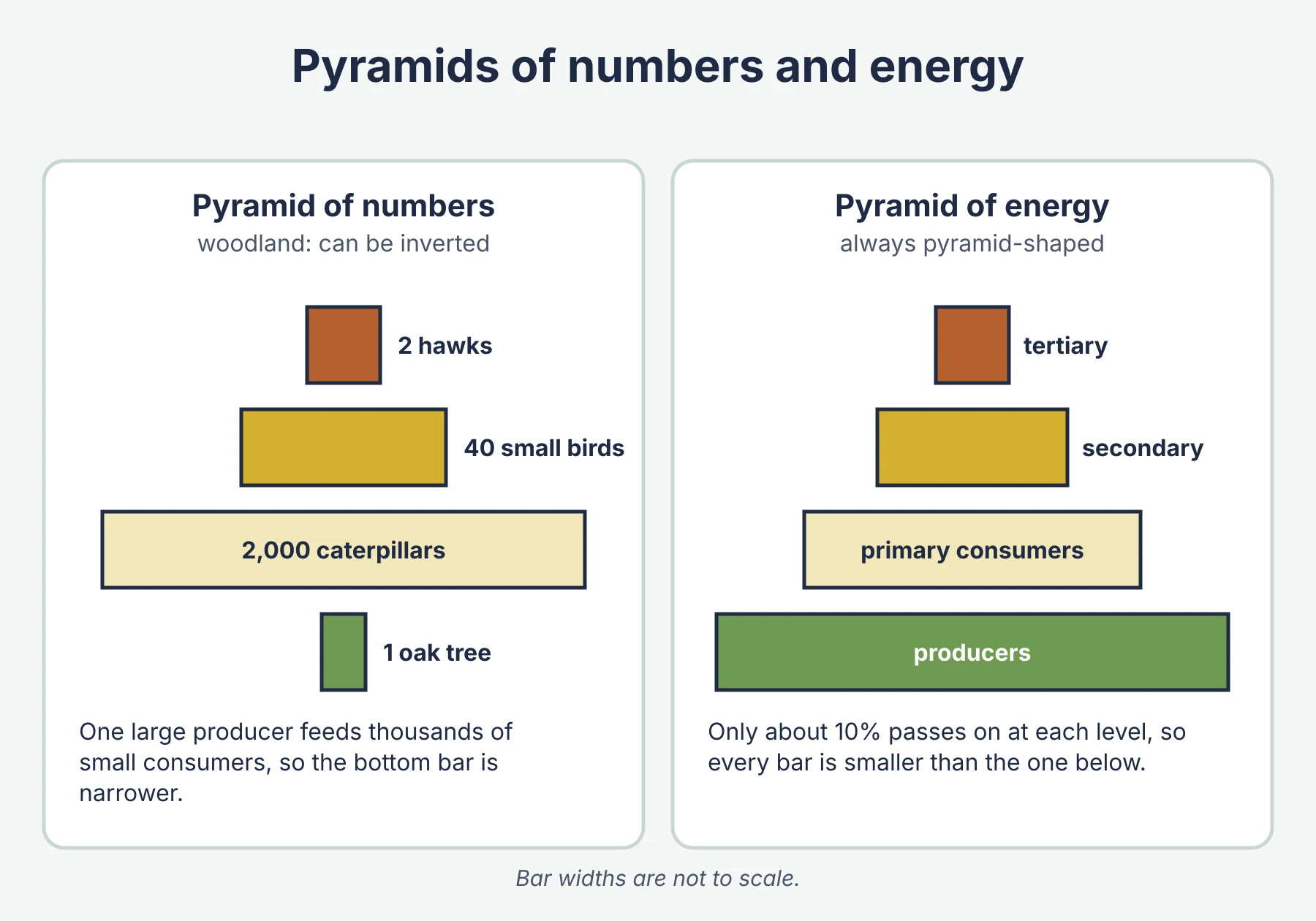
- 10% of energy passes to the next trophic level.
- 90% lost through movement, respiration, digestion and excretion; ends as heat or in faeces and waste.
- Consequence: food chains are short; top predators are few.
Quick maths: energy at level n+1 = energy at level n × 0.1. Efficiency = energy at higher level / energy at lower level × 100.
Pyramids (5.1.7)
| Pyramid | Shows | Shape |
|---|---|---|
| Numbers | Number of organisms at each trophic level | Usually a pyramid; can be inverted when one large producer, such as a tree, supports many small consumers |
| Energy | Energy at each level, for example kJ per square metre per year | Always a pyramid, because energy is lost at each step |
Carbon cycle (5.1.9): six processes
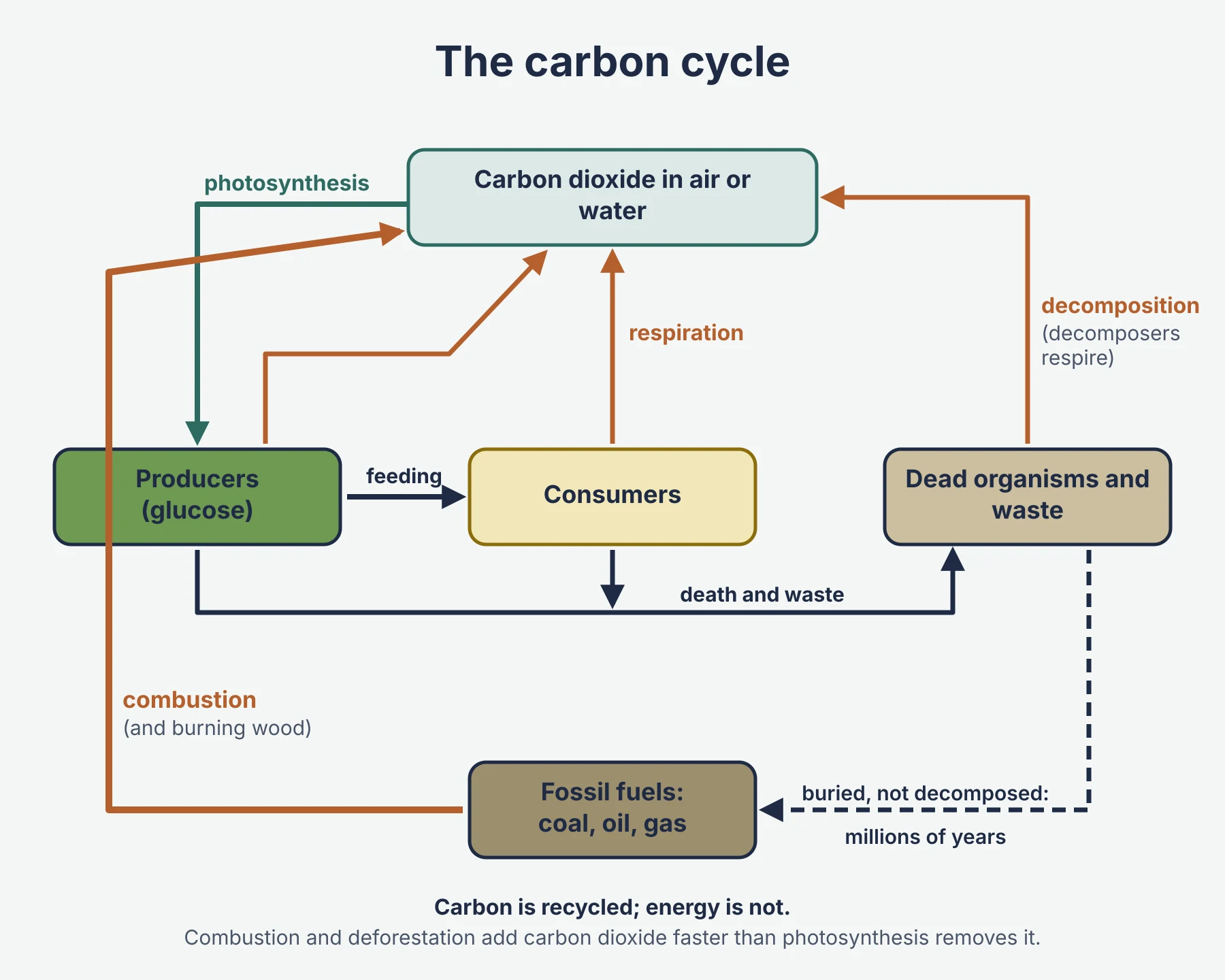
- Photosynthesis: CO₂ → glucose in producers.
- Respiration: glucose → CO₂ (all organisms).
- Feeding: carbon passes from food to consumer.
- Decomposition: decomposers respire dead material and waste → CO₂.
- Formation of fossil fuels: dead organisms buried without decomposing, over millions of years → coal, oil, gas.
- Combustion: burning fuels → CO₂.
Carbon is recycled; energy is not.
Exam traps
- Population = one species; community = all species.
- Niche is a role, not a place.
- Plants respire all the time, not only at night.
- A pyramid of numbers can be inverted; a pyramid of energy cannot.
- Energy flows and is lost as heat; carbon cycles.
- Decomposers return carbon dioxide by respiration.
- Pollination is not fertilisation: pollination comes first and leads to it.
- In calculations, use the 10% figure only when the question tells you to or gives no data; otherwise use the figures provided.
Self-test
- Define a population.
- What is the difference between a habitat and a niche?
- What is an apex predator?
- State four abiotic factors listed in the syllabus.
- Why can an invasive species spread so rapidly?
- Define pollination.
- What happens after pollination?
- Write the word equation for photosynthesis.
- What is the role of chlorophyll?
- Name four ways energy is lost between trophic levels.
- Producers capture 40,000 kJ. Using the 10% rule, how much reaches secondary consumers?
- Why can a pyramid of numbers be inverted but a pyramid of energy cannot?
Answers
- All the organisms of one species living in an area at the same time.
- A habitat is where an organism lives; a niche is its role in the ecosystem.
- A predator at the top of a food chain with no natural predators.
- Any four: temperature, water, oxygen, carbon dioxide, salinity, light, pH.
- It often has no natural predators or diseases in its new area, so it outcompetes native species.
- The transfer of pollen from an anther to a stigma.
- Fertilisation, followed by seed and fruit formation.
- carbon dioxide + water → glucose + oxygen.
- It captures light energy for photosynthesis.
- Movement, respiration, digestion, excretion.
- 40,000 × 0.1 = 4,000 kJ to primary consumers; 4,000 × 0.1 = 400 kJ to secondary consumers.
- One large producer can support many small consumers, so numbers can increase upwards; energy is always lost at each step, so each level has less than the one below.
Linked pages
Practise with the ecosystems practice questions. The rest of Topic 5 is condensed in the Ecosystems, biodiversity and fieldwork revision notes.
Related resources
-
Revision notes
Cambridge IGCSE Environmental Management: Land — Revision Notes
Recall notes on soils and crop growth, food production and soil erosion for Topic 2 Land of Cambridge IGCSE Environmental Management 0680, 2027-2029 series.
Environmental Management · Cambridge · IGCSE
Revise topic -
Study guides
Cambridge IGCSE Environmental Management (0680): Fieldwork investigations
The scientific method, random and systematic sampling, and seven sampling techniques with benefits and limitations, for Cambridge IGCSE 0680 sub-topic 5.4.
Environmental Management · Cambridge · IGCSE
Read guide -
Practice questions
Cambridge IGCSE Environmental Management (0680): Fieldwork investigations – Practice Questions
Twelve original questions with answers on the scientific method, sampling strategies, techniques, anomalies and planning for Cambridge IGCSE 0680 5.4.
Environmental Management · Cambridge · IGCSE
Try questions
Get free revision emails (optional)
Occasional emails with practice questions, worked explanations and links to free resources for the qualification and subjects you choose. No spam, and you can unsubscribe from any email. The free tools on this site never need an email.