
Study Guides
Cambridge IGCSE Environmental Management (0680): Forest ecosystems
The six causes and seven impacts of deforestation, what sustainable forest management means and why forests need it, in Cambridge IGCSE 0680 sub-topic 5.2.
- Subject
- Environmental Management
- Level
- IGCSE
- Topic
- Topic 5: Ecosystems, biodiversity and fieldwork
- Author
- Marlbridge Academic Team
- Updated
- Reviewed by
- Azam Siddique (what this means)
Aligned to Cambridge IGCSE Environmental Management (0680), 2027-2029. Official specification .
Syllabus page (what it covers and how it is assessed): Cambridge IGCSE Environmental Management.
Syllabus points this page covers
0680
- 5.2 Forest ecosystems
Found an error? Report a correction.
Need help with this topic? Request a free trial class for IGCSE Environmental Management (0680).
Sub-topic 5.2 of Cambridge IGCSE Environmental Management (0680, 2027-2029) asks three things of you: describe and explain why forests are cleared, describe and explain what happens when they are, and explain why forests need sustainable management. The syllabus limits each list, so this guide works through every named item, shows how the items link into chains of cause and effect, and finishes with exam practice. For the whole of Topic 5, including the rainforest layers and nutrient store, see the Ecosystems, biodiversity and fieldwork study guide.
What the syllabus asks for
| Statement | Command words | What you must cover |
|---|---|---|
| 5.2.1 | Describe and explain | Six causes of deforestation |
| 5.2.2 | Describe and explain | Seven impacts of deforestation |
| 5.2.3 | Define | Sustainable management of forests |
| 5.2.4 | Describe and explain | Seven reasons forests need sustainable management |
“Describe and explain” means you must say what happens and then why or how it happens. A one-word cause such as “farming” earns little; “forest is cleared for commercial cattle ranching because beef sells for export, so large blocks of trees are felled and burned” shows both.
Causes of deforestation (5.2.1)
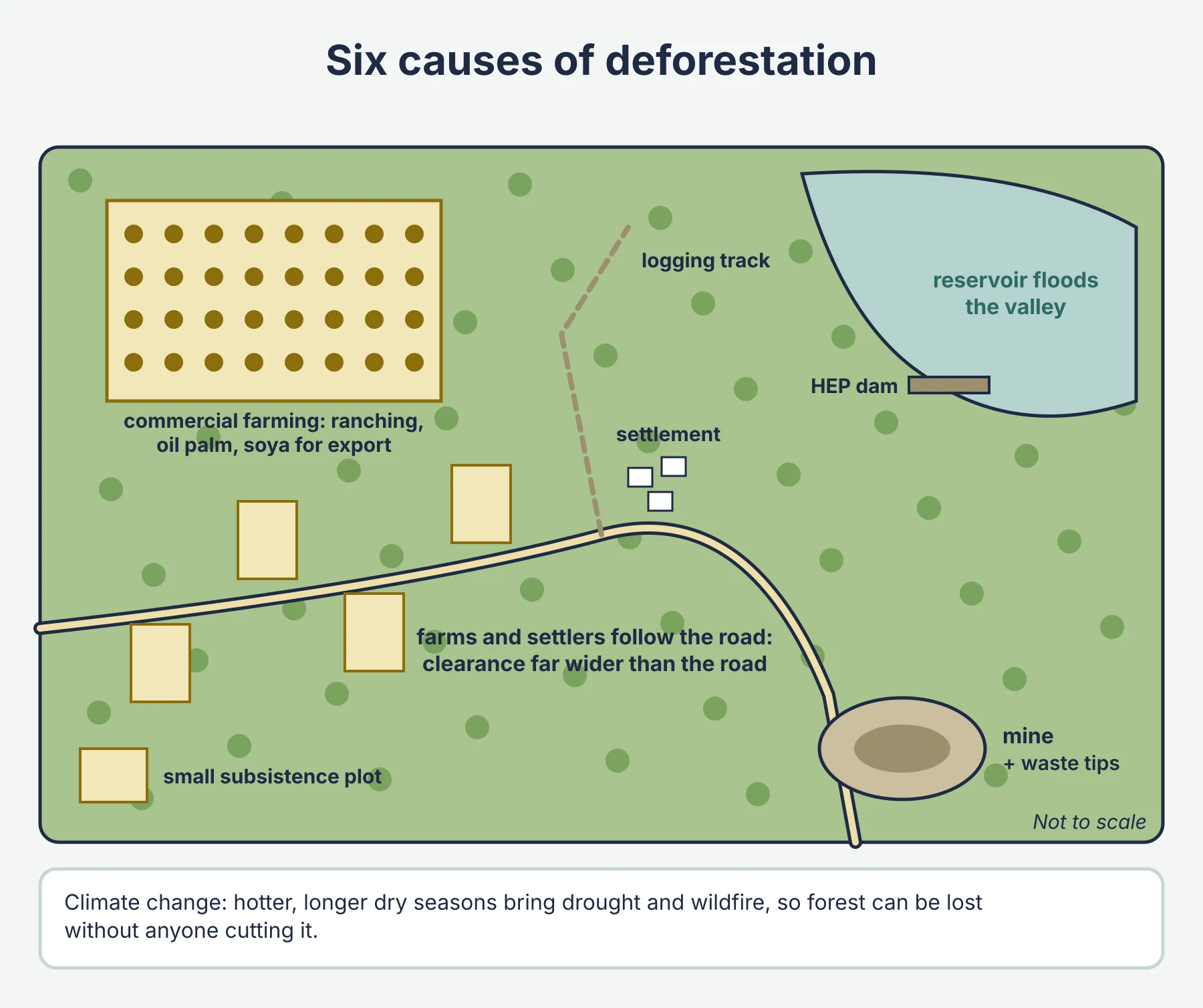
The syllabus names six causes. Learn each with its mechanism, the reason the trees go.
- Logging and timber extraction. Valuable hardwoods are felled for furniture, construction and paper. Even selective logging damages surrounding trees, and the access tracks cut for heavy machinery open the forest to further clearance.
- Subsistence and commercial farming. Subsistence farmers clear small plots to grow food for their families; where population is rising, plots are cleared faster than the forest can regrow. Commercial farming clears much larger areas for cattle ranching or plantation crops such as oil palm and soya, grown for profit and export.
- Roads and settlements. Trees are removed along the route of a road and for new towns, but roads also make remote forest accessible, so loggers, farmers and settlers follow them in. A road therefore causes far more clearance than its own width.
- Rock, ore and mineral extraction. Surface mining removes all vegetation and soil above a deposit. Mines also need access roads, worker housing and waste tips, each clearing more forest.
- Hydro-electric power stations. Building a dam floods the valley behind it, drowning forest over a large area to create the reservoir. Power lines and construction roads add to the loss.
- Climate change. Higher temperatures and longer dry seasons stress trees and make forests more prone to drought and wildfire, so forest can be lost without anyone cutting it.
Several causes often act together: a mining company builds a road, the road brings settlers, and settlers clear land for farming. Linking causes like this is a strong way to answer an “explain” question.
Impacts of deforestation (5.2.2)
The syllabus lists seven impacts. Each one should be explained, not just named.
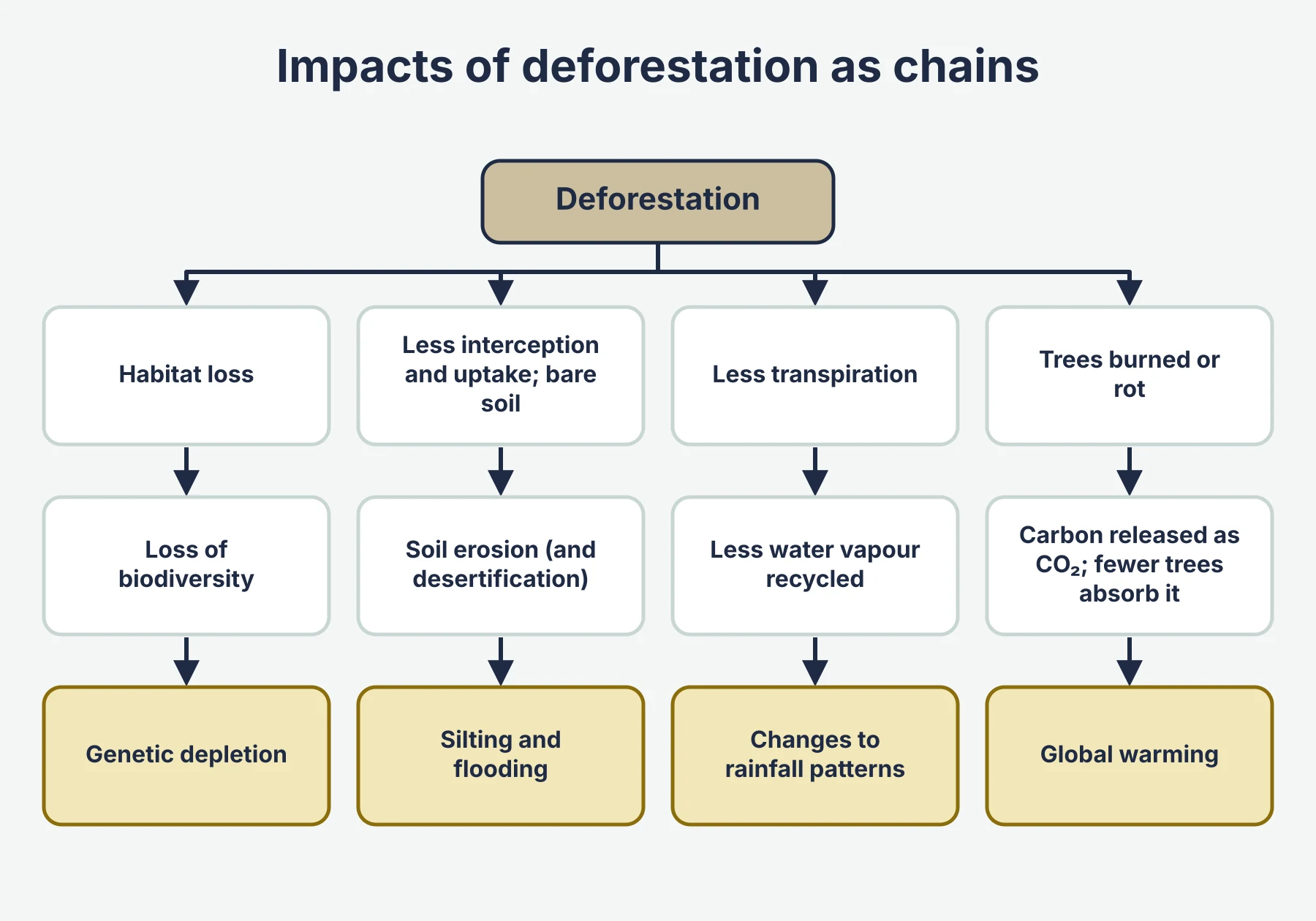
- Habitat loss. Organisms lose the food, shelter and breeding sites the forest provided. Clearance also fragments the forest into small patches that cannot support species needing large territories.
- Loss of biodiversity. With habitat gone, populations fall and species can be lost from the area altogether. Tropical forests hold a very high number of species, so losses there are especially large.
- Soil erosion and desertification. Without a canopy to intercept rain and roots to bind the soil, heavy rain washes topsoil away. Leaf litter, the main source of nutrients, is no longer added. In drier regions the bare, degraded land can turn into desert-like conditions.
- Silting and flooding. Eroded soil is carried into rivers and deposited, so channels become shallower and hold less water. With less interception and infiltration, rain reaches rivers faster, so floods become more frequent.
- Global warming. Trees store carbon. When they are burned or left to rot the carbon returns to the atmosphere as carbon dioxide, and fewer trees remain to absorb it by photosynthesis.
- Changes to rainfall patterns. Forests return large amounts of water vapour to the air by transpiration, and this vapour forms clouds and rain further inland. Remove the trees and less moisture is recycled, so local rainfall can fall and dry seasons lengthen.
- Genetic depletion. As populations shrink and species disappear, the variety of genes in the forest falls. This removes material that could be used to breed crops, develop medicines or help species adapt to change.
Defining sustainable management (5.2.3)
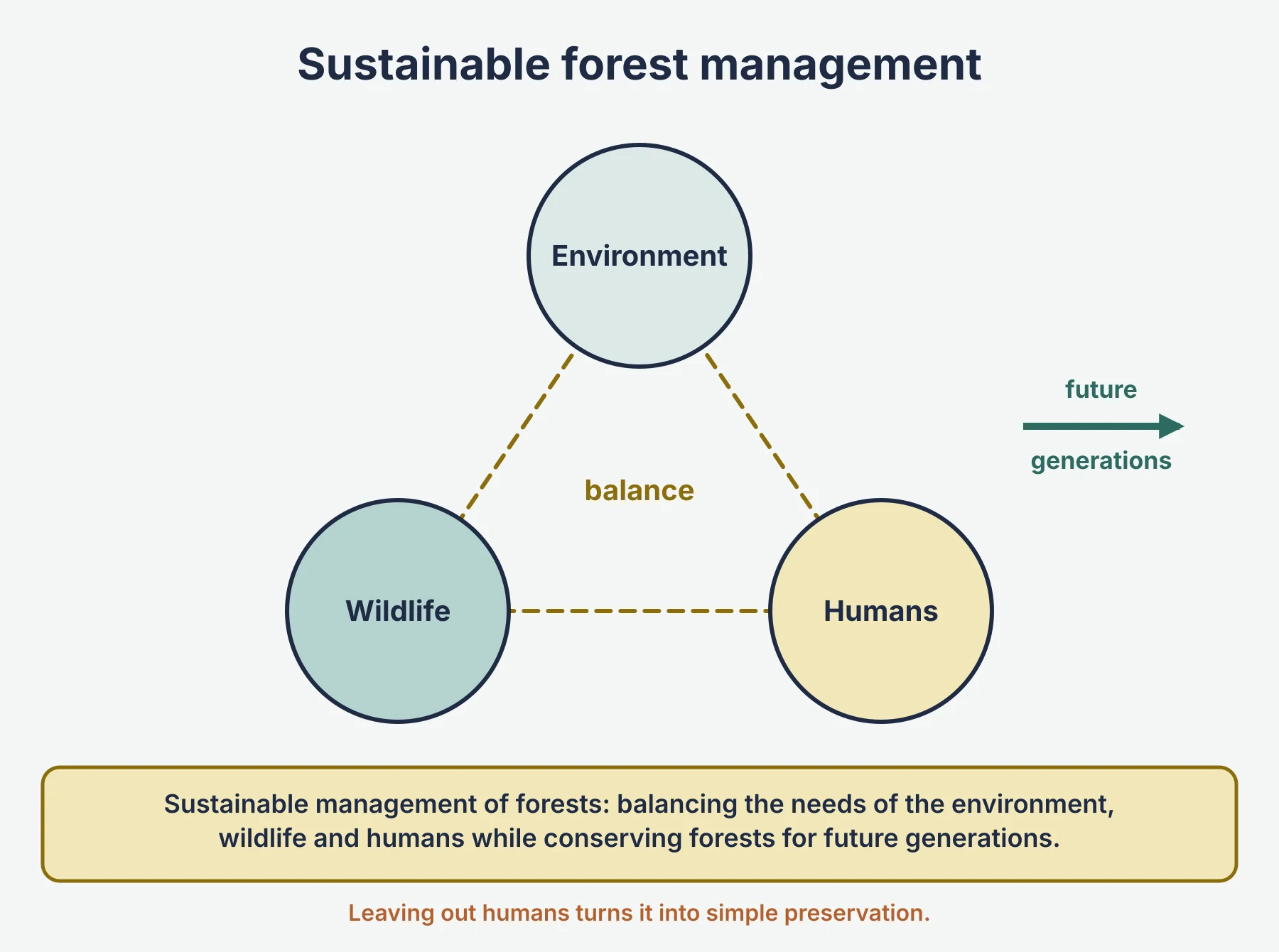
Learn the syllabus definition word for word: sustainable management of forests means balancing the needs of the environment, wildlife and humans while conserving forests for future generations. A definition question will reward all three groups (environment, wildlife, humans) plus the idea of future generations. Leaving out humans is the most common slip, because it turns sustainable management into simple preservation.
Why forests need sustainable management (5.2.4)
These seven reasons are the services a forest provides. If a question asks why forests should be managed sustainably, each is a separate point.
- Climate regulation. Trees act as carbon sinks, absorbing carbon dioxide as they grow, and as carbon stores, holding carbon in wood, roots and soil.
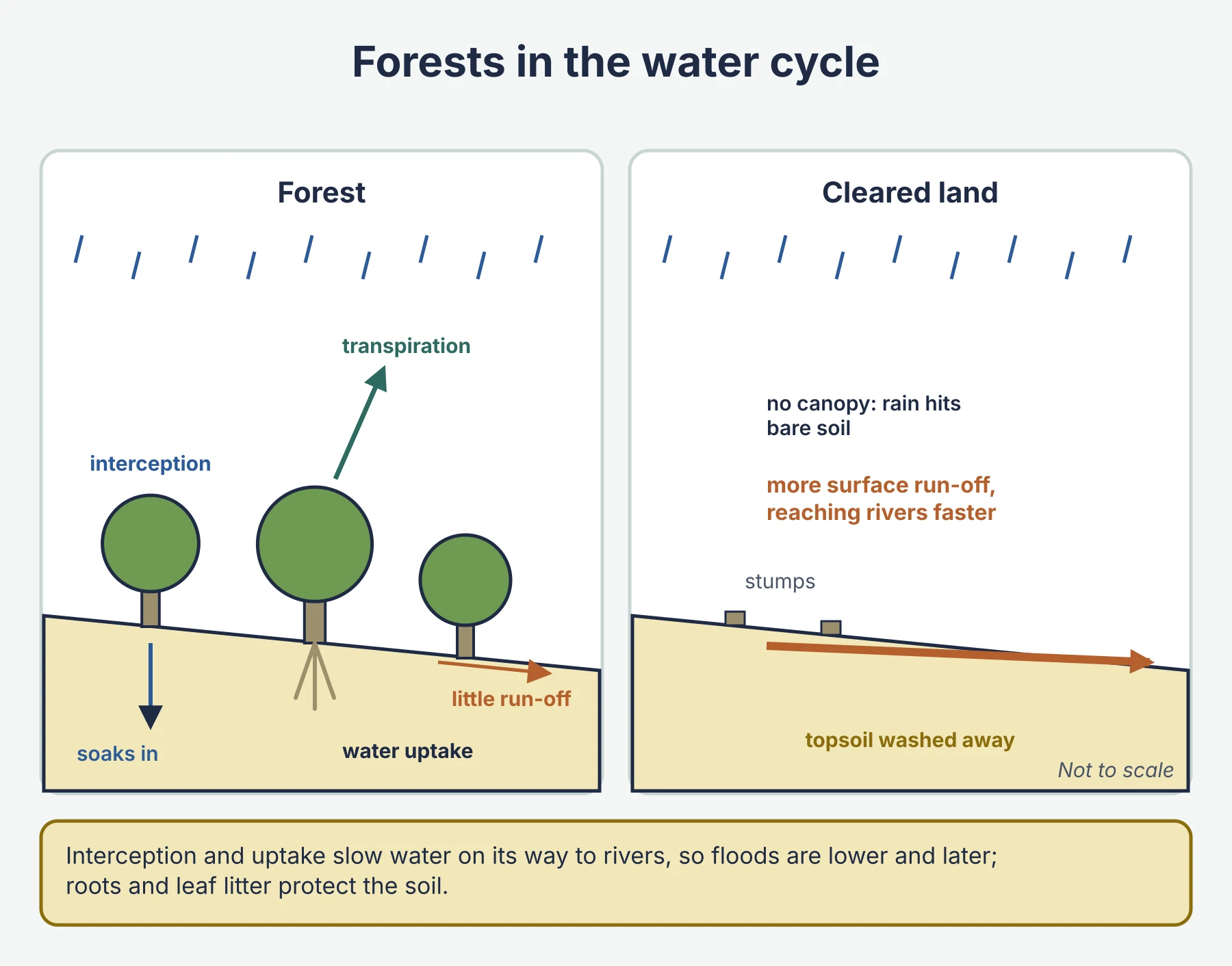
- Role in the water cycle. The syllabus names four processes: interception (leaves catch rain and slow its fall), water uptake (roots absorb water from the soil), transpiration (water vapour leaves through the leaves) and surface run-off (which is reduced because water soaks in rather than flowing over the ground).
- Flood control. Because interception and uptake slow the movement of water to rivers, peak river levels are lower and arrive later.
- Prevention of soil erosion. Roots bind soil, and the canopy and leaf litter protect the surface from raindrop impact.
- Genetic resource. The variety of species and genes is a store for future crop breeding and medicine.
- Food, medicine and raw materials. Forests supply fruit, nuts, game, medicinal plants, timber, rubber and fibres, which can be harvested again and again if managed carefully.
- Recreation, ecotourism and education. Visitors pay to see wildlife and landscapes, creating local jobs, and forests are places to study ecology.
Notice that several reasons are the reverse of the impacts in 5.2.2: forests prevent erosion, control floods and regulate climate, and deforestation removes those services. Seeing this link lets you reuse your knowledge in both directions.
Worked example 1: rate of forest loss
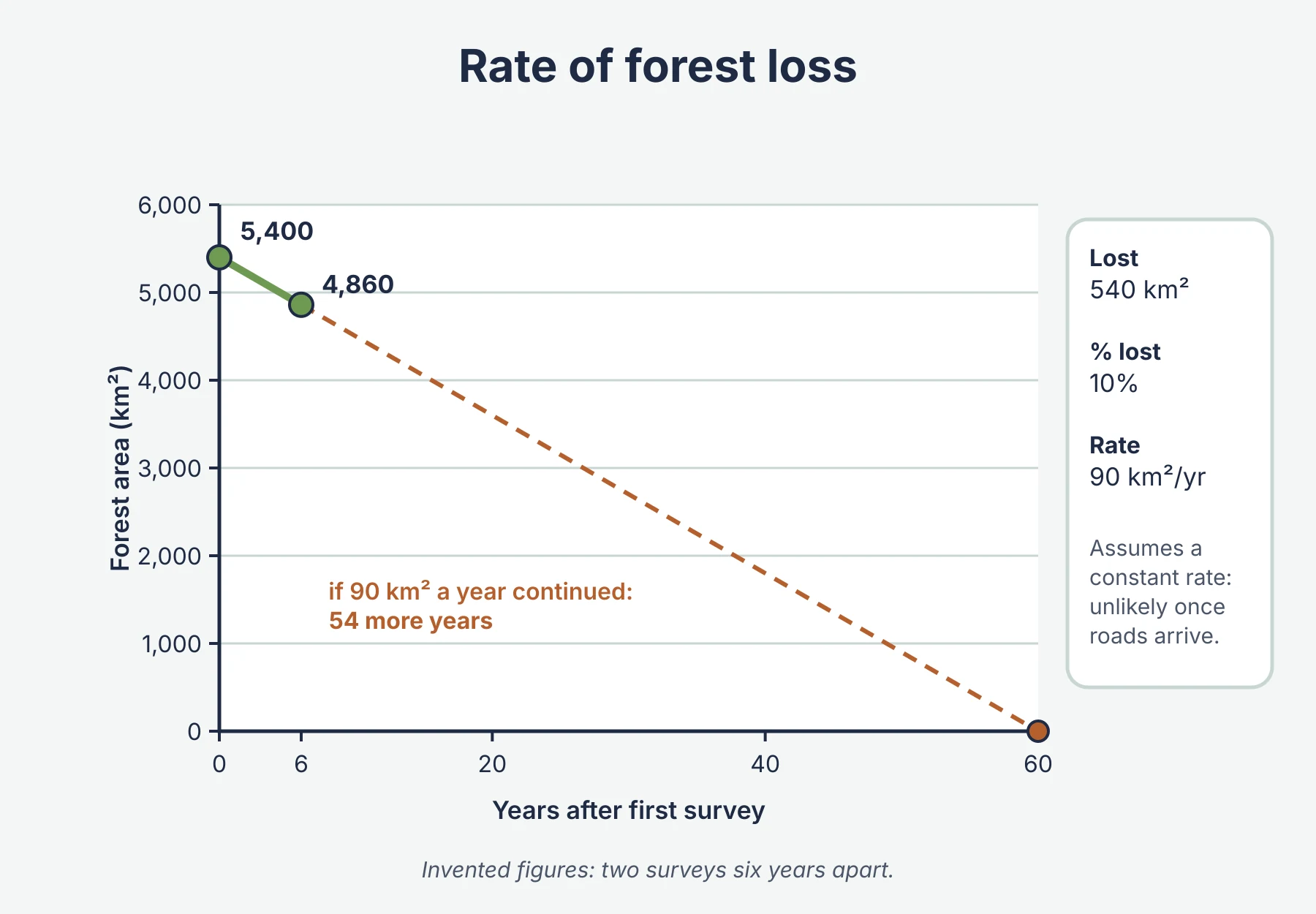
The figures below are invented for practice. A forest reserve covered 5,400 km² in one survey and 4,860 km² in a survey six years later.
- Area lost = 5,400 − 4,860 = 540 km².
- Percentage lost = 540 ÷ 5,400 × 100 = 10%.
- Mean rate of loss = 540 ÷ 6 = 90 km² per year.
- If that rate continued, the remaining 4,860 km² would last 4,860 ÷ 90 = 54 more years.
State the assumption in step 4: the rate stays constant, which is unlikely, because clearance often speeds up once roads reach a forest.
Worked example 2: annotated model answer
Question: Explain how building a road through a forest can lead to flooding downstream. [4]
Model answer: The road opens the forest to settlers and farmers, who clear land beside it [1]. With fewer trees, less rain is intercepted and taken up by roots, so more water flows over the surface and reaches the river quickly [1]. Exposed soil is eroded and washed into the river [1], where it is deposited, making the channel shallower so it overflows more easily [1].
Why it scores: every sentence links a step to the next, and the answer uses the syllabus terms interception, uptake, run-off and silting.
Common mistakes
- Writing “deforestation causes global warming” without the carbon link: trees store carbon and release carbon dioxide when burned or left to decay.
- Confusing interception (leaves catching rain) with infiltration (water soaking into soil).
- Treating subsistence and commercial farming as the same cause; they differ in scale and purpose.
- Forgetting climate change as a cause of forest loss as well as a result.
- Defining sustainable management without humans or future generations.
Exam technique
- Define: give the precise wording, then stop.
- Describe: state the features; a list of named causes or impacts fits here.
- Explain: add “because” or “so” to every point; one developed point is usually worth more than two bare ones.
- Suggest: apply your knowledge to the forest in the source material, for example naming the cause most likely in a region with new mines.
- In source-based questions, quote the data you use, such as an area or a rate of loss, and give the unit.
Check your understanding
- Name the six causes of deforestation in the syllabus. (Logging and timber extraction; subsistence and commercial farming; roads and settlements; rock, ore and mineral extraction; hydro-electric power stations; climate change.)
- How does a hydro-electric power station cause deforestation? (The dam floods the valley behind it, drowning the forest under the reservoir.)
- Explain genetic depletion. (Loss of genetic variety as populations shrink and species disappear.)
- Name the four water cycle processes the syllabus links to forests. (Interception, water uptake, transpiration, surface run-off.)
Condense this into the Forest ecosystems revision notes, then test yourself with the Forest ecosystems practice questions.
Related resources
-
Revision notes
Cambridge IGCSE Environmental Management: Land — Revision Notes
Recall notes on soils and crop growth, food production and soil erosion for Topic 2 Land of Cambridge IGCSE Environmental Management 0680, 2027-2029 series.
Environmental Management · Cambridge · IGCSE
Revise topic -
Practice questions
Cambridge IGCSE Environmental Management (0680): Forest ecosystems – Practice Questions
Twelve original questions with mark-scheme answers on the causes and impacts of deforestation and sustainable forest management for Cambridge IGCSE 0680.
Environmental Management · Cambridge · IGCSE
Try questions -
Revision notes
Cambridge IGCSE Environmental Management (0680): Forest ecosystems – Revision Notes
Recall notes for Cambridge IGCSE 0680 sub-topic 5.2: deforestation causes and impacts, sustainable forest management and its seven reasons, with a self-test.
Environmental Management · Cambridge · IGCSE
Revise topic
Get free revision emails (optional)
Occasional emails with practice questions, worked explanations and links to free resources for the qualification and subjects you choose. No spam, and you can unsubscribe from any email. The free tools on this site never need an email.