
Revision Notes
Cambridge IGCSE Environmental Management (0680): Forest ecosystems – Revision Notes
Recall notes for Cambridge IGCSE 0680 sub-topic 5.2: deforestation causes and impacts, sustainable forest management and its seven reasons, with a self-test.
- Subject
- Environmental Management
- Level
- IGCSE
- Topic
- Topic 5: Ecosystems, biodiversity and fieldwork
- Author
- Marlbridge Academic Team
- Updated
- Reviewed by
- Azam Siddique (what this means)
Aligned to Cambridge IGCSE Environmental Management (0680), 2027-2029. Official specification .
Syllabus page (what it covers and how it is assessed): Cambridge IGCSE Environmental Management.
Syllabus points this page covers
0680
- 5.2 Forest ecosystems
Found an error? Report a correction.
Need help with this topic? Request a free trial class for IGCSE Environmental Management (0680).
Condensed recall for sub-topic 5.2 of Cambridge IGCSE Environmental Management (0680, 2027-2029). For the full explanations and worked examples, use the Forest ecosystems study guide.
The shape of the sub-topic
Causes (5.2.1) → impacts (5.2.2) → definition (5.2.3) → reasons to manage (5.2.4). The reasons to manage are largely the impacts turned around: forests prevent erosion, so deforestation causes erosion. Revise the two lists side by side.
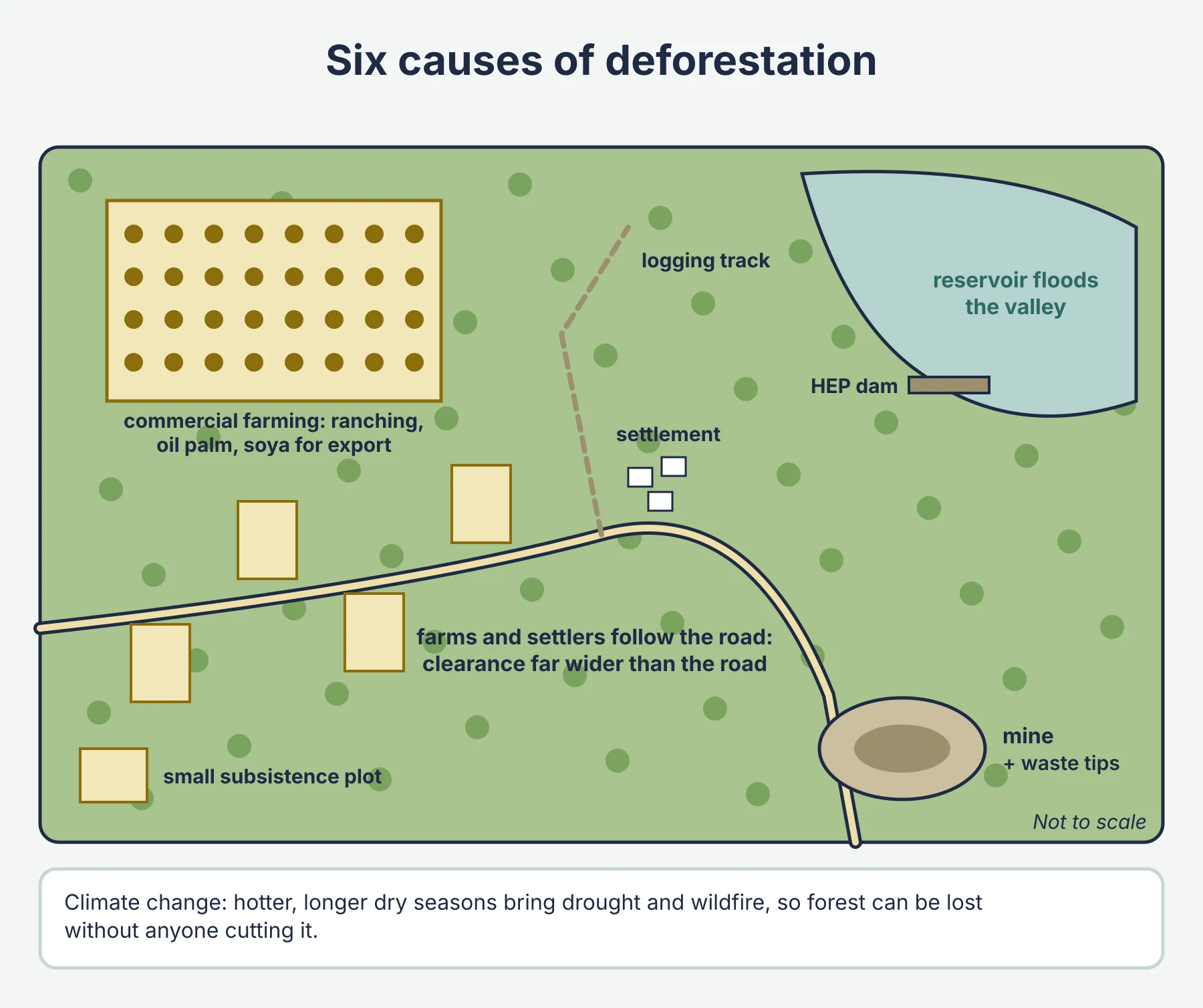
5.2.1 Causes of deforestation: six, each with its mechanism
| Cause | Why trees are removed | Knock-on effect |
|---|---|---|
| Logging and timber extraction | Hardwood for furniture, building, paper | Logging tracks open forest to settlers |
| Subsistence farming | Small plots to feed a family | Faster clearance as population rises |
| Commercial farming | Large areas for cattle, oil palm, soya for export | Huge blocks cleared, often by burning |
| Roads and settlements | Route and building land | Access lets other users move in |
| Rock, ore and mineral extraction | Surface mining strips vegetation and soil | Roads, housing and waste tips add loss |
| Hydro-electric power stations | Reservoir floods the valley | Construction roads and power lines |
| Climate change | Heat, longer dry seasons, drought | More wildfire; trees die without felling |
Exam point: one cause often triggers another. Mine → road → settlers → farms.
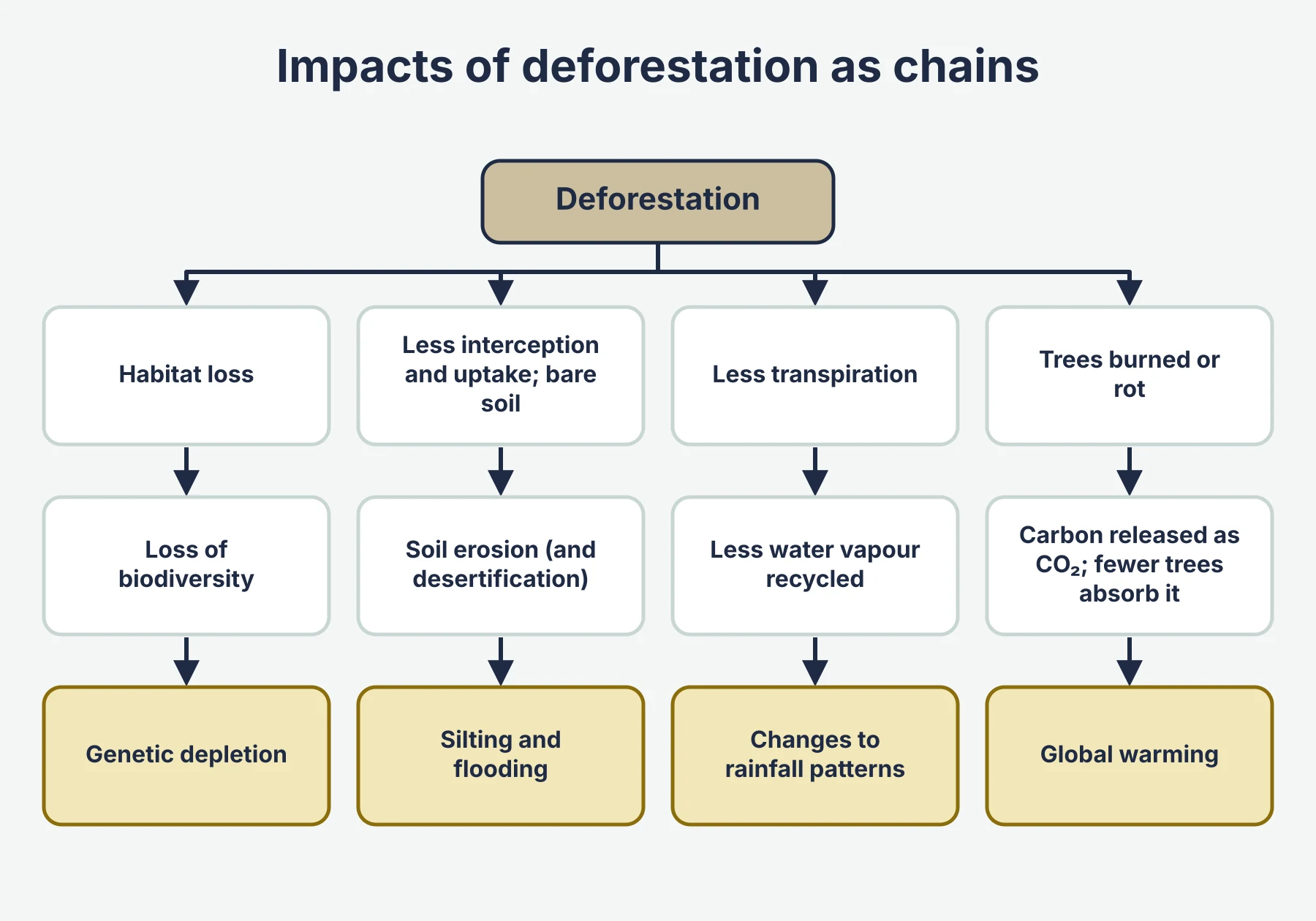
5.2.2 Impacts of deforestation: seven
- Habitat loss: food, shelter and breeding sites gone; remaining forest fragmented into patches.
- Loss of biodiversity: fewer species in the area; populations fall below the size needed to survive.
- Soil erosion and desertification: no canopy or roots; topsoil washed or blown away; no new leaf litter; dry land degrades towards desert.
- Silting and flooding: eroded soil settles in rivers, channel capacity falls; faster run-off reaches rivers sooner.
- Global warming: stored carbon released as carbon dioxide by burning or decay; fewer trees left to absorb it.
- Changes to rainfall patterns: less transpiration, so less water vapour for clouds; rainfall falls inland, dry seasons lengthen.
- Genetic depletion: genetic variety lost as populations and species disappear.
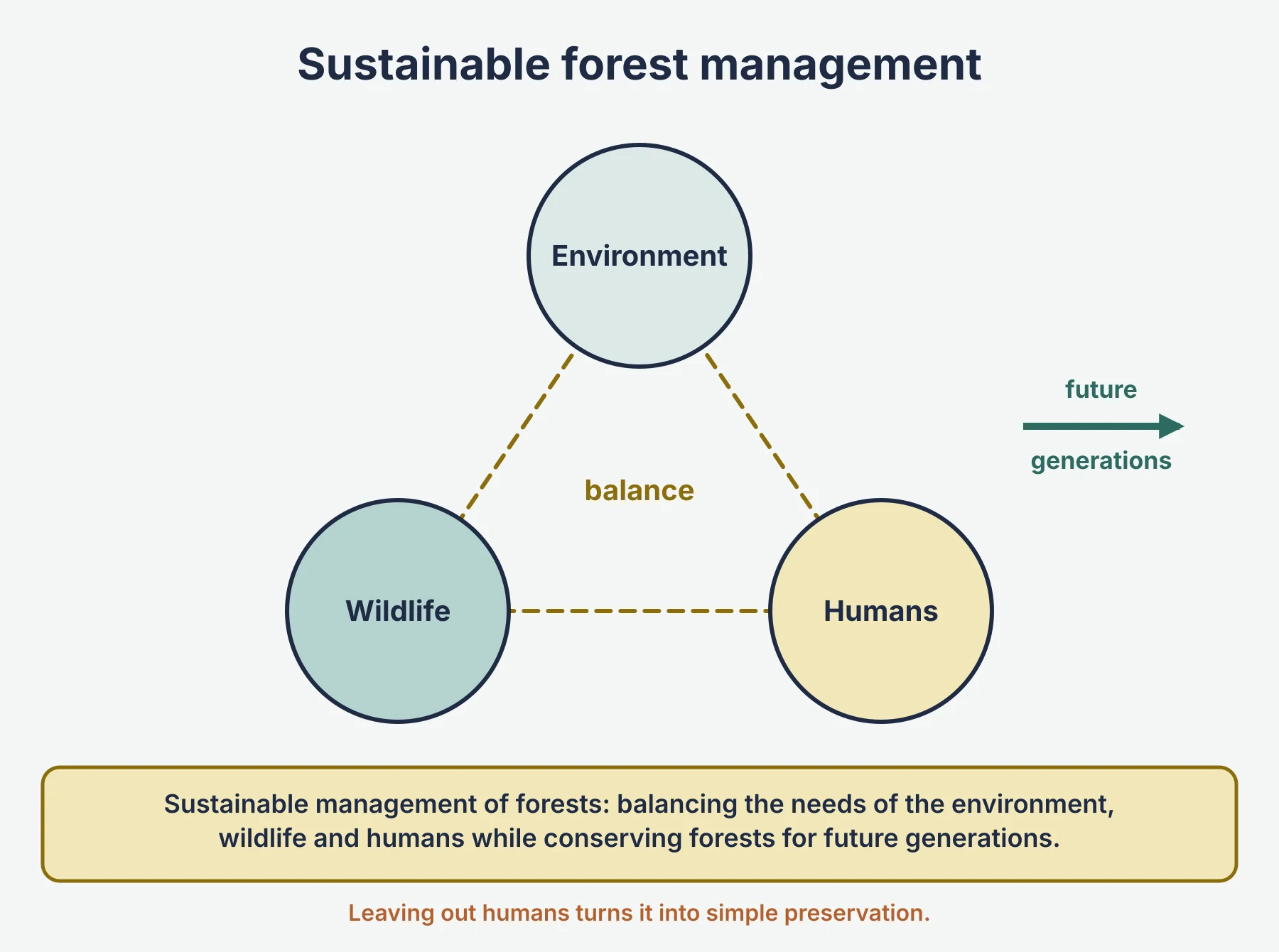
5.2.3 The definition (learn exactly)
Sustainable management of forests = balancing the needs of the environment, wildlife and humans while conserving forests for future generations.
Check your definition contains four parts: environment, wildlife, humans, future generations.
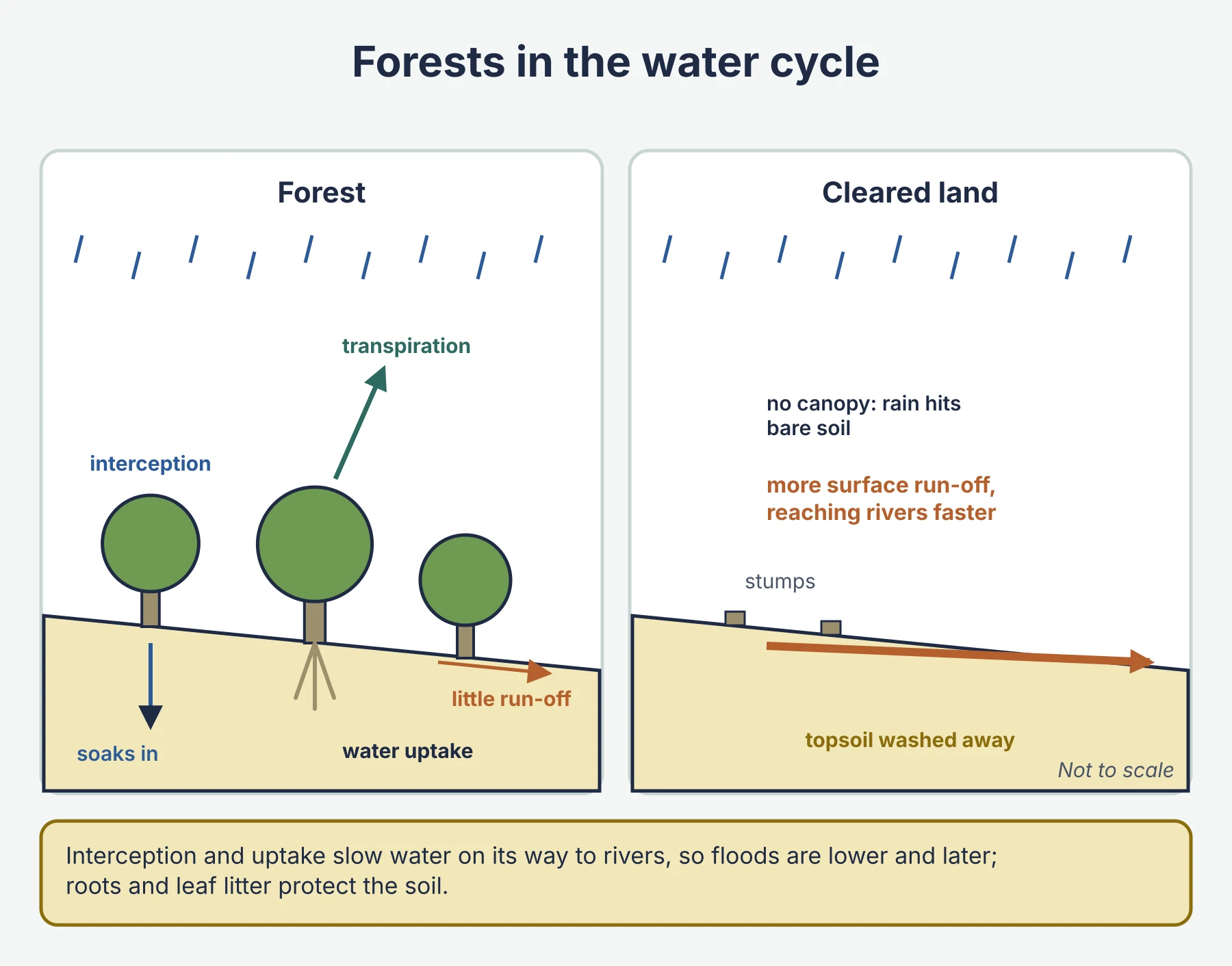
5.2.4 Why forests need sustainable management: seven
- Climate regulation: carbon sink (absorbs carbon dioxide) and carbon store (holds carbon in wood, roots, soil).
- Water cycle: interception, water uptake, transpiration, reduced surface run-off.
- Flood control: slower delivery of water to rivers, lower peaks.
- Prevention of soil erosion: roots bind soil; canopy and litter shield the ground.
- Genetic resource: genes for crop breeding and new medicines.
- Food, medicine and raw materials: fruit, nuts, medicinal plants, timber, rubber, fibre.
- Recreation, ecotourism and education: visitor income, local jobs, ecological study.
Key terms
| Term | Meaning |
|---|---|
| Deforestation | Removal of forest so the land is no longer forested |
| Interception | Leaves and branches catching rainfall before it reaches the ground |
| Water uptake | Roots absorbing water from the soil |
| Transpiration | Loss of water vapour from leaves to the air |
| Surface run-off | Water flowing over the ground surface towards rivers |
| Carbon sink | Something that absorbs more carbon dioxide than it releases |
| Carbon store | Something that holds carbon over a long period |
| Silting | Deposition of eroded soil in a river channel |
| Desertification | Degradation of dry land towards desert-like conditions |
| Genetic depletion | Loss of genetic variety within and between species |
| Subsistence farming | Growing food mainly for the farmer’s own family |
| Commercial farming | Growing crops or rearing animals for sale and profit |
Linked chains worth memorising
- Clearance → less interception and uptake → more surface run-off → faster, higher river peaks → flooding.
- Clearance → bare soil → erosion → soil carried into river → silting → reduced channel capacity → flooding.
- Clearance → less transpiration → less water vapour → less cloud and rain inland → drier climate → more forest stress. This last link shows how deforestation and climate change can feed each other.
- Burning forest → carbon dioxide released + fewer trees to absorb it → enhanced greenhouse effect → global warming.
Exam traps
- Saying trees “produce oxygen” as the main climate point; the syllabus wants carbon sink and store.
- Mixing interception (leaves) with infiltration (soil). Only interception is on the 5.2.4 list.
- Naming “farming” without saying subsistence or commercial and why each clears forest.
- Forgetting that hydro-electric power stations and climate change are named causes.
- Writing “loss of animals” for biodiversity; biodiversity is the variety of species, and genetic depletion is the loss of gene variety, a separate impact.
- Dropping “humans” or “future generations” from the definition.
- In a rate calculation, giving an answer without units such as km² per year.
Self-test
- State the syllabus definition of sustainable management of forests.
- Give two ways a new road leads to deforestation.
- Why does commercial farming usually clear more forest than subsistence farming?
- Explain how a hydro-electric power station causes deforestation.
- Explain how deforestation can change rainfall patterns.
- Distinguish a carbon sink from a carbon store.
- Explain how deforestation leads to silting.
- What is genetic depletion?
- Name the four water cycle processes listed in 5.2.4.
- How can climate change cause deforestation?
- Give two forest products other than timber.
- A forest shrinks from 2,000 km² to 1,700 km² in five years. Calculate the percentage lost and the mean annual loss.
Answers: 1. Balancing the needs of the environment, wildlife and humans while conserving forests for future generations. 2. Trees are removed along the route; access lets loggers, farmers and settlers move in. 3. It clears large areas to grow crops or rear cattle for sale and export, rather than small plots for a family. 4. The dam floods the valley, drowning forest under the reservoir; construction roads clear more. 5. Fewer trees means less transpiration, so less water vapour forms clouds and rain inland. 6. A sink absorbs carbon dioxide; a store holds carbon over time. 7. Exposed soil is eroded and washed into rivers, where it is deposited. 8. Loss of genetic variety as populations shrink and species are lost. 9. Interception, water uptake, transpiration, surface run-off. 10. Higher temperatures and longer droughts kill trees and increase wildfires. 11. Any two: fruit, nuts, medicinal plants, rubber, fibres, game. 12. 300 km² lost; 300 ÷ 2,000 × 100 = 15%; 300 ÷ 5 = 60 km² per year.
Next step
Try the Forest ecosystems practice questions, which include source-based and “discuss” questions.
Related resources
-
Revision notes
Cambridge IGCSE Environmental Management: Land — Revision Notes
Recall notes on soils and crop growth, food production and soil erosion for Topic 2 Land of Cambridge IGCSE Environmental Management 0680, 2027-2029 series.
Environmental Management · Cambridge · IGCSE
Revise topic -
Study guides
Cambridge IGCSE Environmental Management (0680): Managing biodiversity
All ten strategies for conserving biodiversity and genetic resources in Cambridge IGCSE 0680 sub-topic 5.3, with benefits, limitations and discuss technique.
Environmental Management · Cambridge · IGCSE
Read guide -
Practice questions
Cambridge IGCSE Environmental Management (0680): Managing biodiversity – Practice Questions
Twelve original questions with mark-scheme answers on strategies for conserving biodiversity and genetic resources for Cambridge IGCSE 0680 sub-topic 5.3.
Environmental Management · Cambridge · IGCSE
Try questions
Get free revision emails (optional)
Occasional emails with practice questions, worked explanations and links to free resources for the qualification and subjects you choose. No spam, and you can unsubscribe from any email. The free tools on this site never need an email.