
Study Guides
Cambridge IGCSE Environmental Management (0680): Managing biodiversity
All ten strategies for conserving biodiversity and genetic resources in Cambridge IGCSE 0680 sub-topic 5.3, with benefits, limitations and discuss technique.
- Subject
- Environmental Management
- Level
- IGCSE
- Topic
- Topic 5: Ecosystems, biodiversity and fieldwork
- Author
- Marlbridge Academic Team
- Updated
- Reviewed by
- Azam Siddique (what this means)
Aligned to Cambridge IGCSE Environmental Management (0680), 2027-2029. Official specification .
Syllabus page (what it covers and how it is assessed): Cambridge IGCSE Environmental Management.
Syllabus points this page covers
0680
- 5.3 Managing biodiversity
Found an error? Report a correction.
Need help with this topic? Request a free trial class for IGCSE Environmental Management (0680).
Sub-topic 5.3 of Cambridge IGCSE Environmental Management (0680, 2027-2029) has only two statements, but they carry a lot of marks. Statement 5.3.1 asks you to describe ten named strategies for conserving the biodiversity and genetic resources of natural ecosystems. Statement 5.3.2 asks you to discuss the benefits and limitations of those strategies. This guide takes each strategy in turn, gives its main benefit and limitation, and shows how to build a balanced “discuss” answer. For the wider topic, see the Ecosystems, biodiversity and fieldwork study guide.
Two ideas to hold on to
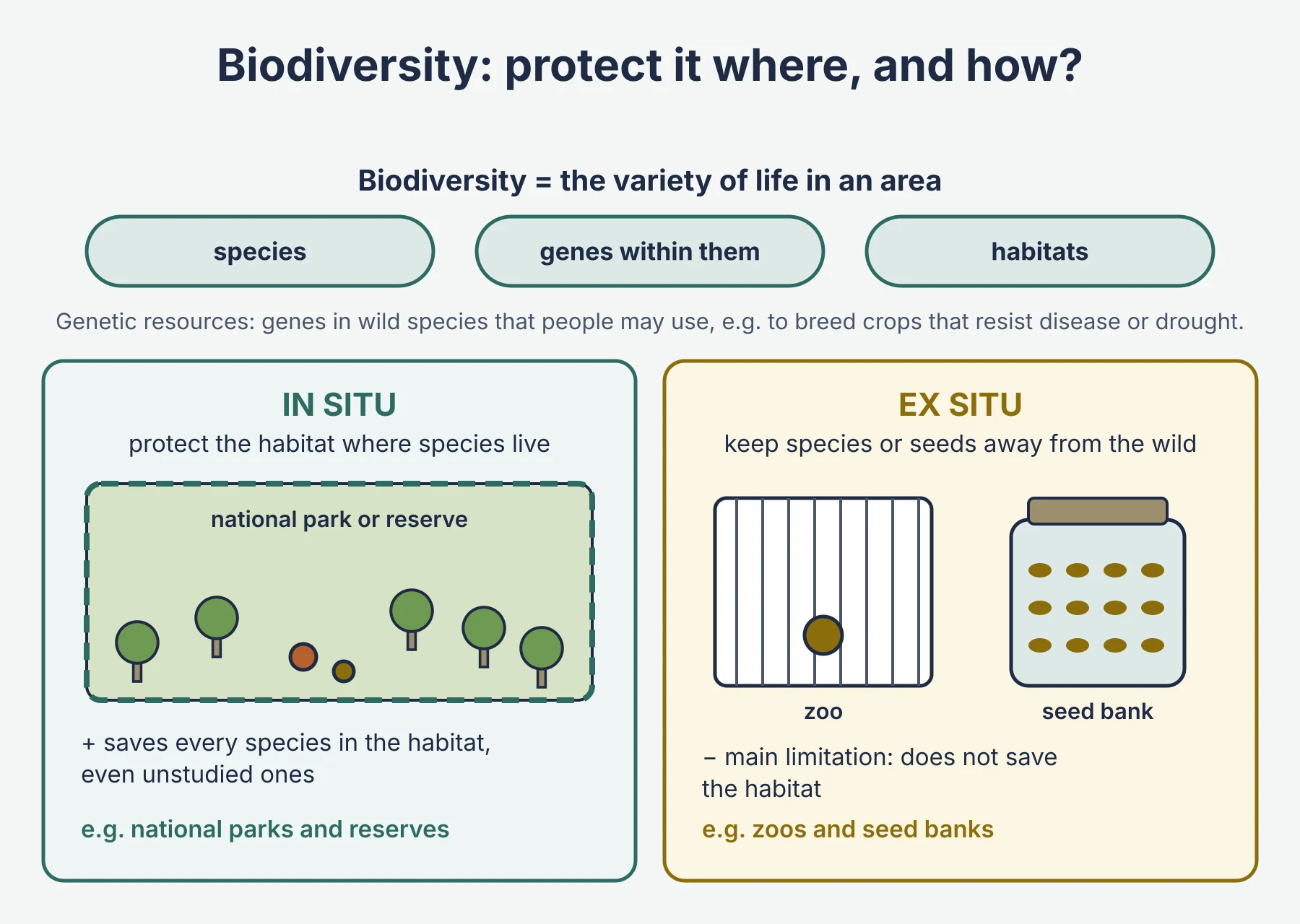
Biodiversity is the variety of life in an area: the number of different species, the variety of genes within them and the variety of habitats. Genetic resources are the genes held in wild plants and animals that people may use, for example to breed crops that resist disease or drought.
Strategies work at different scales. Some protect whole habitats where species live (in situ conservation, such as national parks); others keep species or their seeds away from the wild (ex situ conservation, such as zoos and seed banks). Examiners reward answers that notice this, because the main limitation of most ex situ methods is that they do not save the habitat.
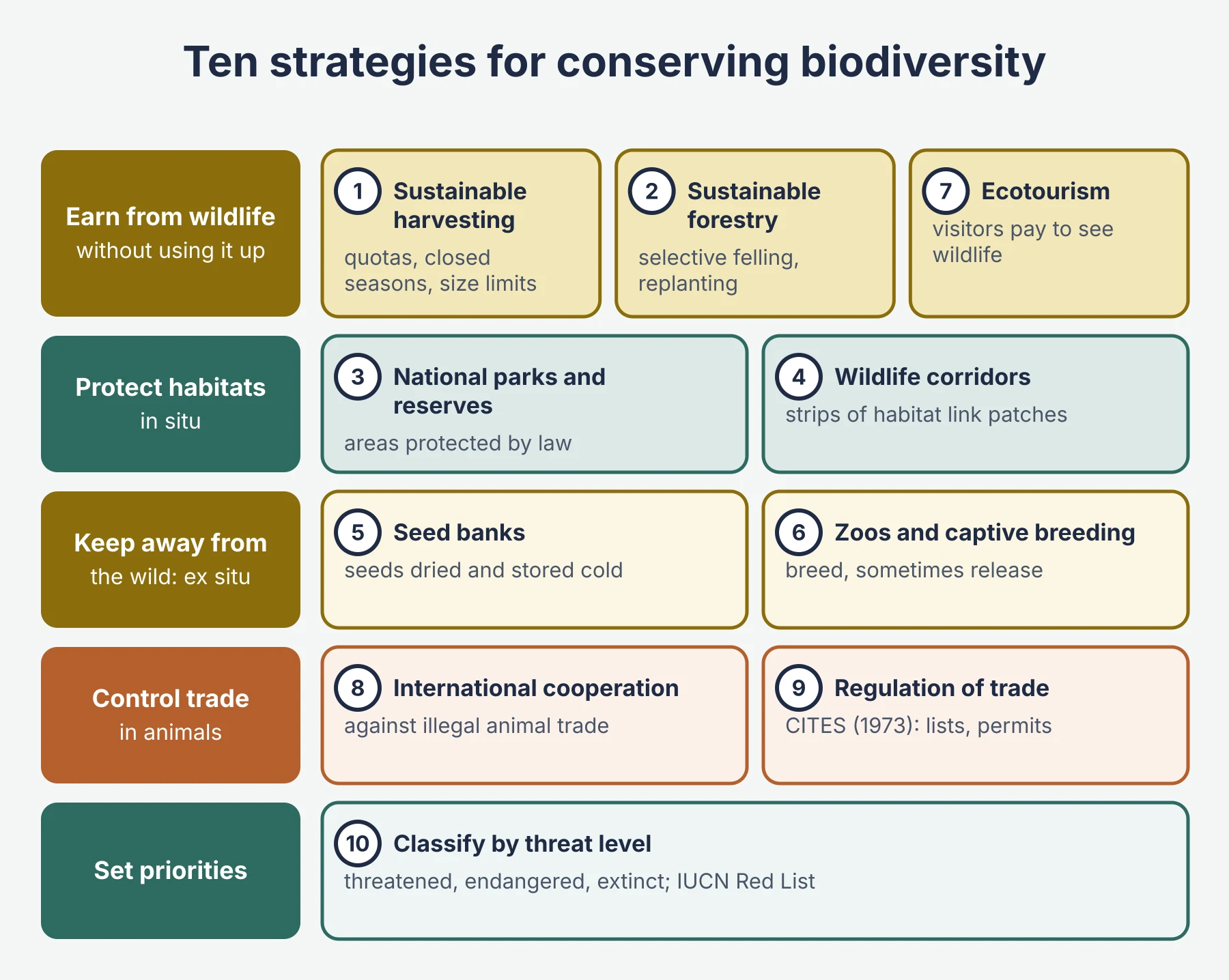
The ten strategies (5.3.1)
1. Sustainable harvesting of wild plant and animal species
Taking wild fish, game, fruit or medicinal plants at a rate no faster than the population can replace itself. Tools include quotas, closed seasons during breeding, size limits and permits.
- Benefit: people keep an income and food supply, so they have a reason to protect the species.
- Limitation: the safe rate is hard to measure, and quotas fail without monitoring and enforcement.
2. Sustainable forestry
Managing forests so timber is taken without destroying the ecosystem: selective felling of mature trees, replanting, leaving buffer strips along rivers and certifying timber from well-managed forests.
- Benefit: combines timber income with habitat that still supports wildlife.
- Limitation: replanted areas often have fewer species than the original forest, and certified timber can cost more.
3. National parks and reserves
Large areas protected by law, where development, hunting or clearance is banned or controlled.
- Benefit: protects whole habitats and every species in them, including ones not yet studied.
- Limitation: needs rangers and funding; local people may lose land or resources, causing conflict; boundaries do not stop pollution or climate change.
4. Wildlife corridors
Strips of habitat, such as hedgerows, forest belts, underpasses or bridges over roads, that link separate patches of habitat.
- Benefit: animals can move between patches to feed and breed, so small populations mix and keep genetic variety.
- Limitation: corridors take land that could be farmed or built on, and narrow strips may also let predators, disease or invasive species spread.
5. Seed banks
Seeds are dried and stored at low temperatures so they stay alive for many years. The Svalbard Global Seed Vault in Norway, opened in 2008, stores duplicate samples of crop seeds from banks around the world.
- Benefit: stores the genetic variety of thousands of plants cheaply in a small space, as insurance against extinction.
- Limitation: does not protect plants in the wild or the animals that depend on them; some seeds cannot survive drying and freezing; stored seeds must be tested and regrown from time to time.
6. Zoos and captive breeding
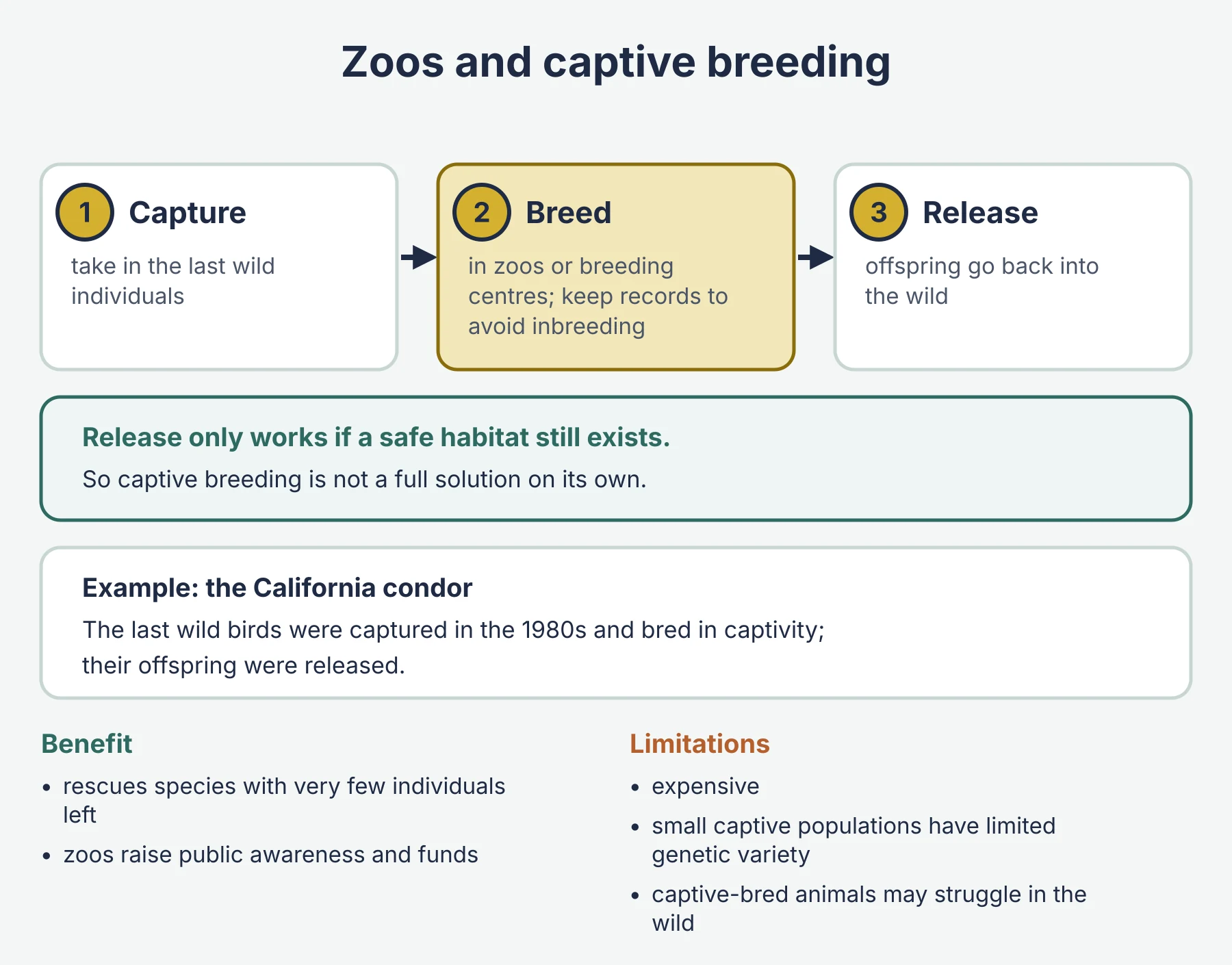
Breeding rare animals in zoos or breeding centres, keeping records to avoid inbreeding, and in some cases releasing them back into the wild. The California condor was saved by capturing the last wild birds in the 1980s, breeding them in captivity and releasing their offspring.
- Benefit: can rescue species with very few individuals left, and zoos raise public awareness and funds.
- Limitation: expensive; small captive populations have limited genetic variety; animals bred in captivity may struggle in the wild; release only works if a safe habitat still exists.
7. Ecotourism
Small-scale, low-impact tourism to natural areas, in which visitors pay to see wildlife and the money supports conservation and local people.
- Benefit: gives wildlife an economic value alive, creating jobs as guides and in lodges.
- Limitation: visitors can disturb animals, cause litter and erosion, and need transport; income falls if tourism declines.
8. International cooperation against animal trade
Countries work together to stop illegal trade in animals and their products, such as ivory or rhino horn, by sharing intelligence, training customs officers and reducing demand.
- Benefit: tackles a trade that crosses borders, which no single country can stop.
- Limitation: high prices encourage smuggling; poorer countries may lack money for enforcement.
9. Regulation of trade in vulnerable and endangered species
Laws and agreements control which species can be bought and sold. The best-known agreement is CITES (the Convention on International Trade in Endangered Species of Wild Fauna and Flora), agreed in 1973. Species are listed according to how threatened they are, and trade in the most threatened is banned for commercial purposes, while trade in others needs permits.
- Benefit: a clear legal framework that most countries have signed.
- Limitation: only works where it is enforced; illegal trade continues; it does not protect habitats.
10. Classifying organisms by threat level
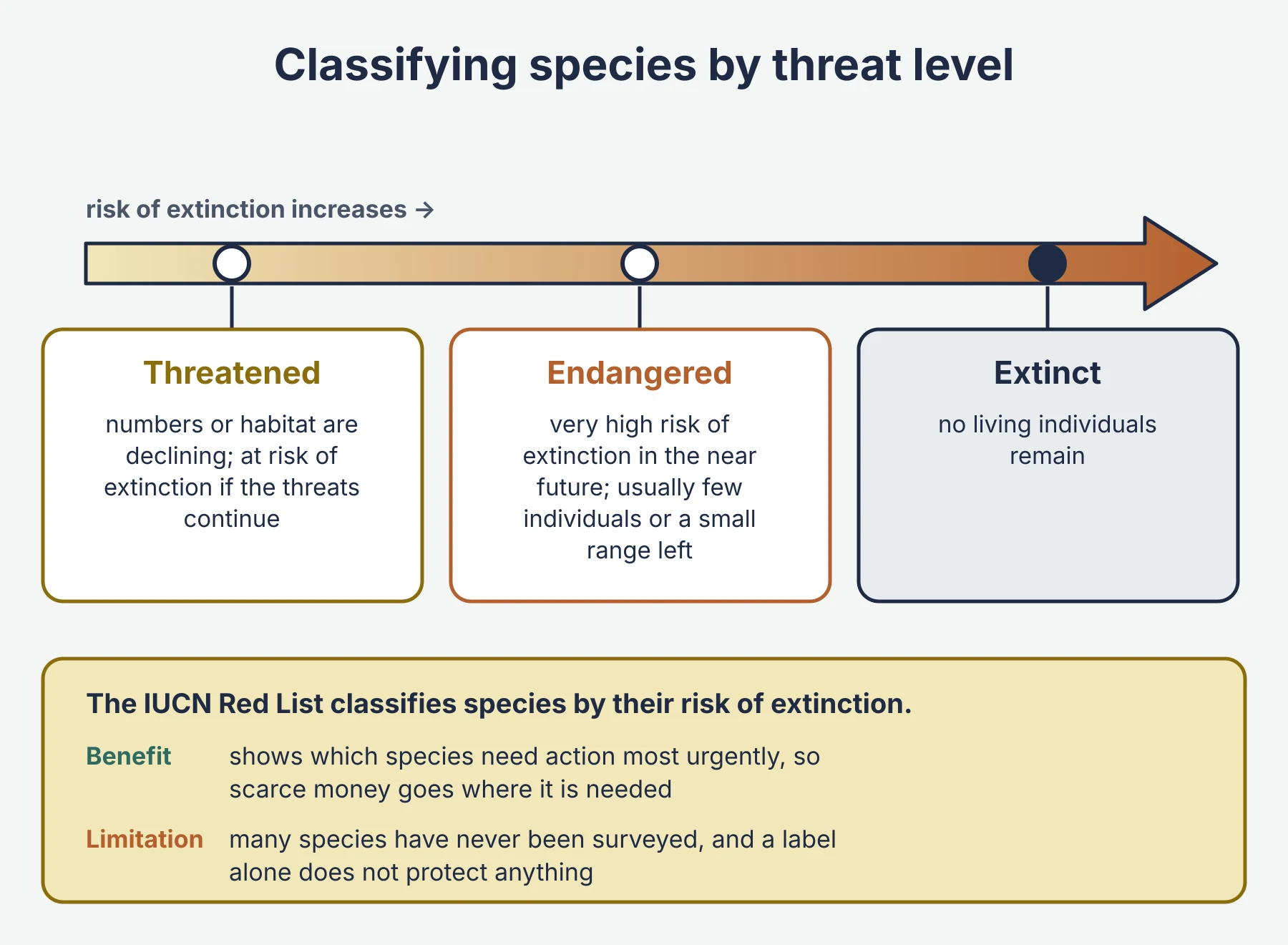
The syllabus names three levels:
- Threatened: numbers or habitat are declining, so the species is at risk of extinction if the threats continue.
- Endangered: a very high risk of extinction in the near future, usually with few individuals or a small range left.
- Extinct: no living individuals remain.
The International Union for Conservation of Nature (IUCN) publishes the Red List, which classifies species by their risk of extinction.
- Benefit: shows which species need action most urgently, so scarce money is directed where it is needed.
- Limitation: many species have never been surveyed, and a label alone does not protect anything.
Discussing benefits and limitations (5.3.2)
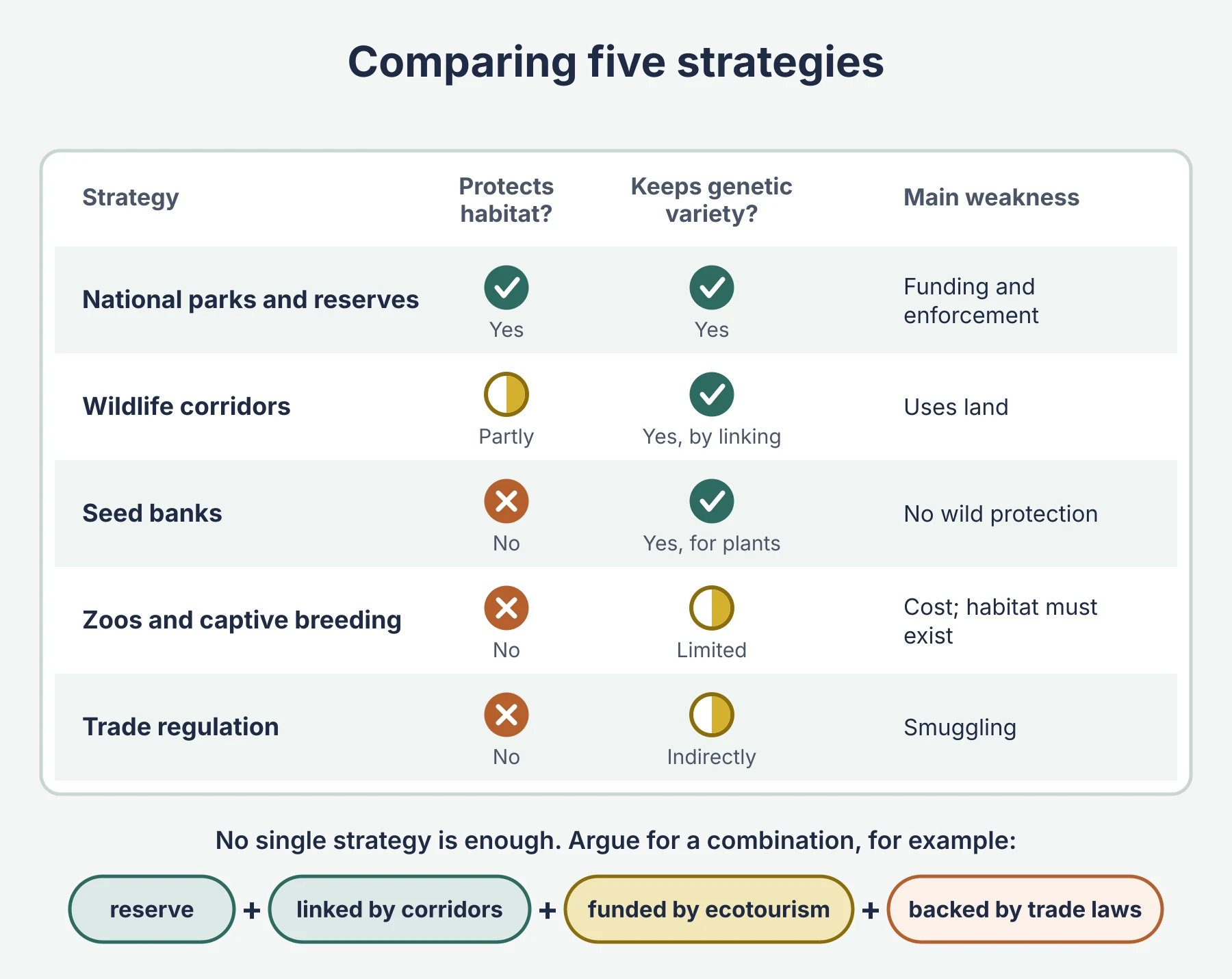
“Discuss” means write in depth in a structured way. A strong answer for a strategy follows four steps: say what the strategy does, give a benefit with a reason, give a limitation with a reason, and reach a judgement. A short comparison table helps planning:
| Strategy | Protects habitat? | Keeps genetic variety? | Main weakness |
|---|---|---|---|
| National parks and reserves | Yes | Yes | Funding and enforcement |
| Wildlife corridors | Partly | Yes, by linking populations | Uses land |
| Seed banks | No | Yes, for plants | No wild protection |
| Zoos and captive breeding | No | Limited | Cost; habitat must exist |
| Trade regulation | No | Indirectly | Smuggling |
No single strategy is enough. Most conclusions should argue for a combination, for example a reserve linked by corridors, funded by ecotourism and backed by trade laws.
Worked example 1: a corridor’s effect
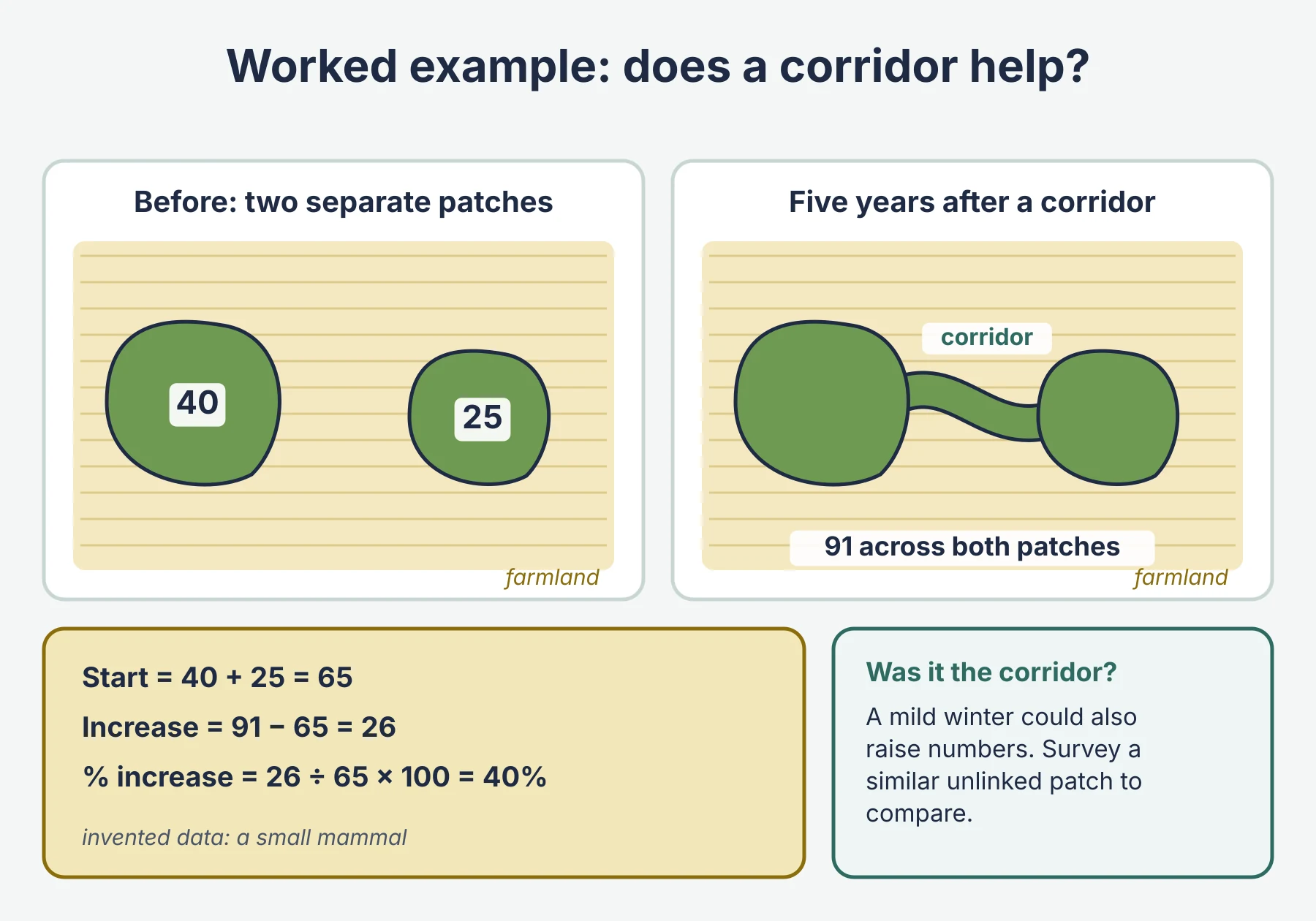
The data are invented. Before a forest corridor was planted, two separated woodland patches held 40 and 25 of a small mammal. Five years after the corridor joined them, a survey counted 91 across both patches.
- Starting total = 40 + 25 = 65.
- Increase = 91 − 65 = 26.
- Percentage increase = 26 ÷ 65 × 100 = 40%.
A careful conclusion adds that other factors, such as a mild winter, could also have raised numbers; a survey of a similar unlinked patch would show whether the corridor was the cause.
Worked example 2: annotated “discuss” answer
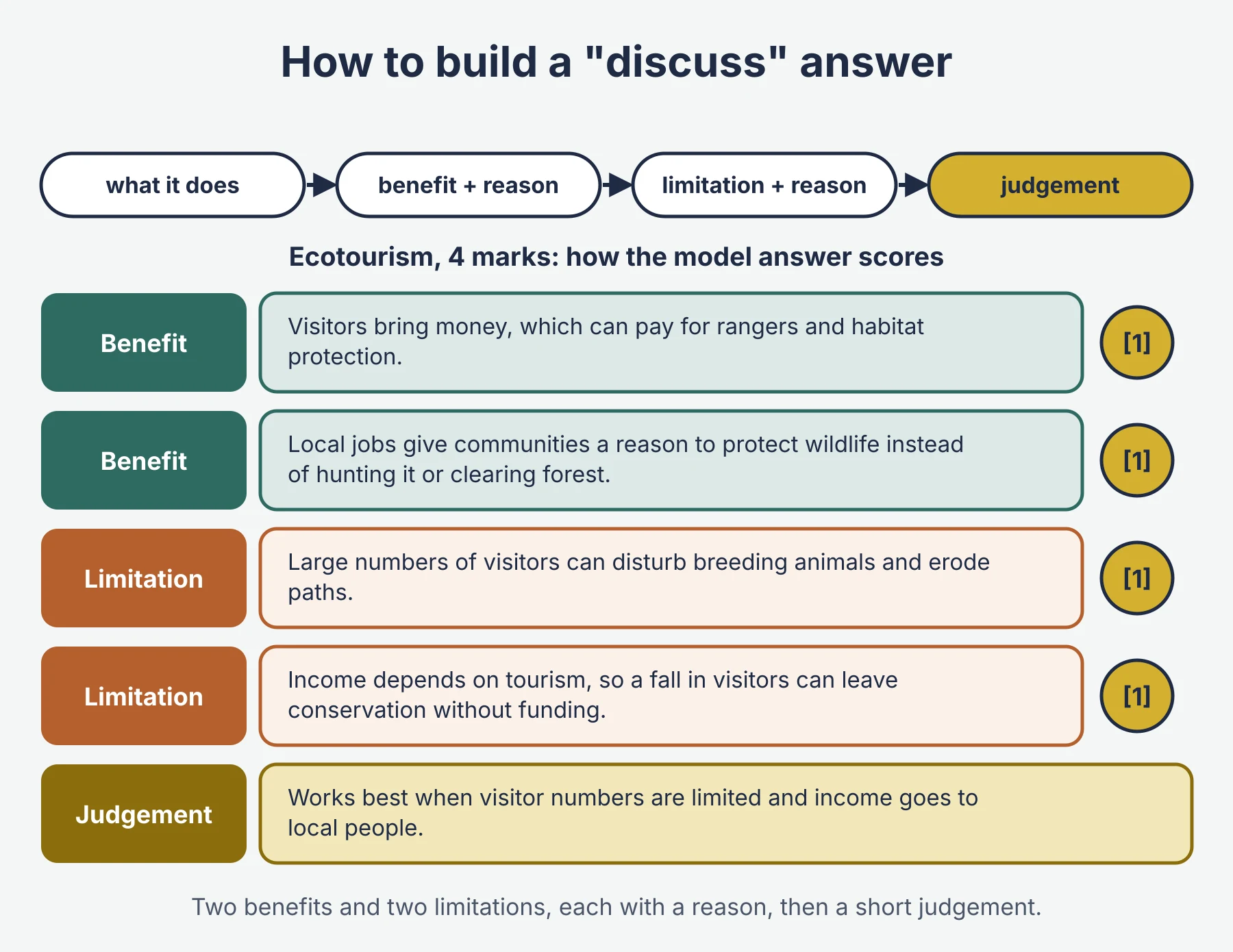
Question: Discuss the benefits and limitations of ecotourism for conserving biodiversity. [4]
Model answer: Ecotourism brings money from visitors, which can pay for rangers and habitat protection [1]. It creates local jobs, so communities have a reason to protect wildlife instead of hunting it or clearing forest [1]. However, large numbers of visitors can disturb breeding animals and erode paths [1], and income depends on tourism, so a fall in visitor numbers can leave conservation without funding [1]. Overall, ecotourism works best when visitor numbers are limited and income goes to local people.
Why it scores: two benefits and two limitations, each with a reason, then a short judgement.
Common mistakes
- Treating zoos as a full solution: captive breeding saves a species only if the habitat survives for release.
- Confusing the two trade strategies; one is cooperation between countries, the other is regulation through lists and permits.
- Calling a seed bank a way to protect animals.
- Writing only benefits in a “discuss” answer.
- Saying “endangered” and “extinct” interchangeably.
Exam technique
- Describe a strategy: say what it involves and how it conserves species or genes.
- Discuss: benefit with a reason, limitation with a reason, then a judgement on when it works best or what to combine it with.
- Suggest a strategy for a named place: match it to the threat in the source, such as corridors where habitat is fragmented or trade controls where poaching is described.
- In calculations, compare with the original value and give the unit or percentage.
Review the Managing biodiversity revision notes and then try the Managing biodiversity practice questions.
Related resources
-
Revision notes
Cambridge IGCSE Environmental Management: Land — Revision Notes
Recall notes on soils and crop growth, food production and soil erosion for Topic 2 Land of Cambridge IGCSE Environmental Management 0680, 2027-2029 series.
Environmental Management · Cambridge · IGCSE
Revise topic -
Practice questions
Cambridge IGCSE Environmental Management (0680): Managing biodiversity – Practice Questions
Twelve original questions with mark-scheme answers on strategies for conserving biodiversity and genetic resources for Cambridge IGCSE 0680 sub-topic 5.3.
Environmental Management · Cambridge · IGCSE
Try questions -
Revision notes
Cambridge IGCSE Environmental Management (0680): Managing biodiversity – Revision Notes
Recall notes for Cambridge IGCSE 0680 sub-topic 5.3: the ten conservation strategies, a benefit and limitation for each, threat levels and a self-test.
Environmental Management · Cambridge · IGCSE
Revise topic
Get free revision emails (optional)
Occasional emails with practice questions, worked explanations and links to free resources for the qualification and subjects you choose. No spam, and you can unsubscribe from any email. The free tools on this site never need an email.