
Revision Notes
Cambridge IGCSE Environmental Management (0680): Managing biodiversity – Revision Notes
Recall notes for Cambridge IGCSE 0680 sub-topic 5.3: the ten conservation strategies, a benefit and limitation for each, threat levels and a self-test.
- Subject
- Environmental Management
- Level
- IGCSE
- Topic
- Topic 5: Ecosystems, biodiversity and fieldwork
- Author
- Marlbridge Academic Team
- Updated
- Reviewed by
- Azam Siddique (what this means)
Aligned to Cambridge IGCSE Environmental Management (0680), 2027-2029. Official specification .
Syllabus page (what it covers and how it is assessed): Cambridge IGCSE Environmental Management.
Syllabus points this page covers
0680
- 5.3 Managing biodiversity
Found an error? Report a correction.
Need help with this topic? Request a free trial class for IGCSE Environmental Management (0680).
Condensed recall for sub-topic 5.3 of Cambridge IGCSE Environmental Management (0680, 2027-2029). The full explanations, examples and a model answer are in the Managing biodiversity study guide.
What 5.3 asks
- 5.3.1 Describe ten strategies for conserving the biodiversity and genetic resources of natural ecosystems.
- 5.3.2 Discuss their benefits and limitations.
So for every strategy you need three things: what it is, one benefit with a reason, one limitation with a reason.
Memory hook: three groups
| Group | Strategies | Common thread |
|---|---|---|
| Use wisely | Sustainable harvesting; sustainable forestry; ecotourism | People earn from nature without destroying it |
| Protect places | National parks and reserves; wildlife corridors | Keep habitats intact and connected (in situ) |
| Protect species away from the wild | Seed banks; zoos and captive breeding | Insurance copies of genes and individuals (ex situ) |
| Control and classify | International cooperation against animal trade; regulation of trade in vulnerable and endangered species; classifying threat level | Laws, lists and priorities |
The ten strategies at a glance
| Strategy | Benefit | Limitation |
|---|---|---|
| Sustainable harvesting | Food and income continue; locals value the species | Safe rate hard to judge; quotas need enforcement |
| Sustainable forestry | Timber income and habitat together | Replanted areas less diverse; certified timber costs more |
| National parks and reserves | Whole habitats and all their species protected | Funding, rangers; conflict with local land use |
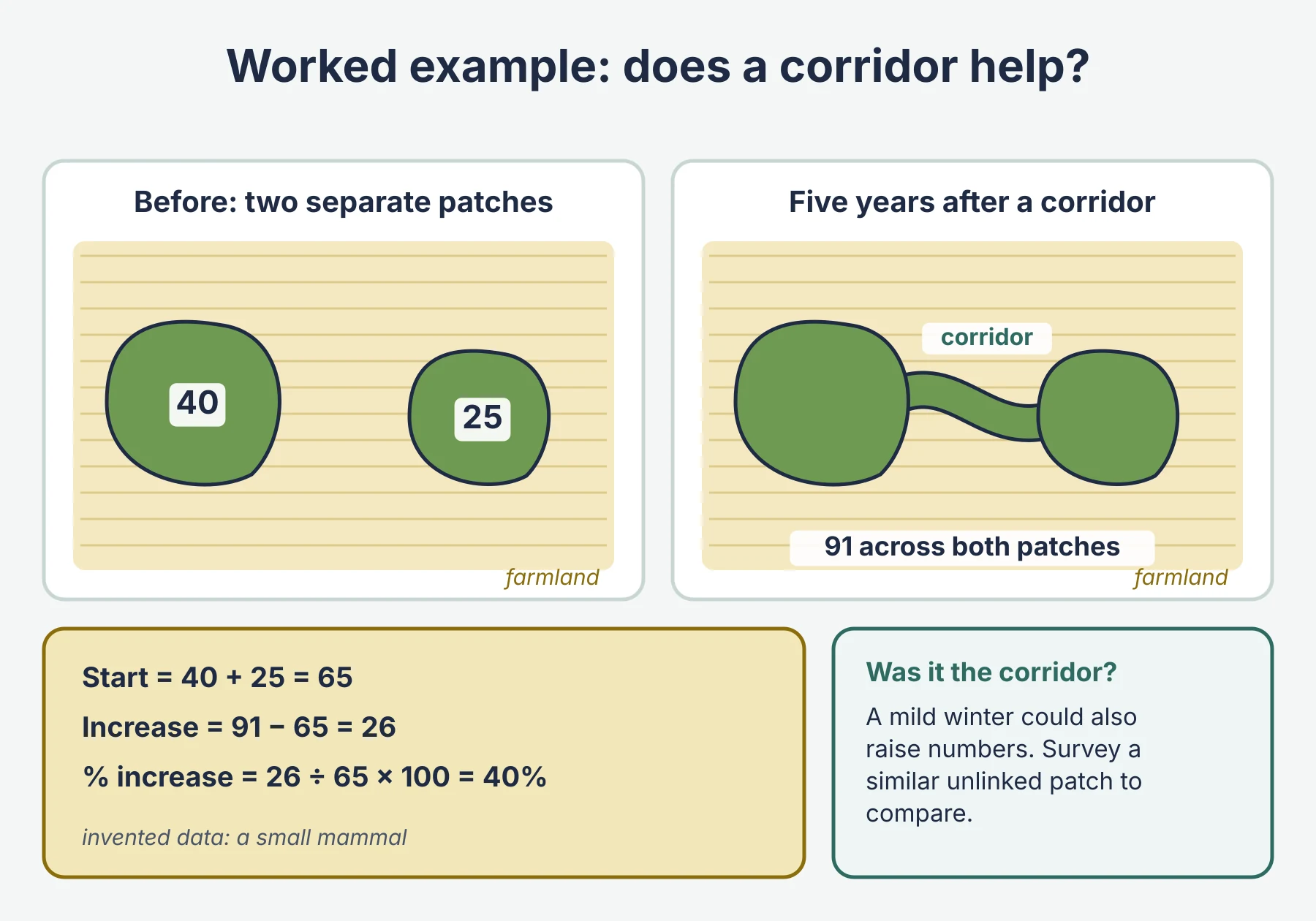
| Wildlife corridors | Populations move, mix, breed; genetic variety kept | Take land; can spread disease or invasive species |
| Seed banks | Cheap, compact store of plant genetic variety | No protection in the wild; some seeds cannot be stored |
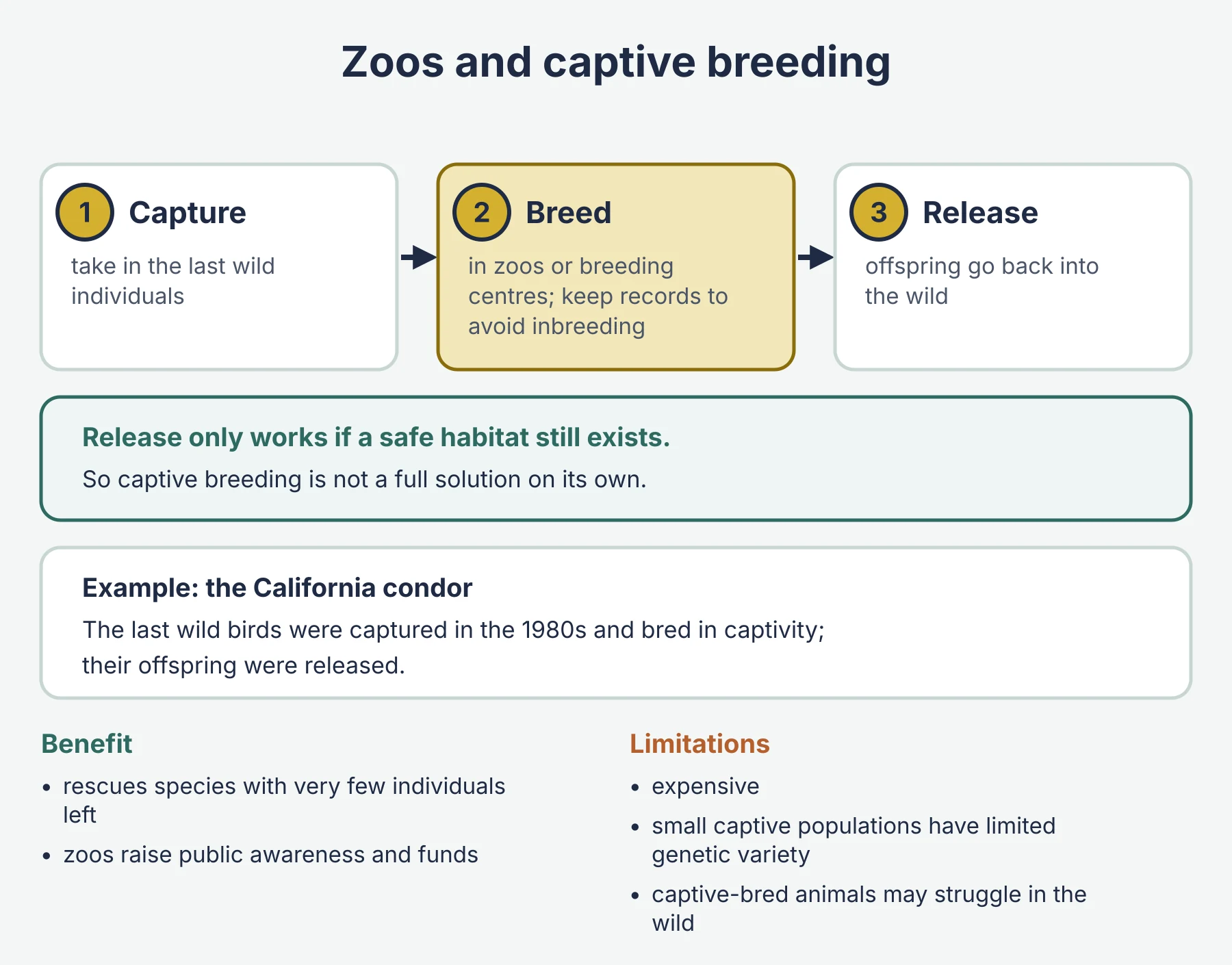
| Zoos and captive breeding | Rescue species with very few left; awareness | Costly; low genetic variety; release needs habitat |
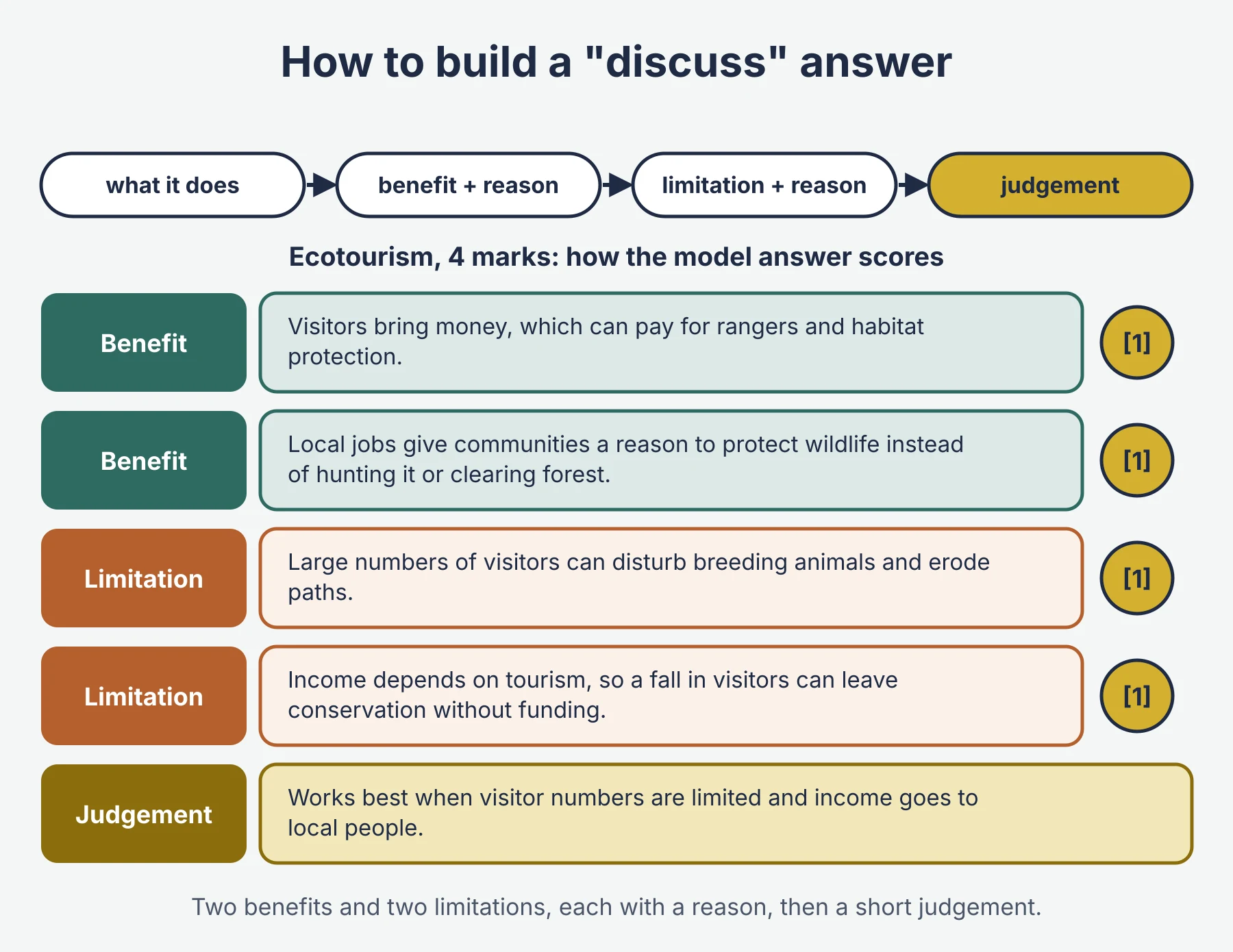
| Ecotourism | Wildlife worth more alive; local jobs | Disturbance, erosion, transport; income unreliable |
| International cooperation against animal trade | Tackles smuggling across borders | High prices drive smuggling; enforcement costs |
| Regulation of trade in vulnerable and endangered species | Legal framework; permits; bans on the most threatened | Weak where unenforced; habitats not protected |
| Classifying threat level | Directs money to the most urgent cases | Many species unsurveyed; a label protects nothing |
Threat levels (as named in the syllabus)
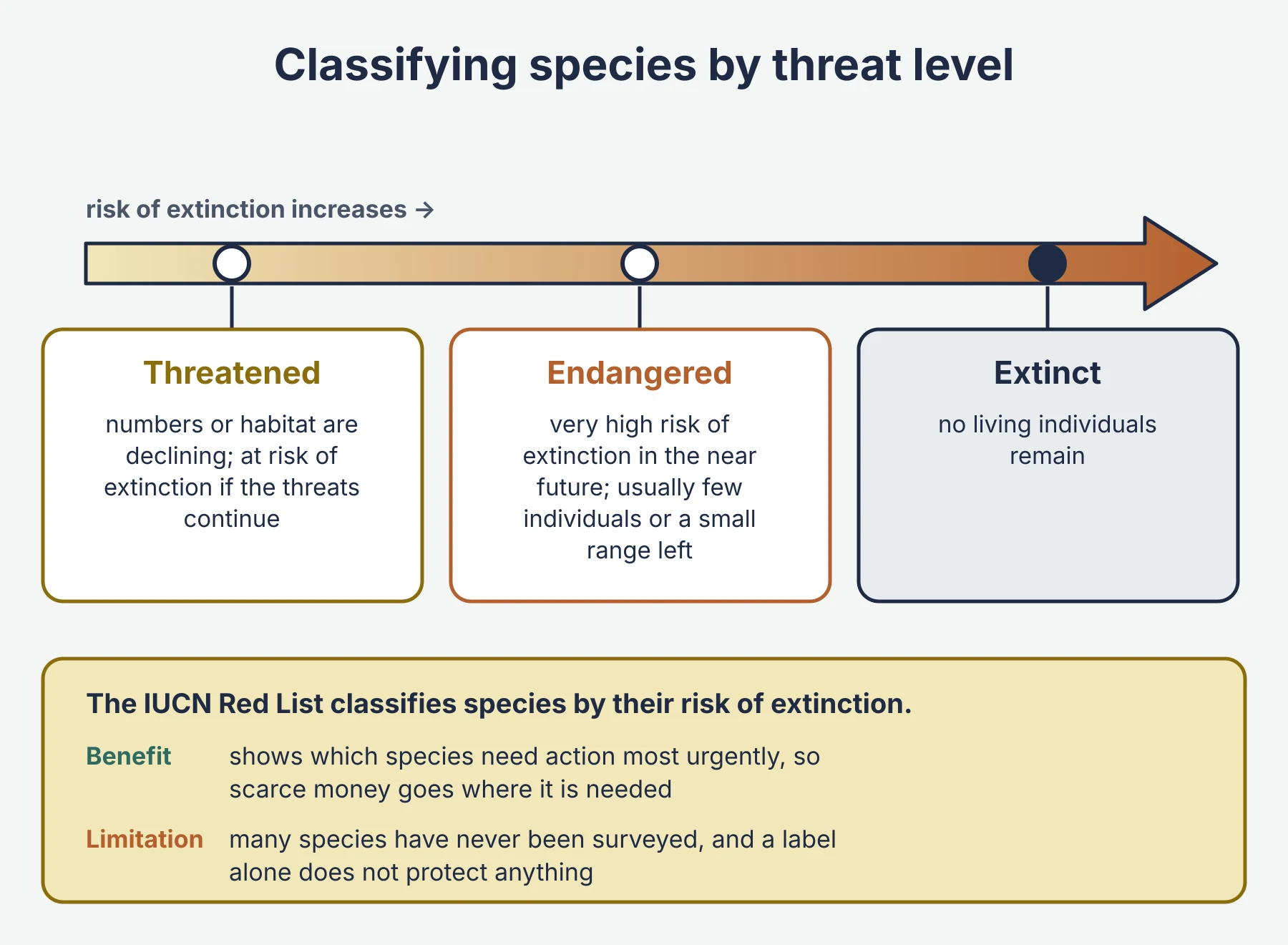
- Threatened: declining, at risk of extinction if threats continue.
- Endangered: very high risk of extinction soon; few individuals or small range.
- Extinct: no living individuals remain.
The IUCN Red List is the international list that classifies species by extinction risk. CITES is the international agreement, from 1973, that regulates trade in listed species.
Key terms
| Term | Meaning |
|---|---|
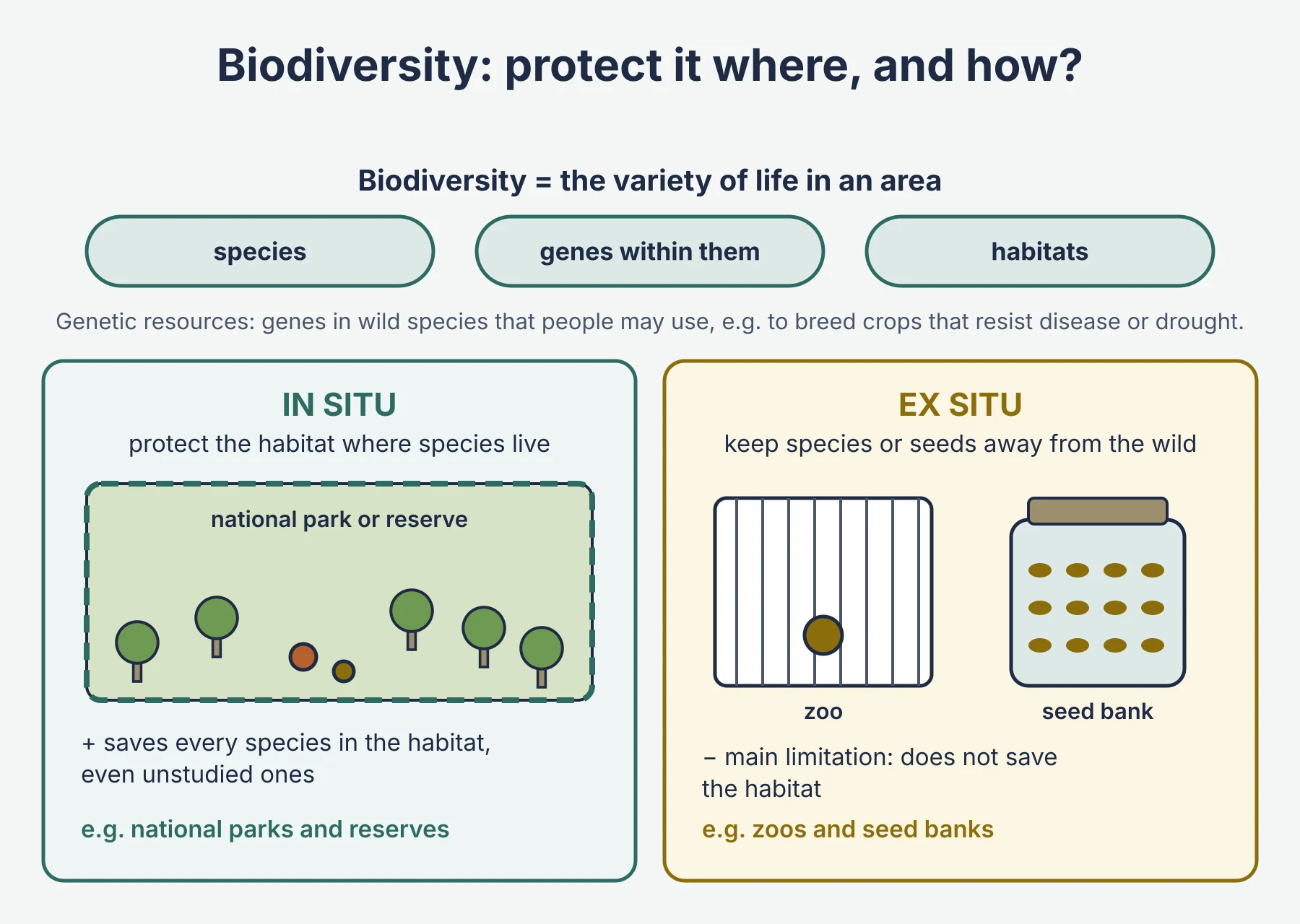
| Biodiversity | Variety of species, genes and habitats in an area |
| Genetic resources | Genes in wild species that people may use, such as for crop breeding |
| In situ conservation | Protecting species in their natural habitat |
| Ex situ conservation | Protecting species outside their natural habitat |
| Quota | A limit on the number or mass that may be harvested |
| Habitat fragmentation | Splitting habitat into small, isolated patches |
| Wildlife corridor | A strip of habitat linking separate patches |
| Captive breeding | Breeding animals in zoos or centres, sometimes for release |
| Reintroduction | Releasing captive-bred organisms into the wild |
| Ecotourism | Low-impact tourism that funds conservation and local people |
| Inbreeding | Breeding between close relatives, which lowers genetic variety |
Building a “discuss” answer in four lines
- What it does: one sentence.
- Benefit + because.
- Limitation + because.
- Judgement: when it works best, or what it should be combined with.
Typical judgement lines:
- Captive breeding is a last resort and only succeeds if the habitat is protected for release.
- Seed banks are insurance, not a replacement for protecting wild plants.
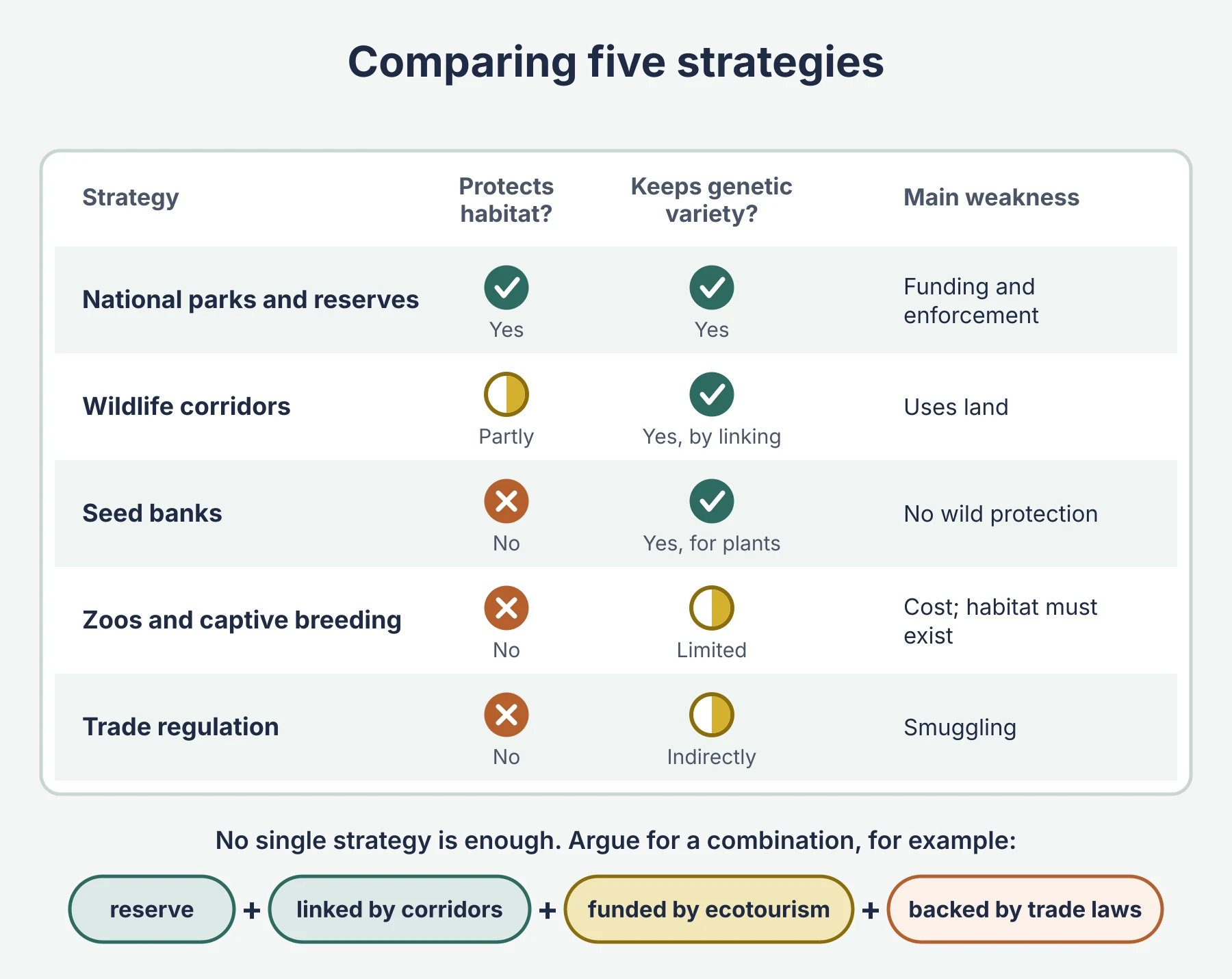
- Reserves work best when linked by corridors and supported by local people through ecotourism income.
- Trade laws need enforcement and reduced demand, or smuggling continues.
Exam traps
- Only benefits: “discuss” needs both sides; one-sided answers lose half the marks.
- Zoos save everything: no, the habitat must still exist for release.
- Seed banks for animals: seed banks store plant genetic material only.
- Mixing the two trade strategies: cooperation between countries against animal trade is one; regulation of trade in vulnerable and endangered species through lists and permits is another.
- Vague benefits: “it helps animals” earns nothing; say how, such as “joins populations so they can breed”.
- Ignoring people: limitations of reserves often concern local livelihoods.
- Threat levels in the wrong order: threatened, then endangered, then extinct.
Self-test
- Define biodiversity.
- What is meant by genetic resources?
- Give one benefit and one limitation of sustainable harvesting.
- Explain how a wildlife corridor helps maintain genetic variety.
- Why is a seed bank not enough to save a plant species on its own?
- Give two limitations of captive breeding.
- How does ecotourism give local people a reason to conserve wildlife?
- Distinguish an endangered species from an extinct one.
- Name the international agreement that regulates trade in endangered species.
- Give one limitation of national parks for local people.
- Which two strategies are ex situ?
- Why does classifying species by threat level help conservation?
Answers: 1. The variety of species, genes and habitats in an area. 2. Genes in wild species that people may use, for example to breed crops. 3. Benefit: food and income continue, so people value the species; limitation: the safe rate is hard to measure and quotas need enforcement. 4. It links isolated populations so they can move and breed together, reducing inbreeding. 5. It does not protect the wild habitat or the animals that depend on the plant, and some seeds cannot be stored. 6. Any two: costly; low genetic variety; captive-bred animals may struggle in the wild; habitat must exist for release. 7. Visitors pay to see living wildlife, creating jobs as guides and in lodges. 8. Endangered species still survive but at very high risk; extinct species have no living individuals. 9. CITES. 10. Loss of access to land, hunting or forest resources. 11. Seed banks; zoos and captive breeding. 12. It shows which species need action most urgently, so limited funds go to them.
Next step
Put this into practice with the Managing biodiversity practice questions.
Related resources
-
Revision notes
Cambridge IGCSE Environmental Management: Land — Revision Notes
Recall notes on soils and crop growth, food production and soil erosion for Topic 2 Land of Cambridge IGCSE Environmental Management 0680, 2027-2029 series.
Environmental Management · Cambridge · IGCSE
Revise topic -
Study guides
Cambridge IGCSE Environmental Management (0680): Ecosystems, biodiversity and fieldwork – Study Guide
Food webs, energy flow, rainforests and deforestation, protecting biodiversity, and sampling fieldwork for Cambridge IGCSE Environmental Management 0680.
Environmental Management · Cambridge · IGCSE
Read guide -
Practice questions
Cambridge IGCSE Environmental Management: Ecosystems, Biodiversity and Fieldwork — Practice Questions (0680)
Exam-style questions with answers on food webs, energy pyramids, deforestation, conservation and quadrats for Cambridge IGCSE Environmental Management 0680.
Environmental Management · Cambridge · IGCSE
Try questions
Get free revision emails (optional)
Occasional emails with practice questions, worked explanations and links to free resources for the qualification and subjects you choose. No spam, and you can unsubscribe from any email. The free tools on this site never need an email.