
Revision Notes
Cambridge IGCSE Environmental Management (0680): Fieldwork investigations – Revision Notes
Recall notes for Cambridge IGCSE 0680 sub-topic 5.4: scientific method, variables, random and systematic sampling, seven techniques and a self-test.
- Subject
- Environmental Management
- Level
- IGCSE
- Topic
- Topic 5: Ecosystems, biodiversity and fieldwork
- Author
- Marlbridge Academic Team
- Updated
- Reviewed by
- Azam Siddique (what this means)
Aligned to Cambridge IGCSE Environmental Management (0680), 2027-2029. Official specification .
Syllabus page (what it covers and how it is assessed): Cambridge IGCSE Environmental Management.
Syllabus points this page covers
0680
- 5.4 Fieldwork investigations
Found an error? Report a correction.
Need help with this topic? Request a free trial class for IGCSE Environmental Management (0680).
Condensed recall for sub-topic 5.4 of Cambridge IGCSE Environmental Management (0680, 2027-2029). For full explanations, a worked anomaly calculation and a model plan, use the Fieldwork investigations study guide.
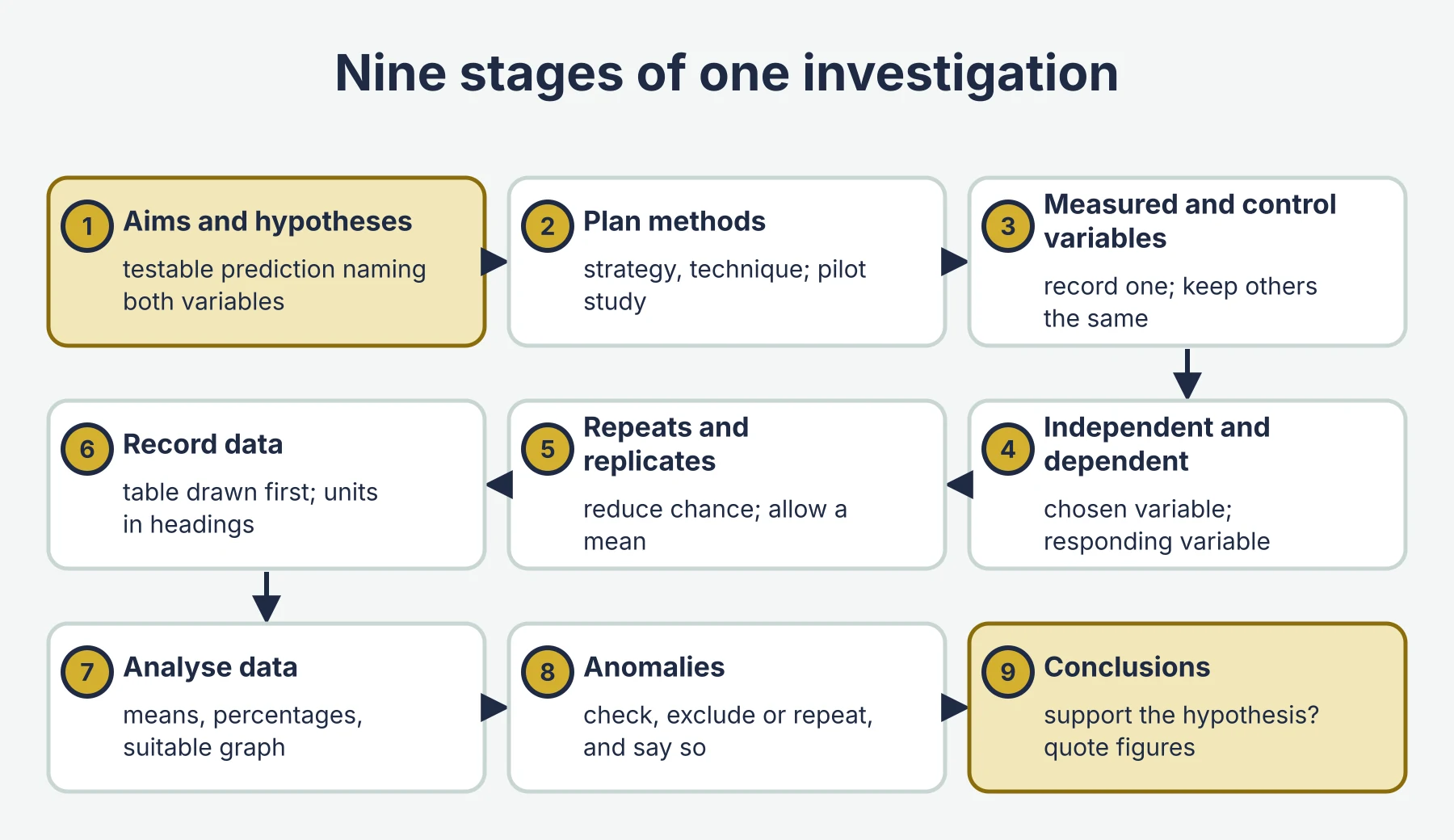
The nine stages of the scientific method (5.4.1)
- Aim (what you want to find out) and hypothesis (a testable prediction naming both variables and the direction of change).
- Plan: sampling strategy, sampling technique, questionnaires, surveys, pilot study.
- Measured and control variables.
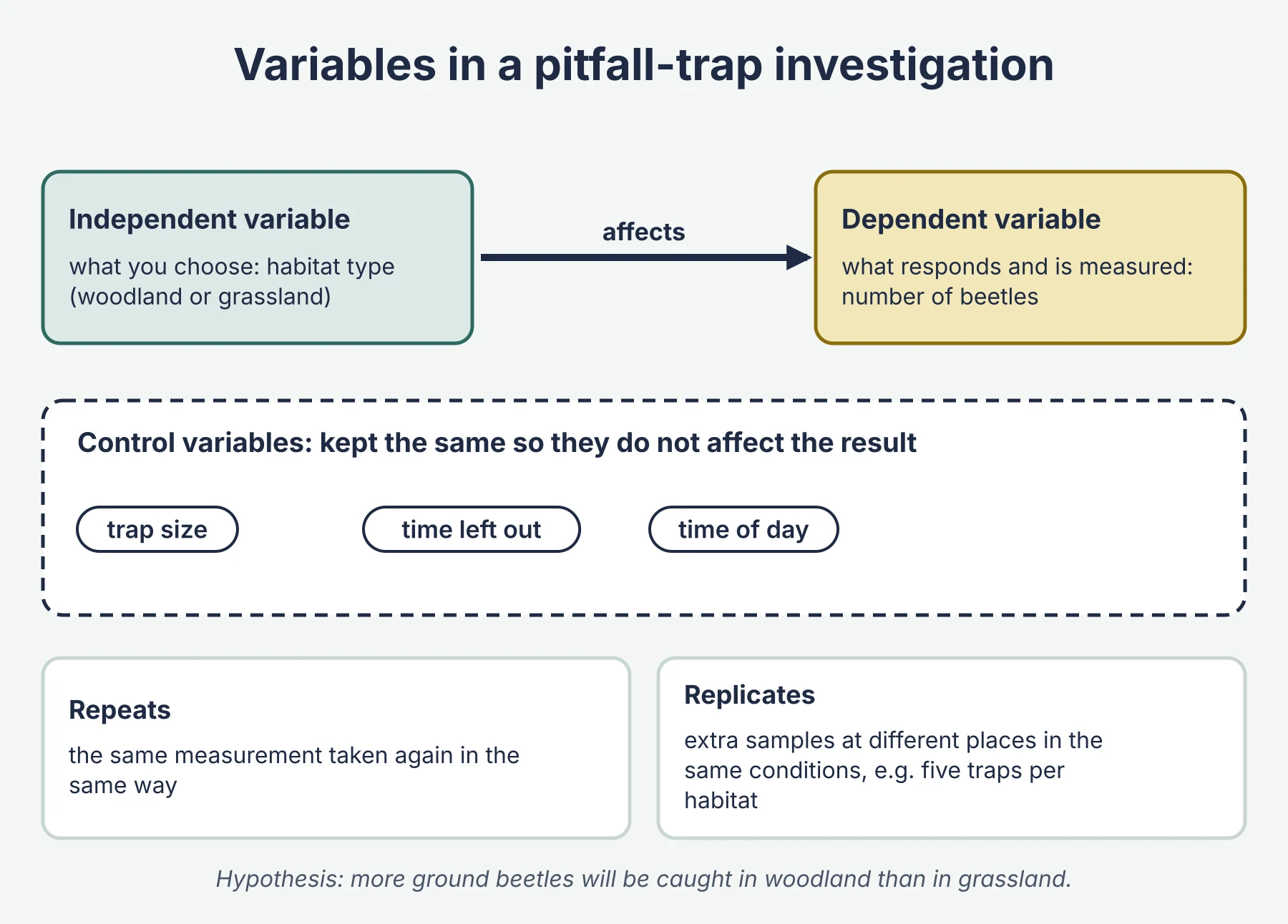
- Independent (changed or chosen) and dependent (measured) variables.
- Repeats and replicates.
- Record data in a prepared table.
- Analyse: means, totals, percentages, graphs.
- Identify and process anomalies.
- Form conclusions that refer to the hypothesis and the data.
Mnemonic: A P V V R R A A C, read as “Aim, Plan, Variables twice, Repeats, Record, Analyse, Anomalies, Conclude”.
Strategy versus technique
- Strategy = where you sample: random or systematic (5.4.2).
- Technique = how you catch or count: pitfall traps, pooters, sweep nets, quadrats, transects, aerial photography and drones, automated sampling (5.4.4).
Exam questions often ask for one and not the other; read carefully.
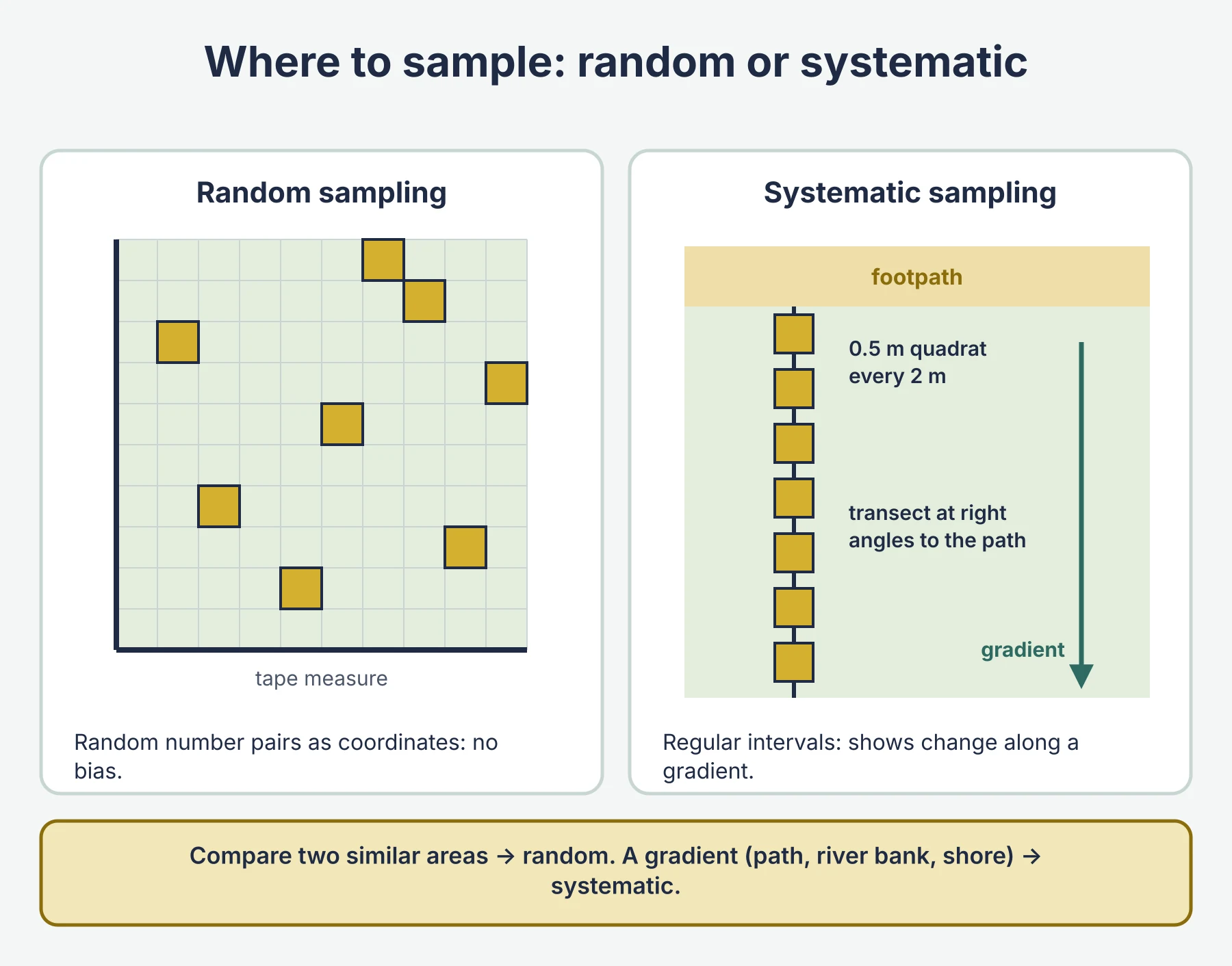
Random and systematic sampling (5.4.2, 5.4.3)
| Random | Systematic | |
|---|---|---|
| How | Grid with tapes; random numbers give coordinates | Samples at fixed intervals, e.g. every 5 m |
| Use when | Area is fairly uniform; comparing two areas | Conditions change along a gradient |
| Benefit | Avoids observer bias | Shows change with distance; even coverage; quick |
| Limitation | May miss rare species or patches; needs many samples | May miss organisms between points; bias if interval matches a pattern |
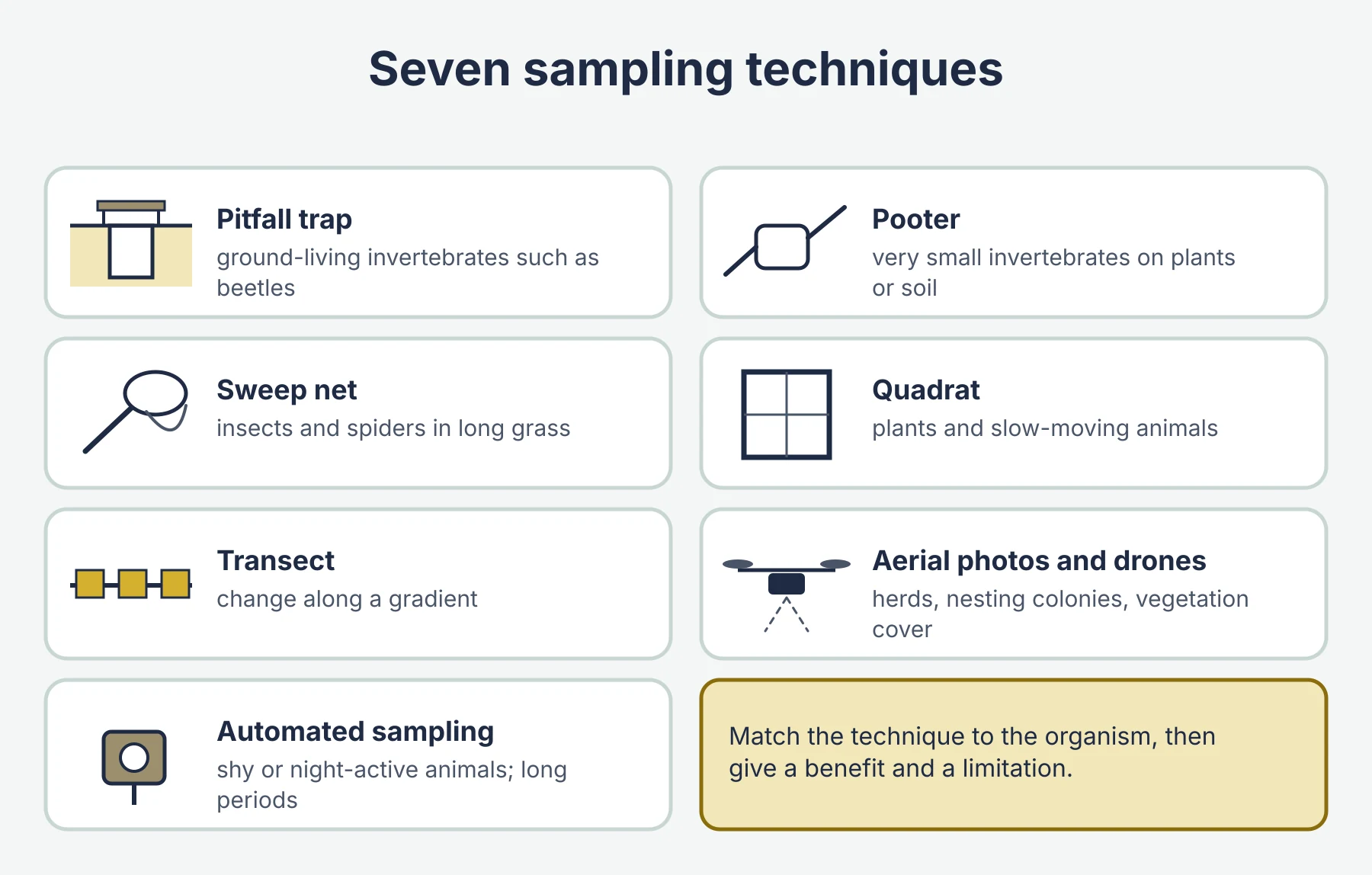
The seven techniques (5.4.4, 5.4.5)
- Pitfall trap: sunk container, lid against rain. Ground invertebrates. Cheap, unattended. Only active ground animals; predation in trap; check often.
- Pooter: suck tube draws tiny animals into a chamber. Small invertebrates. Gentle. Slow; small animals only.
- Sweep net: swept through vegetation. Grassland insects. Fast, large catch. Hard to standardise; poor in wet or short grass.
- Quadrat: square frame; count or estimate percentage cover. Plants, slow animals. Simple; density per m². Cover estimates subjective; not for mobile animals.
- Transect: line with samples along it. Gradients and zonation. Shows change clearly. Slow; one line may be untypical.
- Aerial photography and drones: images from above. Herds, colonies, vegetation. Large or unsafe areas fast. Cost, permits, canopy hides animals, disturbance.
- Automated sampling: camera traps, sound recorders, data loggers. Shy or nocturnal animals; long periods. No observer disturbance, works continuously. Cost, theft, batteries, huge data sets.
Key terms
| Term | Meaning |
|---|---|
| Aim | Statement of what the investigation sets out to find |
| Hypothesis | Testable prediction about the relationship between variables |
| Independent variable | The variable changed or chosen by the investigator |
| Dependent variable | The variable measured in response |
| Control variable | A variable kept the same so it does not affect results |
| Pilot study | Small trial run to test and improve a method |
| Repeat | Measuring again in the same way |
| Replicate | An extra sample taken at another place under the same conditions |
| Anomaly | A result that does not fit the pattern |
| Reliable | Similar results are obtained when the investigation is repeated |
| Bias | A systematic distortion, such as choosing where to sample by eye |
| Percentage cover | Proportion of a quadrat’s area covered by a species |
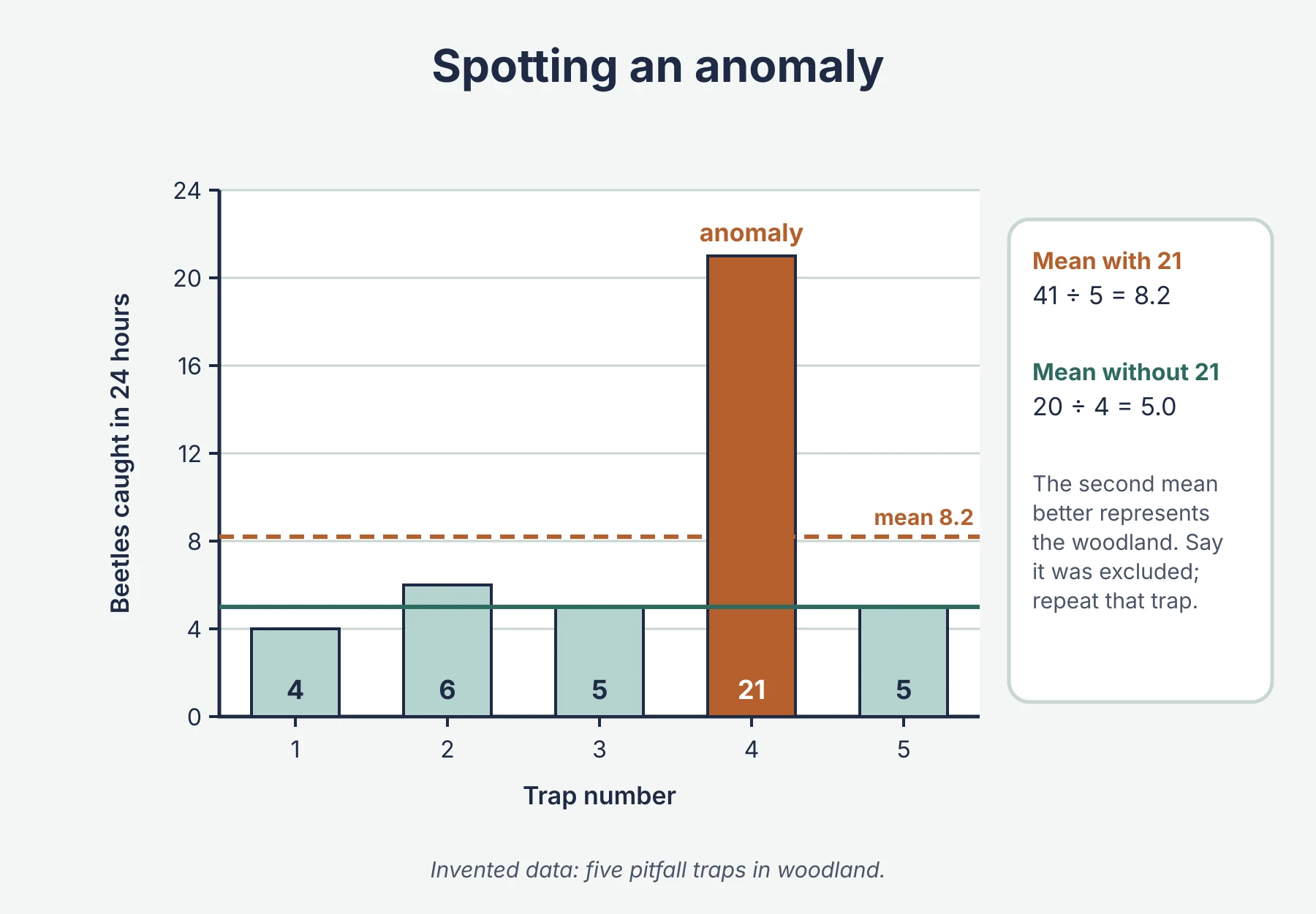
Handling an anomaly in three steps
- Spot it: a value well outside the others.
- Check for a cause: misreading, a disturbed trap, an untypical spot.
- Process it: leave it out of the mean (and say so) or repeat the sample.
Exam traps
- Calling a convenient spot “random”; random needs random numbers.
- Saying “repeat to make it accurate”; repeats improve reliability, and calibrated equipment improves accuracy.
- Writing a hypothesis without a direction: “beetle numbers differ” is weaker than “more beetles in woodland”.
- Choosing a technique that does not suit the organism.
- Forgetting control variables in a plan: same quadrat size, same trap time, same day.
- Leaving out ethics: return animals, avoid trampling, take only what is needed.
Self-test
- Distinguish an aim from a hypothesis.
- What is a pilot study for?
- A student compares snail numbers on north- and south-facing walls. Name the independent and dependent variables.
- Give two control variables for a pitfall-trap investigation.
- Distinguish a repeat from a replicate.
- When should systematic sampling be used instead of random sampling?
- How are random sampling points chosen?
- Which technique suits small insects living in long grass?
- Give one limitation of using drones to count animals.
- What are camera traps an example of?
- Quadrat counts are 7, 9, 8, 26 and 6. Identify the anomaly and give the mean without it.
- Give one ethical precaution in fieldwork.
Answers: 1. An aim states what you want to find out; a hypothesis is a testable prediction. 2. To test the method on a small scale and fix problems first. 3. Independent: wall aspect (north or south); dependent: number of snails. 4. Any two: trap size, time left out, number of traps, same day or weather. 5. A repeat measures again in the same way; a replicate is an extra sample at another place in the same conditions. 6. When conditions change along a gradient. 7. Random numbers used as coordinates on a grid. 8. Sweep net. 9. Any one: cost; permits; cannot see under trees; may disturb animals; weather limits flights. 10. Automated sampling. 11. Anomaly 26; (7 + 9 + 8 + 6) ÷ 4 = 30 ÷ 4 = 7.5. 12. Return animals where found; avoid trampling; minimise disturbance.
Next step
Use the Fieldwork investigations practice questions for planning and evaluation questions with full answers.
Related resources
-
Revision notes
Cambridge IGCSE Environmental Management: Land — Revision Notes
Recall notes on soils and crop growth, food production and soil erosion for Topic 2 Land of Cambridge IGCSE Environmental Management 0680, 2027-2029 series.
Environmental Management · Cambridge · IGCSE
Revise topic -
Study guides
Cambridge IGCSE Environmental Management (0680): Forest ecosystems
The six causes and seven impacts of deforestation, what sustainable forest management means and why forests need it, in Cambridge IGCSE 0680 sub-topic 5.2.
Environmental Management · Cambridge · IGCSE
Read guide -
Practice questions
Cambridge IGCSE Environmental Management (0680): Forest ecosystems – Practice Questions
Twelve original questions with mark-scheme answers on the causes and impacts of deforestation and sustainable forest management for Cambridge IGCSE 0680.
Environmental Management · Cambridge · IGCSE
Try questions
Get free revision emails (optional)
Occasional emails with practice questions, worked explanations and links to free resources for the qualification and subjects you choose. No spam, and you can unsubscribe from any email. The free tools on this site never need an email.