
Study Guides
Cambridge IGCSE Environmental Management (0680): Flooding
Causes and impacts of flooding, eight strategies with benefits and limitations, and the opportunities floods bring, for Cambridge IGCSE 0680 sub-topic 6.3.
- Subject
- Environmental Management
- Level
- IGCSE
- Topic
- Topic 6: Natural hazards
- Author
- Marlbridge Academic Team
- Updated
- Reviewed by
- Azam Siddique (what this means)
Aligned to Cambridge IGCSE Environmental Management (0680), 2027-2029. Official specification .
Syllabus page (what it covers and how it is assessed): Cambridge IGCSE Environmental Management.
Syllabus points this page covers
0680
- 6.3 Flooding
Found an error? Report a correction.
Need help with this topic? Request a free trial class for IGCSE Environmental Management (0680).
Sub-topic 6.3 of Cambridge IGCSE Environmental Management (0680, 2027-2029) has five statements: the causes of flooding (6.3.1), its impacts (6.3.2), strategies for managing the impacts before, during and after a flood (6.3.3), a discussion of those strategies (6.3.4), and the opportunities floods bring (6.3.5). Floods link closely to earlier topics, especially deforestation and soil erosion, so this guide shows those links as well as the content of each list. For a comparison with the other hazards, see the Natural hazards study guide.
How water reaches a river
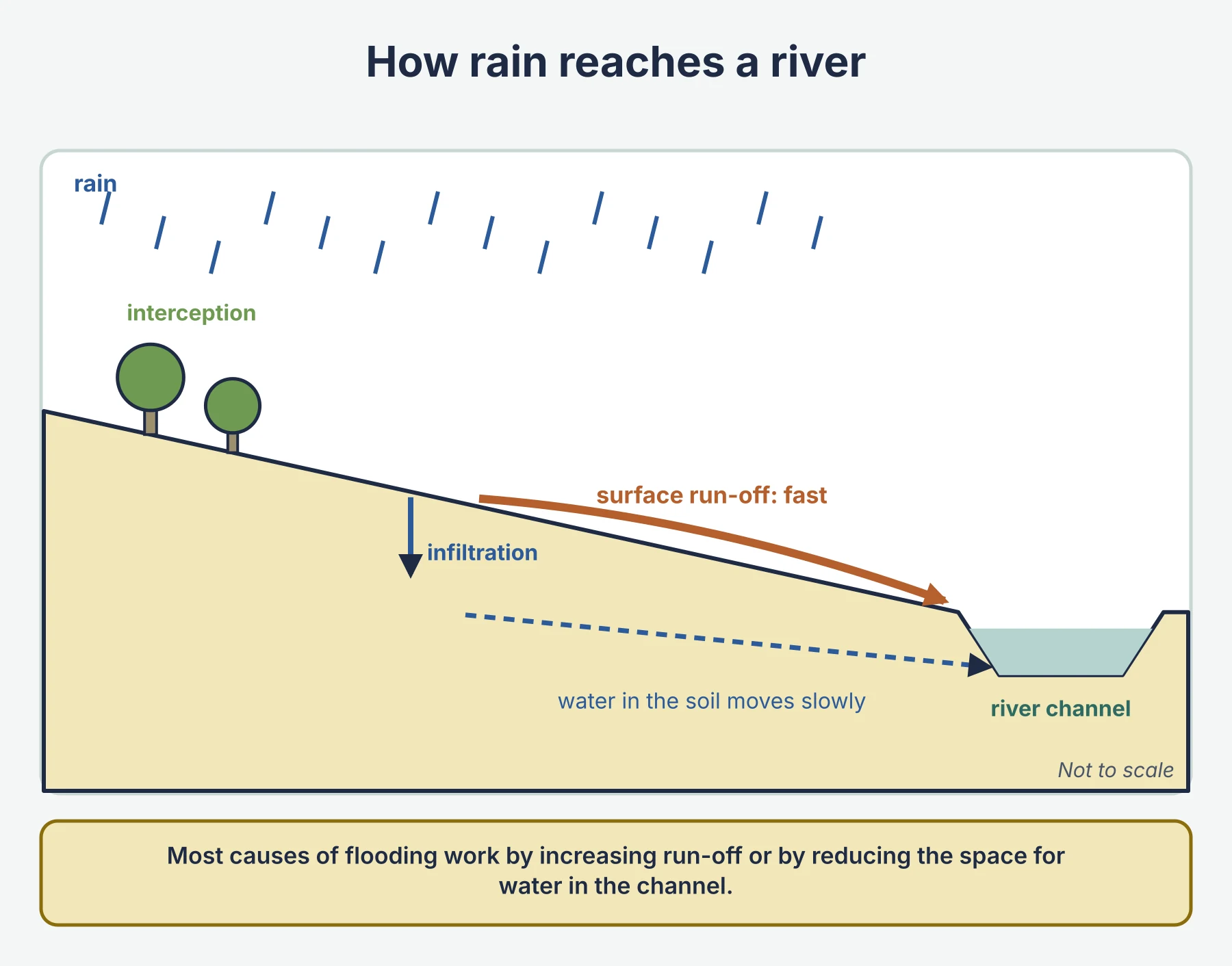
A flood happens when water arrives faster than a river channel, or the land, can carry it away, so it spills onto land that is normally dry. Rain that falls can be intercepted by plants, soak into the ground (infiltration), or flow over the surface (surface run-off). Water that infiltrates moves slowly; run-off reaches rivers quickly. Almost every cause of flooding works by increasing run-off or by reducing the space for water in the channel.
Causes of flooding (6.3.1)
The syllabus groups the causes into five statements.
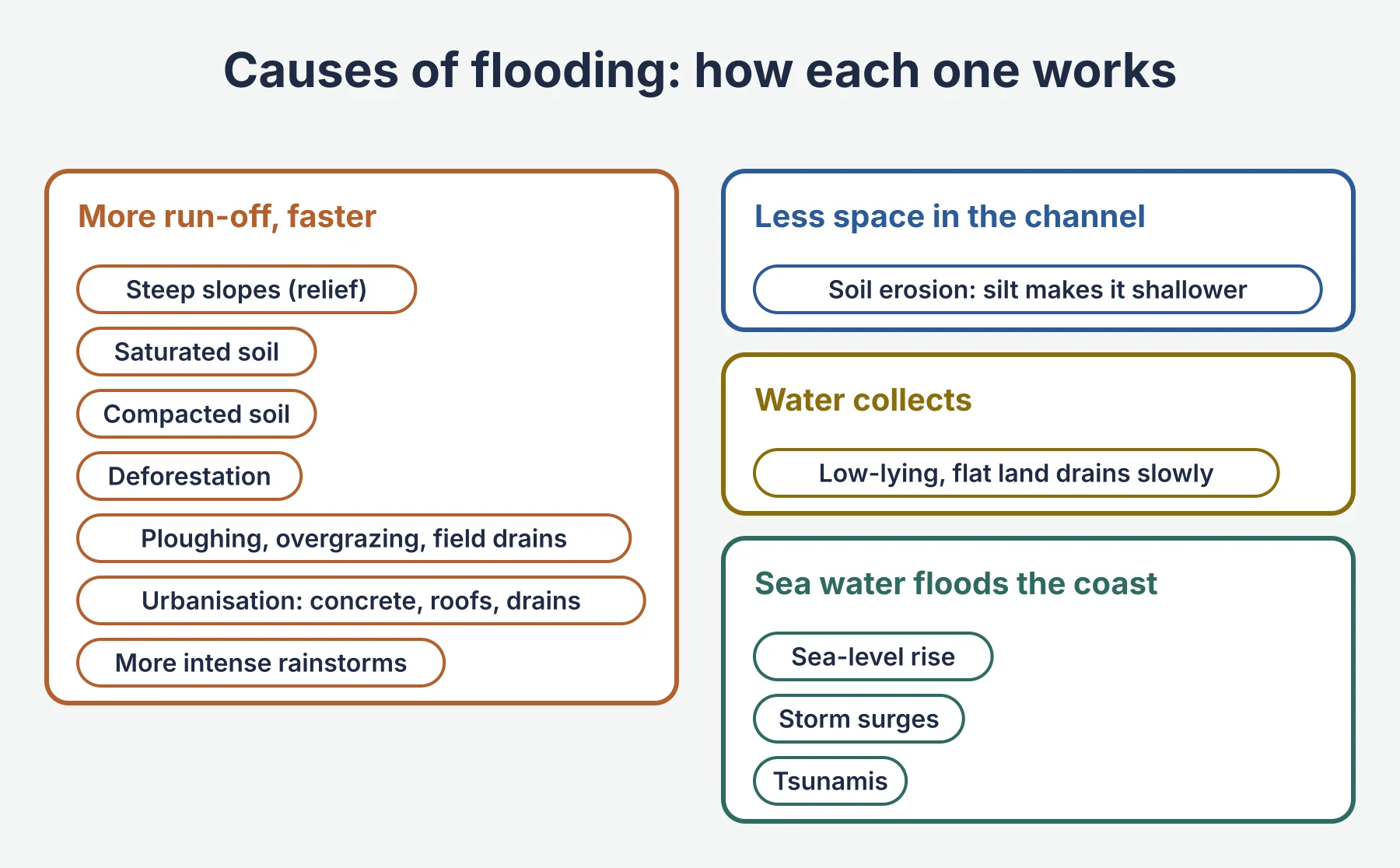
(a) Land relief. Relief is the shape and height of the land. Steep slopes send water downhill quickly into valleys, so river levels rise fast. Low-lying, flat land beside rivers and coasts is where water collects and where it drains away most slowly.
(b) Saturated soil, compacted soil and soil erosion.
- Saturated soil is already full of water after earlier rain, so any further rain cannot infiltrate and runs off.
- Compacted soil has had its pore spaces squeezed together, for example by heavy machinery or trampling animals, so water soaks in slowly.
- Soil erosion carries soil into rivers, where it settles and makes the channel shallower, so it holds less water and overflows sooner.
(c) Deforestation, agricultural practices and urbanisation.
- Deforestation removes interception and water uptake by trees, so more rain reaches the ground and runs off.
- Agricultural practices such as ploughing up and down slopes create channels for run-off; overgrazing leaves bare soil; heavy machinery compacts the ground; draining fields sends water to rivers faster.
- Urbanisation replaces soil with impermeable concrete, tarmac and roofs. Drains then carry the water straight to rivers.
(d) Climate change. A rise in sea level puts low-lying coasts at greater risk, and an increase in extreme weather events means more frequent intense rainstorms that deliver more water than the ground can absorb.
(e) Storm surges and tsunamis. These cause coastal flooding by sea water. A storm surge is a rise in sea level driven by wind and low pressure during a storm; a tsunami is a series of waves caused when an undersea earthquake or landslide displaces water.
Impacts of flooding (6.3.2)
- Damage to buildings and infrastructure: water and mud fill homes; bridges, roads and power stations are damaged.
- Loss of crops: fields are drowned or buried in debris.
- Livestock and habitats: animals drown; habitats are flooded or polluted.
- Evacuation of people and livestock: families leave homes, sometimes for weeks.
- Landslides: saturated slopes collapse.
- Contamination of drinking-water supplies: sewage, farm chemicals and sea water enter wells and treatment works.
- Water-related disease: dirty water spreads cholera and other diarrhoeal diseases; standing water lets mosquitoes breed.
- Financial losses: repairs, lost harvests, closed businesses and insurance costs.
- Human health: drowning, injury, illness and stress.
Managing the impacts (6.3.3)
The flood list has eight strategies, including land use zoning.
| Stage | Strategy | What it involves |
|---|---|---|
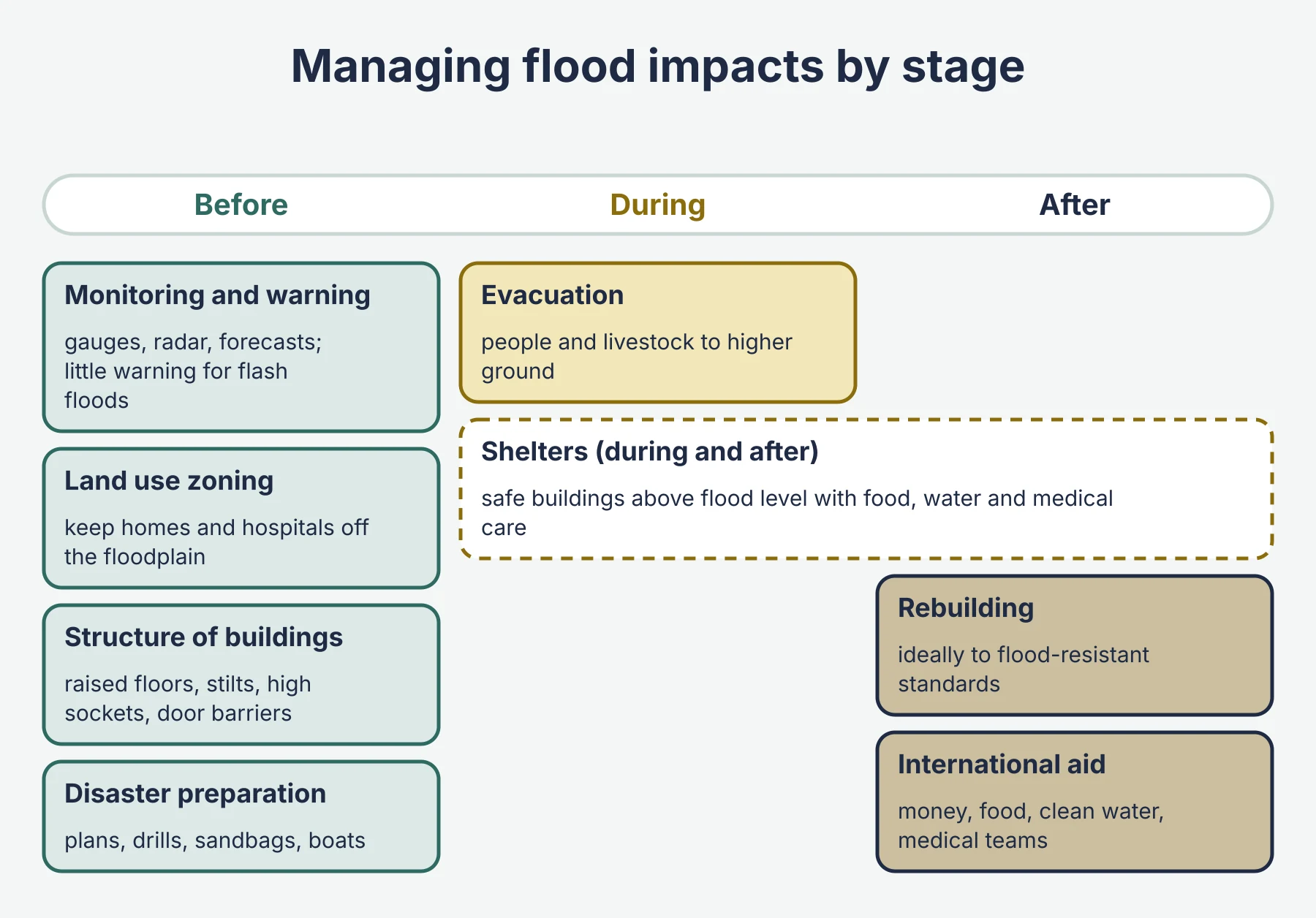
| Before | Monitoring and warning | River level gauges, rainfall radar and weather forecasts; warnings by phone, radio and sirens |
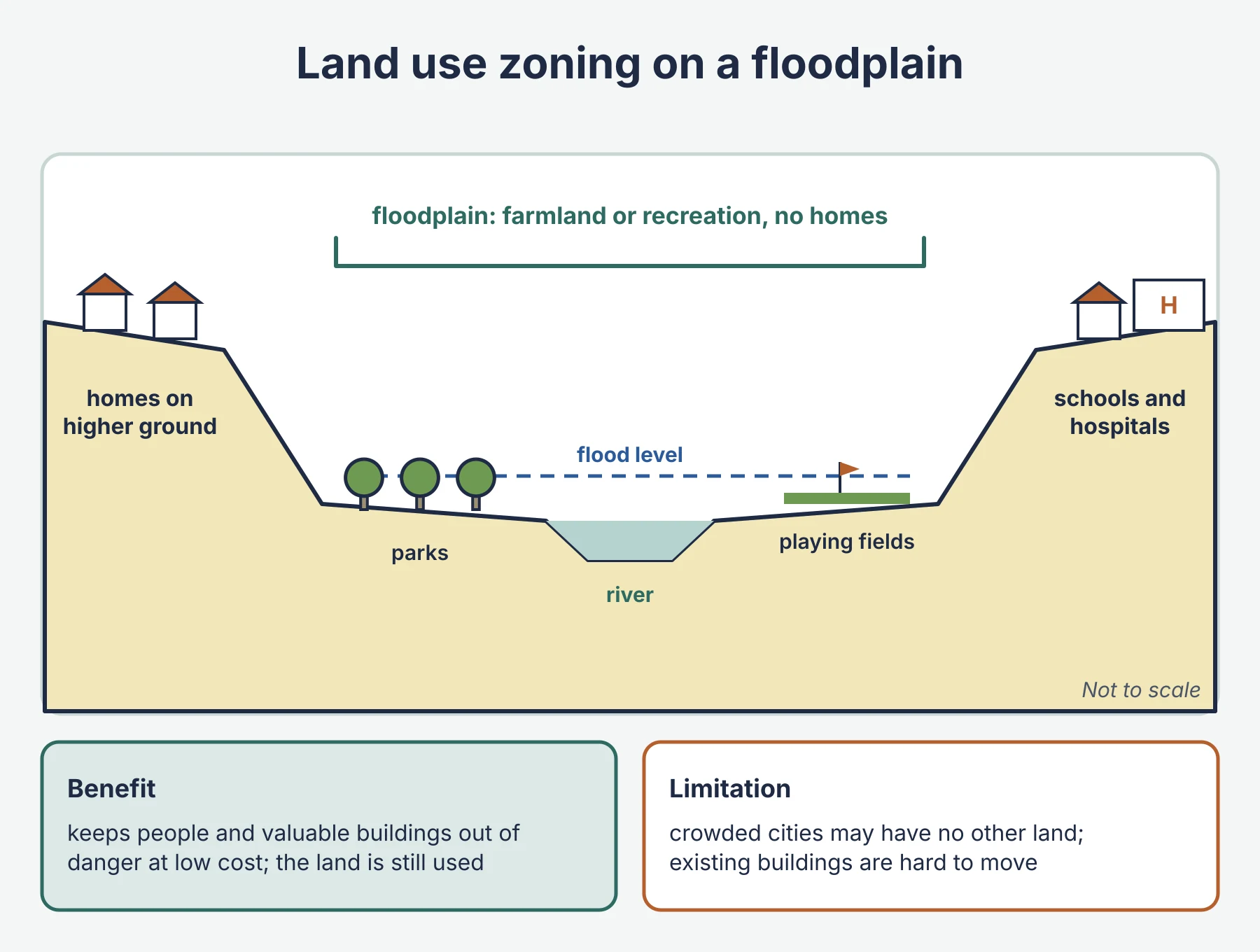
| Before | Land use zoning | Keeping homes, schools and hospitals off the floodplain; using it for parks, playing fields or farmland |
| Before | Structure of buildings | Raised floors or stilts, waterproof walls, electrical sockets placed high, door barriers |
| Before | Disaster preparation | Flood plans, drills, sandbags and emergency supplies, rescue teams with boats |
| During | Evacuation | Moving people and livestock to higher ground |
| During and after | Shelters | Safe buildings above flood level with food, water and medical care |
| After | Rebuilding of damaged areas | Repairing homes, roads and services, ideally to flood-resistant standards |
| After | International aid | Money, food, clean water, medical teams and equipment from other countries |
Discussing the strategies (6.3.4)
- Monitoring and warning. Benefit: river floods often build over hours or days, so warnings give time to move people and belongings. Limitation: flash floods after intense storms rise very quickly, giving little warning; equipment needs maintenance.
- Land use zoning. Benefit: keeps people and valuable buildings out of the most dangerous areas at low cost, and floodplain land can still be used for farming or recreation. Limitation: in crowded cities there may be no other land; existing buildings cannot easily be moved; informal settlements often grow on floodplains.
- Structure of buildings. Benefit: homes recover quickly after water drains. Limitation: costly to adapt existing homes; does not protect roads or crops.
- Disaster preparation. Benefit: people know what to do and supplies are ready. Limitation: needs funding and regular practice; people may forget if floods are rare.
- Evacuation. Benefit: removes people from danger. Limitation: roads may already be flooded; people may stay to protect property or livestock.
- Shelters. Benefit: safe refuge with services. Limitation: overcrowding and poor sanitation can spread disease.
- Rebuilding. Benefit: a chance to rebuild to better standards. Limitation: slow and expensive; may rebuild in the same risky place.
- International aid. Benefit: resources beyond local capacity. Limitation: may arrive late or unevenly and can create dependency.
Opportunities provided by flooding (6.3.5)
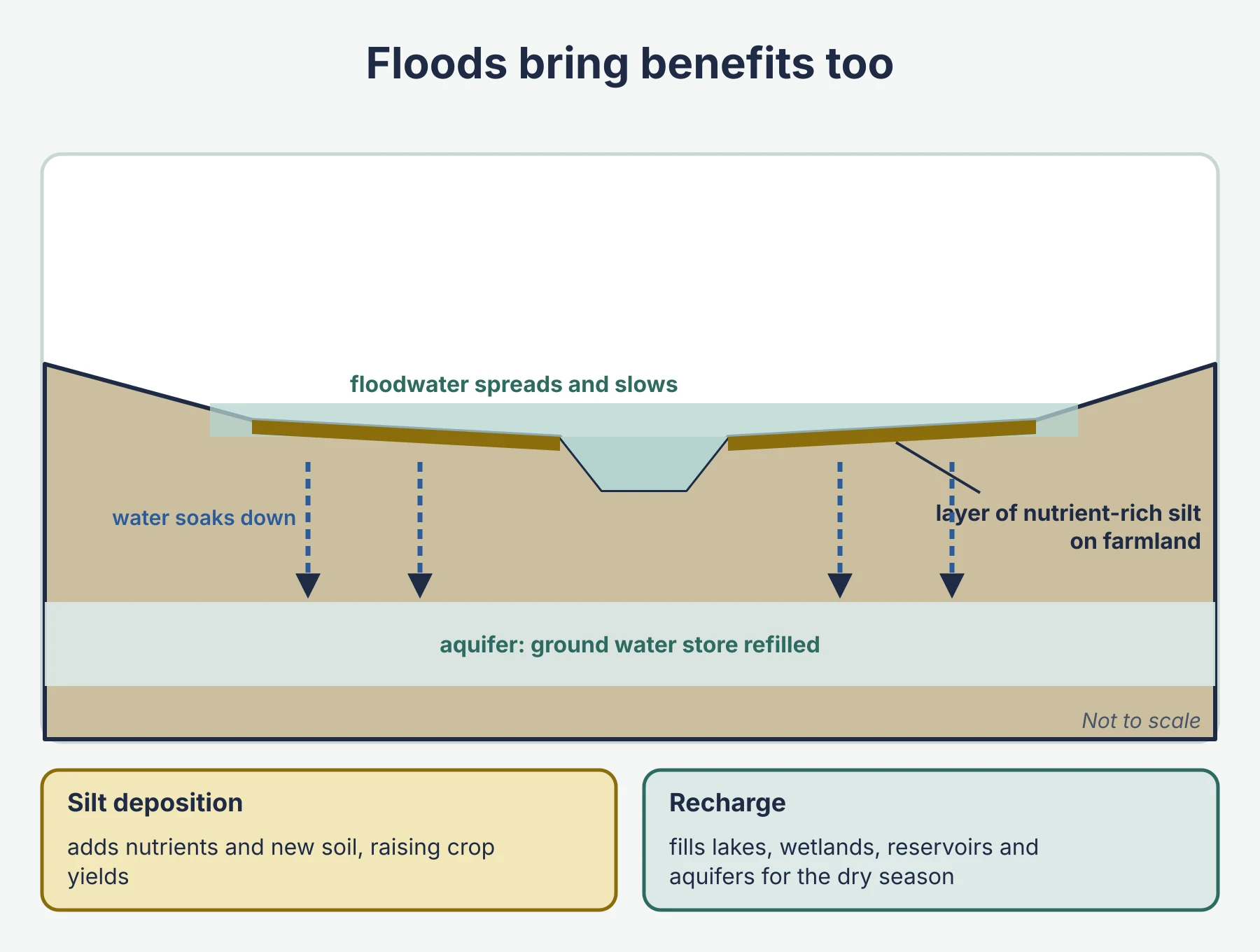
- Deposition of nutrient-rich silt on farmland. When a river spreads over its floodplain, the water slows and drops the fine silt it was carrying. This adds nutrients and new soil, raising crop yields; it is why many farming communities have long lived on floodplains.
- Recharge of surface water and ground water stores. Floodwater fills lakes, wetlands and reservoirs, and soaks down to refill aquifers, providing water for drinking and irrigation in the dry season.
Worked example 1: urban run-off
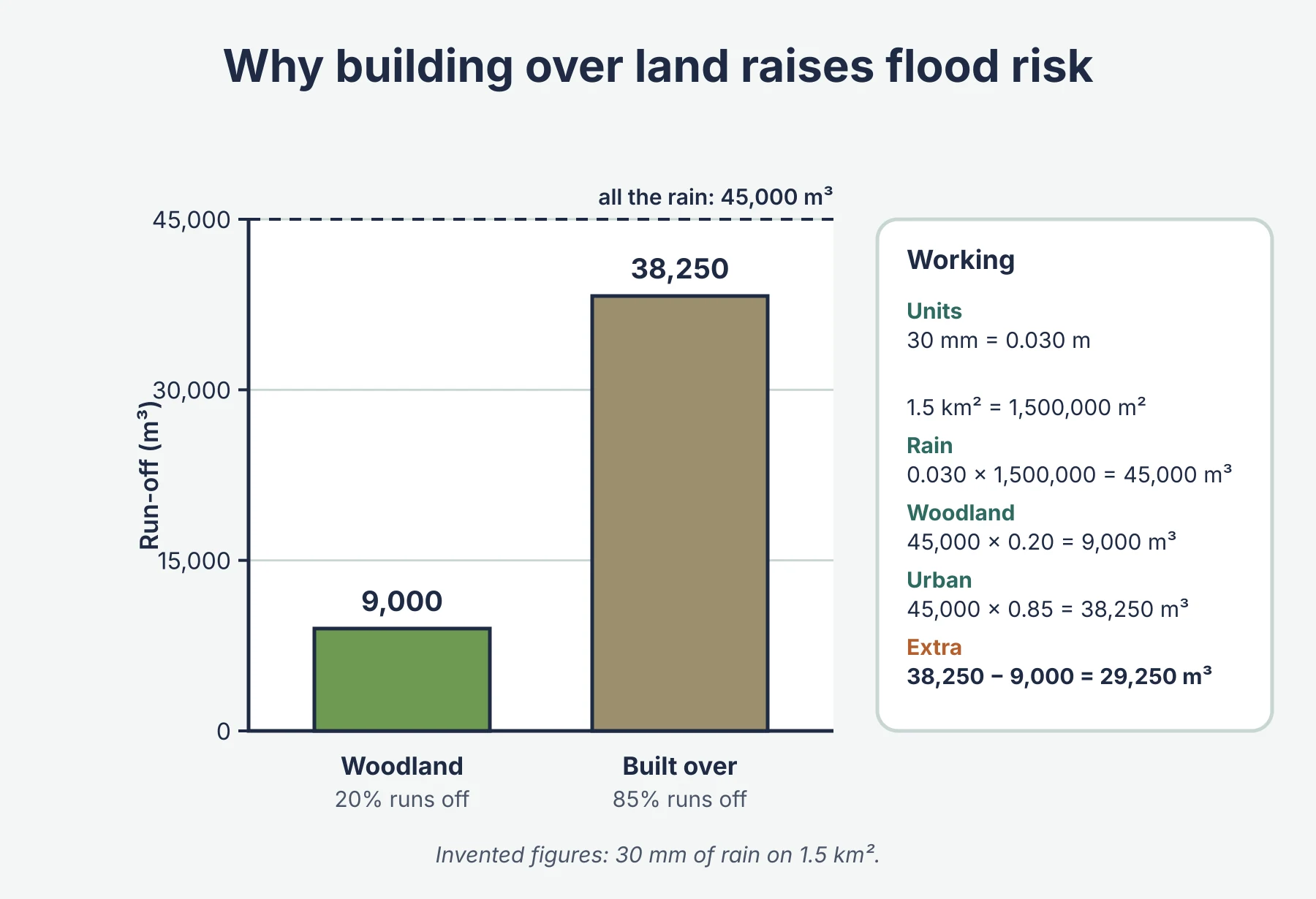
The figures are invented. A storm drops 30 mm of rain on a 1.5 km² area. Assume 20% runs off when the area is woodland and 85% when it is built over.
- Convert units: 30 mm = 0.030 m; 1.5 km² = 1,500,000 m².
- Volume of rain = 0.030 × 1,500,000 = 45,000 m³.
- Woodland run-off = 45,000 × 0.20 = 9,000 m³.
- Urban run-off = 45,000 × 0.85 = 38,250 m³.
- Extra water reaching the river = 38,250 − 9,000 = 29,250 m³, more than four times the woodland figure.
This shows numerically why urbanisation is a cause of flooding.
Worked example 2: annotated “explain” answer
Question: Explain how agricultural practices can increase the risk of flooding. [4]
Model answer: Heavy machinery and large numbers of animals compact the soil, reducing pore spaces [1], so rain infiltrates slowly and more becomes surface run-off [1]. Ploughing up and down slopes makes furrows that channel water quickly downhill to rivers [1]. Overgrazing leaves bare soil that is eroded and washed into rivers, where it reduces channel capacity [1].
Common mistakes
- Writing “rain causes floods” without explaining why the water could not infiltrate.
- Confusing saturated soil (full of water) with compacted soil (squeezed pore spaces).
- Forgetting coastal causes: storm surges, tsunamis and sea-level rise.
- Listing only negative impacts when the question asks about opportunities.
- Describing land use zoning as building walls; zoning controls what is built where.
Exam technique
- Describe causes or impacts: name each one and give a feature.
- Explain: link each cause to infiltration, run-off or channel capacity.
- Discuss: a benefit and a limitation for each strategy, then a judgement, for example that zoning is cheap but hardest to apply where land is scarce.
- In calculations, convert units first and show each step.
Revise with the Flooding revision notes, then practise with the Flooding practice questions.
Related resources
-
Revision notes
Cambridge IGCSE Environmental Management: Land — Revision Notes
Recall notes on soils and crop growth, food production and soil erosion for Topic 2 Land of Cambridge IGCSE Environmental Management 0680, 2027-2029 series.
Environmental Management · Cambridge · IGCSE
Revise topic -
Practice questions
Cambridge IGCSE Environmental Management (0680): Flooding – Practice Questions
Twelve original questions with mark-scheme answers on the causes, impacts, management and opportunities of flooding for Cambridge IGCSE 0680 sub-topic 6.3.
Environmental Management · Cambridge · IGCSE
Try questions -
Revision notes
Cambridge IGCSE Environmental Management (0680): Flooding – Revision Notes
Recall notes for Cambridge IGCSE 0680 sub-topic 6.3: flood causes, impacts, eight strategies with benefits and limitations, opportunities and a self-test.
Environmental Management · Cambridge · IGCSE
Revise topic
Get free revision emails (optional)
Occasional emails with practice questions, worked explanations and links to free resources for the qualification and subjects you choose. No spam, and you can unsubscribe from any email. The free tools on this site never need an email.